
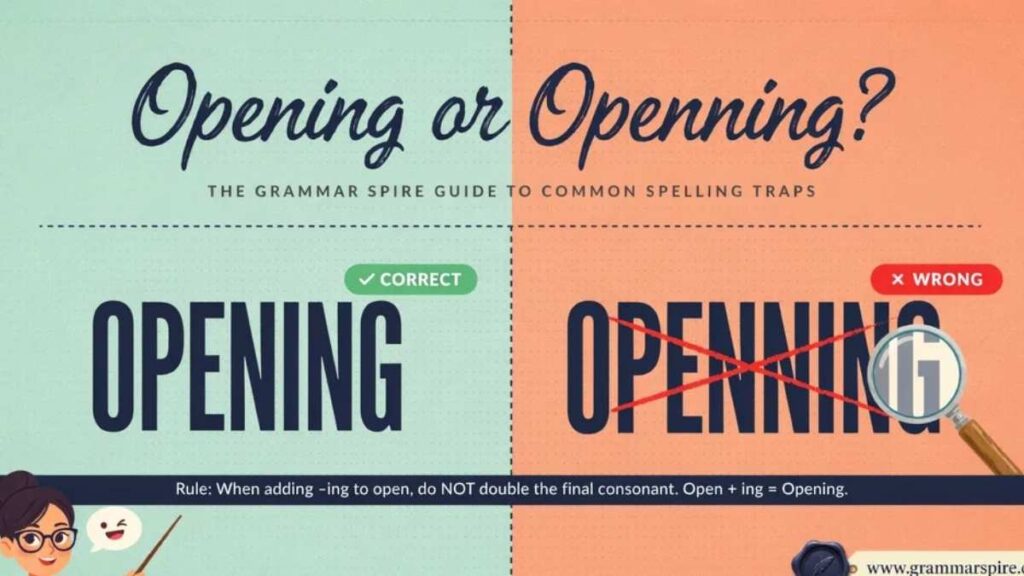
English spelling has a talent for turning one small letter into a full blown mystery. The confusion between opening or openning is a perfect example. One spelling belongs in polished writing, while the other should stay firmly outside the door. If you’ve ever wondered whether opening needs two n’s, you’re not alone. Many writers accidentally apply the consonant-doubling rule where it doesn’t belong. In this guide, you’ll learn the correct spelling, discover why opening has only one n, and understand how to use open, opened, and opening confidently in everyday conversations and professional situations. Say goodbye to extra letters and hello to clearer, more accurate writing.
Opening or Openning Which Spelling Is Correct?
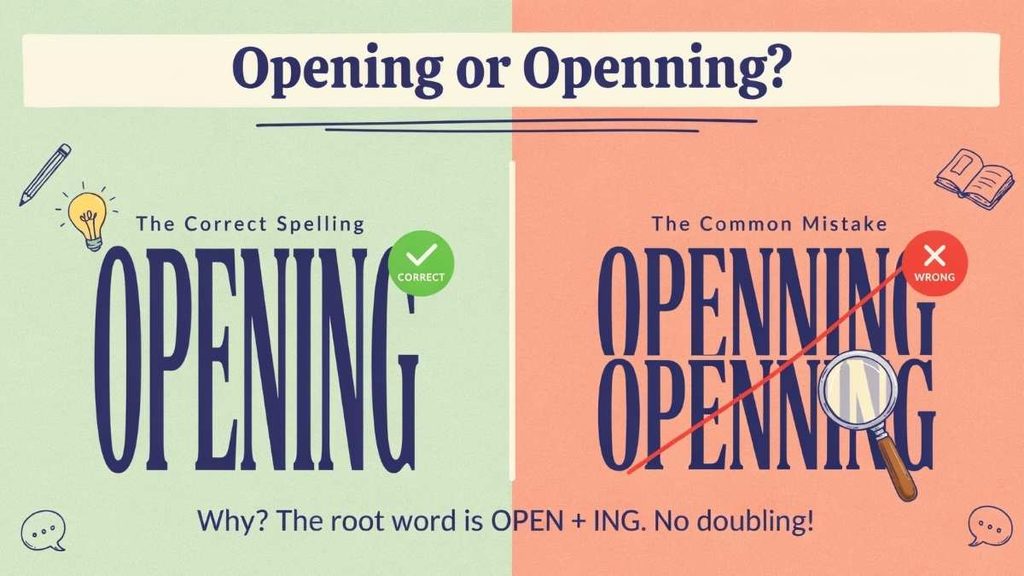
In word of Opening or Openning. Opening is the correct spelling or Openning is incorrect.
The word opening comes from the verb open.
| Spelling | Correct or Incorrect | Explanation |
|---|---|---|
| Opening | Correct | The standard English spelling |
| Openning | Incorrect | Contains an unnecessary extra n |
| Open | Correct | The base form of the word |
| Opened | Correct | The past-tense form of open |
| Opens | Correct | The third-person singular form |
| Opener | Correct | A person or thing that opens something |
Example
The opening of the new library attracted many visitors.
You should not write:
The openning of the new library attracted many visitors.
What Does Opening Mean?
Several meanings depending on how it is used in a sentence. It can function as a noun, an adjective, or the present participle of the verb open.
As a noun, opening refers to the beginning of something, an available space, or an available opportunity. As a verb form, opening describes the action of making something accessible or beginning an activity. An an adjective, it describes something connected with the beginning of an event or process.
The meaning becomes clear through context.
Opening as a Noun
As a noun, opening can refer to the beginning of an event, activity, or period.
The opening of the restaurant is scheduled for Friday.
In this sentence, opening means the official beginning of the restaurant’s operation.
There is a small opening in the fence.
Here, opening refers to a space through which someone or something can pass.
The company has an opening for an experienced editor.
In this example, opening means a vacant job position.
Opening as a Verb Form
Opening is also the present participle of open. It describes an action that is happening now or continuing.
She is opening the window.
They are opening the gifts.
The teacher is opening the discussion.
In each sentence, opening describes an action in progress.
The store is opening at nine o’clock tomorrow.
Opening as an Adjective
Opening can describe something that happens at the beginning of an event.
The opening ceremony was impressive.
The speaker gave an opening statement.
We watched the opening scene of the movie.
In these examples, opening describes the ceremony, statement, and scene that introduce something.
Learn the difference between tricky grammar more words
Excel vs Accel Which Spelling is correct?
Why Is Opening Spelled with One N?
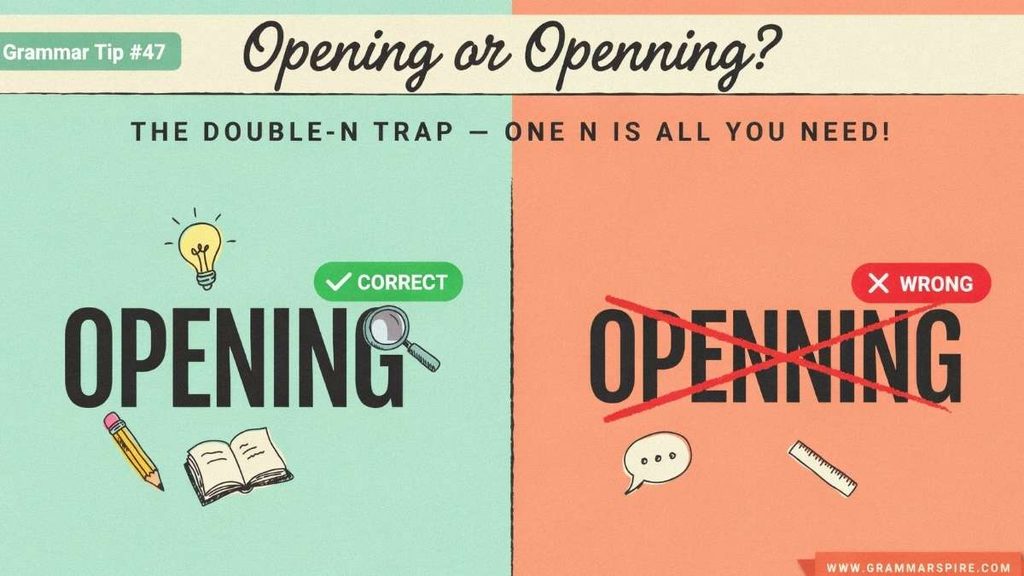
The spelling of opening follows a common English spelling rule.
For example:
- Make becomes making.
- Take becomes taking.
- Write becomes writing.
- Close becomes closing.
- Open becomes opening.
The word open ends with a silent e.
Open + ing = Opening
When Do We Double the Final Consonant?
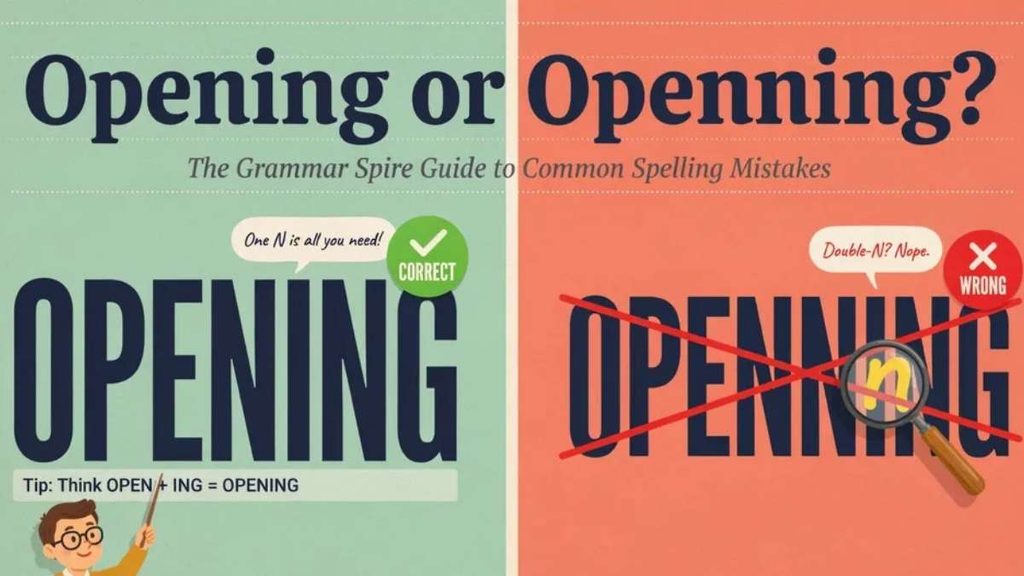
A Final consonant is usually doubled when a one syllable word ends in a single vowel followed by a single consonant.
For example:
- Run becomes running.
- Sit becomes sitting.
- Swim becomes swimming.
- Stop becomes stopping.
- Plan becomes planning
That is why the correct form is:
Open + ing = Opening
Not:
Open + ing = Openning
Compare these examples
| Base Word | Correct -ing Form | Reason |
|---|---|---|
| Run | Running | The final consonant doubles |
| Sit | Sitting | The final consonant doubles |
| Stop | Stopping | The final consonant doubles |
| Make | Making | The silent e is removed |
| Write | Writing | The silent e is removed |
| Open | Opening | The silent e is removed without doubling n |
| Close | Closing | The silent e is removed |
| Hope | Hoping | The silent e is removed |
The key is to learn the spelling pattern rather than simply adding letters based on pronunciation.
Learn the difference between tricky grammar more words
Happened Vs Happend Which Spelling Is Correct?
Is Openning Ever Correct?
No. Openning is not the standard spelling in modern English. A generally considered a spelling mistake.
You may occasionally see openning in an informal message, a social media post, or a document written by someone who is unsure of the spelling. However, its appearance does not make it correct.
If you are writing an email, school assignment, article, report, application, or professional document, always use opening.
Example:
Incorrect:
The openning ceremony will begin at ten.
Correct:
The opening ceremony will begin at ten.
Incorrect:
We are openning a new branch next month.
Correct:
We are opening a new branch next month.
Incorrect:
There is an openning for a marketing assistant.
Correct:
There is an opening for a marketing assistant.
Opening or Openning A Quick Comparison
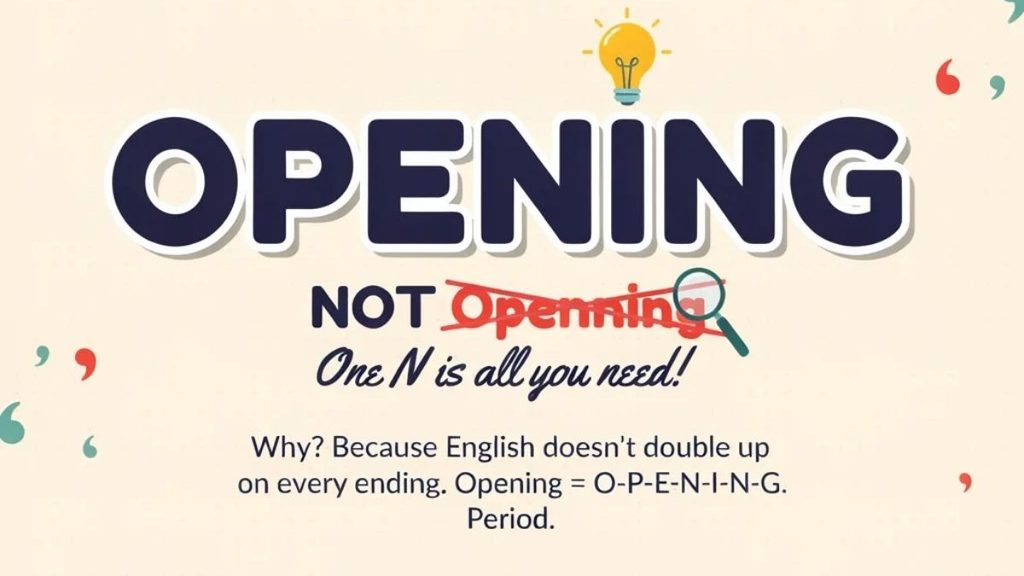
The difference between the Opening or Openning is simple, but the extra n can be easy to overlook.
| Feature | Opening | Openning |
|---|---|---|
| Spelling | Correct | Incorrect |
| Number of Ns | One n | Two ns |
| Meaning | Beginning, opportunity, gap, or action of opening | No standard meaning |
| Grammar | Noun, adjective, or verb form | Incorrect form |
| Suitable for formal writing | Yes | No |
| Example | The opening ceremony starts soon. | The openning ceremony starts soon. |
Common Uses of Opening
The word opening appears in many everyday expressions. It can describe the beginning of an event, a physical entrance, a job opportunity, or an action.
Here are some common uses:
Opening Ceremony
An opening ceremony is an event that officially begins a competition, building, institution, or public activity.
The opening ceremony of the tournament was held on Saturday.
Opening Hours
A Opening hours are the times when a business or organization is available to the public.
What are the opening hours of the museum?
Opening Statement
An opening statement introduces an argument, presentation, discussion, or legal case.
The lawyer delivered a strong opening statement.
Opening Scene
The opening scene is the first scene in a movie, play, or television program.
The opening scene immediately captured the audience’s attention.
Job Opening
A job opening is an available position at a company or organization.
The company announced a new job opening.
Opening Night
The Opening night is the first public performance of a play, movie, concert, or show.
The actors were nervous before opening night.
Opening Move
An opening move is the first action in a game, competition, discussion, or strategy.
Her opening move surprised everyone.
Opening in Everyday Sentences
The following examples show how opening works in different situations:
The opening of the new school was celebrated by the entire community.
He is opening the package carefully.
The shop is opening early tomorrow.
We attended the opening ceremony.
The manager announced a job opening.
Please check the museum’s opening hours.
The opening chapter of the book was exciting.
She made an excellent opening argument.
The door is opening slowly.
The company is opening a new office downtown.
These examples show that opening can describe an action, a beginning, a space, or an opportunity.
Learn the difference between tricky grammar more words
Bellies vs Bellys Which one Is Correct?
Common Mistakes with Opening
One of the most common mistakes is adding an extra n.
Incorrect:
The company is openning a new office.
Correct:
The company is opening a new office.
Another mistake is confusing opening with opened. Opening describes an action in progress or a beginning. Opened usually describes an action that has already happened.
Compare these sentences:
The store is opening today.
The store opened yesterday.
The first sentence refers to the beginning of the store’s operation. The second sentence refers to an event that happened in the past.
Another common mistake is confusing opening with opener. Opening usually refers to the beginning, action, space, or opportunity. Opener refers to something or someone that opens something.
For example:
The opening of the bottle was difficult.
I used a bottle opener.
Opening vs Opened
Opening and opened both come from the verb open, but they serve different grammatical purposes.
| Word | Function | Example |
|---|---|---|
| Open | Base verb | Please open the door. |
| Opens | Present-tense verb | The shop opens at eight. |
| Opened | Past-tense verb or past participle | She opened the box. |
| Opening | Present participle or noun | He is opening the box. |
| Opener | Noun | I need a can opener. |
Use opening when the action is happening or when you are referring to a beginning or opportunity.
Learn the difference between tricky grammar more words
Buoy or Bouy Which Spelling Is Correct?
Synonyms for Opening or openning
The best synonym depends on the meaning of the word.
When opening means the beginning of something, possible synonyms include:
- Beginning
- Start
- Launch
- Introduction
- Commencement
- Inauguration
When opening means an available opportunity, possible synonyms include:
- Opportunity
- Vacancy
- Position
- Chance
- Possibility
The opening means a physical gap, possible synonyms include:
- Gap
- Hole
- Entrance
- Passage
- Break
For example
The opening of the exhibition was successful.
Written as
The launch of the exhibition was successful.
However, not every synonym will fit every sentence. The Job opening can mean a job vacancy, but it cannot usually be replaced with a hole or entrance.
Here’s a trusted source for clear more words Comparison
Practice Session
Complete each sentence by choosing the correct word or form. Use opening, opened, open, opens, or opened where appropriate. Pay close attention to the meaning and grammar of each sentence.
Fill in the Blanks
- The store is ______ today until nine o’clock.
- She is ______ the window because the room is warm.
- The restaurant ______ at seven every morning.
- He ______ the package carefully yesterday.
- The ______ ceremony will begin at ten o’clock.
- The library is ______ every day except Sunday.
- The manager announced a new job ______.
- The door suddenly ______ during the storm.
- Please ______ your book to page twenty.
- The company is ______ a new branch next month.
- The museum ______ hours are listed on its website.
- The guard ______ the gate at six o’clock.
- The shop ______ every morning at eight.
- We attended the grand ______ of the theater.
- The window was ______ by the maintenance worker.
- There is a small ______ in the wall.
- The teacher is ______ the discussion with a question.
- The bakery is ______ on public holidays.
- She ______ the letter and read it aloud.
- The ______ scene of the movie was exciting.
- The café ______ at nine yesterday.
- The company has several job ______ available.
- The door is ______, so please close it.
- The new office will ______ next Monday.
- He is ______ the gift for his sister.
- The store was ______ by the owner at sunrise.
- The hotel ______ its doors to guests last week.
- The speaker gave the ______ remarks at the meeting.
- The window ______ slowly because of the strong wind.
- The school’s ______ ceremony attracted many parents.
Answer Key
- open
- opening
- opens
- opened
- opening
- open
- opening
- opened
- open
- opening
- opening
- opened
- opens
- opening
- opened
- opening
- opening
- open
- opened
- opening
- opened
- openings
- open
- open
- opening
- opened
- opened
- opening
- opened
- opening
Quick Review
Remember these important differences:
- Open describes a condition or gives an instruction.
- Opens describes a regular action performed by one person, animal, or thing.
- Opened describes an action that happened in the past.
- Opening describes an action in progress, a beginning, a gap, or an opportunity.
- Openning and openned are incorrect spellings.
Correct Spelling Reminder
Open + ing = Opening
Open + ed = Opened
Never double the n in opening or opened.
FAQs Opening or Openning
Which spelling is correct opening or openning?
Opening is the correct spelling. Openning is incorrect because it contains an extra n. The word opening can refer to the beginning of an event, an available opportunity, a gap, or the act of making something accessible.
Why is opening spelled with one n?
The word opening comes from open. When the suffix ing is added, the final e is removed
Open + ing = Opening
Which spelling is correct opened or openned?
Opened is correct, while openned is incorrect. Past tense of open is formed by adding ed without doubling the final n.
She opened the window.
How do you spell opening?
Opening is spelled O-P-E-N-I-N-G. To remember the spelling, start with open, remove the silent e, and add -ing.
Open → Opening
What does opening mean?
Opening has several meanings. It can describe the beginning of something, a physical gap, an available opportunity, or the action of making something open.
The opening of the new store is tomorrow.
There is an opening in the wall.
He is opening the package.
Why is the correct form opened instead of openned?
Opened is formed by adding ed to open. The final n does not need to be doubled.
Open + ed = Opened
The spelling openned adds an unnecessary letter and is not accepted in standard English.
Should you say “The door opened” or “The door was opened”?
Both sentences are correct, but they express slightly different ideas. “The door opened” focuses on the door becoming open.
The door opened suddenly.
The door was opened by the guard.
Is “Are you guys open?” or “Are you guys opened?” correct?
“Are you guys open?” is the natural and correct expression when asking whether a business is currently operating or accepting customers.
Are you guys open today?
Opened refers to an action that happened in the past.
The store opened at nine.
Should you say “open every day” or “opens every day”?
Both expressions are correct, but they serve different purposes. “Open every day” describes a business’s availability. “Opens every day” explains when the business begins operating.
The café is open every day.
The café opens every day at seven.
Also, use every day as two words when you mean each day.
When should you use open instead of opened?
Use open to describe a current condition, an instruction, or a regular state.
The door is open.
Please open the window.
Use opened when describing an action that happened in the past.
She opened the door.
Is “The door is opened” grammatically correct?
Yes, but the meaning depends on the context. “The door is open” is more natural when describing its current condition. “The door is opened” emphasizes an action performed by someone or something.
The door is open.
The door is opened by the guard every morning.
Does the word opened exist?
Yes. Opened is the simple past tense and past participle of open.
He opened the letter.
The company has opened a new branch.
The spelling openned is incorrect.
AEO Quick Answers About Opening or Openning
What is the correct spelling of opening?
The correct spelling is opening. Openning is a misspelling because the n should not be doubled.
What is the past tense of open?
The past tense of open is opened.
She opened the box.
Is openned a correct English word?
No. Openned is not a standard English word. The correct form is opened.
What is the difference between open and opened?
Open can describe a current condition, a general state, or the base form of the verb. Opened describes an action completed in the past.
The shop is open.
He opened the shop.
What is the difference between opening and opened?
Opening describes an action in progress or the beginning of something. Opened refers to an action that has already taken place.
She is opening the gift.
She opened the gift yesterday.
Is “The door is opened” correct English?
Yes, but it is not usually the most natural way to describe the door’s current condition. Use “The door is open” for its state. Use “The door is opened” when focusing on an action.
How can you ask whether a business is operating?
The most natural question is:
Are you open today?
You can also ask:
What are your opening hours?
The phrase “Are you opened?” is generally incorrect in this context.
Is “The store is open every day” correct?
Yes. This sentence means that the store is available or operating each day.
The store is open every day.
Conclusion
The mystery is officially solved: opening is correct, while openning is an extra-letter mistake that has no place in standard English. The same rule applies to opened, which is spelled with one n rather than openned. Remember that open becomes opening when the silent e is removed and ing is added. There’s no need to invite a second n to the party.Whether you’re describing a door, a business, a ceremony, or a new opportunity, choosing the correct form makes your writing clearer and more professional. Keep open, opened, and opening in your grammar toolkit, and let incorrect spellings stay closed for good.

Ella AJS
Ella AJS is an experienced blogger and language enthusiast at Grammar Spire, dedicated to making English grammar simple, practical, and easy to understand. She specializes in word comparisons, meanings, usage, and common language confusions. Through clear explanations and engaging examples, Ella helps students, writers, and English learners improve their vocabulary and communicate with greater confidence and accuracy.




