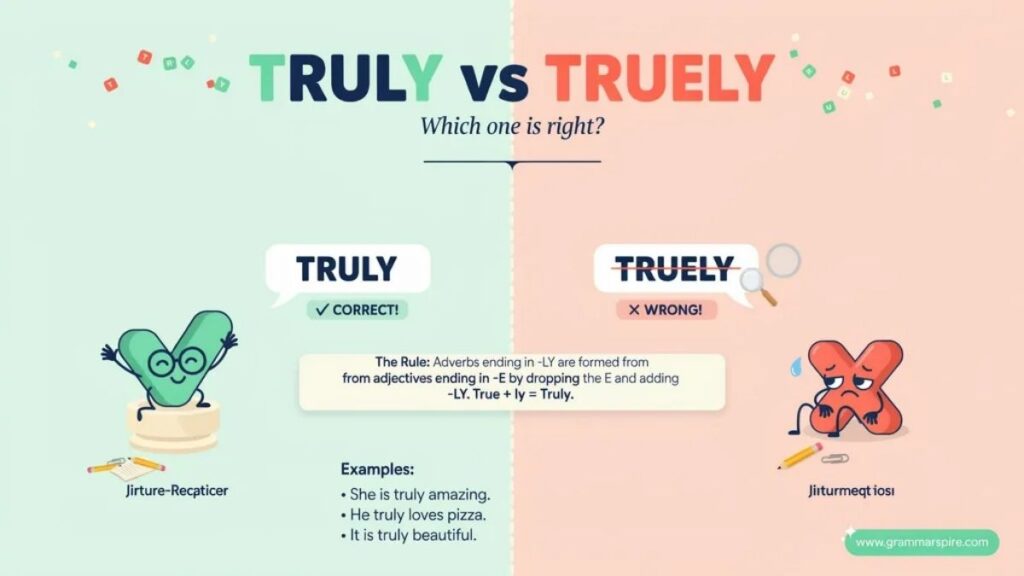
Truly vs truely which spelling is correct? One tiny letter can turn a polished sentence into a spelling slip, and that extra e seems to appear when you least expect it! If you have ever paused while typing this word, you are not alone. Many writers choose truely because it looks like a logical spelling. However, English loves a few unexpected twists. In this guide, you will discover whether truly vs truely is correct, learn why truly drops the final e from true, explore clear examples, and pick up simple memory tricks to avoid this common mistake. By the end, you will spell truly with confidence.
| Feature | Truly | Truely |
|---|---|---|
| Spelling | Correct | Incorrect |
| Standard English usage | Accepted | Nonstandard misspelling |
| Meaning | Genuinely, sincerely, truthfully, or really | No separate standard meaning |
| Part of speech | Adverb | Not an accepted alternative |
| American English | Correct | Incorrect |
| British English | Correct | Incorrect |
| Example | I truly appreciate your help. | I truely appreciate your help. |
Learn the difference between commonly confused more words in English
Bred vs Breeded Which Is Correct?
Quick Answer

In both words Truly vs Truely Truly is correct, while truely is incorrect in standard English. Use truly when you mean genuinely, sincerely, truthfully, or really, depending on the context.
Here are a few examples:
- Correct: I truly believe in your abilities.
- Incorrect: I truely believe in your abilities.
- Correct: She was truly happy with the results.
- Incorrect: She was truely happy with the results.
- Correct: Yours truly, Michael.
- Incorrect: Yours truely, Michael.
The rule applies to both American and British English. Unlike words such as color and colour, truly has no standard regional spelling variation.
If you’re wondering how to spell truly, remember this simple transformation: true becomes truly, not truely.
What Do Truly vs Truely Mean?
Although truly and truely look similar, only truly has an established meaning in standard English. The difference comes down to spelling rather than two separate words with different definitions.
Truly Meaning and Definition
Truly is an adverb that expresses truth, sincerity, genuineness, or emphasis. Its exact meaning depends on the words around it.
The most common meanings of truly include:
- Genuinely: Something is real or authentic rather than false or artificial.
- Sincerely: Someone expresses an honest feeling or intention.
- Truthfully: A statement accurately reflects the facts.
- Really: The word emphasizes that something is actually the case.
- Absolutely: In certain contexts, truly strengthens a statement or emphasizes a quality.
For example, consider the sentence, “She truly cares about her students.” Here, truly emphasizes the sincerity of her feelings.
In “The painting is truly remarkable,” the word strengthens the adjective remarkable. Meanwhile, “He spoke truly about the incident” suggests that he spoke truthfully.
These examples show how truly can communicate different shades of meaning without changing its basic connection to truth or genuine emphasis.
Truely Meaning and Definition
Truely is a misspelling of truly. It has no separate, accepted definition as an alternative spelling in standard modern English.
For example, the sentence “I truely appreciate your support” contains a spelling mistake. The correct version is “I truly appreciate your support.”
You might encounter truely in social media posts, informal messages, or online articles. However, its appearance in published material doesn’t make it correct. People make spelling mistakes, and those mistakes can spread when others copy them.
For school assignments, professional emails, and website content, use truly whenever you intend to express genuine feelings, honesty, or emphasis.
Learn the difference between commonly confused more words in English
Stinged or Stung Which Is Correct?
Truly vs Truely What Is the Difference?
The difference between truly and truely involves only one letter, but that letter determines whether the spelling follows standard English conventions.
Truly is the established adverb formed from true. Truely is an incorrect attempt to preserve the original adjective’s final e.
| Comparison | Truly | Truely |
|---|---|---|
| Standard spelling | Yes | No |
| Relationship to true | Correct adverb form | Incorrect formation |
| Grammatical role | Adverb | No accepted alternative form |
| Meaning | Genuinely, sincerely, truthfully, or really | Depends on the writer’s intended meaning |
| Formal writing | Appropriate | Should be corrected |
| Regional variation | Same in American and British English | Not a standard regional variant |
The two spellings are not interchangeable. Although some English words have accepted spelling variations, truly and truely do not belong to that group.
If you encounter truely in a sentence, replace it with truly when the writer intends the standard adverb. The surrounding sentence usually makes the intended meaning clear.
Learn the difference between commonly confused more words in English
Bought or Brought which one Is correct?
Why Is Truly Spelled Without an E?

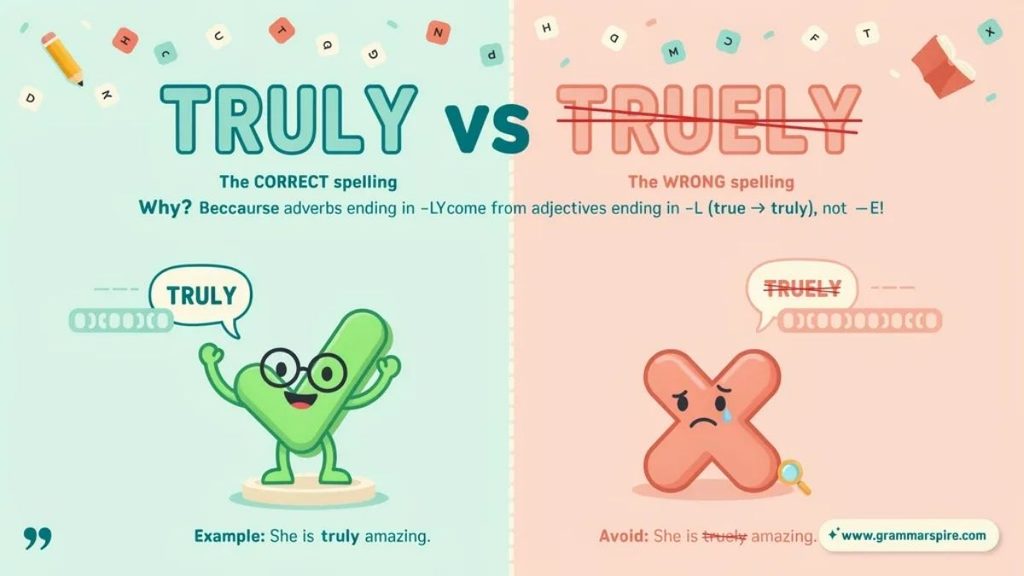
The spelling of truly follows an established English pattern. When you form the adverb from the adjective true, you remove the final e before adding the suffix -ly.
The transformation is straightforward:
True → Truly
This small change explains why truely is incorrect. However, understanding the grammar behind it makes the spelling easier to remember.
The Spelling Rule for Truly
To understand the difference between true and truly, first consider their grammatical roles.
An adjective describes a noun or pronoun. An adverb can modify a verb, an adjective, another adverb, or sometimes an entire statement.
Consider these sentences:
- That is a true story.
- She truly believes the story.
In the first sentence, true describes the noun story. In the second, truly modifies the verb believes and emphasizes the speaker’s conviction.
The adjective and adverb share the same basic idea, but they serve different grammatical functions. The spelling also changes when you form the adverb.
Here is the correct pattern:
- True is the adjective.
- Truly is the adverb.
- Truely is a misspelling.
The Drop-the-Silent-E Rule in English
Many English words end with a silent e. When certain suffixes follow, the final e often disappears. This pattern appears in several familiar words.
| Base word | Correct form | Change |
|---|---|---|
| True | Truly | Drop e and add -ly |
| Due | Duly | Drop e and add -ly |
| Whole | Wholly | Drop e and add -ly |
| Gentle | Gently | Drop e and add -ly |
| Simple | Simply | Drop e and add -ly |
These examples demonstrate a useful spelling pattern, but English has exceptions. For instance, safe becomes safely, and wide becomes widely. In these words, the final e remains before -ly.
Therefore, don’t assume that every adjective ending in e follows exactly the same pattern. Learn common word forms and check a reliable dictionary when you’re uncertain.
For truly, the accepted spelling is fixed: remove the final e from true before adding -ly.
Why Truely Looks Correct but Is Wrong
The misspelling truely makes sense at first glance. You see true, recognize that many adverbs take -ly, and add the suffix without changing the original word.
That approach works with words such as quick and careful, which become quickly and carefully. However, it doesn’t work for every adjective.
English spelling follows several patterns rather than one universal rule. Truly is one of the forms you need to remember because its spelling differs from the base adjective.
The easiest solution is to learn true and truly together. Once you recognize the established form, you’re less likely to add an unnecessary e.
Learn the difference between commonly confused more words in English
Bleeded or Bled Which Is Correct?
How to Use Truly Correctly in a Sentence
Knowing the spelling is important, but understanding how truly works will help you use it naturally. The word can express sincerity, describe something as genuine, or emphasize a statement.
Truly Meaning Genuinely or Really
When truly means genuinely or really, it emphasizes that something is authentic, real, or actually the case.
Examples include:
- This is truly a beautiful place.
- She is truly talented at solving difficult problems.
- The experience was truly unforgettable.
- He is truly interested in learning English.
In each example, truly strengthens the statement. It tells readers that the quality or experience deserves genuine recognition.
You can sometimes replace truly with genuinely or really. However, genuinely often emphasizes authenticity, while really tends to sound more conversational.
Truly Meaning Sincerely or Honestly
Truly also expresses honest feelings, beliefs, and intentions. This use appears frequently in personal messages, apologies, expressions of gratitude, and discussions about relationships.
For example:
- I truly appreciate everything you’ve done.
- She truly wants to help her colleagues.
- We’re truly grateful for your patience.
- I truly believe that honesty matters.
In these sentences, truly emphasizes sincerity. It suggests that the feeling or belief is genuine rather than merely polite.
However, using the word doesn’t automatically prove that someone means what they say. Context and behavior matter, too. A person can write “I truly care,” but their actions ultimately show whether that statement reflects reality.
Truly Meaning Truthfully or Accurately
Truly can describe a statement that reflects the facts. In this context, it comes close to truthfully or accurately.
Examples include:
- He spoke truly about what happened.
- The report truly reflects the team’s progress.
- She wanted to describe the situation truly and fairly.
This use can sound more formal or less common in everyday conversation than alternatives such as truthfully and accurately. Choose the word that expresses your meaning most naturally.
For example, “She described the events accurately” may sound clearer than “She described the events truly.” Both relate to truth, but the first sentence communicates factual precision more directly.
Truly Used to Emphasize a Statement
Truly can also strengthen an adjective or emphasize an entire idea.
Consider these examples:
- That was truly impressive.
- It is truly a pleasure to meet you.
- The final chapter is truly moving.
- She has truly changed how we approach the problem.
In each sentence, truly adds emphasis without changing the basic meaning. It signals that the speaker considers the quality or experience especially noteworthy.
Still, moderation matters. If every sentence contains truly, the word loses some of its impact. Use it when you genuinely want to emphasize an idea.
Learn the difference between commonly confused more words in English
Brung vs Brought Which Is Correct?
Truly vs Truely in a Sentence Correct Examples
Seeing the word in context makes its spelling and meaning easier to remember. The following examples show how truly works in everyday conversation, professional communication, education, and personal writing.
| Context | Correct sentence | Meaning |
|---|---|---|
| Everyday conversation | I truly enjoyed our conversation. | Genuinely |
| Gratitude | We truly appreciate your support. | Sincerely |
| Workplace | She is truly qualified for the position. | Genuinely |
| Education | This lesson truly helped me understand grammar. | Really |
| Apology | I am truly sorry for the mistake. | Sincerely |
| Description | The sunset was truly beautiful. | Emphasis |
| Belief | He truly believes in fairness. | Honestly |
| Letter closing | Yours truly, Daniel | Traditional sign-off |
Common Incorrect Usage
The quickest way to identify the error is to compare the incorrect spelling with the corrected sentence.
| Incorrect sentence | Correct sentence |
|---|---|
| I truely trust your judgment. | I truly trust your judgment. |
| She is truely grateful. | She is truly grateful. |
| I am truely sorry. | I am truly sorry. |
| That was truely amazing. | That was truly amazing. |
| Yours truely, Daniel | Yours truly, Daniel |
Every correction follows the same principle: replace truely with truly.
A Practical Example Correcting a Professional Email
Imagine that an employee writes this sentence in an email:
“I truely appreciate the time you spent reviewing my proposal.”
The message is understandable, but the misspelling distracts from an otherwise professional sentence.
The corrected version reads:
“I truly appreciate the time you spent reviewing my proposal.”
Only one letter changes, yet the revised sentence follows standard English spelling. A spell-checking tool may catch the error, but understanding the rule helps you prevent it before you send the message.
This example shows why small details matter. You don’t need complicated vocabulary to write professionally. Often, careful attention to basic spelling makes your writing clearer and more polished.
Learn the difference between commonly confused more words in English
Goodnight or Good Night Which Is Correct?
Yours Truly or Yours Truely Which Is Correct?
Yours truly is the correct expression. And Yours truely contains a spelling error.
1.Yours truly is a traditional letter or email closing. Depending on the context, it can serve as a polite sign off before the writer’s name. It often carries a formal or traditional tone.
For example:
Dear Ms. Carter,
Thank you for considering my application. I look forward to hearing from you.
Yours truly,
Alex Morgan
Here, Yours truly functions as a complimentary closing. The word truly retains its standard spelling.
What Is the Meaning of Yours Truly?
The expression Yours truly conveys politeness and sincerity in traditional correspondence. In modern American English, it remains recognizable, although some readers may find it more old-fashioned than alternatives such as Best regards or Sincerely.
Choose a closing that matches your relationship with the recipient and the purpose of your message. Regardless of which sign-off you choose, remember that the correct expression is Yours truly, not Yours truely.
Learn the difference between commonly confused more words in English
Principal vs Principle which one is correct?
Truly vs Truely in American and British English
Some English words have different spellings in the United States and the United Kingdom. For example, American English commonly uses color, while British English uses colour.
Truly doesn’t follow that pattern. Both varieties use the same spelling.
| English variety | Correct spelling | Incorrect form |
|---|---|---|
| American English | Truly | Truely |
| British English | Truly | Truely |
| Canadian English | Truly | Truely |
| Australian English | Truly | Truely |
The British spelling of truly is identical to the American spelling. No standard regional variation makes truely correct.
If you’re writing for an American audience, use truly. If you’re writing for a British audience, use truly as well. There’s no need to change the spelling to match a regional style guide.
This distinction matters because people sometimes assume that an unfamiliar spelling belongs to another variety of English. In this case, that assumption is incorrect.
Learn the difference between commonly confused more words in English
Requester or Requestor Which Spelling Is Correct?
Common Spelling Mistakes
Truly isn’t the only English word that causes confusion when a suffix changes its spelling. Recognizing a few related patterns can help you avoid similar mistakes.
Keeping the Final E When It Should Disappear
The most direct mistake is writing truely instead of truly. The writer keeps the final e from true even though the established adverb form drops it.
Words such as duly and wholly follow a similar pattern. Learning these forms together can help you remember that certain adjectives change their spelling before taking -ly.
Assuming Every Adverb Keeps the Base Word Unchanged
Many adverbs form by adding -ly without changing the adjective.
- Quick becomes quickly.
- Careful becomes carefully.
- Slow becomes slowly.
However, English adverb spelling rules include several patterns. Some words drop a final e, while others retain it. In other cases, the spelling changes more noticeably, as in happy becoming happily.
The safest approach is to learn common patterns and check uncertain words in a reliable dictionary.
Confusing Spelling With Pronunciation
Truly and truely usually represent the same intended word when someone makes this mistake. The spelling difference doesn’t create two separate standard pronunciations.
In standard American English, truly is commonly pronounced /ˈtruːli/. It has two syllables, with the stress on the first.
Because truely is a misspelling rather than an accepted alternative, you don’t need to learn a separate standard pronunciation for it.
Relying Only on Autocorrect
Spell-checking tools catch many errors, but they shouldn’t replace an understanding of spelling. A tool can miss an error in certain contexts, particularly when it can’t determine which word you intended.
When you’re uncertain, check a reputable dictionary. That quick step is more reliable than assuming a familiar-looking spelling must be correct.
Learn the difference between commonly confused more words in English
Too Many or To Many Which Is Correct?
How to Remember the Correct Spelling Truly vs Truely
You don’t need to memorize a long list of grammar rules to avoid this mistake. A few simple habits can help you remember the correct form.
Remember True Becomes Truly
The most useful memory trick is simple:
True → Truly, not Truely.
Remember that the final e disappears before you add -ly. Once you learn the correct form, you’ll be less likely to reproduce the common misspelling.
Learn Truly Alongside Similar Words
Related examples can reinforce the spelling pattern.
- True becomes truly.
- Due becomes duly.
- Whole becomes wholly.
- Gentle becomes gently.
These examples show that the final e sometimes disappears before -ly. They don’t mean every adjective follows the same pattern, so check unusual forms rather than guessing.
Proofread Words You Commonly Misspell
If you often type truely, make it one of the words you check before sending a message or publishing an article.
Follow these three steps:
- Search your document for truely.
- Replace it with truly wherever you intend to use the standard adverb.
- Read the surrounding sentence to confirm that truly expresses the meaning you want.
This routine works especially well for long articles, reports, school assignments, and business correspondence.
Learn the difference between commonly confused more words in English
Invision vs Envision Which Spelling Is Correct?
Truly vs truely Synonyms
Several words can replace truly, but they don’t all mean exactly the same thing. The best synonym depends on whether you want to express sincerity, accuracy, authenticity, or emphasis.
| Synonym | Main meaning | Example |
|---|---|---|
| Genuinely | In a real or authentic way | She genuinely cares about the project. |
| Sincerely | With honest feelings or intentions | I sincerely appreciate your help. |
| Honestly | In an honest or truthful manner | He answered honestly. |
| Truthfully | In accordance with the truth | Please describe what happened truthfully. |
| Really | Actually or to a significant degree | The movie was really enjoyable. |
| Absolutely | Completely or without reservation | I absolutely agree with your point. |
| Definitely | Certainly or without doubt | She will definitely attend. |
| Actually | In fact or in reality | The task was actually easier than expected. |
| Authentically | In a genuine or faithful manner | The actor portrayed the character authentically. |
| Earnestly | With serious and sincere intent | He earnestly asked for another chance. |
Truly and Sincerely What’s the Difference?
They overlap, but they aren’t interchangeable in every sentence.
Truly can emphasize that something is genuine, real, or sincerely felt. Sincerely focuses more directly on honest feelings or intentions.
Compare these examples:
- I truly admire her work.
- I sincerely apologize for the delay.
Both sentences express genuine feelings, but sincerely is especially natural in an apology. Truly can also work in an apology, although it places emphasis on genuine regret rather than following the most conventional phrasing.
Truly and Honestly What’s the Difference?
Honestly often emphasizes truthfulness, openness, or a speaker’s frank opinion. Truly has a broader range of uses, including genuineness and emphasis.
For example:
- Honestly, I disagree with that decision.
- I truly respect your opinion.
The first sentence introduces a frank statement. The second emphasizes genuine respect.
Choosing the Right Synonym for Truly
When choosing a synonym, ask what you want the reader to understand.
Use genuinely when you want to emphasize authenticity. Choose sincerely when expressing honest feelings. Use truthfully when accuracy matters, and really when you want a conversational tone.
Absolutely and definitely can strengthen a statement, but they don’t fit every use of truly. Choose the word that preserves your intended meaning rather than selecting one simply because it sounds similar.
Practice Session of Truly vs Truely
Ready to test your spelling skills? Complete these 30 fill-in-the-blank exercises to practice using truly correctly in different sentences. Pay attention to the meaning and context of each sentence. Remember, truly is the correct spelling in both American and British English, while truely is a common misspelling.
Fill in the Blanks Truly vs Truely
- I ______ appreciate everything you have done for me.
- She is a ______ talented musician.
- He ______ believes that honesty matters.
- This was a ______ unforgettable experience.
- I am ______ grateful for your kindness.
- The movie was ______ inspiring.
- You should speak ______ about your feelings.
- I ______ hope you achieve your goals.
- Her performance was ______ impressive.
- I ______ enjoyed spending time with my friends.
- Yours ______, Ella.
- He is a ______ loyal friend.
- I ______ mean what I said.
- The story is ______ remarkable.
- She ______ cares about her students.
- We are ______ excited about the upcoming trip.
- His words were ______ sincere.
- I ______ admire your determination.
- This painting is ______ beautiful.
- She ______ deserves recognition for her hard work.
- I ______ believe that practice improves your skills.
- The experience was ______ life-changing.
- He ______ apologized for his mistake.
- I am ______ happy to see you again.
- Yours ______ is a traditional way to end a letter.
- In the sentence “I truly agree,” the word truly is an ______.
- The correct spelling is ______, not truely.
- She ______ understood the importance of teamwork.
- I ______ appreciate your honest advice.
- He apologized and ______ meant it.
Answer Key
- truly
- truly
- truly
- truly
- truly
- truly
- truly
- truly
- truly
- truly
- truly
- truly
- truly
- truly
- truly
- truly
- truly
- truly
- truly
- truly
- truly
- truly
- truly
- truly
- truly
- adverb
- truly
- truly
- truly
- truly
FAQs About Truly vs Truely
Which spelling is correct, truly vs truely?
Truly is the correct spelling in standard English, while truely is a common misspelling. For example, write “I truly appreciate your help,” not “I truely appreciate your help.”
Is it yours truly or yours truely?
Yours truly is the correct expression. It commonly appears at the end of letters and emails, but people also use it humorously to refer to themselves.
How do you spell truly in British English?
British English uses truly, the same spelling as American English. When adding -ly to true, you drop the final e to form truly.
What does truly mean?
Truly means genuinely, sincerely, or accurately, depending on the context. For example, “She is truly talented” emphasizes that her talent is genuine.
Is yours truly flirty?
Yours truly is not necessarily flirty. Its tone depends on the context. It can sound formal in a letter, playful in a casual message, or affectionate in a romantic conversation.
Why do people say yours truly?
People use yours truly as a traditional letter closing or a playful way to refer to themselves. The expression can convey politeness, humor, or affection depending on the situation.
When should you use truly?
Use truly when you want to emphasize sincerity, confirm that something is genuine, or strengthen a statement. For example, “I am truly grateful for your support.”
What is a better word for truly?
Genuinely, sincerely, honestly, and really can replace truly in certain sentences. Choose the alternative that best matches your intended meaning and tone.
What does truly mean in a sentence?
Truly emphasizes that something is genuine, sincere, or accurate. In the sentence “This book is truly inspiring,” the word stresses how inspiring the book is.
What is another way to say yours truly?
For a letter closing, you can use sincerely, best regards, or kind regards. If you mean the person speaking, alternatives include me, myself, or the person in question, depending on the sentence.
Is it okay to say yours truly?
Yes, yours truly is a standard English expression. It works as a letter or email closing and can also add a humorous touch when you refer to yourself in conversation.
What does I truly mean it mean?
The phrase “I truly mean it” means that you are sincere about what you say. It emphasizes that your words reflect your genuine feelings or intentions.
What kind of word is truly?
Truly is an adverb. It modifies verbs, adjectives, or other adverbs to express sincerity, accuracy, or emphasis. For example, in “I truly believe you,” it modifies the verb believe.
AEO Truly vs Truely
What is the correct spelling of truly?
Truly is the correct spelling in standard English. Truely is a misspelling and should not appear in formal or professional writing.
Why is truly spelled without an e?
Truly comes from true. When you add the suffix -ly, you drop the final e, giving you truly rather than truely.
Is truely accepted in British or American English?
No. Both British and American English use truly as the standard spelling. The incorrect form truely is not a recognized standard variant.
Does truly mean honestly?
Truly can mean honestly or sincerely when a sentence emphasizes genuine feelings or intentions. It can also stress that something is real, accurate, or particularly strong.
Can truly begin a sentence?
Yes. You can write, “Truly, this was an unforgettable experience.” However, placing truly later in a sentence often sounds more natural in everyday writing.
Is truly formal or informal?
Truly works in both formal and informal contexts. You can use it in professional correspondence, personal messages, everyday conversation, and creative writing.
What is the difference between true and truly?
True is usually an adjective that describes something genuine or accurate, as in “a true story.” Truly is an adverb that modifies a verb or adjective, as in “I truly believe it.”
What are the best synonyms for truly?
Useful synonyms include genuinely, sincerely, honestly, authentically, and really. Choose genuinely to emphasize authenticity, sincerely to express honest feelings, or really to add emphasis in casual conversation.
Conclusion
The confusion between truly vs truely is finally settled! Truly is the correct spelling in both American and British English, while truely is a common mistake that can sneak into your writing when you least expect it. Remember the simple rule add -ly to true and drop the final e to form truly. Once you understand this pattern, the spelling becomes much easier to remember. Whether you are writing an email, completing a school assignment, or signing off with yours truly, choose the correct form with confidence. After all, English has enough spelling surprises without inviting an extra e to the party!

Ella AJS
Ella AJS is an experienced blogger and language enthusiast at Grammar Spire, dedicated to making English grammar simple, practical, and easy to understand. She specializes in word comparisons, meanings, usage, and common language confusions. Through clear explanations and engaging examples, Ella helps students, writers, and English learners improve their vocabulary and communicate with greater confidence and accuracy.