
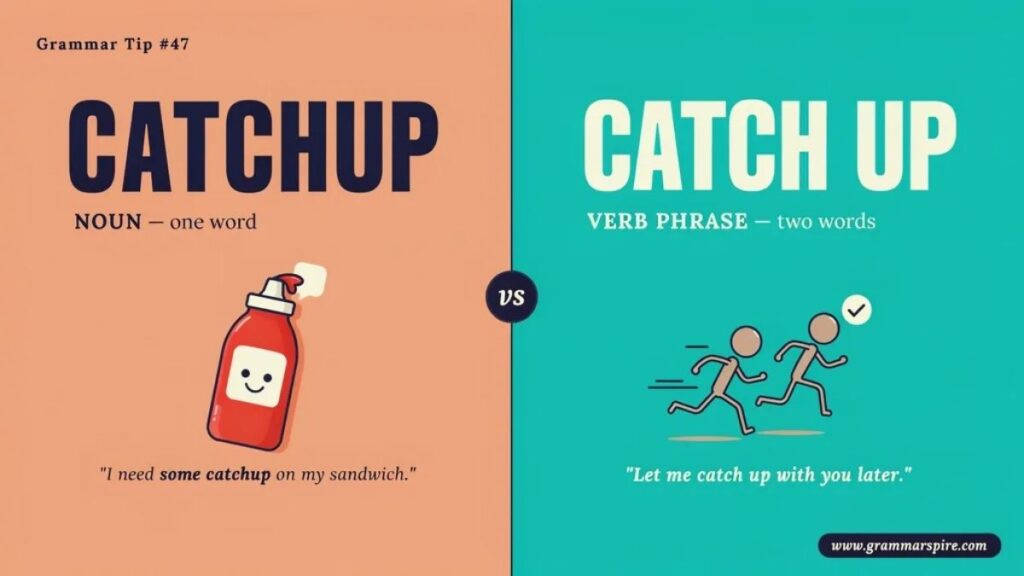
Catchup or catch up? A tiny hyphen might seem harmless, but it can change the meaning of your sentence. Imagine inviting a colleague to a catch up meeting and accidentally making your email sound like a conversation about ketchup! Funny as it sounds, these similar looking forms serve different purposes. Catch up works as a verb, catch up functions as a noun or adjective, and catchup is a variant spelling of ketchup. Mixing them up can lead to confusing sentences, but there is no need to worry. This guide explains the differences with clear examples, practical tips, and exercises to sharpen your grammar skills.
| Form | Meaning and grammatical role | Example |
|---|---|---|
| Catch up | Phrasal verb describing an action | I need to catch up on my reading. |
| Catch-up | Noun or adjective referring to an update or an activity that helps someone get up to date | We scheduled a catch-up meeting. |
| Catchup | Variant spelling associated with ketchup | The old cookbook uses the word catchup. |
| Ketchup | Noun referring to a tomato-based condiment | Please pass the ketchup. |
Learn the difference between similar English words the easy way
Bought or Brought which one Is correct?
What Does Catch Up Mean?
The catch up meaning depends on the context, but the expression generally refers to reaching a desired level, getting updated, or reconnecting with someone after time apart.
In English grammar, catch up is a phrasal verb. It combines the verb catch with the particle up to create a meaning that differs from the meaning of catch alone.
For example, catching a ball means stopping and holding it. However, catching up with a classmate can mean reaching the same level academically or spending time exchanging news. The surrounding words help readers understand which meaning applies.
Catch Up Means to Reach the Same Level
When someone falls behind, they can catch up by reaching the same position, speed, or level of progress as another person or group.
Imagine two students preparing for an exam. One has completed six chapters, while the other has finished only three. The second student needs to study the remaining material to catch up.
This meaning appears in school, sports, business, and everyday life.
Examples:
- I missed two classes, so I need to catch up before the exam.
- The runner increased her speed to catch up with the leaders.
- Our team worked late to catch up with the project schedule.
- He practiced every evening to catch up with his more experienced teammates.
- The company introduced new technology to catch up with its competitors.
In each example, catch up describes closing a gap between the current position and a desired position. The phrase emphasizes progress rather than simply completing an activity.
Catch Up Means to Get Up to Date
Sometimes you don’t need to reach another person. Instead, you need to review information or complete tasks that accumulated while you were away or busy.
For example, after returning from vacation, you might need to answer unanswered emails, review announcements, finish overdue assignments, or read the latest news.
This meaning often appears with the preposition on.
Examples:
- I need to catch up on my homework tonight.
- She spent the morning catching up on emails.
- We watched three episodes to catch up on the series.
- He reads the news each morning to catch up on current events.
- After taking a week off, Maya had to catch up on several reports.
The expression also applies to entertainment and personal interests. If you’ve missed several episodes of your favorite television show, you can catch up on the series by watching them later.
Similarly, if you’ve been away from an industry for several months, you might catch up on recent developments before attending a conference.
Catch Up Means to Reconnect With Someone
Another common meaning involves spending time with someone after you haven’t spoken or met for a while.
When you catch up with friends, you exchange news about your lives. You might discuss a new job, family events, travel plans, or something interesting that happened recently.
Examples:
- I hope we can catch up soon.
- She called her cousin to catch up after the holidays.
- We caught up with our old classmates over lunch.
- Let’s catch up this weekend and talk about what’s new.
- He met a former colleague to catch up on their recent experiences.
This use is especially common in informal conversation. However, it also appears in professional settings when colleagues want to discuss recent developments.
For instance, a manager might tell a colleague, “Let’s catch up tomorrow about the new project.” In this case, the phrase suggests a conversation to exchange updates and discuss progress.
Learn the difference between similar English words the easy way
Bleeded or Bled Which Is Correct?
What Does Catch-Up Mean?
The catch-up meaning is closely related to the verb phrase catch up. The key difference lies in its grammatical role. Catch-up commonly functions as a noun or adjective, particularly when describing an update, meeting, class, or session.
The hyphen helps readers recognize that the two words work together as one grammatical unit.
Catch-Up as a Noun
A noun names a person, place, thing, or idea. In this case, catch-up can refer to a conversation, an opportunity to exchange updates, or a session designed to help someone get up to date.
Consider this sentence:
“We had a quick catch-up before the meeting.”
Here, catch-up names the conversation. It doesn’t describe the action of catching up.
Common examples include:
- We had a catch-up over coffee.
- The team scheduled a short catch-up for Monday.
- Our weekly catch-up helps everyone share project updates.
- I enjoyed our catch-up after such a long time apart.
- Let’s arrange a catch-up to discuss the new plans.
The expression also appears in workplace communication. A manager might schedule a brief catch-up to review a project’s progress, discuss recent challenges, or share important information.
In these examples, catch-up acts as a compound noun. Its exact meaning depends on the context, but it usually involves exchanging information or getting up to date.
Catch-Up as an Adjective
An adjective describes a noun. When catch-up appears before another noun, it can explain the purpose of a meeting, class, session, or activity.
For example, consider this sentence:
“The teacher arranged a catch-up class for students who missed the lesson.”
The word catch-up describes the class. The class exists to help students review missed material and get back on track.
Other examples include:
- We arranged a catch-up meeting for the project team.
- She attended a catch-up session before the final exam.
- I scheduled a catch-up call with my supervisor.
- The company introduced a catch-up program for new employees.
- Friday is our catch-up day for unfinished tasks.
In each case, the hyphenated expression acts as a compound adjective because it modifies the noun that follows it.
However, the hyphen doesn’t appear automatically whenever catch and up sit next to each other. Their grammatical function matters.
What Is a Catch-Up Meeting?
A catch-up meeting is a conversation or work meeting in which people exchange updates, review progress, or discuss matters that have developed since their previous conversation.
For example, a project manager might organize a catch-up meeting after returning from a business trip. The team can explain what happened during the manager’s absence, identify delays, and agree on the next steps.
A catch-up meeting may cover:
- Recent project developments
- Completed and unfinished tasks
- New deadlines or changes in priorities
- Questions that need answers
- Decisions and actions for the coming days
The catch-up meeting meaning is straightforward: it is a meeting designed to bring people up to date.
The same idea applies to a catch-up call, catch-up conversation, or catch-up session. The exact format changes, but the purpose remains similar.
How to Use Catch-Up in Professional Emails
Professional writing often uses catch-up when arranging a short discussion with a colleague, client, or manager.
For example:
“Hi Morgan, could we schedule a brief catch-up meeting this week to review the project updates?”
Another natural option is:
“Let’s catch up on the latest developments during our call tomorrow.”
Notice the difference. In the first sentence, catch-up modifies meeting, so the hyphenated form fits. In the second sentence, catch up is the verb phrase describing the action.
Both expressions work in professional communication. The choice depends on sentence structure, not simply on whether the situation is formal or informal.
Learn the difference between similar English words the easy way
Brung vs Brought Which Is Correct?
What Does Catchup Mean?
The single-word form catchup causes much of the confusion surrounding this topic.
In standard modern American English, catchup isn’t the usual spelling of the verb phrase meaning to get up to date or reconnect with someone. Writers should generally use catch up for that meaning and catch-up when the noun or adjective calls for a hyphen.
However, catchup is a recognized spelling variant of ketchup, the condiment commonly served with fries, burgers, and other foods.
Ketchup is the standard spelling in American English. Catchup may appear in older texts, historical recipes, or some informal and regional usage.
For example:
- Standard modern usage: Please pass the ketchup.
- Historical or variant usage: The recipe calls for catchup.
If you’re writing a modern article, email, school assignment, or professional document, choose ketchup for the condiment unless you have a specific reason to preserve the variant spelling.
Catchup vs Ketchup Are They Different?
The words catchup and ketchup can refer to the same condiment. The difference is primarily spelling, not meaning.
Ketchup is the familiar form most American readers expect. Catchup is a less common variant that you may encounter in historical writing or older cookbooks.
Neither spelling should be confused with the verb phrase catch up.
| Sentence | Meaning |
|---|---|
| I need to catch up on my reading. | Complete missed reading or get up to date. |
| We had a catch-up after lunch. | Have a conversation or exchange updates. |
| Please add ketchup to the fries. | Add the tomato condiment. |
| The old recipe calls for catchup. | Uses a variant spelling for the condiment. |
The context tells you which meaning the writer intends. Still, using the standard spelling for each situation prevents unnecessary confusion.
Learn the difference between similar English words the easy way
Goodnight or Good Night Which Is Correct?
Catchup or Catch Up Key Differences
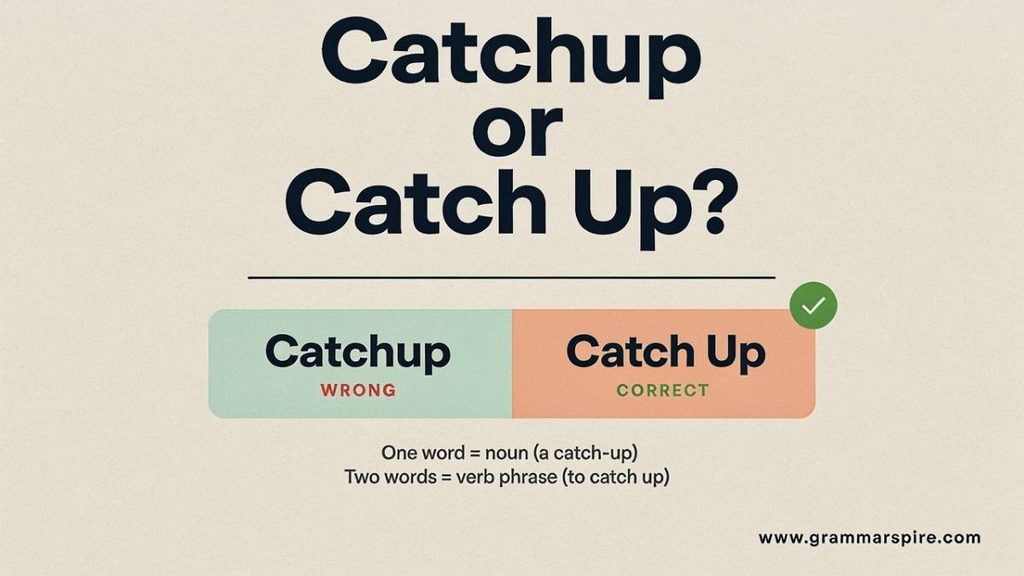
When comparing catchup or catch up, focus on the role each form plays in the sentence. Similar-looking words don’t necessarily have the same grammatical function.
The following table summarizes the main distinctions.
| Feature | Catch up | Catch-up | Catchup |
|---|---|---|---|
| Spelling | Two words | Hyphenated | One word |
| Typical role | Phrasal verb | Noun or adjective | Variant noun spelling |
| Main use | Reach, recover progress, get updated, or reconnect | An update or something intended to help someone get updated | Variant spelling associated with ketchup |
| Example | I need to catch up on work. | We held a catch-up meeting. | The cookbook uses catchup. |
| Standard modern American usage | Yes | Yes, when appropriate | Not the usual spelling for the verb phrase |
Catch Up vs Catchup
The difference between catch up vs. catchup is mainly grammatical and conventional.
Use catch up when describing an action. For instance, “I need to catch up with my classmates” describes what you need to do.
By contrast, catchup isn’t the standard single-word spelling for this action. Writing “I need to catchup with my classmates” would look incorrect in standard American English.
The distinction is useful because readers can recognize the intended meaning more easily when you follow established spelling conventions.
Catch-Up vs Catch Up
The catch-up vs. catch up distinction depends on whether the expression functions as a noun or adjective or as a verb phrase.
Compare these examples:
- “We need to catch up.” Here, catch up describes an action.
- “We need a catch-up.” Here, catch-up names an event or conversation.
- “We need a catch-up meeting.” Here, catch-up describes the meeting.
The meaning stays related, but the grammatical job changes.
Catchup vs Catch-Up
The catchup vs. catch-up comparison highlights the difference between a single-word spelling variant and a hyphenated expression.
Catchup may refer to ketchup in certain contexts. Catch-up commonly describes a meeting, conversation, session, or activity that helps people get updated.
For modern writing about work, school, or social conversations, catch-up is usually the relevant form when you need a noun or adjective.
Learn the difference between similar English words the easy way
Principal vs Principle which one is correct?
Catch Up Grammar Rules for Correct Usage
Understanding catch up grammar becomes easier when you identify the part of speech and sentence structure before choosing a spelling.
Rule Use Catch Up as a Phrasal Verb
A phrasal verb consists of a verb and one or more particles that create a combined meaning. Catch up is a common example.
You can use it in different tenses without changing its two-word spelling.
| Tense or form | Example |
|---|---|
| Present | I catch up on my emails every morning. |
| Third-person singular | She catches up on the news after work. |
| Present continuous | We are catching up with our classmates. |
| Simple past | They caught up last weekend. |
| Present perfect | He has caught up on his assignments. |
| Future | I will catch up on the reports tomorrow. |
| Infinitive | I need to catch up on my reading. |
Notice that the verb catch changes according to tense and subject, but the phrase remains two words.
The past tense is caught up, not catched up. For example, “I caught up with my friend yesterday” is correct.
Rule Use Catch-Up for a Noun or Adjective
When you use the expression as a noun or adjective, the hyphenated spelling often makes the sentence easier to read.
Examples:
- Noun: Our catch-up lasted an hour.
- Adjective: We arranged a catch-up meeting.
- Noun: The team enjoyed a quick catch-up.
- Adjective: The school offered catch-up lessons.
Some style guides and publications may differ in their treatment of compound expressions. If you follow a specific editorial guide, use its preferred convention consistently. Nevertheless, catch-up is a well-established form for these noun and adjective uses.
Rule Don’t Hyphenate Every Use of Catch Up
A common mistake is adding a hyphen simply because catch and up appear together.
Incorrect for the intended verb phrase: “I need to catch-up on my homework.”
Correct: “I need to catch up on my homework.”
However, this sentence is correct:
“I booked a catch-up session to review my homework.”
The first sentence uses a verb phrase. The second uses a hyphenated expression to describe a session.
The spelling follows the grammatical role, not the number of times you use the words together.
Learn the difference between similar English words the easy way
Requester or Requestor Which Spelling Is Correct?
Catch Up With, Catch Up On, or Catch Up To?
The preposition that follows catch up can change the meaning of the sentence. Although these expressions look similar, each serves a slightly different purpose.
Catch Up With Someone or Something
Use catch up with when you mean to reach someone or something that is ahead of you. You can also use it when you reconnect with someone and exchange updates.
Examples:
- I ran faster to catch up with my friends.
- She wants to catch up with her former coworkers.
- Our sales team is trying to catch up with its competitors.
- I called my cousin to catch up with her after the holidays.
The context determines the meaning. In the first and third examples, catch up with refers to reaching a comparable position. In the other examples, it refers to reconnecting or exchanging news.
Catch Up On Something
Use catch up on when you need to complete something you missed or review information you haven’t yet seen.
Examples:
- I need to catch up on work after my vacation.
- He spent Sunday catching up on homework.
- We stayed home to catch up on TV shows.
- She reads the newspaper to catch up on current events.
This construction is particularly useful when discussing unfinished tasks, missed lessons, reading, entertainment, and news.
For example, if you miss four episodes of your favorite series, you can catch up on the series by watching those episodes. If you miss several classes, you can catch up on the material by reviewing your notes and completing assignments.
Catch Up To Someone or Something
Use catch up to when you mean to reach someone or something that is ahead of you, especially in terms of position, progress, or development.
Examples:
- The cyclist pedaled faster to catch up to the leading group.
- Smaller companies are developing new products to catch up to their competitors.
- She studied hard to catch up to the rest of her class.
In some situations, catch up with and catch up to overlap. Both can describe reaching someone who is ahead. However, catch up with is also common when discussing social contact, while catch up to often emphasizes reaching a position or level.
Learn the difference between similar English words the easy way
Too Many or To Many Which Is Correct?
Catch Up Examples How to Use Each Form in a Sentence
Real sentences make spelling rules easier to remember. The examples below show how catch up and catch-up work in everyday situations.
Catch Up in a Sentence
Use the two-word form when the expression describes an action.
- I need to catch up on my reading before the semester ends.
- We should catch up with our old friends this weekend.
- She worked late to catch up on the unfinished reports.
- He watched the latest episodes to catch up on the series.
- The new employee is trying to catch up with the rest of the team.
- Let’s catch up soon and talk about your new job.
- I missed the morning lecture, so I need to catch up on the material.
- The runner sped up to catch up with the leader.
- She spent the afternoon catching up on emails.
- Our department must catch up on several overdue tasks.
Each sentence uses catch up as a verb phrase. The tense may change, as in catching up, but the expression doesn’t become a single word.
Catch-Up Examples
Use the hyphenated form when it serves as a noun or adjective.
- We scheduled a catch-up meeting for Tuesday.
- Our weekly catch-up helps the team share updates.
- She arranged a catch-up call with her supervisor.
- The students attended a catch-up session before the exam.
- I enjoyed our catch-up over coffee.
- Friday is my catch-up day for household chores.
- The manager sent a catch-up email to the team.
- The school created a catch-up program for students who missed lessons.
The grammatical role matters more than the situation. You can use catch up in a professional conversation and catch-up in a casual one. Neither spelling belongs exclusively to formal or informal English.
Learn the difference between similar English words the easy way
Invision vs Envision Which Spelling Is Correct?
Common Mistakes
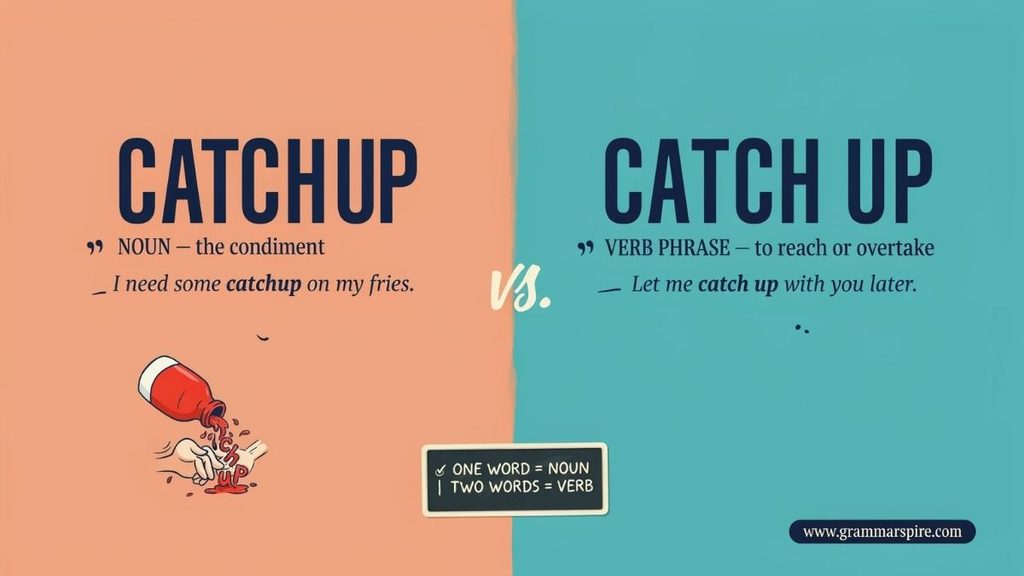
Even experienced writers sometimes mix up these forms, especially when typing quickly or writing informal messages. A few simple checks can prevent most errors.
Writing Catchup as a Verb
Incorrect: “I need to catchup on my assignments.”
Correct: “I need to catch up on my assignments.”
In standard American English, catch up is the accepted spelling for the action. Keep the words separate.
Forgetting the Hyphen in Catch-Up Meeting
A catch-up meeting is a common compound expression. When catch-up modifies meeting, the hyphen helps show that both words work together.
Preferred: “Let’s schedule a catch-up meeting.”
You may encounter variations in published writing, but the hyphenated form is a clear and widely used choice.
Adding a Hyphen to the Verb Phrase
Incorrect for standard usage: “We should catch-up tomorrow.”
Correct: “We should catch up tomorrow.”
The phrase describes an action, so the two-word form is appropriate.
Confusing Catchup With Ketchup
If you’re writing about food, ketchup is the standard modern American spelling.
If you’re writing about work, school, or reconnecting with someone, you probably need catch up or catch-up instead.
Choosing a Form Without Checking the Sentence
The fastest way to choose the correct spelling is to identify the grammatical role.
Ask yourself:
- Does the expression describe an action? Use catch up.
- Does it name a meeting, conversation, or session? Use catch-up.
- Does it describe a meeting, class, or activity? Use catch-up.
- Does it refer to the condiment? Use ketchup in standard modern American English.
This quick check works for most everyday situations.
A Practical Case Study Catch Up in Workplace Communication
Imagine that Maya returns to work after taking a week off. During her absence, her colleagues completed several tasks, the project schedule changed, and her manager introduced a new reporting process.
Maya needs to review the updates, finish the work she missed, and speak with her team.
She might write:
“I need to catch up on the project updates before our meeting.”
Here, catch up describes the action of becoming informed.
Next, her manager schedules a short catch-up meeting for Wednesday. In this phrase, catch-up describes the type of meeting.
After the meeting, Maya sends a message:
“Thanks for the catch-up. I’ll catch up on the remaining reports this afternoon.”
The first catch-up is a noun referring to the discussion. The second catch up is a verb phrase describing what Maya plans to do.
This example demonstrates why the words aren’t interchangeable. The same general idea appears throughout the conversation, but the sentence structure determines the spelling.
Learn the difference between similar English words the easy way
Truly vs Truely Which Spelling Is Correct?
Synonyms for Catch Up and Catch-Up
The best catch up synonym depends on the intended meaning. No single alternative fits every situation.
| Intended meaning | Suitable synonyms or alternatives | Example |
|---|---|---|
| Get up to date | Review, update yourself, become informed | I need to review the latest changes. |
| Finish missed work | Complete overdue work, get back on track | I must complete my overdue assignments. |
| Reach someone ahead | Close the gap, reach, keep pace | The team worked hard to close the gap. |
| Reconnect with someone | Reconnect, touch base, check in, get together | Let’s reconnect over lunch. |
| Share information | Exchange updates, fill someone in, bring someone up to speed | I’ll bring you up to speed tomorrow. |
| A short update meeting | Briefing, progress meeting, review session | We scheduled a progress meeting. |
These expressions are related, but they aren’t perfect replacements in every sentence.
For instance, reconnect works well when talking about an old friend. However, it doesn’t naturally replace catch up in a sentence about completing overdue homework.
Likewise, touch base often describes brief professional communication, but it may not convey the idea of completing missed work.
Choose a synonym that preserves the original meaning rather than changing a sentence simply to avoid repetition.
Learn the difference between similar English words the easy way
Koozie vs Coozie Which Spelling Is Correct?
How to Remember the Difference
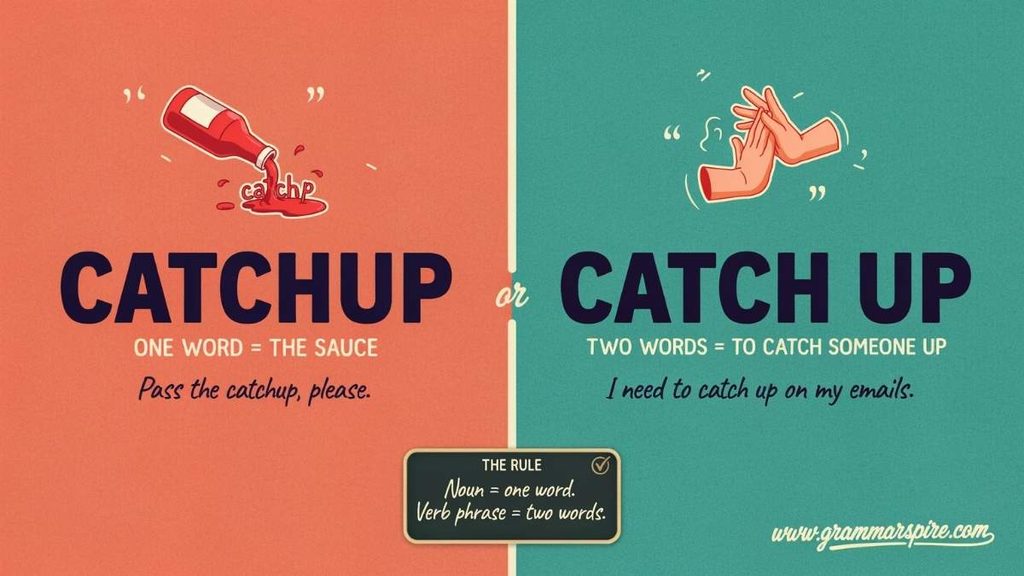
A simple memory trick can save you from second-guessing your spelling.
Catch up means an action. Catch-up is commonly a noun or adjective. Ketchup is the condiment.
Think of the expressions this way:
- Catch up: You need to catch up on your studies.
- Catch-up: You arranged a catch-up session.
- Ketchup: You put ketchup on your fries.
You can also use a substitution test. If you can replace the expression with a verb such as complete, reach, review, or reconnect, catch up is probably the correct form.
If you can replace it with a noun such as meeting, conversation, or update, catch-up may be the right choice.
For example, “We had a quick catch-up” can become “We had a quick conversation.” That substitution works because catch-up acts as a noun.
However, “We need to catch up on our work” cannot become “We need to conversation on our work.” The sentence needs a verb phrase, so catch up is correct.
This test isn’t a replacement for understanding the sentence, but it is a practical way to check your choice.
Here’s a trusted source for clear word meanings:
Practice Session
Ready to test your understanding of catch up, catch-up, and catchup? Complete the 30 fill-in-the-blank sentences below. Pay attention to the meaning of each sentence and how the phrase functions. Remember that catch up is a verb, catch-up is a noun or adjective, and catchup is a variant spelling of ketchup.
Fill in the Blanks
- I need to ______ on my homework before Monday.
- We arranged a ______ meeting to discuss the project.
- After missing two classes, Mia spent the weekend playing ______.
- Let’s ______ over coffee this weekend.
- I have to ______ on my emails before leaving work.
- The manager scheduled a ______ session for Friday.
- He worked late to ______ with the rest of the team.
- We had a quick ______ after several months apart.
- She wants to ______ up with the latest news.
- The students were playing ______ after returning from vacation.
- I bought a bottle of tomato ______ at the grocery store.
- We need to ______ on the changes made to the report.
- Our weekly ______ meeting helps everyone share updates.
- Jake finally ______ up with his classmates after studying hard.
- Let’s ______ up tomorrow and discuss your plans.
- The team is still playing ______ because the project started late.
- I enjoy ______ with my fries and burgers.
- She plans to ______ up with an old friend this weekend.
- We arranged a ______ conversation to discuss recent events.
- He stayed after class to ______ up on the lessons he missed.
- I have already ______ up on all my assignments.
- The company held a ______ meeting to review its goals.
- After a busy week, I called my cousin to ______ up.
- The runner increased his speed to ______ up to the others.
- The employees arranged a short ______ to discuss their progress.
- I am trying to ______ up on the latest developments in technology.
- She spent the morning playing ______ after taking several days off.
- We need a quick ______ meeting before the presentation.
- He finally ______ up with his work after falling behind.
- Would you like to ______ up sometime next week?
Answers
- catch up
- catch-up
- catch-up
- catch up
- catch up
- catch-up
- catch up
- catch-up
- catch
- catch-up
- catchup
- catch up
- catch-up
- caught
- catch
- catch-up
- catchup
- catch
- catch-up
- catch
- caught
- catch-up
- catch
- catch
- catch-up
- catch
- catch-up
- catch-up
- caught
- catch
FAQs About Catchup or Catch Up
1. Is catchup one word or two words?
Catch up is two words when used as a verb, as in “I need to catch up on my work.” Catch-up takes a hyphen when used as a noun or adjective, as in “a catch-up meeting.” Catchup is a less common spelling of ketchup, the tomato-based condiment.
2. Is it catchup or catch-up meeting?
Catch-up meeting is the correct form. The hyphen connects the words because they work together to describe the meeting. For example, “We scheduled a catch-up meeting for Friday.”
3. What is the difference between catchup and catch-up?
Catchup is a variant spelling of ketchup, while catch-up refers to an effort to become up to date or reach the same level as someone else. The hyphenated form can function as a noun or adjective. For example, “We had a quick catch-up after lunch.”
4. Is it playing catchup or catch up?
Playing catch-up is the standard expression. The hyphenated phrase acts as a noun and describes an attempt to make up for lost time or close a gap. For example, “After missing two classes, I spent the weekend playing catch-up.”
5. Does catch up need to be hyphenated?
No. When catch up functions as a verb, write it as two separate words. Use the hyphenated form when it acts as a noun or adjective. For example, “I need to catch up on my reading” and “We arranged a catch-up conversation.”
6. How do you say catch up in a professional way?
In professional communication, you can say “review recent developments,” “discuss progress,” “exchange updates,” or “align on priorities.” Choose the phrase that best fits your purpose. For example, “Let’s review our progress during tomorrow’s meeting” sounds clear and professional.
7. What is a better way to say catch up?
Useful alternatives include reconnect, check in, get up to date, review recent developments, and make up lost ground. Use “reconnect” when speaking with someone after time apart and “get up to date” when you need the latest information.
8. What does catchup mean?
Catchup is a less common spelling of ketchup, a condiment often made from tomatoes. If you mean becoming up to date, completing unfinished work, or exchanging news, use catch up or catch-up, depending on the sentence.
9. What’s another way of saying playing catch up?
You can say “making up lost ground,” “getting back on track,” “closing the gap,” or “working to meet a deadline.” For example, “The team is working to get back on track after the project delay.”
10. Is it correct to say catch up?
Yes. Catch up is grammatically correct when used as a verb. You can catch up on unfinished tasks, catch up with a friend, or catch up to someone who has moved ahead. The intended meaning determines how you use the phrase.
11. Does catch up mean meet up?
Not exactly. Catch up usually involves exchanging news or discussing recent events, while meet up simply means getting together. For example, “Let’s catch up over coffee” suggests that you want to talk about what has happened since you last spoke.
12. What is the past form of catch up?
The simple past form is caught up. The verb catch changes to caught, while up stays the same. For example, “I caught up on my emails yesterday.” The past participle is also caught, as in “I have caught up on my work.”
AEO Quick Answers About Catchup or Catch Up
What is the correct spelling catchup, catch-up, or catch up?
Catch up is the two-word verb, catch-up is the hyphenated noun or adjective, and catchup is a variant spelling of ketchup. Choose the form that matches the meaning and grammatical role in your sentence.
How do you use catch up in a sentence?
Use catch up when you mean to reach the same level, complete delayed work, or exchange news with someone. For example, “I need to catch up on my reading before Monday.”
Is catch-up hyphenated in a meeting invitation?
Yes. Write catch-up meeting because the hyphenated phrase describes the type of meeting. For example, “I’ve scheduled a catch-up meeting to review our progress.”
What does playing catch-up mean?
Playing catch-up means trying to recover lost time, close a gap, or reach the same level as others. For example, a student who misses several lessons may spend the following week playing catch-up.
Which prepositions follow catch up?
The common combinations are catch up on, catch up with, and catch up to. Use catch up on for tasks or information, catch up with for people or progress, and catch up to when reaching someone or something ahead of you.
Is caught up grammatically correct?
Yes. Caught up is the correct past-tense form of catch up, and caught is also its past participle. For example, “She caught up with her classmates” describes a completed action, while “She has caught up with her classmates” uses the present perfect tense.
Conclusion
Understanding catchup or catch up becomes simple once you know when to use each form. Write catch up when you mean to reconnect with someone, finish unfinished work, or reach the same level as others. Use catch-up when the phrase acts as a noun or adjective, as in a catch-up meeting. As for catchup, it is a variant spelling of ketchup, the condiment that belongs on your fries, not in your business emails! Although a tiny hyphen might seem unimportant, using the correct form keeps your writing clear and professional. Practice these rules, avoid common mistakes, and you will soon catch up with confidence!

Ella AJS
Ella AJS is an experienced blogger and language enthusiast at Grammar Spire, dedicated to making English grammar simple, practical, and easy to understand. She specializes in word comparisons, meanings, usage, and common language confusions. Through clear explanations and engaging examples, Ella helps students, writers, and English learners improve their vocabulary and communicate with greater confidence and accuracy.




