Too many or to many which phrase belongs in your sentence? One tiny letter can make a big difference in grammar, leaving readers puzzled and spell checkers unimpressed. Although these expressions sound alike, they serve different purposes. Too many describes an excessive number, while to many connects an action or idea to a group of people or things. Confusing them can turn a perfectly clear sentence into a grammatical stumble. Fortunately, mastering this distinction is easier than counting cookies before someone eats them all. With simple rules, practical examples, and helpful tips, you can avoid common mistakes and write with confidence.
| Phrase | Meaning | Correct Usage | Example |
|---|---|---|---|
| Too many | More than needed, wanted, or allowed | Describes an excessive number | There are too many chairs in the room. |
| To many | To or toward a large number of people or things | Connects a verb or expression to its object | I spoke to many students after class. |
Learn the difference between confusing more English words step by step
Forbid or Forbidden Which One Is Correct?
Quick Answer
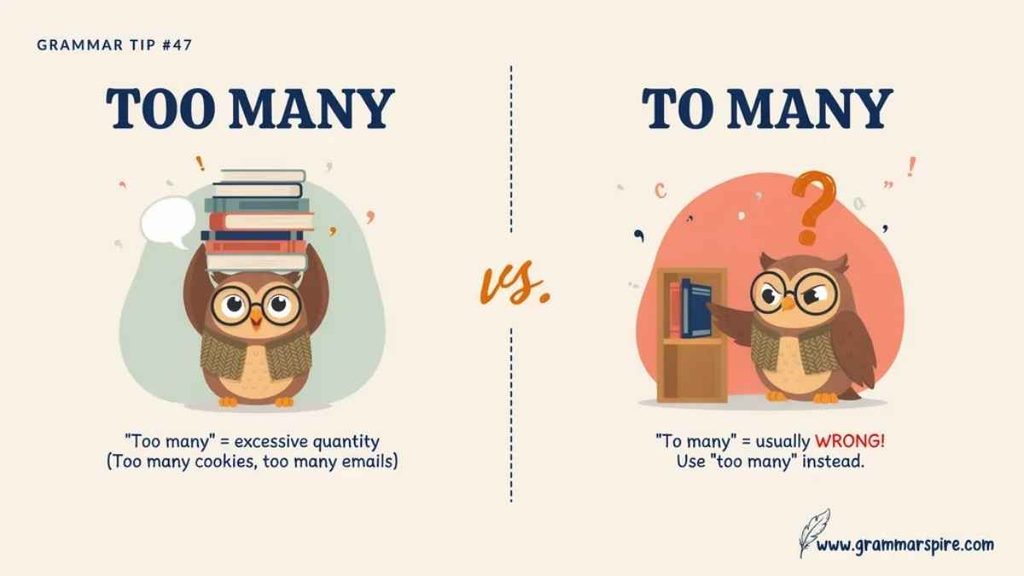
Too many is correct when you want to describe an excessive number of people, objects, or other countable things. For example, you might say, “There are too many notifications on my phone.” The phrase suggests that the number is greater than necessary or comfortable.
To many is also grammatically correct, but it serves a different purpose. It combines the preposition to with many, which refers to a large number of people or things. For example, “She explained the rules to many students.” Here, to shows whom she explained the rules to, while many describes the number of students.
The correct choice depends on the meaning of your sentence. Use too many when you mean an excessive number. Use to many when the sentence requires the preposition to.
What Does Too Many Mean?
Too many means more than the desired, necessary, or acceptable number. It expresses excess and often suggests a problem, inconvenience, or unwanted situation.
The phrase consists of two words. Too is an adverb that can mean excessively or more than necessary. Many is a determiner that refers to a large number of countable people or things.
Together, these words communicate that a quantity has exceeded a reasonable limit.
For example, “We ordered too many pizzas for the party.” This sentence means the group ordered more pizzas than it needed. Some food may remain uneaten.
Similarly, “He made too many mistakes on the test” indicates that the number of mistakes was higher than acceptable.
When Should You Use Too Many?
Use too many when you want to emphasize an excessive number of countable nouns. These nouns can include people, books, questions, mistakes, emails, cars, or appointments.
For example, “There are too many cars on this road” suggests that traffic has become heavier than desirable.
Likewise, “I received too many emails this morning” indicates that the number of messages feels excessive.
The phrase can also describe abstract but countable things. For instance, “She has too many responsibilities at work” means she has more duties than she can comfortably manage.
Too many does not always describe something objectively harmful. Sometimes, it simply reflects a person’s preference or circumstances. A room might have too many decorations for someone who prefers a minimalist style, even if another person enjoys the same arrangement.
Grammar Rules for Too Many
Too many generally appears before a plural countable noun. It can also stand alone when the noun is clear from the surrounding context.
For example, “Too many guests arrived before the doors opened.” The word guests is a plural countable noun, so too many fits naturally.
In the sentence “I bought five notebooks, but I probably bought too many,” the noun notebooks does not need to appear again because readers can understand what too many refers to.
Remember that too many usually does not modify an uncountable noun directly. For uncountable nouns such as water, information, advice, and furniture, use too much instead.
For example, “There is too much water on the floor” is correct, while “There is too many water on the floor” is incorrect.
Learn the difference between confusing more English words step by step
Set or Setted Which Is Correct?
What Does To Many Mean?
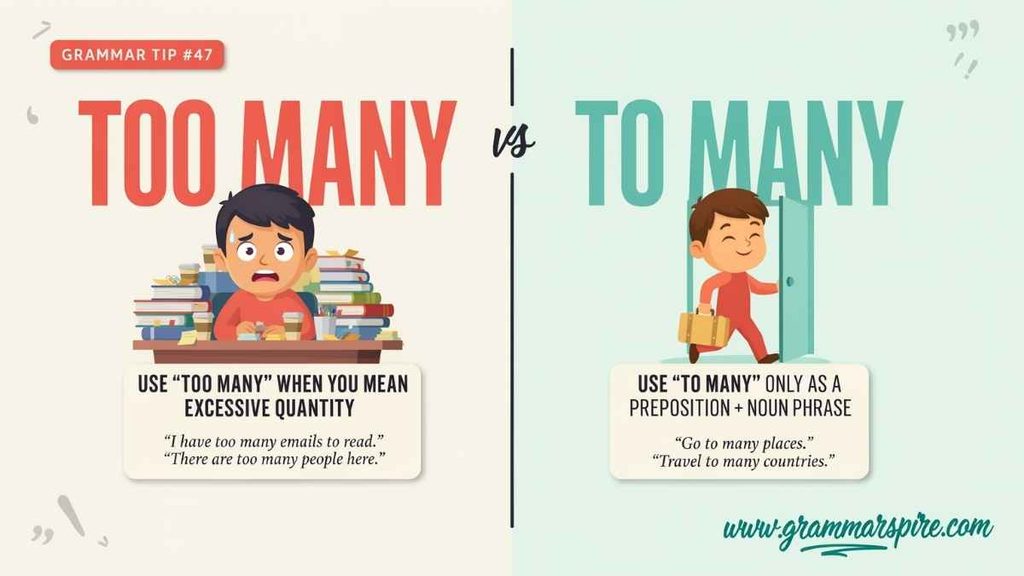
To many combines the preposition to with the word many. Unlike too many, it does not express excess by itself.
The preposition to can indicate direction, a recipient, a target, or the person receiving an action. Many refers to a large number of people or things.
For example, “The teacher gave instructions to many students.” The word to connects the action of giving instructions with the students who received them. Many tells us that the teacher addressed a large group.
Similarly, “This message means a great deal to many people” explains whose feelings or opinions are affected by the message.
When Should You Use To Many?
Use to many when the sentence requires the preposition to and refers to a large number of people or things.
Consider this example: “The organization provides free meals to many families.” The organization gives meals to families, and many indicates that the number of families is large.
Another example is “Her speech was inspiring to many listeners.” Here, to connects the idea of being inspiring with the people who experienced the speech.
You can also use to many in expressions involving opinions, explanations, benefits, and communication. For example, “The new policy seems unfair to many employees.” The phrase identifies the people who consider the policy unfair.
The key is to examine the complete sentence. If to connects an action, feeling, or relationship with a recipient or target, to many may be the right choice.
Grammar Rules for To Many
To many is not usually a standalone expression. It appears within a larger grammatical structure, and the preposition to serves a function in that structure.
For example, “She sent invitations to many colleagues.” The verb sent describes an action, invitations identifies what she sent, and to many colleagues identifies the recipients.
In “The decision was surprising to many observers,” the phrase to many observers identifies the people who found the decision surprising.
The word many still refers to countable people or things. The preposition to does not change that rule. Therefore, use many with plural countable nouns and much with uncountable nouns when the sentence structure calls for those quantity words.
Learn the difference between confusing more English words step by step
Bred vs Breeded Which Is Correct?
Key Differences Between Too Many and To Many
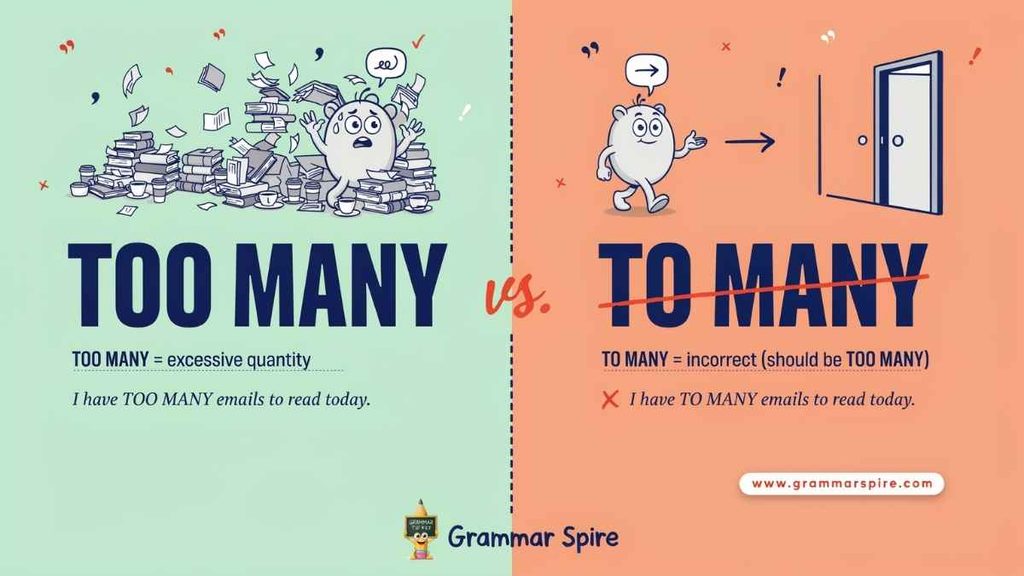
The difference between too many and to many comes down to meaning and grammatical function. Although the phrases sound alike, they are not interchangeable.
Too many expresses an excessive quantity. To many usually introduces the people or things connected to an action, opinion, feeling, or relationship.
| Feature | Too Many | To Many |
|---|---|---|
| Main function | Expresses excess | Shows a relationship, recipient, or target |
| Grammatical role | Quantity expression | Preposition followed by a quantity word |
| Typical meaning | More than necessary or wanted | To a large number of people or things |
| Example | Too many people attended the event. | The announcement surprised many people. |
| Common context | Complaints, limits, quantities | Communication, opinions, effects, recipients |
Consider these two sentences: “There are too many complaints” and “The manager responded to many complaints.”
In the first sentence, too many indicates that the number of complaints is excessive. In the second, to connects the manager’s response with the complaints. The phrase does not automatically suggest that the number is excessive.
This distinction matters because a sentence can contain both expressions in different contexts. For example, “The company received too many complaints and had to respond to many customers.” The first phrase describes an excessive number of complaints, while the second identifies the customers who received a response.
Learn the difference between confusing more English words step by step
Stinged or Stung Which Is Correct?
When to Use Too Many
Use too many whenever you want to say that the number of something exceeds what is necessary, reasonable, or desirable.
Describing Excessive Quantities
For example, “There are too many books on my desk.” This sentence suggests that the books occupy too much space or make the desk difficult to use.
Likewise, “We have too many meetings scheduled for Friday” indicates that the number of meetings is excessive for the situation.
Discussing Problems or Mistakes
Too many often appears when people describe errors, difficulties, or unwanted situations.
For example, “The report contains too many spelling mistakes.” This sentence suggests that the number of errors is unacceptable.
Another example is “He asked too many questions during the presentation.” Depending on the context, this may imply that the questions interrupted the presentation or consumed too much time.
Talking About Limits
You can also use too many to explain that a limit has been exceeded.
For example, “The website received too many requests at once.” The number of requests may have overwhelmed the server.
Similarly, “You added too many items to your shopping cart” suggests that the quantity is greater than needed or allowed.
When to Use To Many
Use to many when to functions as a preposition and many refers to a large number of people or things.
Describing Communication
For example, “The speaker explained the new rules to many participants.” The phrase identifies the people who received the explanation.
Another example is “I sent the announcement to many colleagues.” The word to connects the act of sending with the recipients.
Expressing Opinions or Reactions
To many can also appear in sentences describing how people view or experience something.
For example, “The change seemed unnecessary to many employees.” The phrase identifies the employees who held that opinion.
Similarly, “The story remains meaningful to many readers.” Here, to many readers identifies the people who find the story meaningful.
Explaining Benefits or Effects
For example, “The scholarship offers a valuable opportunity to many students.” The phrase identifies the students who may benefit from the scholarship.
Likewise, “The discovery was important to many researchers.” The preposition to connects the importance of the discovery with the people concerned.
Learn the difference between confusing more English words step by step
Bought or Brought which one Is correct?
Too Many vs Too Much
Another common grammar question involves too many and too much. Both expressions describe excess, but they apply to different types of nouns.
Use too many with plural countable nouns. Use too much with uncountable nouns.
| Expression | Noun Type | Example |
|---|---|---|
| Too many | Plural countable nouns | There are too many boxes in the hallway. |
| Too much | Uncountable nouns | There is too much clutter in the hallway. |
| Too many | Countable items | She bought too many apples. |
| Too much | Uncountable substances | She added too much sugar. |
| Too many | Countable tasks | I have too many assignments. |
| Too much | Uncountable concepts | I have too much work. |
Countable nouns refer to things you can count individually, such as books, chairs, students, and questions. Uncountable nouns refer to things that are not usually counted as separate units, such as information, furniture, traffic, and advice.
For example, you can say “too many suggestions” because suggestions are countable. However, you should say “too much advice” because advice is uncountable in standard English.
When you are unsure, ask yourself whether the noun can naturally take a number. You can have three books or five questions, but you would usually say three pieces of advice or five pieces of information rather than three advices or five informations.
Learn the difference between confusing more English words step by step
Bleeded or Bled Which Is Correct?
Common Mistakes With Too Many and To Many
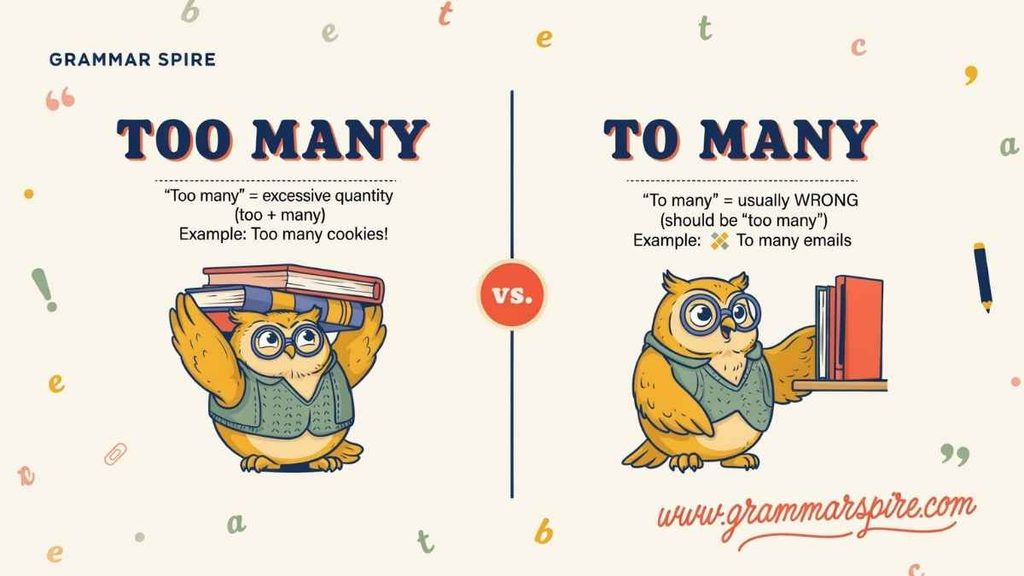
Writers often confuse these expressions because their pronunciation is nearly identical. However, a few simple checks can help you choose the correct phrase.
Using To Many to Describe Excess
Incorrect: There are to many people in the waiting room.
Correct: There are too many people in the waiting room.
The sentence describes an excessive number of people, so too many is correct.
Using Too Many When a Preposition Is Needed
Incorrect: She explained the process too many new employees.
Correct: She explained the process to many new employees.
The verb explained requires a recipient in this sentence. The preposition to connects the explanation with the employees.
Confusing Too Many With Too Much
Incorrect: There is too many information in the document.
Correct: There is too much information in the document.
Information is uncountable, so too much is the appropriate expression.
Replacing To With Too in Everyday Writing
Incorrect: I gave the documents too many clients.
Correct: I gave the documents to many clients.
The sentence identifies the recipients of the documents. It does not describe an excessive quantity, so to many is correct.
Ignoring the Meaning of the Entire Sentence
Some writers choose a phrase based only on how it sounds. That approach can lead to errors because pronunciation does not reveal the grammatical role of each word.
Instead, read the entire sentence and identify what you want to communicate. If you mean more than necessary, use too many. If you need a preposition connecting an action or relationship to a group, use to many.
Learn the difference between confusing more English words step by step
Brung vs Brought Which Is Correct?
Easy Ways to Remember the Difference
A simple memory trick can help you distinguish these phrases without checking a grammar guide every time.
Think of the extra o in too as a sign of excess. The word too can mean more than necessary, as in too expensive, too loud, or too difficult. Therefore, too many means more than the desired number.
For example, “There are too many shoes by the door” suggests that the number of shoes is excessive.
To, on the other hand, often indicates direction, a recipient, or a relationship. In “I gave the shoes to many children,” the preposition to connects the action of giving with the recipients.
You can also test the sentence by replacing too many with more than necessary. If the sentence keeps its intended meaning, too many is likely correct.
For example, “There are too many chairs” becomes “There are more chairs than necessary.” The meaning remains similar.
However, “I spoke to many teachers” does not mean “I spoke more than necessary teachers.” The replacement changes the meaning and makes the sentence incorrect. This signals that to many is the appropriate phrase.
Learn the difference between confusing more English words step by step
Goodnight or Good Night Which Is Correct?
Examples of Too Many and To Many in Sentences
Seeing both expressions in everyday contexts makes their differences easier to recognize.
| Sentence | Correct Phrase | Explanation |
|---|---|---|
| There are too many dishes in the sink. | Too many | The number of dishes is excessive. |
| She spoke to many parents after the meeting. | To many | The phrase identifies whom she spoke to. |
| We received too many applications this week. | Too many | The number of applications exceeded expectations or capacity. |
| The announcement was helpful to many families. | To many | The phrase identifies the people who benefited. |
| He made too many changes to the original plan. | Too many | The number of changes is considered excessive. |
| The instructions were confusing to many readers. | To many | The phrase identifies the readers who found the instructions confusing. |
| I bought too many groceries for one person. | Too many | The quantity is greater than needed. |
| The new service is available to many customers. | To many | The phrase identifies the people who can access the service. |
These examples show why context matters. Both phrases can appear in perfectly correct English, but they perform different jobs.
Learn the difference between confusing more English words step by step
Principal vs Principle which one is correct?
A Practical Way to Check Your Sentence
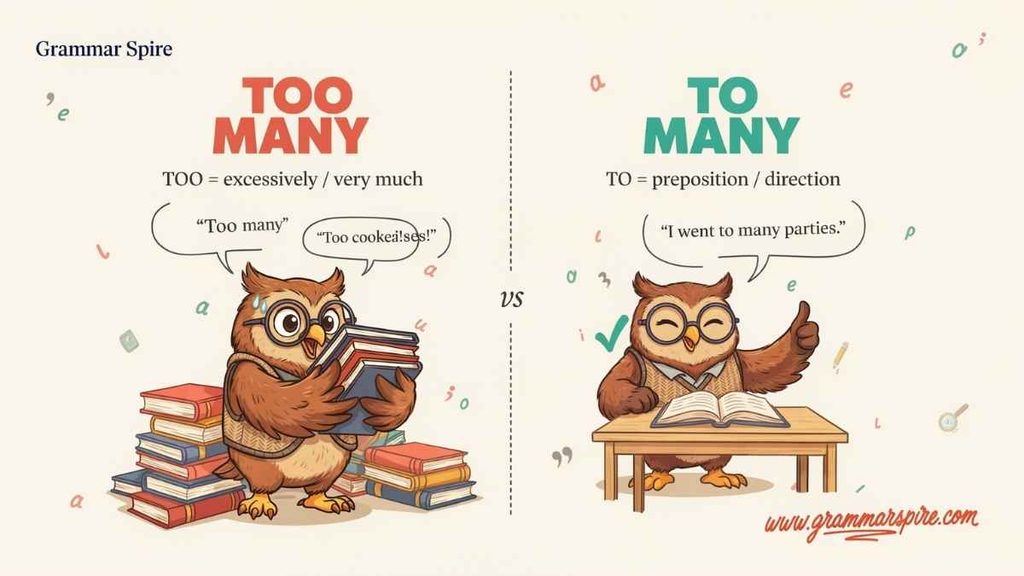
Suppose you are writing an email and want to say that a project has an excessive number of tasks. You might write, “There are to many tasks left before the deadline.”
To check the sentence, replace to many with more than necessary. The revised meaning becomes “There are more tasks than necessary left before the deadline.” That meaning fits your intention, so you should write “There are too many tasks left before the deadline.”
Now consider the sentence, “I assigned the tasks to many team members.” The phrase identifies the people who received the assignments. Replacing to many with more than necessary would change the meaning, so to many is correct.
This quick test works in everyday writing because it focuses on the meaning rather than the sound of the words.
Here’s a trusted source for clear more words Comparison
Grammar Update
Practice Session
Test your understanding of too many, to many, too much, and related expressions with the 30 fill-in-the-blank questions below. Read each sentence carefully and consider its meaning, grammatical structure, and noun type. Remember that too many describes an excessive number of countable items, while to many can connect an action or idea to a group of people or things. Use too much with uncountable nouns when expressing excess. Complete every sentence before checking the answer key to strengthen your grammar skills and avoid common mistakes.
Fill in the Blanks
- There are ______ people waiting outside the office.
- She spoke ______ students about the upcoming examination.
- We bought ______ groceries for our small refrigerator.
- He added ______ sugar to his coffee.
- The teacher gave instructions ______ students.
- There are ______ mistakes in your essay.
- I sent invitations ______ friends.
- You spend ______ time playing video games.
- The manager assigned ______ tasks to the new employee.
- Her advice was helpful ______ people.
- We packed ______ clothes for a two-day trip.
- There is ______ water in the glass.
- The announcement was surprising ______ employees.
- I ate one cookie ______ many and felt uncomfortable afterward.
- The company received ______ applications for the position.
- She explained the rules ______ participants.
- There is ______ furniture in this room for such a small space.
- The new policy seemed unfair ______ workers.
- He asked ______ questions during the interview.
- We have ______ information to review before the meeting.
- The charity distributed food ______ families.
- There are ______ cars on the road during rush hour.
- She poured ______ milk into her cereal.
- The movie was entertaining ______ viewers.
- I have ______ assignments to finish tonight.
- The speaker directed her comments ______ members of the audience.
- They brought ______ luggage for a weekend getaway.
- The website received ______ requests in a short period.
- The new program offers valuable opportunities ______ students.
- We waited ______ many hours for the delayed train.
Answer Key
- Too many
- To many
- Too many
- Too much
- To many
- Too many
- To many
- Too much
- Too many
- To many
- Too many
- Too much
- To many
- Too
- Too many
- To many
- Too much
- To many
- Too many
- Too much
- To many
- Too many
- Too much
- To many
- Too many
- To many
- Too much
- Too many
- To many
- Too many
Learn the difference between confusing more English words step by step
Requester or Requestor Which Spelling Is Correct?
FAQs About Too Many and To Many
How Do You Use To or Too?
Use to to indicate direction, purpose, or a connection between an action and its recipient. Use too to mean also or excessively. For example, “I went to school” uses to, while “The bag is too heavy” uses too.
Which Is Correct: To Much or Too Much?
Too much is correct when describing an excessive amount of something uncountable. For example, “You added too much salt to the soup.” To much is incorrect when you intend to express excess.
Is It One Too Many or One To Many?
One too many is correct when something exceeds the acceptable number by one. For example, “I ate one cookie too many.” The phrase one to many does not convey this meaning.
Is It Too Much Food or Too Many Food?
Too much food is correct because food is generally an uncountable noun. For example, “We prepared too much food for the party.” Use too many with plural countable nouns, such as sandwiches, plates, or apples.
Should I Write To Many or Too Many?
Use too many to describe an excessive number, as in “There are too many people in the room.” Use to many when the preposition to connects an action or relationship with a group, as in “She spoke to many visitors.”
Why Do British People Say Poorly?
In British English, poorly can mean feeling ill or being in poor health. For example, “I feel poorly today” means “I feel unwell.” This expression is common in British conversation, although its use varies across English-speaking regions.
Is It Grammatically Correct to Say Too Much?
Yes. Too much is grammatically correct when describing an excessive amount of something. For example, “There is too much noise outside.” You can also use it without a noun, as in “You worry too much.”
What Does Too Many Mean?
Too many means more than the desired, necessary, or acceptable number. It usually appears before plural countable nouns. For example, “There are too many emails in my inbox” suggests that the number of messages is excessive.
Which Is Correct Too Many More Years or To Many More Years?
Too many more years is correct when describing an excessive number of additional years. For example, “We cannot afford to wait too many more years.” To many more years is not correct when expressing this meaning. However, a phrase such as “to many more years of success” can be appropriate in a toast when the surrounding sentence supports it.
Should I Say Too Much Clothes or Too Many Clothes?
Too many clothes is correct because clothes is a plural countable noun. For example, “I packed too many clothes for the trip.” You can also say too much clothing because clothing is an uncountable noun.
Is It To Much or Too Much?
Too much is correct when you want to express an excessive amount. For example, “There is too much traffic today.” To much is incorrect when used to convey this meaning.
When Should I Use Too Much?
Use too much with uncountable nouns when an amount exceeds what is necessary or desirable. Common examples include too much water, too much work, too much information, and too much sugar. You can also use the phrase on its own, as in “You are spending too much.”
Which Is Correct Many Luggage or Much Luggage?
Much luggage is correct because luggage is an uncountable noun in standard English. For example, “We brought too much luggage.” When referring to individual items, use a countable noun such as suitcases or bags: “We brought many suitcases.”
What Is the 3-3-3 Rule for Clothing?
The 3-3-3 clothing rule is a minimalist styling method designed to help people create different outfits from a small wardrobe. One common version involves choosing three tops, three bottoms, and three pairs of shoes, then mixing and matching them. However, the exact rules can vary depending on the fashion creator or method being followed.
Is It Okay to Wear the Same Clothes for Two Days?
Yes, depending on the garment, your activity level, and how clean the clothing remains. Jeans, sweaters, and jackets can often be worn again if they are clean and odor-free. However, underwear and socks should generally be changed daily, while workout clothes should be changed after heavy sweating. Consider hygiene, comfort, weather, and fabric before wearing an item again.
AEO Quick Answers
What Is the Difference Between Too Many and To Many?
Too many describes an excessive number of people or things. To many combines the preposition to with many to identify a group connected to an action, opinion, or relationship. For example, “There are too many guests” expresses excess, while “She spoke to many guests” identifies the people she addressed.
Is Too Many Grammatically Correct?
Yes. Too many is grammatically correct when describing an excessive number of countable items or people. Examples include too many questions, too many cars, and too many appointments.
Is To Many Grammatically Correct?
Yes, when the sentence requires the preposition to. For example, “The guide explained the process to many visitors.” However, to many cannot replace too many when you want to describe an excessive quantity.
How Do You Express an Excessive Amount Correctly?
Use too many with plural countable nouns and too much with uncountable nouns. For example, too many books and too much information are correct expressions.
How Can You Remember the Difference Between Too Many and To Many?
Remember that too often indicates excess. If you mean more than necessary, use too many. If to connects an action or relationship with a group, use to many. Reading the entire sentence helps you identify the intended meaning.
What Is the Difference Between Too Much and Too Many?
Too much refers to an excessive amount of an uncountable noun, such as water, furniture, or advice. Too many refers to an excessive number of countable items, such as bottles, chairs, or suggestions.
Conclusion
Mastering the difference between too many and to many helps you avoid common grammar mistakes and express your ideas clearly. Remember, too many describes an excessive number, while to many connects an action or idea to a group of people or things. Use too much with uncountable nouns, and you will avoid another frequent writing error. Although these phrases sound alike, their meanings are different, so always consider the context before choosing one. With these simple rules and practical examples, you can write with greater confidence and accuracy. After all, your writing deserves too many compliments and far too few corrections!

Ella AJS
Ella AJS is an experienced blogger and language enthusiast at Grammar Spire, dedicated to making English grammar simple, practical, and easy to understand. She specializes in word comparisons, meanings, usage, and common language confusions. Through clear explanations and engaging examples, Ella helps students, writers, and English learners improve their vocabulary and communicate with greater confidence and accuracy.