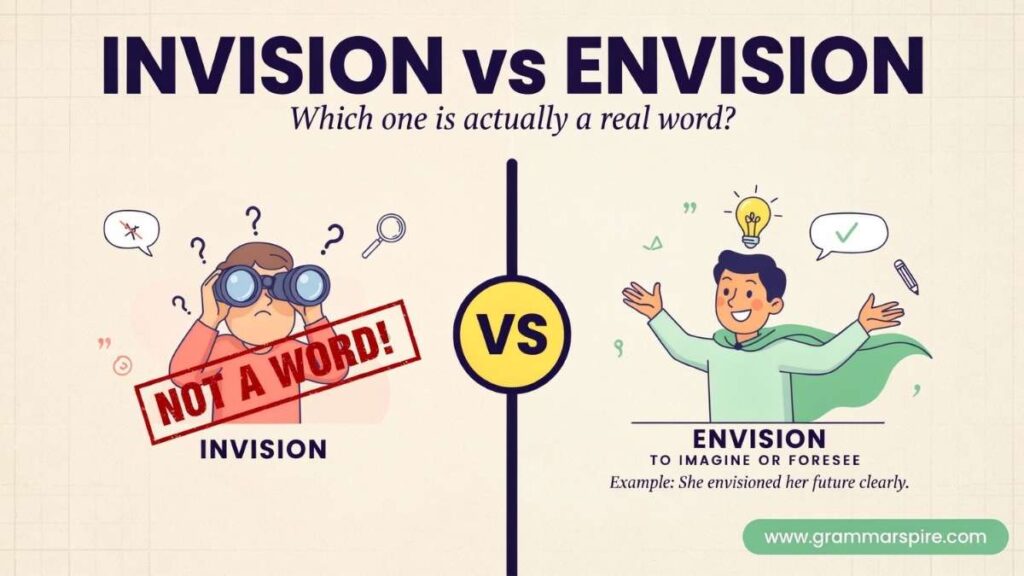
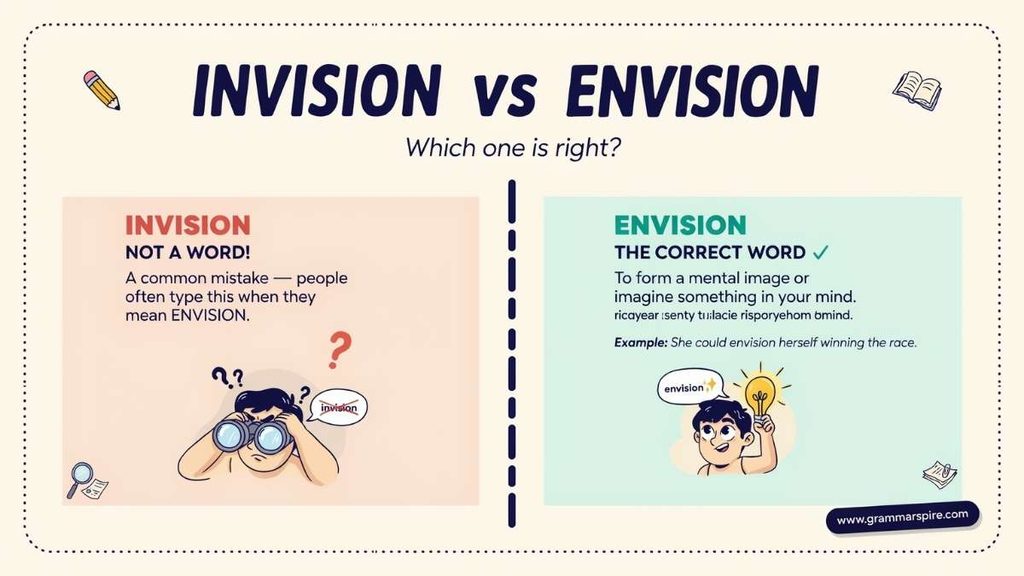
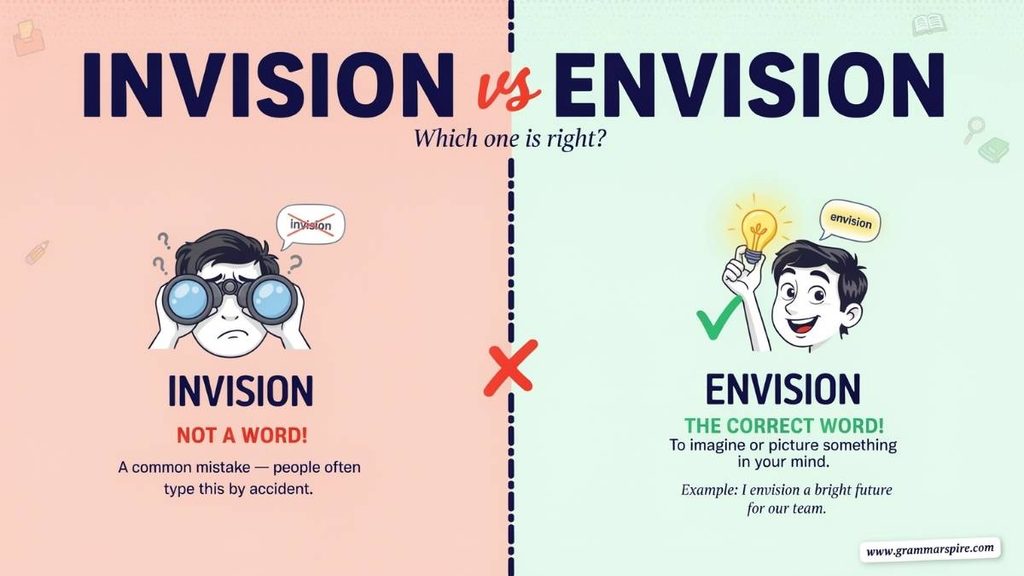
English spelling can turn an ordinary sentence into a grammar puzzle, and “invision vs envision” is a perfect example. One little letter can create confusion faster than a typo in a job application! So, which spelling is correct, and how can you avoid this common mistake? Envision is the standard spelling when you mean to imagine, visualize, or anticipate something. Invision is generally incorrect in everyday writing, although InVision has been used as a proper name. Fortunately, the difference is easy to remember. Let’s explore clear definitions, practical examples, and simple spelling tips to help you write with confidence.
| Feature | Envision | Invision |
|---|---|---|
| Standard spelling for the verb | Yes | No |
| Meaning | To imagine, visualize, or anticipate something | Usually a misspelling of envision in ordinary writing |
| Part of speech | Verb | Not the standard verb for this meaning |
| Example | I envision a brighter future. | I invision a brighter future. |
| Best use | Standard English writing | Only when referring to a specific name or title that uses this spelling |
Learn the difference between confusing more English words step by step
Set or Setted Which Is Correct?
Invision vs Envision Which Is Correct?
In both word Invision vs Envision The Envision is the standard English spelling when you mean to imagine something, picture a possible situation, or anticipate a future event. You can envision a successful career, a peaceful home, a new business, or a different way of living.
Invision, by contrast, is generally a spelling mistake when used as a substitute for envision. The two forms look similar, but standard English uses envision for this meaning.
For example:
Correct: We envision a future where everyone has access to quality education.
Incorrect: We invision a future where everyone has access to quality education.
The first sentence uses the accepted spelling. The second contains a common error.
This confusion often happens because English spelling does not always follow predictable patterns. You might expect the word to begin with the prefix in-, especially because words such as invisible and incredible are familiar. Nevertheless, the correct verb begins with en-.
Why Do People Confuse invision vs envision?
The confusion usually comes from pronunciation, typing habits, and assumptions about spelling. When people say envision aloud, the first syllable may not stand out clearly. As a result, some writers remember the sound but choose the wrong letters.
Another reason is that English includes many words with similar beginnings. Since in- appears in so many familiar words, invision may look reasonable at first glance.
Digital names can add another layer of confusion. InVision was the name of a digital product-design platform, so you may encounter that spelling in discussions about software or design history. However, a proper name does not make invision the standard spelling of the verb meaning to imagine.
The safest rule is simple: use envision when you want to express an idea, picture a possibility, or think about the future.
Learn the difference between confusing more English words step by step
Bred vs Breeded Which Is Correct?
What Does Envision Mean?
Envision means to imagine something, form a mental picture of it, or anticipate what it might be like. The word often appears when people discuss goals, plans, possibilities, and future outcomes.
For example, a student might envision graduating from college. An entrepreneur might envision opening a successful store. A family might envision moving into a larger home.
In each case, the person creates a mental picture of something that may happen in the future.
Envision Definition and Simple Meaning
The simplest envision definition is to imagine or picture something in your mind.
However, envision can mean more than simply seeing an image mentally. It often suggests thinking about a possibility that does not exist yet or considering how a situation could develop.
Consider these examples:
The architect envisions a modern building with natural lighting.
The coach envisions a team that works together and supports every player.
I envision spending more time with my family next year.
The company envisions expanding into new markets.
Each sentence describes a mental picture, plan, or expectation. The subject imagines a possible outcome rather than describing something that has already happened.
How to Use Envision in Everyday English
You can use envision in casual conversations, professional writing, academic discussions, and creative work. It fits particularly well when you want to discuss plans or possibilities.
For example, you might say, “I envision a relaxing weekend at the lake.” In a workplace conversation, you could say, “We envision a more efficient way to manage customer requests.”
The word also works when you discuss personal development. You might envision yourself learning a new skill, improving your health, or becoming more confident.
Although envision often refers to the future, it does not always require a specific date or deadline. You can envision a better classroom, a more welcoming community, or a different approach to solving a problem without knowing exactly when that change will happen.
Envision Synonyms
Several words can replace envision, depending on the meaning you want to express.
| Synonym | Meaning | Example |
|---|---|---|
| Imagine | Form an idea or mental picture | Imagine a world without traffic jams. |
| Visualize | Create a mental image | Visualize the finished design. |
| Picture | Imagine how something looks or might happen | Picture yourself crossing the finish line. |
| Foresee | Anticipate something that may happen | The manager foresees several challenges. |
| Anticipate | Expect or prepare for a future event | We anticipate a busy season. |
| Conceive | Form an idea or plan | She conceived a new approach to teaching. |
| Dream of | Imagine or hope for something desirable | He dreams of owning a bookstore. |
| Project | Estimate or imagine a future outcome | Analysts project steady growth. |
These synonyms are related, but they are not always interchangeable. Visualize emphasizes mental imagery, while foresee focuses more on anticipating events. Anticipate often suggests expecting something, and conceive can emphasize forming an idea.
Choose the word that expresses your intended meaning most accurately.
Learn the difference between confusing more English words step by step
Stinged or Stung Which Is Correct?
Is Invision a Word?
In ordinary writing, invision is not the standard spelling of the verb meaning to imagine or picture something. If you write “I invision a better future,” most readers will understand your meaning, but they may recognize the spelling as an error.
The correct sentence is “I envision a better future.”
However, it is important to distinguish a spelling mistake from a proper name. InVision was the name of a digital product-design and prototyping platform. You may see that name in articles, older software discussions, or professional portfolios.
Therefore, the answer depends on the context. If you are describing an imagined possibility, use envision. If you are accurately reproducing a specific name or title that uses InVision, preserve its official spelling.
What Does Invision Mean?
When people use invision in a sentence such as “She can invision her future,” they generally intend the meaning of envision. In standard English writing, however, you should correct the spelling to envision.
The distinction matters in school assignments, professional emails, website content, reports, and other formal documents. A reader might understand the intended meaning, but correct spelling makes your writing more credible and easier to read.
For example:
Incorrect: The designer can invision the final product before creating it.
Correct: The designer can envision the final product before creating it.
The corrected sentence communicates the same idea with the standard spelling.
Why Is Invision a Common Spelling Mistake?
Several habits can lead to this error.
First, writers sometimes rely on how a word sounds rather than how it is spelled. Second, they may type quickly and fail to notice the missing letter. Finally, familiar words beginning with in- can make the incorrect form look convincing.
Autocorrect may not catch every mistake, especially when a misspelled form resembles a proper name. For that reason, proofreading remains useful even when you use spelling tools.
If you are unsure, look at the meaning of the sentence. When you mean imagine, visualize, or anticipate, envision is the spelling to choose.
Learn the difference between confusing more English words step by step
Bought or Brought which one Is correct?
Envision in a Sentence Correct Usage Examples
Examples make the difference between invision vs envision easier to understand. Rather than memorizing a rule alone, look at how the correct spelling works in different situations.
Everyday Examples
I envision a quiet house surrounded by trees.
She envisions a future filled with travel and adventure.
We envision spending the holidays with our relatives.
He envisions a garden full of flowers and fresh vegetables.
They envision a neighborhood where children can play safely.
These sentences use envision to describe hopes, plans, or mental pictures. Each person imagines a possible situation.
Professional and Academic Examples
The research team envisions a more affordable treatment.
Our company envisions expanding its services next year.
The teacher envisions a classroom where every student feels comfortable asking questions.
The architect envisions a building that uses less energy.
The organization envisions a community with better access to public transportation.
In professional settings, envision often communicates a goal or long-term plan. It can sound more deliberate than imagine because it suggests that someone is considering what a future outcome could look like.
Incorrect vs Correct Examples
| Incorrect sentence | Correct sentence |
|---|---|
| I invision a successful career. | I envision a successful career. |
| She invisions a peaceful world. | She envisions a peaceful world. |
| They invisioned a new community center. | They envisioned a new community center. |
| We are invisioning a different future. | We are envisioning a different future. |
| He cannot invision the final result. | He cannot envision the final result. |
In words Invision vs Envision that correcting the spelling does not require changing the intended meaning. You simply replace the incorrect form with the appropriate form of envision.
A Short Story to Make the Meaning Clear
Maya worked at a small bakery, where she spent her mornings preparing bread and serving customers. Although she enjoyed her job, she had a bigger goal. She envisioned opening a bakery of her own.
At first, the idea seemed distant. However, Maya began saving money, studying business management, and experimenting with new recipes. Over time, her vision became a practical plan.
Eventually, she opened a small shop in her neighborhood.
Maya did not merely imagine a bakery. She envisioned a possibility and took steps to make it real. This example shows how envision often connects imagination with planning and future goals.
Learn the difference between confusing more English words step by step
Bleeded or Bled Which Is Correct?
Envision Verb Forms Present Tense, Past Tense, and More
In both word invasion vs envision. Envision is a regular verb. That means you can form its past tense and past participle by adding -ed to the base form.
Once you know the basic pattern, using the word in different tenses becomes straightforward.
Envision Verb Forms
| Verb form | Correct spelling | Example |
|---|---|---|
| Base form | Envision | I envision a better solution. |
| Third-person singular | Envisions | She envisions a new beginning. |
| Present participle | Envisioning | They are envisioning a larger project. |
| Simple past tense | Envisioned | We envisioned a different outcome. |
| Past participle | Envisioned | The team has envisioned several options. |
What Is the Past Tense of Envision?
The past tense of envision is envisioned.
Use envisioned when describing something that someone imagined or planned in the past.
For example:
She envisioned a career in medicine when she was young.
The founders envisioned a company that would serve small businesses.
I envisioned a quiet evening, but my neighbors had other plans.
The last example adds a little humor while showing that envisioned can describe an expectation that did not match what actually happened.
Envisioning or Envisioned?
Use envisioning when the action is ongoing or when the word functions as a present participle. Use envisioned for the simple past tense and the past participle.
For example:
We are envisioning a new layout for the office.
The team envisioned a new layout last month.
They have envisioned several improvements.
The first sentence describes an action in progress. The second places the action in the past. The third uses the past participle with have.
Learn the difference between confusing more English words step by step
Brung vs Brought Which Is Correct?
Envision Pronunciation How Do You Say It?
It is commonly pronounced en-VIZH-un. The stress falls on the second syllable, which sounds like “vizh.”
Breaking the word into syllables can make it easier to remember:
En-VIZH-un
The pronunciation may help explain why some people misspell the word. When speaking quickly, you might focus on the sound and overlook the initial letters. Still, the standard written form remains envision.
How to Spell Envision Correctly
Use this simple spelling reminder:
Start with en, add vision, and form envision.
You can also connect the word with vision. Both words relate to seeing, whether you mean seeing with your eyes or forming a picture in your mind.
For example, if you envision a new home, you create a mental picture of the place you hope to live in. The word vision can help you remember the spelling of envision.
Learn the difference between confusing more English words step by step
Goodnight or Good Night Which Is Correct?
Envision vs Imagine What Is the Difference?
Envision and imagine share similar meanings, but they do not always carry exactly the same emphasis.
Imagine is a broad, flexible word. You can imagine a fictional character, a surprising event, a different color for your room, or a world with no homework.
Envision often focuses on a particular possibility, plan, or future outcome. It can suggest that you are considering what something could become.
Comparison of Envision and Imagine
| Feature | Envision | Imagine |
|---|---|---|
| Main meaning | Form a mental picture of a possibility | Form a mental image or idea |
| Common focus | Plans, goals, and future outcomes | Ideas, situations, and possibilities of many kinds |
| Typical tone | Often purposeful or forward-looking | Broad and conversational |
| Example | We envision a successful launch. | Imagine launching a business tomorrow. |
| Can refer to the future? | Yes, very commonly | Yes, but not exclusively |
Consider a person who wants to start a restaurant. They might imagine a restaurant with colorful walls, friendly staff, and a menu full of creative dishes. They might envision opening that restaurant in two years after saving money and finding a suitable location.
Both words work, but envision emphasizes the future plan more clearly.
Even so, the distinction is not absolute. People sometimes use envision and imagine in similar ways. The best choice depends on the tone and meaning of your sentence.
Learn the difference between confusing more English words step by step
Principal vs Principle which one is correct?
Envisage or Envision Which Word Should You Use?
Envisage and envision are close in meaning. Both can describe imagining or anticipating a possible future.
For example:
We envision a more efficient transportation system.
We envisage a more efficient transportation system.
Both sentences are understandable and grammatically correct. The choice often depends on regional preference and writing style. Envision is especially common in American English, while envisage is more common in British English.
Since Grammar Spire follows US English, envision is usually the more natural choice for your American audience.
However, you do not need to treat envisage as incorrect. It is a legitimate word with a meaning similar to envision.
Common Mistakes When Using invision vs envision
A small spelling error can change how polished a sentence appears. Fortunately, the most common mistakes are easy to correct once you recognize them.
Using Invision Instead of Envision
This is the central mistake. If you mean imagine or anticipate, write envision.
Incorrect: The students invisioned their graduation day.
Correct: The students envisioned their graduation day.
The corrected form follows the standard spelling and keeps the original meaning.
Misspelling Envision in Different Tenses
Some writers correct the base form but accidentally repeat the error in related forms. Remember that the standard forms follow the same spelling pattern.
Correct forms include envisions, envisioning, and envisioned.
For example:
1.She envisions a successful project.
2.She is envisioning a successful project.
3.She envisioned a successful project.
The spelling changes slightly to fit the tense, but the word always begins with en-.
Confusing Envision With a Software Name
You may encounter InVision in older discussions of design software. In that context, the capital letters are part of a proper name. Do not confuse that usage with the ordinary verb envision.
The distinction is similar to the difference between a brand name and a common word. A name can use a spelling that you would not choose in a normal sentence.
Assuming Envision Always Means Predict
Envision can involve thinking about the future, but it does not necessarily mean predicting what will happen.
For example, “I envision a peaceful weekend” describes a mental picture or hope. It does not guarantee that the weekend will actually be peaceful.
When you need to communicate a strong expectation about a future event, anticipate or foresee may fit better. When you want to describe a possibility you can picture, envision is often the better choice.
Learn the difference between confusing more English words step by step
Requester or Requestor Which Spelling Is Correct?
Tips to Remember the Difference
You do not need to memorize a complicated spelling rule to get this right. A few simple reminders can help.
Connect Envision With Vision
The word envision contains vision, which relates to seeing. When you envision something, you picture it mentally.
Think of the phrase “a vision of the future.” This connection can remind you to begin envision with en- rather than in-.
Remember the Meaning
Ask yourself what you want to say. Are you describing something you imagine, picture, or anticipate? If so, envision is the standard choice.
This meaning-based check is especially useful when you are writing quickly.
Read the Sentence Aloud
Reading your sentence aloud may help you notice awkward wording, but pronunciation alone will not always reveal a spelling error. Envision and invision look different on the page even though readers may understand the intended meaning.
For that reason, combine reading aloud with a quick spelling check.
Proofread Important Writing
Before submitting an assignment, publishing a blog post, or sending a professional email, check words that look or sound similar. A spell checking tool can help, but do not rely on it completely.
If the spelling seems uncertain, confirm the standard form before publishing.
Practice Session Invision vs Envision
Ready to test your understanding of envision and invision? Complete the sentences below by filling in each blank with the correct form of envision. Pay attention to the meaning of each sentence and the verb tense. Remember, envision is the standard spelling when you mean to imagine, visualize, or anticipate something. After completing all 30 questions, check your answers at the end to see how well you have mastered the correct spelling and usage.
Fill in the Blanks Invision vs Envision
- I ______ a bright future filled with exciting opportunities.
- She ______ herself becoming a successful doctor.
- The team ______ a better solution to the problem.
- Can you ______ what your life might look like in ten years?
- They ______ a peaceful community where everyone supports one another.
- He ______ opening his own restaurant someday.
- We have ______ several ways to improve our website.
- The architect is ______ a modern home with large windows.
- My parents always ______ a brighter future for their children.
- She ______ a career in education when she was younger.
- The company ______ expanding into international markets.
- I cannot ______ how beautiful the garden will look in spring.
- The students ______ their graduation day with excitement.
- Our teacher asked us to ______ a world without pollution.
- He is ______ new possibilities for his business.
- The founders ______ a company that would help small businesses.
- She ______ herself living near the ocean.
- We are ______ a more efficient way to complete the project.
- The designer ______ the finished product before creating it.
- You should ______ your goals before developing a plan.
- The coach ______ a team that plays with confidence and determination.
- They have ______ a future powered by cleaner energy.
- Can you ______ yourself working in your dream profession?
- The writer ______ a fictional world filled with mystery and adventure.
- I ______ a relaxing weekend, but unexpected guests arrived.
- The organization ______ a community where every child has access to education.
- She is ______ how the new website design will look.
- The correct spelling is ______, not invision.
- When I was a child, I ______ becoming an astronaut.
- A good leader can ______ possibilities that others might overlook.
Answer Key
- envision
- envisions
- envisioned
- envision
- envision
- envisions
- envisioned
- envisioning
- envision
- envisioned
- envisions
- envision
- envisioned
- envision
- envisioning
- envisioned
- envisions
- envisioning
- envisioned
- envision
- envisions
- envisioned
- envision
- envisions
- envisioned
- envisions
- envisioning
- envision
- envisioned
- envision
Learn the difference between confusing more English words step by step
Too Many or To Many Which Is Correct?
FAQs About Invision vs Envision
1.What is the difference between invision and envision?
Envision is the correct spelling when you mean to imagine, visualize, or anticipate something. Invision is generally a misspelling in standard English, although InVision has been used as a proper name.
2.What does it mean to envision something?
To envision something means to form a mental picture of it or imagine a possible outcome. For example, you might envision starting your own business or moving into a new home.
3. What does envision mean?
Envision means to imagine, picture, or anticipate something that may happen or exist. It often describes plans, goals, and future possibilities.
4. What does envision it mean?
Envision it means to picture something in your mind. For instance, if someone asks you to envision a peaceful garden, they want you to imagine its appearance and atmosphere.
5. Is the word envision or invision?
Envision is the standard spelling of the verb meaning to imagine or anticipate. Use it in essays, emails, blog posts, and professional documents.
6. What is a better word for envision?
Depending on the context, you can use imagine, visualize, picture, foresee, anticipate, or conceive. Visualize emphasizes forming a mental image, while foresee focuses on predicting or anticipating a possible event.
7. What is a good sentence for envision?
“I envision a future where everyone has equal opportunities.”
This sentence uses envision to describe a desired future possibility.
8. Which is correct I envisage or I envision?
Both expressions are correct. Envision is more common in American English, while envisage is more common in British English. For US English writing, envision is usually the preferred choice.
9. What do you invision?
If you want to ask someone what they imagine or picture in their mind, write, “What do you envision?” This question can refer to a person’s goals, plans, hopes, or expectations.
10. What does it mean to envision someone?
To envision someone means to imagine that person in a particular situation, role, or future. For example, “I envision her becoming a successful teacher” means you can picture her succeeding in that profession.
11. How do you say envision?
Envision is commonly pronounced en-VIZH-un, with the strongest emphasis on the second syllable. Saying the word slowly can help you recognize its pronunciation and remember its spelling.
12. What is the meaning of envisioned in one word?
Imagined. Depending on the context, envisioned can also mean pictured or anticipated.
13. What is the noun form of envision?
Vision is a related noun, while envisioning can function as a gerund. Vision refers to an image, idea, or sense of future direction. Envisioning describes the act of imagining something.
14. What is the adjective form of envision?
Envision does not have one standard adjective form that fits every context. Visionary describes someone with original ideas or a clear sense of future possibilities, while imagined describes something formed in the mind.
15. What is the difference between imagine and envision?
Imagine is a broad term for forming a mental picture or idea. Envision often emphasizes a possible future, goal, or planned outcome. For example, you might imagine a beautiful house but envision building one for your family.
AEO Quick Answers About Invision vs Envision
What is the correct spelling invision vs envision?
Envision is the correct spelling when referring to imagining, visualizing, or anticipating something. Invision is generally a spelling error in this context.
What does envision mean in simple English?
Envision means to picture something in your mind, especially a possibility, plan, or future outcome.
Is envision a verb?
Yes. Envision is a verb that means to imagine or anticipate something. Its main forms are envision, envisions, envisioning, and envisioned.
What is the past tense of envision?
The past tense of envision is envisioned. For example, “She envisioned a successful career in medicine.”
Can envision and envisage be used interchangeably?
Yes. Both words can mean to imagine or anticipate a possibility. Envision is more common in American English, whereas envisage appears more frequently in British English.
What is the difference between envision and visualize?
Envision often refers to imagining a possibility, plan, or future goal. Visualize focuses more specifically on creating a mental image, although the meanings overlap.
Is envisioned the same as imagined?
The words can have similar meanings. Envisioned often suggests picturing a possibility or outcome, while imagined can refer to a wider range of mental images, ideas, and situations.
What are the most common synonyms for envision?
Common synonyms include imagine, visualize, picture, foresee, anticipate, and conceive. The best alternative depends on the intended meaning and sentence.
How can you remember the spelling of envision?
Connect envision with vision. Both words relate to seeing or forming a mental picture. Remember that the standard verb begins with en-, not in-.
Can envision refer to a future goal?
Yes. Envision frequently describes ambitions, plans, and future possibilities. For example, “The founders envision expanding their business across the country.”
Is envision formal or informal?
Envision works in both formal and informal English. You can use it in everyday conversations, academic assignments, business discussions, and professional writing.
Conclusion
Choosing between invision vs envision no longer needs to be a grammar puzzle! Envision is the correct spelling when you mean to imagine a possibility, picture a goal, or anticipate the future. Invision is generally a spelling mistake in everyday writing, so let that extra letter go before it causes trouble. To remember the correct form, connect envision with vision, which relates to seeing or forming a mental picture. Whether you envision a successful career, a dream vacation, or a brighter future, keep your spelling as clear as your goals. After all, your readers should admire your ideas, not get lost in a spelling mystery!

Ella AJS
Ella AJS is an experienced blogger and language enthusiast at Grammar Spire, dedicated to making English grammar simple, practical, and easy to understand. She specializes in word comparisons, meanings, usage, and common language confusions. Through clear explanations and engaging examples, Ella helps students, writers, and English learners improve their vocabulary and communicate with greater confidence and accuracy.