
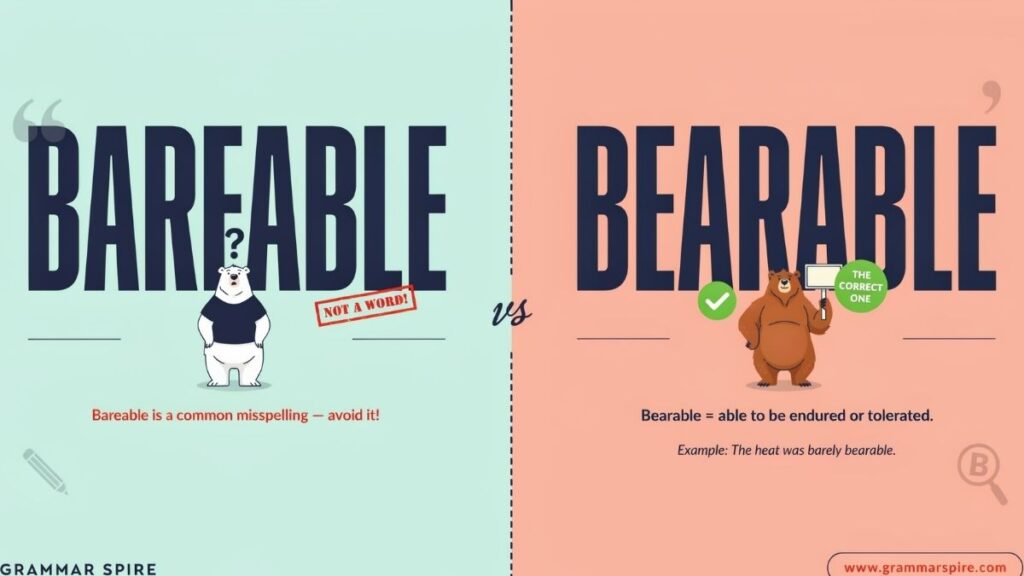
English spelling can turn a simple word into a surprisingly tricky puzzle. The confusion between bearable or bareable is a common example. These two spellings may look almost identical, but only one is correct in standard English. Bearable comes from the verb bear, which means to tolerate, endure, or handle something difficult. Bareable, on the other hand, results from confusing bear with bare, a word that means uncovered or exposed. In this guide, you’ll learn which spelling is correct, understand why the mistake occurs, and see how to use bearable naturally in sentences. You’ll also explore related words and practical examples.
Bareable or Bearable The Quick Answer
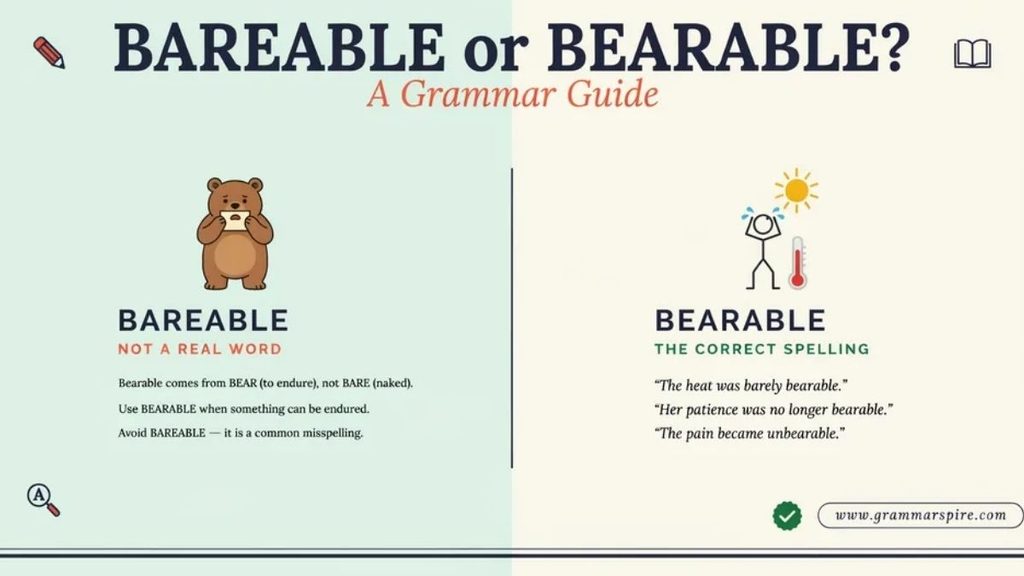
If you’re asking, “Is it bareable or bearable?” choose bearable.
The word bearable describes something that you can tolerate or endure. It may remain unpleasant, painful, tiring, or frustrating, but it does not exceed your ability to handle it.
For example:
The pain was bearable after I rested.
This sentence means that the pain continued, but the speaker could tolerate it.
The spelling bareable does not normally express this meaning in standard English. Writers should use bearable in school assignments, professional communication, academic work, articles, and everyday writing.
Learn the difference between everyday English mistakes
Happened Vs Happend Which Spelling Is Correct?
Bearable or Bareable A Clear Comparison
| Word | Correct for this meaning? | Meaning | Example |
|---|---|---|---|
| Bearable | Yes | Able to be tolerated or endured | The heat became bearable after sunset. |
| Bareable | No, when used to mean tolerable | Usually a spelling mistake | Use bearable instead. |
| Bare | Yes, but it has a different meaning | Uncovered, empty, or basic | The room had bare walls. |
| Barely | Yes, but it has a different meaning | Only just or almost not | I could barely hear her. |
The difference becomes easier when you connect each word with its meaning. Bearable relates to endurance. Bare relates to exposure or emptiness. Barely describes a very small degree.
What Does Bearable Mean?
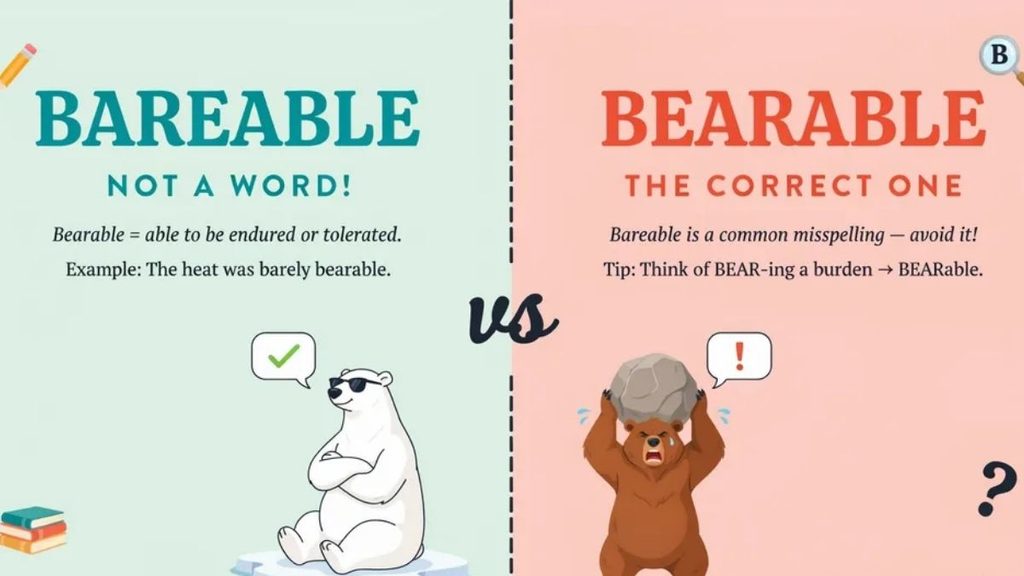
The word bearable means “able to be endured, tolerated, or managed.” It describes something that causes discomfort or difficulty but remains possible to handle.
A bearable experience may not feel pleasant. In fact, it may test your patience. However, you can still cope with it.
For example, a long meeting may feel boring, but you can remain in the room until it ends. The meeting is bearable. A hot afternoon may feel uncomfortable, but you can manage it with shade and water. The weather is bearable.
Consider these examples:
The noise became bearable after the workers lowered the volume.
The long journey was bearable because we stopped for regular breaks.
Her workload is bearable because she plans each day carefully.
The cold weather was bearable with a warm coat.
The criticism was bearable because it sounded fair and helpful.
In each example, the situation creates some difficulty. Still, the person can tolerate it.
Bearable Meaning in Simple English
In simple language, bearable means something is difficult but manageable. You may not enjoy it, but you can get through it.
The word can describe a physical experience, an emotional situation, a responsibility, or an unpleasant condition.
For example, a headache may become bearable after someone rests. A crowded bus may feel bearable when the journey lasts only a few minutes. A stressful project may seem more bearable when a team divides the work.
The word does not mean “excellent” or “comfortable.” If someone says, “The movie was bearable,” they probably mean that the movie was acceptable but not especially enjoyable. The speaker survived the experience without demanding a refund and a formal apology from the universe.
Learn the difference between everyday English mistakes
Excel vs Accel Which Spelling is correct?
Is Bearable a Word?
Yes, bearable is a standard English word. Dictionaries recognize it as an adjective that describes something a person can tolerate or endure.
You can use bearable in formal and informal situations. The word fits naturally into academic essays, professional emails, reports, conversations, text messages, and social media posts.
For example:
The revised schedule makes the workload more bearable.
The temperature feels bearable today.
His behavior became more bearable after he calmed down.
The waiting period was bearable because we had comfortable seats.
The word works in many contexts because people regularly discuss experiences that challenge their patience, comfort, or strength.
Is Bareable a Word?
If you’re asking, “Is bareable a word?” the answer depends on what you mean. Writers sometimes use bareable online, but they usually intend to write bearable.
In standard English, bareable does not normally serve as the correct spelling for “able to be tolerated.” A word can appear in online posts, comments, or informal messages without becoming an accepted spelling.
The confusion comes from the similar words bear and bare. Writers may assume that bareable comes from bare. However, the correct word connects with bear, which can mean “to endure.”
When you want to describe something tolerable, write bearable.
Bareable Meaning Why the Confusion Happens
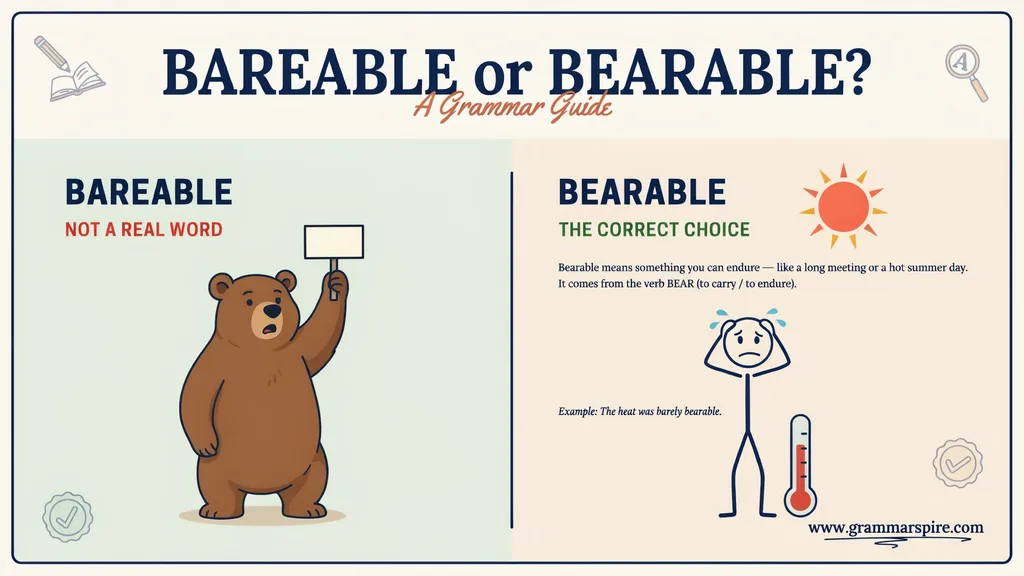
People who search for the bareable meaning usually want to understand bearable. They may have seen the incorrect spelling and wondered whether it carries a separate definition.
The intended meaning often involves something a person can tolerate, endure, withstand, handle, or manage. For example, someone may search for “bareable pain meaning” because they want to describe pain that remains manageable.
The correct phrase is bearable pain.
The spelling becomes clearer when you remember that the verb bear can mean “to tolerate.”
I can’t bear this noise.
This sentence means:
I can’t tolerate this noise.
Now change the verb into an adjective:
The noise is bearable.
The sentence means that the noise remains unpleasant, but you can tolerate it.
Learn the difference between everyday English mistakes
Bellies vs Bellys Which one Is Correct?
Why Is Bearable Spelled With Bear?
The word bearable comes from the verb bear. One meaning of bear involves carrying, supporting, tolerating, or enduring something.
The verb has several meanings. A person can bear a burden, bear responsibility, bear pain, or bear difficult news. In each case, the word suggests that someone carries or endures something.
The adjective bearable uses the meaning connected with endurance.
The word formation looks like this:
bear + able = bearable
The suffix -able often means “capable of” or “fit for.” Therefore, bearable describes something that a person can bear.
The word does not come from bare. That distinction matters because bare has a completely different meaning.
Bear and Bare Understanding the Difference
The words bear and bare sound similar, but they do different jobs in English.
Bear
As a verb, bear can mean “to tolerate,” “to carry,” or “to endure.”
For example:
I can’t bear the smell.
She bore the pain quietly.
They have borne the pressure for months.
He can’t bear unfair treatment.
As a noun, bear also refers to a large animal.
We saw a bear in the wildlife park.
Bare
The word bare means uncovered, exposed, empty, or basic.
For example:
The tree had bare branches.
The room contained only bare walls.
He walked across the bare floor.
The cupboard held bare shelves.
The difference between the two roots explains the spelling of bearable.
| Word | Meaning | Example |
|---|---|---|
| Bear | Tolerate, carry, or endure | I can’t bear the pain. |
| Bare | Uncovered or empty | The room had bare walls. |
| Bearable | Able to be tolerated | The pain was bearable. |
| Bareable | Usually an incorrect spelling | Use bearable instead. |
How to Spell Bearable
If you want to know how to spell bearable, start with the root word bear. Then add the suffix -able.
The correct form is:
bear + able = bearable
The word contains the letters b-e-a-r before the ending. Do not replace bear with bare.
Several other English words follow a similar pattern:
| Root word | Suffix | New word |
|---|---|---|
| Read | -able | Readable |
| Wash | -able | Washable |
| Enjoy | -able | Enjoyable |
| Depend | -able | Dependable |
| Bear | -able | Bearable |
A useful memory sentence can help:
If you can bear it, it is bearable.
You can also remember the difference through two short phrases: bear the pain and bare walls. The first phrase connects bear with endurance. The second connects bare with emptiness.
Learn the difference between everyday English mistakes
Buoy or Bouy Which Spelling Is Correct?
Bearable Grammar What Part of Speech Is It?
Bearable is an adjective. An adjective describes a person, place, thing, condition, or experience.
You can place bearable before a noun:
The patient experienced a bearable level of discomfort.
We worked through a bearable amount of stress.
The noise became bearable.
The word can also take comparative and superlative forms. Use more bearable when you compare two experiences. Use most bearable when you compare several experiences.
The second day was more bearable than the first.
This room has the most bearable temperature.
The delay became less bearable after midnight.
These forms help you describe changes in comfort or difficulty.
Learn the difference between everyday English mistakes
Opening or Openning Which one is correct?
Bearable Pronunciation
The usual bearable pronunciation sounds like BAIR-uh-bul. The word contains three syllables, and the first syllable carries the main stress.
The first part sounds like the word bear. The final two syllables sound lighter and move quickly in ordinary speech.
When practicing how to pronounce bearable, say the first syllable clearly. Then allow the ending to flow naturally.
For example:
The pain is bearable.
The heat is bearable.
The situation is bearable.
The spelling remains the same in American and British English, although speakers may produce slight differences in vowel sounds because of regional accents.
Bearable Pain Meaning
The phrase bearable pain describes pain that a person can tolerate or manage. It does not necessarily mean that the pain feels mild or harmless.
Pain can remain serious, uncomfortable, or distracting while still feeling bearable to the person experiencing it. The word describes the person’s ability to tolerate the pain rather than assigning the pain a fixed level.
For example:
The headache became bearable after she rested.
He described the pain as bearable but unpleasant.
The injury caused bearable discomfort at first.
The phrase works in everyday conversations, personal descriptions, and professional discussions. However, people should not treat the word bearable as a medical measurement. It simply expresses how manageable the discomfort feels to someone.
What Does Emotionally Bearable Mean?
The phrase emotionally bearable describes an experience that a person can handle without feeling completely overwhelmed.
People may use it when discussing sadness, disappointment, grief, fear, conflict, loneliness, or stress. The experience may still hurt, but the person can cope with it.
For example:
Talking with a trusted friend made the situation more emotionally bearable.
The disappointment was emotionally bearable because she had prepared for it.
Taking a short break made the stressful day more bearable.
The phrase does not suggest that the experience feels pleasant. It means that the emotional difficulty remains manageable.
What Does Barely Bearable Mean?
The phrase barely bearable means “just tolerable” or “almost impossible to tolerate.” It describes something that reaches the limit of a person’s patience, comfort, or endurance.
Compare these three sentences:
The heat was bearable.
The heat felt uncomfortable, but the person could manage it.
The heat was barely bearable.
Bearable vs Unbearable
The most direct opposite of bearable is unbearable.
Something bearable remains possible to tolerate. Something unbearable becomes too difficult to tolerate.
For example:
The noise was bearable.
The noise became unbearable.
The workload is bearable.
The workload became unbearable.
The prefix un- changes the meaning to its opposite.
| Word | Meaning | Example |
|---|---|---|
| Bearable | Difficult but manageable | The journey was bearable. |
| Unbearable | Too difficult to tolerate | The journey became unbearable. |
Other opposites include intolerable, unendurable, insufferable, overwhelming, and impossible to endure.
Learn the difference between everyday English mistakes
Many or Meny Which Spelling Is Correct?
Bearable in a Sentence Everyday Examples
The word bearable fits many everyday situations. You can use it to describe weather, noise, pain, delays, responsibilities, and personal experiences.
The weather is bearable today.
The wait became bearable after we found a place to sit.
The noise is bearable with the windows closed.
These sentences show that bearable describes something manageable rather than something perfect.
Bearable in Professional Writing
Professional writers often use bearable when they discuss working conditions, deadlines, responsibilities, costs, or difficult processes.
For example:
The company introduced changes that made the working conditions more bearable.
The new policy created a more bearable process for employees.
The word sounds natural in professional writing because it expresses a realistic level of difficulty. It does not exaggerate the situation by calling everything easy or unbearable.
Bearable in Academic Writing
Academic writers can use bearable when they discuss hardship, emotional responses, social conditions, or human behavior.
For example:
The author explains how community support makes hardship more bearable.
The study examines the conditions that make stressful experiences more bearable.
The difficult reading became more bearable after the teacher explained the central ideas.
In academic writing, the word can help describe how people respond to challenging circumstances. Writers should still choose a more precise term when the subject requires technical language.
Bearable Synonyms
The best synonym depends on the situation. Common bearable synonyms include tolerable, manageable, endurable, acceptable, survivable, supportable, sufferable, livable, and reasonable.
The word tolerable works well when something remains acceptable despite causing discomfort.
The noise was tolerable for a short time.
Use manageable when someone can handle a task, responsibility, or problem.
The workload became manageable after the team shared it.
Bearable and Tolerable Are They the Same?
Bearable and tolerable often share the same meaning. Both words describe something that a person can endure.
However, bearable often sounds more personal and conversational. Tolerable may sound more formal or objective.
Compare these sentences:
The pain was bearable.
The pain was tolerable.
Both sentences explain that the person could endure the pain. The first sounds slightly more natural in everyday conversation.
The same difference appears in other examples:
The noise was bearable.
The noise was tolerable.
Both sentences work. The best choice depends on the tone and context.
Common Mistakes With Bearable
The most common mistake involves writing bareable instead of bearable.
Incorrect:
The pain was bareable.
Correct:
The pain was bearable.
Another mistake involves confusing bearable with bare.
Incorrect:
The room was bearable because it had no furniture.
Correct:
The room was bare because it had no furniture.
The word bare describes the room’s empty condition. The word bearable describes whether someone can tolerate the room or its conditions.
Writers also confuse bearable with barely.
Incorrect:
Use barely when you mean “only just.”
I could barely stay awake.
Use bearable when you mean “possible to tolerate.”
The lecture was bearable.
Finally, remember that bearable does not mean “excellent.” If a person describes a movie, meal, or event as bearable, they may feel only mildly satisfied. The experience did not become a disaster, but it probably did not deserve a standing ovation either.
British English and American English Spelling

Both British English and American English use bearable as the correct spelling.
The spelling does not change between the two varieties. Canadian English and Australian English also use bearable.
| Variety of English | Correct spelling |
|---|---|
| American English | Bearable |
| British English | Bearable |
| Canadian English | Bearable |
| Australian English | Bearable |
Speakers may pronounce the word slightly differently because of regional accents. However, the spelling remains the same.
Is Bareable Incorrect Spelling?
Yes, bareable is an incorrect spelling when you intend to describe something tolerable.
The mistake usually comes from confusing bear, which can mean “to endure,” with bare, which means “uncovered” or “empty.”
The correct word formation uses bear:
bear + able = bearable
It does not use bare:
bare + able = bareable
The second form does not express the intended meaning in standard English. Writers should choose bearable whenever they describe something that a person can tolerate.
Learn the difference between everyday English mistakes
How to Remember the Correct Spelling
The easiest memory trick connects the adjective with its root verb.
If you can bear something, it is bearable.
You can also remember two contrasting phrases:
Bear the pain.
Bare walls.
The first phrase connects bear with endurance. The second connects bare with emptiness.
Another useful method involves the opposite word unbearable. Most readers recognize unbearable as the opposite of tolerable. Remove un-, and you get bearable.
Unbearable → Bearable
This connection can help you remember the spelling whenever you hesitate.
Here’s a trusted source for clear more words Comparison:
Grammar Update
Practice Session Bearable or Bareable
This practice session will help you understand the difference between bear, bare, bearable, and unbearable. Read each sentence carefully before choosing an answer.
Fill in the Blanks
Complete each sentence with bear, bare, bearable, or unbearable.
- The pain was difficult to tolerate, but it remained __________.
- She could not __________ the pressure of the final examination.
- The room looked empty because it had __________ walls.
- The long wait became more __________ after we found comfortable seats.
- I cannot __________ the sound of someone scratching a chalkboard.
- The heat inside the car was completely __________.
- The hikers walked across the __________ ground.
- He had to __________ the consequences of his decision.
- The noise became __________ after the machine continued running all night.
- The medicine made the pain more __________.
- The house had __________ floors and unfinished walls.
- She learned to __________ criticism without becoming angry.
- The difficult situation felt more __________ after her friend offered help.
- The strong smell was __________, so we opened the windows.
- The teacher asked the students to __________ the heavy boxes carefully.
Answer Key
Fill in the Blanks
- Bearable
- Bear
- Bare
- Bearable
- Bear
- Unbearable
- Bare
- Bear
- Unbearable
- Bearable
- Bare
- Bear
- Bearable
- Unbearable
- Bear
FAQs about bareable or bearable
What does bearable mean?
Bearable means something feels difficult, unpleasant, or painful but remains possible to tolerate. For example, a long wait becomes bearable when you have something interesting to read.
How do you spell bear as in “I cannot bear it”?
The correct spelling is bear. In this expression, bear means to tolerate, endure, or put up with something. For example, “I cannot bear the noise.”
What is another word for bearable?
You can replace bearable with tolerable, manageable, endurable, acceptable, or sufferable, depending on the sentence.
Is it bare or bear the pain?
The correct expression is bear the pain. The verb bear means to endure or tolerate discomfort. Bare means uncovered or empty, so it doesn’t fit this context.
Is it bearable or bareable?
Bearable is the correct spelling. Bareable is a common misspelling that doesn’t belong in standard English. The word comes from bear, meaning to tolerate, followed by the suffix -able.
What is barrable?
Barrable is not a common standard English word. Writers may use it mistakenly when they mean bearable. In legal or technical contexts, barrable can occasionally appear as a specialized term, but ordinary writing usually requires bearable.
What is another way to say “more bearable”?
You can say more tolerable, easier to handle, less difficult, more manageable, or easier to endure. The best choice depends on the situation.
What are five good synonyms for bearable?
Five useful synonyms include tolerable, manageable, endurable, acceptable, and sufferable. Tolerable works well for discomfort, while manageable often describes a task, problem, or situation.
How do you use bearable in a sentence?
You can use bearable to describe something unpleasant that you can still tolerate. For example, “The heat became bearable after the sun went down.”
What does the phrase “more bearable” mean?
More bearable means easier to tolerate than before. For example, “The medicine made the pain more bearable” means the pain became easier to endure.
What does wibbling mean?
Wibbling is an informal British expression that can describe speaking or behaving in a confused, nervous, or slightly silly way. It may also refer to making small, unsteady movements. The meaning depends on the context.
What does “airable” mean?
Airable describes something that can receive fresh air or something suitable for airing. For example, an airable room allows fresh air to circulate. The word may also appear in discussions about airing opinions, complaints, or information.
AEO Quick Answer Section
Is bearable the correct spelling?
Yes. Bearable is the correct spelling. Bareable is a misspelling.
What does bearable mean in simple English?
Bearable means difficult or unpleasant but still possible to tolerate.
Which word means to tolerate pain?
Bear is the correct verb for tolerating pain. You can say, “She can bear the pain.”
What is the difference between bear and bare?
Bear can mean to tolerate, carry, or support something. Bare means uncovered, exposed, or lacking something. For example, “I cannot bear the pain” is correct, while “The floor was bare” describes an uncovered floor.
What is the opposite of bearable?
The opposite of bearable is unbearable. Unbearable describes something too painful, difficult, or unpleasant to tolerate.
Why do people spell bearable as bareable?
People often write bareable because bear and bare sound alike in many English accents. However, bearable comes from bear, not bare, so it keeps the letter combination bear.
How can you remember the spelling of bearable?
Remember that bearable comes from bear. If you can bear something, you can describe it as bearable. The spelling follows the root word: bear + able = bearable.
Can bearable describe emotions?
Yes. Bearable can describe emotional experiences as well as physical discomfort. For example, “Talking to a friend made the sadness more bearable.”
Can bearable describe a person?
Bearable can describe someone’s company or behavior when that person remains tolerable. For example, “His jokes were finally bearable after he stopped shouting.”
Is bearable formal or informal?
Bearable works in both everyday and formal writing. It fits conversations, essays, reports, and professional communication when you need to describe something tolerable.
What is the pronunciation of bearable?
Bearable usually sounds like “BAIR-uh-bul.” The first syllable sounds like bear.
Can bearable describe a situation?
Yes. You can use bearable for weather, waiting periods, workloads, expenses, noise, pain, and other challenging situations. For example, “The workload became bearable after the team received help.”
What does unbearable mean?
Unbearable means impossible or extremely difficult to tolerate. For example, “The noise became unbearable.”
Is bearable related to the word bearing?
Yes. Bearable comes from bear, while bearing can mean carrying, supporting, or tolerating something. Both words connect to the idea of handling a burden or difficulty.
What is the difference between bearable and manageable?
Bearable usually means something remains tolerable. Manageable means something can be controlled, completed, or handled successfully. A situation may feel bearable without being easy to man
Conclusion bareable or bearable
The confusion between bearable or bareable may involve just one letter, but that small mistake can weaken otherwise polished writing. Remember that bearable is the correct spelling when you mean something that you can tolerate, endure, or handle. Bare has an entirely different meaning and describes something uncovered, exposed, or empty. The easiest way to remember the difference is to connect bearable with bear: if you can bear something, you can call it bearable. Once this distinction becomes familiar, you’ll avoid the common spelling trap and use bearable with greater accuracy, confidence, and clarity in your writing.

Ella AJS
Ella AJS is an experienced blogger and language enthusiast at Grammar Spire, dedicated to making English grammar simple, practical, and easy to understand. She specializes in word comparisons, meanings, usage, and common language confusions. Through clear explanations and engaging examples, Ella helps students, writers, and English learners improve their vocabulary and communicate with greater confidence and accuracy.




