
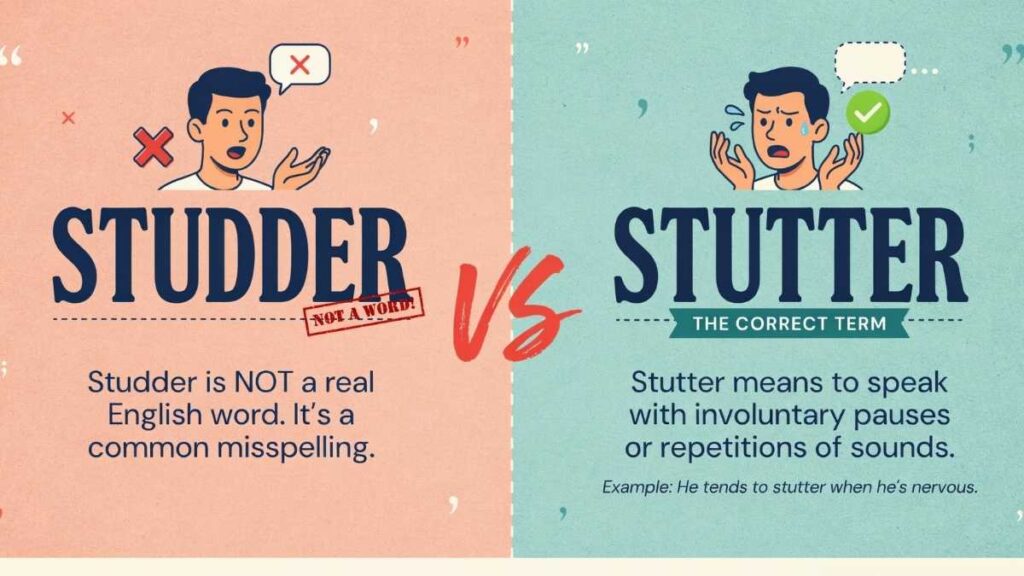
English spelling can turn one small letter into a surprisingly serious confusion. The question of studder or stutter is a perfect example. Although both spellings may sound alike, only stutter is correct in standard English. Writers often choose studder because they rely on pronunciation, but English spelling rarely follows such convenient shortcuts. This guide explains the correct spelling, defines stutter, and shows how to use it naturally in everyday sentences. You’ll also learn about related word forms, common spelling mistakes, and respectful language for discussing speech difficulties. By the end, this confusing spelling question will feel much easier to handle.
Studder or Stutter Quick Answer
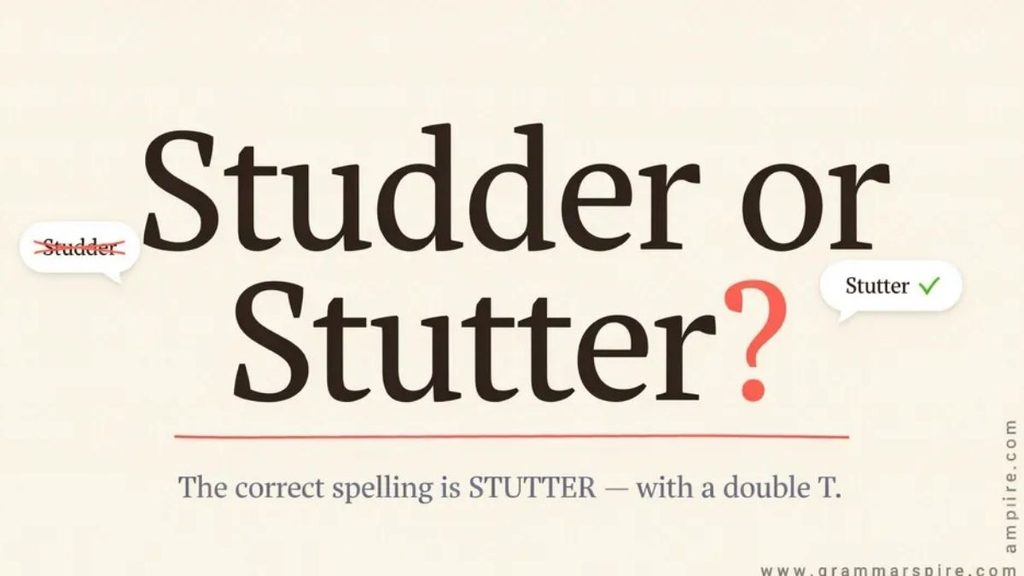
The correct spelling is stutter.
Studder is generally incorrect when the writer means interrupted or repeated speech. Standard English uses stutter as both a verb and a noun.
| Incorrect Form | Correct Form |
|---|---|
| Studder | Stutter |
| Studdered | Stuttered |
| Studdering | Stuttering |
| Studders | Stutters |
| Unstuddered | Unstuttered |
Here is an example:
Incorrect: “He began to studder during the interview.”
Correct: “He began to stutter during the interview.”
The same spelling applies to related forms:
“She stutters when she feels nervous.”
“He stuttered over the first few words.”
“The child is stuttering less often.”
“The video began to stutter during playback.”
If you’re wondering whether to write studder or stutter, choose stutter.
Learn the difference between everyday English mistakes
Happened Vs Happend Which Spelling Is Correct?
Stutter Meaning and Definition
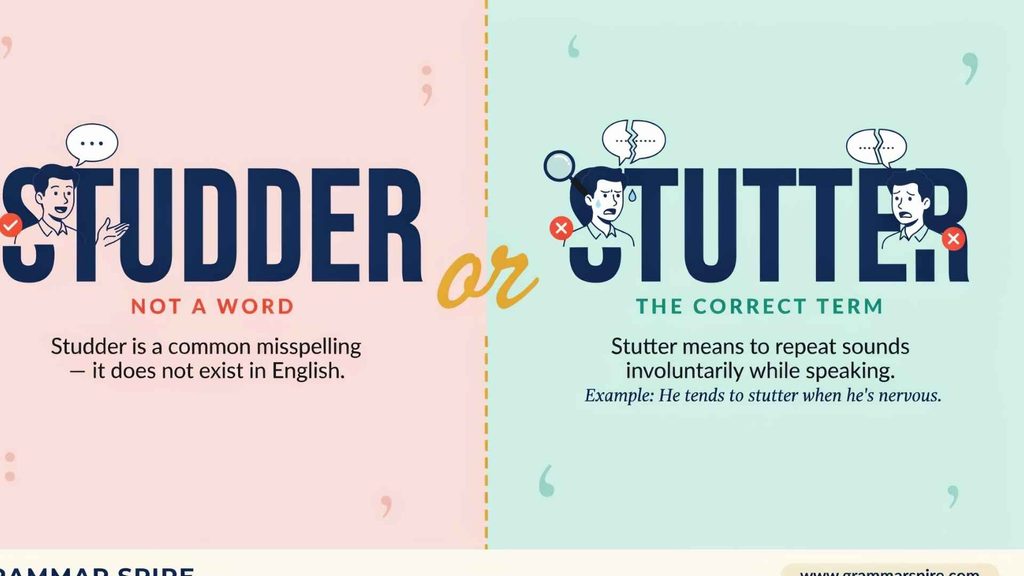
The word stutter has two closely related uses. It can describe interrupted speech, or it can describe something that operates unevenly.
Stutter as a Verb
As a verb, stutter means to speak with repeated sounds, repeated syllables, repeated words, prolonged sounds, or unexpected pauses.
For example:
“He began to stutter when the audience asked a difficult question.”
The sentence describes a speaking pattern. The speaker may repeat part of a word, become stuck on a sound, or struggle to move smoothly to the next word.
Consider these examples:
“She sometimes stutters when she speaks in front of a large group.”
“The student stuttered while reading the paragraph aloud.”
“He tried to answer quickly, but he began to stutter.”
“The child repeated the first sound several times.”
The word can also describe irregular operation:
“The engine began to stutter on the steep hill.”
“The audio started to stutter during the online meeting.”
“The video stuttered when the internet connection slowed down.”
In these examples, stutter means that something stops, starts, or moves unevenly.
Stutter as a Noun
As a noun, stutter refers to a speech pattern that includes interruptions, repetitions, or prolonged sounds.
For example:
“His stutter became more noticeable when he felt rushed.”
“She explained her stutter before giving the presentation.”
“A stutter can affect the rhythm of speech.”
The noun describes a feature of speech. It does not describe a person’s intelligence, confidence, or ability.
What Does Stuttering Mean?
Stuttering refers to a form of speech disfluency. It may involve repeated sounds, repeated syllables, repeated words, prolonged sounds, unexpected pauses, or difficulty moving smoothly from one word to another.
For example:
“B-b-b-book” shows a repeated sound.
“Ta-ta-table” shows a repeated syllable.
A speaker may also stretch a sound or become stuck before completing a word.
Not every pause represents stuttering. People pause while thinking, searching for a word, or organizing an idea. Stuttering involves a different pattern of interruption or difficulty.
Is Stutter a Word?
Yes. Stutter is a standard English word. Dictionaries recognize it as both a verb and a noun.
As a verb, it describes interrupted speech or irregular movement:
“The speaker began to stutter.”
As a noun, it describes the speech pattern itself:
“The speaker has a stutter.”
The word also appears in related forms such as stutters, stuttered, and stuttering.
Is Studder a Word?
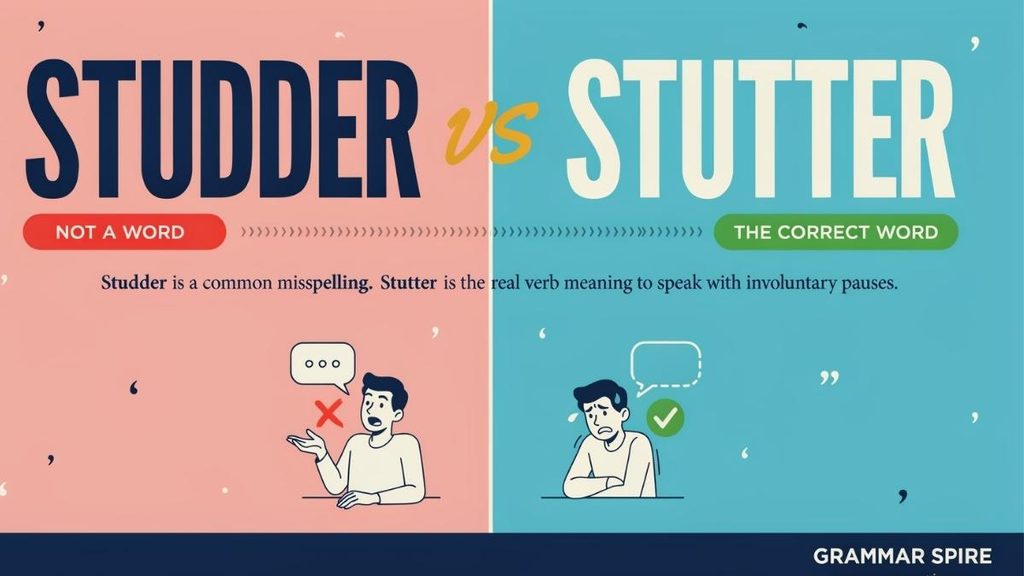
The spelling studder is not the standard form for the speech-related meaning. In most ordinary writing, it represents a misspelling of stutter.
Some writers choose “studder” because the middle sound may resemble a “d” in quick or relaxed speech. However, English spelling does not always follow exact pronunciation.
The spelling may appear in a name, brand, username, or specialized context. That possibility does not make it the correct spelling for interrupted speech.
Use stutter in school assignments, professional documents, articles, emails, and formal communication.
Learn the difference between everyday English mistakes
Excel vs Accel Which Spelling is correct?
The Main Difference between them

The difference between studder and stutter is simple. Stutter is the correct standard English spelling. Studder usually represents a spelling mistake.
| Feature | Stutter | Studder |
|---|---|---|
| Standard English spelling | Correct | Usually incorrect |
| Speech-related meaning | Yes | No standard meaning |
| Verb form | Yes | No standard form |
| Noun form | Yes | No standard form |
| Formal writing | Appropriate | Avoid |
| Common source of confusion | The middle sound may resemble “d” | Phonetic spelling mistake |
The question stutter vs studder does not require a complicated rule. Remember the correct form and use it consistently.
How to Spell Stutter
If you’re asking how to spell stutter, write:
S-T-U-T-T-E-R
The word contains two t’s in the middle:
stutter
A simple memory trick connects the repeated t’s with the repeated sounds that the word can describe. The trick does not explain the word’s complete history, but it can help you remember the spelling.
Why Is Stutter Spelled with TT?
The spelling stutter contains tt because English preserves the established form of the word. The double t also appears in its related forms:
Stutter
Stutters
Stuttered
Stuttering
The double t remains important when you add endings. The past tense is stuttered, not “studdered.”
Learn the difference between everyday English mistakes
Bellies vs Bellys Which one Is Correct?
Stutter Pronunciation
The standard American English pronunciation of stutter sounds like STUT-er. The first syllable receives the main stress.
The spelling studder may seem logical to some writers because the middle sound can resemble a “d” in quick speech. However, the spoken sound does not justify changing the spelling.
Accent differences may slightly change the vowel or final sound, but the standard word remains stutter.
Stutter Examples in Sentences
Examples make the meaning easier to understand. The following sentences show how the word works in different situations.
Stutter as a Speech Verb
“He began to stutter during the interview.”
“She may stutter when she feels under pressure.”
“The student stuttered while answering the question.”
“He tried to slow down because he had started to stutter.”
“The speaker continued after a brief stutter.”
Stutter as a Noun
“Her stutter became less noticeable when she felt comfortable.”
“He discussed his stutter with his classmates.”
“The presenter handled his stutter with confidence.”
“A stutter can affect the rhythm of a conversation.”
Stutter for Repeated Sounds
“He repeated the first sound before finishing the word.”
“The child produced several repeated syllables.”
“She became stuck on the opening sound of the sentence.”
Stutter for Technology
“The video began to stutter during the presentation.”
“The audio stuttered because the connection became unstable.”
“The game stuttered when the computer struggled with the graphics.”
“The engine gave a short stutter before stopping.”
These examples show that stutter does not always refer to human speech. It can also describe interrupted performance.
Stutter in Adults
Adults can stutter just as children can. Some adults continue to stutter from childhood, while others notice changes in their speech later in life.
Stress, pressure, fatigue, and time limits may make stuttering more noticeable for some people. However, stuttering does not simply mean that someone feels nervous. A person may stutter while feeling calm, confident, or prepared.
Respectful language matters. Many writers prefer the phrase person who stutters because it keeps the person at the center rather than treating the speech pattern as the person’s identity.
For example:
Respectful: “The person who stutters gave a thoughtful presentation.”
Less considerate: “The stutterer gave a presentation.”
Individual preferences can vary. Some people use the word stutterer for themselves, while others prefer person-first language.
Adults who want support may work with a qualified speech-language professional. Communication strategies can help people manage speaking situations, improve comfort, and express themselves more freely. No single strategy works for everyone.
Learn the difference between everyday English mistakes
Buoy or Bouy Which Spelling Is Correct?
Stuttering in Children
Children may experience periods of disfluent speech while their language skills develop. They may repeat words, sounds, or phrases as they learn to organize longer sentences.
Persistent stuttering deserves attention from a qualified speech-language professional. Parents and teachers should avoid rushing children, interrupting them, finishing their sentences, or telling them to “slow down” in frustration.
A supportive listener should maintain natural eye contact, give the child enough time to speak, and focus on the message rather than the interruption. Adults should respond calmly and avoid teasing or drawing unnecessary attention to speech differences.
The goal is clear communication and confidence, not perfect fluency in every moment.
Stutter vs Stammer
The words stutter and stammer often overlap. Both can describe interrupted speech that includes repeated sounds, pauses, or difficulty speaking smoothly.
American English commonly uses stutter. British English often uses stammer, although British speakers also use stutter.
| American English | British English |
|---|---|
| He began to stutter. | He began to stammer. |
| She has a stutter. | She has a stammer. |
| Stuttering affected his speech. | Stammering affected his speech. |
The two words do not always carry a strict difference. Regional preference often determines which term people choose.
Learn the difference between everyday English mistakes
Opening or Openning Which one is correct?
Stutter Synonyms and Related Words
Several words may overlap with stutter, but they do not always express exactly the same meaning.
Stammer often works as a close synonym for stutter. British English uses it especially often.
Hesitate means to pause before speaking or acting. A person can hesitate without repeating sounds or experiencing a speech disfluency.
Falter means to lose confidence, strength, rhythm, or smoothness. It can describe speech, movement, or performance.
Stumble over words describes difficulty expressing an idea clearly. Confusion, nervousness, poor preparation, or a speech interruption may cause this difficulty.
Speak haltingly describes speech that moves slowly or includes frequent pauses. It does not necessarily mean that the speaker stutters.
Choose the word that best fits the context. “Hesitate” may describe a thoughtful pause, while “stutter” more specifically describes repeated sounds or interruptions in speech.
Stutter Step Meaning and Usage
A stutter-step is a series of short, hesitant, or broken steps. The expression appears frequently in sports, especially when a player changes direction or pace.
For example:
“The basketball player used a stutter-step to confuse the defender.”
“The runner took a stutter-step before turning.”
“He made a stutter-step toward the doorway.”
The expression uses the idea of interruption or uneven rhythm. It does not refer to a spelling mistake.
Stutter in Everyday Examples
Social Conversations
People may use stutter to describe a speaking pattern in everyday conversation.
“I sometimes stutter when I speak too quickly.”
A respectful sentence focuses on the experience rather than making fun of the speaker.
Avoid exaggerated spellings such as “I-I-I can’t talk” when you want to explain stuttering. Such writing can mock a real speech difference and distract readers from the subject.
Formal Writing
Formal writing should use stutter accurately and respectfully.
“The speaker paused briefly and continued the presentation.”
If the speech pattern matters to the subject, a writer may say:
“The interviewee described how stuttering affected public speaking.”
The sentence provides information without turning the person’s speech into a joke.
Social Media
People sometimes type studder in social media posts because they spell the word according to how it sounds. Informal online writing may contain many such errors, but frequent online use does not make a spelling standard.
Use stutter in educational posts, captions, public announcements, professional profiles, articles, and comments about speech.
Common Mistakes with Studder and Stutter
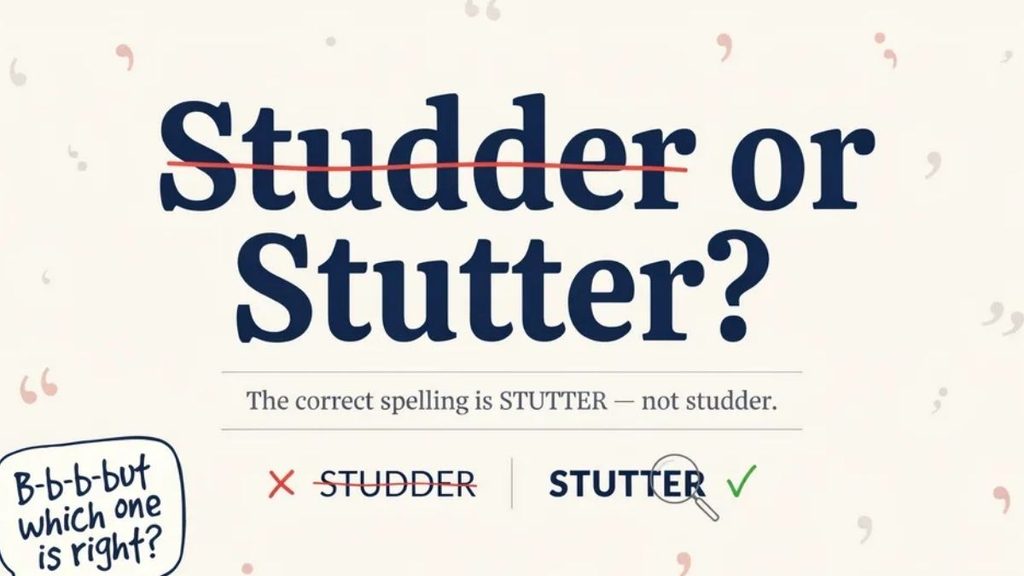
Incorrect: “He began to studder during the meeting.”
Correct: “He began to stutter during the meeting.”
Incorrect: “The speaker studdered before answering.”
Correct: “The speaker stuttered before answering.”
Incorrect: “She is studdering over every word.”
Correct: “She is stuttering over every word.”
Incorrect: “He studders when he feels rushed.”
Correct: “He stutters when he feels rushed.”
The most common mistake involves replacing the second t with d. Keep the original spelling in every form.
Stutter Word Forms
The word changes slightly when you add grammatical endings, but the spelling remains consistent.
| Word Form | Function | Example |
|---|---|---|
| Stutter | Base verb or noun | Some people stutter under pressure. |
| Stutters | Present-tense verb | He stutters during difficult conversations. |
| Stuttered | Past-tense verb | She stuttered before answering. |
| Stuttering | Present participle or gerund | He is stuttering less often. |
| Stutter-step | Compound noun or verb | The player used a stutter-step. |
The past tense follows this pattern:
Stutter + ed = stuttered
The present participle follows this pattern:
Stutter + ing = stuttering
The word does not become “studdered” or “studdering.”
Common Confusions with Stutter
Stutter vs Hesitate
A person may hesitate while choosing the right words. Stuttering involves a speech pattern that may include repeated sounds, prolonged sounds, or interruptions.
“She hesitated before answering.”
“She stuttered while answering.”
The first sentence describes a pause. The second describes a speech interruption.
Stutter vs Stammer
These words often share the same meaning. Regional usage usually explains the difference more than grammar does.
Stutter vs Stuttering
Stutter can work as a base verb or noun:
“He began to stutter.”
“He has a stutter.”
Stuttering can work as a present participle, gerund, or adjective:
“He is stuttering.”
“Stuttering can affect communication.”
“She discussed her stuttering experience.”
Learn the difference between everyday English mistakes
Many or Meny Which Spelling Is Correct?
Why Do People Spell Stutter as Studder?
People often write studder for several reasons.
The middle sound may resemble a “d” during quick or relaxed speech. English speakers do not always pronounce every consonant with the same sharpness.
Some people also connect the spelling with other words that contain “dd.” They may assume that the sound determines the letters.
Others remember hearing the word without seeing it in print. When they later write it, they choose the spelling that seems to match the sound.
However, the standard form remains stutter. Pronunciation can guide memory, but a reliable dictionary spelling determines formal usage.
Learn the difference between everyday English mistakes
Bareable or Bearable Which Spelling Is Correct?
A Simple Memory Trick
Remember this formula:
Stutter + ed = stuttered
Stutter + ing = stuttering
The word contains two t’s in the middle. You can connect those repeated letters with the repeated sounds that stuttering may involve.
A useful reminder is:
Stutter has two t’s. Studder has the wrong middle letter.
Here’s a trusted source for clear more words Comparison:
Grammar Update
Practice Session Studder or Stutter
Test your understanding of the correct spelling, word forms, and meanings of stutter. Complete each exercise before checking the answer key.
Choose the Correct Word
Select the correct option in each sentence.
- He began to (stutter / studder) during the interview.
- The speaker tried to remain calm when he started to (stutter / studder).
- She sometimes (stutters / studders) when she feels nervous.
- The child (stuttered / studdered) while answering the question.
- The presenter continued speaking despite a brief (stutter / studder).
- The correct spelling is (stutter / studder).
- The video began to (stutter / studder) because of a weak internet connection.
- He has a noticeable (stutter / studder) when he speaks quickly.
- The audio (stuttered / studdered) during the online meeting.
- She is (stuttering / studdering) less often during conversations.
- The teacher explained that (stuttering / studdering) can affect speech fluency.
- The player used a (stutter-step / studder-step) to change direction.
- He (stutters / studders) when he feels rushed.
- The engine gave a short (stutter / studder) before stopping.
- The speaker (stuttered / studdered) over the first few words.
Fill in the Blanks
Complete each sentence with the correct form of stutter.
- The correct spelling is __________.
- He began to __________ while answering the question.
- She sometimes __________ when she speaks in front of a large group.
- The student __________ during the presentation.
- The video began to __________ during playback.
- His __________ became more noticeable when he felt pressured.
- The speaker is __________ less often now.
- The audio __________ when the internet connection slowed down.
- The athlete used a __________ to confuse the defender.
- The past tense of stutter is __________.
- The present participle of stutter is __________.
- The word “studder” usually represents a __________ of “stutter.”
- A person may __________ when repeating sounds or syllables.
- The engine began to __________ on the steep hill.
- The speaker continued after a brief __________.
- The child repeated the first sound because he was __________.
- British English often uses the word “stammer” as a close synonym for __________.
- The teacher asked the students to spell the word __________.
- The computer game began to __________ when the system struggled with the graphics.
- The noun form refers to the speech pattern itself: a __________.
Correct the Spelling
Rewrite each sentence using the correct form of stutter.
- He began to studder during the meeting.
- She studders when she feels nervous.
- The speaker studdered before answering.
- The video started to studder during the presentation.
- He is studdering over every word.
- The audio studdered because of the unstable connection.
- The player used a studder step to change direction.
- Her studder became less noticeable over time.
- The engine began to studder before stopping.
- The child was studdering while reading aloud.
Answer Key
Choose the Correct Word
- Stutter
- Stutter
- Stutters
- Stuttered
- Stutter
- Stutter
- Stutter
- Stutter
- Stuttered
- Stuttering
- Stuttering
- Stutter-step
- Stutters
- Stutter
- Stuttered
Fill in the Blanks
- Stutter
- Stutter
- Stutters
- Stuttered
- Stutter
- Stutter
- Stuttering
- Stuttered
- Stutter-step
- Stuttered
- Stuttering
- Misspelling
- Stutter
- Stutter
- Stutter
- Stuttering
- Stutter
- Stutter
- Stutter
- Stutter
Correct the Spelling
- He began to stutter during the meeting.
- She stutters when she feels nervous.
- The speaker stuttered before answering.
- The video started to stutter during the presentation.
- He is stuttering over every word.
- The audio stuttered because of the unstable connection.
- The player used a stutter-step to change direction.
- Her stutter became less noticeable over time.
- The engine began to stutter before stopping.
- The child was stuttering while reading aloud.
Quick Reminder
The correct spelling is stutter. It contains two t’s in the middle.
Its common forms include stutters, stuttered, stuttering, and stutter-step. Avoid studder, studdered, and studdering when you mean interrupted speech or uneven performance.
FAQs About Studder or Stutter
Is It Spelled Stutter or Studder?
Stutter is the correct spelling in standard English. Studder usually appears as a spelling mistake. Use stutter when you discuss interrupted speech, repeated sounds, or uneven movement.
What Does Stutter Mean?
Stutter means to speak with repeated sounds, repeated syllables, prolonged sounds, or unexpected pauses. The word can also describe irregular performance, such as a video that stops and starts during playback.
What Does the Word “Studder” Mean?
“Studder” is not the standard English spelling for interrupted speech. In most situations, writers use it when they actually mean stutter. The spelling may appear in a name, username, or brand, but those special uses do not make it the correct general spelling.
Is Stuttering a Form of Autism?
Stuttering is not a form of autism. The two conditions differ, although a person may experience both. Stuttering affects speech fluency, while autism can affect communication, behavior, sensory experiences, and social interaction. A qualified professional can assess an individual’s needs and provide appropriate guidance.
Why Do People Stutter?
People may stutter for several reasons. Genetics, speech development, brain activity, and communication patterns can all play a role. Stress, tiredness, excitement, and time pressure may make interruptions more noticeable for some people. However, nervousness does not explain every instance of stuttering.
What Does “Stutter” Mean in Slang?
In informal language, stutter may describe hesitation, repeated words, or difficulty expressing an idea. People may also use it figuratively for something that works unevenly, such as a computer, engine, or audio recording. Writers should avoid using the term to mock someone’s speech.
What Is a Person With a Stutter Called?
The phrase person who stutters offers a respectful way to describe someone with a speech difference. Some individuals use the term stutterer for themselves, while others prefer person-first language. When you do not know someone’s preference, person who stutters provides a considerate choice.
What Is Another Word for Stutter?
Stammer is the closest alternative. American English commonly uses stutter, while British English often uses stammer. Other expressions, such as hesitate, falter, or speak haltingly, may fit certain situations. However, they do not always describe the same speech pattern.
Does Stuttering Mean ADHD?
Stuttering does not automatically indicate ADHD. The two conditions can occur together, but one does not prove the presence of the other. ADHD involves attention, impulse control, and activity regulation, while stuttering mainly affects speech fluency. A qualified professional must evaluate each condition separately.
What Is a Good Nickname for Someone Who Stutters?
A nickname should reflect the person’s personality, interests, or preferences rather than focus on a speech difference. Always ask whether the person likes a nickname before using it. Avoid labels that imitate, exaggerate, or make fun of stuttering.
Is a Stutter a Mental Disability?
A stutter is not a mental illness. It is a speech fluency difference. In some circumstances, stuttering may qualify as a disability when it significantly affects communication or daily activities. The classification depends on the individual’s experience and the rules that apply in a particular setting.
Can Adults Fix a Stutter?
Adults can often improve their communication and manage stuttering with support from a qualified speech-language professional. Therapy may focus on speaking comfort, communication strategies, fluency, and confidence. No single approach works for everyone, and improvement does not always mean complete elimination of stuttering.
AEO Quick Answers About Stutter
What Is the Correct Spelling Studder or Stutter?
The correct spelling is stutter. Studder is generally a misspelling.
What Is the Meaning of Stutter?
Stutter means to speak with repeated sounds, repeated syllables, prolonged sounds, or unexpected pauses. It can also describe uneven machine or technology performance.
Is Studder an English Word?
Studder is not the standard spelling for the speech-related word. Writers should use stutter in formal and everyday English.
Is Stuttering the Same as Stammering?
Stuttering and stammering often describe the same speech pattern. American English commonly uses stutter, while British English frequently uses stammer.
Can Stress Make Stuttering More Noticeable?
Yes. Stress, excitement, tiredness, and pressure may increase speech interruptions for some people. However, stuttering does not always result from nervousness.
Can Children Outgrow Stuttering?
Some children experience temporary disfluency as their language skills develop. Persistent or concerning speech difficulties require guidance from a qualified speech-language professional.
How Should People Respond to Someone Who Stutters?
Give the person enough time to speak. Maintain natural eye contact, avoid finishing sentences, and focus on the message rather than the interruption. Patient listening creates a more comfortable conversation.
What Is the Past Tense of Stutter?
The past tense is stuttered.
Example: “He stuttered before answering the question.”
What Is the ing Form of Stutter?
The ing form is stuttering.
Example: “She is stuttering less often during presentations.”
What Does Stutter Step Mean?
A stutter-step describes a series of short, hesitant, or broken steps. Athletes often use this movement to change direction or pace.
Can Stutter Describe Technology?
Yes. Stutter can describe interrupted video, uneven audio, unstable gameplay, or irregular engine performance.
Example: “The video began to stutter when the connection slowed down.”
How Can Writers Remember the Correct Spelling?
Remember that stutter contains two t’s. The same spelling appears in stutters, stuttered, and stuttering. The form “studder” uses the wrong middle letter.
Final Verdict Studder or Stutter
The confusion between studder or stutter may involve only one letter, but that small difference can weaken the clarity of your writing. Remember that stutter is the correct spelling in standard English, while studder is a common misspelling. Use stutter to describe repeated sounds, interrupted speech, or difficulty speaking smoothly. Related forms include stuttered, stuttering, and stutterer, depending on the context. When discussing speech difficulties, choose respectful and considerate language. By remembering the correct spelling and understanding its meaning, you can avoid this common mistake and communicate with greater confidence. Clear writing should guide readers smoothly rather than make them stumble over unnecessary confusion.

Ella AJS
Ella AJS is an experienced blogger and language enthusiast at Grammar Spire, dedicated to making English grammar simple, practical, and easy to understand. She specializes in word comparisons, meanings, usage, and common language confusions. Through clear explanations and engaging examples, Ella helps students, writers, and English learners improve their vocabulary and communicate with greater confidence and accuracy.




