
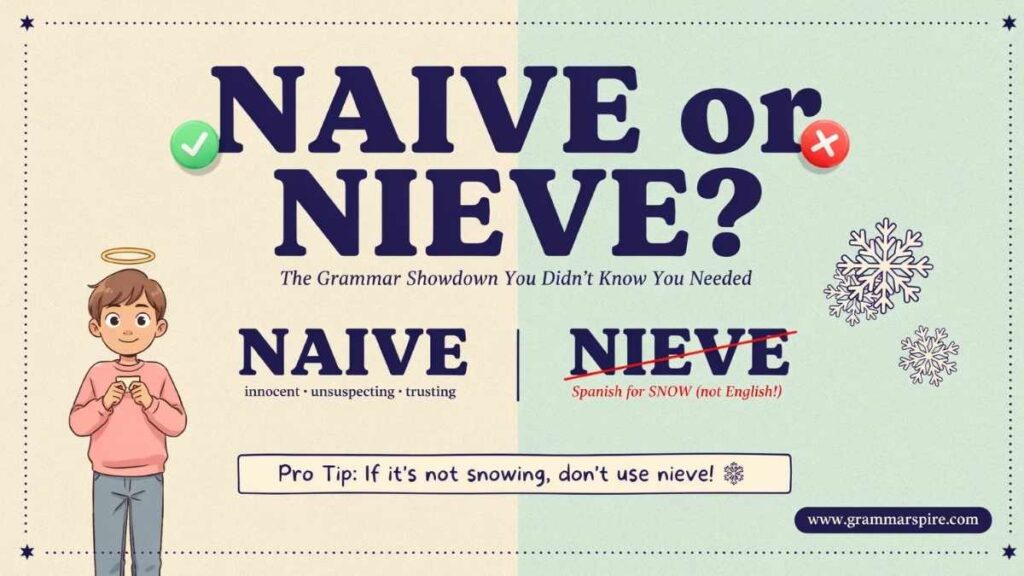
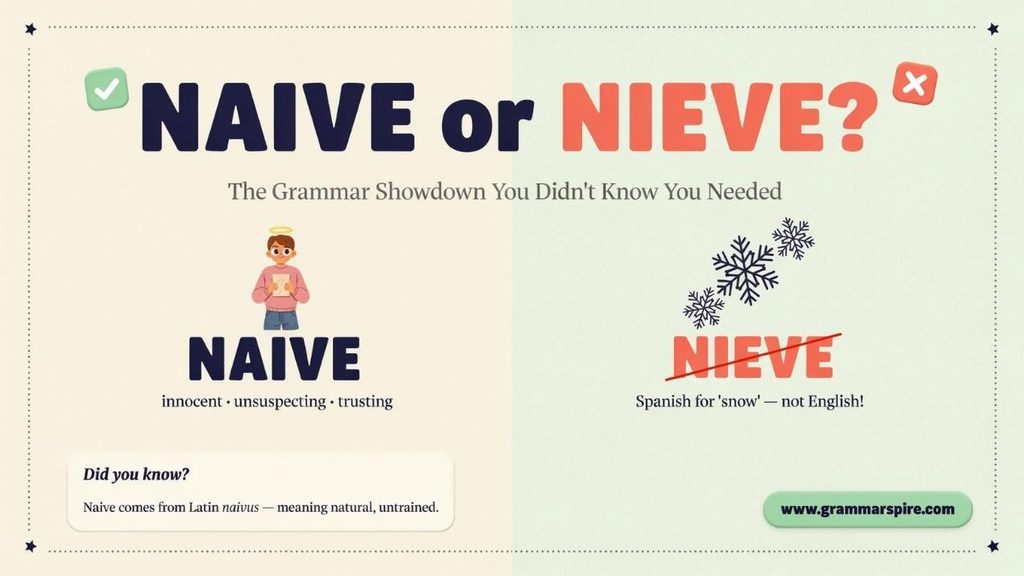
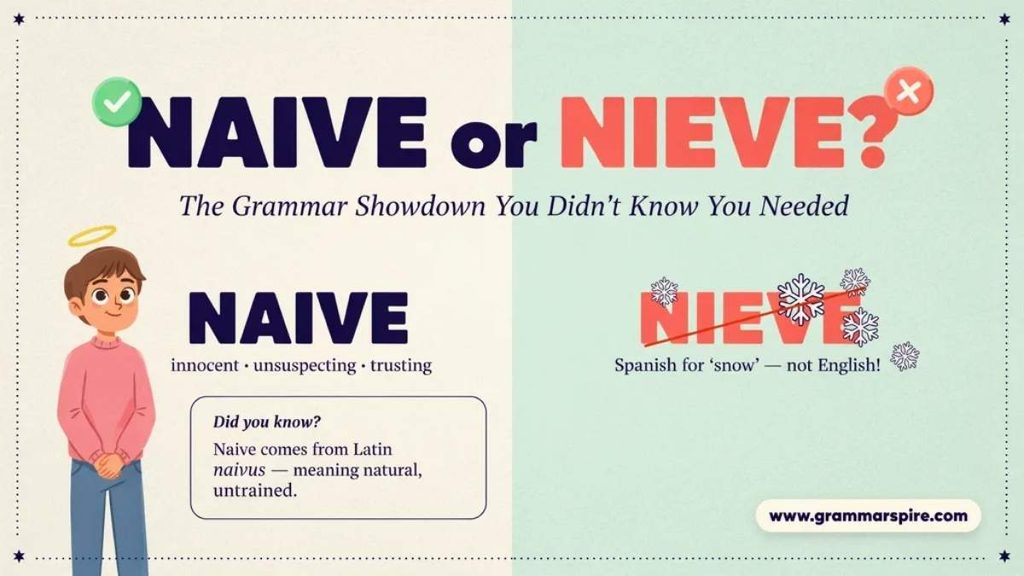
Naive or nieve which spelling belongs in your sentence, and which one could leave your readers scratching their heads? These similar looking words can confuse even careful writers. If you want to describe someone who trusts others too easily or lacks experience, naive is the correct choice. Nieve, on the other hand, means snow in Spanish and has other regional meanings. One small spelling difference can change your message completely! In this guide, you will explore the meanings, spellings, pronunciations, and examples of naive or nieve. You will also discover practical tips and exercises to sharpen your grammar skills and avoid this confusing mistake.
| Word | Meaning | Correct context |
|---|---|---|
| Naive | Inexperienced, overly trusting, or lacking practical judgment | Standard English |
| Naïve | The same meaning as naive | English spelling with a diaeresis |
| Nieve | Snow | Spanish |
| Nieve | A closed hand or fist | Certain Scottish and Northern English dialects |
Understanding these differences will help you choose the right word for your writing. Let us explore their meanings, pronunciations, origins, and examples so you can avoid this spelling confusion.
Learn the difference between tricky English words with easy explanations
Principal vs Principle which one is correct?
What Does Naive Mean?
Naive is an adjective that describes someone who lacks experience, practical knowledge, or awareness of how the world works. A naive person may trust others too easily or believe something without questioning it.
For example, imagine someone who sends money to a stranger because the stranger promises to double it overnight. That person might be naive because they believe an unrealistic promise without checking whether it is genuine.
However, the word does not always describe someone negatively. A naive person may simply have an innocent outlook or limited experience with a particular situation.
What Does It Mean to Be Naive?
Being naive means approaching a situation without enough experience or understanding to recognize its possible risks. You might believe people always tell the truth, assume every business offer is legitimate, or expect everything to work out perfectly.
Consider a student who believes that earning excellent grades automatically guarantees a successful career. The student may be naive because success also depends on practical skills, opportunities, networking, and other factors.
Similarly, someone who has never traveled alone might naively assume that every stranger will offer helpful advice. Their belief comes from limited experience rather than necessarily from poor intentions.
Is Being Naive a Good or Bad Thing?
The answer depends on the situation.
Naivety can reflect innocence, optimism, and an open mind. A person who trusts others may build friendships more easily and approach new experiences with enthusiasm.
On the other hand, excessive trust can make someone vulnerable to manipulation, scams, or disappointment. The problem arises when optimism prevents a person from recognizing clear warning signs.
For instance, trusting a new colleague is reasonable. Sharing confidential information with someone you barely know simply because they seem friendly may show naivety.
Therefore, naive does not automatically mean foolish or unintelligent. It describes a lack of experience or awareness in a particular context.
What Is a Naive Person?
A naive person often accepts information without examining the evidence or considering alternative explanations.
Imagine a friend who believes every advertisement that promises instant results. Whether the advertisement promotes a miracle product or an effortless way to become wealthy, your friend accepts its claims without asking questions.
You might describe your friend as naive because they lack the experience needed to recognize exaggerated promises.
Nevertheless, a person can be naive about one subject and highly knowledgeable about another. An experienced doctor, for example, might understand medicine exceptionally well but have little knowledge of investing.
Naivety depends on the situation rather than defining a person entirely.
Learn the difference between tricky English words with easy explanations
Requester or Requestor Which Spelling Is Correct?
What Does Nieve Mean?
Nieve has meanings that differ from the standard English adjective naive. Most commonly, nieve is a Spanish word meaning snow. It also appears in certain regional English dialects as a word for a closed hand or fist.
Because these meanings belong to different linguistic contexts, you should not automatically substitute nieve for naive.
Nieve Means Snow in Spanish
In Spanish, nieve means snow. You might encounter this word in conversations about winter weather, snowy mountains, or cold destinations.
For example, a Spanish speaker might use nieve when describing fresh snow covering the ground.
The word also appears in food-related expressions in some Spanish-speaking regions, where it can refer to a frozen dessert or sorbet. The exact meaning depends on the country and context.
If you are writing an English sentence about someone who trusts people too easily, however, nieve is not the appropriate spelling.
Nieve Can Mean a Fist in Regional English
Nieve also has a historical or dialectal meaning in some Scottish and Northern English varieties of English. In these contexts, it can refer to a hand, particularly a closed hand or fist.
This usage is uncommon in everyday modern American English. Most readers will not recognize it unless they are familiar with the relevant dialect or historical writing.
For example, a historical text might use nieve to describe a clenched hand. In that setting, the word has nothing to do with inexperience or trusting behavior.
Is Nieve a Correct English Word?
Yes, nieve can be a legitimate word in specific contexts. It is incorrect, however, when you intend to use the standard English adjective naive.
The distinction matters because spelling depends on meaning. A word may be valid in one language or dialect but inappropriate in a different sentence.
If you write, “She was nieve enough to believe the promise,” readers looking for standard English will likely consider the sentence misspelled. The correct sentence is, “She was naive enough to believe the promise.”
By contrast, nieve is appropriate when you are writing in Spanish or deliberately using its regional dialect meaning.
Learn the difference between tricky English words with easy explanations
Too Many or To Many Which Is Correct?
Key Differences
The main difference between naive and nieve lies in their meaning and usage. Naive is the standard English adjective for someone who lacks experience or trusts too readily. Nieve belongs to other linguistic contexts.
| Feature | Naive | Nieve |
|---|---|---|
| Standard English usage | Common adjective | Uncommon regional or foreign-language word |
| Main meaning | Inexperienced or overly trusting | Snow in Spanish |
| Additional meaning | None relevant to the spelling comparison | A hand or fist in certain dialects |
| Part of speech | Adjective | Noun in its main documented uses |
| Typical context | Describing beliefs, behavior, or judgment | Spanish language or regional historical writing |
| Example | He was naive about business. | Nieve means snow in Spanish. |
Which Word Should You Use?
Use naive when you describe someone who does not understand a situation because they lack experience or practical knowledge.
For instance, “The naive buyer believed the seller without checking the product.” This sentence uses the standard English adjective correctly.
Use nieve when you are writing about snow in Spanish or discussing the word in a relevant dialectal or historical context.
The easiest way to remember the distinction is to connect naive with behavior and nieve with its specific foreign-language or regional meanings.
If neither of those meanings fits your sentence, naive is probably the spelling you need when discussing inexperience or excessive trust.
Learn the difference between tricky English words with easy explanations
Invision vs Envision Which Spelling Is Correct?
Naive or Naive Which Spelling Is Correct?
Both naive and naïve are correct English spellings. The difference is the two dots placed over the letter i in naïve. Those dots are called a diaeresis.
The diaeresis indicates that the vowel should be pronounced separately rather than blending into the preceding vowel sound. Although the mark appears in the traditional spelling, modern English frequently omits it.
Why Does Naive Have Two Dots?
The spelling naïve comes from French, which uses the diaeresis in certain words to indicate separate vowel sounds.
English adopted the word while retaining the option of using the diacritic. As a result, both naive and naïve appear in dictionaries and published writing.
You may see naïve in literary works, formal prose, or publications that preserve traditional spellings. Meanwhile, naive is common in everyday writing, digital content, and many American English publications.
Neither spelling is inherently wrong.
Should You Write Naive or Naïve in American English?
For most everyday American English writing, naive is a practical choice. It is simple to type, widely recognized, and accepted as a standard spelling.
However, you can use naïve if you prefer the traditional form or follow a publication style guide that requires the diaeresis.
The most important rule is consistency. If you choose naive in an article, continue using that spelling rather than switching between naive and naïve without a reason.
Remember that neither form should be replaced with nieve when you intend to describe an inexperienced or overly trusting person.
Learn the difference between tricky English words with easy explanations
Truly vs Truely Which Spelling Is Correct?
Naive Pronunciation How Do You Pronounce Naive?
It is commonly pronounced nah-EEV, with the strongest emphasis on the second syllable. Its pronunciation may initially seem unusual because the written vowels do not produce the sound some readers expect.
The word has two syllables: na and ive. The second syllable receives the primary stress.
| Word | Approximate pronunciation | Notes |
|---|---|---|
| Naive | nah-EEV | Standard English pronunciation |
| Naïve | nah-EEV | Same pronunciation as naive |
| Nieve in Spanish | NYEH-beh | Approximation of the Spanish pronunciation |
How Do You Remember the Pronunciation?
Think of naive as sounding similar to “nuh-EEV.” Say the word slowly, emphasizing the second syllable, and then repeat it at a natural speaking speed.
You can also practice it in a sentence: “It was naive to believe every promise.”
Hearing and saying the word in context helps you connect its spelling with its pronunciation.
Is Naive Pronounced Like Nieve?
Not usually in English. Although the words look similar, they belong to different linguistic contexts and may have different pronunciations.
Naive has the familiar English pronunciation nah-EEV. Spanish nieve is generally pronounced approximately NYEH-beh, with Spanish vowel sounds.
Therefore, spelling alone does not tell you how to pronounce both words. Consider the language and meaning before deciding how to say them.
Learn the difference between tricky English words with easy explanations
Koozie vs Coozie Which Spelling Is Correct?
Naive Etymology Where Does the Word Come From?
The English word naive comes from French naïf, the masculine form of an adjective meaning natural or innocent. The feminine French form is naïve.
The French word traces back to Latin nativus, meaning native, natural, or inborn. Over time, the meaning developed to describe people who appear inexperienced, unaffected, or unfamiliar with the more complicated aspects of life.
English adopted the word and gradually established it as a common adjective.
Today, naive can describe a person’s assumptions, expectations, behavior, or understanding. It often suggests that someone has not yet developed the practical judgment that comes from experience.
The Spanish word nieve has a separate history. It comes from Latin nix, meaning snow, through its related Spanish form. Although nieve and naive resemble each other visually, their origins and meanings differ.
This distinction is a useful reminder that similar looking words do not necessarily share a linguistic history.
Learn the difference between tricky English words with easy explanations
Catchup or Catch Up which one is corect?
Naive vs Foolish, Ignorant, Innocent, and Gullible
Naive, foolish, ignorant, innocent, and gullible can all describe situations involving limited understanding or mistaken beliefs. However, each word communicates something slightly different.
Naive vs Foolish
Naive describes someone who lacks experience or awareness. Foolish describes someone who acts without good judgment.
A new employee who believes every promise from a manager may be naive because they do not understand workplace politics. An experienced employee who ignores clear evidence of a serious problem may be acting foolishly.
The distinction is that naivety often comes from inexperience, whereas foolishness focuses more directly on poor judgment.
Naive vs Ignorant
Ignorant means lacking knowledge or information about something. It does not necessarily suggest that a person trusts others too easily.
For example, someone who does not know the rules of a sport is ignorant of those rules. They may simply never have learned them.
A naive person, however, might assume they understand the sport after watching one game. Their lack of experience leads them to overestimate their knowledge.
Although the words can overlap, ignorant emphasizes missing information, while naive emphasizes inexperience or an overly trusting outlook.
Naive vs Innocent
Innocent often describes someone who has done nothing wrong or has a pure, uncomplicated outlook. Naive focuses on limited experience or awareness.
A child may be innocent because they have not engaged in wrongdoing. The same child may be naive about the dangers of speaking to strangers.
The words sometimes describe the same person, but they highlight different qualities.
Naive vs Gullible
Gullible describes someone who is easily tricked or persuaded to believe something, even when the claim lacks credibility.
Naive is broader. It can describe unrealistic expectations or limited understanding without suggesting that anyone has actually deceived the person.
For example, a student who believes that every problem has a simple solution may be naive. Someone who repeatedly falls for obvious fake messages may be gullible.
These distinctions help you describe people more precisely rather than treating all five words as interchangeable.
Learn the difference between tricky English words with easy explanations
Organization or Organisation Which Spelling Is Correct?
Naive or Nieve Examples in Sentences
Examples make the difference between naive and nieve easier to understand. Notice how the correct spelling changes according to the meaning and language.
| Sentence | Explanation |
|---|---|
| He was naive enough to believe the unbelievable offer. | Naive describes excessive trust. |
| Her naive approach to business led to several mistakes. | Naive describes limited practical experience. |
| I was naive to assume everyone would agree with me. | Naive describes an unrealistic expectation. |
| The young traveler was naive about the risks of traveling alone. | Naive describes a lack of experience. |
| His naive optimism helped him remain hopeful during difficult times. | Naive describes an inexperienced but positive outlook. |
| The Spanish word nieve means snow. | Nieve is the Spanish noun for snow. |
| We learned the Spanish word nieve in class. | Nieve appears in a Spanish-language context. |
| The historical text used nieve to refer to a fist. | Nieve reflects a regional or historical English meaning. |
| She was not naive enough to trust the suspicious message. | Naive describes judgment and awareness. |
| The inexperienced investor made a naive decision. | Naive describes limited financial experience. |
Learn the difference between tricky English words with easy explanations
Benefitted or Benefited Which Spelling Is Correct?
Common Mistakes to Avoid
The most common mistake is using nieve when you mean naive.
For example, “He was nieve about relationships” is incorrect in standard English. The correct sentence is “He was naive about relationships.”
Another mistake is assuming that naive always insults someone. Although the word can criticize poor judgment, it can also describe innocence, optimism, or a lack of experience without suggesting that a person lacks intelligence.
You should also avoid assuming that nieve has no legitimate meaning. It is a valid Spanish word and has documented regional English uses. Its meaning simply differs from the standard English adjective naive.
Practice Session
Ready to test your understanding of naive and nieve? Complete the 30 sentences below by filling in each blank with the most suitable word. Pay attention to the meaning of each sentence, because the correct spelling depends on the context. Remember, naive describes someone who lacks experience or trusts too easily, while nieve means snow in Spanish and has other regional meanings.
Fill in the Blanks
- The young investor was too ______ to recognize the warning signs.
- She felt ______ when she realized she had believed a false promise.
- The Spanish word for snow is ______.
- It was ______ of him to trust a stranger with his personal information.
- Someone who believes every story without questioning it may be ______.
- The child had a ______ understanding of how the business world worked.
- Both naive and ______ are accepted English spellings.
- The traveler was ______ about the challenges of living abroad.
- A person who is easily tricked can be described as ______.
- He was ______ enough to believe that every online offer was genuine.
- In Spanish, ______ refers to snow.
- Being inexperienced does not mean someone is ______.
- The manager considered the proposal ______ because it ignored obvious risks.
- Someone who lacks practical knowledge may be described as ______.
- The traditional spelling of naïve includes two dots over the letter ______.
- Trusting people too easily can demonstrate ______.
- The new employee had a ______ expectation of how quickly she would get promoted.
- The word ______ should not replace naive when describing an inexperienced person.
- Someone who is new to a subject may be ______ about its difficulties.
- The noun form of naive is ______.
- A ______ person might believe an unrealistic promise without checking the facts.
- The informal expression green can describe someone who lacks ______.
- The spelling naïve contains a mark called a ______.
- He was not foolish; he was simply ______ about the situation.
- A gullible person is easily ______.
- The Spanish word nieve has a different meaning from the English adjective ______.
- An ______ person may need more experience before making complex decisions.
- Naive and naïve have the same meaning and ______.
- Someone who assumes everyone tells the truth may be overly ______.
- Learning from mistakes can help a ______ person develop better judgment.
Answer Key
- naive
- naive
- nieve
- naive
- gullible
- naive
- naïve
- naive
- gullible
- naive
- nieve
- unintelligent
- naive
- inexperienced
- i
- naivety
- naive
- nieve
- naive
- naivety
- naive
- experience
- diaeresis
- naive
- deceived
- naive
- inexperienced
- pronunciation
- trusting
- naive
Learn the difference between tricky English words with easy explanations
Auntie or Aunty Which Spelling Is Correct?
FAQs About Naive or Nieve
1. What does naive mean in a person?
A naive person lacks experience or practical judgment and may trust others too easily. This does not mean the person lacks intelligence. Instead, they may not yet recognize certain risks or understand how a situation works.
2. What does nieve mean?
Nieve means snow in Spanish. In some Scottish and Northern English dialects, it can also refer to a hand or fist. However, it is not the standard English spelling for someone who is inexperienced or gullible.
3. When is a person considered naive?
Someone is considered naive when they believe others too readily or fail to recognize potential risks. For example, trusting a stranger who promises instant wealth without checking the facts may show naivety.
4. How do you spell nieve when you mean gullible?
The correct spelling is naive. It describes someone who lacks experience or trusts people too easily. Nieve has different meanings and cannot replace naive in standard English.
5. Is it nieve or naive?
Naive is correct when describing someone who lacks experience, practical knowledge, or judgment. Nieve is a Spanish word for snow and has a separate meaning in certain regional English dialects.
6. What does feeling naive mean?
Feeling naive means realizing that you may have misunderstood a situation or trusted someone without enough evidence. It can also describe feeling inexperienced when facing something unfamiliar.
7. What is a nicer word for naive?
Inexperienced, innocent, trusting, and open-minded can sound gentler, depending on the context. Inexperienced emphasizes a lack of knowledge, while open-minded highlights a willingness to consider different ideas.
8. How do you spell naive correctly?
The standard spelling is naive. You can also write naïve, which includes two dots over the letter i. Both forms are correct and have the same meaning.
9. Is naive spelled with two dots?
Sometimes. The spelling naïve uses two dots, called a diaeresis, over the letter i. However, naive without the dots is also correct and widely used in American English.
10. What is a naive person called?
A naive person may be described as inexperienced, trusting, innocent, or gullible. Gullible is most appropriate when someone is easily deceived, while inexperienced focuses on limited knowledge or practice.
11. Is naive a rude word?
Naive is not inherently rude, but it can sound critical when it suggests poor judgment. Depending on the context, it may describe someone with an innocent outlook or someone who has not yet learned to recognize certain risks.
12. What are examples of being naive?
Believing every advertisement, trusting an unfamiliar person with private information, or assuming success requires no effort can demonstrate naivety. These behaviors often reflect limited experience rather than a lack of intelligence.
13. What is a slang term for naive?
Green and wet behind the ears are informal expressions for someone who lacks experience. Gullible is another useful term, especially when describing a person who is easily tricked.
14. Is naive a correct spelling in British English?
Yes. Both naive and naïve are accepted in British English. The spelling with the diaeresis preserves the traditional form, while the version without it is also widely recognized.
15. What does being a naive person mean?
Being naive means approaching people or situations without enough experience to recognize possible risks or hidden motives. A naive person may be optimistic and trusting, but they can develop better judgment through learning and experience.
AEO Quick Answers About Naive or Nieve
Which spelling is correct, naive or nieve?
Naive is the correct standard English spelling when describing someone who lacks experience or trusts too easily. Nieve means snow in Spanish and has other regional uses.
What does naive mean in simple words?
Naive means inexperienced, overly trusting, or unaware of how a situation works.
What is the difference between naive and gullible?
Naive describes limited experience or understanding, while gullible describes someone who is easily tricked into believing something.
Can you spell naive without two dots?
Yes. Both naive and naïve are correct spellings. The diaeresis is optional in common English usage.
What is the noun form of naive?
The noun is naivety, also spelled naïveté. It describes the quality of being naive.
Is naive the same as innocent?
No. Innocent often suggests purity or freedom from wrongdoing, while naive emphasizes limited experience, knowledge, or judgment.
Conclusion
Confusing naive and nieve can turn a simple sentence into a spelling puzzle, but now you know how to solve it. Use naive when describing someone who lacks experience or trusts others too easily. Choose nieve when referring to snow in Spanish or its specific regional meanings. After all, one spelling mistake can send your sentence down a snowy path! The key is to focus on meaning, check your spelling, and practice using each word in context. With these simple habits, you can avoid common grammar mistakes and write with confidence. Keep learning, stay curious, and let your words make the right impression.

Ella AJS
Ella AJS is an experienced blogger and language enthusiast at Grammar Spire, dedicated to making English grammar simple, practical, and easy to understand. She specializes in word comparisons, meanings, usage, and common language confusions. Through clear explanations and engaging examples, Ella helps students, writers, and English learners improve their vocabulary and communicate with greater confidence and accuracy.