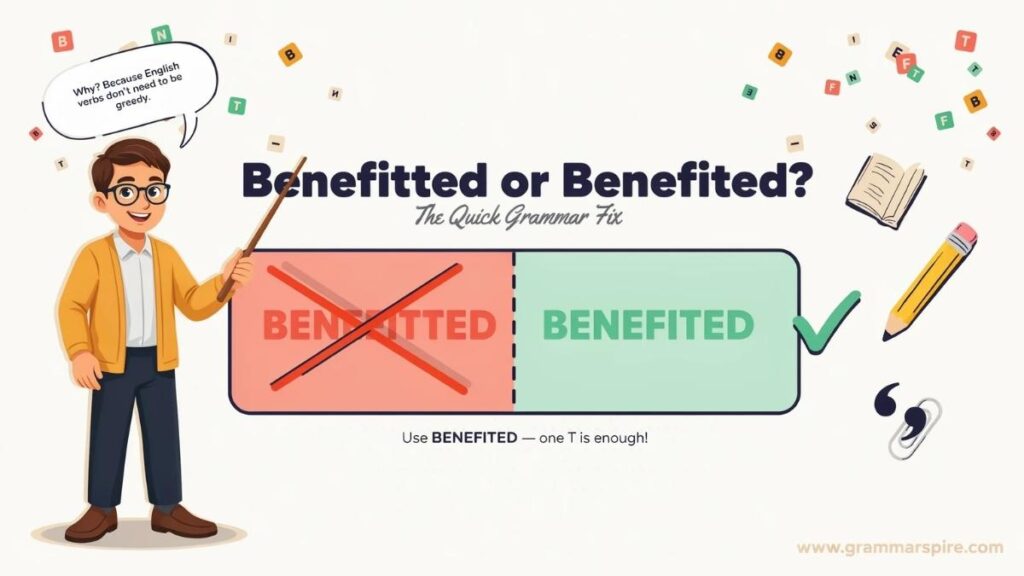
Benefitted or benefited which spelling is correct? That extra t may look harmless, but it can make even confident writers pause and question their grammar. The good news is that both spellings are accepted, although regional preferences differ. American English favors benefited, while British English commonly uses benefitted. Both forms describe gaining an advantage or experiencing a positive result. So, how do you know which one to use in your writing? Let’s clear up the confusion with simple explanations, practical examples, and common mistakes to avoid. By the end, you’ll know which spelling fits your audience and write with greater confidence.
| Feature | Benefited | Benefitted |
|---|---|---|
| Meaning | Received an advantage or positive result | Received an advantage or positive result |
| American English | Preferred spelling | Less common |
| British English | Accepted spelling | Common spelling |
| Past tense | Correct | Correct |
| Past participle | Correct | Correct |
| Pronunciation | Same | Same |
Quick Answer
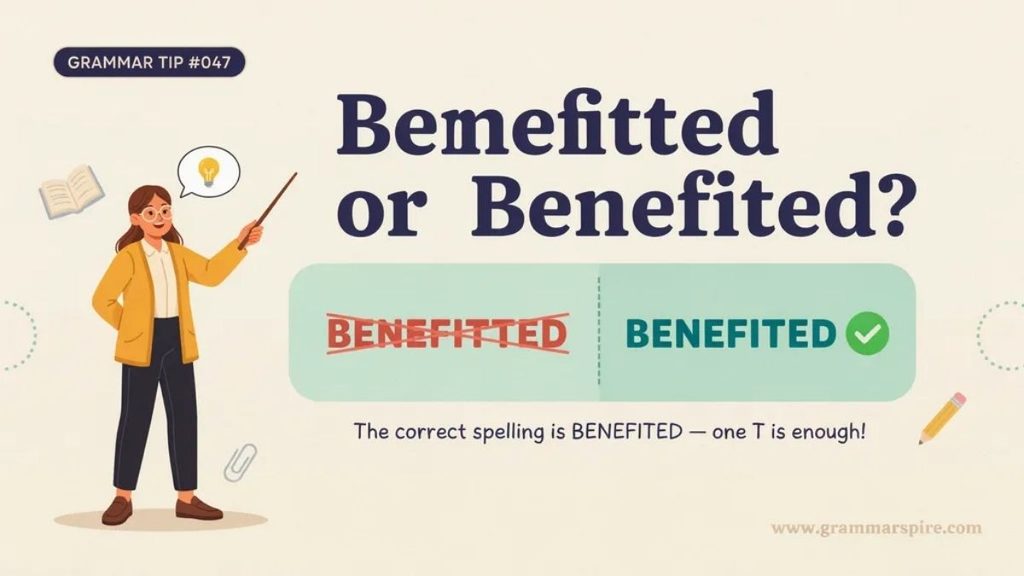
Both benefited and benefitted are correct spellings. However, benefited is the standard preference in American English, whereas British English commonly uses benefitted.
For example, an American writer might say, “The company benefited from the new policy.” A British writer could write, “The company benefitted from the new policy.” Both sentences communicate the same idea: the company gained an advantage.
The easiest way to remember the difference is to connect the spelling with your audience. If you’re writing for American readers, choose benefited. For British readers, benefitted is a common option, although benefited is also accepted.
Consistency matters, too. Once you choose a spelling, use it throughout your article, report, or assignment unless you’re discussing the spelling difference itself.
Learn the difference between tricky words and use them correctly
Brung vs Brought Which Is Correct?
What Does Benefited Mean?
Benefited means received help, gained an advantage, or experienced a positive result. The word comes from the verb benefit, which describes an action that helps someone, improves a situation, or provides something useful.
The meaning covers many everyday situations. A student may benefit from extra lessons, an employee may benefit from professional training, and a business may benefit from a successful marketing campaign. In each case, someone gains something valuable.
Benefited Meaning and Definition
Benefited is the past tense and past participle of benefit in American English. It describes an advantage that someone or something received or an improvement that occurred because of a particular action or situation.
Consider these examples:
The students benefited from the additional lessons.
She benefited financially from the investment.
The neighborhood benefited from the new public park.
We have benefited from years of experience.
The organization had benefited from several successful partnerships.
Each sentence describes a positive outcome. That outcome might involve better health, greater knowledge, financial gain, improved working conditions, or stronger relationships.
Importantly, benefited doesn’t always refer to money or material rewards. Someone who benefited from honest feedback, for instance, may have gained valuable knowledge rather than a financial advantage.
Benefited Example Sentences
The following examples show how to use benefited naturally in different contexts.
1.In education, Maya benefited from her teacher’s detailed feedback because it helped her recognize and correct her mistakes.
2.In health, Daniel benefited from regular exercise and a balanced diet.
3.In business, the small company benefited from a partnership that introduced its products to new customers.
4.In personal development, I benefited from the experience even though the project didn’t go as planned.
5.In a community, local families benefited from the construction of a new library.
6.In technology, the school benefited from software that made lessons more accessible to students.
Notice how benefited often appears with the preposition from. This construction identifies the source of the advantage, such as training, experience, feedback, or a new opportunity.
For example, you can say that someone benefited from a discussion, benefited from a policy, or benefited from additional support. These expressions work naturally in everyday conversation and formal writing.
Learn the difference between tricky words and use them correctly
Goodnight or Good Night Which Is Correct?
What Does Benefitted Mean?
Benefitted has the same meaning as benefited. It describes receiving help, gaining an advantage, or experiencing a positive result. The additional t represents a spelling variation rather than a difference in definition.
British English commonly uses benefitted, although benefited also appears in British writing. Therefore, the double-t spelling isn’t the only acceptable choice for readers in the United Kingdom.
Benefitted Meaning and Usage
The meaning of benefitted remains identical to that of benefited. Writers use it to describe educational progress, financial improvement, better health, professional growth, and other favorable outcomes.
For example, the employees benefitted from the new training program.
The town benefitted from increased investment.
She has benefitted greatly from her mentor’s advice.
The children benefitted from spending more time outdoors.
Several departments benefitted from the updated system.
These sentences follow the same grammatical patterns as their versions with benefited. The spelling changes, but the meaning and sentence structure remain the same.
Benefitted Example Sentences
Consider how benefitted works in different situations.
1.In education, the students benefitted from a practical lesson that connected classroom learning with real-life situations.
2.In health, he benefitted from following a consistent sleep schedule.
3.In business, the retailer benefitted from improved customer service and stronger relationships with returning customers.
4.In professional development, Priya has benefitted from working with experienced colleagues.
5.In a community, residents benefitted from better public transportation.
6.In personal life, everyone benefitted from the lessons they learned during a challenging journey.
These examples show why the spelling question can confuse writers. Both versions fit naturally into the same sentence patterns, and neither requires a different grammatical structure.
Learn the difference between tricky words and use them correctly
Principal vs Principle which one is correct?
Benefited vs Benefitted Key Differences
When comparing benefited vs benefitted, the most important distinction is regional spelling preference. The words don’t have separate definitions, and you don’t need to choose between them based on the kind of advantage you’re describing.
The main differences involve spelling conventions, regional usage, and editorial preferences.
| Feature | Benefited | Benefitted |
|---|---|---|
| Definition | Gained an advantage or positive result | Gained an advantage or positive result |
| Verb form | Past tense and past participle | Past tense and past participle |
| American English | Strongly preferred | Less common |
| British English | Accepted | Common |
| Pronunciation | Same standard pronunciation | Same standard pronunciation |
| Formal writing | Suitable | Suitable when consistent with the chosen convention |
Meaning and Grammar
There is no meaningful difference between the benefited spelling and the benefitted spelling. Both forms express the same action in the past.
For example, “The team benefited from the extra practice” and “The team benefitted from the extra practice” communicate the same idea. The second sentence doesn’t suggest a greater advantage, a longer process, or a different outcome.
Regional Usage
American English generally favors benefited, whereas British English commonly uses benefitted. These preferences reflect established spelling conventions rather than a strict division between correct and incorrect English.
The distinction resembles other regional spelling variations, such as traveled and travelled or canceled and cancelled. English spelling has developed through different traditions, so a form preferred in one region may appear less often in another.
Formal and Professional Writing
Both spellings can appear in formal writing. The important consideration is whether the spelling suits your audience and follows the relevant style guide.
In an American research paper, business report, or website, benefited is usually the safer choice. In a British publication that favors double consonants in words such as travelled, benefitted may fit its house style.
When an institution specifies a particular dictionary or editorial standard, follow that guidance rather than relying on regional assumptions alone.
Learn the difference between tricky words and use them correctly
Requester or Requestor Which Spelling Is Correct?
Why Do Benefited and Benefitted Have Different Spellings?
The difference between benefited and benefitted comes from English verb-forming conventions and regional spelling preferences. When writers form the past tense or past participle of a regular verb, they generally add ed. Some verbs also require a spelling change before the suffix, including doubling the final consonant.
The verb benefit creates confusion because its final consonant can appear once or twice in the resulting forms.
The Spelling Rule Behind Benefited
In American English, the usual form follows this pattern: benefit + ed = benefited. The final t remains single before the ending.
The standard American forms are benefit, benefits, benefiting, and benefited.
This pattern is the one most American readers expect in general writing.
Why Is Benefitted Spelled With Two Ts?
Benefitted follows a spelling pattern in which the final consonant doubles before the ed ending. This form is well established in British English, although the single-t alternative is also used there.
The related forms are benefit, benefits, benefitting, and benefitted.
The double consonant doesn’t create a new sound or meaning. It simply reflects a spelling convention.
Understanding the Consonant Doubling Rule
A common English spelling rule allows or requires writers to double a final consonant when adding a vowel-initial suffix, such as ed or ing, to certain verbs. The pattern often applies to short verbs ending in a consonant-vowel-consonant sequence and to longer verbs whose final syllable carries the main stress.
For example, stop becomes stopped and stopping. Plan becomes planned and planning. Admit becomes admitted and admitting.
Stress matters because the rule commonly applies when the final syllable carries primary stress, as in admit. When the final syllable is unstressed, as in benefit, the usual American spelling retains a single t in benefited and benefiting.
British English has its own established spelling traditions, which help explain the common forms benefitted and benefitting. Consequently, one general consonant rule doesn’t explain every regional spelling variation.
Stressed and Unstressed Syllables in Benefit
The word benefit has three syllables: ben-e-fit. In standard pronunciation, the primary stress falls on the first syllable.
That stress pattern helps explain why American English generally uses benefited rather than benefitted. The final syllable doesn’t carry the main stress, so the usual American consonant-doubling pattern doesn’t call for another t.
British English commonly accepts the double-t forms as established spelling variants. Therefore, regional convention matters alongside the general spelling rule.
The key lesson is simple: spelling rules offer useful guidance, but they don’t always produce one universal form across every variety of English.
Learn the difference between tricky words and use them correctly
Too Many or To Many Which Is Correct?
Benefited or Benefitted in American English
If you’re writing for readers in the United States, benefited is the preferred spelling. It is the standard choice in most American books, articles, school assignments, business documents, and general online content.
For example, the new policy benefited local businesses.
The students benefited from the tutoring sessions.
The company has benefited from better planning.
Regular practice benefited her performance.
The double-t spelling remains understandable, but it is less common in American English. An editor may change benefitted to benefited when adapting British content for an American audience.
Is Benefitted With Two Ts Grammatically Correct in American English?
Benefitted is a recognized English spelling, but it isn’t the usual American preference. If you want your writing to follow standard American spelling conventions, choose benefited.
This recommendation is especially useful for academic work, professional communication, and American-focused website content. Familiar spelling conventions help readers concentrate on your message rather than notice an unexpected variation.
Which Spelling Should You Use in the US?
Choose benefited unless your employer, publisher, or style guide requires another form.
For example, an American business report would normally say, “The organization benefited from the revised strategy.” There is no need to add a second t to make the sentence more formal or grammatically correct.
The same choice applies to American English grammar exercises, school assignments, and most general writing.
Learn the difference between tricky words and use them correctly
Invision vs Envision Which Spelling Is Correct?
Benefitted or Benefited in British English
British English commonly uses benefitted, particularly in writing that follows British spelling preferences. However, benefited is also an accepted form, so the choice isn’t as absolute as a simple US-versus-UK rule might suggest.
Consider these examples.
The charity benefitted from public support.
The company has benefitted from recent investment.
Local residents benefitted from improved transportation links.
These sentences use the double-t form naturally. A British publication may prefer it because it fits the spelling conventions used throughout the rest of its content.
Should You Use Benefited or Benefitted in the UK?
Both forms are possible in British English. If you’re writing for a British publisher, check its house style. If no specific guidance exists, benefitted is a reasonable choice for British English, while benefited remains acceptable.
Consistency is the practical rule. Avoid using benefited in one paragraph and benefitted in the next unless you’re discussing the spelling variation itself.
Oxford Dictionary and the Spellings Benefited and Benefitted
Readers who want to verify the spelling can consult established dictionaries, including the Oxford English Dictionary and Oxford Learner’s Dictionaries. Dictionary entries help clarify accepted forms, definitions, and grammatical functions.
When checking a dictionary, look at the verb entry for benefit and examine its past-tense and past-participle forms. Regional labels and editorial treatment can vary between dictionaries and editions, so consult the current entry rather than assuming that every dictionary uses one spelling exclusively.
The main practical point remains unchanged: benefited is the usual American preference, and benefitted is common in British English.
Learn the difference between tricky words and use them correctly
Truly vs Truely Which Spelling Is Correct?
Benefited or Benefitted Pronunciation
One reason this spelling comparison is easy to resolve is that both forms have the same standard pronunciation. The extra t in benefitted doesn’t add another syllable or change the sound of the word.
The verb benefit has three syllables, with primary stress on the first. Its past forms retain the same basic stress pattern.
Both sentences sound the same when spoken.
She benefited from the course.
She benefitted from the course.
The spelling difference appears on the page, not in the normal pronunciation.
Does the Extra T Change the Pronunciation?
No. Both forms have the same standard pronunciation. You don’t need to pause, lengthen a sound, or pronounce an additional consonant because one spelling contains two ts.
The same principle applies when the forms appear with auxiliary verbs. Has benefited and has benefitted have the same intended pronunciation.
If you’re learning English, focus on the meaning, stress pattern, and sentence structure rather than trying to pronounce the two spellings differently.
Learn the difference between tricky words and use them correctly
Koozie vs Coozie Which Spelling Is Correct?
Benefit Verb Forms Past Tense and Past Participle
Understanding the verb forms of benefit helps explain where benefited and benefitted belong in a sentence. Benefit is a regular verb, and both spellings can express its past tense and past participle.
| Verb form | American English | Common British variant |
|---|---|---|
| Base form | Benefit | Benefit |
| Third-person singular | Benefits | Benefits |
| Present participle | Benefiting | Benefitting |
| Simple past | Benefited | Benefitted |
| Past participle | Benefited | Benefitted |
The table shows a common regional pattern, not an absolute rule that every British writer must follow.
Present Tense Benefit and Benefits
Use benefit when the subject is I, you, we, or they, or when the verb follows a modal verb.
I benefit from daily reading.
They benefit from regular feedback.
Students can benefit from extra practice.
Use benefits with a third-person singular subject in the simple present tense. For example, the program benefits the entire community.
Present Participle Benefiting or Benefitting
The present participle appears in continuous tenses and can also function as a modifier. American English generally uses benefiting, while British English commonly uses benefitting.
She is benefiting from the new schedule.
The students are benefitting from additional support.
Both forms describe an ongoing process or action. Neither is a past-tense form.
Past Tense Benefited or Benefitted
Use the simple past when describing a completed action or result.
The company benefited from the new agreement last year.
The British variant would be, “The company benefitted from the new agreement last year.”
Both sentences describe the same completed event.
Past Participle Benefited or Benefitted
The past participle appears with auxiliary verbs such as has, have, and had. It can also appear in passive constructions when the context supports them.
She has benefited from the experience.
They had benefited from earlier investments.
The program benefited thousands of residents.
The same grammatical patterns work with benefitted. The spelling choice doesn’t change how you form the tense.
Learn the difference between tricky words and use them correctly
Catchup or Catch Up which one is corect?
Common Mistakes
The spelling difference seems minor, but several misunderstandings can lead to unnecessary corrections.
Assuming One Form Is Always Wrong
Neither spelling is universally wrong. Benefited is the preferred American form, while benefitted is common in British English.
Calling benefitted incorrect in every context overlooks established British usage. Likewise, insisting that every American writer should use benefitted ignores the standard American preference.
Mixing Spellings in the Same Document
Switching between benefited and benefitted without a reason can make an article look inconsistent. Choose the spelling that fits your audience and apply it throughout the document.
For example, if an American article uses benefited in the introduction, it should generally keep that form in its examples, conclusion, and frequently asked questions.
Confusing Meaning With Spelling
The extra t doesn’t change what the verb means. Both forms describe gaining an advantage, receiving help, or experiencing a positive outcome.
You don’t need to select one spelling for financial gains and the other for educational or personal gains.
Using the Wrong Verb Form
Writers sometimes focus so much on the final t that they overlook the sentence’s tense.
“She has benefited from the course” is correct because the present perfect tense uses has followed by the past participle.
By contrast, “She has benefit from the course” is incorrect in standard English because the base form doesn’t fit that structure.
The same distinction applies to benefitted. Correct spelling and correct verb form both matter.
Tips to Remember the Correct Spelling of Benefited or Benefitted
A few practical habits can make the choice easier.
For American English, remember the single t. Benefited is the standard choice in most US writing.
For British English, check the preferred convention. Benefitted is common, but benefited is also accepted.
Keep the meaning in mind. Both forms mean gaining an advantage or experiencing a positive result.
Use the same spelling throughout a document. Consistency makes your writing easier to edit and read.
Check your style guide. A publisher or organization may specify one form.
Learn the related forms together. Benefiting is usual in American English, while benefitting is common in British English.
The easiest memory aid is to connect the spelling with your audience. If you’re writing for the United States, choose benefited. If you’re writing in British English, benefitted is a common option, but follow the publication’s guidance when available.
Learn the difference between tricky words and use them correctly
Organization or Organisation Which Spelling Is Correct?
Synonyms for Benefited and Benefitted
Sometimes a synonym can make your sentence more precise or prevent repeated wording. The best alternative depends on the kind of advantage the subject received.
| Synonym | Meaning or emphasis | Example |
|---|---|---|
| Gained | Received something useful or valuable | She gained valuable experience. |
| Improved | Became better | His writing improved with practice. |
| Profited | Gained an advantage, often financial | The business profited from higher demand. |
| Advanced | Made progress | The training advanced her career. |
| Flourished | Grew or developed successfully | The community flourished after the investment. |
| Gained from | Received value from an experience or action | We gained from the discussion. |
| Improved through | Became better as a result of something | Her skills improved through regular practice. |
These synonyms are related, but they aren’t interchangeable in every sentence. Profited often emphasizes financial or practical gain, whereas flourished suggests strong growth or development. Improved focuses on a positive change rather than simply receiving an advantage.
For example, “The students benefited from the lesson” doesn’t necessarily mean their performance improved immediately. They may have gained knowledge or confidence that becomes useful later.
Choose the word that conveys the exact result you intend to describe.
Here’s a trusted source for clear word meanings:
Practice Session
Test your understanding of benefited and benefitted with the following fill-in-the-blank exercises. Complete each sentence with the correct spelling or word form. Remember that benefited is preferred in American English, while benefitted is common in British English. Choose the form that matches the sentence and the spelling convention you are following.
Fill in the Blanks
- She ______ from regular exercise and a balanced diet.
- The students ______ from the extra lessons.
- Our company has ______ from the new marketing strategy.
- He ______ greatly from his teacher’s advice.
- The local community ______ from the new library.
- Many employees have ______ from professional training.
- The children ______ from playing outdoors.
- The business ______ from improved customer service.
- We have ______ from their generous support.
- The team ______ from better communication.
- Regular reading can ______ your vocabulary.
- Education provides many ______ to young people.
- The new program has ______ hundreds of families.
- She is ______ from the experience she gains at work.
- The organization ______ from additional funding last year.
- Better planning ______ everyone involved in the project.
- The patients have ______ from the improved facilities.
- He hopes to ______ from the upcoming training session.
- The company introduced several employee ______.
- They ______ from the agreement signed last month.
- The new transportation system has ______ local businesses.
- Students are ______ from the teacher’s practical examples.
- The project brought several ______ to the neighborhood.
- She had already ______ from years of professional experience.
- The school ______ from the generous donation.
- Good communication can ______ both workers and managers.
- The residents have ______ from cleaner public spaces.
- The organization expects to ______ from the partnership.
- The training course offered several practical ______.
- By joining the program, he ______ from expert guidance.
Answer Key
- benefited
- benefited
- benefited
- benefited
- benefited
- benefited
- benefited
- benefited
- benefited
- benefited
- benefit
- benefits
- benefited
- benefiting
- benefited
- benefits
- benefited
- benefit
- benefits
- benefited
- benefited
- benefiting
- benefits
- benefited
- benefited
- benefit
- benefited
- benefit
- benefits
- benefited
FAQs About Benefitted or Benefited
Which Is the Correct Spelling: Benifit or Benefit?
Benefit is the correct spelling. Benifit is a misspelling. The word refers to an advantage, a helpful result, or something that improves a situation.
What Does Benefited Mean?
Benefited means received help, gained an advantage, or experienced a positive result. For example, she benefited from the extra practice.
Which Is Correct Benefiting or Benefitting?
Both spellings are accepted. Benefiting is preferred in American English, while benefitting is common in British English.
How Do You Use Benefited in a Sentence?
Use benefited to describe a past advantage or improvement. For example, the students benefited from the teacher’s guidance.
Is It Correct to Say Benefited?
Yes. Benefited is grammatically correct and serves as the past tense and past participle of benefit. It is the preferred spelling in American English.
What Is Another Word for Benefited?
Depending on the context, synonyms include gained, improved, profited, advanced, and flourished. Each word describes a different kind of positive outcome.
Which Is Correct: Benefit or Benefited?
Both are correct but serve different grammatical purposes. Benefit is the base verb or a noun, while benefited is its past tense and past participle in American English.
What Are Five Examples of Sentences With Benefited?
- She benefited from regular exercise.
- The students benefited from extra lessons.
- Our business benefited from better planning.
- He benefited from his mentor’s advice.
- The community benefited from the new library.
How Do You Pronounce Benefited?
Benefited has three syllables, with the main stress on the first syllable. Benefitted has the same standard pronunciation.
Is Benefited or Benefitted the Correct Spelling in the UK?
Both spellings are accepted in British English. Benefitted is common in the UK, while benefited is also used. Follow your publisher’s preferred spelling convention.
What Is Another Word for Benefit?
Useful synonyms include advantage, gain, improvement, profit, and help. The best choice depends on whether you mean a helpful result, a financial gain, or a positive change.
Does Benefit Mean Advantage?
Yes. As a noun, benefit can mean an advantage or a positive result. As a verb, it means to help someone or improve a situation.
Answer Engine Optimization (AEO) Quick Answers
What Is the Difference Between Benefitted and Benefited?
Benefited and benefitted have the same meaning and grammatical function. Benefited is preferred in American English, while benefitted is common in British English.
What Are 10 Good Sentences Using Benefited?
- I benefited from reading every day.
- She benefited from the training course.
- The company benefited from increased sales.
- The children benefited from outdoor activities.
- He benefited from years of experience.
- The team benefited from better communication.
- Local residents benefited from improved transportation.
- We benefited from the expert’s advice.
- The school benefited from additional funding.
- Everyone benefited from the successful partnership.
What Is a Simple Sentence?
A simple sentence contains one independent clause and expresses a complete thought. For example, “She benefited from the lesson.” It contains a subject, a verb, and a complete idea.
What Are 10 Sentence Examples With Benefitted?
- She benefitted from regular practice.
- The students benefitted from extra support.
- Our company benefitted from the agreement.
- He benefitted from professional guidance.
- The town benefitted from new facilities.
- The team benefitted from additional training.
- Children benefitted from the educational program.
- The organization benefitted from public support.
- We benefitted from the experience.
- Local businesses benefitted from increased tourism.
Is Benefited the Past Tense of Benefit?
Yes. Benefited is the simple past tense of benefit in American English. Benefitted is a common alternative in British English.
Can Benefited Be Used as a Past Participle?
Yes. Benefited works as a past participle in sentences such as “She has benefited from the experience.” The British variant is “She has benefitted from the experience.”
Which Spelling Should I Use in Formal Writing?
Use benefited for American English. In British English, either spelling may be appropriate. Follow the relevant dictionary or style guide and maintain consistency throughout your document.
Conclusion
Choosing between benefitted or benefited doesn’t have to turn a simple spelling decision into a grammar mystery. Both forms are correct, and the difference comes down to regional preference. American English favors benefited, while British English commonly uses benefitted, although benefited is also accepted in the UK. The meaning stays the same, so that extra t doesn’t give the word any extra benefits! To avoid confusion, consider your audience, follow a consistent style guide, and use the same spelling throughout your writing. With these simple tips, you can write with confidence and keep this little spelling puzzle from becoming a big grammar headache.

Ella AJS
Ella AJS is an experienced blogger and language enthusiast at Grammar Spire, dedicated to making English grammar simple, practical, and easy to understand. She specializes in word comparisons, meanings, usage, and common language confusions. Through clear explanations and engaging examples, Ella helps students, writers, and English learners improve their vocabulary and communicate with greater confidence and accuracy.