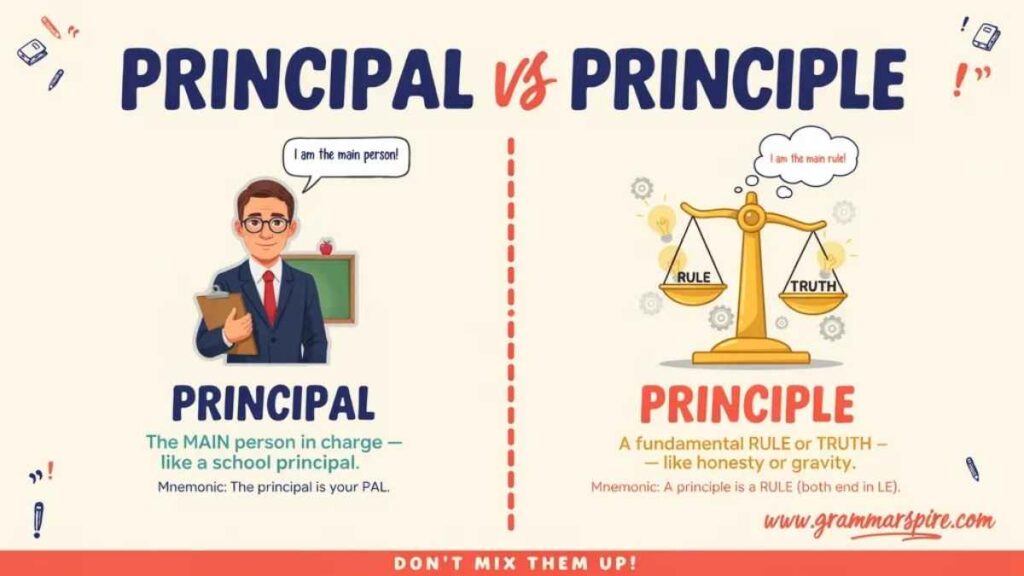
Principal vs principle? These two words sound alike, but confusing them can turn a school leader into a moral rule! Imagine asking your school principle for permission instead of the principal. That little spelling mistake could make your sentence confusing. Although these words share the same pronunciation, they have different meanings and uses. Principal refers to a school leader, something of primary importance, or the original amount of a loan. Principle describes a belief, rule, or fundamental truth. Understanding principal vs principle helps you avoid common grammar mistakes in essays, emails, and everyday conversations. Let’s explore their meanings, differences, and examples to help you use each word correctly.
Learn the difference between tricky English words with easy explanations
Burst or Bursted? Which One Is Correct?
Principal vs Principle Key Distinctions
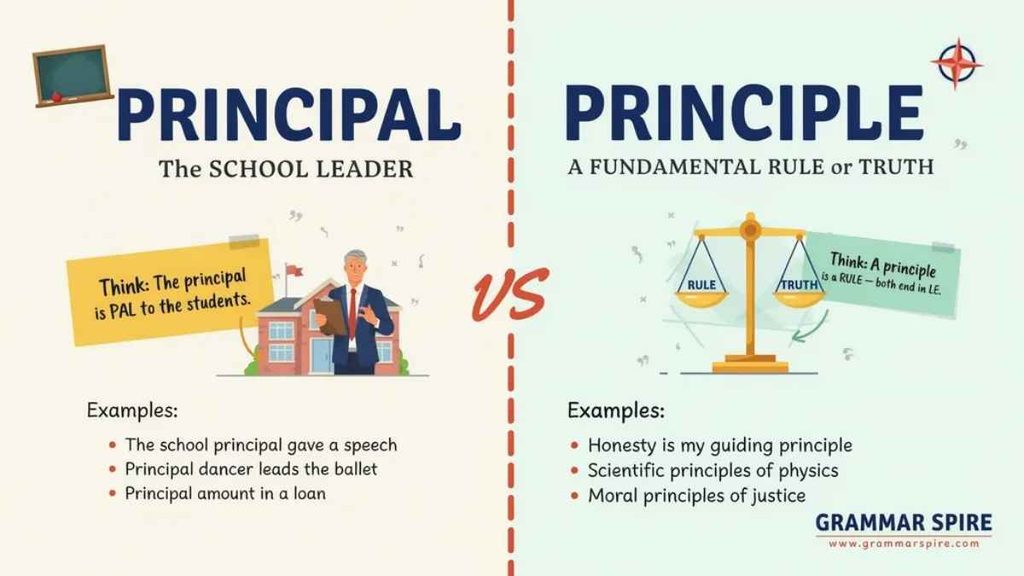
The principal and principle difference becomes clearer when you compare their meanings, parts of speech, and common contexts.
| Feature | Principal | Principle |
|---|---|---|
| Main meaning | A person, an original amount, or something primary | A rule, belief, standard, or general truth |
| Part of speech | Noun or adjective | Noun |
| School context | The person who leads a school | A rule or belief that guides education |
| Financial context | The original amount borrowed or invested | A general rule or belief about finance |
| Business context | A leading person, main party, or primary concern | A guiding business rule or ethical standard |
| Common phrases | School principal, principal amount, principal reason | Moral principle, guiding principle, scientific principle |
Learn the difference between tricky English words with easy explanations
Sweeped or Swept Which One Is Correct?
Why Are Principal and Principle Confused?
Principal and principle are commonly confused words because they look similar and sound alike in many English accents. In those accents, they are homophones: words that sound the same but have different meanings and spellings.
Their shared pronunciation means you cannot always identify the correct spelling by listening. Instead, consider the meaning of the sentence.
For example, the principal addressed the students. Here, principal means a school leader. The principal rule is to treat everyone fairly. In this sentence, principal means the main rule. However, the principle of fairness applies to everyone. Here, principle means a guiding rule or belief.
The second sentence uses principal as an adjective, while the third uses principle as a noun. That grammatical difference helps explain why the spellings are not interchangeable.
The most reliable approach to correct word usage is to ask what you want the word to mean before choosing its spelling.
Learn the difference between tricky English words with easy explanations
Forbid or Forbidden Which One Is Correct?
Principal vs Principle in a Sentence Examples and Explanations
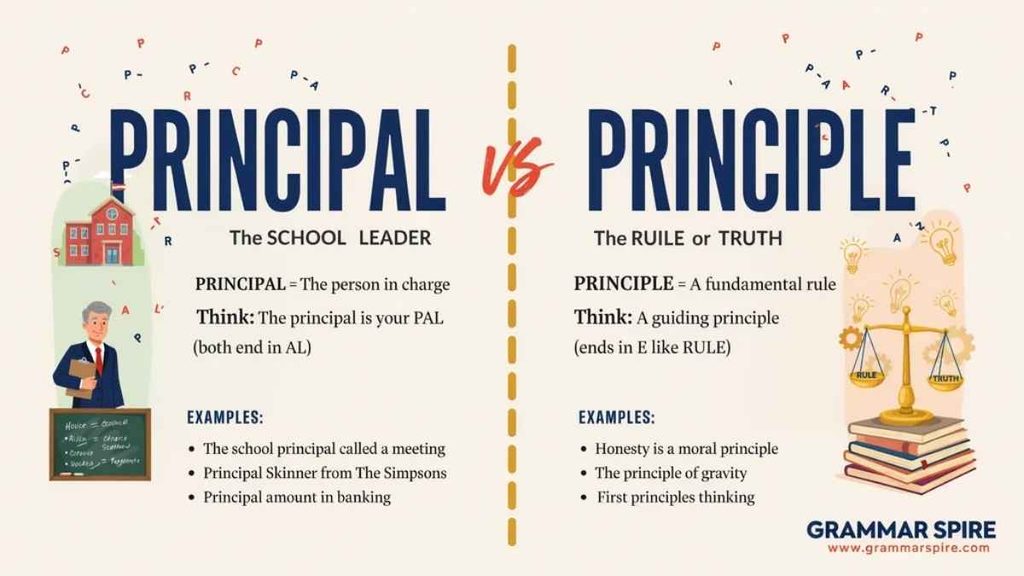
Sometimes, a few well chosen examples teach more than a lengthy definition. The following examples show how to use both words naturally.
Using Principal
The principal greeted the students at the entrance. Principal refers to the school leader.
Her principal concern was the safety of the children. Principal means main or most important.
He paid an additional $500 toward the principal of his loan. Principal refers to the outstanding amount borrowed.
The principal objective of the campaign was to increase awareness. Principal describes the primary objective.
The principal investigator presented the research findings. In research, a principal investigator leads or oversees a study.
Principal photography wrapped up before the end of summer. The phrase refers to the main filming phase.
The house has a large principal bedroom with a private bathroom. Principal describes the main bedroom in this property description.
The principal parties signed the contract. Principal identifies the main parties involved.
Using Principle
Honesty is an important principle in every relationship. Principle refers to a moral standard.
The scientist explained the principle behind the experiment. Principle means a fundamental idea that helps explain how something works.
The company follows the principle of equal opportunity. Principle refers to a guiding business standard.
She refused to compromise her principles for personal gain. Principles are the beliefs guiding her behavior.
The design follows a basic principle of engineering. Principle refers to a foundational rule or concept.
The teacher explained the principles of effective communication. Principles are the rules or ideas that guide a practice.
He acted on principle rather than personal advantage. Principle refers to a moral standard.
The principle of conservation of energy is fundamental to physics. Principle describes a scientific concept.
Learn the difference between tricky English words with easy explanations
Set or Setted Which Is Correct?
Principal and Principle in the Same Sentence
Using both words in one sentence is a useful way to test whether you understand the distinction.
The principal explained why honesty is an important principle at school.
The principal reason for the change was a principle of fairness.
The company principal insisted that the business follow its ethical principles.
The school principal taught students the principles of responsible citizenship.
The principal concern was protecting the principles on which the organization was founded.
In each example, principal identifies a person, a primary concern, or the most important reason. Principle identifies a rule, value, or belief.
Learn the difference between tricky English words with easy explanations
Bred vs Breeded Which Is Correct?
Common Mistakes
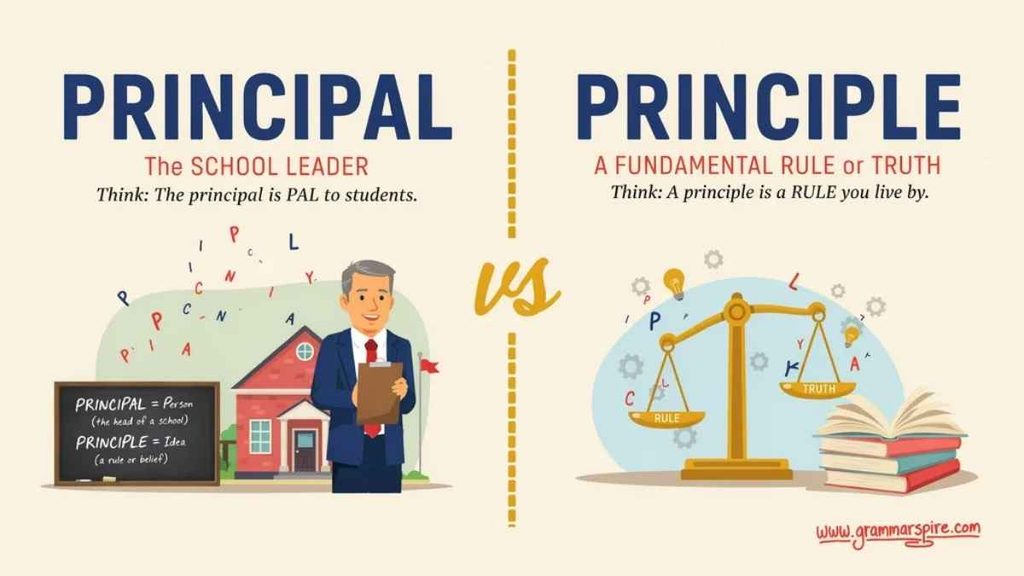
Even experienced writers sometimes make spelling and vocabulary mistakes with these words. Most errors occur when someone chooses a spelling based on sound instead of meaning.
| Incorrect usage | Correct usage | Why? |
|---|---|---|
| The principle welcomed the students. | The principal welcomed the students. | A school leader is a principal. |
| She paid the principle of the loan. | She paid the principal of the loan. | Principal refers to the borrowed amount. |
| Honesty is a principal of good leadership. | Honesty is a principle of good leadership. | Honesty is a guiding belief or standard. |
| The principle reason was cost. | The principal reason was cost. | Principal means main or most important. |
| He acted according to his principals. | He acted according to his principles. | Moral standards are principles. |
| The company follows ethical principals. | The company follows ethical principles. | Principles guide ethical conduct. |
How to Correct Principal and Principle Errors
When editing your work, don’t rely on spell-check alone. Both spellings are legitimate English words, so a spelling checker may accept either one even when the context makes it wrong.
Instead, ask yourself whether you’re referring to a person in charge, describing something as main or most important, or discussing a rule, belief, or fundamental truth. Use principal for the first two meanings and principle for the third.
If you’re discussing a loan, check whether you mean the amount borrowed or a rule about borrowing. That small distinction will usually settle the question.
For professional writing, review the whole sentence as well. Correct spelling matters, but the word must fit the sentence’s meaning and grammatical structure.
Learn the difference between tricky English words with easy explanations
Stinged or Stung Which Is Correct?
Easy Memory Tricks for Principal vs Principle
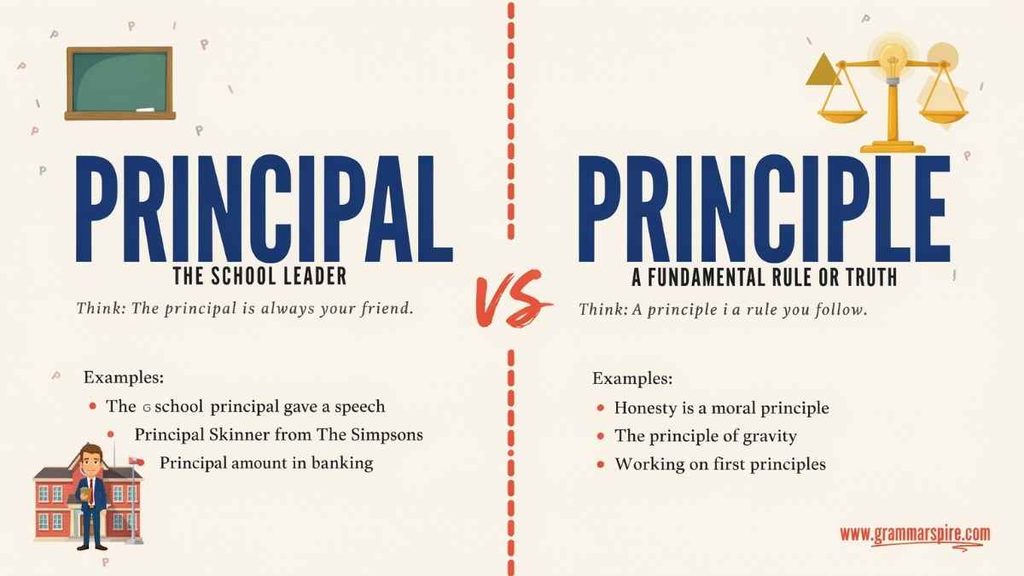
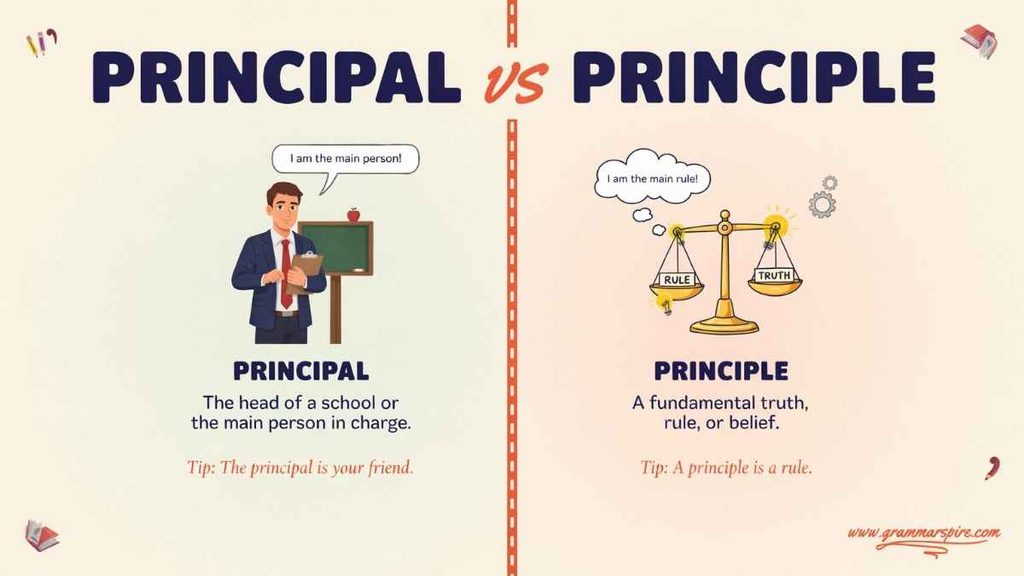
A good memory trick makes the spelling easier to recall when you need it. These simple associations help you distinguish principal from principle without memorizing a complicated rule.
Principal Is Your Pal
Remember the phrase principal is your pal. The word principal contains the letters p-a-l at the end, which can remind you of a school principal or another person in charge.
For example, your school principal is your pal when you need guidance or support.
The phrase is a mnemonic rather than a definition. A principal doesn’t have to be your friend, but the association helps you remember the spelling.
Principal Means Primary
Principal and primary share the same beginning. This offers another useful spelling trick.
When principal describes something as main or most important, connect it with primary. For example, the principal reason is the primary reason. Both expressions communicate the idea of being first in importance.
This memory aid also works for phrases such as principal objective, principal concern, and principal responsibility.
Principle Means a Rule
The word principle ends in -ple. Connect it with a rule or belief that people follow.
For example, a person of principle follows their moral beliefs even when doing so is difficult.
You can also remember the phrase guiding principles. These are the standards that guide behavior and decisions.
Use Context as Your Final Check
Memory tricks help, but context is the strongest test.
Consider these sentences: The principal paid off the principal of the loan. The principal followed the principle of honesty.
In the first sentence, the first principal refers to a person and the second to a financial amount. In the second, principal identifies a person while principle refers to a moral standard.
If the sentence still seems confusing, replace the word mentally with its meaning. You can substitute main or most important, principal may fit. If you can substitute rule or belief, principle is probably correct.
Learn the difference between tricky English words with easy explanations
Bought or Brought which one Is correct?
Synonyms and Related Words
It can help you understand principal and principle, but they don’t always work as direct replacements. The right alternative depends on the meaning and sentence.
Synonyms for Principal
When principal functions as a noun referring to a school leader or another person in charge, related terms include head, leader, director, school administrator, or main party in a transaction. These words aren’t interchangeable in every situation. For example, a school principal and a company director may have different responsibilities and levels of authority.
When principal functions as an adjective, useful alternatives include main, primary, chief, leading, and most important. You can replace principal reason with main reason without changing the central meaning.
In finance, principal refers to the original amount borrowed or invested. Depending on the context, original amount or capital may help explain the concept, although neither phrase is a perfect substitute in every financial situation.
Synonyms for Principle
Depending on the context, synonyms for principle include rule, belief, standard, tenet, doctrine, fundamental truth, and guiding idea.
For example, a moral principle may be described as an ethical standard. A scientific principle may be a fundamental idea used to explain a phenomenon.
However, a principle isn’t always a strict law. A personal principle may represent a person’s values, while a scientific principle may explain a broader pattern or relationship.
Choose a synonym that preserves the meaning you intend rather than replacing one word mechanically with another.
Here’s a trusted source for clear more words Comparison:
Grammar Update
Practice Session
Now that you understand the difference between principal and principle, it is time to put your knowledge to the test. Complete each sentence by filling in the blank with the correct word. Remember, principal can refer to a school leader, something of primary importance, or the original amount of a loan. Principle refers to a fundamental rule, belief, or truth. Read each sentence carefully, pay attention to its meaning, and see how many you can answer correctly.
Fill in the Blanks
- The school ______ welcomed the new students on their first day.
- Honesty is an important ______ that guides her decisions.
- The bank reduced the loan’s ______ balance after receiving the payment.
- He believes in the ______ of treating everyone fairly.
- Our school ______ announced the new attendance policy.
- The ______ reason for the delay was heavy traffic.
- She refused to lie because it went against her personal ______.
- You must repay the loan’s ______ along with any applicable interest.
- The company hired a ______ consultant to lead the project.
- I agree in ______, but we still need to discuss the details.
- The ______ of the school organized a meeting for parents.
- Respect for others is a basic moral ______.
- Most of the monthly payment went toward reducing the loan’s ______.
- The ______ objective of the campaign is to improve public awareness.
- He follows the ______ that promises should always be kept.
- The new school ______ introduced several changes to the schedule.
- The scientist explained the basic ______ behind the experiment.
- The borrower made an extra payment to reduce the loan’s ______.
- Safety is the ______ concern when operating heavy machinery.
- The manager explained the company’s guiding ______ to new employees.
- The school ______ met with teachers to discuss student performance.
- She accepted the proposal in ______, although she requested a few changes.
- The ______ amount invested in the account was $5,000.
- Fairness is a guiding ______ in the organization’s decision-making process.
- The ______ responsibility of the team leader is to coordinate the project.
- The bank calculated the interest based on the outstanding ______.
- The ______ of the school addressed concerns raised by parents.
- One important scientific ______ states that energy cannot be created or destroyed in an isolated system.
- He chose not to compromise his ______, even when others disagreed.
- The ______ purpose of the meeting was to resolve the scheduling conflict.
Answer Key
- Principal
- Principle
- Principal
- Principle
- Principal
- Principal
- Principle
- Principal
- Principal
- Principle
- Principal
- Principle
- Principal
- Principal
- Principle
- Principal
- Principle
- Principal
- Principal
- Principle
- Principal
- Principle
- Principal
- Principle
- Principal
- Principal
- Principal
- Principle
- Principle
- Principal
Learn the difference between tricky English words with easy explanations
Bleeded or Bled Which Is Correct?
FAQs About Principal vs Principle
Is it principal vs principle when referring to money?
Use principal when referring to the original amount of money borrowed, invested, or owed. For example, the principal on a loan decreases as you repay the amount borrowed, while interest represents the cost of borrowing.
What is the difference between principal and principle?
Principal refers to a school leader, a senior professional, something of primary importance, or the original amount of a loan. Principle means a fundamental rule, belief, or truth that guides behavior or explains how something works.
What is the difference between principal and principle in accounting?
In accounting, principal generally refers to the original amount of a loan or investment, excluding interest. Principle refers to a fundamental accounting concept or rule, such as the matching principle, which helps determine when businesses should recognize related expenses and revenues.
Is it principal vs principle for a job title?
Use principal when referring to a professional title that indicates leadership or seniority. For example, a school principal leads a school, while a principal consultant may hold a senior position in a consulting firm.
What does principle mean?
A principle is a fundamental belief, rule, or truth that guides decisions and actions. For example, honesty is an important principle because it encourages people to tell the truth, even when doing so is difficult.
Is it correct to say “I agree in principle” or “I agree in principal”?
The correct expression is “I agree in principle.” It means you support the general idea or proposal, although you may still have concerns about specific details.
What does principle mean in a job title?
Principle is generally incorrect when used to describe a professional title. Principal is the correct word for someone who holds a senior position, such as a school principal or principal consultant. However, a principle may guide how that person performs their job.
Is it principal vs principle for a loan?
Use principal when discussing the original amount borrowed or the remaining amount owed on a loan. For example, if you borrow $10,000, that amount is the initial principal. Interest and repayments affect the total amount you owe over time.
Which is correct “school principal” or “school principle”?
School principal is correct because principal refers to the person responsible for leading a school. Principle means a fundamental rule or belief, so it does not describe a school leader.
Is an owner a principal vs principle?
Principal can describe an owner when that person acts as the main party in a business transaction or holds a leading role. Principle is incorrect in this context because it refers to a rule, belief, or fundamental truth.
Is principal a high ranking title?
Yes, principal can be a senior title, depending on the organization. A school principal typically leads an individual school, while a principal in a consulting firm, investment company, or other business may hold a senior professional position. The exact level of authority varies by workplace.
Is it principle role or principal role?
Principal role is generally correct when you mean the main role or a senior position. For example, “She played the principal role in the project.” Principle role is usually incorrect because principle refers to a guiding rule or belief, not a position.
Should I use principle or principal?
Use principal when referring to a school leader, a senior professional, the main or most important thing, or the original amount of a loan. Use principle when referring to a rule, belief, or fundamental truth. A helpful memory trick is “the principal is your pal,” which can remind you of the spelling used for a school leader.
Can you give me an example of a principle?
Certainly. Consider this sentence: “She follows the principle of honesty, even when telling the truth is difficult.” Here, principle refers to a belief that guides her behavior.
Who ranks higher a superintendent or a principal?
In most school districts, a superintendent ranks above a principal. The superintendent oversees the district or school system, while the principal manages an individual school. However, responsibilities and reporting structures can vary by district.
Learn the difference between tricky English words with easy explanations
Brung vs Brought Which Is Correct?
AEO Quick Answers About Principal vs Principle
What is the easiest way to remember principal and principle?
Principal refers to a leader, something important, or the original amount of money borrowed. Principle refers to a rule, belief, or truth. The phrase “the principal is your pal” can help you remember the spelling for a school leader.
Does principal mean the main thing?
Yes. Principal can mean main, chief, or most important. For example, “The principal reason for the delay was bad weather.” In this sentence, principal identifies the main reason.
Can principle refer to money?
No. When discussing the original amount borrowed or invested, use principal. Principle refers to a fundamental rule, belief, or truth.
What is the correct spelling for a school leader?
Principal is the correct spelling for a person who leads a school. Principle refers to a guiding rule, belief, or fundamental truth.
What does principal mean in business?
In business, principal can refer to a person in a senior position, a main party involved in an agreement, or the original amount of money in a financial arrangement. The intended meaning depends on the context.
What does the phrase “in principle” mean?
“In principle” means that someone generally agrees with or accepts an idea, even if certain details still need discussion. For example, “We agree in principle to the proposal, but we need to review the budget.” The phrase expresses general agreement rather than final approval of every detail.
Learn the difference between tricky English words with easy explanations
Goodnight or Good Night Which Is Correct?
Conclusion
Mastering principal vs principle doesn’t have to feel like a grammar exam! Remember, a principal can lead a school, hold a senior position, or refer to the original amount of a loan. A principle, on the other hand, is a rule, belief, or fundamental truth that guides your decisions. Confusing these words might turn an ordinary sentence into an unexpected grammar comedy, but remembering their meanings makes the distinction simple. Think of it this way: the principal is your pal, while a principle is a rule you stand by. With a little practice and attention to context, you can avoid common spelling mistakes and communicate clearly. Keep your grammar sharp and your principles strong!

Ella AJS
Ella AJS is an experienced blogger and language enthusiast at Grammar Spire, dedicated to making English grammar simple, practical, and easy to understand. She specializes in word comparisons, meanings, usage, and common language confusions. Through clear explanations and engaging examples, Ella helps students, writers, and English learners improve their vocabulary and communicate with greater confidence and accuracy.