English spelling can turn one tiny letter into a surprisingly big headache. The confusion surrounding Benefiting or Benefitting proves the point. When benefit meets the ing ending, should the final t stand alone, or should it bring a twin along? Fortunately, the answer becomes much clearer once regional spelling conventions enter the picture. Both forms appear in English, although their usage varies by region and style. Benefiting is widely preferred in American English, while benefitting is also well established in British English. In this guide, you will explore their meanings, spelling differences, grammar rules, examples, and practical usage so you can choose the appropriate form with confidence.
Quick Answer
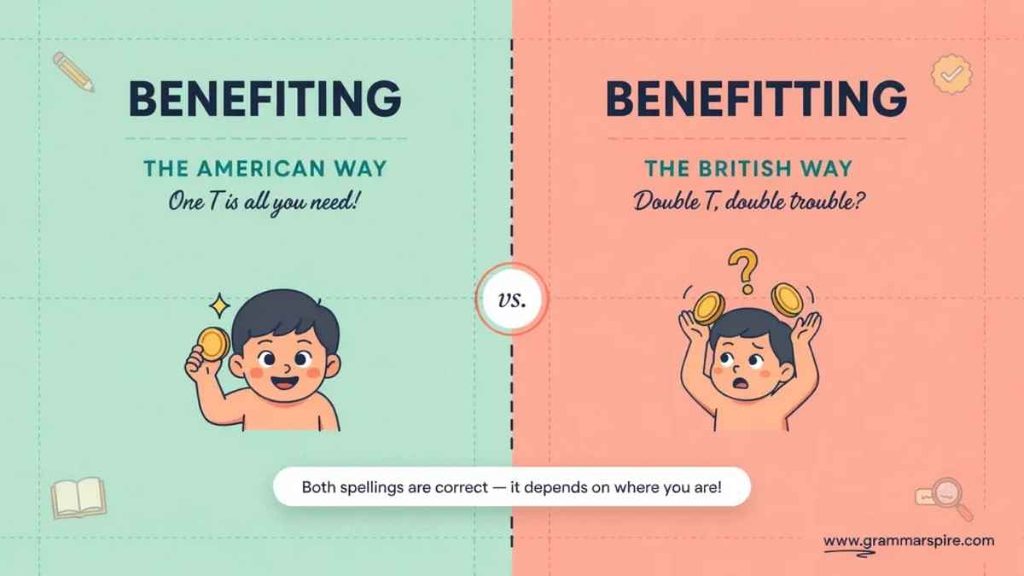
Benefiting and benefitting are forms of the same verb, benefit. They have the same meaning and perform the same grammatical functions. The main difference is spelling.
In US English, benefiting is the preferred spelling in many professional and editorial settings. In British English, benefitting is an established spelling variant, although benefiting is also used.
| Form | Meaning | US English | British English |
|---|---|---|---|
| benefiting | receiving or providing a benefit | Commonly preferred | Used |
| benefitting | receiving or providing a benefit | Recognized variant | Commonly used in some British styles |
| benefit | Base verb | Standard | Standard |
| benefited | Past tense and past participle | Commonly preferred | Used |
| benefitted | Variant past form | Recognized | Used |
The important point is that the extra t does not create a different meaning.
For example:
The students are benefiting from the new program.
The students are benefitting from the new program.
Both sentences say that the students are receiving an advantage from the program.
Therefore, if you are asking, “Is it benefiting or benefitting?” the answer depends on the English variety and style you are following.
Learn the difference between similar English words the easy way
Finaly or Finally Which Spelling Is Correct?
What Does Benefiting Mean?

Benefiting Meaning and Definition
The benefiting meaning comes directly from the verb benefit. To benefit means to receive an advantage, gain something useful, improve because of something, or provide an advantage to someone or something.
The word can describe many kinds of positive results. A person can benefit from education. A company can benefit from increased sales. A community can benefit from better transportation. A student can benefit from additional practice.
For example:
The students are benefiting from the new study program.
Here, the students receive an advantage from the program.
The new policy is benefiting small businesses.
In this sentence, the policy provides an advantage to small businesses.
The verb benefit commonly appears with the preposition from when the subject receives an advantage.
For example:
She benefited from the advice.
The company benefited from the investment.
The children benefited from the additional support.
That same structure becomes benefiting when the action is ongoing:
She is benefiting from the advice.
The company is benefiting from the investment.
The children are benefiting from the additional support.
Benefiting as a Present Participle
Benefiting is the present participle form of benefit.
It commonly appears with a form of the verb be to create the present continuous tense.
For example:
The company is benefiting from higher demand.
Students are benefiting from the additional resources.
Local businesses are benefiting from increased tourism.
The word can also describe a noun:
Students benefiting from the program must complete the form.
Here, benefiting helps identify which students the sentence discusses.
Benefiting as a Gerund
The -ing form can also function as a gerund.
Consider this sentence:
Benefiting from experience takes time.
In this sentence, benefiting from experience acts as the subject.
That distinction is useful because the ending -ing does not automatically mean that a word functions as part of the present continuous tense. Its grammatical role depends on the sentence.
What Does Benefitting Mean?
Benefitting Meaning and Definition
The benefitting meaning is essentially the same as the meaning of benefiting.
Benefitting means receiving an advantage, gaining a useful result, improving because of something, or providing an advantage to someone or something.
For example:
The organization is benefitting from increased support.
The community is benefitting from the new facilities.
Employees are benefitting from additional training.
These sentences can use benefiting instead:
The organization is benefiting from increased support.
The community is benefiting from the new facilities.
Employees are benefiting from additional training.
The meaning does not change.
That extra t is a spelling difference, not a meaning difference.
Is Benefitting a Word?
Yes. Benefitting is an established English word form.
It functions as an -ing form of benefit, particularly in British English usage. Major dictionaries recognize the form, although dictionaries and style guides may differ in which variant they prefer.
Therefore, it is not accurate to treat every use of benefitting as a simple spelling mistake.
At the same time, American writers usually have a simpler choice. When writing in standard US English, benefiting is the preferred form in many editorial settings.
Learn the difference between similar English words the easy way
Hanukkah or Chanukah Which Spelling Is Correct?
Benefiting vs Benefitting What Is the Difference?
The difference between benefiting and benefitting can be understood through three simple ideas: spelling, regional preference, and style.
The spelling difference is obvious. Benefitting contains an additional t.
The regional difference explains why both forms appear in reputable English writing.
The meaning difference is essentially nonexistent.
| Point of comparison | Benefiting | Benefitting |
|---|---|---|
| Base word | benefit | benefit |
| Ending | ing | ing |
| Meaning | Same | Same |
| Pronunciation | Essentially the same | Essentially the same |
| Spelling | One t | Two t’s |
| Common US preference | Yes | Less common |
| British usage | Yes | Yes |
| Grammar | Same | Same |
So, which is correct?
Both forms are established. However, your intended variety of English should guide your choice.
Why Does Benefit Become Benefiting or Benefitting?
This is the part that often causes the real confusion.
The base word is benefit. When you add the suffix -ing, you might expect a simple formula:
benefit + ing = benefiting
That produces the common American spelling.
However, some English spelling conventions double the final consonant before a suffix. This produces:
benefit + ing = benefitting
The difference reflects the way English spelling conventions developed and how different varieties of English apply consonant-doubling patterns.
The Consonant Doubling Rule
English often doubles a final consonant before endings such as -ing or -ed.
Consider:
run → running
sit → sitting
stop → stopping
admit → admitting
However, the rule does not work identically with every English verb.
Word structure, syllable patterns, stress, spelling history, and regional conventions can all affect the final form.
That is why you should not assume that every word ending in t follows exactly the same pattern.
Benefit creates an especially interesting case because major dictionaries record both benefiting and benefitting.
Why Does Benefiting Have One T?
The one-t form, benefiting, is the standard choice in many American English contexts.
The Associated Press style tradition uses benefit, benefited, and benefiting. Therefore, writers following AP style should use benefiting.
This convention also makes the spelling particularly straightforward for American professional writing.
If you write:
The company is benefiting from the new system.
you are using the common American form.
Why Does Benefitting Have Two T’s?
The double-t form, benefitting, reflects a spelling convention found in British English and other varieties influenced by British spelling.
The form is established enough to appear in major dictionaries.
Therefore, the second t is not simply an accidental extra letter.
It represents a legitimate spelling variant.
Learn the difference between similar English words the easy way
usable vs useable Which Spelling Is Correct?
Benefiting or Benefitting in American English
If your question is specifically about benefiting or benefitting in American English, benefiting is the practical answer.
American English commonly uses:
benefit
benefited
benefiting
This pattern appears in professional writing, journalism, business communication, educational material, and general American English.
For example:
The company is benefiting from increased customer demand.
Students are benefiting from additional practice.
The neighborhood is benefiting from improved public transportation.
The organization is benefiting from stronger community support.
If your article, report, website, or assignment follows US English, benefiting will usually fit the expected spelling style.
Is Benefitting Correct in American English?
Benefitting is recognized as a spelling variant, so it is too strong to call it an impossible or meaningless form.
However, recognition does not mean that every American style guide prefers it.
That distinction matters.
A dictionary may record a variant because speakers and writers use it. A style guide may still recommend another form for consistency within a particular publication.
Therefore, American writers who want the most straightforward editorial choice should use benefiting.
Benefiting or Benefitting in British English
The question becomes more flexible when discussing benefiting or benefitting in British English.
British English uses both forms.
Benefitting has a strong association with British spelling, yet benefiting also appears in British dictionaries and actual usage.
That means the statement “British English always uses benefitting” goes too far.
A more accurate explanation is this:
British English permits and uses both spellings, while benefitting is a well-established British variant.
For example:
The company is benefiting from the change.
The company is benefitting from the change.
Both sentences can appear in British English.
The best choice depends on the publication’s preferred spelling convention.
Benefiting or Benefitting UK English
When writing UK English, consistency matters more than trying to force every word into one mechanical spelling formula.
For example, if a publication consistently uses British spellings such as travelling and labelled, it may also prefer benefitting.
However, that does not mean every British writer must use the double-t form.
English spelling has regional variation, and dictionaries often document that variation rather than eliminating it.
Learn the difference between similar English words the easy way
Manuel or Manual Which spelling is correct?
Benefiting or Benefitting Correct Spelling for US English
If you are writing for an American audience, use benefiting unless a particular source or house style requires another form.
This is especially useful for:
American websites
US business documents
American school assignments
US journalism
Marketing material for American readers
Content following AP style
For example:
The new training program is benefiting employees.
That sentence fits a standard American spelling style.
The same principle applies to the related past-tense form.
American editorial style commonly uses:
benefited
rather than:
benefitted
So the American pattern is easy to remember:
benefit → benefited → benefiting
Benefiting vs Benefitting Grammar
The grammar does not change when the spelling changes.
Both benefiting and benefitting can function as a present participle.
For example:
The students are benefiting from the course.
The students are benefitting from the course.
Both can also work as gerunds:
Benefiting from experience requires patience.
Benefitting from experience requires patience.
The sentence structure remains the same.
Only the spelling changes.
Benefit Verb Forms
The word family becomes easier to understand when you compare the main forms.
| Form | Example |
|---|---|
| benefit | Students benefit from practice. |
| benefits | Regular practice benefits students. |
| benefited | The students benefited from the course. |
| benefitted | The students benefitted from the course. |
| benefiting | The students are benefiting from the course. |
| benefitting | The students are benefitting from the course. |
| beneficial | The course was beneficial. |
| beneficiary | The student became a beneficiary of the program. |
The related forms make one fact particularly clear: the spelling variation does not create a separate verb.
Learn the difference between similar English words the easy way
Tweek or Tweak Which Spelling Is Correct?
Benefiting in a Sentence
If you need benefiting in a sentence, the most natural structure often uses benefiting from.
The students are benefiting from the new resources.
The company is benefiting from increased demand.
Employees are benefiting from flexible working arrangements.
The community is benefiting from improved transportation.
Small businesses are benefiting from the additional support.
The construction uses the same grammatical pattern:
subject + be + benefiting + from + source of benefit
For example:
The students + are + benefiting + from + the new resources.
This structure appears frequently in everyday, academic, business, and professional writing.
How to Use Benefiting in a Sentence
Use benefiting when the subject is receiving or experiencing an advantage.
For example:
The patient is benefiting from the treatment.
The patient receives a positive result from the treatment.
You can also use benefiting when an organization or group gains an advantage:
The company is benefiting from improved efficiency.
Here, the company gains an advantage from the change.
Benefitting in a Sentence
Benefitting works in exactly the same grammatical structures.
The students are benefitting from the new resources.
The company is benefitting from increased demand.
Employees are benefitting from flexible working arrangements.
The community is benefitting from improved transportation.
The construction is identical to the one used with benefiting.
Only the spelling differs.
How to Use Benefitting in a Sentence
Use benefitting when your chosen English variety or style guide accepts or prefers that spelling.
For example:
The company is benefitting from the new investment.
The students are benefitting from additional tutoring.
The community is benefitting from the improved facilities.
If your publication uses benefiting throughout, however, keep the one-t spelling.
Benefiting Examples and Benefitting Examples
A side-by-side comparison makes the distinction especially clear.
| Benefiting | Benefitting |
|---|---|
| The company is benefiting from the investment. | The company is benefitting from the investment. |
| Students are benefiting from the new program. | Students are benefitting from the new program. |
| Employees are benefiting from the training. | Employees are benefitting from the training. |
| The community is benefiting from the project. | The community is benefitting from the project. |
| Farmers are benefiting from better equipment. | Farmers are benefitting from better equipment. |
Notice that the meaning does not change.
The subject remains the same. The verb remains in the same tense. The preposition remains the same. The only change is the spelling of the -ing form.
Learn the difference between similar English words the easy way
Quiet or Quite What Is the Difference?
Common Mistakes
Treating Them as Different Words
Benefiting and benefitting do not represent two separate concepts.
Both come from benefit.
Therefore, you should not search for a different definition simply because one form has an additional t.
Assuming the Extra T Changes the Meaning
It does not.
The following sentences mean the same thing:
The business is benefiting from the investment.
The business is benefitting from the investment.
The spelling changes, but the message remains intact.
Calling Benefitting Always Wrong
That claim ignores established English usage.
Benefitting is a recognized form, especially in British English.
Therefore, seeing it in a British publication does not automatically mean that the writer made a spelling mistake.
Assuming British English Always Requires Two T’s
That claim is also too broad.
British English uses both benefiting and benefitting.
Consequently, the better explanation focuses on preference and convention rather than an absolute rule.
Mixing the Two Forms Without a Reason
Switching between benefiting and benefitting in the same article can make the writing look inconsistent.
For example:
The company is benefiting from the change, while its employees are benefitting from the new training.
There is no grammatical disaster here, but the inconsistent spelling may distract readers.
A consistent version would be:
The company is benefiting from the change, while its employees are benefiting from the new training.
Or, under a style that prefers the doubled form:
The company is benefitting from the change, while its employees are benefitting from the new training.
Consistency keeps the writing clean.
How to Spell Benefiting
If you are asking how to spell benefiting, write:
benefiting
It contains one t before the -ing ending.
The simple American spelling pattern is:
benefit → benefiting
For US English writing, this is the form to remember.
A useful memory aid is:
Benefit keeps one t when it becomes benefiting.
The word may look as though it wants another t, but American English usually leaves the consonant alone.
How to Spell Benefitting
If you are asking how to spell benefitting, write:
benefitting
It contains two t’s before the -ing ending.
The spelling pattern is:
benefit → benefitting
This form is well established, particularly in British English usage.
So the visual distinction is simple:
benefiting = one t
benefitting = two t’s
The harder part is not spelling either word. It is knowing when your chosen style calls for one form rather than the other.
One T or Two T in Benefiting?
If you are asking whether benefiting has one t or two, the answer is:
One t.
The standard American form is:
benefiting
If you are writing in British English, however, you may also encounter:
benefitting
Therefore, the question is better framed as a regional spelling question rather than a simple spelling test.
One T or Two T in Benefitting?
Benefitting has two t’s.
The spelling is:
benefitting
It is an established variant and appears particularly often in British English contexts.
The key is not to confuse the extra t with a change in pronunciation or meaning.
There is no separate definition waiting behind the second t.
Learn the difference between similar English words the easy way
Noisey or Noisy Which Spelling Is Correct?
What About Benefited and Benefitted?
The same spelling variation appears in the past tense and past participle.
You may see:
benefited
and:
benefitted
American editorial style generally favors benefited, while benefitted is also recognized in English usage.
That gives you two related patterns:
benefit → benefited → benefiting
benefit → benefitted → benefitting
The first pattern fits common American editorial usage particularly well. The second appears in British English and other varieties that use the doubled consonant.
Benefit, Benefits, Benefited, and Beneficial
Understanding the wider word family makes the spelling question much easier.
Benefit can function as a noun or a verb.
As a noun, it refers to an advantage, useful effect, or form of assistance.
For example:
The new system offers several benefits.
As a verb, benefit means to help or to receive an advantage.
For example:
The new system benefits employees.
Employees benefit from the new system.
The related adjective beneficial means helpful or useful.
For example:
The changes had a beneficial effect on the company.
The word beneficiary refers to someone who receives a benefit, especially under a legal, financial, insurance, or charitable arrangement.
These forms connect naturally:
benefit → benefits → benefited → benefiting → beneficial → beneficiary
The spelling question concerns only particular forms of the verb.
Benefiting vs Benefitting Pronunciation
The spelling difference does not create a meaningful pronunciation difference.
Both forms are pronounced in essentially the same way in ordinary English speech.
That fact explains why listening alone cannot help you decide whether to write benefiting or benefitting.
Someone can say the word perfectly and still have no clue which spelling a particular style guide expects.
In other words, your ears will not solve this spelling puzzle. Your knowledge of English spelling conventions will.
Is Benefiting a Word?
Yes.
Benefiting is an established English word form. It functions as the present participle and gerund form of benefit.
It appears naturally in sentences such as:
The company is benefiting from the change.
Benefiting from experience takes time.
The students benefiting from the program must register first.
Therefore, there is no question about whether benefiting is a legitimate English word.
Is Benefitting a Word?
Yes.
Benefitting is also an established English word form.
It functions in the same grammatical ways as benefiting.
For example:
The company is benefitting from the change.
Benefitting from experience takes time.
The students benefitting from the program must register first.
The difference lies in spelling convention rather than grammatical function.
Benefiting or Benefitting AP Style
For writers following AP style, the choice is straightforward.
AP style uses:
benefit
benefited
benefiting
Therefore, American journalists and other writers following AP style should use benefiting.
For example:
Consumers are benefiting from lower prices.
Students are benefiting from the new program.
The company is benefiting from increased demand.
This is particularly useful when a publication requires a consistent American editorial style.
Learn the difference between similar English words the easy way
Receipt or Reciept Which Spelling Is Correct?
Benefiting or Benefitting in Professional Writing
Professional writing needs consistency more than clever spelling decisions.
Imagine a report that uses benefiting on one page and benefitting on the next without any regional or editorial reason. Readers may understand both forms, but the inconsistency can make the document look less carefully edited.
If your document follows US English, choose benefiting.
If your organization follows a British English style that uses benefitting, choose benefitting.
Then keep that choice throughout the document.
This approach works especially well for:
business reports
websites
academic papers
marketing material
news articles
professional emails
instructional content
Consistency creates a smoother reading experience.
A Simple Case Study
Consider two versions of the same sentence.
American-style version:
The company is benefiting from the new technology.
British style version:
The company is benefitting from the new technology.
Now compare their meanings.
Both say that the company receives an advantage from the technology.
1.Nothing about the subject changes. 2. Nothing about the action changes. 3.Nothing about the result changes.
Only the spelling changes.
Now imagine an article that uses American spelling throughout:
The company is benefiting from the new technology. Its employees are benefiting from improved training. Customers are also benefiting from faster service.
The repeated one-t form creates a consistent pattern.
If a British publication prefers the doubled form, it may instead use:
The company is benefitting from the new technology. Its employees are benefitting from improved training. Customers are also benefitting from faster service.
Again, consistency does the heavy lifting.
When Should You Use Benefiting?
Use benefiting when you are writing in US English or following an American style guide that prefers the one-t form.
It works naturally in everyday writing, professional documents, academic material, journalism, and online content.
For example:
The students are benefiting from additional resources.
The business is benefiting from higher demand.
The organization is benefiting from stronger cooperation.
If your audience expects American spelling, benefiting is the clearest choice.
Learn the difference between similar English words the easy way
Verbage or Verbiage Which Spelling Is Correct?
When Should You Use Benefitting?
Use benefitting when your chosen spelling convention calls for the double-t form, particularly in British English contexts where the form is established.
For example:
The students are benefitting from additional resources.
The business is benefitting from higher demand.
The organization is benefitting from stronger cooperation.
However, remember that British English also uses benefiting. Therefore, you should follow the relevant publication or house style instead of assuming that every British writer must use two t’s.
Common Synonyms for Benefiting
Benefiting can sometimes be replaced with another expression, but the exact choice depends on context.
Possible alternatives include gaining, improving, profiting, receiving benefits, gaining an advantage, making use of, deriving benefit, and receiving a positive result.
However, these words do not always mean precisely the same thing.
For example:
The company is benefiting from the investment.
The company is profiting from the investment.
The second sentence suggests financial gain more strongly. The first sentence can describe financial, practical, operational, or general advantages.
Likewise:
The student is benefiting from extra practice.
The student is gaining an advantage from extra practice.
Both work, but the second sounds more focused on the advantage itself.
Therefore, benefit remains the better choice when you want a broad expression for receiving or producing a positive effect.
Learn the difference between similar English words the easy way
Advise or Advice which spelling is correct?
A Quick Memory Guide
The easiest way to remember the distinction is to connect the spelling with the regional style.
| Situation | Useful choice |
|---|---|
| US English | benefiting |
| AP style | benefiting |
| American professional writing | benefiting |
| British English | benefiting or benefitting |
| British style that prefers doubled consonants | benefitting |
| Dictionary discussion | Both forms may appear |
| Consistent document | Choose one form and keep it consistent |
The shortest memory trick is simple:
benefiting = one t
benefitting = two t’s
US English generally favors the first form.
British English allows both, with the second form strongly established.
Here’s a trusted source for clear more words Comparison:
Grammar Update
Practice Session
Test your understanding of benefiting, benefitting, benefited, benefitted, benefit, benefits, and beneficial. Choose the word that best completes each sentence.
Fill in the Blanks
- The students are ________ from the additional reading sessions.
- Regular exercise can ________ your overall well-being.
- The company ________ greatly from the new marketing strategy last year.
- The new training program is ________ to employees.
- Many customers are ________ from the improved service.
- The organization has ________ from increased community support.
- Healthy habits provide several long-term ________.
- The scholarship ________ students from low-income families.
- The business is ________ from its investment in technology.
- She ________ from the advice given by her teacher.
- The project has proved ________ for the local community.
- Several workers are ________ from the flexible schedule.
- The patients ________ from the improved facilities.
- The new system offers financial ________ to small businesses.
- The charity program is ________ many families in the area.
- Choose the correct spelling: The children are ________ from the new program.
a) benefiting
b) benefitting - Choose the correct spelling: The company ________ from the agreement last year.
a) benefited
b) benefitted - In American English, the commonly preferred spelling is ________.
a) benefiting
b) benefitting - Both benefiting and benefitting have the same ________.
a) meaning
b) pronunciation only - The correct spelling of the noun is ________, not benifit.
- The adjective meaning “helpful or useful” is ________.
- The plural form of benefit is ________.
- The verb phrase “benefit from” means to ________ an advantage from something.
- The past tense form commonly used in American English is ________.
- In the sentence “The students are benefiting from the course,” benefiting functions as the ________ form of the verb.
- In “The new policy benefits employees,” benefits is the ________-person singular form of the verb.
- Someone who gains an advantage from an opportunity is ________ from it.
- The spelling ________ contains one t before the -ing ending.
- The spelling ________ contains two t’s before the -ing ending.
- If a publication follows a specific spelling guide, writers should use the preferred form ________ throughout the article.
Answer Section
- benefiting
- benefit
- benefited
- beneficial
- benefiting
- benefited
- benefits
- benefits
- benefiting
- benefited
- beneficial
- benefiting
- benefited
- benefits
- benefiting
- benefiting or benefitting
- benefited or benefitted
- benefiting
- meaning
- benefit
- beneficial
- benefits
- gain
- benefited
- present participle
- third
- benefiting
- benefiting
- benefitting
- consistently
FAQs
Is benefiting one T or two?
Benefiting has one t before the -ing ending. It comes from benefit, giving the spelling benefit → benefiting. However, benefitting with two t’s is also an established variant. Oxford lists both forms, while Cambridge shows benefiting as its present participle.
What is the meaning of benefitting?
Benefitting means gaining an advantage, receiving help, or experiencing a positive effect. It has the same meaning as benefiting. For example, “The students are benefitting from the new library” means they are gaining an advantage from it.
What is the difference between benefited and benefitted?
Benefited and benefitted have the same meaning and serve as past forms of benefit. The difference is spelling: benefited contains one t, whereas benefitted contains two. Oxford lists both versions.
How do you spell benefited in English?
The spelling benefited uses one t before -ed. For example, “She benefited from the additional training.” The variant benefitted also appears in English, so the preferred form can depend on regional or style conventions.
Is benefitting or benefiting correct?
Both spellings are recognized. Benefiting is widely used in American English, while British English also uses benefitting. Oxford records both forms, and Cambridge marks the verb as having -t- or -tt- variation.
What is another word for benefiting?
Depending on the context, suitable alternatives include gaining, profiting, improving, advancing, helping, or receiving an advantage. The most natural replacement depends on what the subject actually gains.
Is benefited grammatically correct?
Yes. Benefited is a grammatically correct past-tense and past-participle form of benefit. For example, “The company benefited from the new policy.” Oxford lists benefited as a standard verb form and also records benefitted as a variant.
How do you pronounce benefiting?
Benefiting is pronounced with the main stress on the first syllable. The pronunciation remains the same whether the spelling contains one t or two.
What is the past tense of the verb benefit?
The past tense is benefited. Benefitted is also used as a variant. Both forms refer to an earlier action or situation in which someone gained an advantage or received help.
How do you spell benefiting in Canada?
Benefiting is a recognized Canadian spelling. Because Canadian English draws on both British and American conventions, you may also encounter benefitting. The important point is to follow the spelling system used consistently throughout your writing.
Which is correct, benefit or benifit?
Benefit is correct. Benifit is a misspelling. Benefit can work as either a noun or a verb. As a noun, it refers to an advantage or helpful effect. As a verb, it means to gain from something or to help someone.
What does benefited mean?
Benefited means gained an advantage, received help, or experienced a useful effect in the past. For example, “The community benefited from the new park” means the community gained something positive from it.
What is a better word for benefit?
The best alternative depends on the sentence. Advantage, gain, help, value, profit, improvement, and positive effect can work in different contexts. However, each word carries a slightly different nuance, so replacing benefit requires attention to meaning.
Is benefits spelled correctly?
Yes. Benefits is correct. It can serve as the plural noun form of benefit or as the third-person singular form of the verb. For example, “The job offers several benefits” uses the noun, while “Regular exercise benefits your health” uses the verb.
What is the verb for beneficial?
The related verb is benefit. Beneficial is an adjective meaning helpful, useful, or producing a positive effect. For example, “The program is beneficial to students” can be expressed as “The program benefits students.”
AEO
Which is correct, benefiting or benefitting?
Both benefiting and benefitting are recognized spellings. Benefiting uses one t, while benefitting uses two. American English commonly uses benefiting, while British English uses both forms. Oxford lists both variants.
Is benefiting correct in American English?
Yes. Benefiting is a standard American English spelling. It follows the form benefit + -ing without doubling the final t.
Is benefitting correct in British English?
Yes. Benefitting is an established British English spelling, although benefiting also occurs. Therefore, British usage does not require the double-t version in every situation.
What does benefiting mean?
Benefiting means gaining an advantage, receiving help, or experiencing a positive effect. The verb can also describe something that helps another person, organization, or group.
What does benefitting mean?
Benefitting has the same meaning as benefiting. The two forms differ in spelling rather than definition. For example, both can describe someone gaining an advantage from education, training, exercise, or an opportunity.
Is benefited or benefitted correct?
Both spellings are used. Benefited contains one t, whereas benefitted contains two. Oxford records both forms, with the same pronunciation and meaning.
Why does benefit become benefiting?
The standard -ing form is benefiting. English spelling does not apply consonant doubling in exactly the same way to every verb, so the spelling of benefit does not automatically require a doubled t. Regional usage also accounts for the variant benefitting.
Is benifit a correct spelling?
No. Benifit is incorrect. The correct spelling is benefit.
What is the difference between benefit and beneficial?
Benefit can function as a noun or verb, whereas beneficial is an adjective. Benefit refers to an advantage or the act of helping or gaining from something. Beneficial describes something that produces a helpful or useful effect.
What are the forms of benefit?
Common forms include benefit, benefits, benefited, benefitted, benefiting, and benefitting. The one-t and two-t variants occur in different spelling traditions. Oxford records both benefited and benefitted as past forms and both benefiting and benefitting as -ing forms.
What does benefit from mean?
Benefit from means to gain an advantage or receive a positive effect from something. For example, “Employees benefit from flexible working hours” means employees gain an advantage from that arrangement.
Is benefiting the same as gaining?
Not always. The meanings overlap when someone receives an advantage, but gaining has a broader sense. You can gain knowledge, experience, confidence, money, or weight, while benefiting usually emphasizes a helpful or positive outcome.
What is the difference between benefit and beneficial?
Benefit is a noun or verb, while beneficial is an adjective. For example, “The course provided a benefit” uses benefit as a noun. “The course was beneficial” uses beneficial to describe the course.
How do you remember the spelling of benefiting?
For American English, remember the straightforward form benefit + ing = benefiting. If you write for a British audience, benefitting may also be appropriate. When a particular style guide or publication requires one form, follow that convention consistently.
Does benefiting have the same pronunciation as benefitting?
Yes. The spelling difference does not create a different pronunciation. Both forms represent the same -ing form of benefit and are pronounced alike. Oxford gives the same pronunciation for the two variants.
Final Answer
The difference between benefiting and benefitting may look like a tiny spelling issue, but that extra t can create plenty of confusion. Fortunately, both forms are recognized in English and have the same meaning. Benefiting is commonly preferred in American English, while benefitting is also well established, especially in British English. The same regional variation can appear in benefited and benefitted. Therefore, consider your audience and follow the spelling convention required by your publication or style guide. Most importantly, remain consistent throughout your writing. Once you understand the regional distinction, choosing between these forms becomes simple. After all, English has enough surprises without letting one little t steal the spotlight.

Ella AJS
Ella AJS is an experienced blogger and language enthusiast at Grammar Spire, dedicated to making English grammar simple, practical, and easy to understand. She specializes in word comparisons, meanings, usage, and common language confusions. Through clear explanations and engaging examples, Ella helps students, writers, and English learners improve their vocabulary and communicate with greater confidence and accuracy.