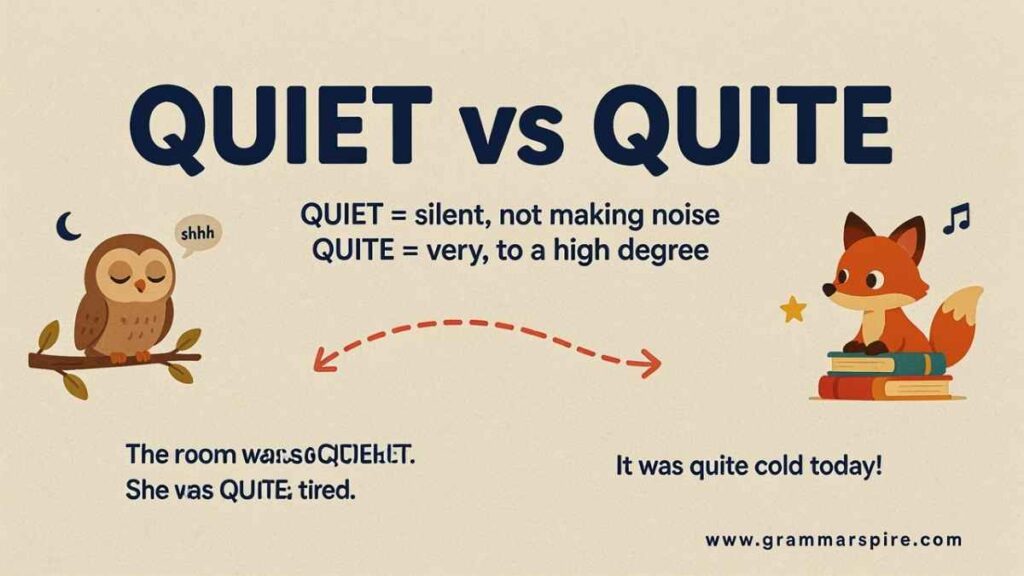
Quiet or quite can cause an oddly big amount of confusion for two words that differ by just one letter. They look similar, but their meanings and grammatical roles are completely different. Quiet relates to little or no noise, while quite is an adverb used to express degree, emphasis, or completeness. Mix them up, and a peaceful sentence can quickly become a grammar puzzle. The good news? The difference is easier to understand than it first appears. This guide breaks down their meanings, pronunciation, grammar rules, common mistakes, and practical examples, helping you choose the right word confidently without second guessing every sentence you write or speak.
Quick Answer
Quiet describes something that makes little noise or has little activity.
Quite changes the strength or degree of another word. It can mean fairly, rather, very, or completely, depending on the context.
For example:
| Word | Meaning | Example |
|---|---|---|
| Quiet | Having little noise or activity | The library is quiet. |
| Quite | To a certain degree, very, or completely | The movie was quite interesting. |
The easiest way to remember the distinction is this:
Quiet is about sound, calmness, or activity.
Quite is about degree.
That small distinction solves most usage problems.
Learn the difference between tricky grammar more words
Seel or Seal Which one is correct?
What Does Quiet Mean?
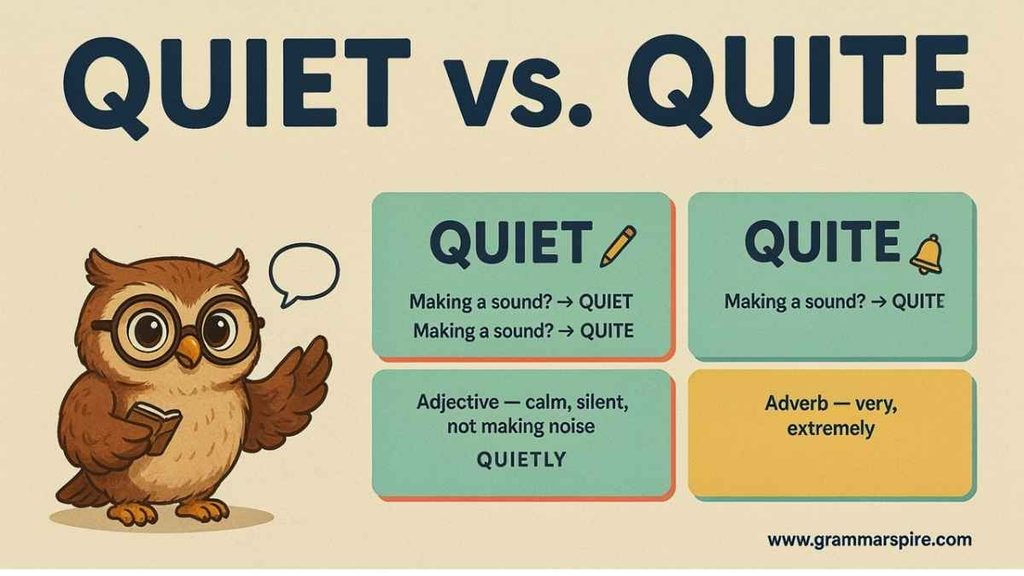
It is mainly used as an adjective. It describes a person, place, sound, situation, or environment that has little noise or activity.
For example, you might describe a room as quiet because nobody is talking.
The word can also work as a noun and a verb, so its use is slightly broader than many learners realize.
as an Adjective
As an adjective, it describes something that produces little noise or creates a calm atmosphere.
Consider these examples:
The classroom became quiet after the teacher entered.
She spoke in a quiet voice.
I enjoy quiet mornings before everyone wakes up.
In each sentence, the word describes a condition of low noise or limited activity.
However, quiet does not always mean complete silence. A quiet room can still have a clock ticking, birds singing outside, or people speaking softly. The main idea is that the sound or activity is low.
as a Noun
It can also be used as a noun when you are talking about a peaceful or calm state.
For example:
I enjoy the quiet of the countryside.
After a long day, I need some peace and quiet.
Here, the word refers to the state of having little or no noise.
This use often appears with the phrase “peace and quiet,” which is a very common expression in everyday English.
as a Verb
It can also function as a verb. In this form, it means to make someone or something calmer or less noisy.
For example:
The teacher asked the students to quiet down.
The mother tried to quiet the crying baby.
You will often see the expression “quiet down.” It means to become less noisy or to make something less noisy.
The children eventually quieted down after lunch.
This form is useful because it shows that the word is not limited to describing silence or low noise.
Learn the difference between tricky grammar more words
High School or Highschool What Is the Correct Spelling?
What Does Quite Mean?
Quite has a completely different job.
It is an adverb, which means it usually modifies an adjective, another adverb, or sometimes a verb. Its meaning depends on the context and, in particular, on the word that follows it.
In many situations, quite means fairly, rather, or to a moderate degree.
For example:
The test was quite difficult.
The restaurant is quite expensive.
She was quite tired after the trip.
The weather is quite cold today.
In these examples, quite adds strength to the description without necessarily meaning “completely.”
However, the word can also express a stronger meaning.
Quite Meaning Fairly or Rather
When quite modifies a gradable adjective, it often means fairly, rather, or moderately.
For example:
The book was quite interesting.
The room is quite small.
He is quite nervous.
The journey was quite long.
These sentences tell you that the quality exists to a noticeable degree. The exact strength depends on the context and the speaker.
For instance, “The movie was quite good” could mean that the movie was fairly good. In another situation, the speaker might use the same phrase to express stronger approval.
That is one reason this word can sometimes feel confusing to English learners.
Quite Meaning Completely
In other contexts, quite can mean completely, entirely, or absolutely.
For example:
You are quite right.
That is quite impossible.
The two situations are quite different.
I am quite certain about the answer.
Here, the meaning is stronger.
“You are quite right” means “You are completely right.”
“That is quite impossible” means “That is completely impossible.”
The meaning therefore depends on the type of word being modified and the context in which the sentence appears. Cambridge notes that the word can express different degrees, including meanings close to “fairly” and “completely.”
Quite in “Not Quite”
One particularly common expression is “not quite.”
It means something is almost true or almost complete, but not entirely.
For example:
The answer is not quite correct.
I am not quite ready.
The project is not quite finished.
That is not quite what I meant.
The phrase is useful because it clearly shows the idea of “almost, but not completely.”
If someone says, “The job is not quite finished,” the job is nearly complete, but something still needs to be done.
Learn the difference between tricky grammar more words
Attornies or Attorneys Which Spelling Is Correct?
The Main Difference
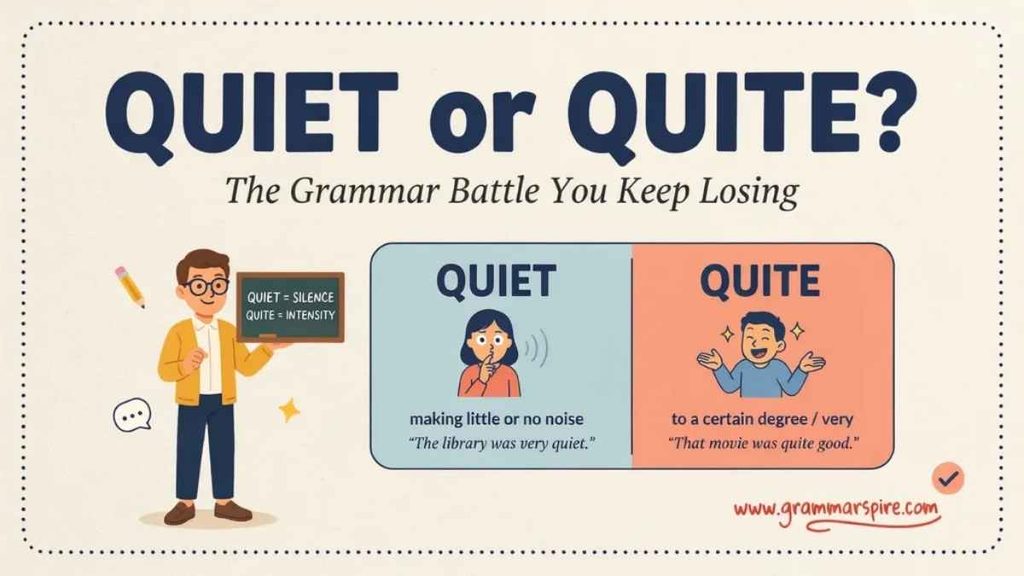
The easiest way to separate the two is to ask yourself what you are trying to describe.
If you are talking about noise, calmness, or a lack of activity, use quiet.
If you are talking about the degree or strength of something, use quite.
Compare these sentences:
The baby is quiet.
The baby is quite tired.
In the first sentence, quiet describes the baby’s behavior or level of noise.
In the second, quite tells us how tired the baby is.
Now look at another pair:
It is a quiet neighborhood.
It is quite a large neighborhood.
The first sentence describes the amount of noise or activity. The second describes the size and adds a degree of emphasis.
That distinction is the key.
Learn the difference between tricky grammar more words
Seen or Saw What’s is the Difference?
Grammar How Each Word Works
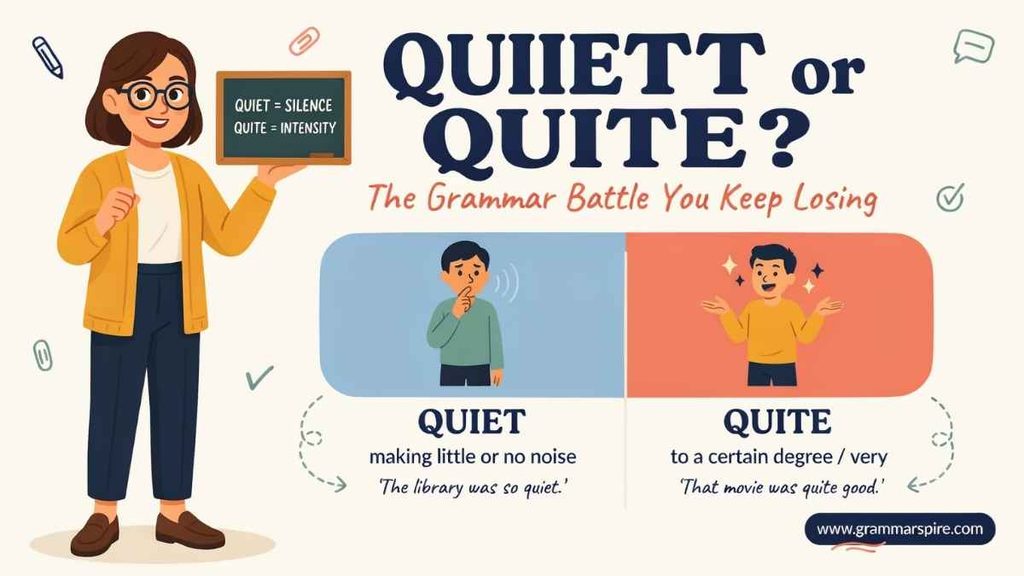
Grammar provides another useful way to keep them apart.
Quiet can be an adjective, noun, or verb.
Quite is an adverb.
This means you can use quiet to describe something directly:
a quiet room
a quiet person
a quiet street
a quiet conversation
Quite works differently because it modifies another word:
quite good
quite difficult
quite unusual
quite clearly
quite often
Quite does not describe a room as being “quite” in the same way that quiet describes a room.
For example, “This is a quiet room” is correct.
“This is a quite room” is incorrect.
However, “This room is quite quiet” is perfectly correct. In that sentence, quite modifies quiet. It tells us the degree of quietness.
That distinction is worth remembering because it explains many common mistakes.
Learn the difference between tricky grammar more words
More Than or More Then Which one is correct?
Spelling and Pronunciation
The spelling difference is small but important.
Quiet contains the letters q-u-i-e-t.
Quite contains the letters q-u-i-t-e.
The positions of e and t are reversed.
The pronunciation is different as well.
Quiet has two syllables: “KWY-uht.”
Quite has one syllable: “KWYT.”
So these words are not homophones.
They may look similar on the page, especially when you are typing quickly, but they do not sound the same when spoken.
A useful pronunciation trick is to slow down and say both words aloud:
quiet
quite
You can hear that quiet has an extra syllable.
Are Quiet and Quite Homophones?
No.
Homophones are words that sound the same but have different meanings or spellings. Quiet and quite do not meet that definition because their pronunciations are different.
For example:
quiet = /ˈkwaɪ.ət/
quite = /kwaɪt/
The difference may seem small at first, but it becomes much clearer when you say the words slowly.
This also explains why the mistake is especially common in writing. Someone may know the difference when speaking but accidentally switch the letters while typing.
Learn the difference between tricky grammar more words
Finaly or Finally Which Spelling Is Correct?
Quiet or Quite in a Sentence
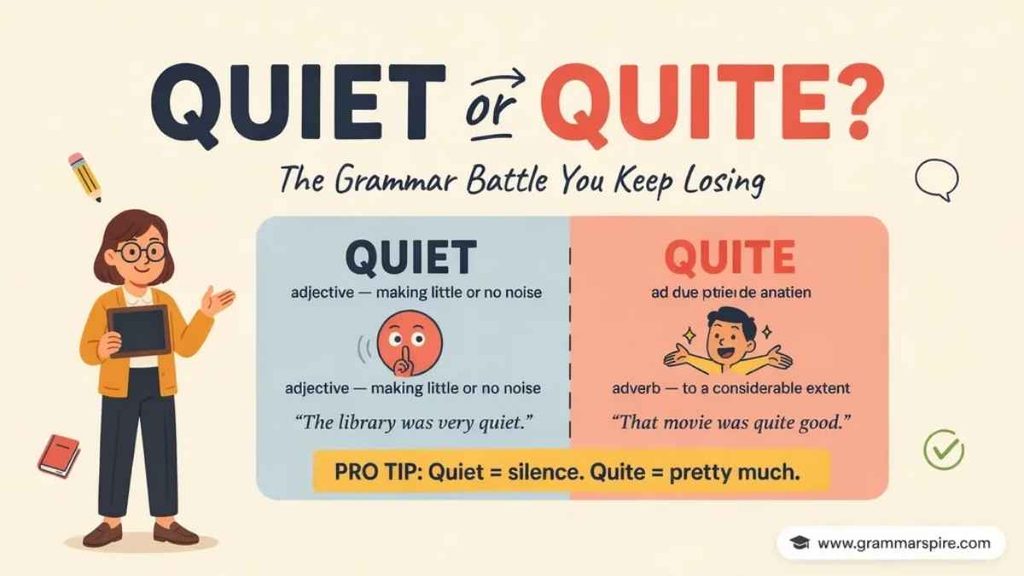
Looking at complete sentences is often the fastest way to understand the distinction.
Here are several examples using quiet:
The house was quiet after everyone went to bed.
Please keep your voice quiet during the exam.
We found a quiet place to read.
He is usually quiet in large groups.
The baby finally became quiet.
Now compare those with examples using quite:
The exam was quite difficult.
She is quite confident about her decision.
The new restaurant is quite popular.
That explanation was quite helpful.
I was quite surprised by the result.
Notice the pattern. The first group focuses on noise, calmness, or behavior. The second group focuses on degree.
Learn the difference between tricky grammar more words
Hanukkah or Chanukah Which Spelling Is Correct?
Common Mistakes
The most common error is using quite when quiet is needed.
For example:
Incorrect: Please be quite.
Correct: Please be quiet.
The first sentence changes the meaning because quite does not mean silent.
Another common mistake happens when people describe something as “quite” when they actually mean “quiet.”
Incorrect: We stayed in a quite room.
Correct: We stayed in a quiet room.
However, the following sentence is correct:
We stayed in a quite comfortable room.
Here, quite modifies comfortable. It means fairly or rather comfortable.
There is also another easily confused word: quit.
Quit means to stop doing something or to leave.
For example:
I decided to quit my job.
She quit smoking last year.
He wants to quit the team.
Therefore, the three words have three separate meanings:
Quiet relates to low noise or calmness.
Quite relates to degree or extent.
Quit relates to stopping or leaving.
Once you connect each spelling with its meaning, the confusion becomes much easier to avoid.
Quiet, Quite, and Quit
These three words are often confused because they look similar.
Consider this simple comparison:
| Word | Part of Speech | Main Meaning | Example |
|---|---|---|---|
| Quiet | Adjective, noun, verb | Little noise or calmness | The room is quiet. |
| Quite | Adverb | Degree or extent | The room is quite large. |
| Quit | Verb | Stop or leave | She decided to quit. |
Now put all three into a short example:
The office was quiet, but I was quite busy because I had decided not to quit until the work was finished.
Each word has a completely different role.
That is why spelling matters.
Learn the difference between tricky grammar more words
usable vs useable Which Spelling Is Correct?
How to Know Which Word to Use
When you are unsure, do not focus only on the spelling. Think about the meaning first.
Ask yourself: Am I talking about noise or calmness?
If the answer is yes, quiet is probably the word you need.
For example:
Keep the room quiet.
I like quiet places.
The street is quiet tonight.
Next, ask yourself: Am I showing how much, how strongly, or to what degree something is true?
If the answer is yes, quite may be appropriate.
For example:
The task is quite easy.
The weather is quite warm.
She was quite surprised.
Finally, ask whether you mean stop or leave.
If you do, the correct word is quit.
This meaning-first approach is much more reliable than trying to memorize spelling alone.
An Easy Memory Trick
Here is a simple way to remember the difference.
Think of the extra “e” in quiet as giving the word extra breathing room.
Quiet has two syllables, so it feels a little longer when you say it.
Quite is short and quick. It has only one syllable.
You can also connect the words with simple ideas:
Quiet = silence.
Quite = degree.
Quit = stop.
Three words. Three meanings.
Once you remember that pattern, you will probably catch the mistake before you finish typing.
Learn the difference between tricky grammar more words
Manuel or Manual Which spelling is correct?
Everyday Examples
In everyday conversation, you might hear phrases such as:
It is quiet here.
Please keep quiet.
The baby is sleeping, so be quiet.
This place is quite nice.
That was quite unexpected.
I am quite tired today.
The meeting was quite long.
The neighborhood becomes quiet after midnight.
The examples may seem simple, but that is exactly what makes them useful. Most grammar mistakes become easier when you connect a word with the situations in which people naturally use it.
Using the Words in Formal Writing
The distinction also matters in professional and academic writing.
Suppose you are describing an office:
“The office remained quiet throughout the afternoon.”
Here, the word describes the environment.
Now suppose you are evaluating a result:
“The results were quite significant.”
Here, the adverb adds degree to the adjective.
The same pattern works in reports, emails, essays, and everyday messages.
For example:
The area remained quiet throughout the evening.
The results were quite unexpected.
The new method is quite effective.
The laboratory was unusually quiet during the experiment.
Because the two terms perform different grammatical jobs, replacing one with the other can make a sentence incorrect or change its meaning.
Learn the difference between tricky grammar more words
Tweek or Tweak Which Spelling Is Correct?
Why People Confuse between quiet or quite
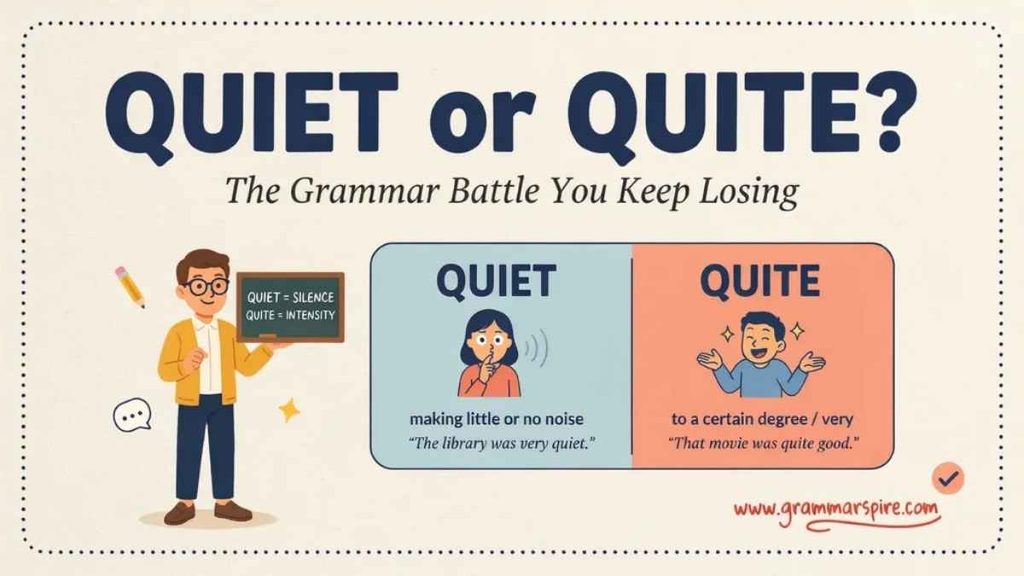
The confusion usually comes from appearance rather than meaning.
Both words begin with “qui.” Both contain the same basic letters. The only difference is the position of the final e and t.
Typing quickly makes the problem even easier to create.
There is also a pronunciation issue. People who are familiar with one word but have not paid attention to the other may not immediately notice that quiet has two syllables while quite has one.
For English learners, the problem can be even more noticeable because spelling and pronunciation in English do not always follow simple patterns.
Here’s a trusted source for clear more words Comparison:
Grammar Update
Practice Session
Choose the correct word to complete each sentence.
Use: quiet, quite, or quit.
Fill in the Blanks
Choose the correct word: quiet, quite, or quit.
- The room was very ______ after everyone left.
- She was ______ happy with her exam results.
- Please remain ______ during the presentation.
- He decided to ______ his job last month.
- The new book is ______ interesting.
- We found a ______ place to relax.
- I am ______ certain that she is right.
- The children became ______ after the teacher arrived.
- She spoke in a ______ voice.
- The movie was ______ difficult to understand.
- He wants to ______ smoking this year.
- I enjoy the peace and ______ of the countryside.
- That was ______ a surprise!
- The street becomes very ______ at night.
- She was ______ nervous before the interview.
- Please keep ______ while the baby is sleeping.
- They live in a ______ neighborhood.
- We have spent ______ a lot of money on this project.
- The students were asked to ______ down.
- He was ______ surprised by the news.
- The library is usually ______ in the morning.
- She decided to ______ the competition.
- The answer is not ______ correct.
- It was ______ a difficult decision.
- The hotel was peaceful and ______.
Answers
- quiet
- quite
- quiet
- quit
- quite
- quiet
- quite
- quiet
- quiet
- quite
- quit
- quiet
- quite
- quiet
- quite
- quiet
- quiet
- quite
- quiet
- quite
- quiet
- quit
- quite
- quite
- quiet
Frequently Asked Questions
What does “quite” mean?
“Quite” is an adverb used to show degree, extent, or emphasis. Depending on the sentence, it can mean fairly, rather, very, or completely.
For example, “The movie was quite interesting” can mean that it was fairly or noticeably interesting. In “You are quite right,” it means completely right. The surrounding words and context determine the intended strength.
What does “quite a” mean?
“Quite a” adds emphasis to a noun and can suggest that something is notable, unusual, impressive, or considerable.
For instance, “That was quite a surprise” emphasizes the strength of the surprise. Similarly, “She made quite an impression” suggests that her impression was especially noticeable.
The construction also appears in expressions such as “quite a few” and “quite a lot,” where it can indicate a considerable number or amount.
What does “quiet” mean?
“Quiet” describes something that has little noise, activity, or disturbance. It can describe a place, person, voice, environment, or situation.
For example, “The library is quiet” means that there is very little noise. Likewise, “He has a quiet voice” tells us that he speaks softly.
The term can also be used as a noun in “peace and quiet” and as a verb in “quiet down.”
Does “quite” mean to be silent?
No. The word associated with silence or low noise is “quiet.”
For example, “Please be quiet” asks someone to stop making noise. On the other hand, “The test was quite difficult” uses the adverb to describe the degree of difficulty.
Changing one letter can therefore change the entire meaning of a sentence.
Does “quite” have two meanings?
Yes. Its sense can change according to the word it modifies.
With a gradable description, it often means fairly, moderately, or rather. With certain absolute or non-gradable descriptions, it can mean completely or totally.
For example, “The room is quite small” may suggest that it is fairly small, while “You are quite right” means completely right.
What is another word for “quite”?
Possible alternatives include “fairly,” “rather,” “pretty,” “very,” “really,” and “completely.” However, the best replacement depends on the sentence.
For example, “quite difficult” may become “fairly difficult” when a moderate degree is intended. In “quite certain,” the natural alternative may be “completely certain.”
In American English, “pretty” is often used informally when the intended meaning is similar to “fairly” or “rather.”
What does “quite” actually mean?
At its core, the word expresses degree or emphasis. It does not have one fixed strength in every sentence.
For example, “quite warm” may indicate a moderate level of warmth, whereas “quite impossible” can express something much stronger.
Therefore, you should look at the entire sentence rather than trying to assign one meaning to the word every time it appears.
Is “quite literally” correct?
Yes, “quite literally” is grammatically correct.
The phrase is used to emphasize that something is true in its literal or exact sense.
For example:
“The building was quite literally shaking.”
This means the building was actually shaking. In careful writing, however, the expression works best when the statement genuinely has a literal meaning.
When should I use “quite” in a sentence?
Use it when you want to add information about degree, strength, or extent.
For example:
The room is quite large.
She was quite surprised.
The instructions are quite clear.
I quite agree.
The meaning can vary from fairly or noticeably to very or completely, depending on the construction and context.
What does “quite literally” mean?
It means that something is true in the exact, literal sense.
For example, “He was quite literally running out of time” emphasizes that the statement should not be understood merely as a figure of speech.
The phrase is often used for emphasis in conversation. In formal writing, though, it is better to use it when the literal meaning is genuinely important.
What can I say instead of “quite literally”?
You can often use “literally,” “actually,” “in fact,” or “in the literal sense,” depending on the sentence.
For example, instead of saying “It was quite literally impossible,” you could simply write “It was literally impossible.”
In many cases, removing the extra modifier makes the sentence cleaner without changing the meaning.
Is “quiet literally” or “quite literally” correct?
“Quite literally” is the correct expression when you mean literally or actually.
“Quiet” relates to low noise, silence, or calmness, so it does not work in this phrase.
For example, “The room was quiet” is correct, while “The room was quite literally empty” uses “quite” to add emphasis.
Do Americans use the word “quite”?
Yes. It is used in American English, although its usual strength can differ from British usage.
In American English, it commonly carries meanings such as very, really, or to a considerable degree. For example, “The situation is quite different” can emphasize a significant difference.
Can we say “quite a lot”?
Yes. “Quite a lot” is a standard English expression for a large amount or number.
For example:
We spent quite a lot of money.
She has quite a lot of experience.
The phrase can also describe frequency:
“I travel quite a lot.”
Similar expressions include “quite a few,” which refers to a fairly large number, and “quite a bit,” which commonly refers to a substantial amount.
Is “quite good” correct?
Yes. “Quite good” is a natural expression.
Depending on the variety of English and the context, it can mean fairly good, rather good, or very good. In British English especially, the intended strength can depend on the speaker’s tone and the adjective being modified.
Is “quite different” correct?
Yes. “Quite different” is completely natural.
Here, the adverb emphasizes the degree of difference. In many contexts, it means very or completely different.
For example:
The second plan is quite different from the first.
Is “quite quiet” correct?
Yes. Both words can appear together because they perform different grammatical jobs.
In “The classroom was quite quiet,” the second word describes the level of noise, while the first one shows its degree.
The sentence therefore means that the classroom was noticeably or very calm and silent.
Can “quite” be used before a noun?
Yes. A common pattern is “quite a” followed by a noun.
For example:
That was quite a mistake.
She is quite a talented writer.
We saw quite a crowd outside.
This structure adds emphasis and can highlight the size, importance, or unusual nature of something.
What does “not quite” mean?
“Not quite” usually means almost, but not completely.
For example:
I am not quite ready.
The answer is not quite correct.
The bottle is not quite empty.
In each case, something is close to being complete or true, but it has not reached that point yet.
Final Takeaway
By now, these two look alike words should feel much less confusing. The key is simple quiet describes silence, calm, or little noise, while quite adds degree or emphasis. If you mean “not noisy,” choose quiet. If you mean “rather,” “very,” or “completely,” depending on the context, choose quite. Then there’s quit, the third troublemaker, which means to stop or leave. One small spelling change can create a surprisingly big grammar mistake, but there’s no need to let these words trip you up. With a little practice, you’ll spot the difference instantly. Keep writing, keep learning, and let your sentences stay clear, confident, and quite mistake free.

Ella AJS
Ella AJS is an experienced blogger and language enthusiast at Grammar Spire, dedicated to making English grammar simple, practical, and easy to understand. She specializes in word comparisons, meanings, usage, and common language confusions. Through clear explanations and engaging examples, Ella helps students, writers, and English learners improve their vocabulary and communicate with greater confidence and accuracy.