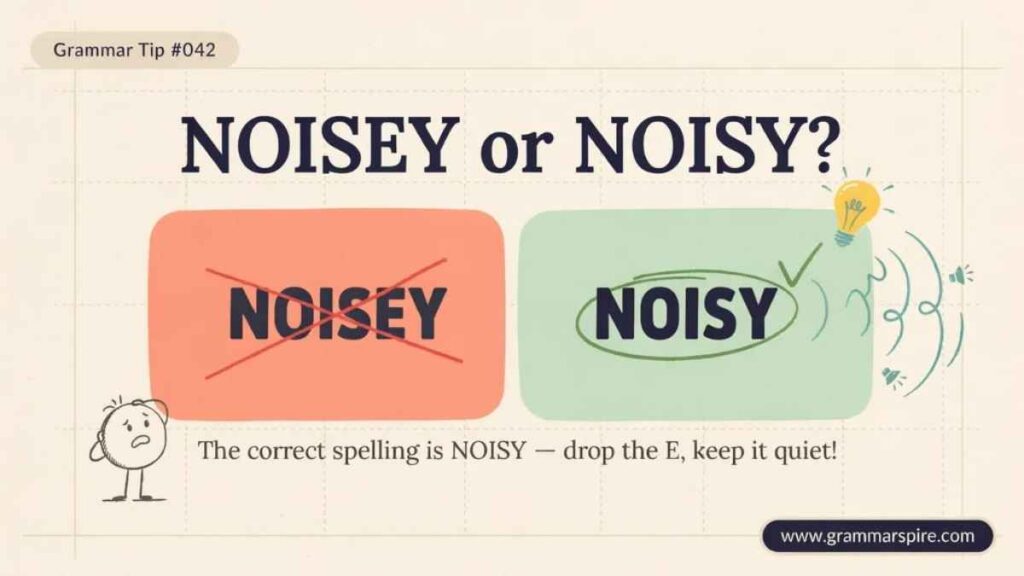
English spelling can create surprising confusion, and “noisey or noisy” is a perfect example. The extra “e” may seem reasonable because the word comes from “noise,” but standard English takes a different route. “Noisy” is the correct spelling when you describe something that produces a lot of sound, while “noisey” is generally considered a spelling error. Fortunately, this confusion is easier to settle than a noisy classroom. In this guide, you’ll discover the correct spelling, meaning, pronunciation, grammar, and everyday usage of “noisy.” You’ll also learn how it differs from similar words, explore practical examples, and discover simple ways to remember the correct form.
Quick Answer
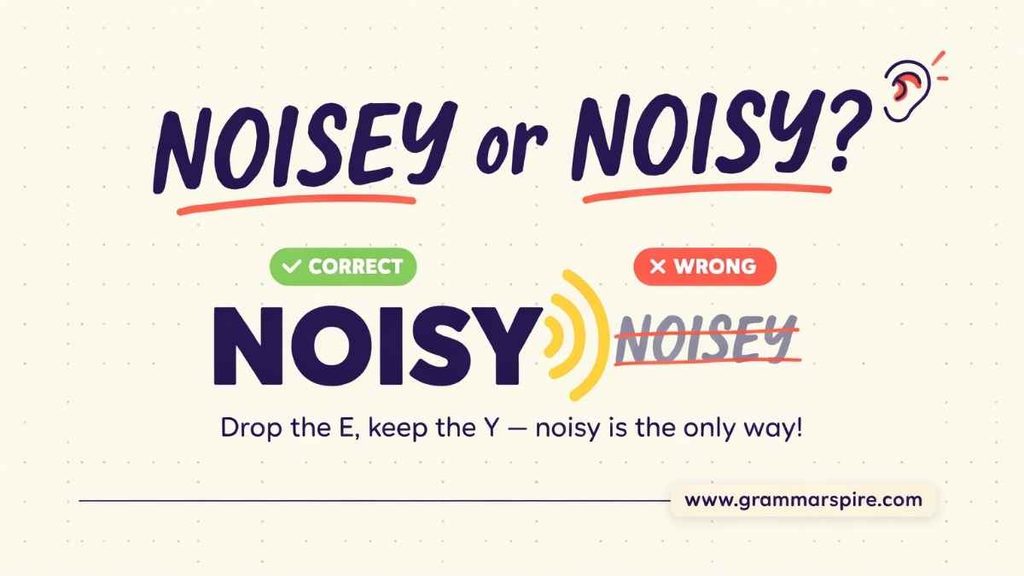
If you are asking, is it noisy or noisey, the answer is noisy.
Noisy is the standard spelling used in English. Noisey is generally an incorrect spelling when someone means “making a lot of noise” or “full of noise.”
The correct form is:
noisy
The incorrect standard-English form is:
noisey
For example:
The classroom became noisy after lunch.
The street is noisy during rush hour.
The old engine is unusually noisy.
You should not write:
The classroom became noisey after lunch.
The street is noisey during rush hour.
The old engine is noisey.
The easiest spelling rule to remember is:
noise → noisy
The final e in noise does not remain before the adjective ending y. This gives you the correct spelling immediately: n-o-i-s-y.
Oxford lists noisy as an adjective meaning “making a lot of noise” and also “full of noise.” It gives examples involving children, traffic, crowds, classrooms, offices, and streets.
Learn the difference between tricky grammar more words
High School or Highschool What Is the Correct Spelling?
What Does Noisy Mean?
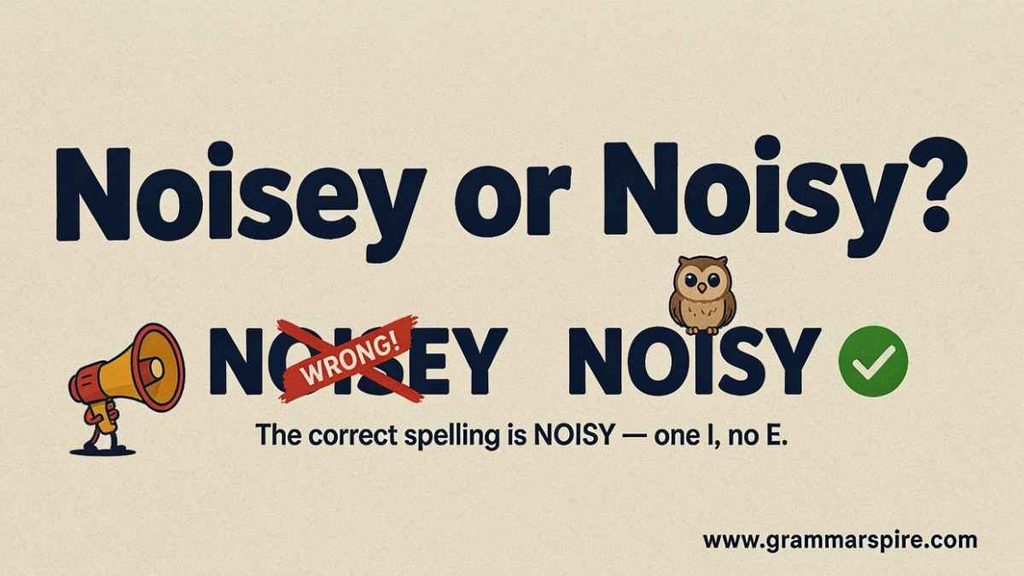
The noisy meaning is closely connected to the noun noise. In ordinary English, noisy describes something that produces a lot of sound or something surrounded by a substantial amount of sound.
For example, a noisy classroom contains a lot of talking, movement, laughter, or other sounds. A noisy engine produces noticeable sound while it operates. A noisy neighborhood contains enough activity and sound to make the environment less quiet.
The word therefore has a flexible meaning. It can describe people, animals, machines, vehicles, places, events, and environments.
Consider these examples:
The children are noisy.
The restaurant is noisy.
The traffic is noisy.
The air conditioner is noisy.
The neighborhood is noisy at night.
The office became noisy after the meeting.
In each example, noisy tells you something about sound.
Oxford separates two closely related uses. A person, group, machine, or other thing can be noisy because it makes a lot of noise. A place can also be noisy because it is full of noise.
That distinction explains why both “a noisy person” and “a noisy room” sound completely natural.
Noisy Definition and Meaning in English
The basic noisy definition is simple: making a lot of noise or full of noise.
However, context gives the adjective more detail.
When you say, “The baby is noisy,” you mean the baby is making considerable sound.
When you say, “The street is noisy,” you mean the street contains a lot of sound, perhaps from traffic, people, construction, or businesses.
The word does not automatically mean that the sound is unpleasant. Context determines how the listener understands it.
1.A noisy playground might be lively and cheerful.
2. A noisy construction site might be disruptive.
3. A noisy engine might be irritating or might simply produce more sound than expected.
Therefore, noisy does not always mean bad. It describes the sound level or sound filled character of something.
Cambridge similarly defines noisy as making a lot of noise and gives examples involving crowds, neighbors, and noisy environments.
Learn the difference between tricky grammar more words
Attornies or Attorneys Which Spelling Is Correct?
Is Noisy an Adjective?
Yes. Noisy is an adjective.
An adjective describes a noun or gives additional information about it. In this case, noisy describes the amount or character of sound associated with a person, place, object, or situation.
You can put noisy before a noun:
1.a noisy classroom
2.a noisy street
3.a noisy machine
4.a noisy neighborhood
5.a noisy crowd
You can also use noisy after a linking verb:
The classroom is noisy.
The street became noisy.
The restaurant seems noisy tonight.
The engine sounds noisy.
This is an important part of noisy grammar because it shows that the word behaves like an ordinary adjective.
The adjective also has comparative and superlative forms:
noisy
noisier
noisiest
For example:
This room is noisier than the library.
That was the noisiest restaurant on the street.
Oxford lists noisier and noisiest as the comparative and superlative forms of noisy.
Learn the difference between tricky grammar more words
Seen or Saw What’s is the Difference?
Noisey vs Noisy What Is the Difference?
The difference between noisey and noisy is primarily a matter of standard spelling.
Noisy is the established English adjective.
Noisey is generally a spelling mistake when someone intends to use the adjective meaning “making a lot of noise.”
There is no ordinary difference in meaning that allows you to choose one form for one situation and the other form for another situation.
For standard writing, the choice is straightforward:
Noisy = correct standard spelling
Noisey = generally incorrect spelling
That means the question “what is the difference between noisy and noisey?” has a much simpler answer than some spelling comparisons. These are not two competing standard English words with different definitions.
For example:
Correct: The neighbors are noisy.
Incorrect: The neighbors are noisey.
Correct: We work in a noisy office.
Incorrect: We work in a noisey office.
Correct: The children became noisy.
Incorrect: The children became noisey.
Once the standard form becomes familiar, the extra e starts to look out of place.
Noisey or Noisy Spelling Why Is Noisy Correct?
The spelling makes more sense when you look at word formation.
The base noun is noise.
The adjective is noisy.
In simplified form:
noise + y → noisy
The suffix -y commonly helps create adjectives that describe something as having, containing, or being characterized by the quality expressed by the base word.
For example:
rain → rainy
cloud → cloudy
wind → windy
dirt → dirty
taste → tasty
noise → noisy
The spelling of each word follows its established form. English word formation does not always work by attaching a suffix while preserving every letter of the root word.
The history of noisy supports this pattern. The word dates from the 1690s and developed from noise plus the adjective-forming suffix -y. An earlier adjective, noiseful, existed in English, but noisy became the established form.
So the question “why is noisy spelled without e?” has a practical answer: noisy is the established adjective formed from noise with the suffix -y.
Learn the difference between tricky grammar more words
More Than or More Then Which one is correct?
Why Is Noisey Incorrect?
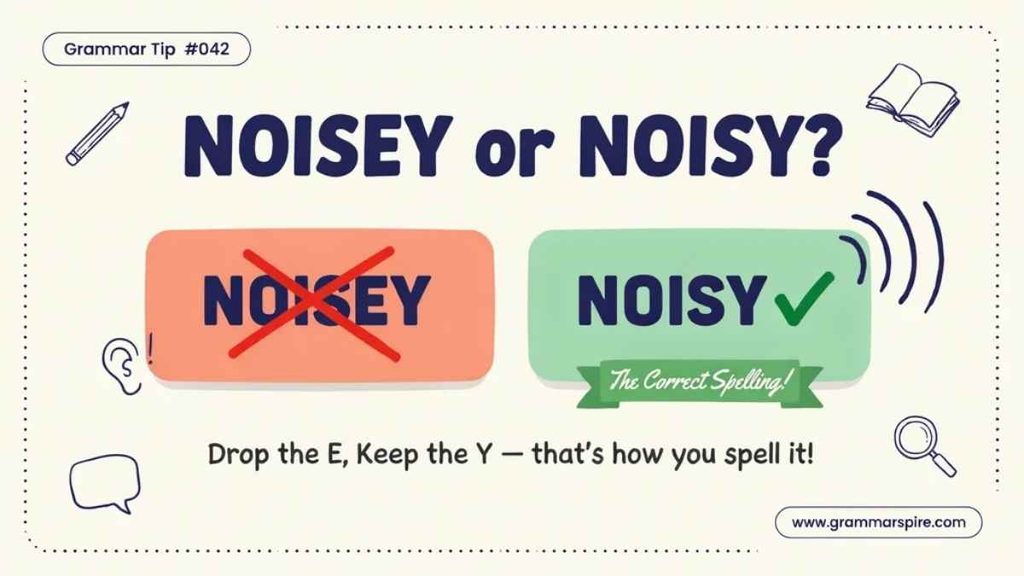
The spelling noisey looks tempting because the root word noise contains an e.
Someone might naturally think:
noise + y = noisey
That reasoning looks perfectly sensible at first. English spelling, however, does not always work by simply attaching letters to a complete root word.
In this case, the standard adjective is noisy.
Think of the transformation as:
noise → noisy
The final e does not stay in the adjective.
This pattern also explains why memorizing the pair noise and noisy is more useful than trying to reason through the spelling every time.
When you see the noun noise, remember the related adjective as noisy.
That simple connection removes most of the confusion.
Learn the difference between tricky grammar more words
Finaly or Finally Which Spelling Is Correct?
Noisy Pronunciation
The noisy pronunciation is the same in standard American and British English in the basic dictionary transcription.
The pronunciation is represented as /ˈnɔɪ.zi/.
The word contains two syllables, with the main stress on the first syllable.
Cambridge gives /ˈnɔɪ.zi/ for both UK and US pronunciation.
The pronunciation helps explain why people sometimes hesitate over the spelling. The final sound does not clearly tell you whether to write y or ey.
That is a common problem in English spelling. Pronunciation can guide you, but it does not always determine the exact written form.
For noisy, the correct written form remains noisy regardless of how quickly or casually someone pronounces it.
Is Noisy a Word?
Yes. Noisy is a standard English word.
It functions primarily as an adjective and appears in everyday speech and writing.
You can use it for physical sounds:
The machine is noisy.
You can use it for people:
The children are noisy.
You can use it for places:
The restaurant is noisy.
You can use it for environments:
The city center is noisy at night.
You can also find a specialized use in technology and information. Cambridge includes a technical meaning in which noisy data contains unexplained or unwanted information that can be ignored.
That broader meaning is useful because it shows that noisy is not limited to literal sound.
For example:
The recording contains a noisy signal.
The data is noisy and difficult to interpret.
In these cases, noisy describes unwanted variation or interference rather than an ordinary loud sound.
Is Noisey a Word?
The answer needs a little context.
You may encounter noisey in usernames, names, informal posts, creative spellings, or ordinary typing mistakes. However, that does not make noisey the standard English spelling of the adjective.
For normal English writing, noisy is the form to use.
This distinction matters because the internet contains countless nonstandard spellings. A form can appear online without becoming part of standard English.
If you are writing an essay, email, school assignment, article, report, or professional message, use noisy.
Therefore, if the question is “is noisey a word?” the safest standard-English answer is that noisey is not the standard spelling of the adjective. Noisy is the established form.
Noisy or Nosy Two Different Words
The noisy or nosy confusion creates a different problem.
Noisy and nosy are both legitimate English words, but they mean completely different things.
Noisy relates to sound.
Nosy relates to excessive curiosity about other people’s private affairs.
Compare these sentences:
The neighbors are noisy.
The neighbors are nosy.
The first sentence says that the neighbors make a lot of noise.
The second says that the neighbors are too interested in other people’s personal matters.
The difference is small in spelling but large in meaning.
A noisy person might talk loudly, laugh loudly, shout, sing, or otherwise make a lot of sound.
A nosy person might ask intrusive questions, pry into private matters, or show too much interest in someone else’s business.
This is why noisy vs nosy meaning deserves separate attention. Neither word is a spelling variation of the other.
Noisy vs Nosy Clear Examples
Consider a neighbor who plays loud music every evening.
That neighbor is noisy.
Now imagine a different neighbor who constantly asks who visits your house and where you go on weekends.
That neighbor is nosy.
The sentences could be:
My neighbor is noisy because he plays loud music late at night.
My neighbor is nosy because she keeps asking personal questions.
The distinction becomes even clearer when both words appear in the same situation:
Our noisy neighbor is also quite nosy.
Here, noisy describes sound while nosy describes behavior.
That sentence is grammatically correct because the two adjectives describe different qualities.
Noisy vs Loud Are They the Same?
Noisy and loud overlap, but they are not exact substitutes in every situation.
Loud usually emphasizes the strength or volume of a sound.
Noisy often emphasizes an abundance of sound, especially when the sound creates disturbance or makes an environment less quiet.
Consider:
The music is loud.
The restaurant is noisy.
The first sentence focuses on volume.
The second focuses on the overall sound-filled environment.
A single sound can be loud without making an entire place noisy. For example, one extremely loud alarm can disturb a quiet room.
On the other hand, a restaurant can be noisy because dozens of people are talking at once even though no individual conversation is extremely loud.
Oxford defines loud in terms of producing a lot of noise and gives examples such as loud laughter, a loud voice, and loud music.
So, while loud and noisy can overlap, the context determines which adjective communicates the idea more precisely.
Noisy Person Meaning
The phrase noisy person meaning is straightforward.
A noisy person makes a lot of sound.
That sound might come from talking, shouting, laughing, singing, playing music, or other behavior.
For example:
The noisy person behind us kept talking during the movie.
The noisy person in the next apartment played music all night.
Notice that noisy does not automatically mean rude, aggressive, or badly behaved. It only describes the person’s sound-producing behavior in the particular context.
That distinction matters because a group of children can be noisy while happily playing a game. A concert audience can also be noisy because people are cheering.
Context gives the adjective its emotional tone.
Noisy Environment and Noisy Surroundings
A noisy environment contains a significant amount of sound.
Common examples include busy roads, airports, factories, construction sites, crowded restaurants, and open-plan offices.
For example:
It is difficult to concentrate in a noisy environment.
The noisy surroundings made it difficult to hear the tour guide.
Oxford specifically uses noisy environments such as open-plan offices as examples of places where concentration can become difficult.
A noisy environment does not have to contain one extremely loud sound. Many moderate sounds can combine to create the same effect.
Traffic is a good example. Engines, horns, conversations, construction, and movement can create a constant background of sound.
Noisy Place and Everyday Usage
A noisy place is simply a location where there is a lot of sound.
You can describe almost any location this way when the context supports it.
The café was noisy during lunch.
The street becomes noisy after sunset.
The classroom was noisy before the teacher arrived.
The neighborhood is noisy on weekends.
The airport was noisy and crowded.
These examples show why noisy is such a useful everyday adjective. It fits naturally into conversations about homes, schools, workplaces, transportation, entertainment, and public spaces.
Noisy Behavior
Noisy behavior refers to actions that produce a lot of sound.
Children running through a hallway and shouting may display noisy behavior. A group of fans chanting loudly at a game may also create noisy behavior.
The phrase can be neutral or negative depending on the situation.
For example:
The children were noisy during the celebration.
The manager asked the employees to stop their noisy behavior.
In the first sentence, the sound may simply be part of a lively event. In the second, the noise is presented as a problem.
Again, context does much of the work.
Learn the difference between tricky grammar more words
Hanukkah or Chanukah Which Spelling Is Correct?
Noisy Synonyms and Their Differences
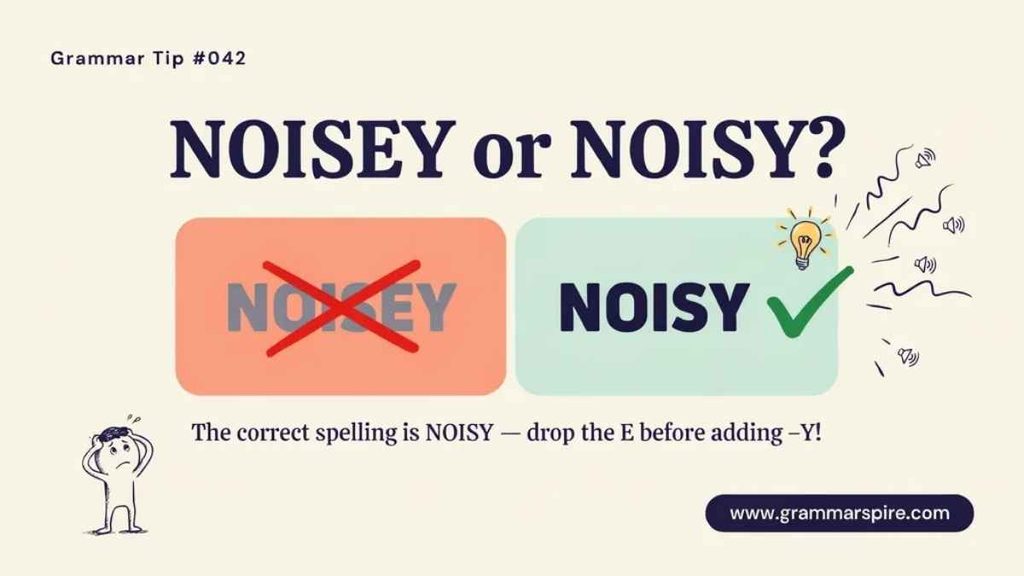
Several words can replace noisy, but each one adds a slightly different shade of meaning.
Loud usually focuses on volume.
Boisterous suggests energetic, lively, and noisy behavior.
Clamorous suggests a loud mixture of voices or sounds, often with a demanding or disorderly quality.
Deafening describes an extremely loud sound.
Raucous suggests a harsh, loud, and often disorderly sound.
Rowdy usually describes people who are noisy and difficult to control.
Uproarious can suggest an extremely lively or noisy atmosphere, often involving laughter.
Tumultuous suggests confusion, disorder, and loud activity.
Vociferous describes people expressing opinions or demands loudly and forcefully.
Blaring describes a loud, harsh sound, especially from music, alarms, horns, or speakers.
Thunderous describes a very powerful sound or something that resembles thunder.
Cacophonous describes a mixture of harsh, unpleasant, or conflicting sounds.
Therefore, noisy is often the safest everyday choice, while these alternatives become useful when you want greater precision.
Learn the difference between tricky grammar more words
usable vs useable Which Spelling Is Correct?
Noisy Examples in Everyday English
The easiest way to understand a word is often to see it doing real grammatical work in a sentence.
The children became noisy after the game.
The noisy classroom made it difficult to concentrate.
Our apartment faces a noisy street.
The old refrigerator has become noisy.
The restaurant was noisy but lively.
The construction work made the neighborhood noisy.
The train was surprisingly noisy.
The office gets noisy around lunchtime.
My neighbors are noisy at night.
The machine makes a noisy vibration.
These sentences show that noisy can describe people, places, objects, and situations.
Noisy in a Sentence Correct Usage
When you want to know how to use noisy in a sentence, remember that it normally describes a noun.
Before a noun:
We moved to a quieter neighborhood because our old street was too noisy.
After a linking verb:
The street is noisy during the evening.
After a change-of-state verb:
The classroom became noisy.
With an adverb:
The children were extremely noisy.
With a comparative:
The new machine is noisier than the old one.
With a superlative:
That was the noisiest room in the building.
This range of sentence patterns makes noisy a flexible adjective rather than a word limited to one grammatical construction.
Noisy Grammar Noisier and Noisiest
The comparative form is noisier.
The superlative form is noisiest.
The spelling changes from y to i before the comparative and superlative endings.
So:
noisy → noisier → noisiest
For example:
The city center is noisier than the suburbs.
Saturday was noisier than Friday.
This is the noisiest classroom in the school.
The forms noisyer and noisyest are not the standard spellings.
This gives you another useful spelling pattern connected to the same word.
What Is the Plural of Noisy?
Noisy does not have a plural form.
That may sound strange at first, but adjectives in English generally do not change for singular and plural nouns.
You say:
a noisy child
noisy children
a noisy street
noisy streets
a noisy machine
noisy machines
The adjective remains noisy while the noun changes.
Therefore, noisy is not turned into noisies simply because the noun is plural.
What Is the Opposite of Noisy?
The most common opposite of noisy is quiet.
For example:
The restaurant was noisy.
The library was quiet.
Other words can work depending on the exact meaning, including silent, peaceful, or calm.
Quiet usually provides the most direct everyday contrast because it describes a state with little noise.
Oxford defines quiet in relation to making very little noise or having little noise or activity.
The difference becomes clear in these examples:
The noisy street kept us awake.
The quiet street was perfect for sleeping.
The noisy classroom was difficult to manage.
The quiet classroom helped students concentrate.
in British English and American English
The spelling noisy is standard in both British English and American English.
There is no standard British spelling noisey that replaces noisy.
Therefore, whether you are writing for readers in the United States or the United Kingdom, use noisy.
The pronunciation is also represented the same way in standard dictionary transcriptions for both varieties: /ˈnɔɪ.zi/. Cambridge lists the UK and US pronunciation as /ˈnɔɪ.zi/.
So searches such as noisy UK, noisy British English, noisey UK, or noisy or noisey UK spelling lead to the same practical conclusion.
The spelling does not change between these two major varieties of English.
Is Noisy Spelled With an E?
No.
The standard spelling is noisy.
The confusion probably comes from looking at the root word noise and assuming that its final e should remain when the adjective is formed.
However, the established form is:
noise → noisy
not:
noise → noisey
If you are writing quickly, this is one of those words worth checking mentally before moving on.
The five letters are:
N-O-I-S-Y
That is the correct spelling noisy.
Learn the difference between tricky grammar more words
Manuel or Manual Which spelling is correct?
How to Spell Noisy
If you are asking how to spell noisy, write:
N-O-I-S-Y
The word contains five letters.
A useful way to remember it is to connect the noun and adjective:
noise → noisy
The spelling changes at the end, but the relationship between the two words remains easy to recognize.
How Do You Spell Noisy Correctly?
To answer “how do you spell noisy correctly,” the answer is simply noisy.
The most common mistake is adding an e:
noisey
That form should normally be corrected to:
noisy
For example:
Incorrect: The children are noisey.
Correct: The children are noisy.
Incorrect: The street is noisey.
Correct: The street is noisy.
Incorrect: The machine is noisey.
Correct: The machine is noisy.
Once you memorize noise → noisy, the spelling becomes much easier to reproduce.
Common Mistakes
The most obvious mistake is writing noisey instead of noisy.
Another common problem is confusing noisy with nosy. These words have different meanings, so replacing one with the other can change the entire sentence.
Writers can also use noisy when loud would be more precise. Although the words overlap, loud emphasizes volume while noisy often describes a sound filled environment.
Another mistake involves the comparative form. The correct spelling is noisier, not noisyer.
Likewise, the correct superlative is noisiest, not noisyest.
These small spelling details become easier once the base word is firmly established.
Noise and Sound Are They the Same?
Noise and sound overlap, but English often uses them differently.
Sound is a broad term for something that can be heard.
Noise often refers to sound that is unwanted, unpleasant, loud, or disturbing.
For example:
I heard the sound of waves.
The traffic noise kept me awake.
Oxford explains that sound is broader, while noise commonly carries the idea of loud, unpleasant, or unwanted sound.
This distinction helps explain why noisy often carries a stronger suggestion of disturbance than simply “sound-filled.”
A concert can contain many sounds. A crowded highway can create noise.
The exact interpretation always depends on context.
Learn the difference between tricky grammar more words
Tweek or Tweak Which Spelling Is Correct?
Is Noisy the Correct Spelling?
Yes. Noisy is the correct standard spelling.
It is an established English adjective that means making a lot of noise or being full of noise.
The spelling does not contain an e before the final y.
The correct form is:
noisy
The usual incorrect form is:
noisey
Therefore, if a teacher, editor, employer, or grammar checker asks for the standard English spelling, choose noisy.
Is Noisey or Noisy Correct?
Noisy is correct in standard English.
The two forms should not be treated as equal alternatives.
Noisey may appear in informal online writing or as a creative spelling, but ordinary English writing calls for noisy.
The distinction is especially important in formal writing, educational work, professional communication, and published content.
Learn the difference between tricky grammar more words
Quiet or Quite What Is the Difference?
Noisey or Noisy Meaning Does the Meaning Change?
No.
When people write noisey instead of noisy, they generally intend the same meaning. The problem is the spelling, not a different definition.
Noisy means making a lot of noise or full of noise.
For example:
1.The noisy children ran outside.
2.The noisy street kept me awake.
3.The noisy machine needs attention.
The meaning remains consistent across these examples.
Here’s a trusted source for clear more words Comparison
Grammar Update
Practice Session
Now it’s time to put the spelling rule into practice. Complete each sentence with the word or phrase that fits best. Pay attention to meaning, grammar, and context because a few questions test related words such as “noise,” “nosey,” and “quiet.”
Fill in the Blanks
- The children became extremely ________ after the teacher left the classroom.
- Construction work makes the neighborhood quite ________ during the day.
- The correct spelling is ________, not “noisey.”
- We closed the windows because the traffic outside was too ________.
- The restaurant can get surprisingly ________ during the dinner rush.
- “Noisey” is generally considered a spelling ________.
- The library was peaceful in the morning, but it became ________ after lunch.
- The crowd grew ________ when the singer walked onto the stage.
- A person who regularly makes a lot of sound can be described as ________.
- The old washing machine produces a strange ________ whenever it spins.
- The adjective “noisy” describes something that makes or contains a lot of ________.
- The opposite of “noisy” is usually ________.
- The word “noisy” is an ________ because it describes a person, place, thing, or situation.
- The street becomes particularly ________ when buses and trucks pass through.
- Which spelling is correct: “noisey” or ________?
- The students were becoming so ________ that the teacher had to stop the lesson.
- The festival was crowded, lively, and ________, with music coming from every direction.
- “Noisy” and “nosey” have different ________, even though they look and sound somewhat similar.
- My new apartment is much quieter because it is not near a ________ road.
- The baby woke up because of the sudden ________ outside.
- Someone who asks too many questions about another person’s private life may be called ________.
- A busy market can be described as ________ because of the conversations, vehicles, and background activity.
- In standard English, “noisey” should generally be replaced with ________.
- The classroom became unusually ________ when the students finished their test.
- If a machine produces an unpleasant amount of sound, you can describe it as ________.
- The concert was extremely ________, but the audience enjoyed every minute.
- The noun “noise” becomes the adjective ________.
- The peaceful garden offered a welcome escape from the ________ city streets.
- If you want a more positive description of a lively gathering, you might use “bustling” instead of ________.
- Always remember the standard spelling: ________.
Answers
- noisy
- noisy
- noisy
- noisy
- noisy
- mistake
- noisy
- noisy
- noisy
- noise
- noise
- quiet
- adjective
- noisy
- noisy
- noisy
- noisy
- meanings
- busy
- noise
- nosey
- noisy
- noisy
- noisy
- noisy
- noisy
- noisy
- noisy
- noisy
- noisy
Quick Review
Remember these three words:
“Noisy” describes something that produces a lot of sound.
“Noise” is the sound itself, especially when it is unwanted or noticeable.
“Nosey” describes someone who shows too much curiosity about other people’s private affairs.
The spelling “noisey” is generally incorrect in standard English. When you mean loud or full of sound, choose “noisy.”
FAQs
How do you spell noisy as in loud?
The correct spelling is “noisy.” It describes something that produces a lot of sound or creates a noticeable disturbance. “Noisey” is a common spelling error.
Is it noisy or nosey?
Both words are correct, but they mean different things. “Noisy” relates to sound, while “nosey” describes someone who is too interested in other people’s private business.
What is the meaning of soundy?
“Soundy” is an uncommon adjective associated with sound. In everyday English, however, writers usually choose a more precise word, such as “noisy,” “audible,” or “sonic,” depending on the context.
What does “noisey” mean?
“Noisey” usually represents an incorrect spelling of “noisy.” When someone uses it to describe something loud or full of sound, they generally intend the standard form “noisy.”
Is it spelled noisey or noisy?
The standard spelling is “noisy.” Although “noisey” may look logical because of the noun “noise,” standard English uses “noisy” without the extra “e.”
What is another word for “noisey”?
If you mean “noisy,” possible alternatives include “loud,” “boisterous,” “rowdy,” “raucous,” “clamorous,” and “uproarious.” The most suitable choice depends on the situation.
Is noisy a negative word?
Not necessarily. The word can carry a negative tone when it describes an unwanted disturbance, such as noisy traffic or a noisy neighbor. In other situations, it can simply describe a lively or active atmosphere.
What are the four types of sound?
There is no single universal system that divides sound into exactly four types. Sound can instead be described through characteristics such as pitch, loudness, duration, and timbre. Different educational systems may classify sounds in different ways.
What does it mean when a person is noisy?
A noisy person tends to speak, laugh, move, or behave in a way that produces noticeable sound. The description can refer to someone who talks loudly or regularly creates a disturbance.
Is noisey a Scrabble word?
“Noisy” is the standard English spelling. “Noisey” is generally treated as a misspelling rather than the standard adjective. Scrabble acceptance can vary according to the official word list or edition being used.
How do you say “noisy” in a nice way?
Choose a more positive expression when the situation calls for one. Words such as “lively,” “bustling,” “energetic,” and “animated” can describe an active atmosphere without making the sound seem bothersome.
What does “noisy” mean?
“Noisy” means producing, containing, or surrounded by a lot of sound. You might describe a classroom, street, machine, crowd, room, or neighborhood as noisy.
What’s a nicer way to say “loud”?
The best alternative depends on what you want to express. “Lively,” “energetic,” “animated,” and “spirited” can soften the description of a person or setting. For sound itself, “high-volume” may be more neutral.
What is a fancy word for noise?
“Clamor,” “din,” “cacophony,” “uproar,” and “racket” offer more vivid alternatives. “Cacophony” is especially useful when several harsh or unpleasant sounds blend together.
Is there such a word as noisy?
Yes. “Noisy” is a standard English adjective. It comes from “noise” and describes something characterized by a considerable amount of sound.
AEO Quick Answers
Is “noisy” the correct spelling?
Yes. “Noisy” is the standard spelling. “Noisey” is generally considered a misspelling.
What is the difference between noisy and noisey?
“Noisy” is the accepted spelling for something that makes or contains a lot of sound. “Noisey” is generally an incorrect spelling of the same intended word.
Is noisy an adjective?
Yes. “Noisy” functions as an adjective because it describes a person, place, object, or situation.
What is the adjective form of noise?
The usual adjective derived from “noise” is “noisy.” For example, “The street is noisy.”
How do you use noisy in a sentence?
You can place “noisy” before a noun or use it after a linking verb. For example, “The children became noisy during the break.”
What is the opposite of noisy?
“Quiet” is the most common opposite. Depending on the context, “silent,” “peaceful,” or “calm” may also express the contrast.
What are some synonyms for noisy?
Common synonyms include “loud,” “boisterous,” “rowdy,” “raucous,” “clamorous,” and “uproarious.” Their meanings overlap, but each can suggest a slightly different type or intensity of sound.
Is noisy the same as loud?
They overlap, but they are not identical. “Loud” mainly describes the volume or intensity of a sound. “Noisy” often suggests an abundance of sound, especially when it becomes distracting or disruptive.
Is noisy the same as nosy?
No. These words describe completely different ideas. “Noisy” concerns sound, whereas “nosy” refers to excessive curiosity about other people’s personal matters.
Why is noisy spelled without an e?
The standard form is “noisy,” not “noisey.” English word formation does not simply preserve every letter from the base word when adding a suffix, so “noise” becomes “noisy.”
What does a noisy environment mean?
A noisy environment contains a high level of noticeable sound. Busy streets, crowded classrooms, construction areas, and packed public spaces can all be described this way.
Can noisy describe a person?
Yes. The adjective can describe someone who speaks loudly, makes frequent sounds, or creates considerable disturbance.
Can noisy describe a place?
Yes. A room, street, neighborhood, classroom, office, restaurant, or other location can be called noisy when it has a substantial amount of sound.
Can noisy have a positive meaning?
Yes. Context controls the tone. A writer may call a festival or celebration noisy simply to show that it is full of activity and sound rather than to criticize it.
What should you remember about noisey and noisy?
The simplest rule is to use “noisy” when you mean something that makes or contains a lot of sound. “Noisey” is generally a spelling mistake, so it should be avoided in standard English.
Final Answer
The confusion between “noisey or noisy” may seem small, but one extra letter can make your writing sound less polished. The correct spelling is “noisy,” which describes a person, place, object, or situation that produces a lot of sound. Although “noisey” may seem logical because of the noun “noise,” it is generally considered a spelling mistake in standard English. Also, remember that “noisy” and “nosey” have completely different meanings. Once you learn this simple distinction, the confusion fades away. So, when your sentence needs the adjective for something loud or full of sound, choose “noisy” and leave “noisey” out of the conversation.

Ella AJS
Ella AJS is an experienced blogger and language enthusiast at Grammar Spire, dedicated to making English grammar simple, practical, and easy to understand. She specializes in word comparisons, meanings, usage, and common language confusions. Through clear explanations and engaging examples, Ella helps students, writers, and English learners improve their vocabulary and communicate with greater confidence and accuracy.