
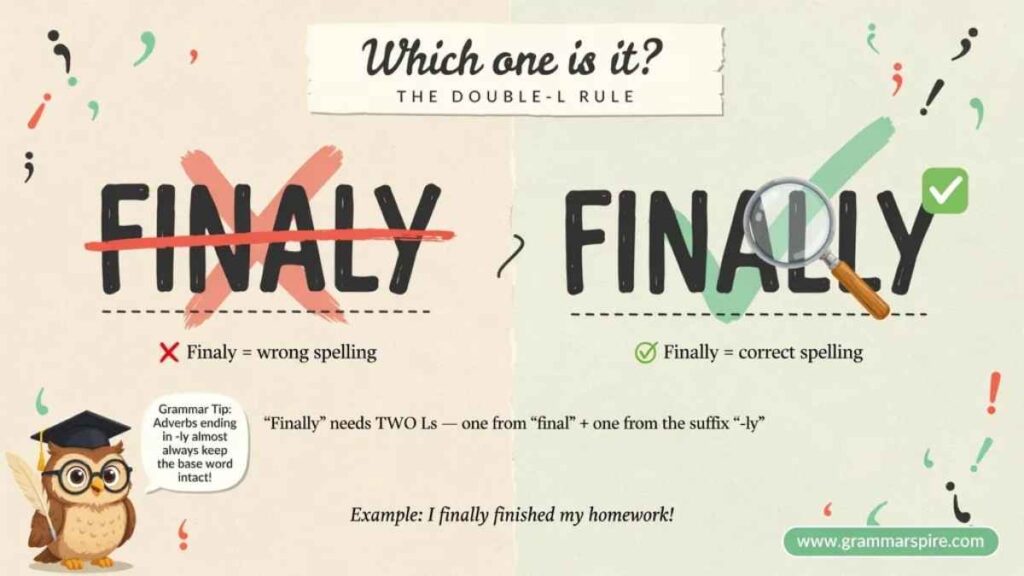
English spelling has a mischievous way of hiding tiny traps in plain sight. One missing letter can turn a perfectly familiar word into an obvious spelling mistake. The confusion over finaly or finally is a classic example. Those two l’s may look like a small detail, but they make a big difference. The correct spelling is finally, an adverb used when something happens after a delay or difficulty or when introducing the last point in a discussion. In this guide, you’ll learn why finally is correct, understand its meaning and usage, explore clear examples, avoid common mistakes, and practice with useful exercises.
Quick Answer Finaly or Finally?
Finally is the correct spelling.
Finaly is a spelling mistake.
The correct word contains two consecutive l’s:
Finally
The incorrect form contains only one:
Finaly
The easiest way to understand the spelling is to look at the word formation:
Final + ly = Finally
The first l belongs to final. The second l comes from the suffix ly. Consequently, dropping one l produces the incorrect spelling finaly.
The meaning does not change because of the spelling mistake. A reader will usually understand finaly as an attempt to write finally. Nevertheless, recognizing the intended meaning does not make the spelling correct.
| Form | Standard English? | Meaning | Example |
|---|---|---|---|
| Finally | Yes | After a delay, at the end, or as the last point | We finally arrived home. |
| Finaly | No | No separate standard meaning | Finaly is an incorrect spelling. |
Therefore, the answer to “Which spelling is correct, finaly or finally?” is finally.
Learn the difference between tricky grammar more words
Eying or Eyeing Which Spelling Is Correct?
Why Is “Finally” the Correct Spelling?

The spelling finally becomes much easier to remember when you stop looking at it as one long string of letters.
Instead, divide it into two parts:
Final + ly
When the suffix -ly is added to final, the spelling becomes finally.
This explains why the word has two l’s. The final l in final remains, while the suffix -ly contributes another l.
That gives us:
Final + ly
Finally
The word final is an adjective. It describes something that comes last or marks the end of something. For example, you might talk about a final exam, a final decision, or the final stage of a process.
When -ly is added, the word changes into the adverb finally. The resulting adverb describes an action, event, stage, or point connected with an ending or something that happens after a period of time.
This type of word formation is useful because it gives you a practical memory tool rather than a spelling fact that you simply have to memorize.
If you remember final + ly, the second l becomes much harder to forget.
Finaly or Finally Spelling Why the Extra L Matters
The central issue in the finaly or finally spelling question is the missing l.
Consider the two forms carefully:
Finaly
Finally
The difference is only one letter. Yet standard English recognizes only finally for the adverb.
This is why finaly is considered an incorrect spelling rather than an alternative spelling. English contains many genuine spelling variations, especially between different varieties of English. However, finaly is not a standard US English alternative to finally.
The correct spelling remains finally.
In other words, the following forms should not be treated as interchangeable:
Finaly
Finally
The first is an error. The second is the standard word.
What Does “Finally” Mean?
The finaly or finally meaning depends on the context. In general, finally connects an event or idea with something that happens after time, difficulty, completion, or a final stage.
Cambridge Dictionary identifies several important uses. It can describe something that happens after a long time or some difficulty. It can also introduce the last point or idea in a discussion or sequence. In another use, it can indicate that something is settled and will not be changed.
The most common meanings can be understood through three broad ideas: after a wait, at the end, and as the last point.
Finally Means “After a Long Time”
First, finally can describe something that happens after a long period of waiting or difficulty.
For example:
We finally reached the hotel.
The sentence suggests that reaching the hotel took some time or involved some difficulty.
Similarly:
After months of searching, she finally found a job.
Here, finally highlights the result that came after an extended search.
This use often carries a sense of relief or completion. The speaker is not simply reporting that the event happened. Instead, the speaker is emphasizing that it happened after a period of waiting, effort, or uncertainty.
That is why finally often appears naturally with words and phrases related to time and difficulty.
After hours of work, he finally finished the report.
After several attempts, they finally solved the problem.
After a long wait, the train finally arrived.
In each case, finally points toward the result that came later.
Finally Means “At the End”
Next, finally can show that something happens at the end of a process or sequence.
For example:
First, wash the vegetables. Next, cut them into small pieces. Finally, cook them.
Here, finally identifies the last step.
The word can therefore help readers follow a sequence. When several actions occur in order, finally signals that the last stage has arrived.
This use appears frequently in instructions, explanations, presentations, recipes, and descriptions of processes.
For example:
Finally, close the application and restart the computer.
Finally, add the remaining ingredients.
Finally, submit the completed form.
The meaning here is closely connected with the last stage or final step.
Finally Introduces the Last Point
Finally can also introduce the last point in an argument, presentation, discussion, or explanation.
For example:
Finally, the report considers the long term effects of the decision.
In this sentence, finally does not necessarily suggest that someone waited for a long time. Instead, it tells the reader that this is the final point under discussion.
Cambridge Grammar describes finally as a discourse marker that can help organize longer pieces of conversation or text.
For example:
First, the article examines the cause. Next, it discusses the effects. Finally, it considers possible solutions.
This structure helps the reader understand the progression from one point to another.
Learn the difference between tricky grammar more words
Treck or Trek Which Spelling Is Correct?
What Does “Finaly” Mean?

The word finaly does not have a separate standard English meaning in this context.
Instead, finaly is an incorrect spelling of finally.
That distinction matters because some readers may assume that finaly and finally are two different words. They are not.
If you see a sentence such as:
We finaly finished the project.
The intended sentence is:
We finally finished the project.
Likewise:
Finaly, we reached an agreement.
should be corrected to:
Finally, we reached an agreement.
Therefore, questions such as “Is finaly a word?” and “Is finaly a real word?” can be answered directly. In standard English, finaly is not the correct form of this adverb.
Finaly vs Finally What Is the Difference?
The finaly vs finally difference is primarily a spelling issue rather than a difference in meaning.
Finally is the standard English adverb.
Finaly is an incorrect spelling.
| Feature | Finaly | Finally |
|---|---|---|
| Standard spelling | No | Yes |
| Standard English word | No, in this intended use | Yes |
| Part of speech | Not applicable here | Adverb |
| Main meanings | None as a standard form | After a delay, at the end, or as the last point |
| Formal writing | Avoid | Correct |
| Everyday writing | Avoid | Correct |
Consequently, the finaly vs finally spelling question does not require choosing between two legitimate words. It requires identifying the correct spelling.
Is Finaly a Word?
If you are asking, “Is finaly a word?” the practical answer is no in standard English.
It may appear in online writing, informal messages, typed documents, or user-generated content because people sometimes leave out the second l. However, its appearance does not make it a standard spelling.
A spelling error can still be easy to understand. If someone writes finaly, most readers will probably recognize the intended word immediately. Nevertheless, clarity of meaning and correctness of spelling are two different things.
Therefore:
Is finaly a correct spelling? No.
Is finaly a real standard English word? No.
Is finaly an English word? Not as the standard form of the adverb intended here.
Is finaly spelled correctly? No.
The correct form is finally.
Learn the difference between tricky grammar more words
Peices or Pieces Which Spelling Is Correct?
Is Finally a Word?
Yes. Finally is a standard English word.
It is an adverb, and dictionaries recognize several meanings and uses for it. Cambridge Dictionary classifies finally as an adverb and provides meanings connected with time, sequence, and finality.
Therefore, if you ask “Is finally a word?” the answer is definitely yes.
The word can appear in several positions within a sentence, although the most natural position depends on what you want it to express.
For example:
We finally finished the project.
Finally, we finished the project.
We finished the project finally.
All three structures are possible, but they do not always sound equally natural. In everyday English, the first two are generally more natural depending on the intended emphasis.
Finaly or Finally Grammar What Part of Speech Is “Finally”?
Finally is an adverb.
That means it can modify an action, describe timing, or help organize a sentence or discussion.
Compare the related forms:
Final is an adjective.
Finally is an adverb.
Finalize is a verb.
Finality is a noun.
Finalist is a noun.
For example:
The final decision was difficult.
The committee finally reached a decision.
The committee will finalize the decision tomorrow.
The finality of the decision surprised everyone.
Although these words share the same basic word family, they perform different grammatical jobs.
Understanding that difference makes the finaly or finally grammar question much easier.
Learn the difference between tricky grammar more words
Sergeant or Sargeant Which Spelling Is Correct?
How to Use Finally in a Sentence
The position of finally can change according to its function.
Finally at the Beginning of a Sentence
Finally can appear at the beginning when it introduces the last point or step.
For example:
Finally, check your answers before submitting the test.
Finally, the report examines the financial consequences.
Finally, turn off the machine.
When finally introduces the sentence in this way, a comma commonly follows it.
The comma helps separate the introductory adverb from the main clause.
Finally in the Middle of a Sentence
Finally often appears in the middle of a sentence when it describes an action that occurred after a delay or difficulty.
For example:
We finally reached the station.
She finally understood the instructions.
The company finally announced its decision.
The researchers finally found the missing evidence.
This position is especially common when finally expresses the idea of something happening after time or difficulty. Cambridge Grammar notes that in this meaning, finally commonly occurs in the normal mid position for adverbs.
Finally at the End of a Sentence
Finally can also appear at the end of a sentence.
For example:
We reached the station finally.
The team completed the work finally.
However, this placement may sound less natural than the middle position in many everyday sentences.
Compare:
We finally reached the station.
We reached the station finally.
The first sentence sounds more natural in ordinary conversation because finally sits naturally before the main verb.
Therefore, when you are learning how to use finally in a sentence, pay attention not only to grammar but also to natural sentence flow.
Finally Comma Usage
The comma after finally depends on how the word functions.
When finally introduces a final point or step at the beginning of a sentence, a comma is commonly used.
For example:
Finally, review the completed form.
Finally, we need to discuss the final stage.
However, when finally appears in the normal middle position, you generally do not place commas around it.
For example:
We finally completed the project.
She finally found her keys.
They finally reached an agreement.
Therefore, do not assume that every sentence containing finally needs a comma.
The sentence structure determines the punctuation.
| Structure | Example | Typical punctuation |
|---|---|---|
| Beginning | Finally, we finished the work. | Comma after finally |
| Middle | We finally finished the work. | No comma |
| End | We finished the work finally. | Usually no comma |
Finaly or Finally Pronunciation
The spelling finaly does not represent a separate standard pronunciation. It is simply a misspelled version of finally.
Cambridge Dictionary gives the US pronunciation of finally as /ˈfaɪ.nə.li/.
The pronunciation can therefore help you recognize the word when you hear it, but it cannot reliably tell you whether the written form contains one or two l’s.
That is a useful lesson in English spelling. Pronunciation and spelling do not always match letter for letter.
Consequently, the safest way to remember the written form is to connect it with its structure:
Final + ly = finally.
Learn the difference between tricky grammar more words
Brasil or Brazil What Is the Difference?
Finaly or Finally Meaning and Usage

The word finally has several closely related uses, but the central idea is that something reaches a later, last, or settled stage.
| Use | Meaning | Example |
|---|---|---|
| After a long wait | Something happens after time or difficulty | We finally arrived. |
| Completion | Something reaches its completed stage | She finally finished the work. |
| Last step | The final action in a sequence | Finally, close the lid. |
| Last point | The final idea in a discussion | Finally, consider the cost. |
| Settled result | Something becomes definite | The decision was finally approved. |
This range explains why finally appears in both everyday conversation and formal writing.
For example, a friend might say:
I finally found my keys.
Meanwhile, a report might say
Finally, the study considers the long term effects.
The word stays the same, but the context determines its exact function.
Learn the difference between tricky grammar more words
Seel or Seal Which one is correct?
Finally Synonyms and Related Words
There is no single synonym for finally that works perfectly in every sentence.
The best alternative depends on what finally means in that particular context.
When finally means after a long wait, words such as eventually and at last may work.
For example:
We finally found the missing document.
We eventually found the missing document.
We found the missing document at last.
However, these alternatives can carry different shades of meaning.
Cambridge Grammar explains that finally, at last, lastly, and in the end overlap in meaning but are used differently.
Finally vs Eventually
Finally and eventually can both describe something that happens after time.
For example:
She finally found a solution.
She eventually found a solution.
Both sentences indicate that the solution came later. However, finally often emphasizes the moment when a long wait or difficult process ends, while eventually focuses more generally on what happened after a period of time.
Finally vs At Last
At last often expresses relief or impatience after a long delay.
For example:
The bus finally arrived.
The bus arrived at last.
Both can work, but at last often gives the sentence a stronger emotional flavor.
Finally vs Lastly
Lastly usually introduces the final item in a list or sequence.
For example:
First, we will discuss the cost. Second, we will examine quality. Lastly, we will consider delivery.
Finally can also introduce the final item:
First, we will discuss the cost. Second, we will examine quality. Finally, we will consider delivery.
However, finally has a wider range of uses because it can also describe something that happens after a long wait.
For example:
After three attempts, she finally opened the door.
Lastly would not naturally replace finally in that sentence.
Finally vs Ultimately
Ultimately often focuses on the final result or outcome of a situation.
For example:
The negotiations ultimately failed.
Finally can also refer to a final result, but its common uses include sequence and delayed completion.
Therefore, although finally, eventually, ultimately, lastly, and at last may overlap, they should not be treated as exact replacements in every sentence.
Learn the difference between tricky grammar more words
High School or Highschool What Is the Correct Spelling?
Common Mistakes

The most common mistake is simply leaving out the second l.
For example:
Incorrect: She finaly finished the report.
Correct: She finally finished the report.
Another common problem occurs when writers hear the word but do not remember its written structure. Because the pronunciation does not clearly announce two l’s, the spelling can easily lose one.
That is why it helps to think of the word as final plus -ly.
Another mistake involves confusing final and finally.
Consider these sentences:
The final chapter was interesting.
The author finally completed the chapter.
Final is an adjective. Finally is an adverb.
The first describes the chapter. The second describes when the author completed it.
Once that difference becomes clear, many grammar mistakes disappear naturally.
Learn the difference between tricky grammar more words
Attornies or Attorneys Which Spelling Is Correct?
Finaly or Finally Examples in Everyday English
The word finally appears in many ordinary situations.
After waiting:
We finally got home after midnight.
After difficulty:
She finally solved the problem.
After repeated attempts:
He finally opened the locked drawer.
At the end of a process:
Finally, save the document.
As the last point:
Finally, the report discusses the cost.
After a long search:
They finally found the missing file.
After a decision:
The committee finally approved the proposal.
After completing several stages:
The team finally reached the final stage of testing.
These examples show that finally does not always mean exactly the same thing. Instead, its meaning shifts slightly according to whether the sentence emphasizes delay, completion, sequence, or finality.
Learn the difference between tricky grammar more words
Seen or Saw What’s is the Difference?
Finaly or Finally Common Misspellings
Finally can appear in several incorrect forms when writers type too quickly or rely only on pronunciation.
Some common errors include finaly, finallly, finelly, finalley, finali, and finallyy.
None of these should be treated as standard alternatives to finally.
The most important distinction is this:
Finaly is incorrect.
Finally is correct.
Once you remember that final already ends in l, the spelling becomes much easier to check.
Learn the difference between tricky grammar more words
More Than or More Then Which one is correct?
How Do You Spell Finally?

If you are asking how to spell finally, the answer is:
F-I-N-A-L-L-Y
The easiest memory method is:
Final + ly
Then:
Finally
This also answers the question, “How to spell finally correctly?”
Keep the original final l and add ly.
Do not turn final into finaly before adding the suffix.
Therefore:
Final + ly = finally
Not:
Fina + ly = finaly
This simple breakdown can prevent the most common spelling mistake.
A Realistic Writing Example
Imagine that a project manager writes:
We finaly completed the testing phase.
The message is understandable, but the spelling mistake stands out.
Now compare:
We finally completed the testing phase.
The second version is correct and polished.
This small example demonstrates why spelling matters even when the reader understands the intended meaning. A missing letter might not create confusion about the message itself, yet it can still make professional writing look unfinished.
In an academic paper, business email, application, or published article, those small errors are worth correcting.
Finaly or Finally Key Facts
| Question | Answer |
|---|---|
| Is finaly correct? | No |
| Is finally correct? | Yes |
| Is finaly a word? | Not as the standard form of this adverb |
| Is finally a word? | Yes |
| What part of speech is finally? | Adverb |
| Does finally have two l’s? | Yes |
| How is finally formed? | Final + -ly |
| Can finally begin a sentence? | Yes |
| Can finally appear in the middle? | Yes |
| Can finally appear at the end? | Yes |
| Can finally mean after a long time? | Yes |
| Can finally introduce the last point? | Yes |
| Is finaly an alternative spelling? | No |
Here’s a trusted source for clear more words Comparison:
Grammar Update
Practice Session
Now it’s time to put your knowledge to the test. Complete each sentence with the correct form: “finaly” or “finally.” Read the entire sentence before choosing your answer because context can help you understand how the word functions.
Fill in the Blanks
- After waiting for several hours, we ______ reached the station.
- ______, check your answers before submitting the assignment.
- She ______ found the document she had been searching for.
- The students ______ completed their final project.
- ______, I would like to thank everyone for joining us.
- After several unsuccessful attempts, he ______ solved the puzzle.
- The delayed flight ______ arrived at the airport.
- After weeks of discussion, the two sides ______ reached an agreement.
- ______, make sure you have included all the required information.
- After months of preparation, the event ______ took place.
- The team ______ completed the project before the deadline.
- ______, let’s review the most important point.
- After searching the entire house, Maria ______ found her missing phone.
- The long meeting ______ came to an end.
- ______, the teacher explained how to complete the final exercise.
- After a tiring journey, they ______ arrived at their destination.
- He ______ understood what the instructions meant.
- ______, check that all the windows are closed before leaving.
- The company ______ approved the revised proposal.
- After several delays, the package ______ arrived.
- ______, we need to consider the final stage of the process.
- She ______ managed to finish the difficult assignment.
- After a busy day, the children ______ fell asleep.
- ______, add the remaining ingredients and stir the mixture well.
- After years of dedication, he ______ achieved his goal.
- The researchers ______ reached a conclusion after examining the evidence.
- ______, the speaker invited the audience to ask questions.
- After reviewing the records, we ______ discovered the source of the problem.
- After a long wait, the doctor ______ called the next patient.
- ______, review your work carefully before handing it in.
Answer Key
- finally
- Finally
- finally
- finally
- Finally
- finally
- finally
- finally
- Finally
- finally
- finally
- Finally
- finally
- finally
- Finally
- finally
- finally
- Finally
- finally
- finally
- Finally
- finally
- finally
- Finally
- finally
- finally
- Finally
- finally
- finally
- Finally
Spelling Reminder
The correct spelling is “finally,” not “finaly.”
A simple way to remember it is:
final + ly = finally
The base word “final” already contains one l, and the “-ly” ending adds another. Therefore, the correct spelling contains two l’s before the final y.
Once you remember that small spelling detail, the “finaly or finally” confusion becomes much easier to avoid.
FAQs About Finaly or Finally
What does “finaly” mean?
“Finaly” does not have a standard meaning in English because it is a misspelling. The correct form is “finally,” an adverb that can describe something happening after a long wait or difficulty, or introduce the last point in a sequence or discussion.
How do you use “finally”?
Use “finally” when you want to show that something happened after a delay, effort, or difficulty. It can also introduce the final idea in a discussion or list.
Example: “We finally finished the project.”
You can also use it at the beginning of a sentence: “Finally, check your answers before submitting the assignment.”
Is it “lastly” or “finally”?
Both “lastly” and “finally” are correct, but their usual functions differ. “Lastly” generally introduces the final item in a list, while “finally” can describe something that happens after a long period or introduce the last point in a discussion.
When should you use “finally” in a sentence?
Use “finally” when an action occurs after waiting, difficulty, or several preceding events. You can also use it to signal the final point of an explanation, presentation, argument, or sequence.
Example: “After several attempts, she finally solved the problem.”
Is “finally” or “finaly” the correct spelling?
“Finally” is the correct spelling. “Finaly” is an incorrect form and should not be used in standard English. The correct word contains two l’s: f-i-n-a-l-l-y.
What is a better word for “finally”?
The best alternative depends on your intended meaning. Possible choices include “eventually,” “ultimately,” “at last,” “in the end,” and “lastly.” However, these expressions are not exact substitutes in every context. For example, “lastly” normally introduces the final item in a list, whereas “eventually” focuses more on an outcome reached after time or difficulty.
How do you spell “finally”?
The correct spelling is “finally,” written f-i-n-a-l-l-y. A useful way to remember it is to start with “final” and add “-ly,” giving you the two l’s in the finished word.
Is it grammatically correct to say “lastly”?
Yes. “Lastly” is a grammatically correct adverb. It is commonly used to introduce the final item in a list, series, or sequence.
Example: “Lastly, review the document for any remaining errors.”
Is “finally made it” correct grammar?
Yes. “Finally made it” can be grammatically acceptable when the subject is clear from the surrounding context, particularly in informal conversation.
For a complete sentence, you could write: “We finally made it home.”
What is a professional way to say “finally”?
“Finally” is already appropriate for professional and formal writing. Depending on the context, you could also use “ultimately,” “in conclusion,” “as a final point,” or “at the final stage.” The most suitable choice depends on whether you are describing an outcome or introducing a concluding idea.
What is a fancy word for “end”?
The appropriate formal alternative depends on the context. “Conclusion,” “completion,” “culmination,” “endpoint,” and “final stage” can all describe an ending in different situations.
For example, “conclusion” works well for a discussion or written piece, while “completion” usually refers to finishing a task or process.
What is the opposite of “finally”?
There is no single exact opposite in every situation. When “finally” refers to the end of a process, contrasting expressions include “initially,” “at first,” “first,” and “at the beginning.”
The appropriate choice depends on whether you are contrasting time, sequence, or position.
What should I say instead of “lastly”?
You do not need to replace “lastly” because it is already correct. However, depending on your sentence, alternatives include “finally,” “to conclude,” “as a final point,” or “in conclusion.”
For a list, “lastly” can be a natural choice because it clearly signals the final item.
How do you say “lastly” in a professional way?
“Lastly” is already suitable for professional writing. If you want a different expression, “finally,” “as a final point,” “to conclude,” and “in conclusion” can work well.
Choose the expression according to the purpose of the sentence rather than changing the word simply to sound more formal.
What does it mean when someone says “finally”?
When someone says “finally,” they may be referring to something that happened after a long wait, delay, or difficulty. The word can also signal the final point in a discussion or sequence.
For example, “We finally reached an agreement” indicates that the agreement came after a period of waiting or difficulty.
AEO: Finaly or Finally
What is the correct spelling: “finaly” or “finally”?
The correct spelling is “finally.” “Finaly” is a misspelling and is not the standard English form.
Is “finaly” a word?
No. “Finaly” is not the standard English spelling of a word. It is a common misspelling of “finally.”
Is “finally” a word?
Yes. “Finally” is a standard English adverb. It can describe an event that occurs after a long period or difficulty, introduce the last point in a discussion, or indicate that something has reached a definite stage.
What does “finally” mean?
“Finally” commonly means after a long time or difficulty, at the end of a sequence, or as the last point in a discussion. Its precise meaning depends on the sentence in which it appears.
Is “finally” an adverb?
Yes. “Finally” is an adverb. It can modify an action or function as a discourse marker that helps organize a longer piece of speech or writing.
Why does “finally” have two l’s?
“Finally” comes from “final” plus the suffix “-ly.” The spelling therefore contains two l’s: the l already present in “final” and another l at the beginning of “-ly.”
So the correct form is “finally,” not “finaly.”
Can “finally” begin a sentence?
Yes. “Finally” can appear at the beginning when it introduces the last point or idea.
Example: “Finally, review all the answers before you submit the test.”
Can “finally” appear in the middle of a sentence?
Yes. In fact, this position is especially common when “finally” describes something that happened after a long wait or difficulty.
Example: “She finally found the document she needed.”
Can “finally” appear at the end of a sentence?
Yes, although the position can affect how natural the sentence sounds. In many sentences, placing “finally” before the main verb is more natural.
For example, “They finally reached an agreement” usually sounds more natural than “They reached an agreement finally.”
What is the difference between “finally” and “eventually”?
Both words can describe something that happens after time has passed. “Eventually” emphasizes an outcome reached after a period of time, effort, or difficulty. “Finally” can express that same idea, but it also has a separate use for introducing the last point in a list or discussion.
What is the difference between “finally” and “lastly”?
“Finally” has several uses. It can describe an outcome after a delay or introduce the final idea in a discussion. “Lastly” mainly identifies the final item in a list or series.
What is the difference between “finally” and “ultimately”?
“Ultimately” usually refers to a final result or conclusion after a series of events, decisions, or developments. “Finally” has a broader range of uses and can also indicate that something happened after a long wait or introduce the final point of a discussion.
What is the easiest way to remember the spelling of “finally”?
Think of the base word “final” and then add “-ly.” The result is “finally,” with two l’s.
A simple memory cue is: “final” + “ly” = “finally.”
Conclusion
English spelling loves to hide little traps, and the confusion between finaly and finally proves how one missing letter can cause unnecessary trouble. The correct spelling is finally, with two l’s. It functions as an adverb and can describe something that happens after a delay or difficulty. It can also introduce the last point in a sequence, discussion, or explanation.
The easiest way to remember the spelling is simple: final + ly = finally. Keep both l’s in place, and this common spelling mistake disappears from your writing. Whether you are writing an email, completing an assignment, or polishing an article, choosing finally keeps your English accurate, clear, and professional. One tiny letter saved, one confusion finally settled.

Ella AJS
Ella AJS is an experienced blogger and language enthusiast at Grammar Spire, dedicated to making English grammar simple, practical, and easy to understand. She specializes in word comparisons, meanings, usage, and common language confusions. Through clear explanations and engaging examples, Ella helps students, writers, and English learners improve their vocabulary and communicate with greater confidence and accuracy.




