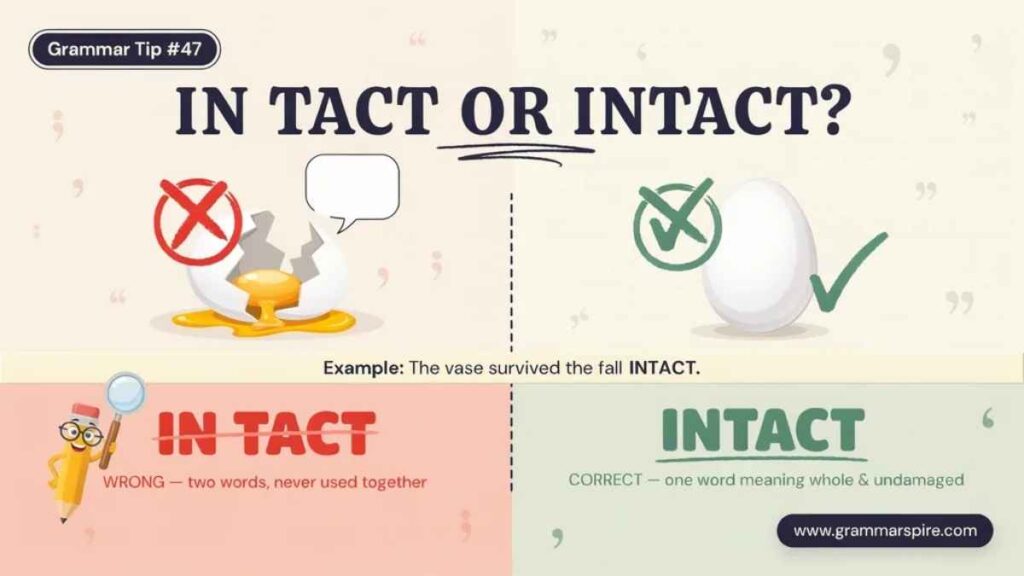
English spelling loves creating tiny traps, and the confusion between in tact or intact is a perfect example. At first glance, “in tact” looks reasonable because tact is a genuine English word. Yet if you’re describing something whole, complete, preserved, or undamaged, intact is the correct spelling. That small space may seem harmless, but it can turn a polished sentence into an obvious spelling mistake. In this guide, you’ll discover the meaning, grammar, usage, examples, and key differences between intact and tact. By the end, you’ll know exactly which form to use and why this tricky pair causes so much confusion.
| Form | Correct? | Meaning | Example |
|---|---|---|---|
| Intact | Yes | Whole, complete, undamaged, or unchanged | The package arrived intact. |
| In tact | No, when meaning whole | Not the standard spelling of intact | The package arrived in tact. |
| Tact | Yes | Diplomacy or sensitivity in dealing with people | She handled the complaint with tact. |
The simplest rule is this if you mean whole, complete, or undamaged, use intact as one word.
Quick Answer
The correct spelling is intact.
Use intact when something remains whole, complete, undamaged, preserved, or unchanged.
For example:
The vase remained intact after the move.
The documents were found intact.
The old building is still intact.
Her reputation remained intact after the controversy.
The phrase in tact is not the standard English spelling when you mean “whole” or “undamaged.”
However, tact is a real English word. It refers to the ability to deal with sensitive situations or people carefully and politely.
For example:
He answered the difficult question with tact.
So, when deciding between in tact or intact, remember that intact describes a condition, while tact describes a social skill.
Learn the difference between everyday English mistakes
Hanukkah or Chanukah Which Spelling Is Correct?
What Does Intact Mean?
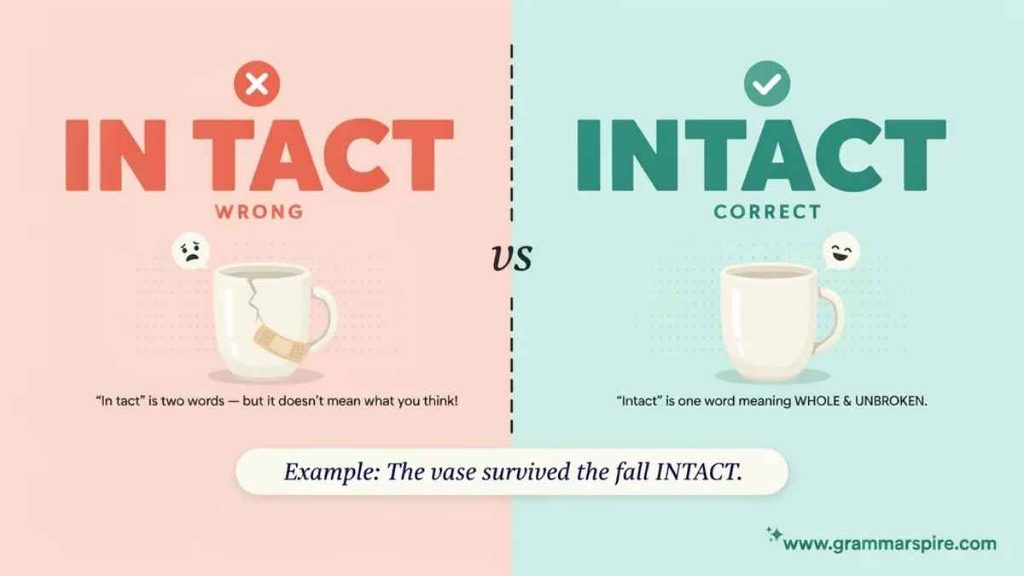
Intact is an adjective that means whole, complete, undamaged, or remaining in its original or preserved condition.
The word often describes something that has survived an event without being broken, destroyed, seriously changed, or separated.
For example:
The antique vase arrived intact.
The rescue team found the documents intact.
The historic wall remains intact.
Her confidence stayed intact despite the criticism.
In each example, intact tells you that something has remained whole or preserved.
Intact Definition
A straightforward intact definition is “whole and not damaged, broken, altered, or destroyed.”
Depending on the context, intact can also mean that something has remained complete or unchanged.
For example, if a package arrives intact, it means the package has not suffered damage that affects its condition.
If a tradition remains intact, it means people have preserved it without major changes.
If someone’s reputation remains intact, it means the person’s good reputation has survived a difficult situation.
Is Intact an Adjective?
Yes. Intact is an adjective.
An adjective describes or gives more information about a noun. In a sentence such as “The painting remained intact,” the word intact describes the condition of the painting.
You can also place it before a noun:
The intact painting was carefully stored.
Or after a linking verb:
The painting was intact.
This makes intact a flexible and useful adjective in both everyday and professional English.
What Does “In Tact” Mean?
When someone writes in tact while trying to mean “whole,” “complete,” or “undamaged,” they are usually making a spelling mistake.
In standard English, intact is written as a single word.
The confusion probably comes from the way the word appears to contain the smaller word tact. Since English has many expressions that begin with in, writers may naturally assume that in tact is a two-word phrase.
That assumption is incorrect when the intended meaning is “whole” or “undamaged.”
For example:
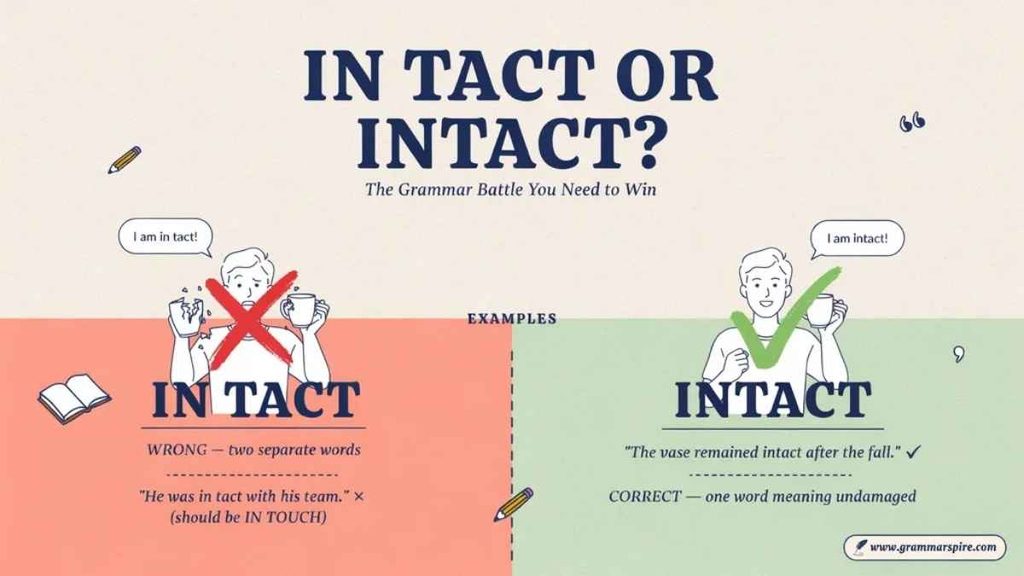
Incorrect: The package arrived in tact.
Correct: The package arrived intact.
Incorrect: The building remained in tact.
Correct: The building remained intact.
The word tact does have its own meaning, but that meaning has nothing to do with physical condition.
Learn the difference between everyday English mistakes
usable vs useable Which Spelling Is Correct?
Is Intact One Word?
Yes, intact is one word.
The correct English spelling is I-N-T-A-C-T.
You should not normally separate it into in tact when you mean “whole,” “complete,” or “undamaged.”
The word comes from Latin intactus, meaning untouched or unharmed, and entered English through French. Its history helps explain why modern English treats intact as a single word.
Therefore, if you are wondering, “Is intact one word?” the answer is clearly yes.
A useful memory trick is simple: intact means something has stayed whole, so the word stays whole too.
Is “In Tact” Grammatically Correct?
When you intend to use intact as an adjective, in tact is not grammatically correct standard English.
Consider these sentences:
The evidence remained intact.
The evidence remained in tact.
The first sentence uses the standard English word. The second uses an incorrect two-word spelling for the intended meaning.
However, this does not mean that the words in and tact can never appear next to each other in English. They can occur separately in a sentence if the context genuinely requires the preposition in and the noun tact.
For example:
She showed great skill in tactful communication.
That sentence uses a different grammatical structure. It does not create the word intact.
Intact Grammar
Intact functions as an adjective.
It can describe physical objects:
The glass remained intact.
It can describe structures:
The bridge remained intact.
It can describe documents:
The original record was still intact.
It can describe abstract things:
His reputation remained intact.
It can also appear after verbs such as remain, stay, keep, leave, and preserve.
For example:
The museum hopes to keep the artifact intact.
The team worked carefully to preserve the structure intact.
The documents remained intact throughout the investigation.
Tact Grammar
Tact is a noun.
It describes the ability to communicate or behave sensitively, especially when a situation could easily cause offense or embarrassment.
For example:
She handled the disagreement with tact.
He showed tact when discussing the sensitive issue.
The manager needed tact to resolve the dispute.
So, although intact and tact look related, they perform different grammatical roles and express different ideas.
Learn the difference between everyday English mistakes
Manuel or Manual Which spelling is correct?
In Tact vs Intact The Key Difference
The difference between in tact and intact becomes clear when you focus on meaning.
| Word or Phrase | Meaning | Grammar | Example |
|---|---|---|---|
| Intact | Whole, complete, undamaged, or unchanged | Adjective | The vase remained intact. |
| In tact | Not the standard spelling of intact in this use | Two word spelling error | The vase remained in tact. |
| Tact | Diplomacy, sensitivity, or skill in handling people | Noun | She handled the issue with tact. |
The key distinction is simple. Intact describes the condition of something. Tact describes the way someone handles a person or situation.
If a building survives an earthquake without major damage, the building may remain intact.
If an employee discusses the disaster with sensitivity, that employee may show tact.
These meanings should never be mixed.
Learn the difference between everyday English mistakes
Tweek or Tweak Which Spelling Is Correct?
When to Use Intact
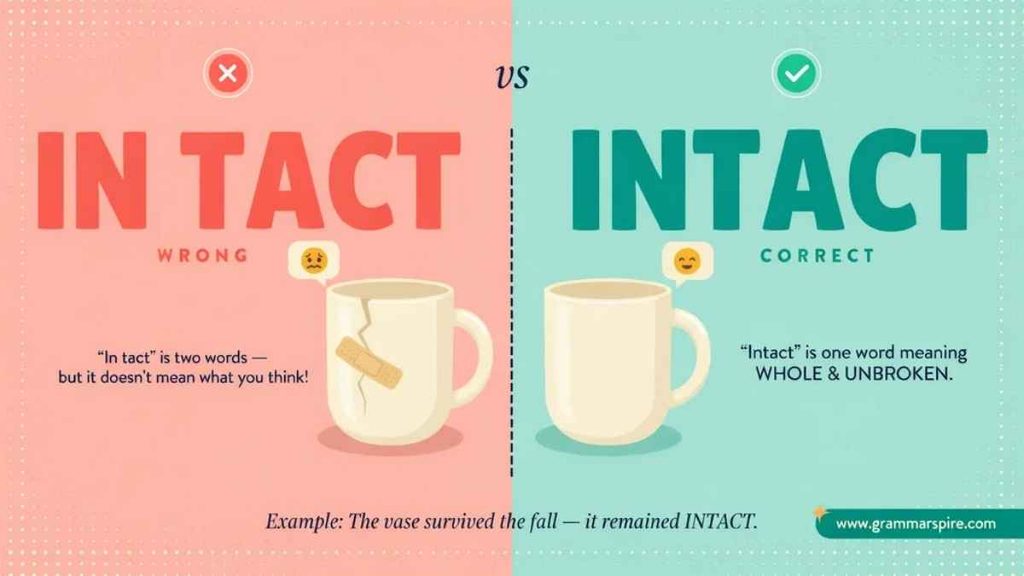
You should use intact when something remains whole, complete, undamaged, preserved, or substantially unchanged.
Intact for Physical Objects
Intact commonly describes physical objects that have survived an accident, move, fall, shipment, or other event.
For example:
The glass arrived intact.
The package was still intact after delivery.
The collector found the coin intact.
The fragile ornament survived the journey intact.
In these sentences, intact tells the reader that the object remained whole.
Intact for Buildings and Structures
You can also use intact to describe buildings, walls, bridges, monuments, and other structures.
For example:
The historic doorway remains intact.
Much of the original structure is still intact.
The old stone wall survived the storm intact.
The building remained structurally intact after the earthquake.
Here, intact can mean that the structure has retained its physical form despite damage or pressure around it.
Intact for Documents and Records
Intact also works well when discussing documents, records, files, evidence, or information.
For example:
The original document remained intact.
The historical records survived intact.
The evidence was recovered intact.
The digital archive remained intact after the system failure.
The word can indicate that the material itself remained complete or preserved.
Intact for Abstract Things
Intact does not only describe physical objects. It can also describe ideas, relationships, reputations, traditions, systems, and other abstract things.
For example:
The team’s trust remained intact.
The tradition has remained intact for generations.
Her reputation came through the controversy intact.
The agreement remained intact despite the disagreement.
In these cases, intact means that something important has remained preserved rather than physically unbroken.
Learn the difference between everyday English mistakes
Quiet or Quite What Is the Difference?
Everything Is Intact Meaning
The phrase everything is intact means that everything remains whole, complete, present, or undamaged.
For example:
After checking the house, the owner confirmed that everything was intact.
This sentence suggests that the important parts of the house remained in good condition.
The phrase can also describe a situation after an event:
After the move, everything was intact.
Here, the speaker means that nothing important was broken, lost, or seriously damaged.
However, everything is intact does not necessarily mean everything is perfect.
A room could have scratches on the floor while the furniture, windows, and major belongings remain intact. In that situation, everything might still be described as intact even though the room is not flawless.
That distinction matters because intact focuses on preservation, not perfection.
Intact Meaning in Medical Terms
In medical language, intact often describes a body structure, tissue, sensation, function, or physical feature that remains whole or preserved.
For example, a medical professional might describe skin as intact when it has no open wound or break in the area being examined.
The word can also appear with terms such as intact tissue, intact bone, intact sensation, intact reflexes, intact circulation, or intact nerve function.
For example:
The skin was intact.
Sensation remained intact.
The bone structure was intact.
The reflexes were intact.
The phrase depends on the specific medical context.
Importantly, intact does not automatically mean that a person is completely healthy. It usually describes the particular structure or function being discussed.
For instance, saying that sensation is intact means the relevant sensation is present or preserved. It does not, by itself, provide a complete assessment of someone’s health.
Learn the difference between everyday English mistakes
Noisey or Noisy Which Spelling Is Correct?
What Does “Intact Dog” Mean?
In veterinary language, an intact dog is a dog that has not been surgically sterilized.
An intact male dog has not been neutered.
An intact female dog has not been spayed.
For example:
The veterinarian asked whether the dog was intact.
This use differs from the everyday meaning of intact. In general English, intact means whole, complete, or undamaged. In veterinary contexts, it can refer specifically to reproductive status.
The context therefore matters.
Intact Synonyms and Related Words
Several English words can express ideas similar to intact, although their exact meanings vary.
Whole means complete and not divided or broken.
Complete means containing all necessary parts.
Undamaged means that something has not suffered damage.
Unharmed means that something or someone has escaped harm.
Unbroken means that something has not been broken.
Preserved means that something has been kept in a particular condition.
Unchanged means that something has stayed the same.
Unaffected means that something has not been influenced or altered by an event.
Unaltered means that something has not been changed.
Entire means complete or whole.
“In one piece” is a common informal expression that can also convey a meaning similar to intact.
For example:
The package arrived in one piece.
The package arrived intact.
Both sentences communicate a similar idea, although the second sounds more formal and precise.
Learn the difference between everyday English mistakes
Receipt or Reciept Which Spelling Is Correct?
Intact Antonyms
The opposite of intact depends on the context.
Damaged, broken, shattered, altered, affected, incomplete, destroyed, impaired, and compromised can all serve as opposites in different situations.
For example:
The vase remained intact.
The vase was shattered.
The original document remained intact.
The document was damaged.
The structure remained intact.
The structure was compromised.
Choosing the right antonym depends on exactly what changed or went wrong.
Why Do People Write “In Tact”?
The spelling mistake happens because intact looks as though it could naturally divide into in and tact.
English contains many words that began as separate words or phrases, so readers sometimes apply familiar spelling patterns to unfamiliar words. In this case, however, intact has become established as one English word.
Another reason is pronunciation. When people hear a word rather than see it written, they may mentally divide it into sounds that resemble familiar words.
That can produce forms such as in tact.
Similar spelling mistakes happen with many English words. Sound and spelling do not always cooperate nicely. English spelling has a talent for making simple things look suspiciously complicated.
The solution is to connect intact with its meaning rather than its apparent parts.
Learn the difference between everyday English mistakes
Verbage or Verbiage Which Spelling Is Correct?
Common Mistakes in Which
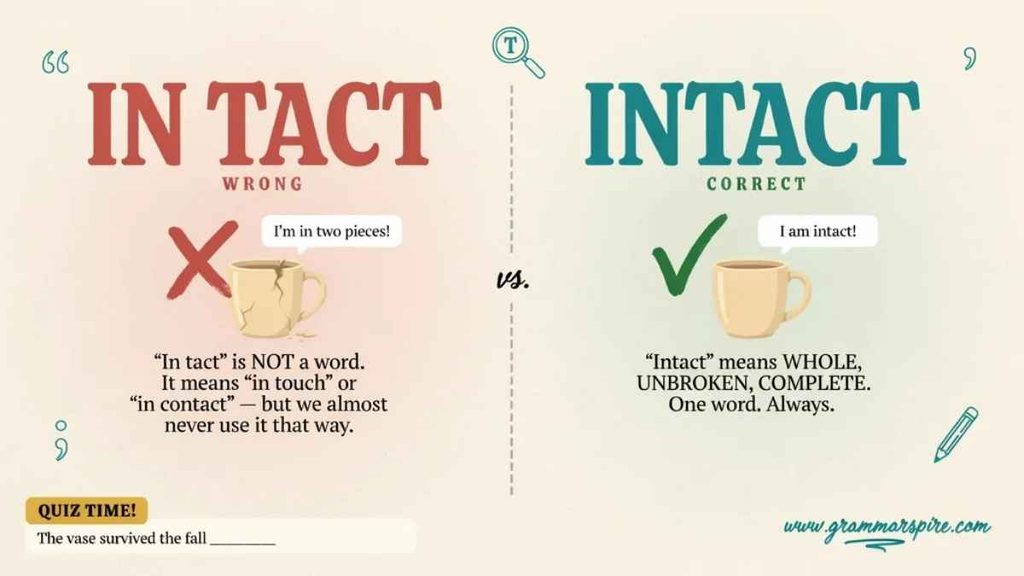
One of the most common mistakes is writing in tact when the intended meaning is “whole.”
For example:
Incorrect: The package arrived in tact.
Correct: The package arrived intact.
Another mistake involves confusing intact with tact.
For example:
Incorrect meaning: The manager handled the complaint with intact.
Correct: The manager handled the complaint with tact.
The third mistake is assuming that intact means perfect.
For example, a damaged object could no longer be intact if it has lost or broken an important part. However, something can remain intact while showing minor signs of wear, depending on the context.
The safest approach is to think about preservation rather than perfection.
In Tact or Intact in Professional Writing
In professional writing, correct spelling matters because a small error can distract readers from important information.
Suppose a shipping report says:
“The equipment arrived in tact.”
The intended meaning is obvious, but the spelling still looks incorrect.
A professional version would be:
“The equipment arrived intact.”
The same principle applies to academic writing, technical reports, business communication, news writing, and formal documentation.
For example:
The original records remained intact.
The historic structure is still intact.
The research data remained intact after the transfer.
The evidence was recovered intact.
Using the standard one-word spelling keeps your writing clear and credible.
In Tact or Intact Real Life Examples
Imagine a museum transporting a fragile vase to another building. After opening the carefully protected container, the curator sees that the vase has survived the journey without breaking.
The curator could say:
“The vase arrived intact.”
Now imagine an old building that survives a major storm. Its windows may need repair, but its main structure remains standing and preserved.
A report might state:
“The historic structure remained largely intact.”
Consider another situation involving a person’s reputation. A public controversy could have damaged someone’s reputation, but if the person comes through without losing public trust, you might write:
“Her reputation remained intact.”
These examples show why context matters. Intact describes something that remains whole, preserved, or substantially unchanged.
Learn the difference between everyday English mistakes
Advise or Advice which spelling is correct?
In Tact or Intact Examples You Can Use
For physical objects:
The package arrived intact.
The glass bottle remained intact.
The painting was found intact.
The antique clock survived the move intact.
For buildings and structures:
The historic wall remains intact.
The bridge remained structurally intact.
The original doorway is still intact.
For documents and information:
The original records remained intact.
The files were recovered intact.
The evidence was preserved intact.
For abstract conditions:
His reputation remained intact.
The agreement stayed intact.
Their relationship remained intact.
The tradition has remained intact.
For tact:
She handled the criticism with tact.
The teacher addressed the sensitive issue with tact.
He answered the difficult question with tact.
These examples make the difference between intact and tact much easier to recognize.
How to Use Intact in a Sentence
Intact works naturally in several sentence patterns.
You can place it after a linking verb:
The package was intact.
The structure remained intact.
The document is intact.
You can also place it before a noun:
The intact package was placed on the shelf.
The intact document was returned to the archive.
Another common structure uses keep:
Please keep the seal intact.
The team worked carefully to keep the original structure intact.
You can also use intact with remain or stay:
The evidence remained intact.
The tradition stayed intact.
These patterns are especially useful when you want your writing to sound natural and precise.
Is “In Tact” Correct?
If you mean “whole,” “complete,” or “undamaged,” no. The correct form is intact.
The correct spelling is:
The package remained intact.
The incorrect spelling is:
The package remained in tact.
If you are using tact as a noun meaning diplomacy or sensitivity, tact is correct.
For example:
She dealt with the situation with tact.
Therefore, the answer to “is in tact correct?” depends on what you mean, but for the meaning “whole or undamaged,” use intact.
Is It In Tact or Intact?
The correct choice is intact when you mean that something remains whole or undamaged.
Use:
The car was still intact after the accident.
Do not write:
The car was still in tact after the accident.
The difference is not stylistic. It is a matter of standard English spelling.
In Tact or Intact Which Is Correct?
Intact is correct when you mean whole, complete, preserved, or undamaged.
Tact is correct when you mean diplomacy or sensitivity.
In tact is not the standard spelling of intact.
A quick replacement test can help. Replace the word with whole or undamaged.
If the sentence still makes sense, you probably need intact.
For example:
The package arrived whole.
The package arrived intact.
That works.
Now consider:
She handled the situation with whole.
That makes no sense. The correct word is tact.
In Tact or Intact Spelling
The correct spelling is intact.
It contains six letters:
I-N-T-A-C-T
It is written as one word.
The spelling mistake in tact adds an unnecessary space and changes the standard form of the word.
When checking your writing, search for the phrase in tact if you suspect you may have made this error. In most cases where you intended to describe something as whole or undamaged, replace it with intact.
Why Is Intact One Word?
The reason intact is one word comes from its history and established development in English.
The English word traces back to Latin intactus, meaning untouched or unharmed. English adopted the word as a single lexical item rather than preserving it as the separate words in and tact.
Modern English therefore recognizes intact as one adjective.
This is a useful reminder that spelling does not always follow the visible parts of a word. A word may look as if it can be divided into familiar pieces while still functioning as one established word.
Learn the difference between everyday English mistakes
Benefiting or Benefitting Which Spelling Is Correct?
Intact in Academic and News Writing
Academic and news writing often uses intact to describe preserved evidence, structures, records, systems, or conditions.
For example:
Researchers found the original sample intact.
The historic structure remained largely intact.
The records survived intact for decades.
The investigation found that the system remained intact.
Because intact communicates a precise idea of preservation, it works well in formal writing.
It is also more concise than repeatedly using longer phrases such as “remained whole and undamaged.”
A Simple Memory Trick
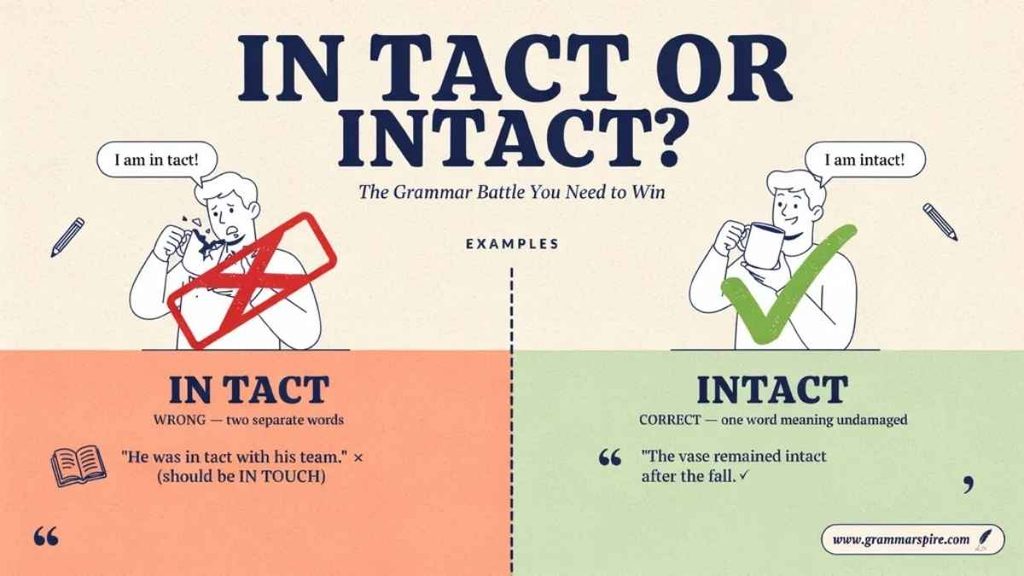
Remember this sentence:
Intact means whole, and the word stays whole.
The trick connects the meaning with the spelling. If something is intact, it has stayed together. Therefore, the word intact also stays together.
You can also use the whole-or-tact test.
If the sentence means whole, complete, or undamaged, choose intact.
If the sentence means diplomacy or sensitivity, choose tact.
For example:
The package stayed whole, so it remained intact.
She handled the complaint with diplomacy, so she used tact.
Once you connect each word with its meaning, the spelling becomes much easier.
Here’s a trusted source for clear more words Comparison
Grammar Update
Practice Session
Now it’s time to put the difference between intact and tact into practice. Read each sentence carefully and use the word that best fits the meaning. Remember, intact describes something that remains whole, complete, preserved, or undamaged. Tact refers to sensitivity, diplomacy, and good judgment when handling people or delicate situations.
Fill in the Blanks
- The fragile package arrived ______ despite the long journey.
- She handled the customer’s complaint with remarkable ______.
- Much of the historic building remained ______ after the earthquake.
- The original documents were found ______ in the archive.
- He approached the sensitive conversation with considerable ______.
- The antique vase survived the move completely ______.
- Their friendship remained ______ despite the disagreement.
- The manager showed great ______ when addressing the employee’s mistake.
- The painting was transported carefully and arrived ______.
- The family tradition has remained ______ for generations.
- She responded to the criticism with admirable ______.
- The investigators recovered the evidence ______ from the site.
- The package seal was still ______ when it reached the customer.
- The diplomat handled the tense discussion with ______.
- The original stone wall is still ______.
- His reputation remained ______ throughout the controversy.
- The teacher explained the sensitive topic with ______.
- The historical records survived ______ for many years.
- The valuable clock arrived ______ despite the rough transportation.
- Her thoughtful response showed considerable ______.
- The agreement remained ______ despite several disagreements.
- The doctor confirmed that the skin was ______.
- He used ______ when explaining the problem to his colleague.
- The old photograph was surprisingly ______ after all those years.
- The restoration team worked carefully to keep the original structure ______.
- She discussed the delicate matter with patience and ______.
- The original file remained ______ after the computer transfer.
- The relationship between the two organizations stayed ______.
- The museum confirmed that the ancient artifact was still ______.
- He needed considerable ______ to discuss the issue without causing offense.
Answers
- intact
- tact
- intact
- intact
- tact
- intact
- intact
- tact
- intact
- intact
- tact
- intact
- intact
- tact
- intact
- intact
- tact
- intact
- intact
- tact
- intact
- intact
- tact
- intact
- intact
- tact
- intact
- intact
- intact
- tact
Frequently Asked Questions
Is it still in tact or intact?
Intact is the correct form when you mean whole, complete, preserved, or free from significant damage. For example, “The package arrived intact.”
What does being intact mean?
Being intact means remaining whole or complete without being seriously damaged, broken, or changed. The term can describe physical objects, structures, documents, relationships, reputations, and other conditions.
What does “tact” mean?
Tact means using good judgment and sensitivity when dealing with people or delicate situations. For example, “She handled the disagreement with tact.”
Is “in tact” ever correct?
Not when you mean whole or undamaged. In and tact may appear beside each other accidentally in a sentence with separate grammatical roles, but that does not make in tact an alternative spelling of intact.
Is “in tact” one word?
No. In tact consists of two words, but it is not the accepted form of the adjective intact. Write intact as a single word when describing something that remains whole or preserved.
What is another word for “intact”?
Possible alternatives include whole, complete, unbroken, undamaged, unharmed, preserved, unchanged, entire, and unaltered. The best choice depends on the context.
What is a better word for “tact”?
Depending on the sentence, you could use diplomacy, sensitivity, discretion, consideration, or delicacy. For example, “He handled the sensitive matter with discretion.”
What does “all in tact” mean?
All in tact is generally a misspelling of all intact. The intended idea is that everything remains whole, complete, present, or undamaged. The standard expression is “all intact.”
What’s the opposite of intact?
Depending on the situation, suitable opposites include damaged, broken, destroyed, incomplete, altered, impaired, or compromised.
What is the full meaning of intact?
Intact describes something that remains whole, complete, preserved, or substantially unchanged. It can refer to both tangible things and abstract conditions.
What does the phrase “still intact” mean?
Still intact means that something has survived an event without losing its essential condition. For example, “The historic building is still intact” indicates that the structure remains substantially preserved.
What is tact in slang?
Tact does not have a commonly established slang meaning in standard American English. In everyday usage, it generally retains its usual sense of sensitivity, diplomacy, and careful judgment.
What is the opposite of tact?
The opposite of tact can include insensitivity, rudeness, bluntness, thoughtlessness, or indiscretion. The most accurate term depends on the behavior involved.
What does the root word “tact” mean?
Tact traces back to a Latin root associated with touching. Over time, the idea developed into the figurative sense of handling people and sensitive situations carefully.
AEO In Tact or Intact
Is it “in tact” or “intact”?
Use intact when you mean something has remained whole, complete, or undamaged. In tact is not the standard spelling for this meaning.
Is intact one word or two?
Intact is one word. It should remain together when used as an adjective.
How do you spell intact correctly?
The correct spelling is intact: I-N-T-A-C-T.
What is the difference between intact and tact?
Intact is an adjective that describes a preserved or undamaged condition. Tact is a noun that refers to sensitivity and diplomacy in social situations.
Can you say “everything is intact”?
Yes. Everything is intact means that the relevant items or parts remain present, complete, whole, or undamaged.
Can intact describe a person?
Yes. The meaning depends on the context. It can describe a person’s physical condition or indicate that a particular ability or quality remains preserved. In veterinary contexts, intact can also describe an animal that has not been surgically sterilized.
Can intact describe an idea or reputation?
Yes. The word can describe something abstract that has survived without substantial damage or change. For example, “Her reputation remained intact.”
What does intact mean in medical language?
In medical writing, intact usually indicates that a particular structure, tissue, sensation, reflex, or function remains whole or preserved. Its precise meaning depends on what the medical professional is describing.
What does “remain intact” mean?
Remain intact means to continue in a whole, complete, or preserved state despite circumstances that could have caused damage or change.
What is a simple sentence with intact?
“The original painting remained intact.” In this sentence, intact means that the painting stayed whole and preserved.
Is “in tact” grammatically correct?
Not as a substitute for intact. When the intended meaning is whole, complete, or undamaged, standard English requires the single word intact.
How can you remember the spelling of intact?
Use the memory phrase “intact stays together.” The meaning refers to something remaining whole, so the spelling stays together as well.
Is tact related to intact?
Although the two forms look similar, they have different meanings and grammatical functions. Intact describes a preserved condition, while tact refers to sensitivity and diplomacy.
Conclusion
The confusion between in tact or intact comes down to one small space, but that space can make a big difference in your writing. When you mean whole, complete, preserved, or undamaged, use intact as one word. When you’re talking about diplomacy, sensitivity, or thoughtful judgment, use tact. In tact is not the standard spelling of intact in this context. The easiest way to remember it is simple: if something stays whole, the word stays together. Keep intact intact, save tact for delicate situations, and you’ll never have to give “in tact” another awkward place in your writing.

Ella AJS
Ella AJS is an experienced blogger and language enthusiast at Grammar Spire, dedicated to making English grammar simple, practical, and easy to understand. She specializes in word comparisons, meanings, usage, and common language confusions. Through clear explanations and engaging examples, Ella helps students, writers, and English learners improve their vocabulary and communicate with greater confidence and accuracy.