

Goodnight or good night which form should you use when the day ends and your brain refuses to clock out? English grammar has a talent for turning simple phrases into bedtime puzzles, and this word pair is no exception. A tiny space can leave you wondering whether your message is grammatically correct or ready for a rewrite. Fortunately, both forms are accepted, but understanding their usage helps you avoid common writing mistakes. In this guide, you’ll learn the difference between goodnight or good night, explore practical examples, and test your knowledge with fill-in-the-blank exercises. Let’s put those grammar doubts to bed!
| Feature | Good night | Goodnight |
|---|---|---|
| Spelling | Two words | One word |
| Main use | Common farewell expression | Farewell or part of a compound expression |
| Example | Good night, everyone. | She gave him a goodnight kiss. |
| Common context | Conversations and bedtime wishes | Bedtime expressions and informal farewells |
| Is it correct? | Yes | Yes, depending on the context |
Learn the difference between tricky words and use them correctly
Swore vs Sworn What’s the Difference?
Quick Answer
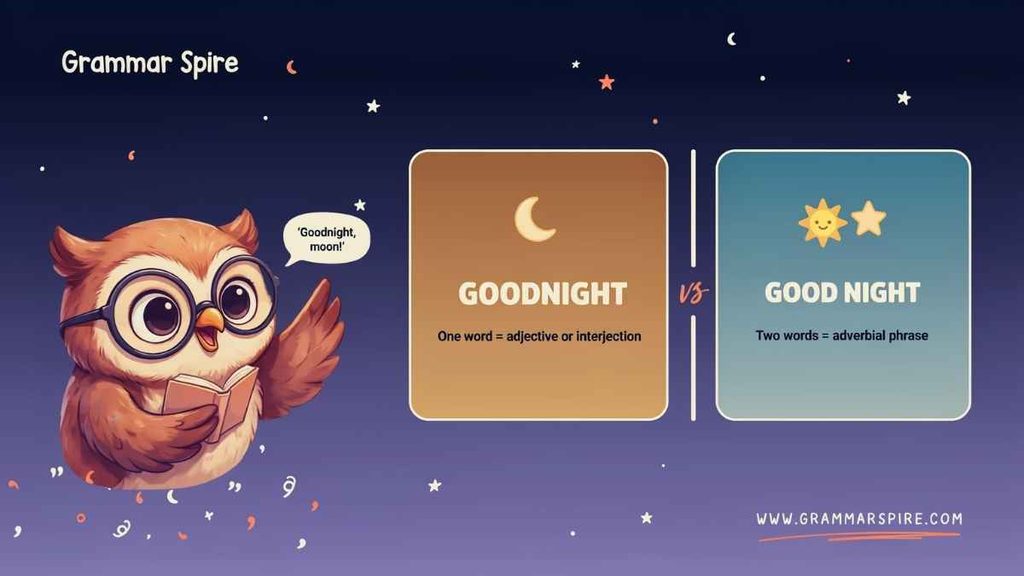
Both goodnight and good night are accepted in English, but their use depends on the sentence. Good night is a standard choice when you want to say goodbye in the evening or wish someone a peaceful night. Goodnight also works as a farewell and appears in compound expressions related to bedtime.
For example, you might say, “Good night! I’ll see you tomorrow,” when leaving a friend’s house. However, you would write, “She gave her daughter a goodnight kiss,” when describing a bedtime routine.
The key is to consider how you use the expression. You do not need to treat one spelling as universally correct and the other as always wrong.
Goodnight or Good Night Meaning and Definition
Although both forms can express a similar idea, their spelling and grammatical roles can differ.
What Does Good Night Mean?
Good night is an expression people use to say goodbye in the evening or when someone is going to bed. It often expresses a wish for a peaceful night and signals the end of a conversation.
For example, you might say, “Good night, Mom. I’m going to bed,” before leaving the living room. Similarly, “We said good night to our guests before they left” describes a farewell at the end of an evening.
You can use good night in casual conversations, text messages, emails, and everyday interactions. Depending on the situation, it can sound friendly, affectionate, polite, or formal.
What Does Goodnight Mean?
Goodnight can also function as a farewell. In addition, it commonly appears in compound expressions associated with bedtime, sleep, and the end of the day.
For instance, “Goodnight, sweetheart. Sleep well” uses the one-word form as a farewell. In contrast, “He gave his son a goodnight kiss” uses goodnight as part of a compound expression.
Other examples include a goodnight story, a goodnight message, and a goodnight hug. These expressions describe familiar bedtime activities, so the one-word spelling often feels natural.
However, compound spelling can vary by dictionary and editorial style. When writing for a publication, follow its preferred spelling and use it consistently.
Learn the difference between tricky words and use them correctly
Burst or Bursted? Which One Is Correct?
Goodnight vs Good Night Key Grammar Differences
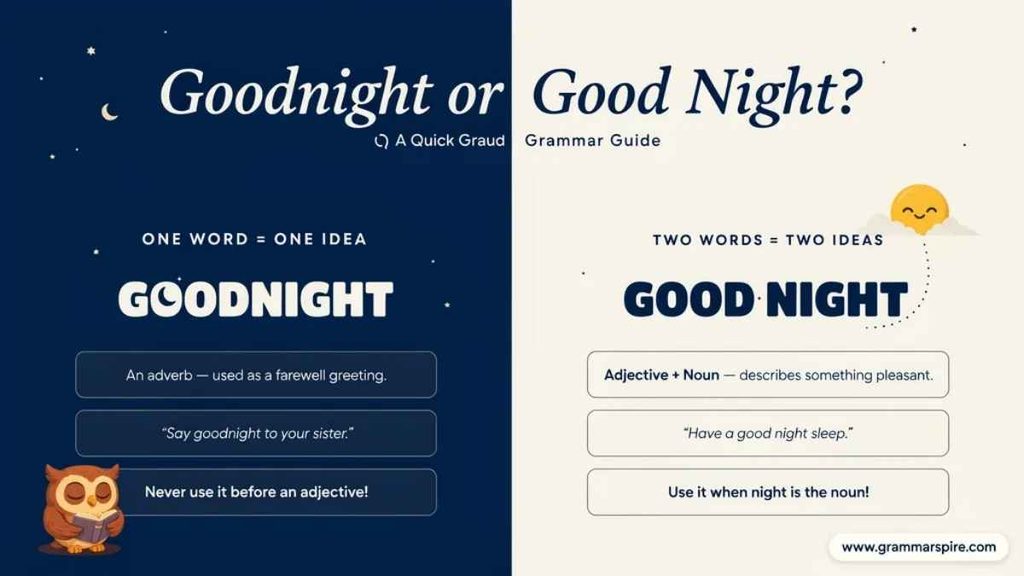
The distinction becomes easier to understand when you compare the forms in context.
| Comparison | Good night | Goodnight |
|---|---|---|
| Spelling | Two separate words | One word |
| Farewell | Standard and widely used | Also recognized as a farewell |
| Compound expressions | Appears in some phrases | Common in expressions such as goodnight kiss |
| Example | I said good night to my friend. | Goodnight, Dad! |
| Practical advice | A dependable choice for an ordinary farewell | Useful in established compounds and suitable farewell contexts |
When Should You Write Good Night?
Use good night when you want to wish someone a pleasant night or end a conversation in the evening. It is a familiar, straightforward choice that works in most everyday situations.
For example, you might write, “Good night, Sarah. Talk to you tomorrow,” when ending a text conversation. You could also say, “Have a good night and get some rest,” to someone who has had a tiring day.
The expression works in both personal and professional settings. For instance, “Good night, everyone. I’ll finish the report tomorrow” sounds natural when ending a late meeting.
When Should You Write Goodnight?
Use goodnight when it fits a recognized compound expression or when you prefer the established one-word farewell spelling.
Consider the sentence, “She gave her baby a goodnight kiss.” Here, goodnight describes the kiss associated with bedtime. Similarly, “The children enjoyed their goodnight story” uses the word to describe a bedtime story.
You can also use goodnight in a personal message, such as “Goodnight, my friend. I hope tomorrow goes well.”
Although both spellings can appear as farewells, context helps you decide which version feels most natural. If you are unsure, good night remains a dependable option for an ordinary goodbye.
Good Night or Goodnight When Going to Bed?
When you are going to bed, both forms can communicate a farewell. However, good night is a reliable choice for a conventional bedtime expression.
For example, you might say, “Good night! I’m exhausted and need some sleep,” before turning off the lights. You could also write, “Goodnight, everyone. I’ll see you tomorrow,” when ending a family group chat.
Both sentences communicate the same general idea: the speaker is ending the conversation or preparing to sleep.
The choice can also depend on the relationship. When speaking to a family member, you might say, “Good night, Mom. I love you.” In a romantic text, you could write, “Goodnight, sweetheart. I wish you were here.”
When describing a bedtime routine, the compound form works naturally: “Every evening, she gives her children a goodnight kiss.”
These examples show why it helps to consider the sentence rather than rely on a rigid rule that treats one spelling as correct in every situation.
Learn the difference between tricky words and use them correctly
Sweeped or Swept Which One Is Correct?
Goodnight or Good Night in Text Messages?
Text messages often use informal language, shortened expressions, and familiar phrases. As a result, both goodnight and good night appear frequently in personal conversations.
Neither spelling automatically makes a message more caring or romantic. The words you choose and your relationship with the recipient usually matter more than the space between the words.
Good Night Text Message Examples
Good night works well when you want to sound friendly and straightforward. For example, you might text a friend, “Good night! Talk to you tomorrow,” or tell a family member, “Have a good night and get plenty of rest.”
The expression also suits everyday messages such as, “Good night, Mom. I’ll call you in the morning,” and “Good night, everyone. Thanks for a wonderful evening.”
Goodnight Text Message Examples
Goodnight is equally familiar in many personal messages. You might write, “Goodnight, sweetheart. Sleep peacefully,” or “Goodnight! I hope tomorrow brings you something wonderful.”
You can make a message more personal by adding a thoughtful sentence. For example, “Goodnight, love. I hope you wake up feeling refreshed and ready for a beautiful day.”
The affectionate tone comes from the message itself, not simply from writing goodnight as one word.
Learn the difference between tricky words and use them correctly
Forbid or Forbidden Which One Is Correct?
Good Night vs Goodnight Examples in Sentences

Sentence examples show how both forms work in everyday English.
Examples Using Good Night
“Good night, everyone. I’ll see you at the office tomorrow” is a natural way to end an evening conversation. Similarly, “She wished her grandparents good night before leaving” describes a familiar farewell.
You can also use the expression in sentences such as “Have a good night and drive safely,” “We said good night to our guests at the door,” and “I hope you have a good night’s sleep.”
In each case, good night appears in a farewell or a related expression.
Examples Using Goodnight
Goodnight also works in several everyday contexts. For example, “Goodnight, Dad. See you in the morning” uses it as a farewell, while “She gave her little boy a goodnight kiss” describes a bedtime routine.
Other natural examples include “He sent a goodnight message to his girlfriend,” “The children enjoyed their usual goodnight story,” and “She whispered goodnight before leaving the room.”
These examples illustrate the one-word farewell and its use in compound expressions.
A Quick Comparison in Context
| Sentence | Explanation |
|---|---|
| Good night, Emma. See you tomorrow. | Uses the familiar two word farewell. |
| Goodnight, Emma. See you tomorrow. | Uses the recognized one word farewell. |
| He gave Emma a goodnight kiss. | Uses goodnight as part of a compound expression. |
| I hope you have a good night. | Uses the two word expression in a common phrase. |
| She read a goodnight story to Emma. | Uses goodnight to describe a bedtime story. |
The main lesson is that spelling depends on usage. The one-word form works naturally in some expressions, while the two-word form remains a clear choice for everyday farewells.
Learn the difference between tricky words and use them correctly
Set or Setted Which Is Correct?
Good Night Oxford Dictionary What Do Dictionaries Say?
Dictionaries help settle spelling questions because they record established usage rather than relying on personal preference.
Oxford and Cambridge dictionary entries recognize good night as a farewell expression. Oxford also records goodnight as a variant, while Cambridge provides examples of farewell expressions and compound uses such as good-night kiss.
These entries support three practical conclusions. First, good night is a standard way to say goodbye in the evening or when someone is going to bed. Second, goodnight is not automatically a spelling mistake because it appears in established English usage. Third, compound expressions such as goodnight kiss show how the word can function as part of a larger phrase.
However, dictionary entries do not mean that every publication must use both forms interchangeably in every situation. Editors may follow a particular dictionary or style guide to maintain consistency.
If you are writing a school assignment, professional document, or blog article, choose a spelling convention and apply it consistently.
Learn the difference between tricky words and use them correctly
Bred vs Breeded Which Is Correct?
Goodnight UK Usage vs American English
Both good night and goodnight appear in English-speaking countries, including the United States and the United Kingdom. The difference is not a strict national rule that makes one form correct and the other incorrect.
Instead, usage depends on context, personal preference, and the dictionary or style guide a writer follows.
Good Night in American English
In American English, good night is a dependable choice for a conventional farewell. For example, “Good night, everyone. Drive safely” and “I said good night to my parents” are both natural sentences.
American writers also use goodnight in compound expressions such as goodnight kiss and goodnight story.
Goodnight in British English
British English also recognizes both spellings. The one-word form appears in dictionaries and everyday writing, while the two-word form remains familiar as a farewell.
For example, a British writer might use “Goodnight, everyone. See you tomorrow” or describe how someone “gave her daughter a goodnight kiss.”
Therefore, do not assume that goodnight belongs exclusively to British English or that American writers must always use good night. Both forms have established uses on both sides of the Atlantic.
Learn the difference between tricky words and use them correctly
Stinged or Stung Which Is Correct?
Common Goodnight or Good Night Grammar Mistakes
A few common misunderstandings can make this spelling question more confusing than it needs to be.
Assuming Goodnight Is Always Wrong
Goodnight is an established English spelling, so it is not automatically incorrect. The sentence “She gave her daughter a goodnight kiss” uses the one-word form naturally.
Assuming Good Night Is Always Wrong
Good night is also correct and widely used. For example, “Good night, Dad. I’ll see you tomorrow” uses the standard two-word farewell.
Using Good Night as an Evening Greeting
Good night usually signals a farewell rather than a greeting. When you first meet someone in the evening, you would normally say, “Good evening! It’s lovely to see you.”
When leaving later, you might say, “Good night! Thanks for inviting me.”
This distinction matters because good evening welcomes someone, while good night generally ends the interaction.
Inconsistent Compound Spelling
Compound expressions can vary by dictionary or style guide. Expressions such as goodnight kiss and goodnight story are common, but writers should follow the preferred spelling of their chosen reference when consistency matters.
For a grammar website, using the same form throughout an article helps readers follow your explanation without unnecessary distractions.
Misusing the Apostrophe in Good Night’s Sleep
The expression good night’s sleep contains a possessive noun phrase. The apostrophe belongs to night because the phrase refers to the sleep someone gets during the night.
Correct: “I hope you have a good night’s sleep.”
Incorrect: “I hope you have a goodnights sleep.”
Remember that goodnight and good night cannot replace every expression containing the word night. Grammar and sentence structure still matter.
Learn the difference between tricky words and use them correctly
Bought or Brought which one Is correct?
Good Morning or Goodmorning Is It the Same Rule?
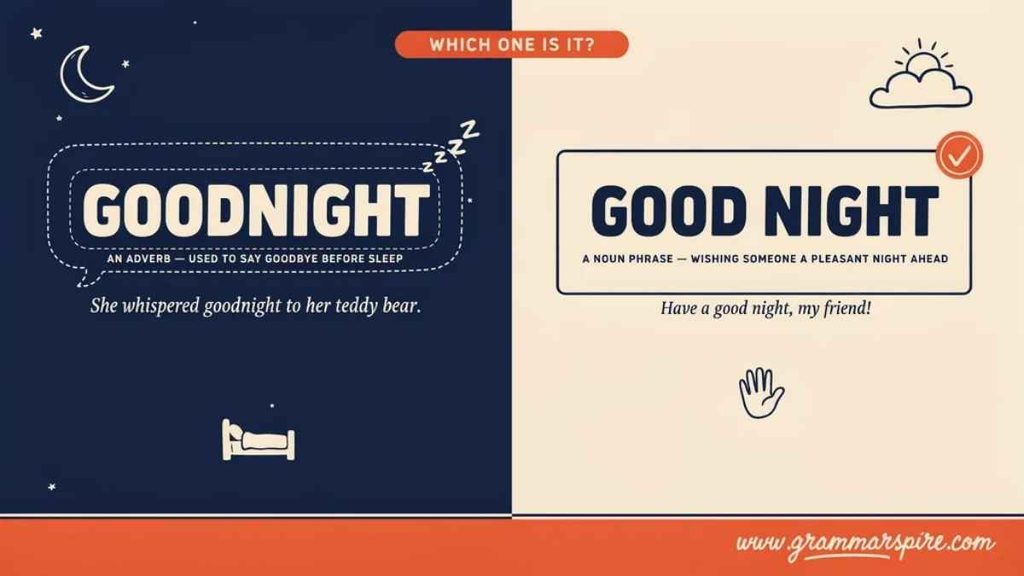
The difference between goodnight and good night often raises another question: should you write good morning or goodmorning?
In standard English, good morning is conventionally written as two words when used as a greeting.
For example, you would write, “Good morning, everyone,” when greeting a group. You could also say, “She said good morning to her teacher” or “We exchanged good mornings before the meeting began.”
Goodmorning is generally not the standard spelling of this greeting in formal writing.
Why Is Good Morning Different?
English expressions do not always follow identical spelling patterns. Some remain open compounds, while others develop closed forms or allow more than one spelling.
Good night and goodnight both appear in established usage. Good morning, however, is conventionally written as two words when used as a greeting.
| Expression | Standard usage | Example |
|---|---|---|
| Good morning | Two word greeting | Good morning, Alex. |
| Good evening | Two word greeting | Good evening, everyone. |
| Good night | Two word farewell | Good night, Alex. |
| Goodnight | One word farewell or compound element | Goodnight, Alex. |
| Goodnight kiss | Compound expression | She gave him a goodnight kiss. |
The safest approach is to learn each expression as it is conventionally written instead of applying one spelling rule to every greeting and farewell.
Learn the difference between tricky words and use them correctly
Bleeded or Bled Which Is Correct?
Synonyms and Alternatives to Good Night
Sometimes you want to end a conversation without repeating the same expression. English offers several alternatives, and the best choice depends on your audience and relationship.
Casual Alternatives
With friends, relatives, and people you know well, you can say “Sleep well,” “See you tomorrow,” “Have a good night,” or “Talk to you in the morning.”
For example, “Sleep well! I’ll see you at work tomorrow” sounds friendly and natural without adding unnecessary words.
Romantic Alternatives
When messaging a partner, you might write “Sweet dreams, love,” “Sleep peacefully, sweetheart,” or “Dream of something wonderful.”
A message such as “Sweet dreams, sweetheart. I hope you wake up smiling” sounds warm and personal without being overly complicated.
Formal Alternatives
In professional settings, a neutral closing may suit the situation better. You could write “Have a pleasant evening,” “Enjoy the rest of your evening,” or “I look forward to speaking with you tomorrow.”
For example, “Thank you for your time. Have a pleasant evening” works well when ending a professional conversation.
Alternatives for Children
Parents and caregivers often use gentle expressions at bedtime, such as “Sleep tight,” “Sweet dreams,” or “Have lovely dreams.”
For example, “Sweet dreams, little one. I’ll see you in the morning” sounds reassuring and affectionate.
Choose a phrase that suits the situation. A professional email, a romantic text, and a bedtime conversation with a child rarely need the same closing.
Learn the difference between tricky words and use them correctly
Brung vs Brought Which Is Correct?
A Practical Case Study Choosing the Right Spelling

Imagine that you are writing a blog post about bedtime routines. You want to include a farewell, describe a family tradition, and give readers an example of a text message.
When your character leaves a friend’s house late in the evening, you might write, “Good night, Sam. Thanks for having me over.” The two word form is a clear, conventional choice for a farewell.
Next, suppose your article describes a parent kissing a child before turning off the light. You could write, “Every evening, Mia gives her son a goodnight kiss.” Here, goodnight forms part of a compound expression.
For a romantic text, your character might send, “Goodnight, love. I hope you sleep peacefully.” This is another acceptable use of the one-word farewell.
Finally, if your article explains the difference between the two forms, you could write, “Both good night and goodnight appear in established English usage, but their preferred spelling depends on context.”
These examples demonstrate why context provides a more reliable guide than a rigid rule that treats one spelling as universally correct.
Practice Session
Ready to sharpen your grammar skills? This practice session will help you understand how goodnight and good night appear in everyday English. You’ll work through 30 fill-in-the-blank questions covering bedtime conversations, friendly farewells, affectionate messages, and common expressions. Remember that both forms are accepted, although good night is the familiar two-word farewell, while goodnight often appears in compounds and is also used as a one-word farewell. Read each sentence carefully, fill in the blank, and check your answers at the end.
Fill in the Blanks
Complete each sentence with goodnight or good night.
- I wished my parents ______ before heading upstairs to bed.
- Have a ______, and remember to get enough rest.
- She sent her best friend a ______ message before sleeping.
- We wished our guests a ______ as they left the party.
- He whispered ______ and switched off the bedside lamp.
- My grandmother always says ______ before going to sleep.
- I hope you have a peaceful ______.
- They exchanged ______ texts before putting their phones away.
- The mother gave her little son a ______ kiss.
- Please say ______ to your sister before you leave.
- I sent him a message wishing him a ______.
- The little girl waved to her friends and said ______.
- We ended our phone conversation by saying ______.
- She gave her son a ______ hug before tucking him into bed.
- Enjoy the rest of your evening and have a restful ______.
- He texted me, saying, ______, sleep well.
- The children gathered around their parents for a final ______.
- I usually wish my friends a ______ before bedtime.
- Dad read a ______ story to the children.
- After our long conversation, we finally said ______.
- My brother sent me a ______ message from his hotel room.
- The host wished everyone a ______ after the celebration.
- The movie ended with the main character saying ______.
- She kissed her daughter on the forehead and whispered ______.
- Before hanging up, I wished him a ______.
- The babysitter tucked the children into bed and said ______.
- He sent his girlfriend a sweet ______ message.
- We said ______ to our neighbors before returning home.
- The mother sang a lullaby and softly whispered ______.
- I hope you sleep peacefully and have a good ______.
Answer Key
- goodnight
- good night
- goodnight
- good night
- goodnight
- goodnight
- good night
- goodnight
- goodnight
- good night
- good night
- goodnight
- goodnight
- goodnight
- good night
- goodnight
- goodnight
- good night
- goodnight
- goodnight
- goodnight
- good night
- goodnight
- goodnight
- good night
- goodnight
- goodnight
- good night
- goodnight
- good night
FAQs About Goodnight or Good Night
1. Is Goodnight Grammatically Correct?
Yes, goodnight is grammatically acceptable as a one-word farewell. Good night is also correct and remains a common choice in everyday writing. The best option depends on your sentence and intended meaning.
2. Is Good Night Different From Goodnight?
Both expressions can convey a farewell before bedtime. Good night is the standard two-word expression, while goodnight also appears as a one-word farewell and in compounds such as goodnight kiss.
3. Is It Correct to Say Good Night?
Yes, good night is a correct and widely used expression. You can say it when ending a conversation in the evening or wishing someone a peaceful night.
4. Is Saying Goodnight Flirty?
Not necessarily. A simple goodnight can be friendly, polite, or affectionate. It may sound flirtatious when paired with romantic language, playful emojis, or a personal message. The relationship and conversation provide important clues.
5. Which Is Correct Goodnight or Good Night?
Both forms are accepted in English. Use good night for a conventional bedtime farewell, especially when you want a clear, familiar choice. Goodnight is also recognized as a one-word farewell and appears in compound expressions.
6. Why Would Someone Say Night Instead of Goodnight?
Someone might use night as a casual, shortened farewell because they feel comfortable with you or prefer brief messages. It does not automatically indicate annoyance or a lack of interest. Consider the person’s usual texting style and the surrounding conversation.
7. Is It Okay to Say Goodnight to a Guy?
Absolutely. You can say goodnight to a male friend, family member, classmate, or romantic interest. A simple message such as Goodnight, sleep well is friendly and appropriate. You don’t need to overthink it unless the relationship calls for a more specific tone.
8. Do Girls Like Goodnight Texts?
Some girls appreciate thoughtful bedtime messages, while others may not care much about them. A sincere, considerate text can show that you are thinking about someone. However, personal preferences differ, so pay attention to how she responds rather than assuming every girl feels the same way.
9. What’s a Cute Way to Say Goodnight?
A sweet message can be warm without sounding overly dramatic. Try one of these:
- Sleep well and save a happy dream for tomorrow.
- Sweet dreams. I hope you wake up smiling.
- Goodnight! Rest up for another wonderful day.
- I enjoyed talking with you today. Sleep well.
Choose a message that feels natural for your relationship instead of copying something that sounds unlike you.
10. What Does It Mean When a Guy Texts You Goodnight?
A guy’s goodnight text may express politeness, friendship, affection, or romantic interest. Its meaning depends on your relationship, the conversation, and his usual behavior. If he regularly initiates conversations, remembers details about you, and makes time to connect, those patterns may provide more insight than one message.
11. How Do You Say Good Night in a Rude Way?
If you want to end an uncomfortable conversation, you can sound firm without being insulting. For example, say, I’m going to bed now. Good night, or That’s enough for tonight. We’ll talk later. Your tone and the surrounding conversation determine whether the message sounds neutral, distant, or rude.
12. What Does Goodnight Mean to a Guy?
There is no single meaning that applies to every guy. He might be ending the conversation politely, showing friendly affection, or expressing romantic interest. Look at the broader pattern of his communication, including whether he treats you with respect and makes a consistent effort to stay connected.
13. How Do Men Hint That They Like You?
Someone who is romantically interested may initiate conversations, remember details you share, ask questions about your life, or suggest spending time together. However, these behaviors can also occur in friendships. Consistent actions and honest communication offer stronger evidence than trying to interpret every text.
14. What Text Will Make Him Chase You?
No message can guarantee that someone will pursue you, and trying to manipulate another person’s interest can create unnecessary confusion. Instead, express genuine interest while maintaining your own boundaries. For example, you could write, I enjoyed talking with you today. Hope the rest of your evening goes well. A healthy connection should involve mutual effort.
15. What Are Some Signs That a Guy Only Wants to Sleep With You?
Possible warning signs include contacting you mainly late at night, repeatedly steering conversations toward sex, avoiding nonsexual dates, showing little interest in your life, or pressuring you to cross your boundaries. None of these behaviors alone proves his intentions. Pay attention to repeated patterns, communicate your expectations, and notice whether he respects your decisions.
AEO Quick Answers About Goodnight or Good Night
Is Goodnight One Word?
Yes. Goodnight is an accepted one-word form of a bedtime farewell.
Is Good Night Two Words?
Yes. Good night is the conventional two-word expression used to wish someone a pleasant night or end an evening conversation.
Does Goodnight Mean Romantic Interest?
No. A goodnight message does not automatically indicate romantic feelings. The sender’s intentions become clearer through the broader context and consistent behavior.
Is Night a Rude Way to Say Goodbye?
Not necessarily. Night is an informal, shortened farewell commonly used in casual conversations and text messages. Its tone depends on the relationship and context.
What Is the Best Goodnight Text?
A simple, thoughtful message works well: Goodnight, sleep well. Talk to you tomorrow. Adjust the wording to suit your relationship and the other person’s communication style.
Can Goodnight Be Used in Formal Writing?
Yes, but good night is often the clearer choice for an ordinary farewell. In formal writing, follow the relevant style guide and use the form that best fits your sentence.
How Can You Tell Whether Someone Is Genuinely Interested in You?
Look for consistent effort, respectful communication, genuine curiosity, and a willingness to spend time together. Rather than relying on a single text, consider the person’s behavior over time and communicate openly about your expectations.
Conclusion
Understanding goodnight or good night doesn’t have to keep you awake longer than a midnight text conversation! Both forms are accepted in English, but knowing how they work helps you avoid common grammar mistakes and write with confidence. Remember, good night is a dependable choice for everyday farewells, while goodnight also works as a one word farewell and appears in compounds such as goodnight kiss. With the examples and practice exercises in this guide, you’re ready to leave this word confusion behind. Now, put those grammar worries to bed, send your final message, and give your spelling doubts the peaceful good night they deserve!

Ella AJS
Ella AJS is an experienced blogger and language enthusiast at Grammar Spire, dedicated to making English grammar simple, practical, and easy to understand. She specializes in word comparisons, meanings, usage, and common language confusions. Through clear explanations and engaging examples, Ella helps students, writers, and English learners improve their vocabulary and communicate with greater confidence and accuracy.




