
Brung vs brought which word belongs in your sentence? This tiny verb can create a surprisingly big grammar puzzle, leaving you wondering whether you have written correctly or accidentally invented a new word. Although brung appears in casual conversations and regional dialects, brought is the standard past tense and past participle form of bring. The confusion becomes even trickier when irregular verbs refuse to follow familiar spelling rules. Fortunately, you do not need a dictionary army to solve this mystery. This guide explains the meanings, correct usage, common mistakes, and practical examples to help you avoid grammatical slipups and write with confidence.
Brung vs Brought Quick Comparison
| Feature | Brung | Brought |
|---|---|---|
| Meaning | A nonstandard form associated with bring | The standard past form of bring |
| Past tense | Nonstandard in standard English | Correct |
| Past participle | Nonstandard in standard English | Correct |
| Formal writing | Generally avoid | Recommended |
| Informal speech | Used by some speakers | Common and widely accepted |
| Example | He brung his lunch. | He brought his lunch. |
Learn the difference between tricky words and use them correctly
Smoky or Smokey Which Spelling Is Correct?
Quick Answer
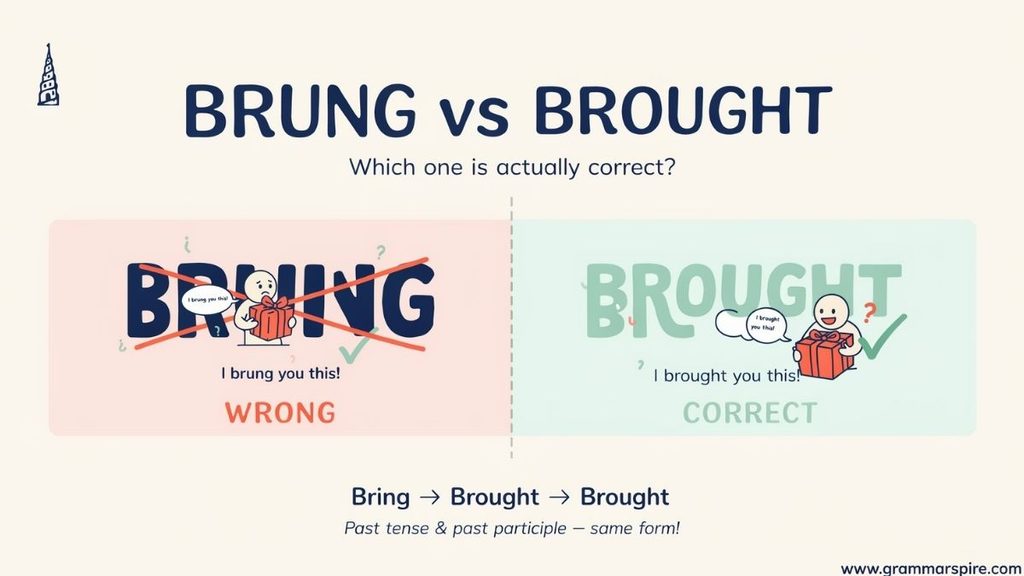
Brought is the correct form in standard English. It works as both the simple past tense and the past participle of bring. In contrast, brung appears in some dialects and informal speech but does not follow the standard verb pattern.
For example, write, “I brought my notebook to class yesterday,” rather than, “I brung my notebook to class yesterday,” when using standard English.
Similarly, write, “She has brought everything we need,” instead of, “She has brung everything we need.”
Although listeners can usually understand both forms, brought is the appropriate choice for academic assignments, professional emails, business documents, and published articles.
The standard verb pattern is bring, brought, brought. Once you remember these three forms, you can avoid one of the most common mistakes involving this irregular verb.
What Does Bring Mean?
Bring means to carry or transport something to a particular place or person. It can also describe accompanying someone or causing a particular result.
For instance, when your friend asks you to bring a book to their house, they want you to take the book there. Likewise, a teacher might ask you to bring your homework to class.
Consider these examples:
I bring my lunch to work every day.
Sarah brings her laptop to school.
We are bringing extra chairs for the guests.
Could you bring me a glass of water?
They brought their children to the park.
Notice that the verb changes according to the sentence. Bring and brings describe present habits, while bringing often describes an ongoing action. Meanwhile, brought describes a completed past action or appears as a past participle with a helping verb.
The Different Forms of Bring
Bring is an irregular verb because it doesn’t form its past tense by adding the usual -ed ending. Instead, both its simple past and past participle use brought.
| Verb form | Word | Example |
|---|---|---|
| Base form | Bring | I bring my lunch. |
| Third-person singular | Brings | She brings her lunch. |
| Present participle | Bringing | He is bringing lunch. |
| Simple past | Brought | We brought lunch yesterday. |
| Past participle | Brought | They have brought lunch. |
These forms help you express different times and situations accurately. For example, use bring when describing a regular habit, brought when discussing a completed past action, and have brought when connecting a past action to the present.
Learn the difference between tricky words and use them correctly
Swore vs Sworn What’s the Difference?
What Does Brought Mean?
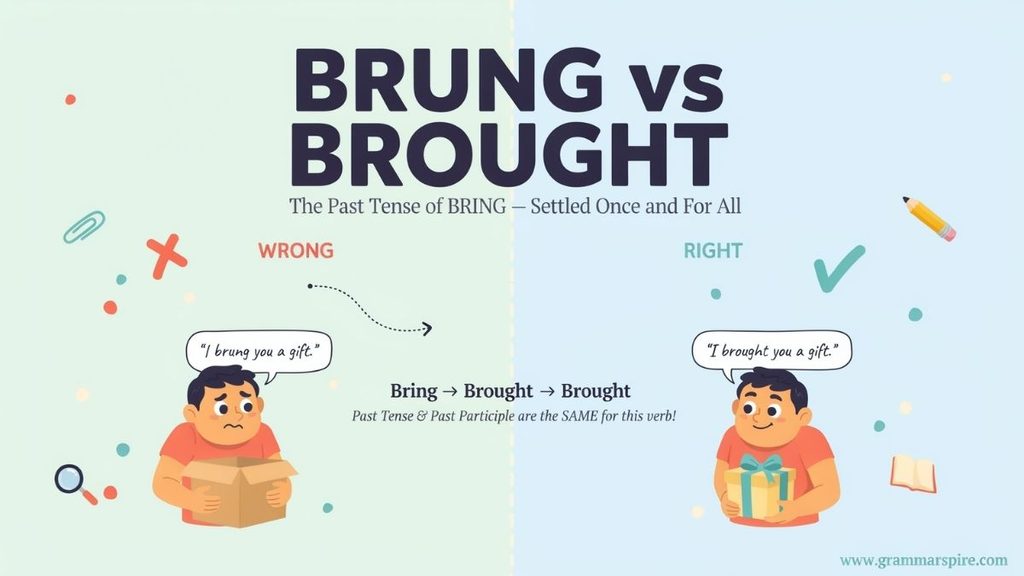
Brought is the standard past tense and past participle of bring. Its meaning usually involves carrying, taking, or accompanying someone or something to a particular place. However, it can also describe causing an event or producing a result.
For example, “The new policy brought major changes” means that the policy caused those changes. In this sentence, brought doesn’t refer to carrying a physical object.
Understanding the meaning of brought becomes easier when you examine its use in different grammatical structures.
Brought as the Simple Past Tense
Use brought when an action happened and finished in the past. Words such as yesterday, last week, and this morning can help establish the time, although a sentence doesn’t always need an explicit time expression.
Examples include:
I brought my umbrella because the forecast predicted rain.
Olivia brought a homemade cake to the party.
The delivery driver brought our package this morning.
We brought enough food for everyone.
Daniel brought his younger brother to the game.
Each sentence describes an action that occurred in the past. Because bring is irregular, you use brought rather than bringed or brung in standard English.
Brought as the Past Participle
The past participle of bring is also brought. It commonly appears with helping verbs such as has, have, and had to form perfect tenses.
For example, “I have brought all the documents you requested” uses the present perfect tense. Meanwhile, “They had brought the equipment before the meeting started” uses the past perfect tense.
Compare these sentences:
I brought the keys yesterday.
I have brought the keys.
The first sentence uses the simple past tense. The second uses the present perfect tense, which connects a past action to the present situation.
The word brought remains unchanged in both sentences. Instead, the helping verb and sentence structure determine the tense.
Brought in Expressions With Broader Meanings
Brought can describe results, effects, and changes rather than physical movement. This use appears frequently in everyday conversation, news reports, and professional writing.
The storm brought heavy rain to the region.
Her speech brought the audience to tears.
The discovery brought new attention to the problem.
The charity brought hope to families in need.
In each example, brought describes something that caused an effect. Recognizing this broader meaning will help you understand the verb in a wider range of contexts.
Learn the difference between tricky words and use them correctly
Burst or Bursted? Which One Is Correct?
Is Brung a Word?
Yes, brung appears in actual English speech and writing. However, it is a nonstandard form of bring that some speakers use in informal conversations and regional dialects.
Therefore, claiming that brung never exists would be misleading. People do use it, and you may encounter it in dialogue, humorous writing, regional speech, or discussions of English grammar.
Nevertheless, standard English uses brought as the past tense and past participle of bring.
For example, “He brought his guitar to the rehearsal” follows standard grammar, while “He brung his guitar to the rehearsal” uses a nonstandard form.
Both sentences communicate a similar idea, but their grammatical status differs.
What Is the Definition of Brung?
Brung is a nonstandard form associated with the verb bring. Some speakers use it to describe a past action or in a construction that requires a past participle.
However, this definition doesn’t mean brung is the recommended form for general written English. A word can occur in real language without being suitable for every audience or situation.
For Grammar Spire readers, the practical rule is straightforward: recognize brung when you encounter it, but use brought when standard English is expected.
Why Do People Say Brung Instead of Brought?
People sometimes form irregular verbs by analogy with other familiar words. For example, sing becomes sang, and ring becomes rang. Because bring resembles these verbs, some speakers may produce brang or brung by following a similar pattern.
However, English doesn’t apply one uniform pattern to every irregular verb. Bring follows the established standard pattern bring, brought, brought.
Regional speech patterns, family habits, local expressions, and informal conversations can also influence the forms people use. Consequently, you might hear brung in a conversation even though a grammar guide recommends brought.
Understanding this distinction helps you recognize language variation without confusing it with standard written conventions.
Learn the difference between tricky words and use them correctly
Sweeped or Swept Which One Is Correct?
Brung vs Brought Key Differences Explained
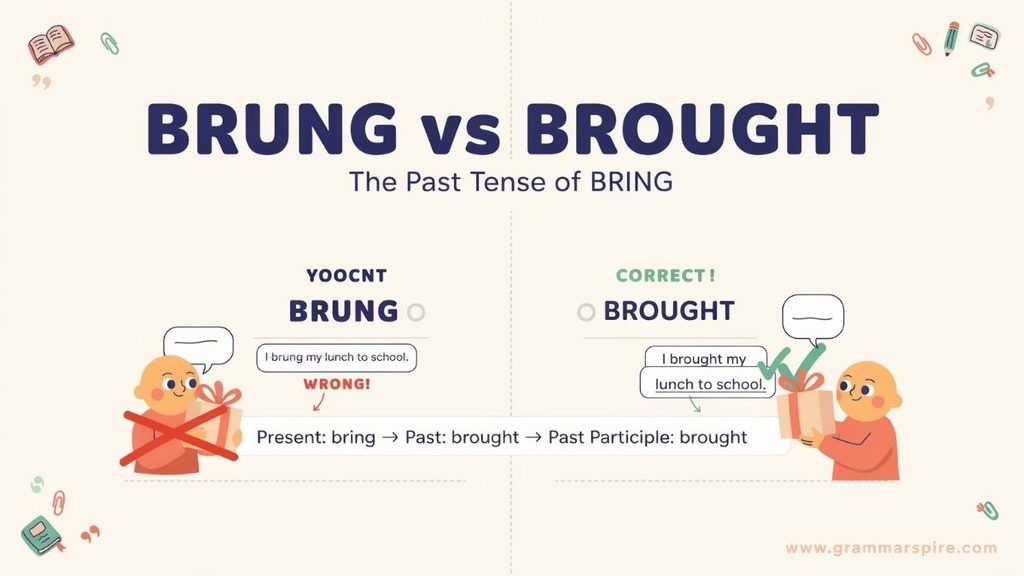
The main difference between brung and brought concerns standard grammatical usage rather than two separate meanings. In most contexts, both forms communicate the idea of bringing something somewhere, but brought follows conventional English grammar.
| Feature | Brung | Brought |
|---|---|---|
| Standard status | Nonstandard | Standard |
| Simple past | Not the standard form | Correct |
| Past participle | Not the standard form | Correct |
| Academic writing | Generally avoid | Appropriate |
| Professional communication | Generally avoid | Appropriate |
| Regional speech | May occur | Widely used |
| Example | She brung the documents. | She brought the documents. |
This comparison also explains why the question “brung vs brought correct spelling?” requires a little context. Brought is the standard form, while brung is a nonstandard variant that appears in some varieties of spoken English.
Brung vs Brought Meaning Are They Different?
In most situations, the intended meaning remains similar. Someone who says, “I brung the groceries,” generally means the same thing as someone who says, “I brought the groceries.”
However, the standard form matters when you write for an audience that expects conventional English grammar.
For example, “The announcement brought relief to the employees” follows standard usage. Replacing brought with brung would make the sentence nonstandard.
Therefore, the distinction isn’t usually about what the speaker wants to communicate. Instead, it concerns which verb form fits the variety of English being used.
Bring, Brought, and Brung Verb Forms Explained
Understanding bring and brought makes it easier to answer questions about the correct past tense of bring. You don’t need to memorize several competing forms. You only need to learn the standard pattern and recognize nonstandard alternatives when they appear.
The Standard Bring Verb Forms
The three principal forms are bring, brought, and brought.
| Base form | Simple past | Past participle |
|---|---|---|
| Bring | Brought | Brought |
This pattern applies to standard American English and other major standard varieties of English.
Use the base form after modal verbs such as will, can, and should. Use brought for completed past actions, and pair the past participle with the appropriate helping verb when forming perfect tenses.
For example, “I will bring my notes tomorrow” describes a future action. “I brought my notes yesterday” describes a completed past action. Meanwhile, “I have brought my notes every week this semester” uses the present perfect tense.
The verb forms remain consistent even when the sentence structure changes.
Why Bring Is an Irregular Verb
Regular verbs typically form the simple past and past participle by adding -ed or -d. For example, walk becomes walked, and clean becomes cleaned.
Bring doesn’t follow that pattern. Instead, it changes to brought in both the simple past and the past participle.
English contains many other irregular verbs, including buy, catch, teach, and think. Their forms provide useful comparisons.
| Base form | Simple past | Past participle |
|---|---|---|
| Buy | Bought | Bought |
| Catch | Caught | Caught |
| Teach | Taught | Taught |
| Think | Thought | Thought |
| Fight | Fought | Fought |
| Seek | Sought | Sought |
| Bring | Brought | Brought |
Notice the recurring -ought and -aught endings. These similarities can help you remember the forms, although they don’t provide a universal rule for every irregular verb.
Is Brung the Past Tense of Bring?
Brung is not the standard past tense of bring. The correct form in standard English is brought.
For example, write, “She brought her lunch to work,” rather than, “She brung her lunch to work,” in an essay or professional email.
Likewise, when you use a perfect tense, write, “She has brought her lunch,” instead of, “She has brung her lunch,” in standard written English.
The important point is that the verb doesn’t change to brung simply because the action happened in the past. The standard form remains brought.
Learn the difference between tricky words and use them correctly
Forbid or Forbidden Which One Is Correct?
Brung or Brang Which Form Is Correct?
Brang is another nonstandard form sometimes associated with the past tense of bring. You may encounter both brang and brung in informal speech, but neither replaces brought in standard English.
The question of brung or brang often arises because English speakers recognize a pattern in verbs such as sing and ring.
Compare these forms:
| Base verb | Standard past tense | Example |
|---|---|---|
| Sing | Sang | We sang together. |
| Ring | Rang | The phone rang twice. |
| Bring | Brought | She brought a gift. |
Although bring resembles sing and ring, its standard past tense follows a different pattern.
Therefore, if you’re choosing between brang vs. brought or brung vs. brought for a school assignment, report, or article, choose brought.
You might still encounter brang or brung in a quotation or a character’s dialogue. In those situations, the form may reflect the speaker’s dialect rather than an attempt to follow standard written English.
Learn the difference between tricky words and use them correctly
Set or Setted Which Is Correct?
Brung vs Brought in a Sentence Examples and Corrections

Examples make grammar rules easier to remember because they show how a verb works in real situations. The following sentences cover everyday conversation, school, work, travel, and perfect-tense constructions.
Correct Examples With Brought
I brought my lunch from home today.
Sarah brought her favorite book to the library.
They brought extra blankets for the camping trip.
My brother brought his friends to dinner.
The teacher brought several examples to class.
We have brought everything needed for the project.
He had brought the wrong documents to the meeting.
The new manager brought fresh ideas to the company.
Their teamwork brought the project to a successful conclusion.
Have you brought your identification with you?
The heavy rain brought flooding to several streets.
She has brought a positive attitude to the team.
Each sentence uses brought according to standard English grammar. Some describe physical movement, while others describe a result or an effect.
Nonstandard Brung Examples and Their Standard Versions
The following examples show how brung may appear in informal or dialectal speech and how to express the same idea in standard English.
| Nonstandard example | Standard English version |
|---|---|
| I brung my lunch to work. | I brought my lunch to work. |
| She brung her dog to the park. | She brought her dog to the park. |
| They brung the supplies yesterday. | They brought the supplies yesterday. |
| He has brung his homework. | He has brought his homework. |
| We had brung enough food. | We had brought enough food. |
| Who brung these flowers? | Who brought these flowers? |
These examples illustrate the difference between brung and brought without suggesting that speakers who use dialectal forms cannot communicate effectively. Instead, they show which form to choose when standard English is expected.
A Real Life Writing Example
Imagine that you’re writing an email to your manager after a meeting. You want to explain that you delivered the reports everyone requested.
You might write, “I brung the reports to the meeting this morning.”
Your manager would probably understand the message. However, the sentence doesn’t follow standard English grammar.
A better version would be, “I brought the reports to the meeting this morning.”
The second sentence communicates the same information while following the conventions expected in professional writing.
This distinction matters because workplace emails, academic assignments, and published articles often follow standard English usage. In those settings, using the conventional verb form helps your writing appear polished and clear.
Learn the difference between tricky words and use them correctly
Bred vs Breeded Which Is Correct?
When Should You Use Brought Instead of Brung?
For most writing and everyday communication in standard English, brought is the safest and most appropriate choice. However, understanding when a nonstandard form appears can help you read dialogue and recognize regional language variation.
Use Brought in Formal and Standard Writing
Choose brought when writing school assignments, academic papers, professional emails, workplace reports, blog posts, business documents, presentations, applications, and cover letters.
For example, write, “The research brought new evidence to light,” in an academic paper. The sentence follows conventional grammar and communicates the result clearly.
Similarly, use brought in ordinary conversations when you’re aiming to speak standard English. The form is familiar, widely accepted, and suitable for almost any audience.
Understand Brung in Informal Speech
You may encounter brung in casual conversations, regional dialects, humorous expressions, or fictional dialogue. A speaker might say, “I brung something for you,” and listeners may understand the message immediately.
If you’re quoting someone, writing dialogue, or analyzing a dialect, preserving the original wording may be appropriate. Changing every nonstandard form to a standard one can remove details about how a character or speaker communicates.
However, when you’re speaking or writing in standard English yourself, brought remains the recommended choice.
A Note on Dialects and Grammar
Language isn’t limited to formal essays and edited publications. People use different speech patterns depending on their community, background, setting, and audience.
Linguists study these patterns as part of language variation. A dialect may have consistent grammatical features that differ from those taught in standard-English instruction.
Consequently, calling brung nonstandard doesn’t mean that everyone who uses it is careless or unintelligent. It simply identifies the form’s relationship to standard English conventions.
For practical writing purposes, the distinction remains clear: use brought in standard English, and recognize brung when it appears in dialectal or informal contexts.
Learn the difference between tricky words and use them correctly
Stinged or Stung Which Is Correct?
Common Brung vs Brought Grammar Mistakes
Even when you understand the rule, a few common mistakes can slip into your writing. Fortunately, you can avoid them by paying attention to tense and helping verbs.
Using Brung in Standard Past-Tense Sentences
Incorrect in standard English: He brung his laptop to school.
Correct: He brought his laptop to school.
The simple past tense describes an action that happened in the past. For bring, the standard form is brought.
Using Brung After Has, Have, or Had
Incorrect in standard English: They have brung all the supplies.
Correct: They have brought all the supplies.
The past participle follows the helping verb in this construction. Since brought serves as both the simple past tense and the past participle of bring, you use it in perfect tenses.
Confusing Bring With Brought
Incorrect: Yesterday, I bring my homework to class.
Correct: Yesterday, I brought my homework to class.
The word yesterday identifies a completed past action, so brought is the appropriate form.
However, bring works in sentences about the present or future.
I bring my lunch to work every day.
I will bring my lunch tomorrow.
The time of the action helps you select the correct verb form.
Assuming Every Irregular Verb Follows the Same Pattern
English irregular verbs don’t all change in the same way. For example, sing becomes sang, but bring becomes brought.
Although these verbs share some sounds, their standard past-tense forms differ. Avoid guessing a verb’s form simply because it resembles another word.
Learn the difference between tricky words and use them correctly
Bought or Brought which one Is correct?
A Simple Memory Trick
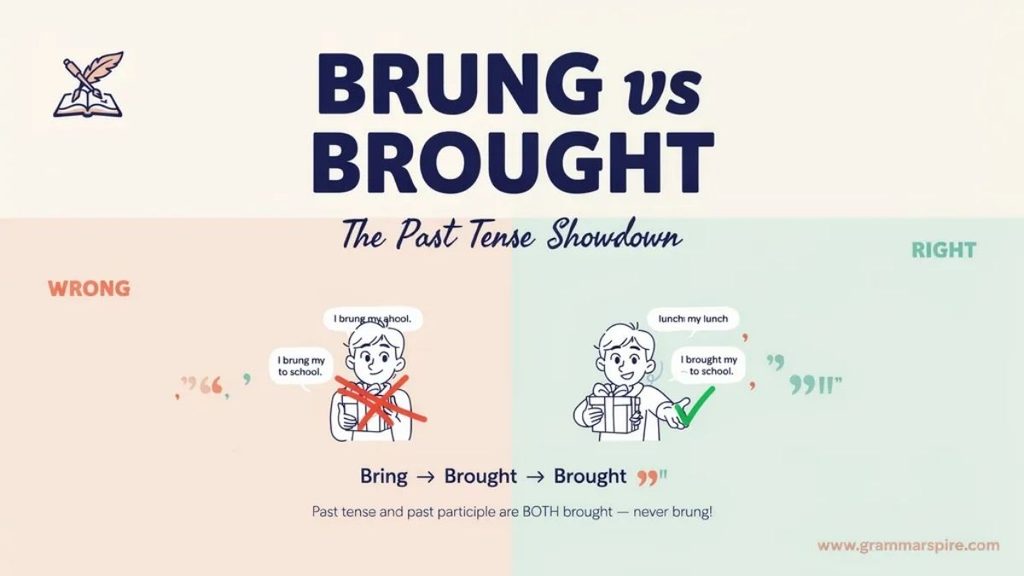
If you keep forgetting whether to use brung vs brought, remember the three standard forms together bring today, brought yesterday, and brought with have.
This short reminder connects the base form, simple past tense, and past participle.
Today: I bring my notebook to class.
Yesterday: I brought my notebook to class.
Perfect tense: I have brought my notebook to class.
You can also connect bring with other verbs that use similar endings, such as buy and catch. Bring becomes brought, buy becomes bought, and catch becomes caught.
These comparisons offer a useful memory aid. Still, the most reliable approach is to practice the correct forms in complete sentences.
Here’s a trusted source for clear more words Comparison:
Grammar Update
Practice Session
Test your understanding of brung vs brought with these 30 fill in the blank questions. Complete each sentence using the correct form of the verb bring. Pay attention to the context, including past actions and sentences that use has, have, or had. Remember that brought is the standard past-tense and past participle form of bring.
Fill in the Blanks
- Sarah _____ her notebook to class yesterday.
- My brother has _____ me a birthday present.
- They _____ their lunch to the picnic.
- Who _____ these flowers into the house?
- I have _____ all the documents you requested.
- The teacher _____ extra worksheets for the students.
- He had _____ his umbrella before the rain started.
- We _____ our dog to the park last Sunday.
- Have you _____ your homework to school?
- The delivery driver _____ our package this morning.
- My parents have _____ delicious food for dinner.
- She _____ her friend to the party last night.
- The children had _____ their toys into the living room.
- I _____ my camera on the trip.
- The manager has _____ an important announcement.
- Why did you _____ so many books home?
- He _____ his lunch to work every day last week.
- They have _____ new ideas to the meeting.
- Who had _____ this letter to your office?
- My sister _____ a cake for the celebration.
- We have _____ everything needed for the project.
- The storm _____ heavy rain to our town.
- She had _____ her passport before leaving home.
- I _____ my friend a cup of coffee yesterday.
- The students _____ their assignments to the teacher.
- Have they _____ the keys back yet?
- The waiter _____ us the menu as soon as we sat down.
- He has _____ his bicycle inside the garage.
- Our neighbors _____ gifts for everyone at the gathering.
- By noon, the workers had _____ all the equipment inside.
Answer Key
- Brought
- Brought
- Brought
- Brought
- Brought
- Brought
- Brought
- Brought
- Brought
- Brought
- Brought
- Brought
- Brought
- Brought
- Brought
- Bring
- Brought
- Brought
- Brought
- Brought
- Brought
- Brought
- Brought
- Brought
- Brought
- Brought
- Brought
- Brought
- Brought
- Brought
Learn the difference between tricky words and use them correctly
Bleeded or Bled Which Is Correct?
FAQs About Brung vs Brought
Is brung a correct word?
Brung appears in some regional dialects and informal speech, but it is not the standard past tense or past participle of bring. In standard English, brought is the correct form.
Why do people say brung instead of brought?
People may say brung because of regional speech patterns, family habits, or the way they learned English. Although the form occurs naturally in some dialects, brought remains the standard choice for everyday and formal writing.
What does brung mean?
Brung is a nonstandard variant of brought. People generally use it to describe carrying, taking, or delivering something to a particular place.
Is brung slang?
Brung is more accurately described as a nonstandard or dialectal form than simply as slang. Some speakers use it in informal conversation, but standard English uses brought.
Can you use brung in a sentence?
Yes. Brung can appear in dialogue or writing that reflects a particular dialect. For example, “He brung his lunch to work.” In standard English, the sentence becomes “He brought his lunch to work.”
Is brung in the Oxford English Dictionary?
Brung has been documented in nonstandard and dialectal English usage. However, a word’s presence in a dictionary does not make it the standard form. For ordinary writing, brought is the appropriate choice.
Why do people say broughten?
Some speakers may add the ending “-en” because they associate it with past participles such as eaten, written, and forgotten. However, brought is already the correct past participle of bring. Broughten is nonstandard.
Is brung a valid Scrabble word?
Acceptance depends on the official word list used for the game. Check the dictionary specified by your Scrabble version or tournament to confirm whether brung is allowed.
Is brang spelled correctly?
Brang occurs in some dialects as a nonstandard past-tense form of bring. However, brought is the standard form. Use brought in school assignments, professional documents, and formal communication.
Is brung a Wordle word?
Brung contains five letters, but whether Wordle accepts it as a guess or uses it as a solution depends on the game’s word list. Acceptance as a guess does not mean the form is standard English.
Is the past tense of bring brung?
No. The standard simple past tense of bring is brought. For example, “She brought her notebook yesterday.” Although some speakers use brung, it is not the standard form.
Should I say brought or bought?
Use brought when you mean carried or delivered something. Use bought when you mean purchased something. For example, “I brought my books to class” means I carried them, while “I bought new books” means I paid for them.
Is brung grammatically correct?
Brung may be appropriate when reproducing a particular dialect, but it is not considered standard English grammar. In most writing situations, brought is the correct choice.
Can you give 20 examples of past participles?
Here are 20 common verbs and their past participle forms.
| Base verb | Past participle |
|---|---|
| Bring | Brought |
| Go | Gone |
| Eat | Eaten |
| Write | Written |
| Speak | Spoken |
| See | Seen |
| Take | Taken |
| Give | Given |
| Break | Broken |
| Choose | Chosen |
| Drive | Driven |
| Fall | Fallen |
| Forget | Forgotten |
| Know | Known |
| Ride | Ridden |
| Sing | Sung |
| Swim | Swum |
| Do | Done |
| Make | Made |
| Buy | Bought |
Why do kids say brang?
Children sometimes say brang because they apply a familiar pattern to an irregular verb. They may assume that bring changes to brang in the past, just as sing changes to sang. With practice and exposure to standard English, they learn that brought is the correct past-tense form.
AEO Brung vs Brought
What is the correct form, brung vs brought?
Brought is the correct standard form. It serves as both the simple past tense and the past participle of bring. Brung is a nonstandard variant used in some dialects and informal speech.
What are the three forms of bring?
The three principal forms are bring, brought, and brought. Bring is the base form, the first brought is the simple past tense, and the second brought is the past participle.
Is brung ever acceptable?
Brung can be suitable in dialogue, dialect writing, or informal speech when it accurately reflects how someone speaks. However, brought is the recommended form for standard written English.
What is the difference between brung and brought?
Brought is the standard past-tense and past-participle form of bring. Brung is a regional or nonstandard variant that some speakers use in conversation.
Is brang the same as brought?
Brang is a nonstandard past-tense variant of bring in some dialects. Brought is the accepted standard form and also serves as the past participle.
Conclusion
The difference between brung and brought may seem small, but choosing the correct form makes your writing clearer and more professional. Although brung appears in some regional dialects and informal conversations, brought is the standard choice for everyday writing, school assignments, and workplace communication. Remember the simple pattern: bring, brought, brought. Once you learn these three forms, you can avoid common grammar mistakes without turning every sentence into a spelling detective case. So, whether you are carrying groceries, delivering a package, or sharing exciting news, make sure you have brought the right word along. After all, good grammar makes every message easier to understand!

Ella AJS
Ella AJS is an experienced blogger and language enthusiast at Grammar Spire, dedicated to making English grammar simple, practical, and easy to understand. She specializes in word comparisons, meanings, usage, and common language confusions. Through clear explanations and engaging examples, Ella helps students, writers, and English learners improve their vocabulary and communicate with greater confidence and accuracy.