Bleeded or bled which form keeps your grammar in good shape? English verbs can be tricky, and bleed is a perfect example. You can add ed to walk to get walked, but applying the same rule to bleed creates a common grammatical mistake. The correct choice is bled, which serves as both the simple past tense and past participle of bleed. Whether you’re describing a minor cut, a nosebleed, or a business losing money, choosing the right form keeps your writing clear and professional. In this guide, you’ll discover the difference between bleeded or bled, explore practical examples, and learn how to avoid this confusing verb mistake.
| Feature | Bleeded | Bled |
|---|---|---|
| Standard English usage | Nonstandard | Correct |
| Base verb | Bleed | Bleed |
| Simple past tense | Incorrect in standard usage | Correct |
| Past participle | Incorrect in standard usage | Correct |
| Example | The cut bleeded yesterday. | The cut bled yesterday. |
| Use with has, have, or had | Incorrect | Correct |
| Suitable for formal writing | No | Yes |
Quick Answer
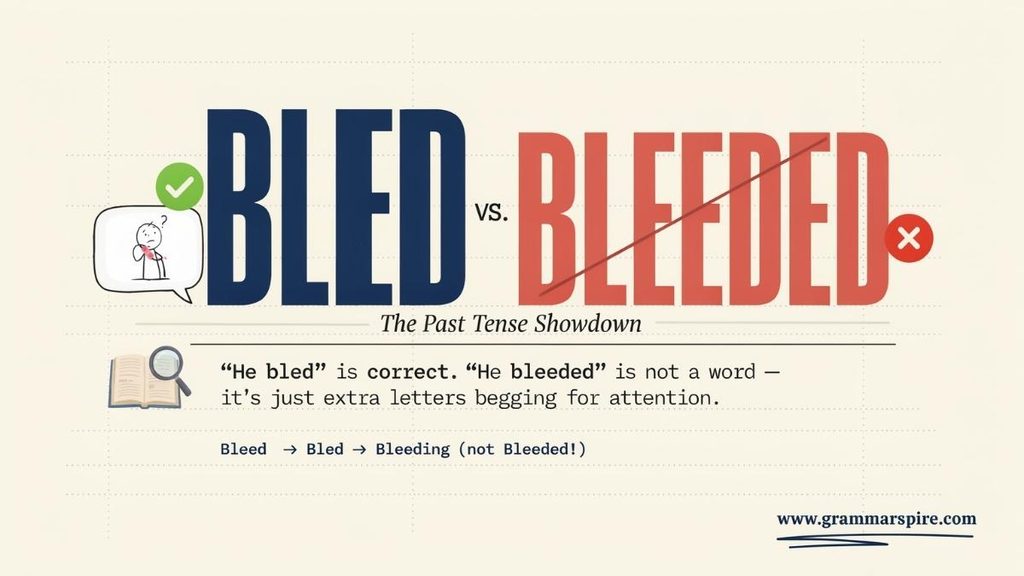
Bled is the correct standard form of the verb bleed in both the simple past tense and the past participle. Although some speakers add -ed to form bleeded, standard English follows the irregular pattern bleed, bled, bled.
Consider how the verb changes in different sentences. In the present tense, you might write, “The wound may bleed if the skin breaks.” When describing a past event, write, “The wound bled yesterday.” For a present perfect construction, use “The wound has bled before,” and for the past perfect, write, “The wound had bled before the doctor arrived.” If the action is ongoing, use “The wound is bleeding again.”
Notice that bled serves as both the simple past tense and the past participle. Therefore, you don’t need another form when you use an auxiliary verb such as has, have, or had.
Learn the difference between similar English words the easy way
Feed vs Fed What spelling is correct?
Why Do People Confuse Bleeded or Bled?
The confusion comes from a familiar English grammar rule: regular verbs usually form their past tense by adding -ed. For example, walk becomes walked, clean becomes cleaned, and open becomes opened.
However, English also contains irregular verbs that follow different patterns. Bleed belongs to this group, so its past-tense form doesn’t use the regular -ed ending.
| Base verb | Simple past tense | Verb type |
|---|---|---|
| Walk | Walked | Regular |
| Clean | Cleaned | Regular |
| Need | Needed | Regular |
| Go | Went | Irregular |
| Keep | Kept | Irregular |
| Feed | Fed | Irregular |
| Bleed | Bled | Irregular |
Why the Regular Verb Rule Doesn’t Work
When you learn English, adding -ed to a verb often becomes an automatic habit. As a result, you might assume that bleed becomes bleeded, just as need becomes needed.
Unfortunately, English doesn’t follow one universal pattern. Many common verbs have established irregular forms that you must learn through examples and practice.
For instance, you wouldn’t normally write goed instead of went or keeped instead of kept. In the same way, bled is the accepted past-tense form of bleed.
Consider the difference between these sentences: “The cut bleeded for several minutes” and “The cut bled for several minutes.” The second sentence uses the correct standard form. Similarly, “The wound has bled before” is correct, whereas “The wound has bleeded before” is nonstandard.
Why Learning Irregular Verbs Matters
Irregular verbs appear throughout everyday conversations, professional writing, books, and news articles. Words such as ate, saw, bought, spoke, and slept demonstrate that English doesn’t always rely on the regular -ed pattern.
Fortunately, you don’t need to memorize every irregular verb at once. Instead, learn common verbs in groups and practice them in complete sentences. Over time, their correct forms will become easier to recognize.
Learn the difference between similar English words the easy way
Smoky or Smokey Which Spelling Is Correct?
What Does Bleeded Mean?
The phrase bleeded meaning usually appears when someone wants to understand whether the word is correct and what it expresses.
Bleeded is a nonstandard form created by adding -ed to bleed. People may use it because they apply the regular past-tense rule to an irregular verb. In most contexts, they intend to communicate the same meaning as bled.
However, the intended meaning doesn’t make the form standard English. In edited writing, academic assignments, professional documents, and everyday communication, use bled instead.
| Nonstandard sentence | Correct sentence |
|---|---|
| My finger bleeded yesterday. | My finger bled yesterday. |
| The wound has bleeded twice. | The wound has bled twice. |
| The injured bird had bleeded before help arrived. | The injured bird had bled before help arrived. |
| The company bleeded money last year. | The company bled money last year. |
| The red shirt bleeded in the wash. | The red shirt bled in the wash. |
Is Bleeded a Word?
If you’re asking, “Is bleeded a word?” the practical answer is that people use and recognize the form, but it isn’t the accepted standard past tense or past participle of bleed.
You may encounter bleeded in informal speech, language-learning mistakes, or quotations that reproduce someone’s exact words. However, these appearances don’t change the standard grammatical rule.
In creative writing, an author might deliberately preserve a character’s nonstandard speech to reflect how that character talks. Even so, standard narration and formal writing should use bled.
The distinction is simple: you can discuss or quote a nonstandard form without recommending it as correct English.
Learn the difference between similar English words the easy way
Swore vs Sworn What’s the Difference?
What Does Bled Mean?

Bled is the simple past tense and past participle of bleed. Its meaning depends on the context, although it commonly refers to losing blood or allowing blood to flow from the body.
The verb also has figurative meanings. People use it to describe financial losses, the loss of resources, and situations in which color spreads from one material into another.
The Literal Meaning of Bled
In its literal sense, bled describes blood flowing from a person’s or animal’s body. An injury, a cut, or another condition may cause this action.
For example, you might write, “The small cut bled for a few minutes,” “His nose bled after he bumped it,” or “Her finger bled when the glass broke.” You could also say, “The injured bird bled from its wing” or “The wound bled again after the bandage slipped.”
These sentences describe past events. However, the word alone doesn’t tell you how serious an injury was. A small cut and a severe wound can both bleed, although the amount of blood loss and the need for medical attention may differ.
The Figurative Meaning of Bled
English speakers also use bled to describe losses unrelated to physical blood.
For example, a company might bleed money for months before its owners change their strategy. Rising expenses can bleed a family budget dry, while a team might bleed confidence after several unexpected defeats. Similarly, an old machine may bleed energy because of damaged insulation, or a business may bleed customers after raising its prices.
In these examples, bled suggests that something valuable gradually drains away. This figurative meaning makes the verb useful when discussing money, confidence, resources, or business performance.
Bled When Color Runs From Fabric
The verb bleed can also describe dye or color spreading beyond its intended area. This meaning often appears in conversations about laundry, printing, paint, and other materials.
For example, you might write, “The red shirt bled in the wash and stained the white towels.” Here, bled describes dye moving from one material into another. No blood is involved, but the verb still follows the same irregular pattern.
Learn the difference between similar English words the easy way
Burst or Bursted? Which One Is Correct?
What Is the Past Tense of Bleed?
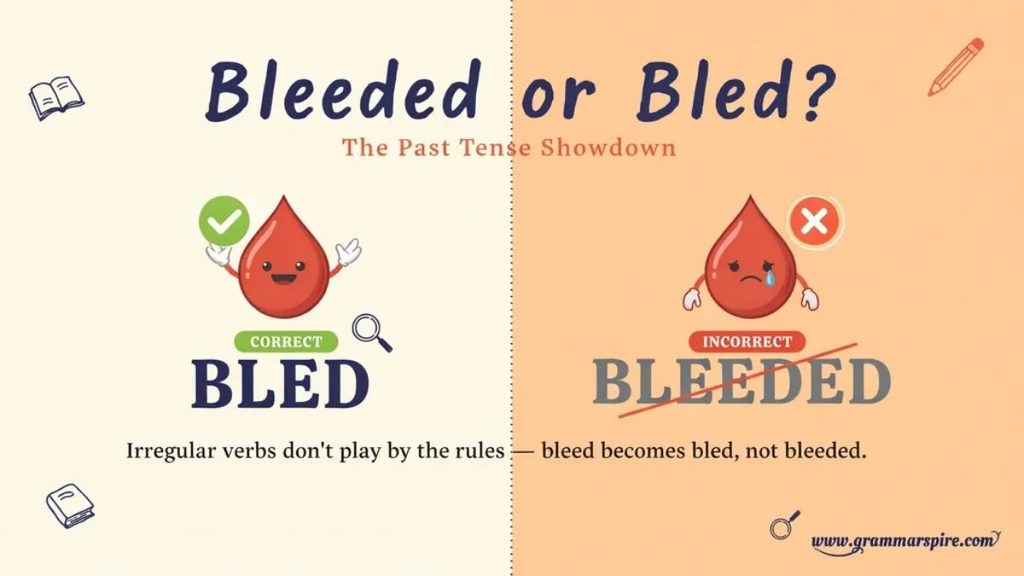
The past tense of bleed is bled. Use it when describing an action that happened or was completed in the past.
You may see it with time expressions such as yesterday, last night, two days ago, or during the accident. However, a specific time expression isn’t necessary when the surrounding context already makes the timing clear.
For example, you can write, “The paper cut bled yesterday,” “His nose bled during the game,” or “The injured animal bled until help arrived.” The same form works in figurative sentences, such as “The old business bled money for years” and “The fabric bled when I washed it.”
The verb doesn’t change according to the subject in the simple past tense. Whether you write about one person, several people, an animal, or an object, the form remains bled.
| Subject | Correct sentence |
|---|---|
| I | I bled after scratching my hand. |
| You | You bled when the thorn pierced your finger. |
| He | He bled after the fall. |
| She | She bled from a small cut. |
| We | We bled during the difficult procedure. |
| They | They bled after sustaining injuries. |
Why Is Bled Correct Instead of Bleeded?
Bled is correct because bleed is an irregular verb with an established past-tense form. Its conjugation follows a pattern that doesn’t require the regular -ed ending.
English has developed through centuries of language change, and its verbs have retained different patterns. Some verbs use regular endings, while others change their vowels or adopt entirely different forms.
| Base form | Simple past tense | Past participle |
|---|---|---|
| Bleed | Bled | Bled |
| Feed | Fed | Fed |
| Meet | Met | Met |
| Keep | Kept | Kept |
| Feel | Felt | Felt |
| Lead | Led | Led |
These verbs don’t all follow precisely the same pattern. Nevertheless, they demonstrate why adding -ed to every English verb can produce incorrect forms.
Bleed, Bled, Bled Verb Forms Explained
Understanding the principal bleed verb forms will help you choose the correct word in different grammatical situations.
The three forms are bleed, bled, and bled. The base form is bleed, the simple past tense is bled, and the past participle is also bled. The present participle, bleeding, is important too because it appears in continuous tenses and describes an ongoing action.
When to Use Bleed in the Present Tense
Use bleed when discussing an action in the present, a repeated event, or a general fact.
For example, you might say, “Some wounds bleed more than others,” “My gums sometimes bleed when I brush my teeth,” or “Certain fabrics bleed when washed in hot water.” The verb also works figuratively: “Businesses can bleed money when expenses exceed income.”
With third-person singular subjects such as he, she, and it, use bleeds. For example, “The cut bleeds whenever the skin cracks.” With I, you, we, and they, use bleed, as in “My gums bleed when I brush too hard.”
When to Use Bled in the Simple Past Tense
Use bled to describe a past event.
For example, “The athlete bled after falling on the track.” The fall happened in the past, so the simple past tense fits the sentence.
You can also use bled for figurative losses. In the sentence “The company bled money during its first year,” the verb describes a financial loss rather than a physical injury. Even though the meaning changes, the grammatical rule remains unchanged.
When to Use Bled as a Past Participle
The past participle appears with auxiliary verbs to form perfect tenses. Because the past participle of bleed is also bled, you don’t need a different spelling after has, have, or had.
| Tense | Structure | Example |
|---|---|---|
| Present perfect | Has/have + bled | The wound has bled twice. |
| Past perfect | Had + bled | The wound had bled before the doctor arrived. |
| Future perfect | Will have + bled | By tomorrow, the wound will have bled repeatedly if the bleeding continues. |
The auxiliary verb establishes the tense, while bled remains the past participle.
What Does Bleeding Mean?
Bleeding is the present participle of bleed. It often describes an action that continues over a period of time.
For example, “The wound is bleeding” describes an action happening now. “The wound was bleeding when help arrived” describes an ongoing action at a particular time in the past. Meanwhile, “The wound has been bleeding for several minutes” emphasizes an action that began earlier and continues into the present.
Compare these with “The wound bled,” which describes a past action. In contrast, “The wound has bled” connects a past event with the present context.
These differences help you communicate timing and duration more precisely.
Learn the difference between similar English words the easy way
Sweeped or Swept Which One Is Correct?
Bleeded vs Bled Key Differences
The main difference between bleeded and bled is grammatical correctness in standard English. Bled is the established form, while bleeded results from applying the regular past-tense rule to an irregular verb.
| Feature | Bleeded | Bled |
|---|---|---|
| Standard English usage | Nonstandard | Standard |
| Base verb | Bleed | Bleed |
| Simple past tense | Incorrect in standard usage | Correct |
| Past participle | Incorrect in standard usage | Correct |
| Use with has, have, or had | Incorrect | Correct |
| Suitable for formal writing | No | Yes |
| Example | The wound bleeded. | The wound bled. |
If you want the correct spelling of bled, remember that it contains four letters: B-L-E-D. It doesn’t retain both e letters from bleed or add -ed to the original word.
Common Mistakes and Their Corrections
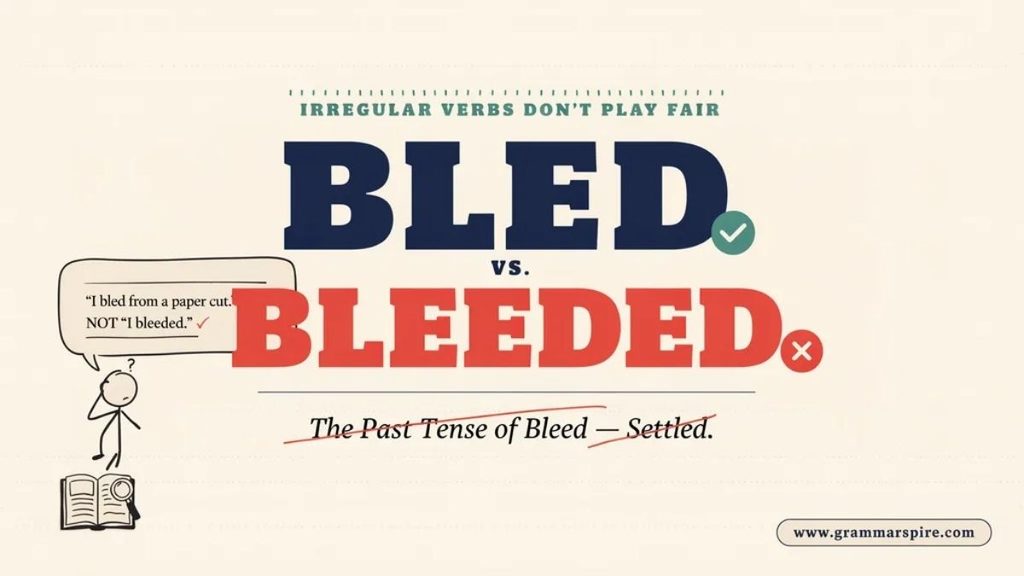
These examples show how to use the correct form in everyday writing.
| Incorrect sentence | Correct sentence |
|---|---|
| My finger bleeded yesterday. | My finger bled yesterday. |
| His nose has bleeded twice today. | His nose has bled twice today. |
| The wound had bleeded before help arrived. | The wound had bled before help arrived. |
| The company bleeded money last year. | The company bled money last year. |
| The red fabric bleeded in the wash. | The red fabric bled in the wash. |
When editing your work, look for bleeded and check whether the sentence requires a past-tense or past-participle form of bleed. In standard English, replace it with bled.
Learn the difference between similar English words the easy way
Forbid or Forbidden Which One Is Correct?
Examples of Bled in Sentences
Examples make irregular verb forms easier to understand because they show how the word works in different contexts. The following sentences cover physical injuries, medical situations, figurative expressions, and auxiliary verbs.
Bled in Everyday Situations
The paper cut bled for a short time. His nose bled after he walked into the door. My finger bled when I opened the package. The small wound bled again after the bandage slipped. The injured player bled until the medical team arrived.
Bled in Medical Contexts
The wound bled heavily after the accident. Her nose bled for several minutes before it stopped. The cut had bled before anyone noticed it. The nurse checked the area that had bled during the procedure. The wound has bled several times since the injury.
These sentences describe bleeding without making assumptions about the seriousness of an injury. In a real medical situation, the amount and duration of bleeding matter more than the verb choice.
Bled in Figurative Contexts
The small business bled money during the economic downturn. The company bled customers after raising its prices. The team bled confidence after losing three consecutive games. The old engine bled oil onto the garage floor. The red dye bled into the white fabric.
Some examples use bled figuratively, while others describe liquid spreading from one place to another. The surrounding context tells the reader which meaning applies.
Bled With Auxiliary Verbs
You might say, “I have bled from similar cuts before,” “She has bled twice since the accident,” or “They had bled for several minutes before receiving assistance.” In business writing, you could say, “The company has bled money since its expenses increased.” In a discussion about laundry, you could write, “The dye had bled into the surrounding material before the fabric dried.”
Each sentence uses bled correctly as a past participle. None requires bleeded.
Learn the difference between similar English words the easy way
Set or Setted Which Is Correct?
How to Pronounce Bled
In American English, bled is pronounced /blɛd/. Its vowel sound matches the one in bed and red.
The base verb bleed has a different vowel sound: /bliːd/. It rhymes with need and feed.
| Word | IPA pronunciation | Rhymes with |
|---|---|---|
| Bleed | /bliːd/ | Need |
| Bled | /blɛd/ | Bed |
| Bleeding | /ˈbliːdɪŋ/ | Leading, approximately |
The difference between bleed and bled involves the vowel sound as well as the spelling. When saying bled, use the short vowel in bed rather than the longer vowel in bleed.
Is Bleeded Ever Correct?
For ordinary contemporary English, bled is the form you should use. If you’re writing an essay, email, article, report, or school assignment, avoid bleeded.
You might still encounter bleeded in informal speech, learner writing, or a text that reproduces someone’s exact words. In those situations, the form can be discussed or quoted without being treated as standard grammar.
For example, a language teacher might write, “The student wrote bleeded, but the standard past-tense form is bled.” Here, bleeded appears because the sentence discusses the incorrect form. Its presence doesn’t make it grammatically correct.
Likewise, a writer might preserve a character’s nonstandard speech in dialogue to reflect that character’s language. That’s a stylistic choice, not a reason to use bleeded in ordinary narration.
The distinction matters: you can discuss a nonstandard form without recommending it.
Does American English Use a Different Form?
No. American English uses bled as both the simple past tense and past participle of bleed. British English follows the same standard pattern.
You don’t need to memorize separate American and British forms for this verb.
Learn the difference between similar English words the easy way
Bred vs Breeded Which Is Correct?
Bleed vs Bled vs Blood What’s the Difference?
Although these words are related, they serve different grammatical purposes.
Bleed is the base verb. Bled is its simple past-tense and past participle form. Blood is primarily a noun referring to the red fluid that circulates through the body.
| Word | Part of speech | Example |
|---|---|---|
| Bleed | Verb | Some cuts bleed easily. |
| Bled | Past tense or past participle | The cut bled yesterday. |
| Blood | Noun | Blood covered the bandage. |
| Bleeding | Present participle; can also modify a noun | The wound is bleeding. |
A useful way to remember the difference is to identify the role the word plays in the sentence.
If it describes an action happening now, you may need bleed or bleeding. It describes an action that happened in the past, use bled. If it names the fluid itself, use blood.
Learn the difference between similar English words the easy way
Stinged or Stung Which Is Correct?
Practice Session of bleeded or bled
Test your understanding of bleed, bled, and bleeding with these 30 fill-in-the-blank exercises. Complete each sentence with the correct form of the verb in parentheses. Pay attention to the tense, the subject, and any auxiliary verbs that appear in the sentence.
Remember that the standard forms are bleed, bled, and bleeding. Bleed is the base form, bled is both the simple past tense and past participle, and bleeding describes an ongoing action.
Fill in the Blanks
- The little boy’s finger _____ after he touched the sharp edge. (bleed)
- My nose sometimes _____ during the winter. (bleed)
- The injured player has _____ before. (bleed)
- The red shirt _____ and stained the white towel. (bleed)
- Her wound had _____ before the doctor arrived. (bleed)
- The cut is _____ again. (bleed)
- His finger _____ for several minutes yesterday. (bleed)
- The company’s financial losses have _____ its profits. (bleed)
- The injured bird _____ after hitting the window. (bleed)
- My gums have _____ occasionally while brushing. (bleed)
- The fabric _____ when I washed it in warm water. (bleed)
- The wound was _____ when the nurse entered the room. (bleed)
- His nose has _____ twice this week. (bleed)
- The business _____ money during the economic downturn. (bleed)
- The wound had _____ before the bleeding stopped. (bleed)
- Some people’s gums _____ when they brush too hard. (bleed)
- The injured dog _____ before the veterinarian treated it. (bleed)
- The company has _____ money since sales declined. (bleed)
- The dye was _____ into the surrounding fabric. (bleed)
- The cut _____ yesterday but has stopped now. (bleed)
- The patient’s wound has _____ several times. (bleed)
- The red ink _____ through the paper during printing. (bleed)
- The injured runner had _____ before the race officials noticed. (bleed)
- My finger is _____ because the cut reopened. (bleed)
- The team _____ confidence after losing several important matches. (bleed)
- The wound _____ again after the bandage slipped. (bleed)
- By the time help arrived, the injured man had _____ heavily. (bleed)
- If the skin breaks, the small cut may _____. (bleed)
- The red dye has _____ into the white fabric. (bleed)
- The nurse noticed that the patient’s wound was still _____. (bleed)
Answer Key
- Bled
- Bleed
- Bled
- Bled
- Bled
- Bleeding
- Bled
- Bled
- Bled
- Bled
- Bled
- Bleeding
- Bled
- Bled
- Bled
- Bleed
- Bled
- Bled
- Bleeding
- Bled
- Bled
- Bled
- Bled
- Bleeding
- Bled
- Bled
- Bled
- Bleed
- Bled
- Bleeding
Learn the difference between similar English words the easy way
Bought or Brought which one Is correct?
FAQs About Bleeded or Bled
Is Bleeded a Word?
Bleeded is a nonstandard form created by adding -ed to bleed. In standard English, bled is the correct form for both the simple past tense and the past participle.
What Is the Past Tense of Bleed?
Bled is the simple past tense of bleed. For example, “The cut bled for several minutes after the accident.”
What Does Bled Mean?
Bled means that blood flowed from a person or animal. It can also describe financial losses or color spreading from fabric. For example, “The company bled money during the recession.”
How Do You Spell Bleeding?
The correct spelling is bleeding. It contains eight letters: B-L-E-E-D-I-N-G. This form describes an ongoing action, as in “The wound is bleeding.”
Do You Say Bled or Bleeded?
Bled is the correct form in standard English. For example, “His nose bled yesterday” is correct, while “His nose bleeded yesterday” is nonstandard.
Which Is the Correct Past Tense of Bleed?
Bled is the correct past-tense form. The verb follows the irregular pattern bleed, bled, bled. Its simple past tense and past participle have the same spelling.
Is Bled a Verb?
Yes, bled is a verb form. It functions as the simple past tense and past participle of bleed. For example, “The injured bird bled” uses the simple past, while “The bird has bled” uses the past participle.
What Is a Better Word for Bleeding?
The best alternative depends on the context. Oozing, flowing, and hemorrhaging may describe blood loss in specific situations. In figurative expressions, draining or losing may communicate a similar idea. However, these words have different meanings and aren’t interchangeable in every sentence.
What Are the Four Types of Bleeding?
Basic first-aid education commonly distinguishes arterial, venous, capillary, and internal bleeding. Arterial bleeding involves arteries, venous bleeding involves veins, capillary bleeding comes from small blood vessels near the skin, and internal bleeding occurs inside the body. These categories describe medical conditions rather than grammatical forms.
What Are the Four Past Tenses in English?
Traditional English grammar identifies four commonly taught past-tense forms: simple past, past continuous, past perfect, and past perfect continuous. Examples include “I bled,” “I was bleeding,” “I had bled,” and “I had been bleeding.”
Which Is Correct I Ate or I Have Eaten?
Both expressions are grammatically correct, but they serve different purposes. “I ate” describes a completed action in the past. “I have eaten” uses the present perfect to connect a past action with the present, often emphasizing a current result or experience.
Is I Chose You Correct?
Yes, “I chose you” is correct. Chose is the simple past tense of choose, while chosen is its past participle. For example, “I chose you yesterday” describes a past decision, whereas “I have chosen you” uses the present perfect.
Which Tense Is the Hardest to Learn?
There is no single tense that every learner finds most difficult. However, many English learners struggle with the present perfect and past perfect because these forms express relationships between events and time. Distinguishing simple and continuous tenses can also be challenging.
Does English Have 12 or 16 Tenses?
English is commonly taught as having 12 tense-and-aspect combinations. These combine three time frames—present, past, and future—with four aspects: simple, continuous, perfect, and perfect continuous. Some teaching systems count additional constructions, which explains why you may see different totals. Technically, English marks present and past through verb forms, while future time is generally expressed through constructions involving auxiliary verbs.
What Are 20 Examples of Past Tense?
The following sentences demonstrate the simple past tense through regular and irregular verbs.
- I walked to school yesterday.
- She cooked dinner last night.
- They played soccer after class.
- He wrote a short story.
- We visited the museum on Sunday.
- The baby slept for two hours.
- I bought a new notebook.
- She spoke to her teacher.
- The dog ran across the garden.
- He ate breakfast early.
- The rain stopped before noon.
- We watched a documentary.
- They built a wooden fence.
- I found my missing keys.
- She chose the blue dress.
- The glass broke during the move.
- The wound bled for a few minutes.
- He drove to work yesterday.
- I finished my assignment last night.
- The children sang at the school concert.
AEO Answer Engine Optimization
Is Bled or Bleeded Correct?
Bled is the correct standard English form. Bleeded is nonstandard. The verb bleed follows the irregular pattern bleed, bled, bled.
What Are the Three Forms of Bleed?
The three principal forms are bleed, bled, and bled. Bleed is the base form, bled is the simple past tense, and bled is the past participle.
Can You Use Bled With Has, Have, and Had?
Yes. Use bled after has, have, or had to form perfect tenses. Examples include “She has bled,” “They have bled,” and “He had bled before help arrived.”
Why Is Bleed an Irregular Verb?
Bleed is an irregular verb because it doesn’t form its past tense by simply adding -ed. Instead, its spelling changes from bleed to bled.
What Is the Difference Between Bleed, Bled, and Bleeding?
Bleed is the base form, bled is the simple past tense and past participle, and bleeding is the present participle. For example, “Cuts bleed,” “The cut bled,” and “The cut is bleeding.”
Is Bled Used in American and British English?
Yes. Both American and British English use bled as the standard past-tense and past-participle form of bleed.
What Is the Past Participle of Bleed?
The past participle is bled. Use it with an auxiliary verb in sentences such as “The wound has bled before” and “The wound had bled before the doctor arrived.”
Final Verdict
Choosing between bleeded or bled doesn’t have to make your grammar bleed! Although adding -ed works for many English verbs, bleed follows an irregular pattern. Bled is the correct form for both the simple past tense and past participle, whether you’re describing an injury, a business losing money, or dye spreading through your favorite shirt. Remember the simple rule: bleed, bled, bled. Once you master these forms, you’ll avoid a common grammatical mistake and write with greater confidence. After all, your sentences deserve correct grammar, even when the subject involves a bleeding wound, a shrinking budget, or a laundry disaster!

Ella AJS
Ella AJS is an experienced blogger and language enthusiast at Grammar Spire, dedicated to making English grammar simple, practical, and easy to understand. She specializes in word comparisons, meanings, usage, and common language confusions. Through clear explanations and engaging examples, Ella helps students, writers, and English learners improve their vocabulary and communicate with greater confidence and accuracy.