
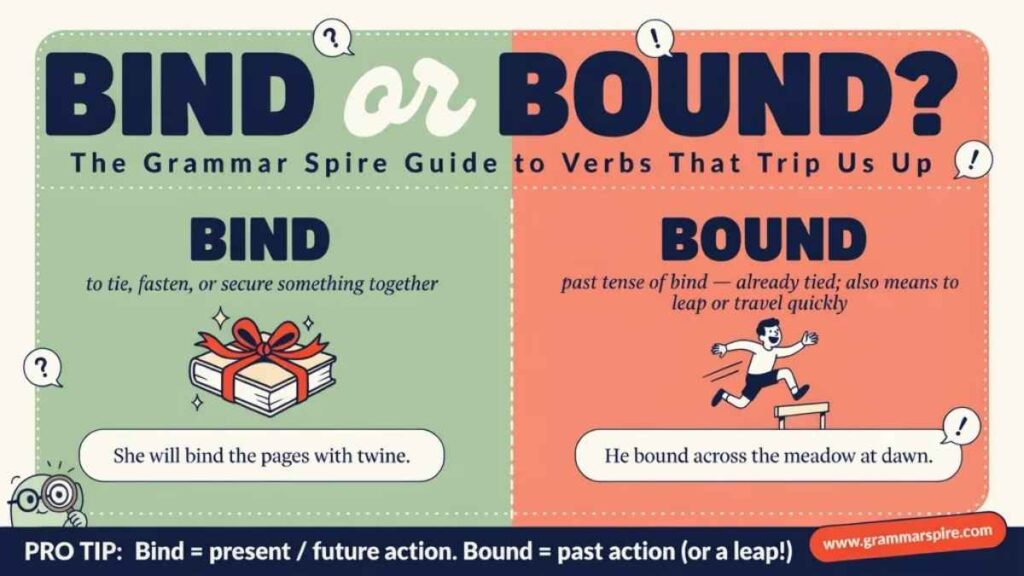
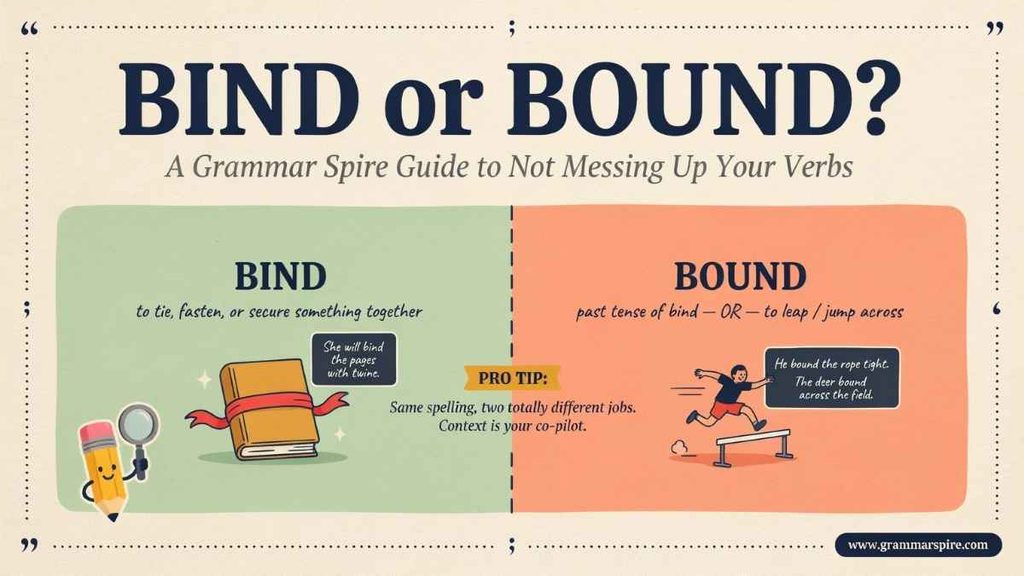
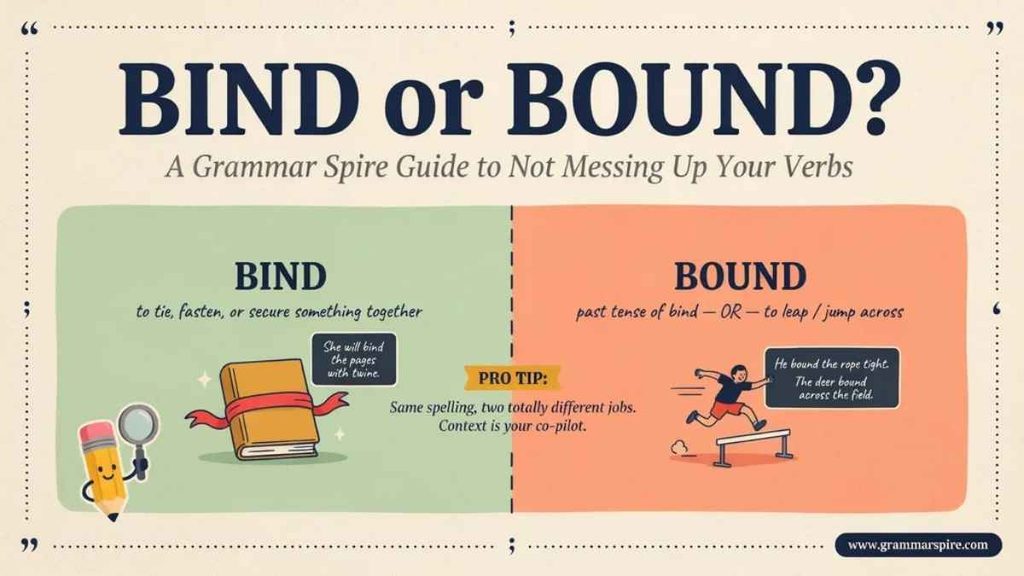
English grammar loves turning simple words into unexpected puzzles. The question of bind or bound is a perfect example. These forms belong to the same irregular verb, yet they don’t work in the same grammatical situations. Bind is the base form, while bound serves as both the past tense and past participle. To make matters more interesting, bound has other meanings too. It can describe an obligation, a destination, or something certain to happen. No wonder this little word pair causes so much confusion! Once you understand the pattern, however, the mystery quickly disappears. You’ll know which form to use and avoid awkward grammar mistakes with confidence.
| Form | Word | Main Use | Example |
|---|---|---|---|
| Base form | bind | Present tense, infinitive, and after modals | We bind the pages. |
| Third-person present | binds | He, she, or it in the present | She binds the pages. |
| Past tense | bound | A completed past action | She bound the pages. |
| Past participle | bound | Used with have, has, or had | She has bound the pages. |
| -ing form | binding | An ongoing action | She is binding the pages. |
The Quick Answer
Bind is the base form of the verb. You use it for present actions, infinitives, commands, and after modal verbs such as will, can, should, and must.
Bound is the simple past tense and past participle of bind.
For example:
I bind the pages together.
Yesterday, I bound the pages together.
I have bound the pages together.
The key pattern is simple:
Bind → Bound → Bound
So, if you’re asking, “What is the past tense of bind?” the answer is bound.
If you’re asking, “What is the past participle of bind?” the answer is also bound.
The form changes only once in the main verb pattern. That’s why bind and bound can look confusing at first, especially when you’re writing quickly.
Learn the difference between confusing word pairs
usable vs useable Which Spelling Is Correct?
Bind vs Bound The Basic Difference
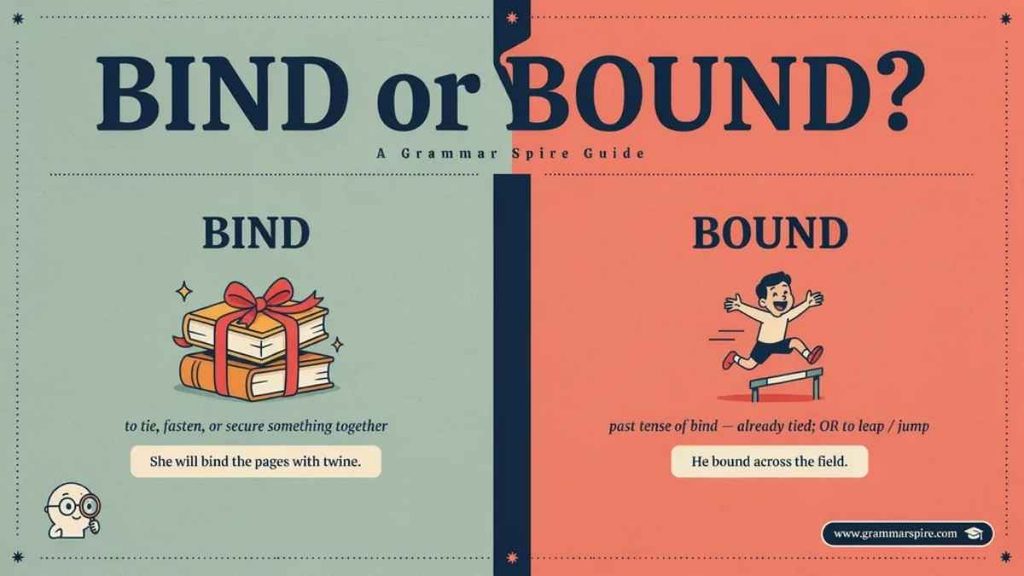
The simplest way to understand bind vs bound is to look at time and sentence structure.
Bind refers to the base form. It often describes something that happens now, happens regularly, or may happen in the future.
Bound describes a completed action in the past or works as the past participle with have, has, or had.
Consider these examples:
1.The printer binds the books every Friday.
2.The printer bound the books yesterday.
3.The printer has bound the books already.
The first sentence uses binds because the subject is singular and the action occurs in the present. The second uses bound because the action happened in the past. The third uses bound as a past participle after has.
That pattern solves most bind or bound grammar questions.
What Does Bind Mean?
Bind means to tie, fasten, secure, join, or hold something together. It can describe a physical action, a connection between things, or an obligation.
Bind as a Physical Action
You can bind something when you fasten it tightly with string, rope, wire, thread, or another material.
For example:
Please bind the papers with a piece of string.
The worker binds the wires together.
The nurse used a bandage to bind the injured area.
In each sentence, bind describes an action that holds something together.
Bind as a Way to Join Things
Bind can also describe joining separate parts into one unit.
A publisher may bind the pages of a book.
A craft worker may bind several pieces of material together.
A cook may use an ingredient to bind the mixture.
For example:
The publisher binds hundreds of books each month.
The glue helps bind the pieces together.
The pages need to bind securely before the cover goes on.
Here, the idea remains the same: something connects or holds separate parts together.
Bind and Obligations
Bind can also describe an obligation. In this sense, something binds a person to a promise, agreement, rule, or responsibility.
For example:
The contract binds both companies to the agreement.
The promise binds him to his decision.
The rules bind every member of the organization.
This meaning appears frequently in formal, legal, and professional English.
Learn the difference between confusing word pairs
Manuel or Manual Which spelling is correct?
What Does Bound Mean?
Bound has several meanings, so context matters. In the bind or bound comparison, bound can function as the past tense or past participle of bind. However, it can also work as an adjective, noun, or a completely different verb.
Bound as the Past Tense of Bind
When bound describes a completed action involving tying, fastening, joining, or obligating, it acts as the past tense of bind.
For example:
She bound the package with twine.
The publisher bound the book last week.
The agreement bound the company to certain conditions.
They bound the documents together.
Each action happened in the past.
Bound as the Past Participle of Bind
Bound also serves as the past participle of bind. You normally use it with have, has, or had.
For example:
She has bound the documents together.
The printer had bound the books before noon.
We have bound the pages securely.
The contract has bound both parties to specific terms.
Notice the pattern:
Have + bound
Has + bound
Had + bound
That structure is important when deciding between bind and bound.
Bound as an Adjective
Bound can also describe someone or something that has an obligation, restriction, destination, or strong expectation.
For example:
She is legally bound by the contract.
The employees are bound by company rules.
The team is bound to face challenges.
In these sentences, bound does not simply mean “tied with rope.” It expresses obligation, restriction, or expectation.
Learn the difference between confusing word pairs
Tweek or Tweak Which Spelling Is Correct?
Is Bound the Past Tense of Bind?
Yes. Bound is the simple past tense of bind.
The complete basic pattern is:
Present: bind
Past: bound
Past participle: bound
For example:
1.I bind the pages.
2.I bound the pages yesterday.
3.I have bound the pages already.
Because bind is an irregular verb, it doesn’t form its past tense by adding -ed. That’s why binded is not the standard past tense of bind.
Learn the difference between confusing word pairs
Quiet or Quite What Is the Difference?
What Is the Past Tense of Bind?
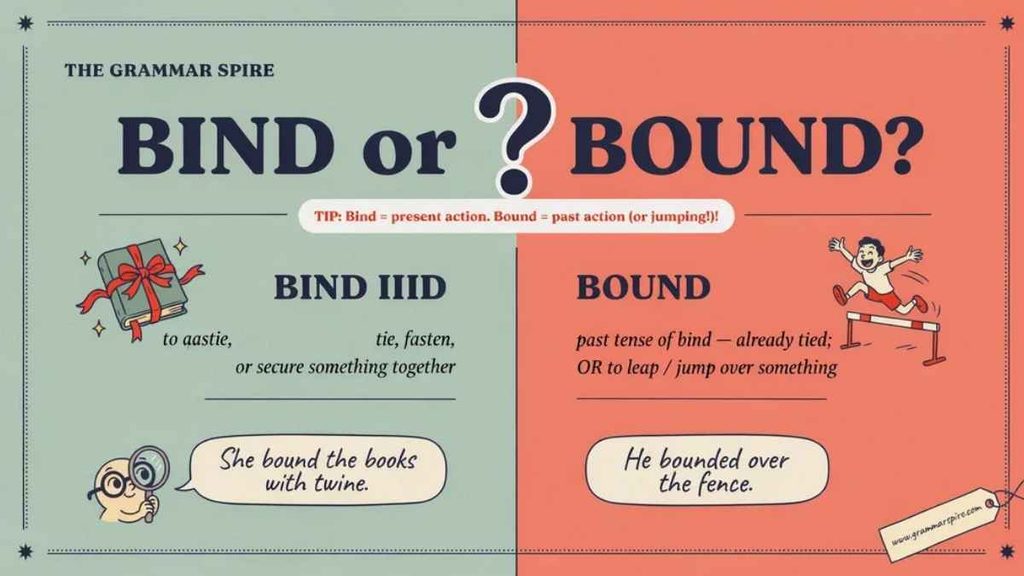
The past tense of bind is bound.
For example:
The librarian bound the damaged book.
The worker bound the cables together.
She bound the documents with a ribbon.
The contract bound the two parties to its terms.
Each sentence describes an action that occurred in the past.
Bind Past Tense Examples
Here are a few natural examples:
Yesterday, the printer bound the reports.
She bound the loose papers together.
The old contract bound the company to several conditions.
He bound the package with strong cord.
The publisher bound the book in a durable cover.
These examples show why context matters. Bound can describe physical fastening as well as a legal or figurative obligation.
What Is the Past Participle of Bind?
The past participle of bind is also bound.
You use it with helping verbs such as have, has, and had.
For example:
I have bound the pages.
She has bound the documents.
They had bound the books before the store opened.
The editor has bound the loose materials together.
The important point is that the past tense and past participle share the same form.
Bind → Bound → Bound
Learn the difference between confusing word pairs
Noisey or Noisy Which Spelling Is Correct?
Bind Past Tense and Past Participle
Many learners expect an irregular verb to have three completely different forms. English doesn’t always work that way.
Bind is a useful example because its past tense and past participle are identical.
| Verb Form | Correct Word | Example |
|---|---|---|
| Base form | bind | We bind the pages. |
| Past tense | bound | We bound the pages. |
| Past participle | bound | We have bound the pages. |
| Present participle | binding | We are binding the pages. |
Once you memorize this pattern, many sentences become easier to construct.
Is Binded a Word?
Binded is not the standard modern past tense or past participle of the ordinary English verb bind.
In standard English, use bound instead.
Incorrect:
She binded the book yesterday.
Correct:
She bound the book yesterday.
The same rule applies when you use the past participle.
Incorrect:
She has binded the documents.
Correct:
She has bound the documents.
Some specialized or historical uses of binded may appear in unusual contexts, but standard modern English uses bound for the ordinary verb bind.
Learn the difference between confusing word pairs
Receipt or Reciept Which Spelling Is Correct?
Binded or Bound Book Which Is Correct?
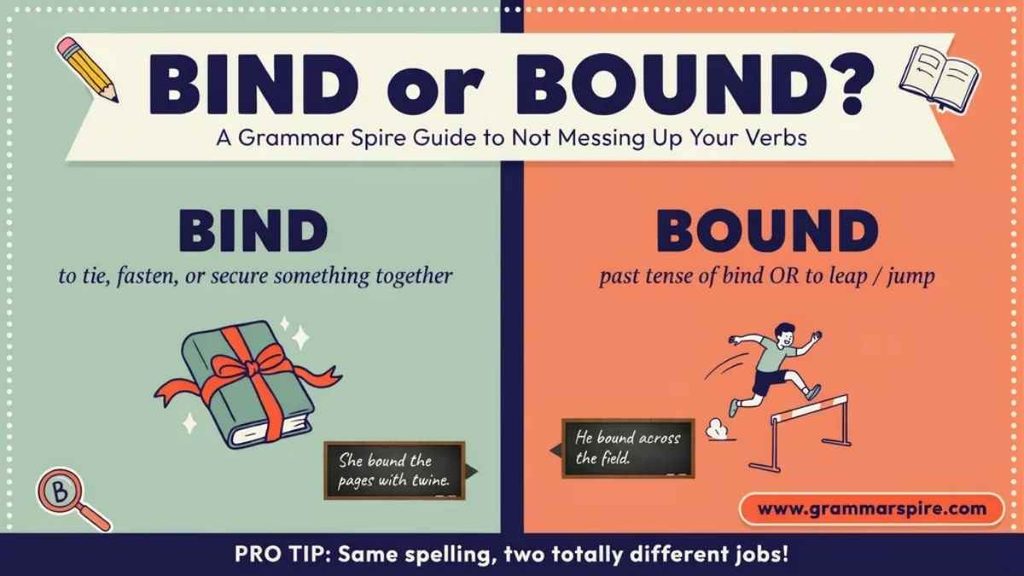
If you’re talking about a book that someone has fastened, assembled, or covered with a binding, bound is the standard form.
For example:
The printer bound the book yesterday.
The library has a beautifully bound book in its collection.
The publisher has bound the pages with a hard cover.
You can also use binding as a noun:
The book has a leather binding.
So the useful distinction is:
Bind a book = perform the action.
Bound the book = completed the action in the past.
A bound book = a book that has a finished binding.
Book binding = the process or craft of binding books.
When to Use Bind or Bound
Choosing between bind and bound becomes much easier when you look at the words around the verb.
Use Bind for the Base Form
Use bind after modal verbs, after to in an infinitive, and in present-tense structures where the subject does not require binds.
For example:
I need to bind these pages.
We will bind the documents tomorrow.
You should bind the loose papers.
They can bind the materials together.
Use binds with a singular third-person subject in the present:
She binds the books.
The machine binds the pages automatically.
Use Bound for the Simple Past
Use bound when the action happened in the past.
For example:
She bound the book yesterday.
They bound the documents last night.
The worker bound the cables together.
Use Bound as the Past Participle
Use bound after have, has, or had.
For example:
She has bound the book.
They have bound the documents.
The printer had bound all the copies before closing.
Use Binding for an Ongoing Action
Use binding when the action continues or happens around a particular time.
For example:
She is binding the pages.
They are binding the books now.
The machine was binding the documents when it stopped.
Learn the difference between confusing word pairs
Verbage or Verbiage Which Spelling Is Correct?
Bind or Bound in Different Sentence Structures
The words around the verb often tell you which form belongs in the sentence.
| Sentence Structure | Correct Form | Example |
|---|---|---|
| Present | bind / binds | We bind books. |
| Past | bound | We bound books. |
| Present perfect | has/have bound | We have bound books. |
| Past perfect | had bound | We had bound the books. |
| Future | will bind | We will bind the books. |
| Modal | can/should/must bind | You should bind the papers. |
| Continuous | binding | We are binding the books. |
This structure-based approach works better than trying to memorize isolated sentences.
Bound as an Adjective
It can appear as an adjective in several common expressions.
Bound by Rules
When someone is bound by rules, those rules restrict what the person can do.
For example:
Students are bound by the school rules.
The players are bound by the tournament regulations.
Legally Bound
Legally bound means legally obligated to do something or follow an agreement.
For example:
The two companies are legally bound by the contract.
Once you sign the agreement, you may become legally bound by its terms.
Bound by Contract
Bound by contract means that a contract creates an obligation or restriction.
For example:
The supplier is bound by contract to deliver the materials on time.
The agreement bound the company to specific conditions.
Bound to Happen
Bound to happen means something seems certain or very likely to happen.
For example:
Mistakes are bound to happen when you rush.
With that much traffic, delays are bound to happen.
This use has nothing to do with physically tying something.
Bound for a Destination
Bound can also describe a person, vehicle, train, plane, ship, or other traveler heading toward a destination.
For example:
The train is bound for Chicago.
They boarded a flight bound for New York.
The ship was bound for Boston.
In these sentences, bound means headed toward or destined for a particular place.
Therefore, “bound for Chicago” does not mean someone tied Chicago to something. It describes direction or destination.
Learn the difference between confusing word pairs
Advise or Advice which spelling is correct?
Bound, Bounded, and Bind Are Not the Same
This distinction causes another common grammar problem.
Bound is the past tense and past participle of bind.
Bound can also function as a separate word meaning to leap or jump.
That second verb forms its past tense with bounded.
For example:
The deer bounded across the road.
Here, bounded comes from the verb bound, meaning to leap or move with energetic jumps.
It does not come from bind.
Compare these sentences:
She bound the papers together.
The deer bounded across the road.
The first sentence comes from bind.
The second sentence comes from a different verb, bound, meaning to leap.
Bounded can also describe something that has a boundary or limit.
For example:
A stone wall bounds the property.
The area is bounded by two roads.
These meanings make context especially important.
Common Mistakes
Using Binded as the Past Tense
One of the most common mistakes involves adding -ed to bind.
Incorrect:
She binded the pages.
Correct:
She bound the pages.
English has many regular verbs that form the past with -ed, but bind is irregular.
Using Bound After Will
After will, use the base form.
Incorrect:
We will bound the documents tomorrow.
Correct:
We will bind the documents tomorrow.
Modal verbs and similar constructions normally take the base form.
Using Bound After Did
After did, use the base form.
Incorrect:
Did she bound the book?
Correct:
Did she bind the book?
The auxiliary did already marks the past tense, so the main verb stays in its base form.
Using Bind After Has
After has, use the past participle.
Incorrect:
She has bind the pages.
Correct:
She has bound the pages.
Remember:
Has + bound
Have + bound
Had + bound
Confusing Bound With Bounded
Not every occurrence of bounded relates to bind.
The deer bounded across the field.
Here, bounded means jumped or moved energetically.
The printer bound the book.
Here, bound means fastened or assembled the book.
A simple look at the meaning can prevent the confusion.
Learn the difference between confusing word pairs
Benefiting or Benefitting Which Spelling Is Correct?
How to Use Bind and Bound Correctly
A practical approach works better than memorizing dozens of grammar rules.
First, ask whether you’re describing the base action. If you are, use bind.
Next, ask whether the action happened in the past. If it did, use bound.
Then check whether have, has, or had comes before the verb. If so, use the past participle bound.
Finally, watch for special meanings of bound. The word may describe an obligation, destination, limit, or leap rather than the past form of bind.
Consider this progression:
1.I bind the book.
2.I bound the book.
3.I have bound the book.
4.I will bind the book.
5.I am binding the book.
Each sentence uses a different verb form because the surrounding grammar changes.
Bind and Bound Sentence Examples
Everyday Use
I bind the papers together before filing them.
She bound the loose documents with string.
They have bound the materials securely.
We will bind the reports tomorrow.
Books
The publisher binds books for schools and libraries.
The printer bound the novel last week.
The company has bound the final copies.
The author received a beautifully bound edition.
Packages
We bind the package securely before shipping it.
He bound the box with strong cord.
The worker has bound the materials together.
Rules and Contracts
The contract binds both parties.
The agreement bound the company to several conditions.
The employees are bound by the company rules.
The two organizations are legally bound by the agreement.
Present and Future
I bind the pages every morning.
She binds the reports before lunch.
We will bind the remaining documents tomorrow.
You should bind the loose papers before storing them.
Questions
Did you bind the documents?
Have you bound the book?
Will they bind the pages today?
Why did she bind the materials together?
These examples show how sentence structure determines the correct form.
Bind Verb Forms The Complete Pattern
The main bind verb forms are easy to memorize once you see them together.
| Verb Form | Word | Example |
|---|---|---|
| Base form | bind | They bind the pages. |
| Third-person singular | binds | She binds the pages. |
| Past tense | bound | She bound the pages. |
| Past participle | bound | She has bound the pages. |
| Present participle | binding | She is binding the pages. |
The most important pattern remains:
Bind → Bound → Bound
That pattern is worth remembering because it answers most questions about bind and bound grammar.
Learn the difference between confusing word pairs
In Tact or Intact Which Spelling Is Correct?
A Simple Way to Remember
Think of bind as the action before it happens and bound as the completed form.
Today:
I bind the papers.
Yesterday:
I bound the papers.
Already completed:
I have bound the papers.
You can also remember the three main forms as a short rhythm:
Bind, bound, bound.
It may sound almost too simple, but that little pattern can save you from writing binded when you mean bound.
There’s another useful trick. When you see will or did, look backward at the helping verb.
Will → bind
Did → bind
Have → bound
Has → bound
Had → bound
That small pattern handles many of the most common mistakes.
Here’s a trusted source for clear more words Comparison
Grammar Update
Practice Session
Now it’s time to put the grammar into practice. Read each sentence carefully and complete the blank with the form that fits the context. Watch for helping verbs such as did, will, has, have, and had because they often reveal which verb form you need.
- The publisher plans to ______ the new books next week.
- Sarah ______ the loose papers together yesterday.
- We have already ______ the documents for the meeting.
- The machine is ______ the pages automatically.
- They will ______ the reports before sending them to the client.
- Did you ______ the package before taking it to the post office?
- The contract ______ both parties to its terms.
- He has ______ the book with a sturdy cover.
- The printing company ______ thousands of books each year.
- The workers ______ the cables together during yesterday’s repair.
- You should ______ these pages before placing them in the folder.
- She is ______ the documents for tomorrow’s presentation.
- The agreement ______ the company to several conditions.
- Have you ______ the papers into one file?
- We need to ______ these loose pages before they get lost.
- The employee ______ the package with strong cord.
- The publisher has ______ the final copies for shipment.
- Will the printer ______ the remaining books tomorrow?
- Did she ______ the documents before the office closed?
- The company ______ its monthly reports into organized volumes.
- They had ______ the papers before the meeting started.
- The collector purchased a beautifully ______ book.
- The technician ______ the wires together during the repair.
- We are ______ the pages for the final edition.
- The rules ______ every member of the organization.
- She needs to ______ the receipts together before submitting them.
- The librarian ______ the damaged book last week.
- They have ______ the materials securely.
- The workers will ______ the cables tomorrow morning.
- The editor is ______ the pages before the book goes to print.
Answers
- bind
- bound
- bound
- binding
- bind
- bind
- binds
- bound
- binds
- bound
- bind
- binding
- bound
- bound
- bind
- bound
- bound
- bind
- bind
- binds
- bound
- bound
- bound
- binding
- bind
- bind
- bound
- bound
- bind
- binding
FAQs About Bind and Bound
What do bind and bound mean?
Bind means to tie, fasten, join, secure, or connect something. Bound is the simple past and past participle of bind. However, it can also describe an obligation, destination, limit, or strong expectation, depending on the context.
Is it legally binded or bounded?
Neither form works for the standard expression. The correct phrase is legally bound.
Example: The company is legally bound by the contract.
Here, bound indicates a legal obligation.
What does “bound” mean?
Bound has several meanings in English. It can describe a completed action involving fastening or joining. It can also refer to an obligation, a destination, a limit, or something considered certain.
For example, “She bound the papers” describes a completed action, while “The train is bound for Chicago” describes its destination.
What is the difference between binding and bonding?
Binding generally refers to fastening or holding things together. Bonding usually emphasizes the connection formed between people, materials, or substances.
For example, a bookbinder binds pages into a book, while two people may develop a strong bond through shared experiences.
Is it correct to say “bind” or “bound”?
Both forms are correct, but they have different grammatical roles. Bind is the base form, while bound is the simple past and past participle.
For example:
I will bind the pages.
I bound the pages yesterday.
How do you use the word “bound”?
The meaning of bound depends on the sentence. It can describe a completed fastening action, an obligation, a destination, or something likely to happen.
Examples include:
“She bound the documents.”
“He is bound by the rules.”
“The train is bound for Chicago.”
“Mistakes are bound to happen.”
What is another word for “bound”?
A suitable synonym depends on the meaning. When bound means obligated, you can use obligated, committed, or restricted. When it refers to a destination, headed or destined may fit. It means a limit, boundary or limit can wo
What does it mean to be bound to someone?
Being bound to another person usually means having a strong commitment, responsibility, connection, or obligation toward that individual.
For example, someone may feel bound to a friend because of a promise or a sense of duty.
Does “bound” mean going?
It can indicate movement when you use the expression “bound for.” In that construction, it means heading toward or destined for a particular place.
Example: The flight is bound for New York.
What is another word for “bind”?
Depending on the context, alternatives include tie, fasten, secure, attach, join, connect, or obligate.
For example, you might fasten a rope, join two materials, or obligate someone through a contract.
What does “to bind” mean?
To bind means to fasten, tie, join, hold together, or place someone under an obligation.
For example, binding pages means fastening them together. A contract can bind two parties by creating specific responsibilities.
What does it mean if you are bound to something?
If you are bound to something, you usually have an obligation, commitment, connection, or restriction involving it.
Example: She is bound to the terms of the agreement.
This means the agreement places a responsibility on her.
What are bind and bound?
Bind and bound are forms of the same irregular verb.
The basic pattern is:
Bind → Bound → Bound
Bind serves as the base form. Bound serves as both the simple past and past participle.
Examples:
I bind the pages.
I bound the pages.
What does bind mean biblically?
In biblical language, bind can mean to tie, fasten, restrain, or hold something under authority. It can also describe placing someone or something under an obligation or restriction.
The precise sense depends on the passage and the Bible translation. In many religious contexts, the word carries a figurative meaning rather than referring to physical tying.
What is the full meaning of bind?
Bind has several connected meanings. It can refer to fastening objects, joining separate parts, creating a connection, restricting someone, or placing a person under an obligation.
For example, thread can bind pages together, while a contract can bind two parties to certain terms.
AEO
What is the past tense of bind?
The past tense of bind is bound.
Example: She bound the documents yesterday.
What is the past participle of bind?
The past participle is also bound.
Example: She has bound the documents securely.
Is “binded” correct English?
No. Binded is not the standard past tense or past participle of bind in modern English. Use bound instead.
Correct: He bound the book.
Incorrect: He binded the book.
Is “bounded” the past tense of bind?
No. Bounded does not serve as the standard past form of bind. It commonly belongs to the verb bound, meaning to leap or move energetically.
Example: The deer bounded across the field.
Should you use “bind” after “will”?
Yes. After will, use the base form bind.
Correct: We will bind the pages.
Incorrect: We will bound the pages.
The same principle applies after other modal verbs such as can, should, must, and may.
Should you use “bind” after “did”?
Yes. Did takes the base form of the main verb.
Correct: Did you bind the documents?
Incorrect: Did you bound the documents?
Should you use “bound” after “has” or “have”?
Yes. Has and have take the past participle, which is bound.
Correct: She has bound the papers.
Correct: They have bound the papers.
Is “bound for” related to the verb “bind”?
Not in that sentence. In “bound for Chicago,” bound expresses direction or destination.
Example: The bus is bound for Chicago.
Here, the meaning is “heading toward Chicago,” not “fastened to Chicago.”
What is the easiest way to remember bind and bound?
Remember the irregular verb pattern:
Bind → Bound → Bound
Use bind as the base form, and use bound for both the simple past and past participle. Words such as will, did, has, have, and had can help you identify which form belongs in a sentence.
Final Takeaway
The bind or bound confusion doesn’t need to tie your grammar in knots. Just remember the simple pattern: bind, bound, bound. Use bind as the base form, especially after will, can, should, or did. Choose bound for a completed past action and after have, has, or had. Most importantly, don’t let binded sneak into your writing as if it belongs there. Also, pay attention to context because bound can express an obligation, destination, or certainty. Once you recognize these patterns, the choice becomes much easier. Your sentences will stay clear, accurate, and firmly connected, with no loose grammar ends waiting to trip you up.

Ella AJS
Ella AJS is an experienced blogger and language enthusiast at Grammar Spire, dedicated to making English grammar simple, practical, and easy to understand. She specializes in word comparisons, meanings, usage, and common language confusions. Through clear explanations and engaging examples, Ella helps students, writers, and English learners improve their vocabulary and communicate with greater confidence and accuracy.




