
English spelling has a funny habit of creating confusion where you least expect it. The question of monkeys or monkies is a perfect example. Both spellings may look plausible at first, but only one is correct in standard English. Monkeys is the correct plural form of monkey, while monkies is a common spelling mistake. But why does the final y remain unchanged instead of becoming ie? The answer comes down to a straightforward plural spelling rule based on the letter before y. Once you understand this rule, the confusion disappears. Let’s explore the correct spelling, examine clear examples, and make this tricky little word much easier to remember.
Monkeys or Monkies Quick Answer
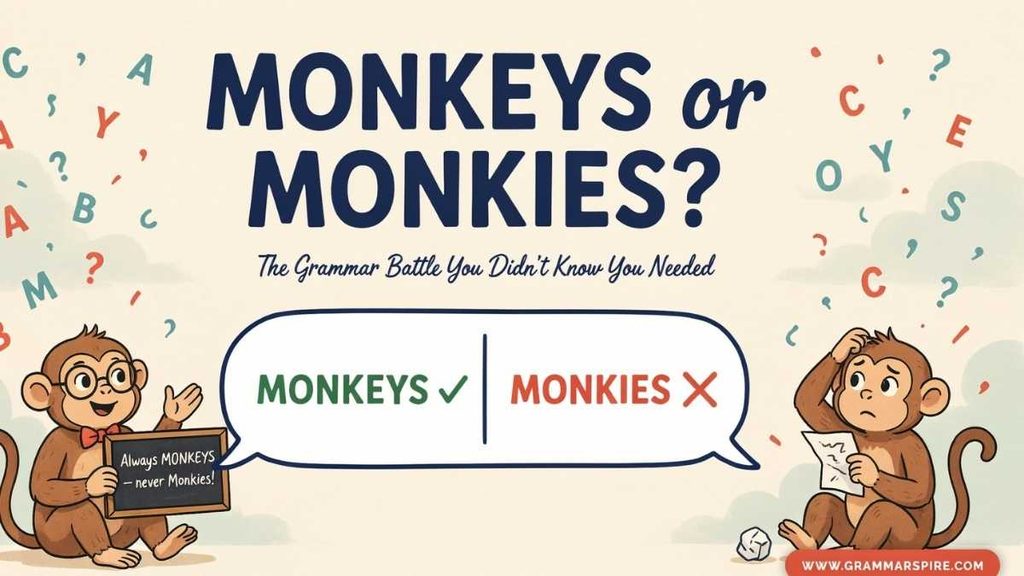
Monkeys is the correct spelling.
The singular noun is monkey, while the plural noun is monkeys. The spelling monkies is incorrect when someone uses it as the plural of monkey.
| Singular | Plural | Correct Form |
|---|---|---|
| monkey | monkeys | Yes |
| monkey | monkies | No |
The easiest way to remember the answer is simple: monkey + s = monkeys.
You don’t remove the y, and you don’t change it to ie. The word keeps its original ending and takes s.
So, if the question is “Is it monkeys or monkies?”, the answer is clearly monkeys.
Learn the difference between commonly confused more words in English
Happened Vs Happend Which Spelling Is Correct?
Is It Spelled Monkeys or Monkies?
The standard English spelling is monkeys.
The confusion comes from a genuine English spelling rule. Some nouns that end in y change the y to i before adding es. For example, baby becomes babies, while party becomes parties.
That pattern doesn’t apply to monkey.
Look closely at the final letters of the word:
monkey
The y follows the vowel e. Because a vowel comes before the y, the word normally takes s when it becomes plural.
The result is:
monkey → monkeys
Writing monkies means you’ve applied the consonant + y rule to a word that actually follows the vowel + y pattern.
That makes monkies spelling an easy mistake to understand, even though it isn’t correct.
What Does Monkey Mean?
The word monkey functions primarily as a noun. It commonly refers to a primate that people generally recognize as a monkey.
For example, consider the sentence:
A monkey climbed the tree.
The sentence refers to one animal, so monkey works as a singular noun.
Now change the number:
Several monkeys climbed the trees.
The sentence refers to more than one animal, so the plural form monkeys becomes necessary.
The word can also appear in informal expressions and figurative uses. English speakers sometimes use monkey when describing playful or mischievous behavior. The exact meaning depends on the context.
For the spelling question, though, the important point remains straightforward. The singular form is monkey, and the plural form is monkeys.
Learn the difference between commonly confused more words in English
Excel vs Accel Which Spelling is correct?
What Is the Plural of Monkey?
The plural of monkey is monkeys.
This is a regular plural form. English doesn’t create a special or irregular plural for this noun. Instead, the word follows the common pattern of adding s.
The transformation looks like this:
Monkey → Monkeys
Here is how the two forms work in sentences:
| Form | Example |
|---|---|
| Singular | A monkey is sitting in the tree. |
| Plural | Several monkeys are sitting in the trees. |
The difference isn’t limited to spelling. The number of the noun can affect the verb as well.
For example:
The monkey is climbing.
Here, monkey is singular, so the sentence uses is.
Now consider:
The monkeys are climbing.
The plural noun monkeys takes are.
Understanding the monkey plural form therefore helps with both spelling and sentence grammar.
Learn the difference between commonly confused more words in English
Bellies vs Bellys Which one Is Correct?
Why Is It “Monkeys” and Not “Monkies”?
The answer depends on the letter immediately before y.
In monkey, the ending contains:
e + y
The letter e is a vowel.
English generally uses s when a noun ends in a vowel followed by y. As a result, the word keeps its y and adds s.
That gives us:
monkey → monkeys
The spelling monkies would suggest that the word belongs to the consonant + y group. It doesn’t.
This explains why is it monkeys and not monkies.
It also answers the question why is it monkeys not monkies without requiring an exception or unusual pronunciation rule. The spelling follows a regular pattern.
Why Is Monkeys Spelled With S?
The question why is monkeys spelled with s often comes from another familiar spelling pattern.
English has many nouns ending in y. However, they don’t all form plurals in the same way.
When a vowel appears immediately before y, the noun generally keeps the y and takes s.
For example:
| Singular | Letter Before Y | Plural |
|---|---|---|
| monkey | e | monkeys |
| donkey | e | donkeys |
| toy | o | toys |
| boy | o | boys |
| key | e | keys |
| day | a | days |
Every word in this table contains a vowel before the final y.
That is why the plural spelling stays straightforward.
Learn the difference between commonly confused more words in English
Buoy or Bouy Which Spelling Is Correct?
The Monkey Plural Spelling Rule
The monkey plural spelling rule becomes much easier when you divide nouns ending in y into two main patterns.
A noun ending in vowel + y generally takes s. A noun ending in consonant + y generally changes y to i and adds es.
This gives us two useful patterns.
| Ending Pattern | Singular | Plural |
|---|---|---|
| Vowel + y | monkey | monkeys |
| Vowel + y | toy | toys |
| Vowel + y | key | keys |
| Vowel + y | boy | boys |
| Consonant + y | baby | babies |
| Consonant + y | party | parties |
| Consonant + y | city | cities |
| Consonant + y | story | stories |
The key isn’t simply the presence of y. The letter before y determines which spelling pattern applies.
That distinction makes the words ending in y plural rule much easier to understand.
Nouns Ending in Vowel + Y
Nouns ending in a vowel followed by y usually form their plurals by adding s.
The word monkey fits this pattern because e comes immediately before y.
So:
monkey → monkeys
The same pattern appears in donkey.
The word ends in ey, so its plural becomes:
donkey → donkeys
The pattern also works with toy and key.
We write:
toy → toys
and:
key → keys
Nothing happens to the final y.
This is why the phrase vowel before y plural rule provides such a useful memory aid. When you see a noun ending in vowel + y, think about adding s rather than changing y to ies.
Learn the difference between commonly confused more words in English
Opening or Openning Which one is correct?
Nouns Ending in Consonant + Y
The other major pattern applies when a consonant comes immediately before y.
In these words, English generally changes y to i and adds es.
Consider baby.
The letter before y is b, which is a consonant. Therefore:
baby → babies
The same thing happens with party:
party → parties
It also happens with city:
city → cities
And with story:
story → stories
This is the consonant before y plural rule.
The important point is that this rule doesn’t apply merely because a word ends in y. The word must fit the consonant + y pattern.
That’s why monkey doesn’t become monkies.
Why Isn’t the Plural of Monkey Monkies?
The spelling monkies looks reasonable if you remember the changing y to ies plural rule but forget when that rule applies.
Take baby and monkey.
The endings look similar because both words finish with y. Yet the letters before the y are different.
In baby, the letter is b.
In monkey, the letter is e.
That gives us two different plural patterns:
baby → babies
monkey → monkeys
So the answer to why isn’t the plural of monkey monkies comes down to one letter.
The e before y tells you to keep the y and add s.
Monkeys vs Monkies Side by Side Comparison
The difference between the two spellings becomes especially clear when you compare them directly.
| Feature | Monkeys | Monkies |
|---|---|---|
| Base word | monkey | monkey |
| Standard plural | Yes | No |
| Correct spelling | Yes | No |
| Formation | Add s | Incorrect y-to-ies change |
| Standard English | Yes | No |
| Used for more than one monkey | Yes | No |
When someone searches for monkeys vs monkies, they’re usually trying to determine whether the final y should remain or change.
It should remain.
The correct plural is monkeys.
Monkey vs Monkeys Singular and Plural
The difference between monkey vs monkeys comes down to number.
Use monkey when you mean one.
Use monkeys when you mean more than one.
| Number | Form | Example |
|---|---|---|
| One | monkey | One monkey climbed the tree. |
| More than one | monkeys | Several monkeys climbed the trees. |
This distinction matters in everyday writing.
If you write:
I saw three monkey.
the noun doesn’t match the number.
The correct sentence is:
I saw three monkeys.
Likewise, you wouldn’t normally write:
A monkeys climbed the tree.
The singular article a requires the singular noun:
A monkey climbed the tree.
Small changes like these make a sentence grammatically complete.
Learn the difference between commonly confused more words in English
Many or Meny Which Spelling Is Correct?
Monkeys in Sentences
The correct form becomes easier to remember when you see monkeys in a sentence.
The monkeys climbed from one branch to another.
Here, monkeys acts as the plural subject.
We watched several monkeys from a safe distance.
The word follows several, which requires a plural noun.
The monkeys were searching for food.
The plural noun works with the plural verb were.
A group of monkeys gathered near the trees.
The phrase a group of monkeys uses the plural noun after of.
The researcher observed the monkeys carefully.
The word monkeys identifies more than one animal.
These examples show how the plural form naturally fits different sentence structures.
Learn the difference between commonly confused more words in English
Bareable or Bearable Which Spelling Is Correct?
Monkey Plural Examples With Similar Words
The easiest way to remember how to spell monkey plural is to compare it with other nouns that follow the same pattern.
Consider these pairs:
| Singular | Correct Plural |
|---|---|
| monkey | monkeys |
| donkey | donkeys |
| toy | toys |
| key | keys |
| boy | boys |
| day | days |
Each singular word contains a vowel immediately before y.
Now compare them with:
| Singular | Correct Plural |
|---|---|
| baby | babies |
| party | parties |
| city | cities |
| family | families |
| story | stories |
These words contain a consonant immediately before y.
Once you notice this pattern, the spelling becomes much less mysterious.
Monkeys and Donkeys Plural
The relationship between monkeys and donkeys plural forms is especially useful because the two words follow the same pattern.
Both words end in ey.
Therefore:
monkey → monkeys
donkey → donkeys
The plural of monkey and donkey doesn’t require changing y to i.
Compare that with baby → babies. The difference comes from the letter before the final y.
This gives you a simple comparison:
| Word | Ending | Plural |
|---|---|---|
| monkey | ey | monkeys |
| donkey | ey | donkeys |
| baby | by | babies |
| party | ty | parties |
The spelling pattern becomes clear once you stop looking at the final y by itself.
Learn the difference between commonly confused more words in English
Studder or Stutter Which Spelling Is Correct?
Is Monkies a Word?
The question “is monkies a word?” deserves a careful answer.
When someone uses monkies as the plural of monkey, the spelling is incorrect in standard English.
The standard plural is monkeys.
An unusual spelling could still appear as a name, username, title, fictional term, or other proper use. Such a special use doesn’t make monkies the standard plural form of monkey.
Therefore, in ordinary English writing, use monkeys.
The same answer applies to is monkies correct and is monkies a misspelling.
When the intended meaning is more than one monkey, monkies is a misspelling.
Is Monkeys a Word?
Yes. Monkeys is a standard English word.
It is the plural form of the noun monkey.
For example:
The monkeys are moving through the trees.
Here, monkeys clearly functions as a plural noun.
So the question “is monkeys a word?” has a simple answer: yes.
The spelling is recognized in standard English, and writers can use it in everyday, educational, professional, and formal contexts.
Learn the difference between commonly confused more words in English
Useing or Using Which spelling Is Correct?
How to Spell Monkeys
If you’re wondering how to spell monkeys, start with the singular form:
monkey
Then add s.
The result is:
monkeys
The spelling process doesn’t require a change to the final y.
You don’t write monkies.
You don’t write monkeies.
just simply add s:
monkey + s = monkeys
This also answers how do you spell monkeys.
How to Spell Monkey Plural
The answer to how to spell monkey plural is monkeys.
The word remains almost exactly the same as the singular form. The only addition is s.
The pattern is:
Singular: monkey
Plural: monkeys
This is one of those English spelling rules that becomes easy once you understand the reason behind it.
How Do You Make Monkey Plural?
To make monkey plural, add s to the singular form.
Therefore:
monkey → monkeys
You don’t change y to i.
The spelling follows the vowel + y pattern.
A quick mental check can help. Look at the letter immediately before y. In monkey, that letter is e.
Because e is a vowel, keep the y and add s.
Learn the difference between commonly confused more words in English
Speach or Speech What one is Correct?
Monkey vs Monkies Why the Confusion Happens
The confusion between monkey vs monkies comes from a real English spelling pattern.
Words such as baby and party change their final y when they become plural. Writers often remember the result without remembering the condition.
That can lead to an incorrect assumption:
Words ending in y always become ies.
That isn’t the rule.
The more accurate rule says that nouns ending in consonant + y generally change y to i and add es.
Words ending in vowel + y generally take s.
Once you remember that distinction, monkeys no longer seems unusual.
Monkeys in British English and American English
The spelling doesn’t change between British and American English.
Both varieties use:
monkeys
There is no standard British spelling monkies, and American English doesn’t use monkies as an alternative plural either.
So whether you’re writing monkeys in British English or monkeys in American English, the standard spelling remains the same.
The same applies to donkeys.
This means regional English doesn’t create another spelling choice here. Writers in both varieties can use monkeys confidently.
Is Monkies Correct in Informal Writing?
No, not when you mean the plural of monkey.
Text messages and casual online conversations sometimes contain spelling mistakes. Readers may understand monkies because the intended meaning is obvious, but recognition doesn’t make the spelling correct.
Standard spelling still uses monkeys.
If you’re writing a school assignment, article, email, report, caption, or professional message, monkeys is the appropriate form.
The Difference Between Monkey, Monkeys, and Monkies
These three forms can cause confusion, so here’s the clearest comparison.
| Form | Meaning | Standard English? |
|---|---|---|
| monkey | One monkey | Yes |
| monkeys | More than one monkey | Yes |
| monkies | Intended as plural of monkey | No |
The distinction is simple once the plural rule becomes familiar.
Monkey is singular.
Monkeys is plural.
Monkies is an incorrect spelling when used as the plural.
A Simple Way to Remember the Rule
Here’s an easy memory trick.
Don’t look only at the final y.
Look at the letter standing directly before it.
If that letter is a vowel, the noun generally keeps the y and takes s.
If that letter is a consonant, the noun generally changes y to i and adds es.
That gives you:
Monkey → Monkeys
but:
Party → Parties
and:
Baby → Babies
The trick works because it focuses on the part of the spelling that actually determines the pattern.
Here’s a trusted source for clear more words Comparison:
Grammar Update
Practice Session
Now it’s time to put the spelling rules into practice. These exercises will help you master the difference between monkeys and monkies while reviewing the plural rules for nouns ending in y.
Complete each sentence with the correct word or form. The answer appears immediately after each question so you can check your understanding as you go.
Fill in the Blanks
Monkeys or Monkies
- We watched several ______ swinging from the branches.
Answer: monkeys - The plural of monkey is ______.
Answer: monkeys - The spelling ______ is incorrect in standard English.
Answer: monkies - The correct plural of monkey is ______, not monkies.
Answer: monkeys - The zookeeper gave food to the ______.
Answer: monkeys - One monkey becomes two ______.
Answer: monkeys - The children enjoyed watching the playful ______ at the zoo.
Answer: monkeys - How do you spell the plural of monkey? ______
Answer: monkeys - The word monkey keeps its final ______ when it becomes plural.
Answer: y - To make monkey plural, simply add ______.
Answer: s
Practice With Similar Words
- The farmer owns several ______.
Answer: donkeys - The plural of donkey is ______.
Answer: donkeys - I found several colorful ______ in the toy box.
Answer: toys - She collected several old ______ from the table.
Answer: keys - The teacher spoke to the ______ about the upcoming event.
Answer: boys - The children played several different ______ during the afternoon.
Answer: games - The store sells many different ______.
Answer: toys - The farmer saw two ______ walking across the field.
Answer: donkeys
Vowel + Y Plural Rule
- A noun ending in vowel + y usually forms its plural by adding ______.
Answer: s - In monkey, the letter before y is the vowel ______.
Answer: e - Because monkey ends in vowel + y, its plural is formed by adding ______.
Answer: s - Monkey becomes ______ in the plural.
Answer: monkeys - Donkey becomes ______ in the plural.
Answer: donkeys - Toy becomes ______ in the plural.
Answer: toys - Key becomes ______ in the plural.
Answer: keys - Boy becomes ______ in the plural.
Answer: boys
Consonant + Y Plural Rule
- A noun ending in consonant + y usually changes y to ______ and adds es.
Answer: i - Baby becomes ______ in the plural.
Answer: babies - Party becomes ______ in the plural.
Answer: parties - City becomes ______ in the plural.
Answer: cities - Story becomes ______ in the plural.
Answer: stories - The word baby changes y to i because the letter before y is a ______.
Answer: consonant - The word monkey does not change y to i because the letter before y is a ______.
Answer: vowel
Mixed Review
- A group of monkeys is commonly called a ______.
Answer: troop - The sentence “Three ______ were climbing the tree” uses the correct plural form.
Answer: monkeys
Quick Spelling Challenge
Complete these pairs by writing the correct plural form.
| Singular | Correct Plural |
|---|---|
| monkey | monkeys |
| donkey | donkeys |
| toy | toys |
| key | keys |
| boy | boys |
| baby | babies |
| party | parties |
| city | cities |
| story | stories |
| family | families |
Final Review
The most important rule to remember is simple.
When a noun ends in vowel + y, keep the y and add s.
monkey → monkeys
donkey → donkeys
toy → toys
key → keys
boy → boys
When a noun ends in consonant + y, change y to i and add es.
baby → babies
party → parties
city → cities
story → stories
family → families
So, when you’re deciding between monkeys or monkies, look at the letter before the final y. In monkey, that letter is e, a vowel. Therefore, the correct spelling is monkeys.
Once you remember this pattern, monkies becomes much easier to spot as the incorrect form.
FAQs About Monkeys or Monkies
Which is correct, monkeys or monkies?
Monkeys is the correct spelling. Monkies is a misspelling and should not be used in standard English. Since monkey ends with a vowel followed by y, you form its plural by adding s: monkey → monkeys.
What is the plural of monkey?
The plural of monkey is monkeys. The final y remains unchanged because it follows the vowel e. Therefore, the correct spelling is monkeys, not monkies.
Why is it monkeys and not monkies?
The spelling follows the standard plural rule for nouns ending in vowel + y. Because the y in monkey comes after the vowel e, you simply add s. This gives us monkey → monkeys.
Is monkies a word?
Monkies is not the standard plural form of monkey. In standard English, the correct spelling is monkeys. If you’re referring to more than one monkey, use monkeys.
What is the plural of donkey?
The plural of donkey is donkeys. Like monkey, the word donkey ends in vowel + y, so you add s without changing the y.
What are baby monkeys called?
A young monkey is commonly called a baby monkey or an infant. The term can vary according to the species and the context in which the animal is being discussed.
What is a group of monkeys called?
A group of monkeys is commonly called a troop. This collective noun is widely used when referring to monkeys living or traveling together.
Is a flock of monkeys the correct term?
No. Flock is not the usual collective noun for monkeys. Troop is the more appropriate term for a group of monkeys. The word flock is most commonly associated with birds and certain other animals.
Are apes and monkeys the same?
No. Apes and monkeys are different groups of primates. Apes include chimpanzees, gorillas, orangutans, and gibbons, while monkeys belong to other primate groups. Although they share several characteristics, they are not interchangeable terms.
Which is more intelligent, a monkey or a chimpanzee?
Chimpanzees generally show more advanced cognitive abilities than monkeys. They can demonstrate sophisticated problem-solving, tool use, memory, communication, and social learning. However, intelligence differs among individual primate species.
What is the slang meaning of monkey?
In informal English, monkey can describe someone who behaves playfully, mischievously, or energetically. The word also appears in several idiomatic expressions. Because some uses can be offensive depending on the context, it’s important to consider how the term is being used.
What is the plural of kangaroo?
The standard plural of kangaroo is kangaroos. The word forms its plural by adding s, just as many other nouns do.
Is giraffes the plural of giraffe?
Yes. Giraffes is the correct plural form of giraffe. You use giraffe for one animal and giraffes for two or more.
What is the plural of moose?
The standard plural of moose is moose. You can say one moose or several moose. The plural does not normally change to mooses in standard English.
AEO About Monkeys or Monkies
What is the correct plural of monkey?
The correct plural is monkeys. The spelling monkies is incorrect because monkey ends in vowel + y, so you add s.
How do you spell the plural of monkey?
The plural is spelled monkeys: M-O-N-K-E-Y-S.
Does monkey change y to ies when it becomes plural?
No. The y remains unchanged in monkey. Since the letter before y is the vowel e, you add s to create monkeys.
What is the plural rule for words ending in y?
The letter before y determines the usual plural spelling. When a noun ends in vowel + y, keep the y and add s, as in monkey → monkeys and toy → toys. When a noun ends in consonant + y, change y to i and add es, as in baby → babies and party → parties.
What is the difference between monkeys and monkies?
Monkeys is the correct plural spelling of monkey. Monkies is an incorrect spelling. The difference comes from the pluralization rule for nouns ending in vowel + y.
What is a group of monkeys called?
A group of monkeys is commonly called a troop.
What are young monkeys called?
Young monkeys are commonly referred to as infants or baby monkeys.
What is the plural of donkey?
The plural of donkey is donkeys. It follows the same vowel + y pattern as monkey → monkeys.
Is monkeys a word?
Yes. Monkeys is a standard English word and the plural form of monkey. It refers to more than one monkey.
Is monkies the correct spelling?
No. Monkies is not the correct plural spelling. The standard form is monkeys.
The Simple Rule Behind the Spelling
The easiest way to remember the difference is to examine the letter immediately before the final y.
Vowel + Y Add S
monkey → monkeys
donkey → donkeys
toy → toys
key → keys
boy → boys
Consonant + Y Change Y to I and Add ES
baby → babies
party → parties
city → cities
story → stories
The word monkey belongs to the first group. The y follows the vowel e, so you keep the y and add s.
That gives you the correct form: monkey → monkeys.
Conclusion
The monkeys or monkies confusion becomes much easier once you understand the spelling rule behind it. Monkeys is the correct plural of monkey, while monkies is an incorrect spelling. Since monkey ends in a vowel followed by y, you keep the y and simply add s. The same pattern appears in words such as donkey, toy, and key. However, words such as baby and party follow a different rule because a consonant comes before y. Remember to check that letter before changing the word. With this simple trick, monkies won’t cause any more spelling mischief in your writing.

Ella AJS
Ella AJS is an experienced blogger and language enthusiast at Grammar Spire, dedicated to making English grammar simple, practical, and easy to understand. She specializes in word comparisons, meanings, usage, and common language confusions. Through clear explanations and engaging examples, Ella helps students, writers, and English learners improve their vocabulary and communicate with greater confidence and accuracy.




