

English verbs can be tricky little troublemakers. Just when you think a sentence is perfectly clear, “seen or saw” can sneak in and create a grammar headache. Both words come from the verb “see,” yet they cannot be used interchangeably. “Saw” is the simple past form, whereas “seen” is the past participle, so each one follows a different grammatical pattern. Fortunately, the rule is easier than it looks. Once you understand how these forms work, confusing sentences such as “I seen him” and “I saw him” become much easier to handle. Let’s explore the difference and clear up the confusion once and for all.
Seen or Saw Quick Answer
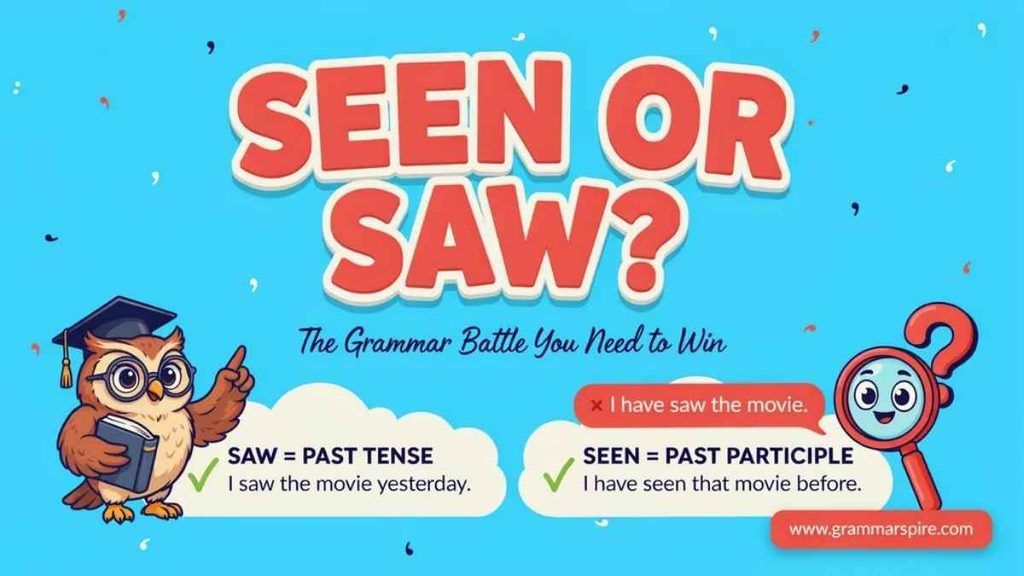
If you need the short answer to the seen or saw meaning question, use “saw” for the simple past and “seen” as the past participle.
For example:
| Form | Grammatical role | Example |
|---|---|---|
| see | Base form | I want to see the movie. |
| saw | Simple past | I saw the movie yesterday. |
| seen | Past participle | I have seen the movie before. |
So, if you are asking, “What is the past tense of see?” the answer is “saw.”
If you are asking, “What is the past participle of see?” the answer is “seen.”
That distinction answers many questions about saw or seen meaning and seen or saw correct usage.
Consider these sentences:
I saw Maria yesterday.
I have seen Maria before.
Both sentences describe seeing Maria. However, they use different verb forms and different tense structures.
The first sentence uses the simple past. The second uses the present perfect.
That is the central seen or saw difference.
Learn the difference between commonly confused more words in English
Skis or Skiis Which Spelling Is Correct?
Saw vs Seen at a Glance
The best way to understand saw vs seen is to look at how each form behaves inside a sentence.
| Word | Verb form | Typical use | Example |
|---|---|---|---|
| see | Base form | Present tense and after certain auxiliaries | I see the problem. |
| saw | Simple past | Completed past action | I saw the problem yesterday. |
| seen | Past participle | Perfect tenses and passive constructions | I have seen the problem. |
The pattern is important because “saw” and “seen” are not two alternative versions of the same past tense.
Instead, they have different grammatical jobs.
The simple past uses “saw”:
I saw him at the station.
The present perfect uses “seen”:
I have seen him at the station before.
The past perfect also uses “seen”:
I had seen him before the meeting.
However, questions with “did” use the base form “see”:
“Did you see him?”
This small difference explains a surprisingly large number of common English mistakes.
What Does “Saw” Mean?
Saw Is the Simple Past of See
“Saw” is the simple past form of the irregular verb “see.” Cambridge Dictionary lists “saw” as the past simple form of “see.”
The word describes an event that happened in the past.
For example:
I saw your brother yesterday.
She saw a bird in the garden.
In each sentence, the seeing happened in the past.
The action is presented as a completed event. Therefore, “saw” works naturally as the main verb.
When to Use Saw
Use “saw” when you are describing a completed action in the simple past.
Specific past time expressions often appear with it. These include “yesterday,” “last night,” “last week,” “two days ago,” “last year,” and particular years.
For example:
I saw James yesterday.
She saw the doctor last Monday.
The time expression helps establish a finished past period. Consequently, the simple past fits naturally.
However, a sentence does not need a time expression to use “saw.”
You can simply say:
I saw what happened.
The context can make the past time clear.
Saw in Questions
There is an important twist when you form questions.
You do not normally say:
Did you saw him?
Instead, you say:
Did you see him?
Why does “saw” disappear?
The auxiliary “did” already carries the past-tense marking. Therefore, the main verb returns to its base form, “see.”
The same pattern appears in negative sentences:
I did not see him.
She did not see the accident.
We did not see anything unusual.
This rule is essential when considering the question “did you see or did you saw?”
The correct structure is “did you see.”
Learn the difference between commonly confused more words in English
Steer or Stear Which Spelling Is Correct?
What Does “Seen” Mean?
Seen Is the Past Participle of See
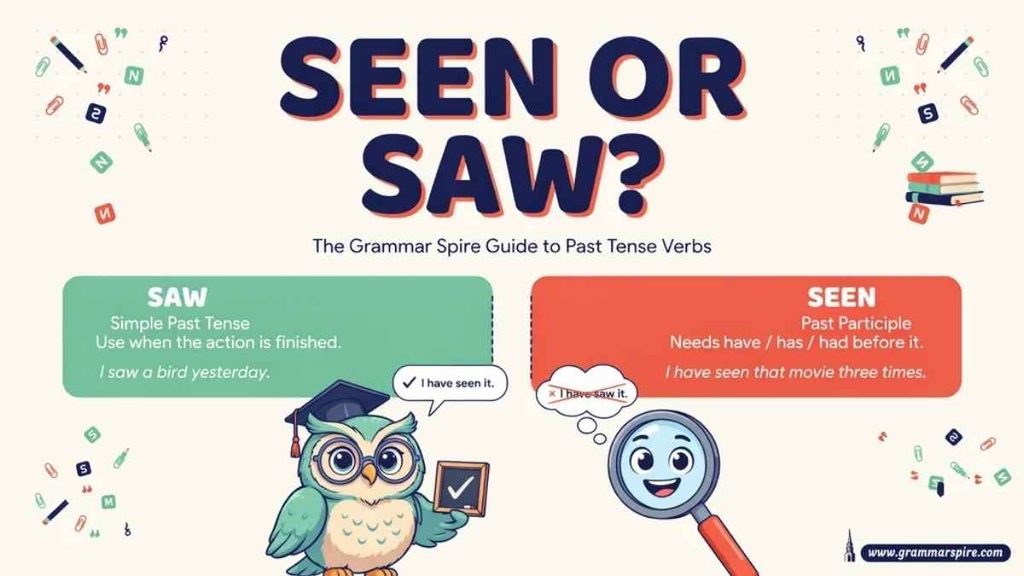
“Seen” is the past participle of “see.” Cambridge Dictionary defines “seen” as the past participle of “see.”
That means “seen” does not normally function as the simple past form.
The three principal forms are:
See → saw → seen
This is an irregular verb pattern because the past forms do not follow the regular “-ed” pattern.
For example:
Walk → walked → walked
But:
See → saw → seen
That difference is one reason learners often ask whether “seen” is the past tense of “see.”
It is not.
“Saw” is the simple past.
“Seen” is the past participle.
Seen With Have, Has, and Had
The word “seen” commonly appears with the auxiliary verbs “have,” “has,” and “had.”
For example:
I have seen that movie.
She has seen the report.
We have seen this problem before.
He had seen the building earlier.
They had seen enough evidence.
These constructions are grammatically different from a simple past sentence.
The auxiliary carries part of the tense structure, while “seen” supplies the past participle.
Therefore, the following sentence is correct:
I have seen him.
The following sentence is not standard English:
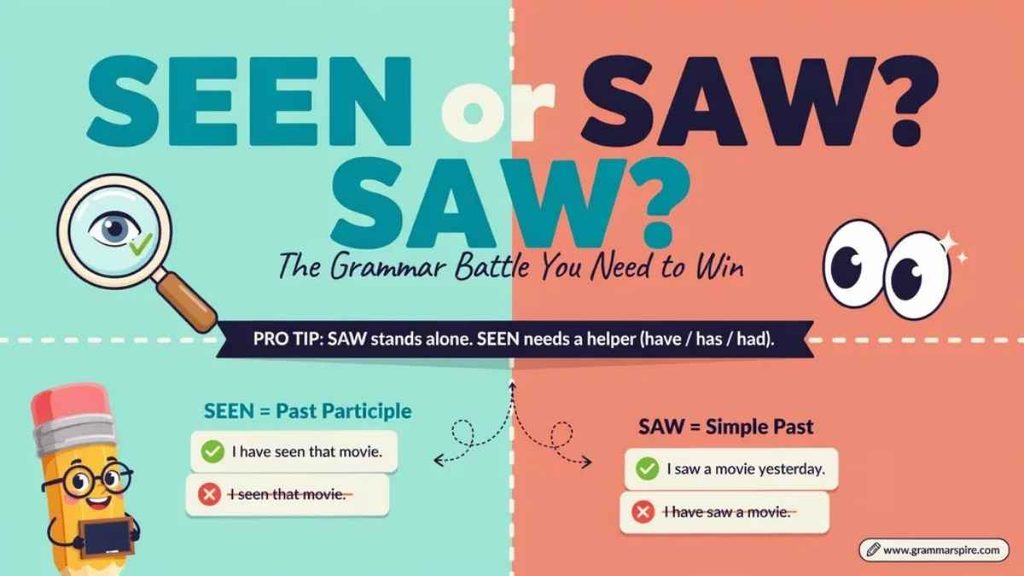
I have saw him.
Similarly:
I had seen him before.
is correct, while:
I had saw him before.
is incorrect.
Seen in Passive Constructions
There is another important use of “seen.”
The word can appear in passive constructions with forms of “be.”
For example:
She was seen near the entrance.
They were seen leaving the building.
The bird was seen in the garden.
He has been seen in the area.
Here, the subject is not necessarily the person doing the seeing.
Compare these two sentences:
Sarah saw the dog.
Sarah was seen by the neighbor.
In the first sentence, Sarah performs the seeing.
In the second sentence, someone else sees Sarah.
This distinction helps explain why “seen” can appear without “have,” “has,” or “had.” The more accurate rule is that “seen” is a past participle and normally appears within a grammatical structure that supports a past participle.
Learn the difference between commonly confused more words in English
Eying or Eyeing Which Spelling Is Correct?
The Main Seen or Saw Difference
The most useful seen or saw grammar rule is simple.
“Saw” is the simple past.
“Seen” is the past participle.
That difference affects the entire sentence structure.
Saw as the Simple Past
The common structure is:
Subject + saw + object
Examples include:
“I saw Tom.”
She saw the bird.
We saw the problem.
They saw the accident.
In each example, “saw” acts as the main verb in a simple past sentence.
Seen as the Past Participle
The common structures include:
Subject + have/has + seen
I have seen Tom.
She has seen Tom.
Subject + had + seen
I had seen Tom.
They had seen Tom.
Passive structure:
Subject + was/were + seen
He was seen outside.
They were seen together.
Once these patterns become familiar, the difference between seen and saw becomes much easier to spot.
Learn the difference between commonly confused more words in English
Treck or Trek Which Spelling Is Correct?
Why “I Saw” and “I Have Seen” Are Different
At first, these two sentences can appear almost identical:
I saw that movie.
I have seen that movie.
However, the tense changes the way the experience is presented.
I saw that movie last Friday.
Here, the speaker refers to a completed event at a specific past time.
I have seen that movie before.
Here, the speaker focuses on past experience rather than identifying one particular finished time.
Therefore, “I saw” and “I have seen” should not be treated as interchangeable.
Consider another example.
I saw Sarah yesterday.
I have seen Sarah before.
The first sentence places the event in a completed past period.
The second describes an experience that has relevance to the present conversation.
This distinction is especially useful when learning have seen vs saw.
use in Different Tenses

Understanding the verb forms becomes much easier when you see them together.
| Tense or construction | Correct form | Example |
|---|---|---|
| Simple present | see / sees | I see the problem. |
| Simple past | saw | I saw the problem. |
| Present perfect | have/has seen | I have seen the problem. |
| Past perfect | had seen | I had seen the problem. |
| Future perfect | will have seen | I will have seen it by then. |
| Past passive | was/were seen | She was seen there. |
| Present perfect passive | has/have been seen | He has been seen nearby. |
This table also explains why the phrase “seen past tense” can be misleading.
“Seen” is not the simple past.
It is the past participle.
Likewise, “saw past tense” is correct because “saw” is the simple past form of “see.” Cambridge Dictionary confirms this distinction.
Learn the difference between commonly confused more words in English
Peices or Pieces Which Spelling Is Correct?
Seen or Saw After Helping Verbs
Helping verbs provide one of the quickest ways to choose the correct form.
After Did, Use See
When “did” forms a simple past question, use the base form “see.”
Correct:
Did you see John?
Incorrect:
Did you saw John?
Also incorrect:
Did you seen John?
The reason is straightforward. “Did” already expresses the past tense.
The same principle applies to negatives:
I did not see him.
She did not see the accident.
We did not see the sign.
Therefore, if you are wondering “did you see or did you saw,” choose “did you see.”
After Have, Has, or Had, Use Seen
When “have,” “has,” or “had” forms a perfect construction, use “seen.”
Correct:
I have seen it.
She has seen it.
They had seen it.
Incorrect:
I have saw it.
She has saw it.
They had saw it.
This is one of the most useful saw vs seen grammar rules.
After Would Have, Use Seen
The same principle applies to conditional perfect constructions.
Correct:
I would have seen him if I had arrived earlier.
Incorrect:
I would have saw him if I had arrived earlier.
The structure is “would have + past participle.”
Because “seen” is the past participle, it follows “have.”
That is why the correct phrase is “would have seen.”
Learn the difference between commonly confused more words in English
Sergeant or Sargeant Which Spelling Is Correct?
Have Seen vs Saw
The difference between “have seen” and “saw” often causes confusion because both refer to something that happened before now.
However, the speaker presents the event differently.
Use “saw” for a simple past event:
I saw him yesterday.
I saw the movie last Friday.
We saw the building during our trip.
Use “have seen” for present perfect situations:
I have seen him before.
I have seen that movie several times.
We have seen this problem before.
The present perfect often focuses on experience, change, or a past event that remains relevant to the present.
The simple past, meanwhile, places the event in a completed past time.
Specific Time and Unspecified Time
This distinction becomes particularly useful when choosing between “saw” and “have seen.”
Compare:
I saw the movie last Friday.
I have seen the movie before.
The first sentence identifies when the event happened.
The second does not identify a specific completed time. Instead, it focuses on experience.
Another comparison makes the difference clearer:
She saw him at the station yesterday.
She has seen him at the station before.
The word “yesterday” creates a clear finished past reference. The second sentence focuses on whether the experience has occurred before.
This is why “I have seen him yesterday” does not normally work in standard English.
Instead:
I saw him yesterday.
Had Seen vs Saw
The difference between had seen vs saw becomes clearer when two past events are involved.
Consider:
I saw the building during the tour.
The sentence simply reports a past event.
Now consider:
I had seen the building before the tour started.
The sentence contains two past events. The past perfect shows that seeing the building happened before the tour started.
The timeline looks like this:
Seeing the building → Tour started
The past perfect is useful because it makes the order of past events clear.
Another example is:
When Anna arrived, Mark had already seen the message.
First, Mark saw the message.
Later, Anna arrived.
Therefore, “had seen” establishes the earlier past event.
Seen or Saw in Questions
Questions reveal the difference particularly well.
For the simple past, use “did + see”:
Did you see him?
When did you see her?
Did they see the accident?
For the present perfect, use “have/has + seen”:
Have you seen him?
Has she seen the report?
Have they seen the new building?
For the past perfect, use “had + seen”:
1. Had you seen him before?
2. Had she seen the message?
3. Had they seen the results?
Therefore, when deciding between saw or seen, look at the auxiliary first.
Seen or Saw in Negative Sentences
Negative sentences follow the same pattern.
For the simple past:
I did not see him.
For the present perfect:
I have not seen him.
For the past perfect:
I had not seen him.
The incorrect forms are:
1.I did not saw him.
2. I have not saw him.
3. I had not saw him.
The auxiliary determines the structure.
Consequently, learning the helping verb patterns is more useful than trying to memorize every possible sentence separately.
I Seen or I Saw Which Is Correct?
The question “I seen or I saw” has a clear answer when the sentence is a simple past statement.
Correct:
I saw him.
Not standard:
I seen him.
However, “seen” becomes correct when the sentence has the appropriate structure:
I have seen him.
I had seen him.
He was seen near the station.
So, the problem is not that “seen” is an incorrect word. It is a perfectly standard English verb form. The problem occurs when it is placed in a sentence that requires the simple past.
This distinction is important in both spoken English and written English.
I Have Seen or I Have Saw?
The correct form is:
I have seen him.
Not
I have saw him.
The reason is grammatical. “Have” is functioning as an auxiliary in the present perfect, so the main verb appears in its past participle form.
The same pattern works with “has”:
She has seen the movie.
And with “had”:
She had seen the movie.
Therefore:
Have + seen
Has + seen
Had + seen
These are reliable patterns to remember.
I Saw It or I Have Seen It?
Both can be correct.
The right choice depends on what you want to communicate.
I saw it yesterday.
This refers to a completed past event.
I have seen it before.
This refers to past experience.
The same difference appears in questions.
Did you see the new restaurant yesterday?
Have you seen the new restaurant before?
The first question asks about a particular past event.
The second asks about experience.
Learn the difference between commonly confused more words in English
Brasil or Brazil What Is the Difference?
I Have Never Seen or Saw?
The natural present-perfect construction is:
I have never seen it.
For example:
I have never seen snow.
She has never seen the ocean.
They have never seen anything like it.
However, “never” does not automatically require “seen.”
The tense still depends on the sentence.
For example:
I never saw him after that day.
This uses the simple past because the sentence refers to a completed past period.
Therefore, the important point is not the word “never” itself. The important point is the tense and timeline.
Seen or Saw in Everyday English
The verb “see” has several uses beyond physically noticing something with your eyes. Cambridge Dictionary also records uses connected with understanding, meeting people, experiencing something, and making sure something happens.
For example:
I see what you mean.
This can mean I understand
She is seeing a doctor tomorrow.
Here, “seeing” can refer to meeting or visiting someone.
We went to see my grandmother.
Here, “see” means to visit.
However, when the specific issue is the past forms “saw” and “seen,” the same core verb form rules remain in place.
Saw and Seen in Real Sentences
Consider these examples:
I saw your message yesterday.
Have you seen my keys?
“Did you see that?”
I have seen that show before.
She saw a fox on the road.
They had seen the problem earlier.
The man was seen near the entrance.
Each sentence uses the form required by its grammatical structure.
That is why learning isolated definitions is not enough. You also need to understand how the verb behaves inside a sentence.
Learn the difference between commonly confused more words in English
Seel or Seal Which one is correct?
Common Mistakes With Seen and Saw

Using Seen as the Simple Past
A common mistake is:
I seen him yesterday.
The standard form is:
I saw him yesterday.
The reason is simple. “Yesterday” places the action in the simple past, so “saw” is required.
Using Saw After Have
Another common mistake is:
I have saw that movie.
The correct sentence is:
I have seen that movie.
After “have,” the perfect construction requires the past participle.
Using Saw After Had
Incorrect:
She had saw him before.
Correct:
She had seen him before.
Again, “had” is followed by the past participle.
Using Saw After Did
Incorrect:
Did you saw him?
Correct:
Did you see him?
The auxiliary “did” already carries the past-tense meaning.
Using Seen After Did
Incorrect:
Did you seen him?
Correct:
Did you see him?
After “did,” return to the base form.
Seen vs Saw Examples in Sentences
Here are some useful comparisons.
| Sentence | Explanation |
|---|---|
| I saw him yesterday. | Simple past |
| I have seen him before. | Present perfect |
| I had seen him earlier. | Past perfect |
| Did you see him? | Did + base form |
| I did not see him. | Did not + base form |
| She was seen downtown. | Passive construction |
| They have never seen snow. | Present perfect |
| We had never seen anything like it. | Past perfect |
| He would have seen the sign. | Conditional perfect |
Notice how “saw” appears when the simple past is required.
Meanwhile, “seen” appears after auxiliary structures that require the past participle.
Learn the difference between commonly confused more words in English
High School or Highschool What Is the Correct Spelling?
How to Use Seen and Saw
If you are still asking how to use seen and saw, start with the verb before them.
If you have “did,” use “see.”
Did you see him?
If you have “have” or “has,” use “seen.”
I have seen him.
She has seen him.
If you have “had,” use “seen.”
I had seen him before.
If you have “would have,” use “seen.”
I would have seen him.
If you are simply describing a completed past event, use “saw.”
“I saw him yesterday.”
This approach makes the correct use of seen much easier.
Here’s a trusted source for clear more words Comparison
Grammar Update
Practice Session
Now it is time to put the rules into practice. Choosing between “saw” and “seen” becomes much easier when you look at the structure of the sentence. In particular, words such as have, has, had, and did can help you identify the correct verb form.
For each sentence, fill in the blank with the correct form of “see.” Choose from see, saw, or seen.
Fill in the Blanks
- I ______ your brother at the grocery store yesterday.
- Have you ever ______ that movie?
- She ______ a beautiful sunset last evening.
- We have ______ this problem before.
- Did you ______ my message this morning?
- They ______ the accident while they were driving home.
- I had ______ that painting before the exhibition ended.
- He has never ______ snow in person.
- I just ______ your friend outside.
- Have you ______ the new restaurant downtown?
- Maria ______ her teacher at the library yesterday.
- We had ______ the warning before entering the building.
- Did you ______ who was standing near the door?
- I have ______ that actor in several movies.
- They ______ the fireworks from their balcony last night.
- She has ______ the same mistake several times.
- I ______ him at the meeting last Monday.
- Have they ever ______ the Grand Canyon?
- He had ______ the documentary before you recommended it.
- We ______ a strange bird in the park yesterday.
- Did she ______ the sign on the wall?
- I have never ______ anything like that before.
- She ______ her old friend at the airport last week.
- They have ______ the results already.
- I ______ your car outside the office earlier.
- Had you ______ that place before your trip?
- Did he ______ the doctor yesterday?
- We have ______ enough evidence to understand what happened.
- She ______ the message but forgot to reply.
- I had never ______ such a crowded street before that day.
Answers
- saw
- seen
- saw
- seen
- see
- saw
- seen
- seen
- saw
- seen
- saw
- seen
- see
- seen
- saw
- seen
- saw
- seen
- seen
- saw
- see
- seen
- saw
- seen
- saw
- seen
- see
- seen
- saw
- seen
Learn the difference between commonly confused more words in English
FAQs About Seen or Saw
Is it “I just saw” or “I just seen”?
“I just saw” is correct in standard English when you mean that you saw something a short time ago.
Example: I just saw your brother outside.
“I just seen” is not standard because “seen” is a past participle and normally needs a suitable auxiliary verb.
Why do people say “I seen” instead of “I saw”?
Some speakers use “I seen” in certain regional or informal varieties of English. However, standard English uses “saw” for the simple past of “see.”
Therefore, in formal writing, use “I saw him,” rather than “I seen him.”
Is it proper to say “I seen you” or “I saw you”?
“I saw you” is the correct standard form for a simple past statement.
Example: I saw you at the store yesterday.
If you want to use “seen,” you need a construction that supports the past participle, such as “I have seen you before.”
Which is correct “I saw it” or “I seen it”?
“I saw it” is correct when you are using the simple past.
Example: I saw it on the desk this morning.
You can use “seen” in a different structure, such as “I have seen it before.”
Is it correct to say “seen” or “saw”?
Both are correct forms of the verb “see,” but they have different grammatical roles.
“Saw” is the simple past form, while “seen” is the past participle. For example, “I saw the movie yesterday” uses “saw,” whereas “I have seen the movie before” uses “seen.”
Do you say “I saw her” or “I seen her”?
Use “I saw her” for a simple past statement.
Example: I saw her at the library.
For a perfect construction, use “seen” with an auxiliary.
Example: I have seen her at the library before.
Which is correct “I have seen you” or “I saw you”?
Both can be correct, but the context changes.
“I saw you” normally refers to a particular past event.
Example: I saw you at the concert last Friday.
“I have seen you” presents the experience without focusing on one completed past occasion.
Example: I have seen you here several times.
Is it correct to say “I’ve seen it”?
Yes. “I’ve seen it” is a contraction of “I have seen it,” and it is grammatically correct.
Example: I’ve seen that movie before.
Here, “seen” follows “have,” which creates the present perfect construction.
Which is correct “I ever saw” or “I ever seen”?
Neither phrase is normally used by itself as a complete standard expression. The correct form depends on the sentence.
For example, “Have you ever seen that movie?” uses “seen” after “have.”
For a simple past statement, you could say, “I saw that movie when I was younger.”
Is “I’ve seen” grammatically correct?
Yes. “I’ve seen” is the standard contraction of “I have seen.”
Example: I’ve seen that place before.
The structure is have + seen, so “seen” functions as the past participle.
Which is correct “I seen them” or “I saw them”?
“I saw them” is correct when you are describing a completed event in the simple past.
Example: I saw them at the restaurant yesterday.
If you are using the present perfect, say “I have seen them.”
Example: I have seen them at that restaurant before.
Is it correct to say “I have seen you”?
Yes. “I have seen you” is grammatically correct.
It uses the present perfect structure have + past participle. Therefore, “seen” is the appropriate form after “have.”
Example: I have seen you here several times.
Why are people saying “I seen” instead of “I saw”?
The form “I seen” can occur in some varieties of spoken English. Nevertheless, standard English uses “saw” as the simple past form.
So, for standard written English, use:
I saw him yesterday.
Not:
I seen him yesterday.
Do I say “I just saw” or “I just seen”?
Use “I just saw” when “saw” is the main verb.
Example: I just saw your message.
Alternatively, you can use “seen” with an auxiliary:
I have just seen your message.
Both sentences are grammatical, but their structures are different.
How do you use “seen” in a sentence?
Use “seen” as the past participle of “see.” It commonly follows “have,” “has,” or “had.”
For example:
I have seen that movie.
She has seen the new building.
They had seen the warning before they entered.
“Seen” can also occur in passive constructions, such as “He was seen near the station.”
AEO Quick Answers About Seen or Saw
What is the difference between “saw” and “seen”?
“Saw” is the simple past form of “see,” whereas “seen” is the past participle. Use “saw” in sentences such as “I saw him yesterday” and “seen” in constructions such as “I have seen him before.”
Is “saw” the past tense of “see”?
Yes. “Saw” is the simple past form of “see.”
Example: I saw a bird outside.
Is “seen” the past tense of “see”?
No. “Seen” is the past participle. The simple past form is “saw.”
The basic verb forms are:
See → present
Saw → simple past
Seen → past participle
What is the past participle of “see”?
The past participle of “see” is “seen.”
Example: I have seen that movie before.
What are the three forms of “see”?
The three main forms are “see,” “saw,” and “seen.”
“See” is the present form, “saw” is the simple past, and “seen” is the past participle.
Can you say “I seen him”?
In standard English, “I seen him” is not correct as a simple past sentence.
Use:
I saw him.
If the sentence uses the present perfect, use:
I have seen him.
Can “seen” be used by itself?
“Seen” can appear without “have,” “has,” or “had” in certain grammatical constructions, particularly passive sentences.
Example: He was seen near the station.
However, in an ordinary active simple past sentence, use “saw” instead:
I saw him near the station.
Does “saw” need a helping verb?
No. “Saw” can work as the main verb in a simple past sentence.
Example: I saw the accident.
However, “did” can appear with the base form “see” for emphasis:
I did see the accident.
What should I say “I saw” or “I seen”?
Use “I saw” when you need the simple past.
Example: I saw her yesterday.
Use “I have seen” when the present perfect is required.
Example: I have seen her before.
What should I say “I have seen” or “I have saw”?
Use “I have seen.”
The verb pattern is have + past participle, so “seen” follows “have.”
Correct: I have seen that movie.
Incorrect in standard English: I have saw that movie.
What should I say “I had seen” or “I had saw”?
Use “I had seen.”
The past perfect follows the pattern had + past participle.
Example: I had seen the warning before I entered the building.
Is “I saw you” grammatically correct?
Yes. “I saw you” is a standard simple past sentence.
Example: I saw you at the station yesterday.
Is “I have seen you” grammatically correct?
Yes. “I have seen you” is a standard present perfect construction.
Example: I have seen you here before.
Is “I just seen it” correct?
Not in standard English when “seen” is being used without a suitable auxiliary.
Use “I just saw it” for the simple past.
Alternatively, use “I have just seen it” with the present perfect.
Is “I saw it” correct?
Yes. “I saw it” correctly uses “saw” as the simple past form of “see.”
Example: I saw it on the table this morning.
Can “seen” appear in a passive sentence?
Yes. “Seen” can appear in passive constructions.
Example: The suspect was seen near the building.
Here, “seen” is part of the passive structure was seen. In contrast, “I saw the suspect” uses “saw” as the main verb in the simple past. Standard dictionaries identify “seen” as the past participle of “see.”
Final Takeaway
The difference between “seen or saw” becomes much simpler once you know the job each form performs. “Saw” is the simple past form of “see,” so you can write, I saw him yesterday. “Seen” is the past participle, so it normally appears with a helping verb such as “have,” “has,” or “had,” as in, “I have seen him before.” Likewise, after “did,” the correct form is “see,” not “saw” or “seen.” With these patterns in mind, mistakes such as “I seen him” are easy to catch. English may enjoy keeping you on your toes, but this grammar puzzle does not need to remain a mystery.

Ella AJS
Ella AJS is an experienced blogger and language enthusiast at Grammar Spire, dedicated to making English grammar simple, practical, and easy to understand. She specializes in word comparisons, meanings, usage, and common language confusions. Through clear explanations and engaging examples, Ella helps students, writers, and English learners improve their vocabulary and communicate with greater confidence and accuracy.




