
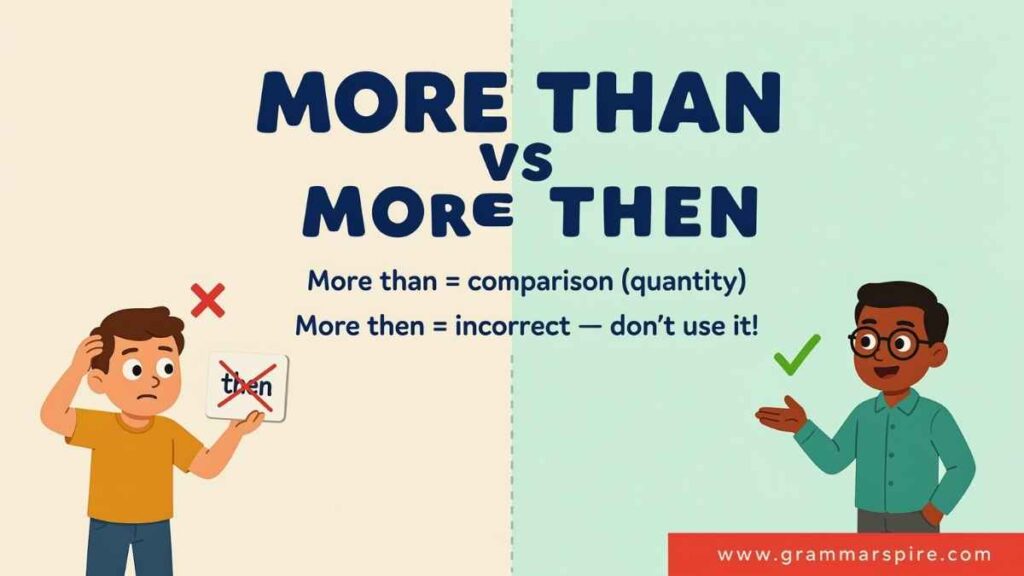
English grammar loves creating confusion with words that differ by just one letter. The mix up between more than or more then is a classic example. Although these two forms can sound remarkably similar in everyday speech, they have different meanings and grammatical roles. If you have ever hesitated before typing one, the good news is that the rule is surprisingly simple. More than expresses comparison, quantity, or degree, while then usually refers to time, sequence, or what happens next. Once you understand this distinction, choosing the correct form becomes much easier. So, let’s clear up this tiny spelling trap before it causes another grammatical headache.
More Than or More Then Quick Answer
If you are asking which is correct, more than or more then, use more than when the sentence expresses comparison, quantity, amount, or degree.
| Correct expression | Why it works |
|---|---|
| She has more than ten books. | It compares the number of books with ten. |
| The car costs more than $20,000. | It indicates an amount greater than $20,000. |
| He works more than I do. | It compares the amount of work. |
| We waited more than two hours. | It indicates a duration greater than two hours. |
By contrast, then generally deals with time, order, or what happens next.
| Use of then | Example |
|---|---|
| A particular time | I lived there then. |
| The next event | We ate dinner, then watched a movie. |
| A consequence | If you agree, then we can begin. |
The basic rule is simple: when you compare, use than. When you refer to time, sequence, or a result, use then.
Learn the difference between tricky English words with easy explanations
Steer or Stear Which Spelling Is Correct?
What Does “More Than” Mean?

The phrase more than expresses a greater number, amount, degree, or extent. In many sentences, it has a meaning similar to greater than.
For example, “The library has more than 5,000 books” means that the library has a number of books exceeding 5,000.
Likewise, “The journey takes more than three hours” means that the journey lasts longer than three hours.
However, more than does not only work with numbers. You can also use it to compare actions, qualities, experiences, preferences, and other ideas.
She studies more than her brother.
This route is more difficult than the other one.
I enjoy reading more than watching television.
The second option requires more time than the first.
Than commonly connects the two parts of a comparison. Therefore, when more introduces a comparison, than usually follows it.
More Than Definition
A simple more than definition is this:
More than is a comparative expression that shows that something exceeds another amount, number, degree, or comparison point.
The comparison may be obvious in a sentence such as “Eight is more than five.”
It may also appear inside a longer sentence, such as “The new model is more reliable than the older version.”
In the first example, the comparison involves numbers. In the second, it involves quality.
As a result, more than can appear in many different types of English sentences.
What Does “More Then” Mean?
The phrase more then causes confusion because then is a real English word. However, then does not normally perform the comparative job of than.
Then generally relates to time, sequence, or consequence.
Consider the sentence “I lived there then.” Here, then means at that time.
In “First, read the instructions, then begin the exercise,” then means next or afterward.
In “If you finish early, then you can leave,” then introduces a consequence.
Therefore, the more then meaning is not the same as the more than meaning.
When you intend to say that something is greater than another thing, amount, or degree, more than is the correct phrase.
Learn the difference between tricky English words with easy explanations
Eying or Eyeing Which Spelling Is Correct?
More Than vs More Then The Main Difference
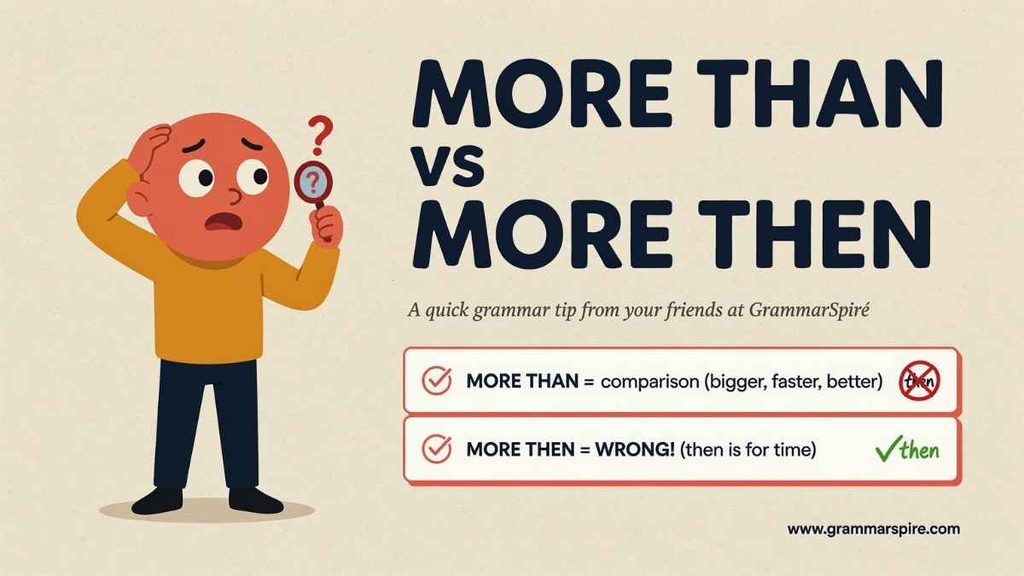
The easiest way to understand more than vs more then is to focus on the function of than and then rather than simply looking at their spelling.
Than is associated with comparison.
Then is associated with time, sequence, or consequence.
Compare these sentences:
This house costs more than that house.
Buy the house, then contact the bank.
The first sentence compares two prices. The second sentence places two actions in sequence.
The same distinction remains clear in more detailed sentences:
She knows more about science than I do.
She finished the science project, then submitted it.
The first sentence contains a comparison. The second describes what happened afterward.
More Than or More Then Grammar How Each Word Works
Understanding the grammar behind these words makes the correct choice much easier.
Than Introduces a Comparison
Than commonly introduces the second part of an unequal comparison.
“Sarah is taller than Maria.”
“This computer is faster than my old one.”
“The blue jacket is more expensive than the black jacket.”
In each example, than connects the thing being compared with the comparison point.
The same structure appears with more:
She has more experience than I do.
The company sold more products than expected.
We need more time than we originally planned.
The comparison does not always have to involve two people or objects. You can compare an amount with an expectation, a previous condition, or another standard.
Then Usually Relates to Time or Sequence
Then works differently.
We finished lunch, then went back to work.
The word tells the reader which action came next.
It can also refer to a particular time:
Things were different then.
Here, then means at that time.
It can also appear in conditional constructions:
If the weather improves, then we will go outside.
In this sentence, then helps introduce the result of the condition.
Learn the difference between tricky English words with easy explanations
Treck or Trek Which Spelling Is Correct?
More Than Correct Spelling How to Choose the Right Word
If your main concern is more than correct spelling, start by identifying the meaning of the sentence.
Ask yourself one simple question: Are you comparing something?
If the answer is yes, use than.
Are you talking about what happens next, what happened at a particular time, or what follows from a condition?
If the answer is yes, use then.
For example, “The restaurant has more than 100 seats” compares the number of seats with 100.
Now consider “We had dinner, then went home.”
You are describing the order of events.
The spelling changes because the grammatical job changes.
Learn the difference between tricky English words with easy explanations
Peices or Pieces Which Spelling Is Correct?
How to Use More Than

If you are learning how to use more than, begin with the idea of comparison.
More Than With Numbers
More than frequently appears before a number.
More than 100 people attended the meeting.
The company has more than 500 employees.
The book contains more than 300 pages.
The museum attracts more than 50,000 visitors each year.
In each example, more than tells you that the actual number exceeds the number mentioned.
Therefore, “more than 100” means a quantity greater than 100. It does not mean exactly 100.
More Than With Money
Money provides another common setting for the phrase.
The laptop costs more than $800.
The repairs cost more than $500.
She saved more than $1,000.
The meal cost more than I expected.
The phrase can refer to a precise threshold or a general expectation.
For example, in “The laptop costs more than $800,” the comparison point is clear. In “The repairs cost more than I expected,” the comparison is with an expectation rather than a specific number.
More Than With Time and Duration
You can also use more than to describe a period that exceeds a particular amount.
We waited more than two hours.
The project took more than six months.
He has worked there for more than ten years.
This explains why phrases such as more than ten dollars and more than two hours follow the same basic principle. In both cases, more than introduces a quantity that exceeds a stated amount.
More Than With Age
Age provides another straightforward use.
The building is more than 100 years old.
The child is more than five years old.
The company has existed for more than 50 years.
Again, the phrase establishes a comparison between the actual age and the stated number.
More Than With Degree
More than can also compare degrees or qualities.
This problem is more difficult than the previous one.
She is more patient than her brother.
The new system is more efficient than the old one.
Here, the comparison involves qualities rather than physical quantities.
This is an important part of more than usage because English comparisons are not limited to numbers.
Learn the difference between tricky English words with easy explanations
Sergeant or Sargeant Which Spelling Is Correct?
More Than Can Express Emphasis
Sometimes more than does not simply mean a greater quantity. Instead, it strengthens the meaning of an adjective or adverb.
For example, “I am more than happy to help.”
Here, more than happy means very happy or completely willing.
Similarly:
She is more than capable of handling the task.
We have more than enough food.
He was more than willing to explain the problem.
The result was more than satisfactory.
Therefore, more than can function as an intensifying expression as well as a comparison phrase.
More Than Happy Meaning
The more than happy meaning is usually very happy or entirely willing.
For example, “I am more than happy to help you.”
The speaker is not merely saying that helping is acceptable. The expression emphasizes a strong willingness to help.
Therefore, more than happy is correct.
More then happy is not the standard spelling.
More Than Enough Meaning
More than enough means that there is an amount beyond what is necessary.
We have more than enough food for everyone.
Ten minutes is more than enough time.
The team has more than enough experience to complete the project.
The phrase suggests a comfortable surplus rather than bare sufficiency.
More Than Ever Meaning
More than ever means to a greater degree than before.
People use online services more than ever.
She wants to improve her writing more than ever.
Good communication matters more than ever.
The phrase compares the present level with an earlier period.
More Than Likely Meaning
More than likely means very likely or highly probable in ordinary usage.
She will more than likely arrive early.
The store will more than likely be busy on Saturday.
This expression uses more than as an intensifier rather than as a straightforward numerical comparison.
More Than One Meaning An Important Grammar Detail
The phrase more than one creates an interesting grammatical pattern.
Consider the sentence More than one student was absent.
Although the sentence refers to multiple students, the noun after more than one is singular: student.
The verb is also singular: was.
Therefore, standard English uses “More than one student was absent” rather than “More than one student were absent.”
This construction is useful to remember because the meaning involves more than a single person, yet the grammatical structure treats the expression more than one as singular.
Learn the difference between tricky English words with easy explanations
Brasil or Brazil What Is the Difference?
More Than a Friend Meaning
The phrase more than a friend can carry a meaning beyond simple comparison.
For example, “He is more than a friend to me.”
Depending on context, the sentence may suggest a particularly close emotional relationship or a relationship that has developed beyond ordinary friendship.
Similarly, She became more than a colleague.
The exact meaning depends on the surrounding context.
Therefore, word choice alone does not always determine the complete meaning of an expression.
“I Love You More Than” or “I Love You More Then”?
The phrase I love you more than or more then is another common question.
When the sentence introduces a comparison, use than.
I love you more than you know.
I love you more than words can express.
I love you more than anything.
In each sentence, than introduces the comparison.
The comparison can also be subtle:
I love you more than yesterday.
This can mean that the speaker loves the person to a greater degree now than yesterday.
The important point is that than connects the comparison.
More Than Happy or More Then Happy?
The correct phrase is I am more than happy to help.
The phrase means very happy or extremely willing.
The incorrect form is I am more then happy to help.
That spelling changes the word from than, which marks comparison or intensification, to then, which deals with time or sequence.
Therefore, if you are wondering whether to write more than happy or more then happy, choose more than happy.
Learn the difference between tricky English words with easy explanations
Seel or Seal Which one is correct?
Can More and Then Be Used Together?
Yes. This is an important point because saying that more then is always impossible would be misleading.
The words more and then can appear together when they have separate grammatical functions.
Consider this sentence:
We need more supplies, then we can finish the project.
Here, more means an additional quantity. Then means afterward.
Another example is:
I need more time, and then I can complete the report.
Again, the two words perform different jobs.
Therefore, more and then can appear in the same sentence. However, that does not make more then an alternative spelling of more than.
The distinction depends on sentence structure and meaning.
When Can More and Then Appear Together?
The two words can appear together when more refers to quantity and then refers to the next event.
For example:
“We need more information, then we can make a decision.”
The word more modifies information. Then places the decision after obtaining the information.
By contrast:
We need more information than the report provides.
Here, than introduces a comparison.
The difference becomes obvious when you identify what follows each word.
More Than or More Then Spelling Difference
The more than or more then spelling difference involves just one letter, but that letter changes the grammatical role.
| Word | Main function | Typical meaning | Example |
|---|---|---|---|
| than | Comparison marker | Comparison with another thing | She is older than me. |
| then | Adverb | Time, sequence, or consequence | Eat first, then leave. |
The pronunciation can also contribute to the confusion. In natural speech, the two words may sound similar enough to cause uncertainty, especially when someone speaks quickly.
Because of that, spelling by sound alone can lead to mistakes.
Context provides a much better test.
Why Do People Confuse Than and Then?
The confusion is understandable.
First, the words look almost identical. They share the same first three letters, and only the final vowel changes.
Second, their pronunciation can sound similar in everyday speech.
Third, both words appear frequently in ordinary English.
Finally, people often write quickly. When that happens, the brain may select a familiar spelling before the writer consciously checks the meaning.
That is why learning the function of each word is more useful than simply memorizing their spellings.
Learn the difference between tricky English words with easy explanations
High School or Highschool What Is the Correct Spelling?
Common Mistakes
Using Then for Comparison
Incorrect: “This car is more expensive then that one.”
Correct: “This car is more expensive than that one.”
The sentence compares two cars, so than is required.
Using Than for Sequence
The opposite mistake can happen too.
Incorrect: “We ate dinner, than went home.”
Correct: “We ate dinner, then went home.”
The sentence describes two events in order, so then is correct.
Choosing the Word Based Only on Sound
Pronunciation can mislead you because the words can sound similar.
Instead, ask what the sentence means.
If the sentence compares two things, choose than.
If the sentence describes what happens next, choose then.
Assuming Every Sentence With More Needs Than
Not every use of more requires than.
I need more time.
This sentence is complete.
However:
I need more time than you gave me.
Now a comparison appears, so than follows more.
This distinction matters because more can function independently.
More Than or More Then Sentence Examples
The following examples cover common situations.
Comparison Examples
My new phone is more powerful than my old one.
Sarah is more experienced than Tom.
This road is more dangerous than the other route.
The second chapter is more interesting than the first.
Quantity Examples
More than 50 students attended the event.
The store sells more than 1,000 products.
We need more than five chairs.
Money Examples
The jacket costs more than $100.
The repairs cost more than expected.
The project requires more than $10,000.
Duration Examples
The journey took more than three hours.
She has lived there for more than five years.
Degree Examples
The situation is more complicated than it appears.
He was more nervous than expected.
Sequence Examples
First, read the instructions, then begin.
We had dinner, then watched a movie.
She called me, then sent a message.
These examples reinforce the central distinction than creates comparison, while then organizes time or events.
Learn the difference between tricky English words with easy explanations
Attornies or Attorneys Which Spelling Is Correct?
More Than or More Then Grammar Rule
A practical more than or more then grammar rule is simple:
Use more than when you mean a greater quantity, number, degree, or comparison.
Use then when you mean at that time, next, afterward, or as a consequence.
For example:
The company has more than 500 employees.
This expresses comparison.
Now consider:
The company expanded, then hired more employees.
This expresses sequence.
Interestingly, both words can appear in one sentence:
The company hired more employees than it did last year, then opened another office.
Here, than handles the comparison, while then handles the sequence.
More Than Comparison Examples
A mathematical comparison can make the idea especially clear.
When you see 8 > 5, you can say “Eight is greater than five.”
You can also express the relationship in ordinary language as “Eight is more than five.”
Similarly:
“20 is more than 15.”
“100 is more than 75.”
The important comparison phrase is than.
| Relationship | English expression |
|---|---|
| > | greater than / more than |
| < | less than |
| = | equal to |
This connection explains why more than works naturally with numbers and quantities.
Learn the difference between tricky English words with easy explanations
Seen or Saw What’s is the Difference?
A Simple Memory Trick

A reliable way to remember the difference is to associate than with comparison.
Think: Than = comparison.
For example:
She is taller than her sister.
Now associate then with time or sequence.
She finished her homework, then went outside.
There is also a simple memory aid that some learners find useful: than contains the letter a, so you can associate a with comparison. This is only a memory trick rather than a formal grammar rule, but it can help when you are writing quickly.
Here’s a trusted source for clear more words Comparison:
Grammar Update
Practice Session
Now it’s time to put your knowledge to work. Read each sentence carefully and decide whether the blank needs “than” or “then.” Pay attention to the meaning of the sentence. If you see a comparison, “than” is usually the answer. If the sentence shows time, order, or what happens next, “then” is generally the right choice.
Fill in the Blanks
- Sarah is taller _____ her younger sister.
- We finished dinner and _____ went for a walk.
- This laptop costs more _____ $800.
- I would rather stay home _____ go out tonight.
- The blue jacket is cheaper _____ the black one.
- Finish your assignment, and _____ you can relax.
- More _____ fifty students joined the competition.
- He arrived early and _____ waited outside.
- This road is safer _____ the old route.
- I’m more _____ happy to help you with the project.
- The movie was better _____ I expected.
- If you need anything, _____ give me a call.
- Emma has known him for more _____ ten years.
- We visited the museum and _____ had lunch nearby.
- The new phone is lighter _____ the previous model.
- She wanted more information, so she _____ asked another question.
- This box contains more _____ twenty books.
- My brother is older _____ me.
- First, check the address, and _____ send the package.
- The test was easier _____ the students expected.
- I have more _____ enough time to finish the work.
- He studied for an hour and _____ took a short break.
- This restaurant is more expensive _____ the one across the street.
- The temperature dropped lower _____ we expected.
- We can discuss the problem _____.
- She earns more money _____ her previous job paid.
- I’ll see you _____ after the meeting.
- The company has more _____ 500 employees.
- He is more experienced _____ his colleague.
- Read the instructions carefully, and _____ begin the exercise.
Answer Key
- than
- then
- than
- than
- than
- then
- than
- then
- than
- than
- than
- then
- than
- then
- than
- then
- than
- than
- then
- than
- than
- then
- than
- than
- then
- than
- then
- than
- than
- then
Quick Review
Use “than” for comparisons:
“She is faster than her brother.”
Use “then” for time, order, or the next action:
“Finish your work, then take a break.”
One small spelling choice can change the meaning of a sentence, so pause and check the context before you choose.
FAQs
When should I use “than” or “then”?
Use “than” when you compare two people, things, amounts, or degrees. Use “then” when you refer to time, order, or what happens next. For example, “Lena is older than Mark” makes a comparison, while “Finish your homework, then watch TV” shows sequence.
Is it “I love you more than” or “I love you more then”?
“I love you more than” is the correct form when the sentence expresses a comparison. “Than” connects the two parts being compared, while “then” relates to time or sequence. Therefore, “more then” would be incorrect in this expression.
How do you say “more than”?
“More than” is pronounced naturally as two connected words in everyday English. When spoken quickly, the words may flow together, which can make “than” and “then” sound similar. In writing, however, the distinction remains important.
What is the difference between “more than” and “over”?
Both expressions can indicate an amount greater than a particular number. For example, “more than 100 guests arrived” and “over 100 guests arrived” can communicate the same basic idea. “More than” makes the comparison especially explicit, while “over” can provide a shorter alternative in many contexts.
What is an easy trick to remember “then” vs. “than”?
Remember this simple rule: “than” compares, while “then” deals with time or sequence. If you can replace the idea with “compared with,” choose “than.” If you can replace it with “next” or “afterward,” choose “then.”
What is a better word than “then”?
There is no universal replacement because “then” can serve different purposes. Depending on the sentence, alternatives include “next,” “afterward,” “later,” or “at that time.” Choose the word that preserves the intended meaning.
Should I say “more than” or “more then”?
Use “more than” when you are making a comparison or showing that something exceeds a particular amount, number, or degree. “More then” is not the standard form for this purpose.
What is a better word for “more than”?
The appropriate alternative depends on the context. Words and phrases such as “over,” “above,” “greater than,” and “exceeding” may work in certain sentences. However, they should not be treated as interchangeable in every situation.
What is meant by “more than”?
“More than” indicates a greater amount, number, or degree. For example, “The bag costs more than $50” means the price exceeds $50. It can also add emphasis, as in “She is more than capable.”
Do you say “OK then” or “OK than”?
The correct expression is “OK then.” Here, “then” responds to what someone has said or signals acceptance of a situation. “Than” does not have this function.
Is it “I’ll see you then” or “I’ll see you than”?
“I’ll see you then” is correct. In this sentence, “then” refers to a particular time or occasion. “Than” would be inappropriate because no comparison is being made.
Why do people confuse “than” and “then”?
The two words are commonly confused because they look and sound quite similar. Only one letter separates their spellings, and their pronunciation may become even harder to distinguish in fast conversation. Their meanings, however, are different, so context provides an important clue.
What is the difference between “more than” and “more then”?
“More than” is a standard English phrase used for comparison and emphasis. “More then” does not have a fixed meaning as a phrase. The words “more” and “then” can appear next to each other when they perform separate grammatical roles, but that does not make “more then” a replacement for “more than.”
Is it “more than happy” or “more then happy”?
“More than happy” is correct. In this expression, “more than” strengthens the adjective and means very willing, pleased, or enthusiastic, depending on the context. For example, “I’m more than happy to help” means the speaker is very willing to help.
AEO Quick Answers
Which is correct: “more than” or “more then”?
“More than” is correct when you are making a comparison or expressing a greater amount, number, or degree. “More then” is not the standard spelling of this phrase.
Is “more than” grammatically correct?
Yes. “More than” is grammatically correct and widely used in standard English. It can compare quantities, numbers, degrees, prices, ages, and other characteristics.
Is “more then” grammatically correct?
“More then” is not grammatically correct when you intend to write the comparison phrase “more than.” The word “then” has different functions, mainly involving time, sequence, or result.
What does “than” mean?
“Than” is mainly used to introduce the second element in a comparison. For example, “This route is shorter than the other one” compares the length of two routes.
What does “then” mean?
“Then” commonly refers to a particular time, the next point in a sequence, or a consequence. For example, “We finished dinner, then went home” uses it to show what happened next.
How can I remember “than” vs “then”?
Keep one short rule in mind: “than” compares, while “then” shows time, sequence, or result. When you are comparing two things, “than” is usually the word you need.
Can “more” and “then” appear together?
Yes. They can appear together when each word has its own grammatical function. For example, “If you want more, then ask for another serving” uses “more” to refer to an additional quantity and “then” to introduce the resulting action.
Is “more than” used for comparison?
Yes. “More than” frequently expresses a comparison involving quantity, number, degree, price, age, time, or another measurable quality. For example, “The building is more than 100 years old” indicates an age exceeding 100 years.
Final Takeaway
The confusion between more than or more then may seem like a tiny spelling slip, yet that single letter can steer your sentence in the wrong direction. Fortunately, the solution is simple. Use than for comparisons involving people, things, numbers, amounts, or degrees. Use then for time, sequence, or the next action. Write “more than $50” when describing an amount, but choose “I’ll see you then” when referring to a future time. Once you understand the difference, these two look-alike words become much easier to handle. Give than and then their proper jobs, and your writing will remain clear, accurate, polished, and free from unnecessary grammatical confusion.

Ella AJS
Ella AJS is an experienced blogger and language enthusiast at Grammar Spire, dedicated to making English grammar simple, practical, and easy to understand. She specializes in word comparisons, meanings, usage, and common language confusions. Through clear explanations and engaging examples, Ella helps students, writers, and English learners improve their vocabulary and communicate with greater confidence and accuracy.




