
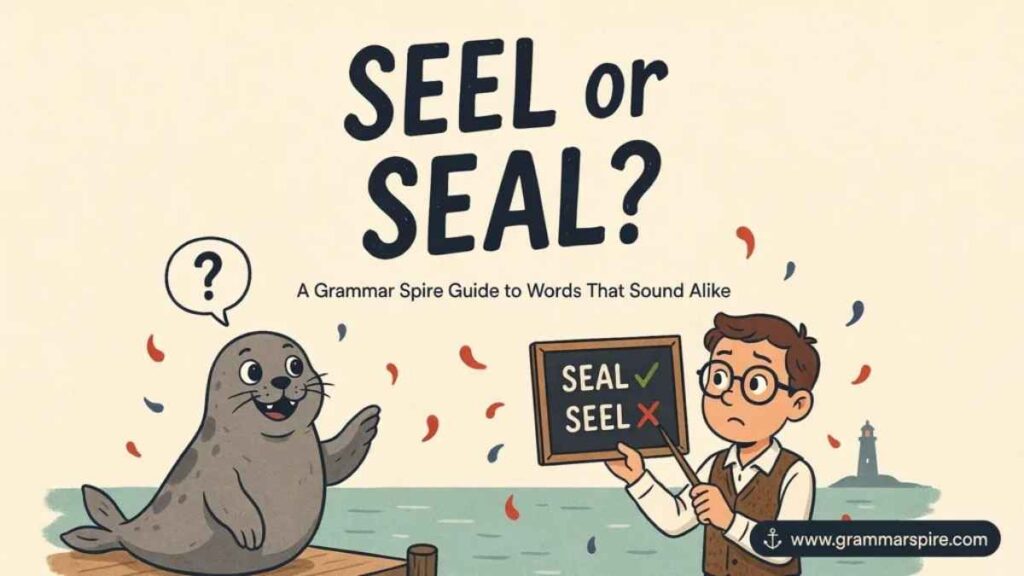
English spelling has a mischievous way of turning one tiny letter into a full blown vocabulary puzzle. That’s where “Seel or Seal” can leave even careful writers scratching their heads. These words look nearly identical, yet they serve very different purposes. “Seal” is the familiar choice when you mean to close an envelope, secure a package, finalize an agreement, or refer to the marine mammal. “Seel,” however, is a rare historical term associated with falconry. Knowing this distinction can save you from an embarrassing spelling slip and help you write with confidence. Once context enters the picture, choosing the right word becomes much easier.
Seel or Seal The Quick Answer
If you need to close an envelope, use seal.
You need to close a package, use seal.
If you need to secure a container, use seal.
When you are referring to the marine mammal, the word is seal.
You are discussing the historical falconry practice involving a bird’s eyelids, seel can be correct.
The easiest rule to remember is this: seal belongs to common modern English, while seel has a rare and specialized historical use.
| Word | Main Meaning | Modern Everyday Use |
|---|---|---|
| Seal | Close, secure, officially mark, finalize, or refer to a marine mammal | Very common |
| Seel | Historical falconry term involving a bird’s eyelids | Very rare |
Therefore, if you are asking which is correct in ordinary writing, seal is almost always the answer.
Learn the difference between tricky words and use them correctly
Fiend or Feen which spelling is correct?
Seel vs Seal What Is the Difference?

The spelling difference between seel and seal is only one letter, but their meanings are quite different.
Seal is a common English word that can function as both a noun and a verb. You can seal an envelope, seal a package, seal a container, seal an agreement, or examine an official seal. You can also use seal to describe an aquatic mammal.
Seel, on the other hand, has a much narrower meaning. It is mainly associated with historical falconry and refers to closing or sewing the eyelids of a hawk or falcon.
This distinction matters because calling seel simply “wrong” would not be accurate. Seel is a real word. The mistake occurs when someone uses it as though it were the ordinary spelling of seal.
For example, if you write “Please seel the envelope,” the spelling is incorrect because the intended meaning is to close the envelope.
The correct sentence is:
Please seal the envelope.
However, a historical sentence discussing falconry may correctly use seel.
That is the essential difference between seel and seal.
Learn the difference between tricky words and use them correctly
Salvadoran or Salvadorian Which Spelling Is Correct?
Seal Meaning in English

It has several meanings, so its definition depends on how it appears in a sentence.
It can function as a noun or a verb. As a noun, seal can refer to an official mark, a physical closure, or a marine mammal. As a verb, it can describe closing something securely, creating a protective barrier, or making an agreement final.
Seal as a Verb
As a verb, seal commonly means to close something securely.
For example:
Please seal the package before shipping it.
She sealed the envelope carefully.
The workers sealed the opening to prevent water from entering.
In each sentence, seal describes an action that creates a secure closure.
The closure can serve different purposes. A person might seal a box with tape, seal a container to protect its contents, or seal a crack to keep water from entering.
The word often suggests more than simply closing something. It usually implies creating a barrier that prevents something from passing through.
Seal as a Noun
Seal can also describe the object or material that creates a closure.
For example:
The bottle has a broken seal.
The rubber seal around the door needs replacing.
Check the seal before opening the container.
In these sentences, seal does not describe an action. Instead, it refers to the physical barrier or closure.
A rubber seal may prevent water from entering. A plastic seal may protect food. An airtight seal can prevent air from passing through.
Therefore, seal can describe both the action of closing something and the barrier created by that action.
Seal as an Official Mark
Seal can also refer to an official mark, emblem, or design used to indicate authority or authenticity.
For example:
The document bears the official seal.
The certificate includes the organization’s seal.
The invitation features a traditional wax seal.
Historically, seals were often created by pressing a design into soft wax. The resulting mark could identify a person, institution, or authority.
Today, an official seal may appear as a printed, embossed, stamped, or digitally reproduced emblem.
The basic idea remains the same: the seal can represent authority, authenticity, identification, or formal approval.
Seal as a Marine Mammal
Seal has another completely different meaning. It can refer to a marine mammal that lives in coastal and marine environments.
For example:
We saw a seal resting on the rocks.
The seal disappeared beneath the waves.
A harbor seal appeared near the shore.
In this context, seal has nothing to do with closing something. English simply uses the same spelling for different meanings.
Context tells you which meaning the writer intends.
Learn the difference between tricky words and use them correctly
Lilies or Lillies Which Spelling Is Correct?
Seel Meaning in English
The word seel has a much narrower meaning than seal.
Seel is a rare historical verb associated with falconry. Its best-known meaning refers to closing or sewing the eyelids of a hawk or falcon.
The word may appear in historical literature, old descriptions of falconry, or discussions of traditional bird-training practices.
Therefore, seel is a genuine word, but it is not part of most people’s everyday vocabulary.
Seel as a Falconry Term
Falconry developed a specialized vocabulary because people who worked with birds of prey needed precise terms for particular practices and equipment.
Seel belongs to that historical vocabulary.
In its falconry sense, seel referred to closing a bird’s eyelids. As a result, the word naturally appears in historical discussions involving hawks, falcons, and falconers.
This meaning is completely different from everyday uses of seal.
Seel as a Rare Historical Word
You may see seel described as archaic, obsolete, or historical depending on the dictionary or context in which it appears.
That does not mean the word is fake. It simply means that modern speakers rarely use it.
English contains many words that survive mainly in historical literature or specialized fields. Seel is one of them.
Therefore, the seel definition should not be treated as a spelling variation of the everyday word seal.
Learn the difference between tricky words and use them correctly
Skis or Skiis Which Spelling Is Correct?
Is Seel a Word?
Yes, seel is a real English word.
However, the context matters.
If someone writes:
Please seel the envelope.
they are almost certainly making a spelling mistake.
If a historical text uses seel while discussing falconry and the closing of a bird’s eyelids, the word can be correct.
Therefore, both of these statements can be true:
Seel is a real English word.
Seel is incorrect when used as the ordinary spelling of seal.
This distinction resolves much of the confusion surrounding the question, “Is seel a word?”
Is Seal a Word?
Yes. Seal is a common and well-established English word.
It can function as both a noun and a verb.
As a noun, it can refer to a marine mammal, an official mark, or a physical closure.
As a verb, it can mean to close something securely, create a barrier, protect a surface, or make an agreement final.
So, if someone asks whether seal is a word, the answer is straightforward: yes.
Seel or Seal an Envelope?
The correct phrase is seal an envelope.
You should not write seel an envelope when you mean to close it.
For example:
Please seal the envelope before mailing the letter.
She sealed the envelope after signing the card.
Make sure you seal the envelope properly.
The verb seal describes the act of closing the envelope securely.
The same rule applies to packages, bags, boxes, and containers.
You can seal a package.
You can seal a box.
Seal a bag.
Seal an opening.
In all of these ordinary situations, seal is the correct word.
Learn the difference between tricky words and use them correctly
Steer or Stear Which Spelling Is Correct?
Seel or Seal to Close Something?
When you mean “to close something securely,” use seal.
For example:
Seal the container tightly.
Seal the bag before placing it in the refrigerator.
The workers sealed the crack.
The manufacturer sealed the package to protect its contents.
The idea of creating a barrier is central to this meaning of seal.
The barrier may keep air, water, dust, heat, or another substance from passing through.
Therefore, when someone asks whether to use seel or seal to close something, the answer is seal.
Seel or Seal Stamp?
If you mean an official or decorative stamp, the correct word is seal.
A seal can refer to an official emblem or mark used to identify an organization, authority, or document.
For example:
The organization used its official seal on the document.
The invitation was decorated with a wax seal.
The seal stamp created a clear impression in the wax.
A seal stamp may be used to create a physical impression, especially in traditional or decorative settings.
The word seel does not belong in this context.
Seel or Seal of Approval?
The correct expression is seal of approval.
A seal of approval means a clear sign or indication that something has been accepted or approved.
For example:
The proposal received the director’s seal of approval.
The new design finally received the committee’s seal of approval.
Writing seel of approval is a spelling mistake when you mean this familiar expression.
Seel or Seal the Deal?
The correct expression is seal the deal.
For example:
The two companies signed the contract to seal the deal.
The final agreement helped seal the deal.
Here, seal has a figurative meaning. It suggests making an agreement definite or final.
The phrase seel the deal is incorrect in standard modern English.
Learn the difference between tricky words and use them correctly
Eying or Eyeing Which Spelling Is Correct?
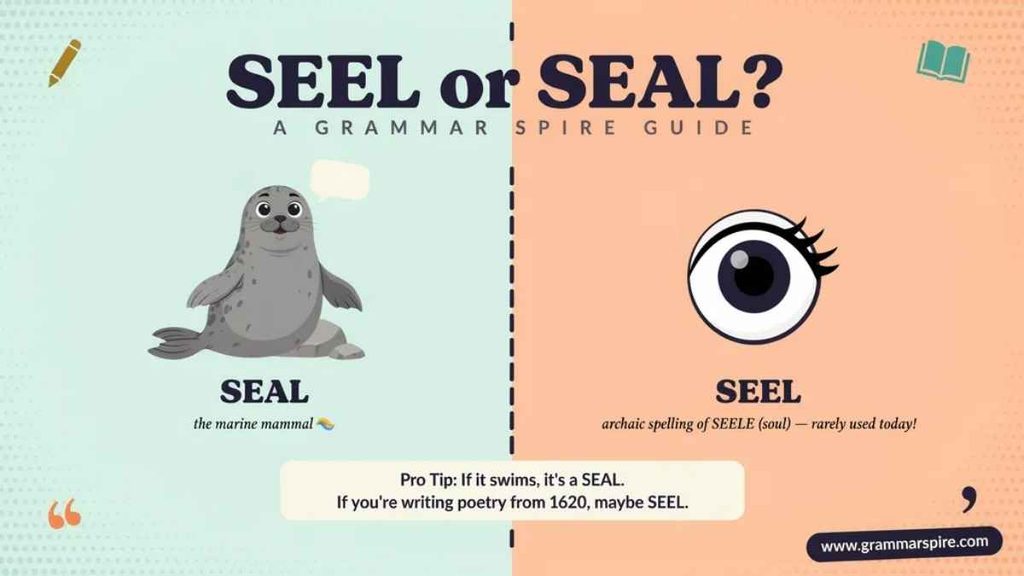
Comparison Table
| Feature | Seal | Seel |
|---|---|---|
| Standard modern English | Yes | Rare historical usage |
| Common vocabulary | Yes | No |
| Used as a verb | Yes | Yes, historically |
| Used as a noun | Yes | Rare |
| Means “close securely” | Yes | No |
| Used for envelopes | Yes | No |
| Used for packages | Yes | No |
| Used for containers | Yes | No |
| Refers to an official mark | Yes | No |
| Used in “seal of approval” | Yes | No |
| Used in “seal the deal” | Yes | No |
| Refers to a marine mammal | Yes | No |
| Associated with historical falconry | No | Yes |
| Common in modern writing | Yes | Very rare |
The comparison makes the main spelling difference clear. Seal belongs to ordinary modern English, while seel has a specialized historical role.
Seel or Seal Spelling Why the Confusion Happens
The confusion often comes from pronunciation.
Seal contains a vowel combination that produces a long “ee” sound. Because English spelling does not always match pronunciation perfectly, learners may wonder whether the word should contain “ea” or “ee.”
That uncertainty can lead to the spelling seel.
However, pronunciation alone is not a reliable way to determine English spelling.
When you learn a word, it helps to connect three things at once: its pronunciation, spelling, and meaning.
For seal, remember the complete spelling rather than trying to rebuild it from sound.
That small habit can prevent many spelling mistakes.
Learn the difference between tricky words and use them correctly
Treck or Trek Which Spelling Is Correct?
Seal Spelling and Its Word Forms
The standard spelling of seal remains consistent in its common verb forms.
| Form | Example |
|---|---|
| seal | Seal the package. |
| seals | She seals the package. |
| sealed | He sealed the envelope. |
| sealing | They are sealing the container. |
The past tense is sealed, not seeled.
The present participle is sealing, not seeling.
Learning these forms together makes the spelling easier to remember.
Common Spelling Mistakes
Writing Seel for Seal
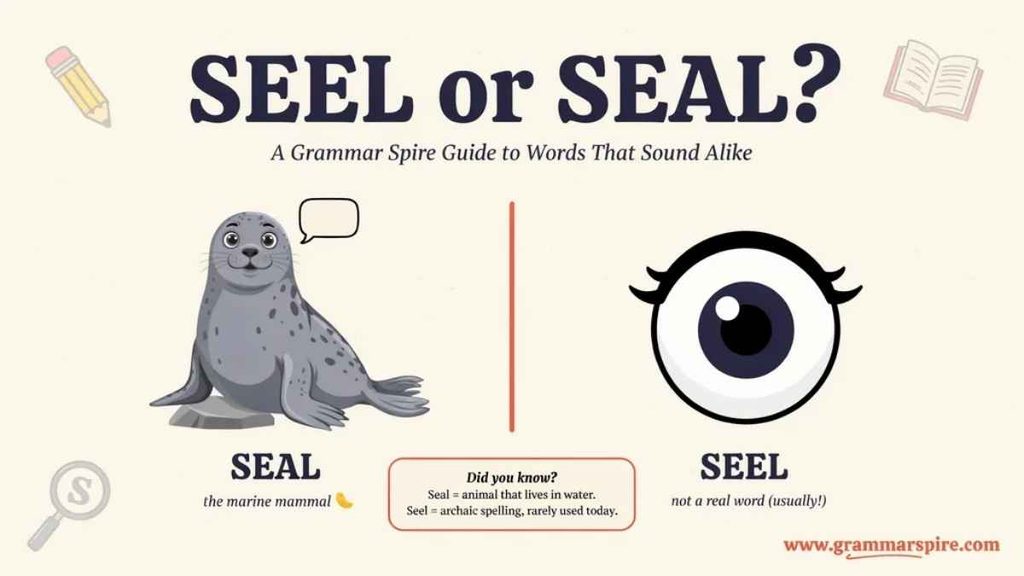
One of the most common mistakes is using seel when the sentence requires seal.
Incorrect:
Please seel the box.
Correct:
Please seal the box.
The intended meaning is to close the box securely, so seal is the appropriate word.
Writing Seel the Deal
The correct expression is seal the deal.
Incorrect:
They hope to seel the deal today.
Correct:
They hope to seal the deal today.
Writing Seel of Approval
The correct phrase is seal of approval.
Incorrect:
The project received a seel of approval.
Correct:
The project received a seal of approval.
Using Seel Because It Sounds Right
Sometimes spelling mistakes happen because a word sounds as though it could have more than one spelling.
That is particularly common with English words whose pronunciation does not clearly reveal their written form.
If you already know what seal means, focus on connecting the meaning with the correct spelling.
That is more reliable than trying to spell the word from sound alone.
Synonyms and Related Words
The best synonym for seal depends on the meaning you intend.
When seal means “close,” related words include close, shut, secure, fasten, block, and cover.
For example, “seal the container” can sometimes be replaced by “secure the container,” although the meanings are not always identical.
Seal often emphasizes creating a barrier that prevents something from passing through.
When seal means an official mark, related words include stamp, emblem, mark, and insignia.
When seal means making an agreement final, related words include finalize, confirm, conclude, and secure.
Because seal has several meanings, you should always choose a synonym according to context.
Learn the difference between tricky words and use them correctly
Peices or Pieces Which Spelling Is Correct?
Seal in Common Expressions
It appears in several familiar English expressions.
Seal the Deal
Seal the deal means to finalize an agreement or arrangement.
For example:
The signed contract helped seal the deal.
Seal of Approval
A seal of approval means a sign or indication of acceptance or approval.
For example:
The plan received the manager’s seal of approval.
Seal Something Off
To seal something off means to close an area so people cannot enter or pass through it.
For example:
The authorities sealed off the entrance.
Seal Something In
To seal something in means to prevent something from escaping.
For example:
The packaging helps seal in the product’s freshness.
My Lips Are Sealed
“My lips are sealed” is an idiom meaning that someone will keep a secret.
For example:
Don’t worry. My lips are sealed.
Here, the physical idea of closing something has developed into a figurative expression.
Learn the difference between tricky words and use them correctly
Sergeant or Sargeant Which Spelling Is Correct?
Examples of Seal in a Sentence

Seal appears naturally in many types of writing.
Please seal the envelope before sending it.
The bottle has a protective seal.
The workers sealed the window against the rain.
The company sealed the agreement yesterday.
The certificate carries the official seal.
The proposal received the board’s seal of approval.
Both sides signed the contract to seal the deal.
A harbor seal rested near the shore.
The airtight seal keeps the food fresh.
The authorities sealed off the entrance.
These examples show why seal is far more useful in everyday English than seel.
Learn the difference between tricky words and use them correctly
Brasil or Brazil What Is the Difference?
Examples of Seel in a Sentence
Because seel has a specialized historical meaning, examples naturally appear in historical or falconry contexts.
The historical account describes how a falconer would seel a hawk’s eyelids.
The old text uses seel as a specialized falconry term.
These sentences work because the context supports the historical meaning.
However, a sentence such as “Please seel the envelope” is incorrect because the intended word is seal.
A Closer Look at the Difference
The history of these words makes their difference more interesting.
Seal has developed several meanings over time. Its modern uses include physical closure, official marks, agreements, and the marine mammal.
Seel developed separately and became associated with falconry.
Therefore, the similarity in spelling should not lead you to treat the two words as interchangeable.
They are separate words with different meanings and different areas of use.
Here’s a trusted source for clear more words Comparison:
Grammar Update
Practice Session
Now it’s time to put your understanding to the test. Choose the word that correctly completes each sentence. Pay close attention to the context because “seal” has several everyday meanings, while “seel” has a much more specialized historical use.
Fill in the Blanks
- Please ______ the envelope before placing it in the mailbox.
- The workers used a waterproof material to ______ the cracks in the roof.
- After weeks of discussion, both companies finally managed to ______ the deal.
- The document carried the organization’s official ______.
- Make sure you ______ the container tightly to prevent the liquid from leaking.
- A harbor ______ rested quietly on the rocks near the shore.
- The agreement helped ______ the partnership between the two companies.
- She placed the letter inside a ______ envelope.
- The manager gave the proposal his ______ of approval.
- Before shipping the package, ______ it securely with strong tape.
- In historical falconry, the word “______” referred to closing or sewing a bird’s eyelids.
- The old document displayed the royal ______ of the kingdom.
- The technician replaced the worn door ______ to prevent drafts.
- Both parties hoped to ______ the agreement before the meeting ended.
- A young ______ swam alongside its mother.
- The historical account explained how a falconer might ______ a bird’s eyelids.
- After filling the jar, ______ it tightly with its lid.
- The certificate contained an official ______ at the bottom.
- The negotiators worked late to ______ the deal.
- The window needs a new ______ to keep rainwater from entering.
- “______” is a rare historical term associated with falconry.
- The package had a tamper-evident ______ across its opening.
- The official document bore the president’s ______.
- The technician used adhesive to ______ the opening.
- The expression “______ the deal” means to finalize an agreement.
- A gray ______ appeared in the distance as the boat approached the coast.
- When you mean “close or secure,” the standard modern spelling is “______.”
- “______” should not be used as an alternative spelling of “seal” in ordinary expressions.
- Before mailing the parcel, ______ it carefully to protect the contents.
- The final signature helped ______ the agreement between the two parties.
Answer Key
- seal
- seal
- seal
- seal
- seal
- seal
- seal
- sealed
- seal
- seal
- seel
- seal
- seal
- seal
- seal
- seel
- seal
- seal
- seal
- seal
- seel
- seal
- seal
- seal
- seal
- seal
- seal
- seel
- seal
- seal
A Simple Way to Remember
Use “seal” in ordinary modern English when you mean to close, secure, protect, mark officially, or finalize something. It can also refer to the marine mammal.
Use “seel” only when you encounter its rare historical falconry meaning, which refers to closing or sewing the eyelids of a hawk or falcon.
Here’s the easiest memory clue: if something is being closed, secured, or finalized, think “seal.” If the context involves historical falconry and a bird’s eyelids, “seel” is the specialized word.
FAQs About Seel and Seal
How Do You Spell Seal as in Close?
The correct spelling is “seal.” As a verb, it means to close or secure something so that it remains shut or protected. For example, you can seal an envelope, package, container, or opening.
What Is the Difference Between a Seel and a Seal?
“Seal” is a common modern English word used for closing something, applying an official mark, finalizing an agreement, or referring to a marine mammal. “Seel” is a rare historical term associated with falconry and refers to closing or sewing the eyelids of a hawk or falcon.
Is It Seel or Seal the Deal?
The correct expression is “seal the deal.” It means to finalize an agreement or make an arrangement definite. “Seel the deal” is not correct in standard modern English.
What Are the Two Meanings of Seal?
“Seal” has several meanings rather than only two. As a verb, it can mean to close or secure something. As a noun, it can refer to a physical closure, an official mark, or a marine mammal. The intended meaning depends on context.
Is “Seal” or “Seel” the Correct Spelling?
“Seal” is the standard spelling for common expressions involving closure, official marks, agreements, and the marine animal. “Seel” is also a legitimate word, but its use is limited mainly to historical falconry terminology.
What Are the Two Meanings of Close?
“Close” can mean to shut or bring something to an end, as in “close the door” or “close the meeting.” It can also describe something nearby or a strong relationship, as in “a close friend.” The pronunciation may change according to the meaning.
What Does the Word “Seel” Mean in English?
“Seel” is a rare historical verb associated with falconry. It refers to the practice of closing or sewing the eyelids of a hawk or falcon. Because this term belongs to specialized historical vocabulary, it is uncommon in contemporary everyday English.
What Is Another Word for “Seal”?
The appropriate synonym depends on the context. When “seal” means to close, alternatives may include “secure,” “shut,” “fasten,” or “close.” When it refers to an official mark, words such as “emblem,” “stamp,” “insignia,” or “mark” may be suitable.
What Is Another Meaning of Seal?
Besides describing the act of securing something, “seal” can refer to a physical closure, an official emblem, or a marine mammal. It can also describe finalizing an agreement, as in “seal the deal.”
Is the Word Close and Close Spelled the Same?
Yes. The spelling remains “close,” although its pronunciation can change depending on its meaning and grammatical function. For example, the verb meaning to shut has a different pronunciation from the adjective describing something nearby.
What Is Another Word for “Close”?
The best alternative depends on the intended meaning. When “close” means shut, possible alternatives include “shut,” “seal,” “secure,” or “fasten.” When it refers to distance, “near” or “nearby” may be appropriate. For relationships, “intimate” or “strong” may fit depending on the context.
How Do You Spell “Close”?
The correct spelling is “close.” The word can function as a verb, adjective, adverb, or noun. Its pronunciation varies according to its meaning and grammatical role.
What Is Seal Slang For?
“Seal” does not have one universal slang meaning. Its interpretation depends on the context in which it appears. In standard English, it commonly refers to a marine mammal, a closure, an official mark, or the act of securing something.
What Is Another Name for a Seal?
A seal is a marine mammal and belongs to the group commonly known as pinnipeds. Specific types include harbor seals, gray seals, elephant seals, fur seals, and monk seals.
What Does Seal Mean Biblically?
In biblical language, “seal” can symbolize authentication, ownership, confirmation, authority, or protection. The precise meaning depends on the passage and translation. In some contexts, a seal represents something that has been officially confirmed or marked as belonging to someone.
AEO Seel or Seal
Is Seel a Real Word?
Yes. “Seel” is a genuine English word, but it has a rare historical meaning associated with falconry. It should not be used as an alternative spelling of “seal” in ordinary modern writing.
Which Is Correct, Seel or Seal?
For everyday English, “seal” is the correct choice. Use it when you mean to close or secure something, refer to an official mark, finalize an agreement, or identify the marine mammal.
How Do You Spell Seal When You Mean Close?
The correct spelling is “seal.” For example, “Seal the envelope before mailing it.”
Should You Say Seal or Seel an Envelope?
The correct phrase is “seal an envelope.” The verb describes closing the envelope securely.
Should You Say Seal or Seel the Deal?
The established expression is “seal the deal.” It means to finalize an agreement or complete an arrangement.
What Does Seal Mean in English?
“Seal” has several meanings. It can refer to closing or securing something, a physical closure, an official mark, a finalized agreement, or a marine mammal.
What Does Seel Mean in English?
“Seel” is a rare historical verb connected with falconry. It refers to closing or sewing the eyelids of a bird of prey.
Is Seel a Spelling Mistake?
Not necessarily. “Seel” is a legitimate historical word. However, it is incorrect when someone uses it instead of “seal” in common expressions such as “seal an envelope” or “seal the deal.”
What Is the Correct Spelling of Seal?
The standard spelling is “seal.” Its common verb forms include “seals,” “sealed,” and “sealing.”
What Is the Correct Spelling of Seel?
“Seel” is the correct spelling when referring to the historical falconry term. It should not replace “seal” when you mean to close, secure, or finalize something.
What Does Seal of Approval Mean?
“Seal of approval” means an indication that something has received acceptance, endorsement, or approval from a person or organization.
What Does Seal the Deal Mean?
“Seal the deal” means to finalize an agreement or complete an arrangement. The expression uses “seal” figuratively to suggest that the matter has been settled.
Can Seal Be a Noun and a Verb?
Yes. As a verb, “seal” can describe the act of closing or securing something. As a noun, it can refer to a physical closure, official mark, or marine mammal.
Why Do People Confuse Seel and Seal?
The words have similar sounds and differ by only one letter in spelling. Their meanings, however, are distinct. “Seal” is common in contemporary English, whereas “seel” has a specialized historical use.
What Is the Easiest Way to Remember the Difference?
Connect “seal” with familiar actions such as closing an envelope, securing a package, or finalizing an agreement. Reserve “seel” for its rare historical falconry meaning. This simple distinction makes the correct choice much easier.
Final Takeaway
English spelling loves to turn one little letter into a surprisingly tricky puzzle, but “seel” and “seal” become much easier once you know their roles. In everyday English, “seal” is the word to choose when you mean to close, secure, finalize, mark officially, or name the familiar marine mammal. “Seel,” by contrast, is a rare historical falconry term with a specialized meaning involving a bird’s eyelids. So, when you’re ready to seal an envelope, secure a package, or seal the deal, don’t let that extra “e” cause trouble. Keep the context in mind, choose “seal” for modern usage, and leave “seel” to its historical perch.

Ella AJS
Ella AJS is an experienced blogger and language enthusiast at Grammar Spire, dedicated to making English grammar simple, practical, and easy to understand. She specializes in word comparisons, meanings, usage, and common language confusions. Through clear explanations and engaging examples, Ella helps students, writers, and English learners improve their vocabulary and communicate with greater confidence and accuracy.




