
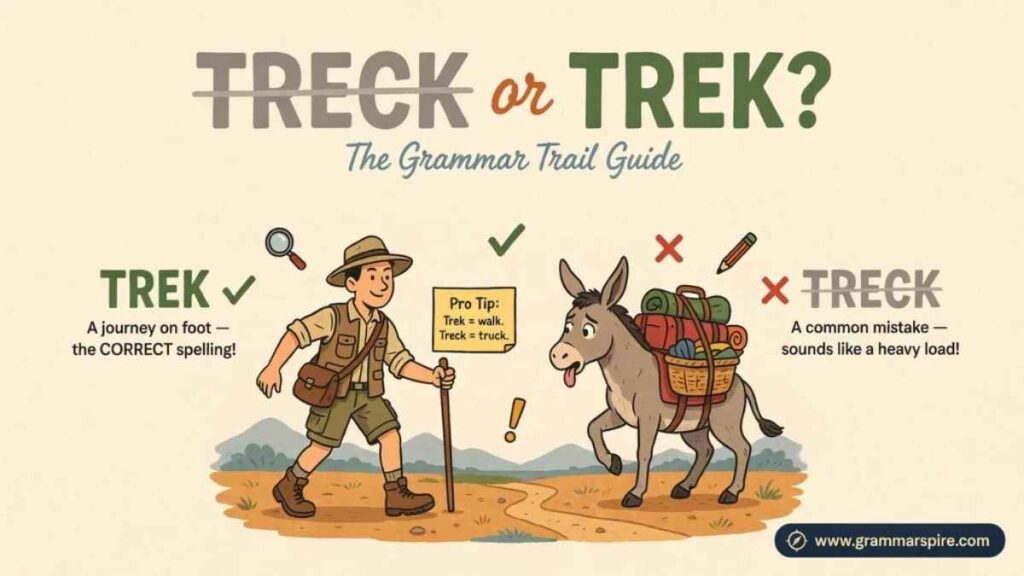
“Treck or Trek” may look like a small spelling question, but that extra “c” can quickly lead your sentence off the trail. English loves to scatter little spelling traps where you least expect them, and this one is no exception. If you’ve ever paused over this pair, you’re certainly not alone. However, the answer becomes simple once you understand the correct spelling and its related forms. In this guide, you’ll learn what “trek” means, whether “treck” is an English word, and how “trek” differs from “track” and “hike.” You’ll also discover why “trekked” and “trekking” use a double “k” in their spelling.
Quick Answer Treck or Trek?
The correct standard English spelling is trek.
Trek is a recognized English noun and verb. Treck is not the standard spelling when you mean a long or difficult journey or walk.
For example:
We went on a long trek through the mountains.
They trekked through the forest before sunset.
The first sentence uses trek as a noun. The second uses trekked as the past tense of the verb.
Cambridge defines trek as walking a long distance, usually over land such as hills, mountains, or forests. It also records the noun as a long walk over such terrain or, informally, a walk that is long and difficult or tiring. Oxford gives similar meanings and also records the word as a noun and verb.
Therefore, the answer to the trek or treck spelling question is clear:
Trek is the standard spelling.
Treck is generally a spelling mistake when the intended word is trek.
Learn the difference between more words people mix up
Skied or Skiied Which Spelling Is Correct?
Treck or Trek What Is the Difference?

The difference between trek and treck is mainly a matter of spelling because they are not normally two standard English words with different meanings.
Trek is the established English word.
Treck is generally what happens when a writer adds an unnecessary c to the spelling.
This mistake is understandable. English contains many familiar words ending in ck, including check, deck, neck, and wreck. Because trek has a similar short vowel and final k sound, treck can look perfectly believable at first glance.
However, spelling does not always follow pronunciation in English. A word can sound similar to several other words while following a completely different spelling pattern.
That is exactly what happens here.
What Does Trek Mean?
The trek meaning centers on a long, difficult, or demanding journey.
The word often describes travel on foot. A trek can take place through mountains, forests, valleys, deserts, or other challenging areas. However, the word does not require an extreme expedition.
For example:
The hikers began their trek before sunrise.
Here, trek refers to the journey itself.
You can also use the word in an everyday situation:
It is a long trek from the station to my house.
In that sentence, the speaker does not necessarily mean an adventure through the wilderness. Instead, trek emphasizes that the walk is long or tiring.
Oxford records both meanings. Its noun entry describes a long, hard walk lasting several days or weeks, especially in the mountains. It also gives the informal meaning of a long walk.
Therefore, the trek definition can change slightly with context, but the central idea remains a journey that involves distance, effort, or difficulty.
What Does Treck Mean?
When someone asks what does treck mean, the practical answer is that treck is generally a misspelling of trek when the intended meaning is a long or difficult journey.
For example:
Incorrect: We planned a treck through the mountains.
Correct: We planned a trek through the mountains.
The extra c does not create a different standard English meaning.
Consequently, if you are writing an article, email, school assignment, travel description, or professional document, use trek for this meaning.
Learn the difference between more words people mix up
Curtsy or Curtsey Which Spelling is Correct?
Is Trek a Word?
Yes, trek is a well established English word.
If you are asking is trek a word, is trek a real word, or is trek an English word, the answer is yes.
Both Oxford and Cambridge list trek as a noun and a verb. Cambridge gives the noun meaning of a long walk over land such as hills, mountains, or forests. It also gives the informal meaning of a long or difficult walk. As a verb, Cambridge defines it as walking a long distance, usually over land such as hills, mountains, or forests.
Oxford also records trek as a noun and verb and gives related forms such as trekked and trekking.
So, if you ever wonder is trek the correct spelling, you can confidently choose trek.
Is Treck a Word?
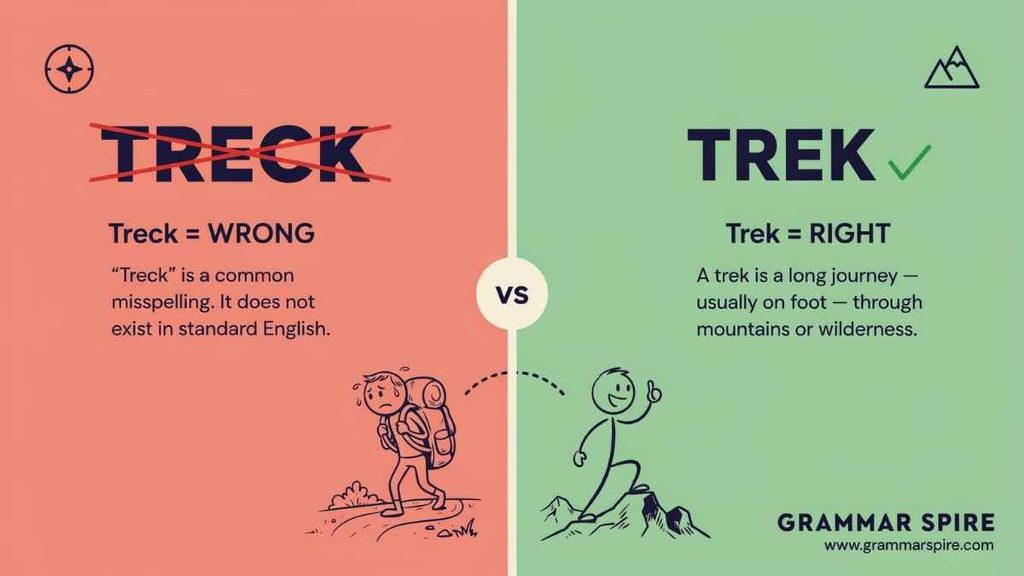
The question is slightly more complicated when phrased as is treck a word because words can appear in different languages, names, historical sources, or specialized contexts.
However, if you mean the English word for a long or difficult journey, treck is not the standard spelling.
In ordinary modern English, use trek.
This also means that the question is treck a real word should not lead you to use treck in place of trek. A spelling may appear somewhere without being the appropriate standard English form for the meaning you intend.
Similarly, if you search for is treck an English word, the useful distinction is between a form that appears in some context and the standard English spelling of the journey-related word. For normal English writing, trek is the form to choose.
Is Treck an Archaic Word?
There is no need to treat treck as an archaic spelling of modern English trek.
An archaic form is an older word or spelling that genuinely belonged to an earlier stage of the language and has largely disappeared from ordinary modern use. Treck should not simply be labeled an archaic form of trek because it looks like an older version.
Therefore, if someone asks is treck an archaic word or is treck an old spelling of trek, the safest practical answer is no. For modern standard English, use trek.
That distinction matters because calling a common spelling mistake an archaic spelling can make the confusion worse rather than better.
Trek as a Noun
Trek is commonly used as a noun when you are talking about a long or difficult walk or journey.
For example:
The trek through the mountains lasted three days.
The word can describe a serious outdoor journey, but it can also describe an ordinary walk that feels long.
Consider this sentence:
It is quite a trek to the nearest grocery store.
Here, trek simply emphasizes the distance or inconvenience.
Oxford specifically includes this informal use for a long walk.
The noun often appears with words such as long, difficult, hard, arduous, mountain, wilderness, and cross-country.
For example:
The group prepared for a difficult trek.
They completed a long mountain trek.
The final part of the trek was exhausting.
The team began its wilderness trek early in the morning.
These examples show how the noun focuses attention on the journey rather than simply the act of walking.
Trek as a Verb
Trek also works as a verb.
As a verb, it means to make a long or difficult journey, especially on foot. Oxford also records the verb for spending time walking, especially in mountains for pleasure or interest.
For example:
We trekked through the forest all afternoon.
They trekked across the valley before nightfall.
She trekked up the hill carrying a heavy backpack.
The travelers trekked toward the village.
The verb often appears with a preposition or adverb that explains the direction or location of the journey.
Common combinations include trek through, trek across, trek up, trek down, and trek toward.
This makes the word flexible enough for both formal descriptions of journeys and everyday conversation.
For example:
I had to trek across town to find the right store.
Here, trek adds a sense of effort or inconvenience to an otherwise ordinary trip.
Trek Verb Forms
Understanding the verb forms helps prevent a second set of spelling mistakes.
The main forms are trek, treks, trekked, and trekking. Oxford lists the past form as trekked and the -ing form as trekking.
| Verb form | Correct spelling | Example |
|---|---|---|
| Base form | trek | We trek through the hills. |
| Third-person singular | treks | She treks through the mountains. |
| Past tense | trekked | They trekked across the valley. |
| Past participle | trekked | We have trekked through the forest. |
| Present participle | trekking | They are trekking in the mountains. |
The most important thing to notice is what happens when an ending is added.
The base word is trek.
The past form becomes trekked.
The -ing form becomes trekking.
Therefore, the correct spelling family is:
trek → treks → trekked → trekking
Not treck, trecked, or trecking.
Trekked
The past tense of trek is trekked.
For example:
We trekked through the valley yesterday.
The travelers trekked for several hours before reaching the camp.
The double k can confuse learners because the base word has only one k. However, the doubled consonant belongs to the inflected forms.
Trekking
The present participle and gerund form is trekking.
For example:
They are trekking through the mountains.
Trekking can be physically demanding.
Cambridge defines trekking as the activity of walking long distances on foot for pleasure.
So, when you write about the activity, trekking is the standard form.
Learn the difference between more words people mix up
Lovable or Loveable Which Spelling Is Correct?
Trek Meaning in Different Contexts

The meaning of trek becomes clearer when you see it in several situations.
Mountain Trek
A mountain trek usually involves a long walk through mountainous terrain.
For example:
The group prepared for a week-long mountain trek.
The phrase immediately suggests a challenging outdoor journey.
It may involve steep paths, changing weather, uneven ground, and considerable physical effort. However, the word itself does not specify exactly how difficult the journey must be.
Wilderness Trek
A wilderness trek takes place in a natural environment, often away from cities and developed areas.
For example:
They planned a wilderness trek through the remote forest.
Here, trek highlights the journey through challenging surroundings.
Everyday Trek
Trek can also describe an ordinary journey.
For example:
It is quite a trek from my office to the parking lot.
This use is informal. The speaker may simply want to emphasize that the distance feels inconvenient or tiring.
Cambridge and Oxford both recognize this broader use of trek for a long or difficult walk.
Difficult Journey
Trek can emphasize the effort involved in reaching a destination.
For example:
The final trek to the village took several hours.
The sentence focuses on the journey as a demanding experience.
That is why trek often sounds stronger than the neutral word walk.
Learn the difference between more words people mix up
Outting or Outing Which Spelling Is Correct?
Trek vs Walk Are They the Same?
Trek and walk are related, but they do not always communicate the same idea.
Walk is a broad and neutral word. It can describe almost any movement on foot.
Trek usually adds a sense of distance, difficulty, effort, or adventure.
Compare these sentences:
I walked to the store.
I trekked to the store.
The first sentence sounds completely ordinary. The second suggests that the journey was long, tiring, or inconvenient.
This does not mean that every trek must be difficult. Instead, trek gives the journey more weight.
You can think of the difference this way:
Walk focuses on the action.
Trek focuses more strongly on the journey and the effort involved.
Therefore, trek is not simply a fancy replacement for walk. Context determines whether it sounds natural.
Learn the difference between more words people mix up
Fiend or Feen which spelling is correct?
Trek vs Hike What Is the Difference?
The trek vs hike distinction is more subtle because the meanings overlap.
A hike usually refers to walking outdoors, especially for recreation. A trek can also involve recreational walking, particularly in mountains, but the word often emphasizes the length or difficulty of the journey.
For example:
We went on a short hike through the park.
The sentence sounds like a recreational outdoor activity.
Now consider:
We went on a five-day trek through the mountains.
Here, the length and demanding nature of the journey are more important.
Therefore, the trek vs hike meaning depends on context.
A mountain trek may involve hiking. However, not every hike needs to be described as a trek.
Trek vs Track Do Not Confuse Them
Trek and track have completely different primary meanings.
Trek refers to a long or difficult journey or walk.
Track can refer to a path, route, trail, mark, course, or the act of following something.
For example:
We trekked through the mountains.
We followed a narrow track through the mountains.
The first sentence describes the journey. The second describes the route.
You can even use both words together:
The trekkers followed the mountain track during their trek.
Here, each word has a different function.
Therefore, if you are comparing trek vs track, remember that trek describes the journey while track can describe the path or route.
Learn the difference between more words people mix up
Salvadoran or Salvadorian Which Spelling Is Correct?
Trek vs Trekking What Is the Difference?
The trek vs trekking question is mainly a grammar question.
Trek is the base form of the verb and also a noun.
Trekking is the -ing form of the verb and can also function as a noun when referring to the activity.
For example:
We plan to trek through the valley.
We enjoy trekking through the valley.
The first sentence uses trek after “plan to.” The second uses trekking after “enjoy.”
Cambridge defines trekking as the activity of walking long distances on foot for pleasure.
Therefore, when someone asks about the trek or trekking difference, remember that these forms are related but serve different grammatical purposes.
Learn the difference between more words people mix up
Lilies or Lillies Which Spelling Is Correct?
Common Spelling Mistakes
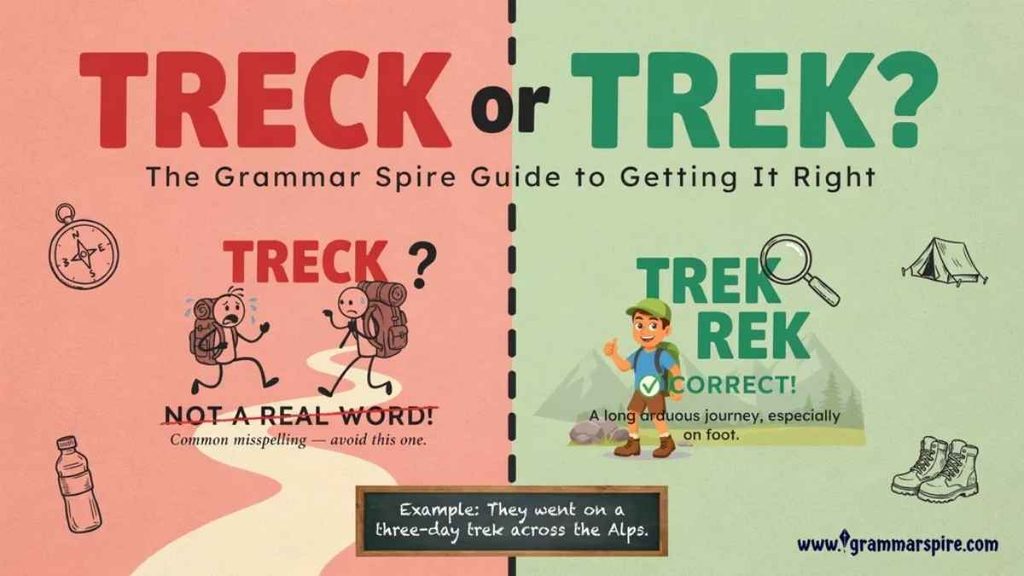
Treck Instead of Trek
The most common mistake is adding c after the e.
Incorrect:
We went on a treck through the mountains.
Correct:
We went on a trek through the mountains.
The extra c is unnecessary.
Treking Instead of Trekking
Another frequent spelling mistake occurs when adding -ing.
Incorrect:
They are treking through the forest.
Correct:
They are trekking through the forest.
The final k doubles before the -ing ending.
Treked Instead of Trekked
The past tense also contains double k.
Incorrect:
We treked across the valley.
Correct:
We trekked across the valley.
The correct pattern is easy to remember once you learn the word family.
Trek becomes trekked and trekking.
Trecking Instead of Trekking
This combines the unnecessary c with the incorrect -ing form.
Incorrect:
They went trecking in the mountains.
Correct:
They went trekking in the mountains.
When in doubt, return to the base word:
trek.
From there, the correct forms become much easier to recognize.
Learn the difference between more words people mix up
Skis or Skiis Which Spelling Is Correct?
How to Spell Trek
If you want to know how to spell trek, the answer is:
T-R-E-K
The standard trek spelling does not contain c.
A useful way to remember the spelling is to learn the complete word family:
trek
treks
trekked
trekking
trekker
Once you recognize this pattern, the common spelling mistakes become much easier to avoid.
How to Spell Treck
If you are searching for how to spell treck because you are unsure whether the word needs a c, stop and check the intended meaning.
If you mean a long or difficult journey, the correct spelling is trek.
For example:
Correct: We planned a trek through the hills.
Incorrect: We planned a treck through the hills.
Therefore, the treck spelling should not be used as an alternative to trek in standard English.
Trek in a Sentence
Seeing the word in context can make its meaning much easier to understand.
As a noun:
The trek through the mountains lasted four days.
We began our trek before sunrise.
The final part of the trek was especially difficult.
They completed a long-distance trek across the region.
As a verb:
We trekked through the forest for six hours.
They trekked across the valley before sunset.
She trekked up the steep trail.
The travelers trekked toward the village.
In everyday conversation:
It is quite a trek from here to the station.
Getting there was a bit of a trek.
We had a long trek back to the car.
These examples show that trek is not limited to professional hikers or major expeditions.
Common Expressions With Trek
The phrase go on a trek is commonly used when someone takes part in a long or demanding journey.
For example:
They went on a trek through the mountains.
A long trek emphasizes distance or duration.
For example:
The long trek left everyone exhausted.
A difficult trek emphasizes the challenging nature of the journey.
For example:
The difficult trek required careful preparation.
You can also say trek through the mountains when describing movement through mountainous terrain.
For example:
The group trekked through the mountains for several days.
Similarly, trek across the country can describe an extended journey across a large region.
For example:
They trekked across the country during their long journey.
Trekking and Its Meaning
Trekking is closely connected to trek.
It describes the activity of walking long distances, particularly for pleasure or outdoor recreation.
For example:
We spent two weeks trekking in the Himalayas.
The word is especially common when people discuss mountain travel, outdoor adventures, long hiking routes, and extended walking journeys.
Cambridge defines trekking as the activity of walking long distances on foot for pleasure. Oxford also connects trekking with walking, especially in mountains and for enjoyment or interest.
That gives you a useful distinction between the forms.
Trek can describe one journey or the act of making a journey.
Trekking can describe the activity itself.
Trekker refers to a person who takes part in trekking.
Trek Pronunciation
Trek is pronounced /trek/.
The pronunciation has a short e sound, similar to the vowel sound in words such as deck and neck.
Interestingly, that similarity may help explain why some people write treck. English has many words with similar sounds and different spellings.
However, pronunciation does not determine spelling by itself.
The fact that words sound alike or nearly alike does not mean they follow identical spelling patterns.
Therefore, the pronunciation can help you remember the word, but the dictionary spelling remains trek.
The Origin of Trek
The history of trek adds an interesting layer to the word.
Oxford traces trek to the mid-19th century and identifies its origin in South African Dutch trek, with the related verb trekken meaning “pull” or “travel.”
The word therefore entered English with a strong connection to travel and movement.
Over time, English developed the modern meanings associated with long journeys, difficult travel, and walking through challenging terrain.
This history also helps explain why trek has a stronger journey related sense than the ordinary word walk.
Learn the difference between more words people mix up
Steer or Stear Which Spelling Is Correct?
Comparison between them

| Feature | Trek | Treck |
|---|---|---|
| Standard English spelling | Yes | No, when intended as trek |
| Meaning | A long or difficult journey or walk | Usually a misspelling of trek |
| Part of speech | Noun and verb | Not the standard form for this meaning |
| Example | We went on a trek. | We went on a treck. |
| Past tense | Trekked | Not applicable |
| ing form | Trekking | Not applicable |
This comparison answers the main trek vs treck question without creating a false difference between two standard English words.
Learn the difference between more words people mix up
Eying or Eyeing Which Spelling Is Correct?
Why Treck Looks Correct to Some Writers
The confusion is understandable because English contains many short words that end with ck.
Consider check, deck, neck, peck, speck, and wreck.
When people see trek, they may unconsciously expect the same spelling pattern and produce treck.
However, English spelling is shaped by word history, pronunciation, borrowing, and established usage. Similar sounds do not guarantee similar spellings.
Another possible source of confusion is the word trekking.
Because trekking contains two k letters, someone may assume that the original word must contain an additional consonant. In reality, the base form is simply trek.
The double k appears in forms such as trekked and trekking.
That distinction is worth remembering:
The base word has one k.
The inflected forms trekked and trekking have double k.
Is Trek the Same as an Expedition?
Not exactly.
An expedition usually refers to an organized journey undertaken for a particular purpose. That purpose might involve exploration, research, mountaineering, or another planned activity.
A trek focuses more directly on the journey itself.
An expedition can contain a trek as one part of the larger undertaking.
For example:
The research expedition included a three-day trek into the mountains.
Here, expedition describes the larger organized activity, while trek describes the long journey on foot.
The two words can therefore appear together without repeating the same meaning.
Is Trek the Same as Backpacking?
Trek and backpacking also overlap, but they are not identical.
Backpacking usually involves carrying supplies in a backpack while traveling. Depending on the context, backpacking may involve hiking, camping, or extended independent travel.
A trek, on the other hand, describes the long or difficult journey itself.
A backpacking trip may include a trek, but a trek does not necessarily involve backpacking.
For example:
They went backpacking through the mountains and completed a three-day trek.
Both terms make sense because they describe different aspects of the experience.
What Does “Trek on Foot” Mean?
The phrase trek on foot emphasizes that the journey takes place by walking.
For example:
The travelers trekked on foot across the remote region.
However, trek already commonly suggests travel on foot, so the phrase can sometimes be more emphatic than necessary.
In some contexts, that extra emphasis is useful because it contrasts walking with traveling by car, train, boat, or another form of transportation.
What Does “Long Hard Journey” Mean in Relation to Trek?
The phrase long hard journey meaning connects closely with the central idea of trek.
A trek can be long, difficult, tiring, or demanding. However, it does not have to be dangerous or extremely difficult.
For example:
The trek to the village took five hours.
The journey may have been safe and manageable, but the distance makes trek a natural choice.
That flexibility is one reason the word appears in both travel writing and ordinary conversation.
Practice Session
Ready to put your spelling skills to the test? Complete each sentence by choosing the word that best fits the context. Pay close attention to whether the sentence requires the base form, past tense, or -ing form.
Fill in the Blanks
- We planned a challenging ______ through the mountains.
- The hikers ______ for several hours before reaching the campsite.
- She enjoys ______ through remote areas during her vacations.
- “Treck” is generally a ______ of “trek” in standard English.
- The difficult ______ took the group across rocky terrain.
- They spent three days ______ through the wilderness.
- After a tiring ______, the travelers finally reached the village.
- The explorers ______ across the valley before sunset.
- He loves ______ in the mountains during the summer.
- Choose the correct spelling: “treck” or ______?
- The group decided to ______ through the forest.
- Their ______ lasted almost a week.
- We were exhausted after ______ for most of the afternoon.
- She ______ along the narrow trail despite the heavy rain.
- A long and demanding journey on foot can be called a ______.
- The tourists went ______ in the hills.
- “Trekking” is formed from the base word ______.
- The travelers ______ through difficult terrain for several days.
- A short, casual stroll is usually a walk, while a demanding journey may be a ______.
- The standard English spelling is “______,” not “treck.”
- The mountain ______ required careful preparation.
- They are ______ toward a remote campsite.
- The explorers ______ across the rugged landscape last summer.
- “Trekk” is not the standard ______ form of the word.
- The family went on a memorable ______ during their vacation.
- She spent the weekend ______ through the countryside.
- The hikers ______ nearly twenty miles before stopping for the night.
- Add “-ing” to “trek” to form ______.
- Add “-ed” to “trek” to form ______.
- A narrow ______ can refer to a path or route, whereas a trek describes a journey.
Answer Key
- trek
- trekked
- trekking
- misspelling
- trek
- trekking
- trek
- trekked
- trekking
- trek
- trek
- trek
- trekking
- trekked
- trek
- trekking
- trek
- trekked
- trek
- trek
- trek
- trekking
- trekked
- base
- trek
- trekking
- trekked
- trekking
- trekked
- track
FAQs About Treck or Trek
What does “treck” mean?
“Treck” is generally a misspelling of “trek” when the intended meaning is a long or difficult journey, especially one made on foot. In standard English, “trek” is the correct spelling.
Is treck an English word?
“Treck” is not the standard English spelling for the word that describes a long journey or demanding walk. When you mean that type of journey, use “trek.”
Is it trek or trekk?
“Trek” is the correct base form. “Trekk” is not the standard spelling. However, the final consonant doubles in forms such as “trekked” and “trekking.”
Is treck a valid Scrabble word?
“Scrabble” dictionaries can differ depending on the edition and word list being used. For standard English writing, however, “trek” is the appropriate spelling for a long or challenging journey.
What does trek mean?
“Trek” refers to a long or difficult journey, particularly one made on foot. It can also describe an extended walk through demanding terrain.
For example: “The group went on a trek through the mountains.”
Is it trek or track?
Both words are correct, but they have different meanings. “Trek” describes a journey or extended walk. “Track” can refer to a path, route, trail, or the act of following something.
For example: “We planned a trek through the forest.”
“The hikers followed a narrow track.”
What does “trek” mean in slang?
In informal conversation, “trek” can describe any long, tiring, or inconvenient trip. It doesn’t have to involve hiking. For example, someone might say, “It was a trek to get there,” simply to emphasize that the destination was far away or difficult to reach.
What is a trekk?
“Trekk” is not the standard English base form. The correct word is “trek.” The doubled consonant appears when certain endings are added, as in “trekked” and “trekking.”
What is another word for “trek”?
Possible alternatives include “journey,” “hike,” “expedition,” “trip,” “walk,” and “voyage.” The most suitable choice depends on the context. For instance, “hike” often suggests outdoor recreation, while “expedition” can imply a planned journey with a specific purpose.
Is it trek or treak?
“Trek” is the correct spelling when you mean a long or difficult journey or walk. “Treak” is a misspelling in this context.
How do you say trek?
“Trek” has one syllable. Its pronunciation is similar to the vowel sound in “check” and “wreck.”
Does trek mean walk?
Yes, but “trek” usually suggests more than an ordinary walk. It often emphasizes length, difficulty, effort, or adventure. A short stroll around the neighborhood would normally be called a walk, whereas a demanding journey through the mountains could be called a trek.
Is the word trek or treck?
“Trek” is the standard English spelling. “Treck” is generally an incorrect spelling when referring to a long or difficult journey.
What does “treck” mean?
In standard English, “treck” is generally used as a misspelling of “trek.” If you want to describe an extended or challenging journey, write “trek.”
Is it trecking or trekking?
“Trekking” is correct. The final consonant in “trek” doubles before the “-ing” ending.
Correct: “They enjoy trekking through the mountains.”
Incorrect: “They enjoy trecking through the mountains.”
AEO Quick Answers About Treck and Trek
Which spelling is correct, treck or trek?
“Trek” is the correct English spelling for a long or difficult journey or walk. “Treck” is generally a spelling error.
What is the difference between trek and walk?
“Walk” has a broad meaning and can describe anything from a short stroll to a longer journey on foot. “Trek” usually conveys greater distance, difficulty, effort, or adventure.
What is the past tense of trek?
The past tense is “trekked.” The final consonant doubles before the “-ed” ending.
Example: “They trekked across the valley.”
What is the present participle of trek?
The present participle is “trekking.”
Example: “She enjoys trekking through the hills.”
Can trek be a noun and a verb?
Yes. As a noun, “trek” means a long or difficult journey. As a verb, it means to make such a journey.
Noun: “The trek lasted three days.”
Verb: “We trekked through the forest.”
Is trek the same as hike?
Not exactly. The meanings overlap, particularly when discussing outdoor walking. “Hike” commonly refers to recreational walking outdoors, while “trek” can place more emphasis on the length, difficulty, or demanding nature of the journey.
Is trek the same as track?
No. “Trek” refers to a journey or long walk. “Track” can mean a path, route, trail, or the process of following something.
Why do people spell trek as treck?
The error may occur because many familiar English words end in “-ck,” such as “check,” “deck,” and “wreck.” However, “trek” follows a different spelling pattern and ends with “-ek.”
How can you remember the spelling of trek?
Remember the basic form as T-R-E-K. When you add “-ed” or “-ing,” double the final consonant: “trekked” and “trekking.” This simple pattern can help prevent the common “treck” mistake.
What does trekking mean?
“Trekking” means taking part in long walks or journeys, especially for recreation, exploration, or adventure. The activity often takes place in natural environments such as mountains, forests, and remote trails
Final Answer
When spelling confusion sends your sentence down the wrong trail, remember this simple rule: trek is the standard English spelling for a long or difficult journey, especially one made on foot. Treck usually takes a wrong turn, so avoid it in standard English writing. The related forms follow a clear pattern, too. The past tense is trekked, while the -ing form is trekking, both with a double “k.” Meanwhile, track refers to a path, route, or course, so it has a different meaning. Once you understand these distinctions, the confusion becomes much easier to avoid. Keep your writing on the right path, skip the extra “c,” and choose trek with confidence.

Ella AJS
Ella AJS is an experienced blogger and language enthusiast at Grammar Spire, dedicated to making English grammar simple, practical, and easy to understand. She specializes in word comparisons, meanings, usage, and common language confusions. Through clear explanations and engaging examples, Ella helps students, writers, and English learners improve their vocabulary and communicate with greater confidence and accuracy.




