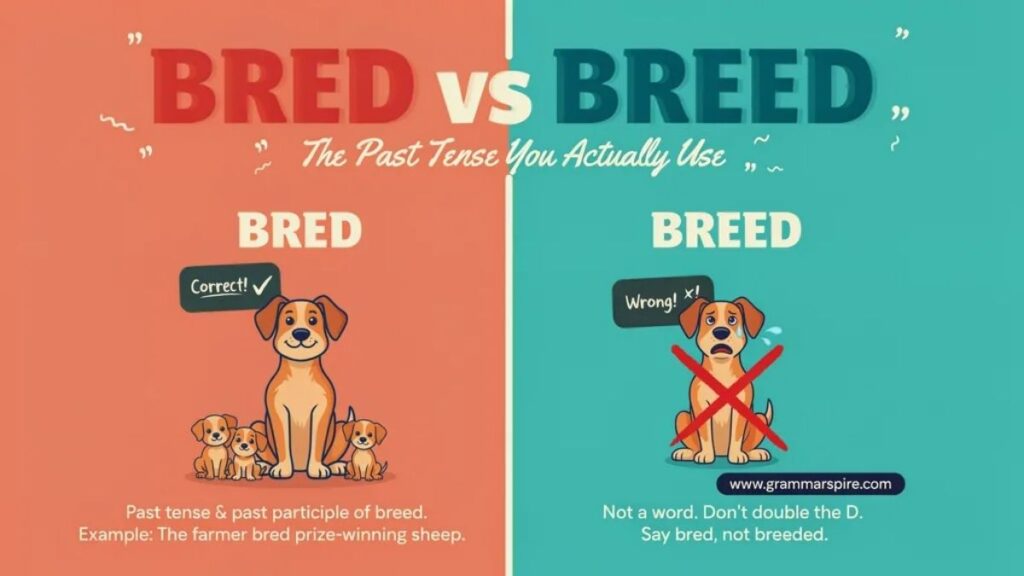
English grammar has a knack for turning simple words into confusing puzzles, and bred vs breeded is a perfect example. Adding -ed works for many verbs, so why should breed be any different? Well, English loves an exception! The correct past tense and past participle of breed are both bred, while breeded is nonstandard in standard English. Whether you are writing about dogs, horses, livestock, or someone’s upbringing, choosing the right form keeps your writing clear and professional. Fortunately, the rule is easier to remember than it seems. Let’s explore the meanings, practical examples, and grammar tips that will help you avoid this common mistake.
Learn the difference between commonly confused more words in English
In Tact or Intact Which Spelling Is Correct?
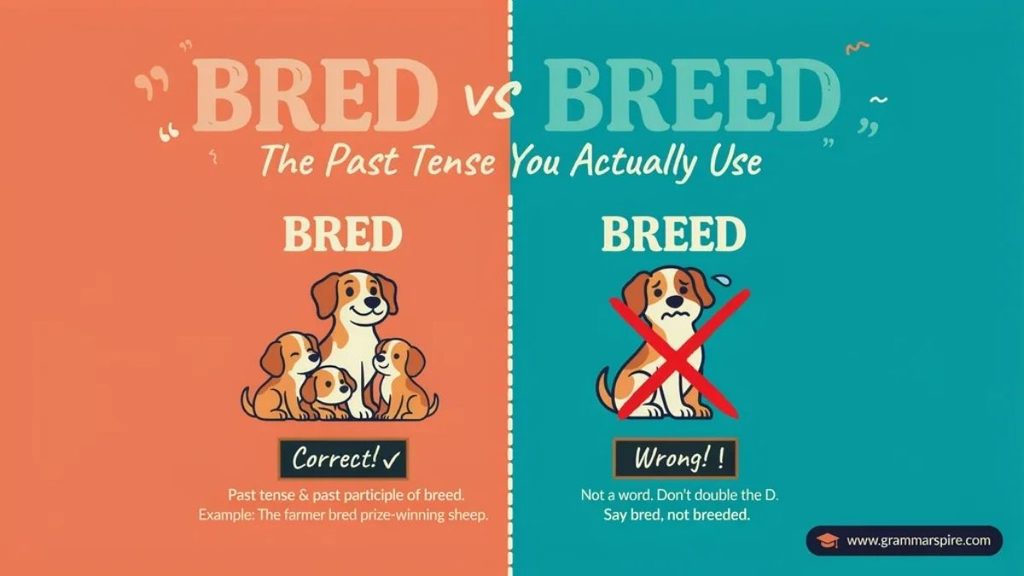
Quick Comparison
| Feature | Bred | Breeded |
|---|---|---|
| Standard English | Correct | Nonstandard |
| Past tense of breed | Correct | Incorrect in standard usage |
| Past participle of breed | Correct | Incorrect in standard usage |
| Formal writing | Recommended | Avoid |
| Example | The farmer bred horses. | The farmer breeded horses. |
| Best choice | Use bred | Use bred instead |
Learn the difference between commonly confused more words in English
Bind or Bound which one is correct?
What Does Bred Mean?
In the word bred vs breeded Bred is the simple past tense and past participle of the verb breed. It describes producing offspring, raising animals, or developing particular qualities through upbringing or experience. Depending on the context, it can refer to animals, plants, or people.
For example, “The farmer bred two healthy goats last spring” describes a completed action. Similarly, “The puppies were bred for their calm temperaments” explains why the breeder selected particular dogs.
Bred also appears in expressions that describe a person’s background or upbringing. In these cases, it can communicate more than reproduction. It may suggest the environment in which someone grew up or the qualities they developed.
Bred as the Past Tense of Breed
Use bred when describing an action that happened in the past. The sentence usually identifies an event that has already occurred.
For example, “The breeder bred a litter of puppies last year” describes a completed event. Likewise, “The farmer bred stronger cattle over several seasons” explains an action that took place over time.
Because breed is irregular, you cannot form its standard past tense by adding -ed. Therefore, bred is the correct form, even though breeded might appear to follow a familiar English spelling pattern.
Bred as the Past Participle of Breed
Bred also serves as the past participle. You commonly use it with helping verbs such as has, have, and had. It also appears in passive sentences with forms of be.
For example, “The farmer has bred several award-winning horses” uses bred with has. The sentence “They had bred the dogs before the competition began” uses bred with had.
In a passive sentence, you might write, “The animals were bred on a family farm.” Here, the sentence focuses on the animals rather than the person who bred them.
Common Expressions With Bred
The word bred appears in several familiar expressions. “Born and bred” describes someone who was born and raised in a particular place or environment. For example, “She is a New York-born-and-bred writer” emphasizes her connection to New York.
“Well-bred” traditionally describes someone whose upbringing has encouraged polite behavior and good manners. “Home-bred” can describe something raised or produced at home, although its meaning depends on the context.
You may also see bred used in phrases such as “specially bred for racing” or “bred for strength.” These expressions describe qualities that breeders have sought through selective breeding.
Learn the difference between commonly confused more words in English
Beat or Beated Which spelling Is Correct?
What Does Breeded Mean?
Breeded is a nonstandard form of breed. It sometimes appears because English speakers apply the regular past-tense pattern of adding -ed to a verb. However, breed does not follow that pattern in standard English.
For example, the sentence “The farmer breeded several horses” should be written as “The farmer bred several horses.” Similarly, “The puppies were breeded for their size” should read “The puppies were bred for their size.”
Although readers may understand what breeded means, understanding a word does not automatically make it grammatically standard. In school assignments, professional documents, published articles, and formal communication, use bred instead.
Is Breeded a Word?
You may encounter breeded in online discussions, informal messages, or writing by people who are unfamiliar with the irregular verb form. Nevertheless, standard English dictionaries and conventional grammar usage recognize bred as the past tense and past participle of breed.
The important distinction is between a form people sometimes use and the form recommended in edited English. When accuracy matters, choose bred.
Why Do People Write Breeded?
Many English verbs form their past tense by adding -ed. For example, walk becomes walked, clean becomes cleaned, and open becomes opened. Because of this familiar pattern, someone might assume that breed becomes breeded.
However, English also contains irregular verbs that change their form in other ways. For example, feed becomes fed, meet becomes met, and keep becomes kept. Breed follows a similar pattern, changing to bred.
Once you recognize this pattern, remembering the correct form becomes much easier.
Learn the difference between commonly confused more words in English
Feed vs Fed What spelling is correct?
Breed, Bred, and Bred Understanding the Verb Forms
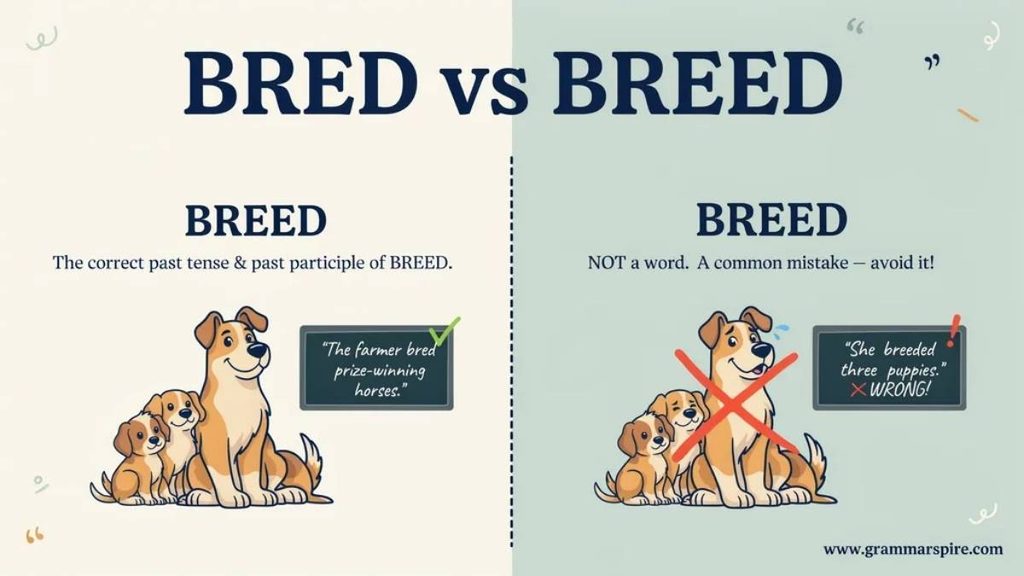
The three principal forms of breed are breed, bred, and bred. Each form serves a different grammatical purpose, so choosing the right one depends on the sentence.
| Verb Form | Correct Word | Example |
|---|---|---|
| Base form | Breed | They breed horses. |
| Simple past tense | Bred | They bred horses last year. |
| Past participle | Bred | They have bred horses for decades. |
| Present participle | Breeding | They are breeding horses. |
| Third-person singular present | Breeds | She breeds horses. |
When to Use Breed
Use breed for the base form of the verb. It appears after words such as to and modal verbs such as can, will, and should. It also appears with plural subjects in the simple present tense.
For example, “They breed sheep on their farm” describes a regular activity. “The organization plans to breed healthier cattle” describes a future plan. Similarly, “Farmers can breed plants with desirable characteristics” explains a general possibility.
When to Use Bred
Use bred when describing a completed past action or when the sentence requires a past participle.
For example, “The breeder bred three dogs last summer” uses the simple past tense. “The breeder has bred dogs for twenty years” uses the past participle with has.
The same form appears in passive constructions. For instance, “The horses were bred for endurance” emphasizes the horses and their characteristics rather than the breeder.
When to Use Breeding
Breeding is the present participle and gerund form of breed. You can use it in continuous verb tenses or as a noun.
For example, “The farmer is breeding healthier chickens” describes an ongoing activity. In the sentence “Selective breeding improves certain plant characteristics,” breeding functions as a noun that names a process.
Remember that breeding is correct, while breeded is not the standard past tense or past participle.
Learn the difference between commonly confused more words in English
Smoky or Smokey Which Spelling Is Correct?
Bred vs Breeded Comparison and Example Sentences
The clearest way to understand bred vs breeded is to compare the forms in complete sentences. The following examples show how bred works in different grammatical structures.
| Sentence Type | Correct Example | Incorrect Example |
|---|---|---|
| Present tense | They breed cattle. | They breeded cattle. |
| Simple past | They bred cattle last year. | They breeded cattle last year. |
| Present perfect | They have bred cattle for years. | They have breeded cattle for years. |
| Past perfect | They had bred the animals earlier. | They had breeded the animals earlier. |
| Passive voice | The horses were bred locally. | The horses were breeded locally. |
| Continuous tense | They are breeding cattle. | They are breeded cattle. |
These examples highlight an important point: the correct form depends on the tense and sentence structure. Use breed for the base form, bred for the simple past and past participle, and breeding for the -ing form.
For instance, “They bred the horses last year” describes a completed action. By contrast, “They have bred horses for many years” connects past activity with the present. Although the sentences use different tenses, both require bred.
When Should You Use Bred?
Use bred whenever you need the standard past tense or past participle of breed. This rule applies whether you are writing about animals, plants, family backgrounds, or qualities developed through upbringing.
Describing a Past Action
When an action happened in the past, use bred.
For example, “The farmer bred a new line of chickens last year” clearly identifies a completed event. Similarly, “The kennel bred several working dogs in the spring” describes an activity that occurred at a particular time.
Using Has, Have, or Had
When a sentence uses the present perfect or past perfect tense, bred serves as the past participle.
For example, “The organization has bred horses for competitive riding since 2010” describes an activity that began in the past and continues to matter in the present. Likewise, “The farmer had bred the animals before the new facility opened” places one past action before another.
Writing Passive Sentences
Bred also works in passive constructions. These sentences often focus on the animal, plant, or person affected by the action.
For example, “The dogs were bred for their intelligence” emphasizes the dogs and the purpose of the breeding. Similarly, “The plants were bred to resist certain diseases” highlights the result of selective breeding.
Describing Background or Upbringing
You can also use bred in expressions about someone’s origins or upbringing. For example, “He was born and bred in Chicago” indicates that he was born and raised there.
In this expression, bred does not refer to animal reproduction. Instead, it describes the person’s upbringing and connection to a place.
Learn the difference between commonly confused more words in English
Swore vs Sworn What’s the Difference?
Breed vs Bred What Is the Difference?
Breed and bred belong to the same verb, but they perform different grammatical roles. Breed is the base form and present-tense form used with certain subjects. Bred is the simple past tense and past participle.
| Word | Grammatical Role | Example |
|---|---|---|
| Breed | Base form | We want to breed healthier plants. |
| Breed | Present tense with plural subjects | They breed horses. |
| Breeds | Present tense with he, she, or it | She breeds horses. |
| Bred | Simple past tense | She bred horses last year. |
| Bred | Past participle | She has bred horses for years. |
| Breeding | Present participle or gerund | She is breeding horses. |
The difference becomes clearer when you look at the time of the action. “They breed horses” describes a regular activity, while “They bred horses last year” describes a past event.
Similarly, “They have bred horses for decades” uses bred as a past participle with have. In contrast, “They are breeding horses” describes an ongoing process.
Learn the difference between commonly confused more words in English
Burst or Bursted? Which One Is Correct?
Bred vs Breeded in Animal Breeding

The word bred vs breeded the bred frequently appears in agriculture, veterinary writing, animal care, and discussions about selective breeding. In these contexts, it describes producing offspring or selecting animals for particular traits.
Dog Breeding
Dog breeders may select animals based on health, temperament, size, or working ability. For example, “The breeder bred two dogs with calm temperaments” describes a completed action.
You might also write, “The puppies were bred by an experienced breeder.” Both sentences use bred correctly. The form breeded would be nonstandard in these examples.
Horse and Livestock Breeding
Farmers may breed horses for speed, cattle for milk production, or sheep for wool. When describing a completed activity, use bred.
For example, “The farmer bred horses for endurance” is correct. So is “The farm has bred dairy cattle for several generations.” These sentences follow the same irregular verb pattern regardless of the animal involved.
Plant Breeding
Bred also appears in agriculture and horticulture. Scientists and growers may breed plants to develop useful characteristics, such as improved yield, disease resistance, or tolerance to particular growing conditions.
For example, “Researchers bred plants that could tolerate dry conditions” describes a completed effort. “The plants were bred for improved disease resistance” uses bred in a passive sentence.
Across all these contexts, the same rule applies: breed, bred, bred. The subject may change, but the standard verb forms do not.
Learn the difference between commonly confused more words in English
Sweeped or Swept Which One Is Correct?
Common Mistakes With Bred vs Breeded
One common mistake is adding -ed to breed because it seems to follow the regular past tense pattern. However, breed is irregular, so the correct past form is bred.
For example, write “She bred several horses last year,” not “She breeded several horses last year.”
Another mistake is using breed instead of bred after a helping verb when the sentence requires a past participle. For instance, “They have bred healthy animals for years” is correct, while “They have breed healthy animals for years” is not.
Writers sometimes confuse breed with breeding as well. Although both forms are correct, they serve different purposes. “They are breeding cattle” describes an ongoing process, while “They bred cattle last year” describes a past event.
Finally, be careful not to confuse bred with bread. Bred is a form of the verb breed, while bread usually refers to a food made from flour and other ingredients. The words sound alike in many varieties of English, but their meanings and spellings differ.
Learn the difference between commonly confused more words in English
Forbid or Forbidden Which One Is Correct?
How to Remember the Correct Form
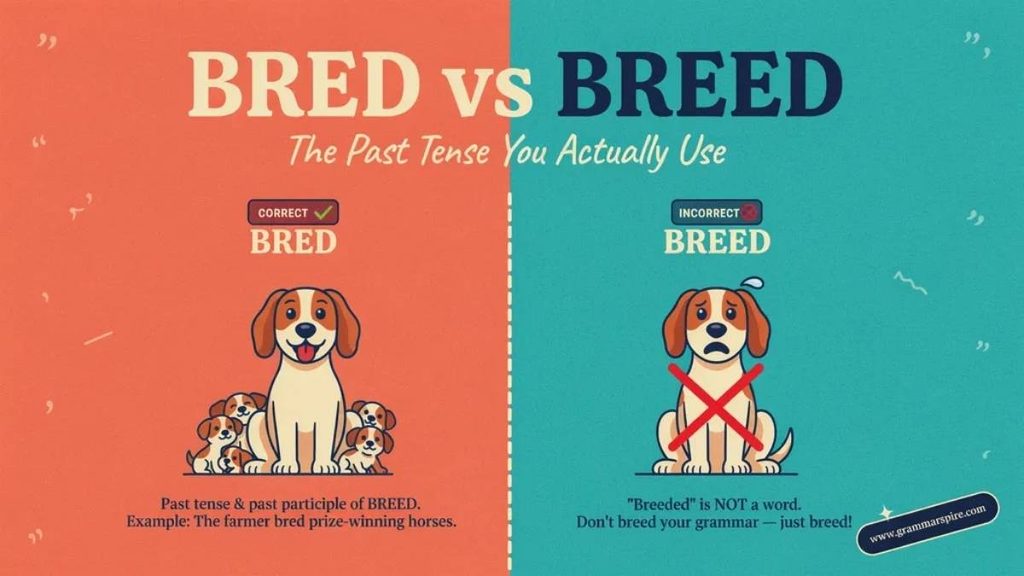
A simple way to remember the past tense of breed is to connect it with other irregular verbs that change their spelling rather than adding -ed.
| Base Form | Past Tense | Past Participle |
|---|---|---|
| Breed | Bred | Bred |
| Feed | Fed | Fed |
| Meet | Met | Met |
| Keep | Kept | Kept |
| Lead | Led | Led |
Notice how breed follows the same general pattern as feed. You would say, “The farmer fed the animals,” not “The farmer feeded the animals.” In the same way, you should write “The farmer bred the animals,” not “The farmer breeded the animals.”
You can also remember the three principal forms as a short sequence: breed, bred, bred. Repeating this sequence when you practice grammar can help you recall the correct form while writing.
Learn the difference between commonly confused more words in English
Set or Setted Which Is Correct?
bred vs breeded in american and british english
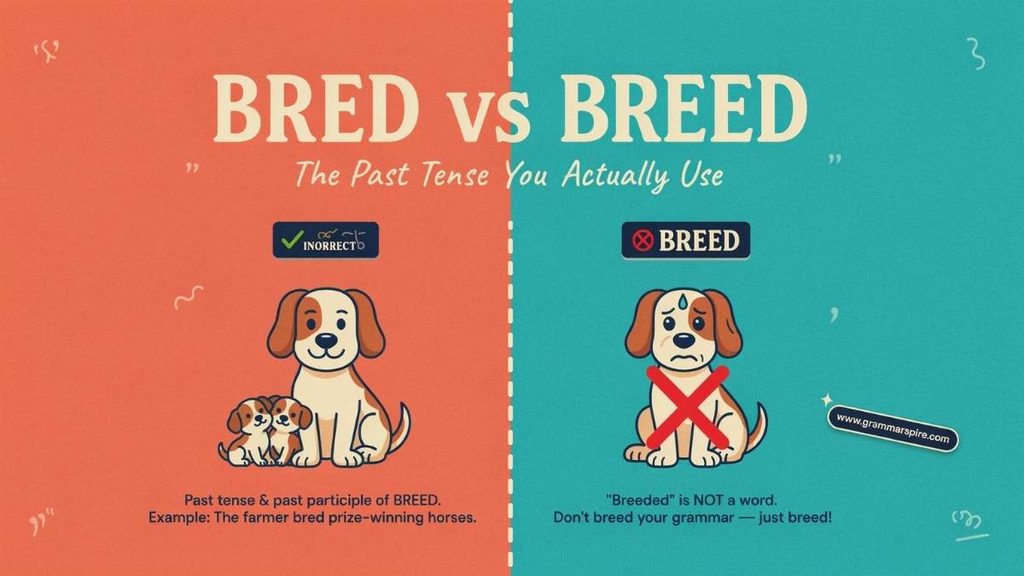
The standard distinction between bred and breeded remains the same in American and British English. In both varieties, bred is the accepted past tense and past participle of breed.
For example, an American writer might say, “The farmer bred cattle on the family farm.” A British writer could use exactly the same sentence. Neither needs to change bred to breeded because of regional spelling or grammar differences.
Although vocabulary and spelling sometimes vary between American and British English, this verb form does not follow a different regional pattern. Therefore, use bred in formal writing, educational material, business communication, and everyday English.
Bred vs Breeded Practice Session
Ready to master the difference between bred and breeded? This practice session will help you recognize the correct forms of breed in different sentences. Complete the 30 fill-in-the-blank exercises below by choosing the form that fits each context. Pay attention to verb tenses, helping verbs, and sentence structure. Remember that breed, bred, and breeding each serve a different grammatical purpose, while breeded is nonstandard in standard English.
Fill in the Blanks of bred vs breeded
- The farmer ______ several healthy horses last spring.
- They ______ cattle on their farm every year.
- The breeder has ______ dogs for more than ten years.
- The puppies were ______ for their friendly temperaments.
- She ______ Golden Retrievers professionally.
- The organization had ______ horses before the competition began.
- The farmer is ______ chickens for egg production.
- My neighbor ______ two German Shepherds last year.
- These plants were ______ to resist certain diseases.
- The family has ______ sheep for generations.
- He was born and ______ in New York.
- Responsible breeders carefully ______ healthy animals.
- The veterinarian confirmed that the dog had been ______ responsibly.
- The farmer ______ stronger cattle through selective breeding.
- They are ______ horses with desirable characteristics.
- The breeder has never ______ unhealthy animals intentionally.
- She ______ rabbits when she lived on the farm.
- The organization plans to ______ dogs with suitable temperaments.
- The animals were ______ on a small family farm.
- He ______ several prize-winning horses during his career.
- The farmer had ______ the goats before winter arrived.
- My uncle ______ Labrador Retrievers as a hobby.
- The researchers are ______ plants that tolerate dry conditions.
- The dog was ______ for its intelligence and agility.
- They have ______ healthy livestock for many years.
- The breeder ______ a litter of puppies last month.
- This farm continues to ______ rare varieties of cattle.
- The horses were ______ for endurance rather than speed.
- She has been ______ dogs for several years.
- The correct past tense of breed is ______, not breeded.
Answer Key
- bred
- breed
- bred
- bred
- breeds
- bred
- breeding
- bred
- bred
- bred
- bred
- breed
- bred
- bred
- breeding
- bred
- bred
- breed
- bred
- bred
- bred
- breeds
- breeding
- bred
- bred
- bred
- breed
- bred
- breeding
- bred
FAQs About Bred vs Breeded
What Is Bred Slang For?
In informal English, bred can relate to someone’s upbringing, background, or the environment that shaped them. In some Caribbean English varieties and Jamaican Patois, the related term bredren refers to a brother, friend, or close companion. The meaning depends on the speaker and context.
Can Males Be Bred?
Yes. Male animals, including dogs, can be used for breeding. In this context, bred refers to an animal selected to produce offspring with a female. For example, “The male dog was bred with a healthy female.”
Can You Still Say Born and Bred?
Yes. Born and bred is a standard English expression meaning born and raised in a particular place or environment. For example, “She is a born-and-bred New Yorker.” The phrase remains common in both American and British English.
Is It Purebred or Pure Breed?
Purebred is the standard adjective for an animal that belongs to a particular breed and has an established pedigree. For example, “They adopted a purebred German Shepherd.” The phrase pure breed may appear in other grammatical contexts, but purebred is the usual choice when describing an animal’s breed status.
At What Age Do Male Dogs Try to Mate?
Male dogs may begin showing sexual behaviors at around five or six months of age, although development varies by breed, size, and individual. Many reach sexual maturity between six and twelve months, while larger breeds may mature later. Sexual maturity does not mean a dog has reached full physical maturity.
How Many Times Will a Male Dog Mate With a Female in Heat?
There is no fixed number. A male dog may mate more than once while a female is in heat, depending on their health, behavior, and circumstances. Repeated mating does not guarantee pregnancy. Anyone planning to breed dogs should consult a veterinarian about reproductive health, genetic screening, and responsible breeding practices.
Which Dog Breed Is Not Purebred?
Mixed-breed dogs are not considered purebred because their ancestry includes multiple breeds or an uncertain combination of lineages. Labradoodles, Cockapoos, and many rescue dogs are examples of dogs with mixed ancestry. However, breed recognition and registration requirements vary among kennel organizations.
Is Any Dog 100% Purebred?
A dog may be recognized as purebred when its pedigree meets the registration requirements of a relevant kennel organization. However, the phrase 100% purebred is not a universal guarantee of genetic uniformity. Pedigree records, breed registration, and DNA tests provide different kinds of information about a dog’s ancestry.
What Dog Breeds Are Purebred?
Many established breeds are recognized as purebred by kennel organizations. Examples include Labrador Retrievers, German Shepherds, Poodles, Beagles, Golden Retrievers, Dachshunds, and Siberian Huskies. Recognition varies between organizations, and pedigree records can help establish a dog’s lineage.
What Is the Unfriendliest Dog Breed?
No single breed is universally the unfriendliest. A dog’s behavior depends on genetics, socialization, training, health, and individual experiences. Some breeds were developed for guarding or protection, but that does not mean every dog from those breeds is unfriendly. Evaluating a dog’s individual temperament is more useful than judging it by breed alone.
What Dog Costs $1,000,000?
There is no standard dog breed that consistently costs $1 million. Reports sometimes describe dogs sold for extraordinary sums, but these claims can be difficult to verify. A dog’s price may depend on its pedigree, training, rarity, location, and demand. Such prices are exceptional rather than typical.
What Is the No. 1 Lazy Dog?
The English Bulldog is often considered a relatively low-energy breed that enjoys relaxing at home. Basset Hounds and some Mastiff breeds are also known for their laid-back temperaments. However, every dog needs suitable exercise, mental stimulation, and veterinary care, regardless of its energy level.
What Is the Kindest Dog Ever?
There is no objective winner for the kindest dog breed. Golden Retrievers and Labrador Retrievers are often praised for their friendly, sociable temperaments. Nevertheless, a dog’s personality also reflects its upbringing, socialization, training, and individual experiences.
What’s the Highest IQ Dog Breed?
The Border Collie is frequently ranked among the most intelligent dog breeds, particularly for learning commands and working with people. However, canine intelligence includes several abilities, such as problem-solving, adaptability, social understanding, and instinctive skills. A breed’s reputation does not determine every individual dog’s abilities.
What Dog Breed Is the Least Bred?
There is no universally accepted ranking of the least-bred dog breed. Some breeds have very small populations or are found mainly in specific regions. Their numbers can change over time, so identifying the rarest breeding population requires current records from kennel organizations and breed conservation groups.
What Is the No. 1 Cheapest Dog?
There is no universally cheapest dog because prices vary by location, availability, and adoption or purchase fees. Adopting from a reputable animal shelter can often cost less initially than buying from a breeder. However, prospective owners should also consider food, training, grooming, preventive care, and veterinary expenses.
What Is the Most Loyal Dog Breed?
German Shepherds are widely known for their loyalty and strong working relationships with their handlers. Labrador Retrievers and Golden Retrievers can also develop close bonds with their families. However, loyalty depends on the individual dog’s temperament and the trust built through consistent, compassionate care.
What Is the Rarest Dog on Earth?
There is no universally agreed-upon answer because worldwide population figures and breed records vary. Otterhounds and Norwegian Lundehunds are considered uncommon in many regions. The rarest breed may differ depending on whether you compare registered births, estimated global populations, or availability in a particular country.
AEO: Quick Answers About Bred vs Breeded
What Is the Correct Past Tense of Breed?
Bred is the correct past tense of breed. For example, “The farmer bred horses last year.” Breeded is nonstandard in standard English.
Is Breeded Grammatically Correct?
Breeded is not the standard past tense or past participle of breed. Use bred in academic assignments, professional documents, and everyday writing.
What Are the Three Forms of Breed?
The three principal forms are breed, bred, and bred. Breed is the base form, while bred serves as both the simple past tense and the past participle.
What Does Bred Mean in a Sentence?
Bred can refer to producing offspring, developing particular characteristics through selective breeding, or growing up in a particular environment. For example, “The dog was bred for agility.”
What Is the Difference Between Bred and Purebred?
Bred is the past tense and past participle of the verb breed. Purebred is an adjective that describes an animal belonging to a particular breed under the relevant pedigree or registration standards.
Is Born and Bred Grammatically Correct?
Yes. Born and bred is a standard expression meaning born and raised. For example, “He was born and bred in Boston.”
Can Bred Describe Humans?
Yes. In expressions such as born and bred and well-bred, the word can refer to a person’s upbringing, background, or manners. The precise meaning depends on the expression and context.
Is Breded or Breeded Correct?
Neither breded nor breeded is the standard form of the verb breed. The correct past tense and past participle are both bred.
Conclusion of bred vs breeded
Understanding the difference between bred and breeded is simple once you learn the correct forms of the verb breed. The standard forms are breed, bred, and bred, making bred the right choice for both the past tense and past participle. Whether you are writing about dog breeding, raising livestock, or describing someone who was born and raised in a particular place, using the correct form keeps your writing clear and professional. Although adding -ed might seem logical, English grammar has a few surprises that refuse to follow the usual rules. Remember this simple pattern, practice it regularly, and you will avoid this common mistake with confidence. After all, good grammar should help your writing grow, not breed confusion!

Ella AJS
Ella AJS is an experienced blogger and language enthusiast at Grammar Spire, dedicated to making English grammar simple, practical, and easy to understand. She specializes in word comparisons, meanings, usage, and common language confusions. Through clear explanations and engaging examples, Ella helps students, writers, and English learners improve their vocabulary and communicate with greater confidence and accuracy.