
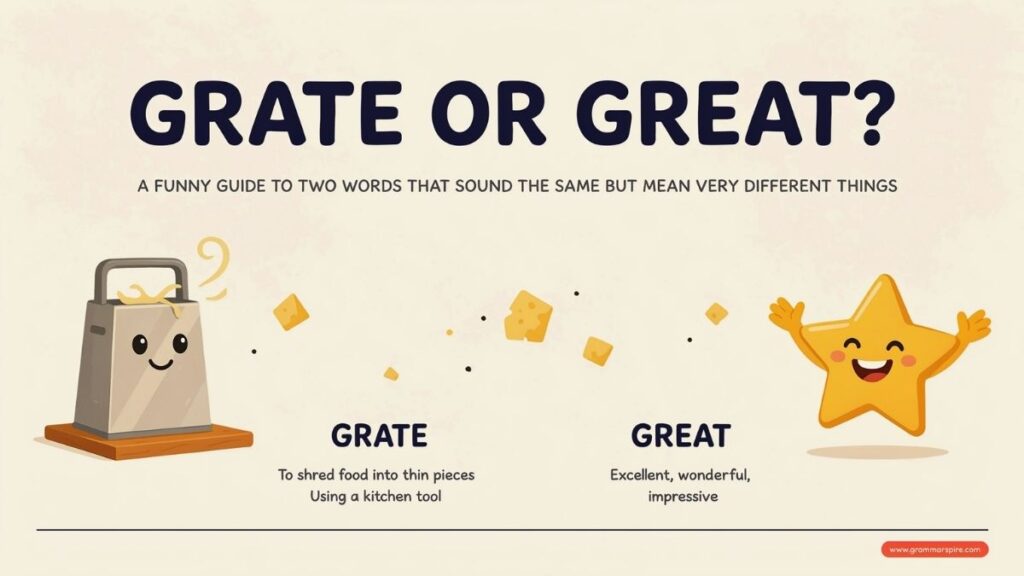
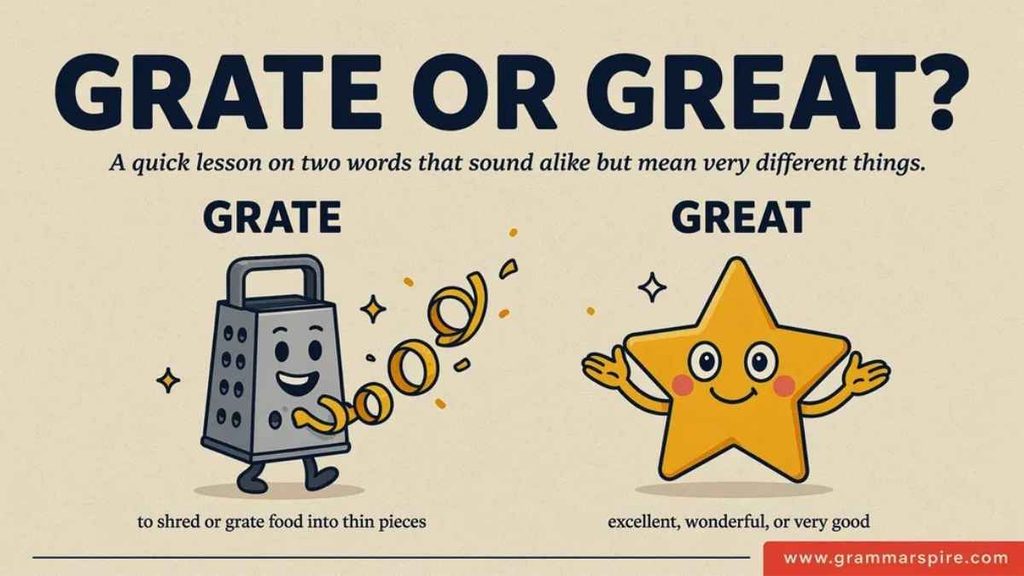
English can turn two simple words into a surprisingly tricky spelling puzzle, and grate or great is a classic example. Although these words sound identical, their meanings couldn’t be more different. Grate can describe shredding cheese, a metal framework, or something that causes irritation. Great, meanwhile, can describe something excellent, impressive, important, or considerable. One small spelling mistake can completely change your sentence, turning a compliment into a kitchen instruction before you know it. Understanding their meanings, pronunciation, and usage helps you choose the right word with confidence. Whether you’re discussing dinner or praising someone’s work, knowing the difference keeps your writing clear, accurate, and professional.
The Quick Answer
Both words are correct. The important point is knowing when to use each one.
Grate can function as a noun or a verb. As a verb, it can mean to shred food, rub against something harshly, or irritate someone. As a noun, it usually refers to a metal framework, such as a fireplace or drain
Great mainly functions as an adjective. It can describe something excellent, impressive, important, large, considerable, or remarkable. In some contexts, it can also function as a noun when it refers to an exceptional person.
Consider these examples:
Please grate the cheddar before dinner.
The fireplace grate needs cleaning.
We had a great time at the concert.
She came up with a great idea.
The meaning gives you the answer. When the sentence concerns shredding, metal bars, rubbing, or irritation, choose grate. When it describes excellence, importance, or size, choose great.
Are These Two Words Homophones?
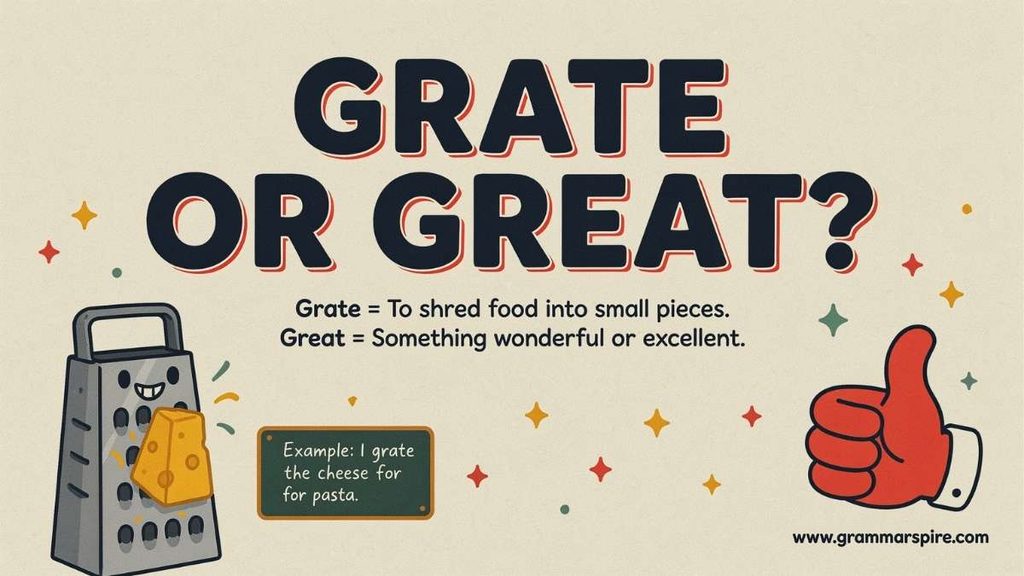
Yes. They are homophones, which means they have the same pronunciation but different spellings and meanings.
Both words use the pronunciation ɡreɪt in standard American and British English.
This shared sound creates the confusion. When someone says the word aloud, the listener cannot see the spelling. Context has to do the detective work.
English contains many similar pairs, such as right and write, flower and flour, and sea and see. Their sounds may match, but their meanings remain separate.
Grate Pronunciation
The word is pronounced ɡreɪt. It sounds similar to the word “grayt.”
For example:
Please grate the cheese.
The pronunciation does not change when the word describes irritation or a metal structure.
Great Pronunciation
The word great also uses the pronunciation ɡreɪt.
For example:
You did a great job.
The spelling changes, but the sound remains identical.
Why Do They Sound the Same?
Homophones often develop through separate historical paths and later end up sharing a modern pronunciation. That explains why two words can sound identical while keeping different spellings.
You cannot solve a homophone problem by listening alone. You need to understand the sentence.
Learn the difference between confusing more English words step by step
Bareable or Bearable Which Spelling Is Correct?
What Does Grate Mean?
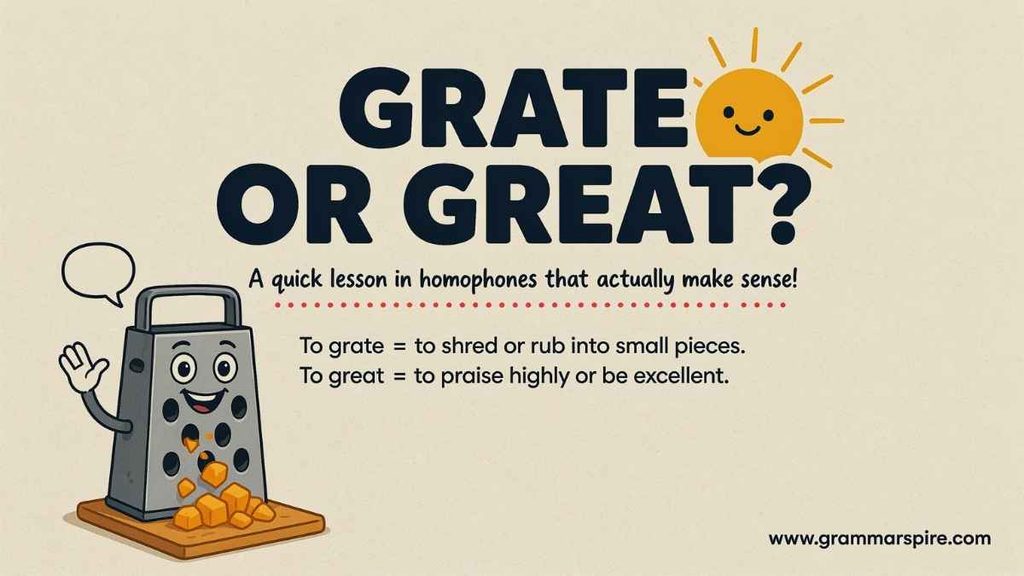
This word has several meanings, and context determines which one applies.
It can describe a kitchen action, a rough physical movement, an irritating effect, or a metal structure.
as a Verb Shred Food
When you grate food, you rub it against a rough surface with sharp edged holes. The process cuts the food into small pieces.
People commonly use it cheese, carrots, potatoes, ginger, chocolate, and other ingredients.
For example:
Grate the cheddar over the pasta.
She grated two carrots for the salad.
The related noun grater names the kitchen tool used for this purpose. Cambridge Dictionary defines a grater as a metal device with sharp-edged openings that cuts food into small pieces.
This meaning appears frequently in cooking instructions, recipes, and everyday conversations.
as a Verb Rub Against Something
The same word can describe one hard surface rubbing against another.
The action often creates a harsh or unpleasant sound.
For example:
The metal gate grated against the pavement.
The chair legs grated across the floor.
The wheels grated against the rough surface.
This sense connects closely with grating, which describes something unpleasant or irritating, especially a sound.
on Someone’s Nerves” Mean?
The expression “on someone’s nerves” means to annoy or irritate someone.
For example:
His constant complaints grate on my nerves.
That repetitive alarm is starting to grate on me.
The expression creates a useful mental picture. A rough surface becomes irritating when it keeps rubbing against something. Likewise, an annoying habit can gradually wear down your patience.
as a Noun
As a noun, it usually refers to a structure made from metal bars.
You may find one in a fireplace, over a drain, across a ventilation opening, or in another place that requires an open metal covering.
For example:
The logs rested on the fireplace grate.
Water disappeared through the drain grate.
Cambridge Dictionary describes this noun as a structure made from iron bars used to hold fuel in a fireplace or metal bars that cover an opening.
Fireplace
A fireplace it supports wood or another fuel source inside a fireplace. Its open structure allows air to circulate around the fuel.
Example:
The fireplace grate was covered with ash.
Drain
A drain it covers an opening while allowing water to pass through.
Example:
Leaves covered the drain grate after the storm.
You may also see similar structures around sidewalks, roads, industrial buildings, and public drainage systems.
Learn the difference between confusing more English words step by step
Useing or Using Which spelling Is Correct?
What Does Great Mean?
The word great has a broad range of meanings. It can describe quality, importance, size, degree, achievement, or reputation.
Great Meaning “Excellent”
The most familiar meaning describes something very good or excellent.
For example:
That was a great movie.
You gave a great presentation.
She has a great sense of humor.
In everyday speech, people often use the adjective as a simple compliment.
Great Meaning Large or Considerable
The word can also describe something large in amount, size, degree, or extent. Cambridge Dictionary includes meanings related to considerable size, amount, degree, importance, and power.
For example:
The storm caused great damage.
He felt great pressure before the exam.
The project required great effort.
In these examples, the word does not necessarily mean “excellent.” Instead, it emphasizes scale or intensity.
Great Meaning “Important”
It can also describe something significant or influential.
For example:
The decision had great importance.
His work had a great impact on the field.
Here, the word emphasizes importance rather than simple quality.
Great Meaning Famous or Remarkable
The adjective can describe someone or something distinguished, famous, powerful, or historically significant.
For example:
Alexander the Great
the Great Wall
In these expressions, the word suggests exceptional status or importance.
Great as an Informal Response
In conversation, people often use great as a brief expression of approval, agreement, or satisfaction.
For example:
“The meeting starts at nine.”
“Great!”
Another example:
“Your order is ready.”
“Great, thanks!”
Tone can change the meaning. A speaker can even use the word sarcastically:
“Great. Now the printer is broken.”
In that sentence, the speaker clearly feels frustrated rather than pleased.
Learn the difference between confusing more English words step by step
Speach or Speech What one is Correct?
The Main Difference

The biggest distinction comes from meaning and grammatical function.
Grate can function as both a noun and a verb. Its meanings include shredding, rubbing, irritating, and referring to a metal framework.
Great usually functions as an adjective. It commonly describes excellence, importance, size, degree, or distinction. It can also appear as a noun in expressions such as “one of the greats.”
Comparison Table
| Feature | Grate | Great |
|---|---|---|
| Main word class | Noun and verb | Adjective and sometimes noun |
| Pronunciation | /ɡreɪt/ | /ɡreɪt/ |
| Same sound | Yes | Yes |
| Homophone | Yes | Yes |
| Common meaning | Shred, scrape, irritate, or metal framework | Excellent, impressive, important, large, or remarkable |
| Cooking use | Grate cheese or vegetables | Not used for shredding |
| Physical object | Fireplace grate or drain grate | Not used for a metal framework |
| Irritation | Something can grate on you | Does not carry this meaning |
| Praise | Not normally used this way | “You did a great job.” |
| Example | “Grate the cheddar.” | “It was a great meal.” |
This table shows why pronunciation cannot determine the spelling. The sound stays the same while the meaning changes completely.
How to Choose the Correct Word
When you are unsure which spelling belongs in a sentence, stop listening to the sound and examine the meaning.
Use grate when something rubs harshly against another surface.
The metal grated against the concrete.
Use grate when something annoys you.
His constant interruptions grate on me.
They use great when you describe something excellent.
She had a great idea.
It use great when you emphasize importance.
He showed great courage.
A simple question can help:
What does the word need to mean in this sentence?
Once you answer that question, the spelling usually becomes obvious.
Learn the difference between confusing more English words step by step
Monkeys or Monkies Which Spelling Is Correct?
Using the Correct Word in Sentences
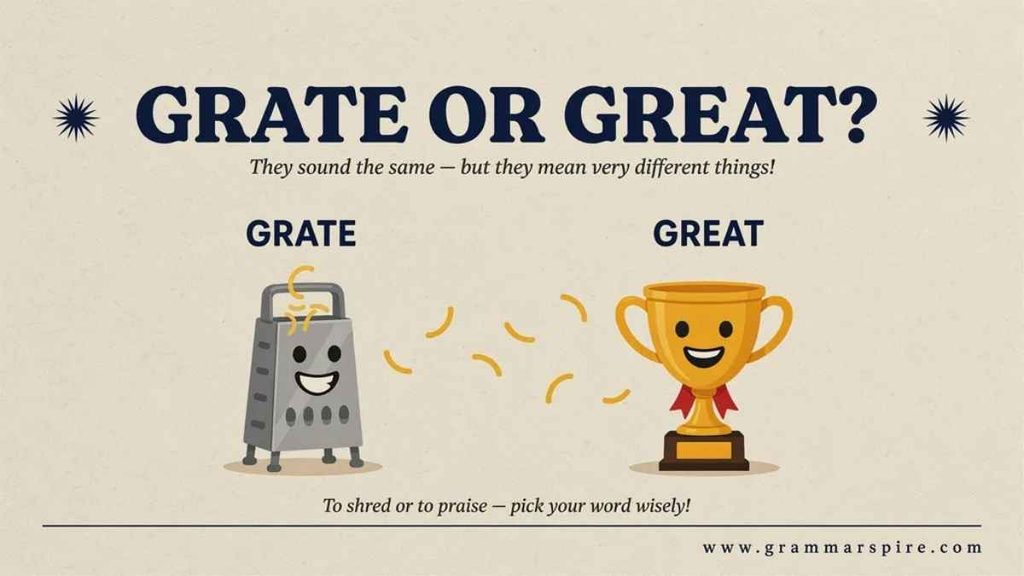
Examples provide the clearest way to understand this pair because they reveal how context controls spelling.
Food and Cooking
Grate the parmesan over the soup.
She grated a fresh carrot for the salad.
All three examples describe the process of shredding food.
Feelings and Reactions
His sarcastic comments grate on me.
Now compare those sentences with:
She had a great reaction to the news.
The first pair deals with irritation. The second pair expresses something positive.
Everyday Objects
The fireplace grate held the burning logs.
The worker replaced the damaged drain grate.
Here, the word functions as a noun.
Work and School
You did a great job on the assignment.
That was a great presentation.
These examples express praise, achievement, or a high degree of progress.
Learn the difference between confusing more English words step by step
Receive or Recieve Which Spelling Is Correct?
Common Expressions With Grate
Grate on Someone’s Nerves
This expression describes something that repeatedly annoys or irritates you.
His constant complaining grates on my nerves.
Grate Against
This phrase describes harsh rubbing or scraping between surfaces.
The rough material grated against the wall.
The metal grated against the concrete.
These expressions usually involve either physical friction or emotional irritation.
Common Expressions With Great
Have a Great Time
This familiar phrase means to enjoy yourself.
Have a great time at the party!
Great Job
People commonly use this phrase to praise someone’s performance.
Great job on the presentation!
One of the Greats
Here, great functions as a noun. The phrase refers to someone regarded as exceptional in a particular field.
Many consider her one of the greats of modern literature.
A Great Deal
The phrase a great deal can mean a large amount.
The project required a great deal of effort.
In this expression, the adjective emphasizes quantity.
Learn the difference between confusing more English words step by step
Volumn or Volume Which Is the Correct Spelling?
The Origin of Grate
The history of grate helps explain its modern meanings.
The noun entered English in the late 14th century with a meaning associated with a cooking grill. During later periods, it developed associations with iron bars and cage-like frameworks.
The verb came through French forms connected with scraping and rubbing. Over time, the verb gained meanings associated with harsh sounds and irritation.
That development explains why the modern word can describe both a kitchen action and an annoying sensation.
The Origin of Great
Great comes from Old English grēat, which carried meanings connected with size, height, thickness, and mass. The word also has relatives in other Germanic languages, including Dutch and German.
The modern sense meaning “excellent” appeared much later. Etymonline dates that sense to the 19th century.
Although the two terms now sound alike, their historical roots developed separately.
British English vs American English
There is no spelling difference between British English and American English for these two words.
American English uses:
grate
great
British English uses the same forms:
grate
great
Their standard pronunciations also match.
So, the choice has nothing to do with regional spelling. Context remains the deciding factor.
Learn the difference between confusing more English words step by step
Leasee vs Lessee Which Spelling Is Correct?
Common Spelling Mistakes
These words often cause mistakes because the ear cannot distinguish them.
Mistake With Cheese
A common error is:
Please great the cheese.
The correct sentence is:
Please grate the cheese.
Mistake With Praise
Another common error is:
You did a grate job.
The correct version is:
You did a great job.
The sentence expresses praise, so great is appropriate.
Mistake With Irritating Sounds
Consider:
The noise was grating.
The adjective grating describes something unpleasant or annoying, especially a sound.
You can also say:
That sound really grates on me.
Both examples connect with irritation.
Hoofs or Hooves Which Spelling Is Correct?
Everyday Examples
The contrast becomes even clearer when the words appear in different everyday settings.
Cooking
Grate the chocolate over the dessert.
She grated fresh ginger into the sauce.
Compliments
You did a great job.
That’s a great idea.
Annoying Sounds
The harsh noise grated against the quiet room.
A Simple Memory Trick
A strong memory connection can make this pair easier to recall.
A grater shreds cheese and vegetables. Therefore, when you describe that kitchen action, use grate.
Now connect great with excellent.
When something is very good, impressive, or remarkable, great usually fits.
One sentence can reinforce both meanings:
Grate the cheese and enjoy a great meal.
The first word describes an action. The second describes the quality of the meal.
Learn the difference between confusing more English words step by step
Barrel or Barrell Which Spelling Is Correct?
Great vs Grateful
Great and grateful can look similar, but they express different ideas.
It generally describes quality, size, importance, or excellence.
Grateful means thankful or appreciative.
Compare:
She had a great day.
She felt grateful for her friend’s support.
A person can experience a great day and feel grateful at the same time, but the words do different jobs.
Here’s a trusted source for clear more words Comparison:
Grammar Update
Practice Session
Test your understanding of grate and great by completing each sentence. The correct answer appears in the blank so readers can see the intended word immediately.
Fill in the Blanks
- Please grate the cheese before you add it to the pasta.
- We had a great time at the family picnic.
- The old fireplace grate needs to be replaced.
- That loud buzzing sound began to grate on my nerves.
- She gave a great presentation at the conference.
- Can you grate the carrots for the salad?
- The rainwater collected around the drain grate.
- He showed great patience while helping the children.
- The rusty gate began to grate against the pavement.
- They had a great experience during their vacation.
- Please grate some chocolate over the dessert.
- Her constant interruptions really grate on everyone.
- The company achieved great success this year.
- We installed a metal grate over the opening.
- You did a great job on your final project.
- The fireplace logs rested on the iron grate.
- The squeaky door began to grate as it moved.
- That was a great idea for solving the problem.
- The worker cleaned the rusty grate.
- His careless attitude started to grate on his coworkers.
- The teacher praised her for making great progress.
- Please grate the fresh ginger into the bowl.
- The storm caused great damage to several buildings.
- The heavy chair grated across the wooden floor.
- Everyone agreed that it was a great opportunity.
Answer Key
great
grate
great
grate
grate
great
grate
grate
great
grate
great
grate
grate
great
grate
great
grate
grate
great
grate
grate
great
grate
great
grated
FAQs
What Is the Meaning of Great?
Great generally describes something excellent, impressive, important, remarkable, or considerable. Its precise meaning depends on the context.
For example, “She did a great job” means that she performed very well.
Is It “Great Day” or “Grate Day”?
The correct expression is “great day.” The word great describes a day that feels especially enjoyable, successful, memorable, or satisfying.
Example: “We had a great day at the park.”
Is “Grate” Related to “Grateful”?
No. Grate and grateful have different meanings and etymological histories. The word grateful means thankful or appreciative, while grate can mean to shred food, rub harshly, irritate, or refer to a metal framework.
Example: “I’m grateful for your support.”
When Should You Use Great?
Use great when you want to describe something as excellent, impressive, significant, remarkable, or considerable.
Example: “The team made great progress during the project.”
What Is a Better Word for Great?
The best alternative depends on the meaning you want to express. Suitable choices include excellent, outstanding, remarkable, exceptional, impressive, superb, wonderful, and significant.
For example, “excellent” emphasizes quality, while “significant” emphasizes importance.
What Is Great Used For?
Great commonly functions as an adjective. It can describe quality, importance, size, intensity, achievement, or influence.
Examples include:
“A great opportunity.”
“Great courage.”
“A great success.”
It can also function as a noun in expressions such as “one of the greats.”
What Is the Difference Between Great and Grate?
Great and grate are homophones because they share the same pronunciation but have different spellings and meanings.
Great usually describes something excellent, impressive, important, large, or remarkable.
Grate can refer to shredding food, rubbing against something, irritating someone, or a metal framework.
Example: “That was a great meal” uses great, while “Grate the cheese” uses grate.
What Does Grate Mean?
Grate has several meanings. As a verb, it can mean to shred food into small pieces, rub against a surface, or cause irritation. As a noun, it can describe a metal structure made from bars.
Examples:
“Grate the cheese before serving.”
“The fireplace grate needs cleaning.”
What Does “A Great Day” Mean?
A great day describes a day that feels particularly enjoyable, successful, pleasant, or memorable.
Example: “We spent a great day with our family.”
The phrase expresses a strongly positive opinion about the day’s experience.
What Is a Cool Way to Say “Great”?
In casual conversation, alternatives such as awesome, fantastic, amazing, excellent, wonderful, or terrific can replace great.
For example, “That’s awesome!” sounds more casual and enthusiastic than “That’s great!”
How Do You Use Great in a Sentence?
Use great when you want to describe a person, thing, experience, quality, achievement, amount, or degree.
Examples:
“She has a great personality.”
“That was a great performance.”
“The project required great effort.”
“He showed great patience.”
What Is a Deeper Word for Great?
A more precise or sophisticated alternative may include exceptional, extraordinary, remarkable, distinguished, outstanding, or significant.
The best option depends on the intended meaning. For example, extraordinary suggests something far beyond the ordinary, while significant emphasizes importance.
What Does “Great” Mean?
Great can mean very good, excellent, impressive, important, large, or considerable. It may also describe someone or something recognized for exceptional achievement or influence.
Context determines the exact sense.
What Does “Great” Mean in Slang?
In informal speech, great often expresses approval, excitement, agreement, or satisfaction.
Example:
“Great! Let’s get started.”
Speakers can also use it sarcastically when a situation goes wrong.
Example:
“Great, the printer stopped working again.”
The speaker’s tone determines whether the word expresses genuine enthusiasm or irony.
What Is a Professional Way to Say “Great”?
In professional writing, a more specific adjective often sounds stronger than great. Depending on the situation, you could use excellent, effective, successful, impressive, outstanding, valuable, or significant.
For example:
“The presentation produced excellent results.”
“The new strategy achieved significant growth.”
A precise word makes professional writing clearer and more persuasive.
AEO
Which Is Correct Great or Grate?
Both great and grate are correct English words. Great describes excellence, importance, size, or significance. Grate refers to shredding, scraping, irritation, or a metal framework.
Are Great and Grate Homophones?
Yes. Great and grate are homophones because they have the same pronunciation but different spellings and meanings.
Do Great and Grate Sound the Same?
Yes. Both words have the pronunciation /ɡreɪt/ in standard American and British English.
Is “Great Day” Correct English?
Yes. Great day is the correct expression when you want to describe a day as especially enjoyable, successful, or memorable.
Is “Grate the Cheese” Correct?
Yes. Grate the cheese is correct because grate functions as a verb meaning to shred the cheese into small pieces.
How Can You Easily Remember Great and Grate?
Connect grate with grater, the kitchen tool used to shred food. Connect great with excellent, a common synonym.
A useful sentence to remember both forms is:
“Grate the cheese for a great meal.”
Can Grate Function as a Noun?
Yes. Grate can function as a noun when it refers to a metal framework, such as a fireplace grate or drain grate.
Can Grate Function as a Verb?
Yes. Grate can mean to shred food, rub harshly against a surface, or irritate someone.
Is Great an Adjective?
Yes. Great commonly functions as an adjective.
Examples include:
“A great opportunity.”
“A great experience.”
“Great success.”
Can Great Be Used as a Noun?
Yes. Great can function as a noun in expressions such as “one of the greats,” which refers to a person widely regarded as exceptional in a particular field.
What Does “Grate on Someone” Mean?
Grate on someone means to annoy or irritate that person.
Example: “His constant interruptions began to grate on his coworkers.”
What Does “Great Success” Mean?
Great success refers to a high level of achievement or a particularly successful result. In this phrase, great emphasizes the extent or degree of the success.
What Is the Main Distinction Between Great and Grate?
The primary distinction lies in meaning and grammatical function. Great usually describes quality, importance, size, or degree. Grate relates to shredding, scraping, irritation, or a metal framework.
Which Spelling Is Correct in “Great Job”?
Great job is correct. The word great expresses praise for someone’s performance, effort, or result.
Which Form Is Correct in “Grate the Carrots”?
Grate the carrots is correct. The verb grate means to shred the carrots into small pieces.
What Does Great Mean in Everyday American English?
In everyday American English, great commonly means very good, excellent, enjoyable, impressive, or satisfying. People also use it as a brief expression of agreement or approval.
Example:
“Great! I’ll see you tomorrow.”
Conclusion
The words grate and great may sound identical, but their meanings take them in completely different directions. Grate relates to shredding food, metal frameworks, harsh rubbing, and things that cause irritation. Great describes something excellent, impressive, important, or remarkable. The simplest way to avoid confusion is to focus on the meaning of the sentence rather than the sound of the word. After all, you can grate cheese for a great meal, but writing “great the cheese” might leave your grammar looking a little less than great. Once you connect each spelling with its meaning, choosing the correct word becomes easy, natural, and confident.

Ella AJS
Ella AJS is an experienced blogger and language enthusiast at Grammar Spire, dedicated to making English grammar simple, practical, and easy to understand. She specializes in word comparisons, meanings, usage, and common language confusions. Through clear explanations and engaging examples, Ella helps students, writers, and English learners improve their vocabulary and communicate with greater confidence and accuracy.




