

English grammar has a funny way of making two nearly identical words look like twins while giving them completely different jobs. The confusion between losses or loses is a perfect example. Although these words share the same word family, they cannot freely replace each other in a sentence. Losses is the plural form of the noun loss, whereas loses is the third person singular present form of the verb lose. One describes multiple instances of loss; the other describes an action. In this guide, you’ll learn their meanings, grammatical roles, pronunciation, differences, and correct usage through clear examples, helping you avoid this tricky grammar mistake.
Losses Meaning, Grammar, and Examples

What Does Losses Mean?
Losses is the plural noun form of loss. It refers to more than one loss or to multiple amounts, events, defeats, reductions, or disadvantages.
The exact meaning depends on context.
For example, financial losses refer to money a person or organization has lost. Sports losses refer to games or competitions that a team failed to win. Personal losses can describe painful experiences involving people or important possessions.
The definition of losses can therefore include several related ideas:
- Financial deficits
- Sports defeats
- Property damage
- Reduced income
- Lost opportunities
- Personal setbacks
- Multiple experiences of loss
Consider this sentence:
The company reported substantial financial losses.
Here, losses names the financial damage. It doesn’t describe an action.
Is Losses a Noun?
Yes. Losses is a plural noun.
The singular noun is loss.
The plural form is losses.
| SingularPlural | |
|---|---|
| loss | losses |
| one loss | several losses |
| a financial loss | financial losses |
| one defeat or loss | multiple losses |
The spelling follows a common English plural pattern. Words that end in certain sounds or letters often take -es rather than simply -s.
For example:
- loss → losses
- class → classes
- pass → passes
- glass → glasses
- boss → bosses
This explains why the plural of loss is losses rather than loses.
How to Use Losses
Use losses when the word functions as a noun.
For example:
The business suffered heavy losses.
Here, losses identifies the negative financial results.
You can also place an adjective before losses:
The company experienced unexpected losses.
The report showed significant financial losses.
The team suffered consecutive losses.
In each sentence, losses names something rather than describing an action.
Losses in a Sentence
These losses or loses examples show how losses works in different contexts:
- The company reported significant financial losses.
- The team suffered three losses during the season.
- The storm caused serious property losses.
- The business struggled to recover from its earlier losses.
- The report includes the company’s annual losses.
- The investor wanted to reduce potential losses.
- The family experienced several personal losses.
- The factory recorded production losses after the equipment failure.
The grammatical role remains the same in every example. Losses functions as a noun.
Learn the difference between tricky words and use them correctly
Useing or Using Which spelling Is Correct?
Loses Meaning, Grammar, and Examples
What Does Loses Mean?
Loses is a verb. More specifically, it is the third-person singular present-tense form of lose.
The word can describe several situations. Someone can lose an object, a game, money, control, interest, time, patience, or an opportunity.
The meaning of loses depends on what follows the verb.
For example:
She loses her keys frequently.
Here, loses means she fails to keep track of her keys.
Now consider:
The team loses the game.
Here, loses means the team fails to win.
The definition of loses therefore centers on an action, event, or change involving a singular third-person subject.
Is Loses a Verb?
Yes. Loses is a verb form.
It comes from the base verb lose.
The basic pattern looks like this:
lose → loses
For example:
I lose my keys.
She loses her keys.
The subject changes from I to she, so the verb changes from lose to loses.
How to Use Loses
Use loses with a singular third-person subject in the present tense.
Common subjects include:
- He
- She
- It
- A person
- A company
- A team
- An animal
- A machine
- A singular noun
Examples:
He loses his phone often.
She loses interest quickly.
The team loses when it fails to score.
Each sentence contains a singular third-person subject followed by the verb loses.
Loses in a Sentence
Here are several examples of loses:
- She loses her wallet frequently.
- The company loses money every quarter.
- He loses interest when the lesson becomes repetitive.
- The team loses another game.
- The player loses control of the ball.
- The business loses customers when service declines.
- The child loses patience during long delays.
- The machine loses power after several hours.
These examples show the meaning of loses through different contexts. The word always functions as a verb.
Learn the difference between tricky words and use them correctly
Speach or Speech What one is Correct?
Losses vs Loses The Key Difference
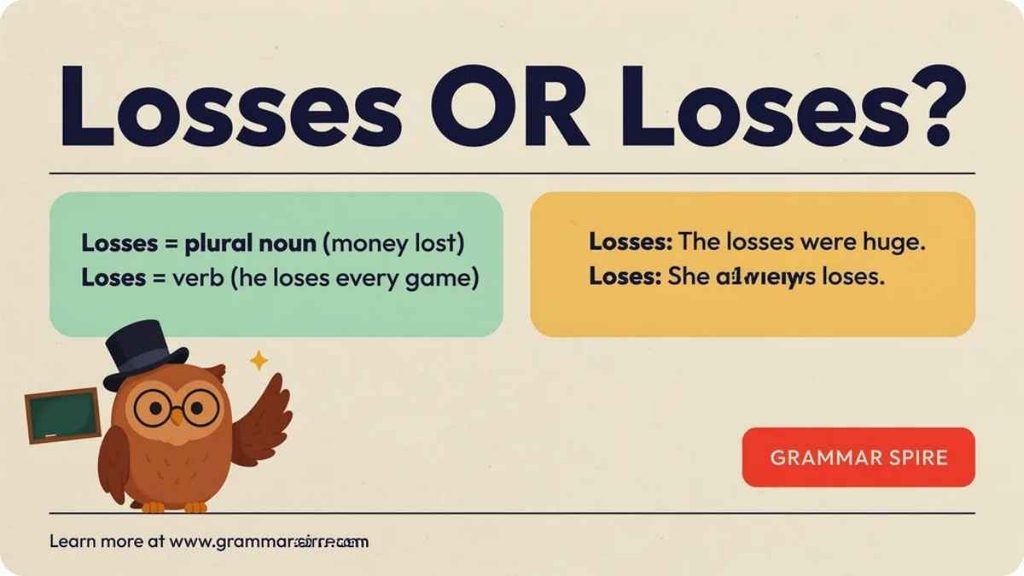
The easiest way to understand losses vs loses is to identify the part of speech.
Losses is a noun. Loses is a verb.
That distinction solves most confusion between the two words.
Compare these sentences:
The company suffered financial losses.
The company loses money every year.
The first sentence names the result. The second sentence describes what the company does.
This difference also explains much of the losses or loses grammar.
Losses Is a Plural Noun
Losses names multiple instances or amounts of loss.
For example:
The business reported heavy losses.
The word losses refers to the negative financial results.
You could replace losses with setbacks in some contexts:
The business reported heavy setbacks.
The meaning changes slightly, but the grammatical role remains noun-like.
Loses Is a Verb
Loses describes what a singular third-person subject does.
For example:
The business loses customers.
Here, business serves as the singular subject, while loses serves as the verb.
You could explain the meaning with a phrase such as “fails to retain”:
The business fails to retain customers.
That substitution helps show why loses functions as a verb.
What Is the Difference Between Losses and Loses?
The core difference is grammatical:
Losses = plural noun
Loses = third person singular verb
Compare:
The team suffered several losses.
The team loses important matches.
The first sentence names several defeats. The second sentence describes the team’s action or result.
Learn the difference between tricky words and use them correctly
Monkeys or Monkies Which Spelling Is Correct?
Losses or Loses Comparison Table
| FeatureLossesLoses | ||
|---|---|---|
| Part of speech | Noun | Verb |
| Form | Plural noun | Third-person singular present |
| Related word | Loss | Lose |
| Singular/base form | Loss | Lose |
| Refers to | Multiple losses | An action or situation |
| Common context | Financial losses, sports losses | Someone loses money, a team loses |
| Example | The company reported losses. | The company loses money. |
Lose vs Loss Understanding the Difference
The lose vs loss distinction helps you understand losses and loses as well.
Lose functions as a verb.
Don’t lose your passport.
Loss functions as a noun.
The loss of the passport caused serious problems.
These words belong to the same family, but they perform different jobs.
| WordGrammatical RoleExample | ||
|---|---|---|
| Lose | Base verb | Don’t lose your keys. |
| Loses | Third person singular verb | She loses her keys. |
| Losing | Present participle/gerund | He is losing his patience. |
| Lost | Past tense/past participle | She lost her keys. |
| Loss | Singular noun | The loss was frustrating. |
| Losses | Plural noun | The losses were significant. |
Once this pattern becomes familiar, the difference between lose vs loses and loss vs losses becomes much easier to recognize.
Lose vs Loses
The difference between lose vs loses depends mainly on the subject and sentence structure.
Use lose with:
- I
- You
- We
- They
- Plural subjects
- Modal verbs
- Certain auxiliary structures
Examples:
I don’t want to lose this opportunity.
They may lose the match.
Use loses with a singular third person subject:
He loses his temper easily.
She loses interest quickly.
A common grammar mistake occurs when writers use lose after a singular third-person subject.
Incorrect:
He lose his phone every week.
Correct:
He loses his phone every week.
However, the base form returns after does or doesn’t.
Correct:
He doesn’t lose his phone often.
Incorrect:
He doesn’t loses his phone often.
The auxiliary verb doesn’t already carries the required third person form, so the main verb stays in its base form.
Loss vs Losses
The loss vs losses distinction concerns number.
Use loss when you mean one loss.
The financial loss was substantial.
Use losses when you mean multiple losses.
The financial losses were substantial.
This answers the question, “What is the plural of loss?”
The answer is losses.
It also answers, “Is losses plural?”
Yes. Losses is the plural form of the singular noun loss.
Loss or Losses?
Choose between them according to number.
The company suffered a major loss.
This refers to one loss.
The company suffered several major losses.
This refers to more than one loss.
The same rule applies to many other nouns. Singular and plural forms must match the meaning of the sentence.
Losses vs Lose
The losses vs lose comparison involves a noun and a verb.
Losses is a plural noun:
The company reported large losses.
Lose is a base verb:
Companies can lose money during difficult periods.
You cannot normally swap the two words without changing the grammar.
Compare:
The business experienced heavy losses.
The business may lose money.
The first sentence uses a noun after experienced. The second uses a verb after may.
Loses vs Loss
The loses vs loss comparison follows the same pattern.
Loses is a verb:
She loses money.
Loss is a noun:
Her loss was unexpected.
The first sentence describes an action or situation. The second names the resulting loss.
Use in Everyday Contexts

Business Writing
Business language frequently uses both words.
The company reported annual losses of $2 million.
Here, losses refers to financial deficits.
Now compare:
The company loses approximately $2 million each year.
Here, loses describes the company’s financial situation.
These sentences discuss similar ideas, but they use different grammatical structures.
Sports Writing
Sports provides another clear example.
The team suffered five losses this season.
Here, losses means defeats.
Now consider:
The team loses when it fails to score enough points.
Here, loses acts as the verb.
The distinction also appears in win or lose and win or loss expressions.
Use win or lose when both words act as verbs:
Every competitor must eventually win or lose.
Use wins and losses when you treat the results as nouns:
The team finished the season with ten wins and four losses.
Everyday Conversations
You can find both words in ordinary situations.
She loses her glasses every morning.
Her repeated losses of personal items became frustrating.
The first sentence describes an action. The second uses losses as a noun.
Learn the difference between tricky words and use them correctly
Receive or Recieve Which Spelling Is Correct?
Losses and Loses When Talking About Death
Loss and lost often appear in conversations about death, but their grammatical roles remain different.
Use loss when you refer to the experience or event:
The family experienced a devastating loss.
The loss of a loved one can be deeply painful.
Use lost when you describe what happened:
She lost her father last year.
The distinction between lost or loss when someone dies can therefore be summarized simply:
- Loss names the experience or event.
- Lost describes what happened.
- Losses refers to multiple experiences of loss.
- Loses remains a present-tense verb for a singular third-person subject.
For example:
His loss deeply affected the family.
She lost her brother several years ago.
The community suffered several tragic losses.
Notice that the words remain different even though they describe closely related ideas.
Volumn or Volume Which Is the Correct Spelling?
Lose, Loses, Lost, Loss, and Losses Explained
These five words can cause confusion because they share the same basic word family.
Their grammatical roles make the difference clear.
Lose
Lose is the base verb.
Don’t lose your receipt.
Loses
Loses is the third-person singular present-tense form of lose.
She loses her receipt frequently.
Losing
Losing is the present participle and can also function as a gerund.
He is losing patience.
Losing the match disappointed the players.
Lost
Lost serves as both the past tense and past participle of lose.
She lost her receipt yesterday.
He has lost his wallet.
Loss
Loss is a singular noun.
The loss was frustrating.
Losses
Losses is the plural noun.
Several losses affected the business.
The complete pattern is easier to remember this way:
| Verb FormsNoun Forms | |
|---|---|
| lose | loss |
| loses | losses |
| losing | — |
| lost | — |
This word family explains the difference between lose loses lost and loss as well as the broader relationship among these commonly confused words.
Learn the difference between tricky words and use them correctly
Leasee vs Lessee Which Spelling Is Correct?
Word Formation Why Is the Plural of Loss “Losses”?
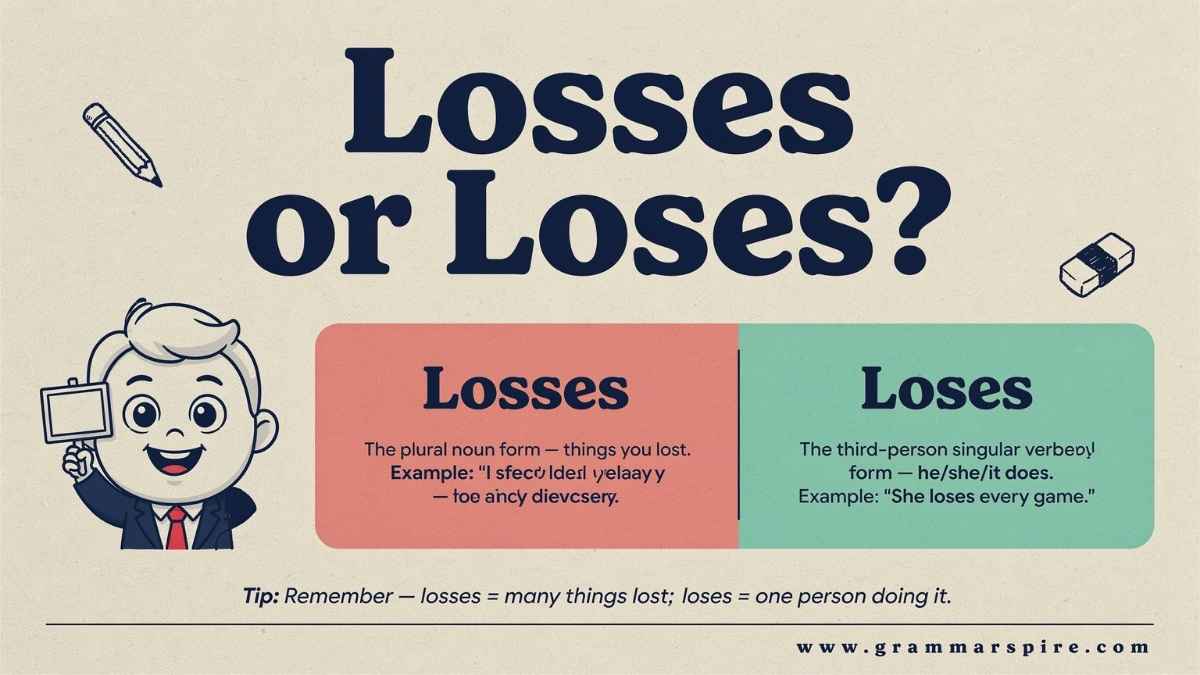
The spelling of losses follows a regular English plural pattern.
The singular noun is:
loss
To form the plural, English adds -es:
loss → losses
The spelling keeps the original double s and adds -es.
Compare:
- loss → losses
- class → classes
- kiss → kisses
- pass → passes
- business → businesses
The pronunciation also changes in the plural. The ending receives an additional syllable.
This pattern explains why loss plural is losses rather than loses.
Common Mistakes With Losses or Loses
Using Losses as a Verb
Incorrect:
The company losses money every year.
Correct:
The company loses money every year.
The sentence needs a verb. Loses supplies that verb.
Using Loses as the Plural of Loss
Incorrect:
The company experienced heavy loses.
Correct:
The company experienced heavy losses.
The sentence needs a plural noun after experienced.
Confusing Lose and Loss
Incorrect:
The team suffered a lose.
Correct:
The team suffered a loss.
But:
The team might lose.
Lose acts as the verb. Loss acts as the noun.
Using Loses After Doesn’t
Incorrect:
She doesn’t loses her keys often.
Correct:
She doesn’t lose her keys often.
The auxiliary verb doesn’t already marks the third-person singular form. Use the base verb lose after it.
Confusing Lost and Loss
Incorrect:
His lost was devastating.
Correct:
His loss was devastating.
But:
He lost his father.
Lost functions as a verb in the second sentence. Loss functions as a noun in the first.
Using Lose After a Singular Third Person Subject
Incorrect:
The company lose money every year.
Correct:
The company loses money every year.
A singular third person subject requires loses in the simple present tense.
Learn the difference between tricky words and use them correctly
Hoofs or Hooves Which Spelling Is Correct?
British English vs American English
Losses and loses are standard in both American English and British English.
Neither word has a separate British spelling.
The distinction comes from grammar and meaning rather than regional spelling.
| WordAmerican EnglishBritish English | ||
|---|---|---|
| Loss | Correct | Correct |
| Losses | Correct | Correct |
| Lose | Correct | Correct |
| Loses | Correct | Correct |
| Lost | Correct | Correct |
Therefore, don’t choose between losses and loses based on whether you’re writing for an American or British audience.
Choose according to the sentence.
When to Use Losses
Use losses when you need a plural noun.
You should choose losses when:
- You mean more than one loss.
- You discuss financial deficits.
- You describe several defeats.
- You refer to multiple reductions.
- You discuss several personal losses.
- You name several negative results.
Examples:
The business suffered major losses.
The team recorded several losses.
The company reported financial losses.
When to Use Loses
Use loses when you need a present-tense verb for a singular third-person subject.
Choose loses when:
- The subject is he, she, or it.
- The subject is a singular noun.
- The sentence describes an action or situation.
- The subject fails to keep something.
- The subject fails to win.
- The subject experiences a reduction.
Examples:
She loses her keys frequently.
The team loses when it plays poorly.
The machine loses power quickly.
A Simple Test for Correct Word Usage
When you’re unsure whether to use losses or loses, don’t stare at the two spellings until they start looking like alphabet soup. Instead, examine the sentence.
Ask yourself these questions:
Is the word naming multiple losses?
If yes, choose losses.
Is a singular person or thing performing the action of losing?
If yes, choose loses.
Does the sentence contain does, doesn’t, can, could, may, might, should, or will before the verb?
Use lose, not loses.
For example:
She loses money.
But:
She may lose money.
The helping word changes the verb form.
Losses or Loses Side by Side Examples
| Confusing VersionCorrect VersionReason | ||
|---|---|---|
| The company losses money. | The company loses money. | Loses is the verb. |
| The team suffered three loses. | The team suffered three losses. | Losses is the plural noun. |
| She doesn’t loses often. | She doesn’t lose often. | Use the base verb after doesn’t. |
| His lost was painful. | His loss was painful. | Loss is the noun. |
| The team may loses. | The team may lose. | Use the base verb after may. |
| She loss her phone. | She lost her phone. | Lost is the past-tense verb. |
| The company lose money every year. | The company loses money every year. | A singular subject takes loses. |
| They loses money. | They lose money. | A plural subject takes lose. |
Losses or Loses Grammar Checker What Should You Check?
A losses or loses grammar checker can help identify certain mistakes, but context remains essential.
Consider:
The company losses money.
The sentence needs a verb. The correct word is loses.
Now look at:
The company’s losses increased.
Here, losses is correct because the word functions as a plural noun.
A grammar checker can highlight possible errors, but a basic understanding of English grammar makes the correction much more reliable.
Before accepting a suggested correction, check:
- The part of speech
- The subject
- The verb tense
- Singular or plural meaning
- The surrounding words
- The intended meaning
This approach supports accurate English word usage and correct word usage rather than relying entirely on automated suggestions.
Learn the difference between tricky words and use them correctly
Barrel or Barrell Which Spelling Is Correct?
Losses or Loses Pronunciation
The words also have different vowel sounds.
Losses contains the vowel sound commonly heard in words such as “loss” in many American accents. It also ends with the plural sound represented by -es.
Loses begins with the vowel sound found in “lose” and ends with the same general /ɪz/ type of ending heard in many third-person singular and plural forms.
This difference can help with loses pronunciation vs losses pronunciation.
When someone asks, “How do you pronounce losses?” or “How do you pronounce loses?”, the first vowel sound provides an important clue.
However, context remains the strongest way to distinguish them in writing.
Here’s a trusted source for clear more words Comparison:
Grammar Update
Practice Session Losses or Loses
It’s time to put the difference between losses, loses, lose, loss, lost, and loose into practice. Choose the word that best completes each sentence. Pay close attention to the meaning and grammar of every sentence.
Fill in the Blanks
1. The company experienced significant financial ________ last year.
2. She often ________ her keys when she is in a hurry.
3. I don’t want to ________ this valuable opportunity.
4. The team ________ the final match yesterday.
5. The death of a loved one can cause a deep sense of ________.
6. The business reported several unexpected ________ during the year.
7. He doesn’t want to ________ his phone again.
8. My brother frequently ________ his wallet.
9. The players ________ the championship after a close contest.
10. The family struggled with the ________ of their loved one.
11. You could ________ money if you make a careless investment.
12. She ________ patience when people interrupt her.
13. The company faced heavy financial ________ after the failed project.
14. We must work hard if we don’t want to ________ the game.
15. He ________ concentration during important matches.
16. The sudden ________ of confidence affected her performance.
17. Did you ________ weight after starting your new routine?
18. The business ________ money on the unsuccessful project.
19. Several companies suffered major ________ during the difficult period.
20. He ________ his place in the competition after making a mistake.
21. Nobody wants to ________ someone they care about.
22. The player rarely ________ focus during an important match.
23. The manager described the financial ________ as a serious concern.
24. The team recorded five wins and two ________ this season.
25. If you aren’t careful, you may ________ your chance.
26. She ________ her temper whenever the discussion becomes stressful.
27. The organization reported substantial ________ after the investment failed.
28. We ________ the match because we made several errors.
29. The ________ of trust can seriously damage a relationship.
30. These shoes are too ________, so they don’t fit securely.
Answers
1. losses
2. loses
3. lose
4. lost
5. loss
6. losses
7. lose
8. loses
9. lost
10. loss
11. lose
12. loses
13. losses
14. lose
15. loses
16. loss
17. lose
18. lost
19. losses
20. lost
21. lose
22. loses
23. loss
24. losses
25. lose
26. loses
27. losses
28. lost
29. loss
30. loose
Learn the difference between tricky words and use them correctly
Grate or Great Which One Is Correct?
FAQs About Losses or Loses
Which is correct, loses or losses?
Both loses and losses are correct words, but they have different grammatical roles. Loses is the third-person singular form of the verb “lose,” while losses is the plural form of the noun “loss.”
Which is correct, lose or loses?
Both forms are correct, depending on the subject and sentence structure. Use lose with subjects such as “I,” “you,” “we,” and “they.” Use loses with a singular third-person subject, such as “he,” “she,” or “the team.”
What does losses mean?
Losses refers to more than one loss. It can describe financial setbacks, defeats, reductions, or instances in which something valuable has been lost. For example, “The company reported significant losses.”
Which is correct “wins and losses” or “loses”?
The correct expression is “wins and losses.” Here, “wins” and “losses” are both plural nouns. “Loses” is a verb and does not fit this construction.
What does the word loses mean?
Loses means that a singular person, animal, organization, or thing fails to keep, obtain, find, or win something. For example, “She loses her keys frequently.” It can also describe being defeated, as in “The team loses every close match.”
Do you loose or lose weight?
The correct word is lose. You say, “I want to lose weight.” Loose means not tight or firmly attached, so it does not express the idea of reducing body weight.
Did you lose or loose weight?
The correct expression is “Did you lose weight?” The auxiliary “did” requires the base form lose, not “loses” or “loose.”
Do you lose money or loose money?
The correct expression is “lose money.” For example, “You could lose money if you invest without understanding the risks.” “Loose” has a different meaning and does not work in this context.
Do you say loss or lost?
The choice depends on the grammatical role. Loss is a noun, while lost is the past tense and past participle of “lose.” For example, “The loss was painful” uses a noun, while “She lost her wallet” uses a verb.
Do you loose or lose a game?
The correct expression is “lose a game.” For example, “The team may lose the game.” The word “loose” does not describe being defeated.
What does the word losses mean?
Losses is the plural noun form of loss. It describes multiple instances of losing something or multiple amounts of reduction, damage, defeat, or financial deficit. For example, “The business experienced heavy losses.”
Do you lose or loose a person?
The correct expression is “lose a person.” For example, “She was afraid she might lose someone she loved.” When referring to death, loss is normally used as a noun, such as “the loss of a loved one.”
Do I say lose me or loose me?
The correct expression is “lose me.” For example, “You might lose me if you keep changing the plan.” Loose does not have the same meaning.
Which is correct “lose someone” or “loss someone”?
The correct expression is “lose someone.” “Lose” functions as a verb in this phrase. Loss is a noun, so you could say “the loss of someone” but not “loss someone.”
Is it loss or lose a match?
The correct phrase is “lose a match.” Since the sentence describes an action or result involving a verb, use lose. For example, “The player could lose the match.”
AEO Losses or Loses
What is the difference between losses and loses?
Losses is a plural noun, while loses is a verb. “Losses” refers to multiple instances of loss, whereas “loses” describes what a singular subject does. For example, “The company suffered losses” and “The company loses money.”
Is “losses” a correct word?
Yes. Losses is the correct plural form of loss. It can refer to financial deficits, defeats, reductions, or other forms of loss.
Is “loses” a correct word?
Yes. Loses is the correct third-person singular present form of lose. For example, “He loses his keys often.”
When should I use losses?
Use losses when you need the plural noun form of loss. For example, “The business recorded losses this year.” You can also use it when discussing multiple defeats or other instances of losing something.
When should I use loses?
Use loses when a singular third-person subject performs the action described by lose. For example, “She loses her phone often” or “The team loses another match.”
What is the plural of loss?
The plural of loss is losses. For example, “The company suffered one loss” becomes “The company suffered several losses.”
Is losses a noun?
Yes. Losses is a plural noun. It is the plural form of loss and can describe multiple instances or amounts of loss.
Is loses a noun?
No. Loses functions as a verb. It is the third-person singular present form of lose.
How do you use losses in a sentence?
Use losses when referring to more than one loss. For example, “The company reduced its financial losses.”
How do you use loses in a sentence?
Use loses with a singular third-person subject. For example, “He loses concentration when he feels tired.”
What is the difference between lose, loss, lost, and loses?
Lose is the base verb, loses is its third-person singular present form, lost is its past tense and past participle, and loss is a noun. For example, “I may lose,” “She loses,” “They lost,” and “The loss was unexpected.”
Should I say lose or loss?
Use lose when you need a verb and loss when you need a noun. For example, “I don’t want to lose the game” uses a verb, while “The defeat was a painful loss” uses a noun.
Should I say lost or loss?
Use lost when describing the act or result of losing, and use loss when naming the event, experience, or thing that was lost. For example, “She lost her father” and “She struggled with the loss of her father.”
How do you pronounce losses?
Losses is pronounced approximately LAW-siz in many varieties of American English. It contains two syllables and ends with an /ɪz/ sound.
How do you pronounce loses?
Loses is pronounced approximately LOO-ziz in many varieties of American English. It also contains two syllables, but its first vowel sound differs from that of “losses.”
Is “loose” the same as “lose”?
No. Loose and lose have different meanings and pronunciations. “Loose” generally means not tight or securely fixed, while “lose” means to no longer have something, fail to win, or be unable to find something.
Is “losses” the plural of “lose”?
No. Losses is the plural of the noun loss. The word lose is a verb, and its third-person singular present form is loses.
What should I use after “did”?
Use lose, not “loses.” After the auxiliary verb “did,” English uses the base form of the main verb. For example, “Did you lose your keys?”
What should I use after “does”?
Use lose, not “loses.” For example, “Does she lose her phone often?” The auxiliary “does” already carries the third-person singular marking.
Is it “lose a match” or “loss a match”?
The correct expression is “lose a match.” “Lose” acts as the verb. For example, “They could lose the match.”
Is it “loss someone” or “lose someone”?
The correct expression is “lose someone.” “Lose” functions as a verb, while “loss” functions as a noun. For example, “Nobody wants to lose someone they love.”
Conclusion
The difference between losses or loses may look minor, but that single letter can completely change a sentence. Losses is the plural form of the noun loss, while loses is the third-person singular form of the verb lose. Once you recognize their grammatical roles, the choice becomes much simpler. A company can report financial losses, while it loses money. A team can suffer several losses, while a player loses a match. Keep this noun and verb distinction in mind, and these commonly confused words won’t have to keep you guessing. With a little practice, choosing between them becomes as easy as spotting the difference between a noun and a verb.

Ella AJS
Ella AJS is an experienced blogger and language enthusiast at Grammar Spire, dedicated to making English grammar simple, practical, and easy to understand. She specializes in word comparisons, meanings, usage, and common language confusions. Through clear explanations and engaging examples, Ella helps students, writers, and English learners improve their vocabulary and communicate with greater confidence and accuracy.




