
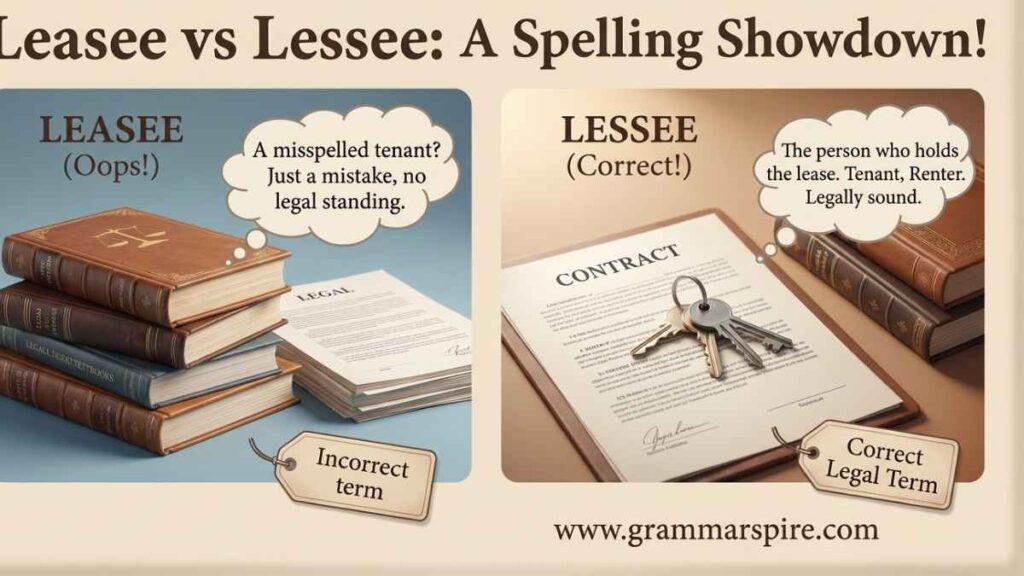
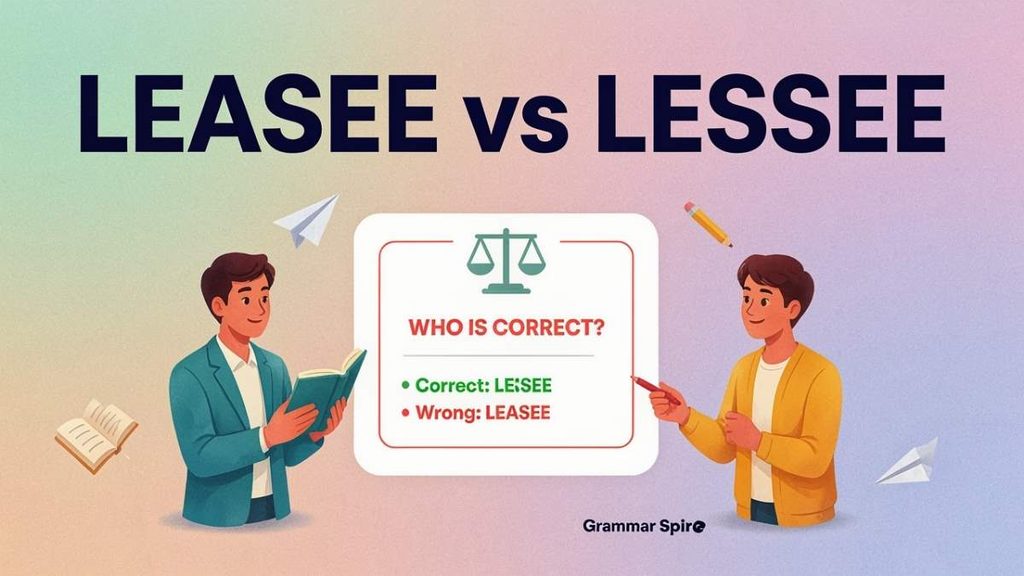
English can make a simple spelling choice feel like a legal puzzle, and leasee vs lessee is a classic example. At first glance, leasee seems logical because it looks connected to lease. However, appearances can be misleading. The standard term is lessee, which refers to the person or organization that receives the right to use property or an asset under a lease. If you’re writing a rental agreement, business document, or formal article, choosing the correct spelling keeps your writing clear and professional. So, let’s settle this confusing word pair, uncover why the mistake happens, and make lessee easy to remember once and for all.
Leasee vs Lessee Which Is Correct?
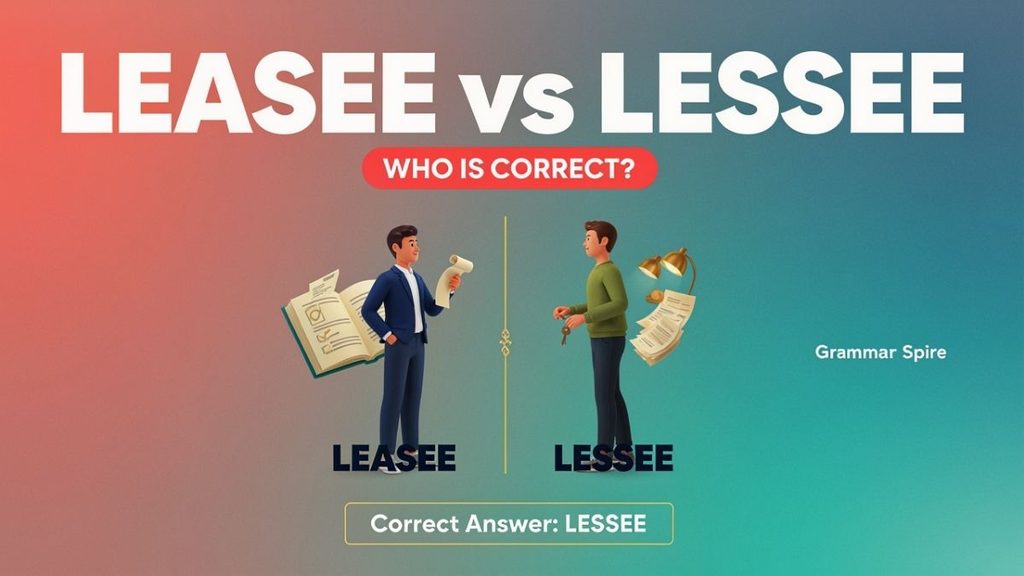
Lessee is the standard spelling.
The confusion usually comes from the relationship between lease and lessee. Someone might naturally think that adding ee to lease should produce leasee. English, however, doesn’t always create related words by following such a neat formula.
The established noun is lessee.
| Word | Standard usage | Meaning |
|---|---|---|
| Lessee | Standard | Person or organization receiving rights under a lease |
| Leasee | Nonstandard | Form sometimes used for a lessee |
| Lessor | Standard | Person or organization granting rights under a lease |
| Tenant | Standard | Person occupying property under a rental arrangement |
| Renter | Standard | Person who rents something |
If you’re preparing a lease agreement, business document, legal explanation, or professional email, choose lessee.
Leasee vs Lessee Correct Spelling
The leasee vs lessee correct spelling is:
Lessee
Spell it as:
L-E-S-S-E-E
Notice the important details:
- It contains two s’s.
- It ends with two e’s.
- It doesn’t contain a after the first syllable.
- It doesn’t follow the modern spelling of lease.
For example:
The lessee must pay the monthly rent according to the lease terms.
That sentence uses the standard spelling.
Is It Leasee vs Lessee?
If you’re asking “is it leasee vs lessee?”, choose lessee.
The distinction matters even more in formal writing. Contracts rely on precise terminology, so replacing an established legal term with a nonstandard spelling can make a document look careless.
The meaning may remain understandable, but correct spelling gives your writing greater clarity and professionalism.
Learn the difference between similar English words the easy way
Buoy or Bouy Which Spelling Is Correct?
Leasee vs Lessee Spelling Why Is Lessee Correct?
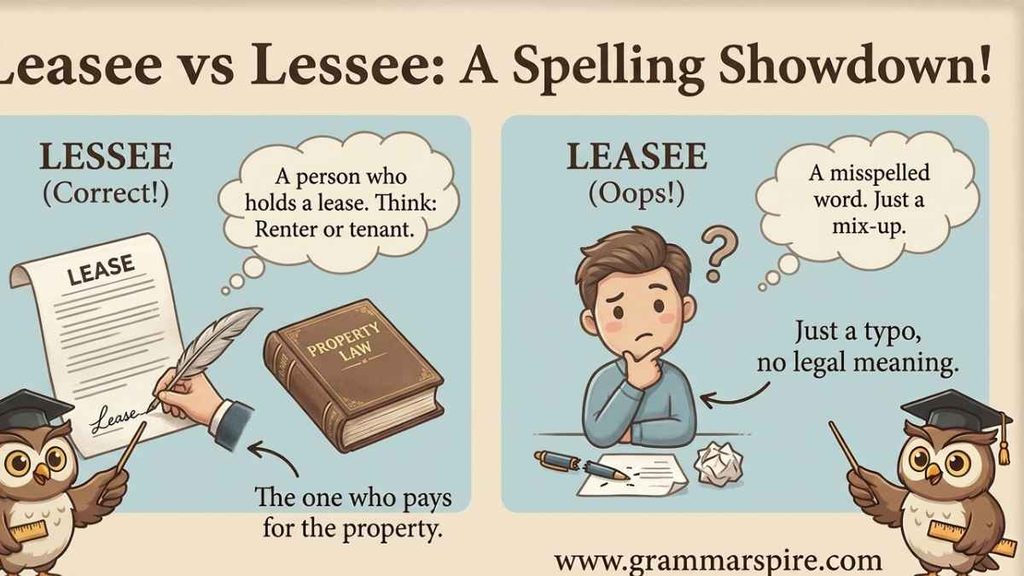
The spelling lessee comes from an older linguistic and legal tradition. Its history connects to Anglo-French and Old French forms associated with leasing and letting property.
That history explains why the word doesn’t simply look like lease + ee.
English contains many words that preserve older spellings even when modern speakers expect a more obvious pattern. Lessee belongs to that group.
Think of it as a word that took its own historical road.
The modern spelling stayed with lessee, even though leasee looks tempting.
How to Spell Lessee
If you often forget how to spell lessee, memorize this pattern:
LES + SEE = LESSEE
You can also remember the relationship between lessor and lessee:
Lessor gives. Lessee gets.
The lessor grants the right to use the property.
The lessee receives that right.
This memory trick helps with both spelling and meaning.
Learn the difference between similar English words the easy way
Opening or Openning Which one is correct?
Is Leasee a Word?
Is leasee a word? You may find leasee in some dictionaries or online references. Those sources may describe it as a nonstandard form referring to someone who leases something.
That doesn’t make it the preferred choice in formal English.
Major dictionaries recognize lessee as the standard noun. Legal terminology also uses lessee.
Therefore, if you’re deciding between the two forms, choose lessee.
Leasee Spelling Mistake
The leasee spelling mistake makes perfect sense from a word-building perspective.
Someone sees:
lease + ee = leasee
The logic looks convincing.
Yet the established word uses a different spelling:
lessee
You might encounter leasee in casual online content, but formal writing calls for the standard form.
Use lessee when writing:
- lease agreements
- rental contracts
- property documents
- business correspondence
- legal explanations
- academic material
- real-estate content
- professional reports
- Learn the difference between similar English words the easy way
Many or Meny Which Spelling Is Correct?
Lessee Meaning and Definition
What Does Lessee Mean?
Lessee meaning refers to the person or organization that receives the right to use or possess property under a lease.
In simple terms, a lessee leases something from another party.
For example, imagine that Daniel rents an apartment for two years.
Daniel signs the lease agreement and agrees to pay $1,600 each month.
In this situation:
- Daniel is the lessee.
- The property owner is the lessor.
- The apartment is the leased property.
- The signed contract is the lease agreement.
- The $1,600 payment represents the agreed monthly rent.
The lessee receives certain rights under the contract. Those rights depend on the lease terms and applicable law.
Lessee Meaning in English
The lessee meaning in English is relatively simple:
A lessee is a person or organization that holds the right to use or possess something under a lease.
The leased item doesn’t have to be a house.
A person might become a lessee when they:
- rent an apartment
- rent a house
- lease a car
- lease equipment
- lease an office
- rent commercial property
- use machinery under a lease
A company can also act as a lessee.
For example:
The company became the lessee of a new office building.
The company receives the contractual right to use the building during the agreed lease period.
Learn the difference between similar English words the easy way
Bareable or Bearable Which Spelling Is Correct?
Lessee Definition in Law
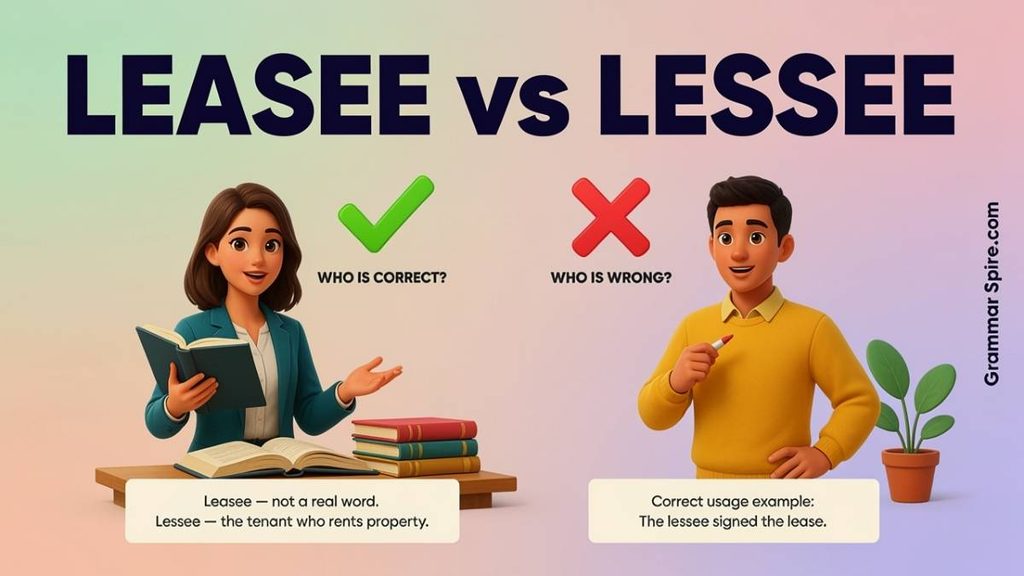
The lessee definition in law generally describes the party that receives temporary possession or use of property through a lease.
A lease creates a contractual relationship between the parties.
The lessee receives certain rights.
The lessor grants those rights.
The agreement usually establishes the terms that govern their relationship.
Those terms can cover:
- rent payments
- lease duration
- maintenance
- permitted use
- renewal
- termination
- security deposits
- property care
- other contractual obligations
The law may also impose rights and duties on the parties.
For that reason, the exact legal meaning of a lessee can depend on the type of lease and the jurisdiction involved.
Lessee Definition in Real Estate
The lessee definition in real estate refers to the person or organization that receives the right to occupy or use real property under a lease.
Suppose a property owner rents an office to a marketing company.
The property owner serves as the lessor.
The marketing company serves as the lessee.
The company can use the office according to the lease terms. The lease doesn’t normally transfer ownership of the building to the company.
That distinction separates ownership from possession and use.
What Is a Lessee?
So, what is a lessee in everyday language?
A lessee is simply the party on the receiving side of a lease.
The party could be:
- an individual
- a family
- a business
- a nonprofit organization
- another legal entity
The leased item could include:
- residential property
- commercial property
- vehicles
- machinery
- equipment
- other assets
This broad meaning makes lessee useful in both real estate and business contexts.
Who Is a Lessee in a Lease?
Who is a lessee?
The lessee is the person or organization that receives the contractual right to use or possess the leased property or asset.
Consider a simple example.
Maria owns a house and rents it to James for one year.
Maria grants James the right to occupy the house under the lease.
Therefore:
Maria = lessor
James = lessee
James doesn’t become the owner simply because he lives there.
He receives the rights described in the rental contract.
Lessee in a Lease Agreement
The lessee in a lease has a defined role in the contract.
A lease agreement usually identifies the parties and describes the property or asset involved. It then establishes the terms that govern the arrangement.
A residential lease might address:
- monthly rent
- security deposit
- lease term
- move-in date
- move-out date
- maintenance duties
- utility payments
- occupancy rules
- pets
- subleasing
- renewal
- termination
A commercial lease may cover much more detailed issues.
For example, a commercial lease could address:
- operating hours
- permitted business activities
- insurance
- property improvements
- signage
- common-area expenses
- maintenance
- taxes
- renewal options
The lessee must follow the obligations stated in the agreement.
Lessee in a Rental Agreement
The lessee in a rental agreement is the party receiving the right to use the rental property.
In everyday conversation, people usually say tenant or renter.
Formal documents often use lessee.
For example:
The lessee shall make the monthly rental payment according to the terms of this agreement.
The sentence identifies the renter in formal contractual language.
A rental arrangement doesn’t always involve a house or apartment. Businesses can rent office space, stores, warehouses, and other commercial property.
Learn the difference between similar English words the easy way
Studder or Stutter Which Spelling Is Correct?
Lessee vs Lessor What’s the Difference?
The lessee vs lessor distinction becomes easy once you understand who gives and who receives.
Lessor Meaning
The lessor is the party that grants the right to use or possess property under a lease.
In a residential setting, the lessor usually acts as the landlord.
Lessee Meaning
The lessee is the party that receives the right to use or possess the property.
In a residential setting, the lessee usually acts as the tenant.
| Role | Formal term | Common real-estate term |
|---|---|---|
| Grants lease rights | Lessor | Landlord |
| Receives lease rights | Lessee | Tenant |
Difference Between Lessee and Lessor
Imagine that a company leases a warehouse from its owner.
The owner grants the company the right to use the warehouse.
Therefore:
Owner = lessor
Company = lessee
The company may operate its business from the warehouse during the agreed lease period. The owner generally retains ownership.
This simple relationship explains the difference between lessee and lessor.
Lessee and Lessor Relationship
The lessee and lessor form the two primary sides of a lease.
Their relationship depends on the agreement and applicable law.
The lessee typically receives possession or use.
The lessor typically retains ownership or the relevant property interest.
Both parties may have contractual responsibilities.
Simple Case Study Residential Lease
Imagine that Olivia owns a two-bedroom house.
She leases the property to Noah for 12 months.
The agreement requires Noah to pay $2,000 each month.
It also explains who handles repairs, how either party can terminate the agreement, and whether Noah can keep pets.
Here’s how the arrangement works:
| Element | Example |
|---|---|
| Property | Two-bedroom house |
| Property owner | Olivia |
| Lessor | Olivia |
| Lessee | Noah |
| Lease period | 12 months |
| Monthly rent | $2,000 |
| Agreement | Residential lease |
Olivia remains the property owner.
Noah receives the contractual right to occupy and use the house during the lease period.
Simple Case Study Business Lease
Now consider a technology company that leases office space.
The company signs a five-year commercial lease and pays $8,000 each month.
The building owner grants the company the right to use the office.
Here:
- The building owner is the lessor.
- The technology company is the lessee.
- The office is the leased property.
- The five-year period represents the lease term.
- The $8,000 payment represents the agreed monthly rent.
The same lessee-and-lessor relationship appears in both residential and commercial leasing.
Learn the difference between similar English words the easy way
Useing or Using Which spelling Is Correct?
Leasee vs Lessee What’s the Difference?
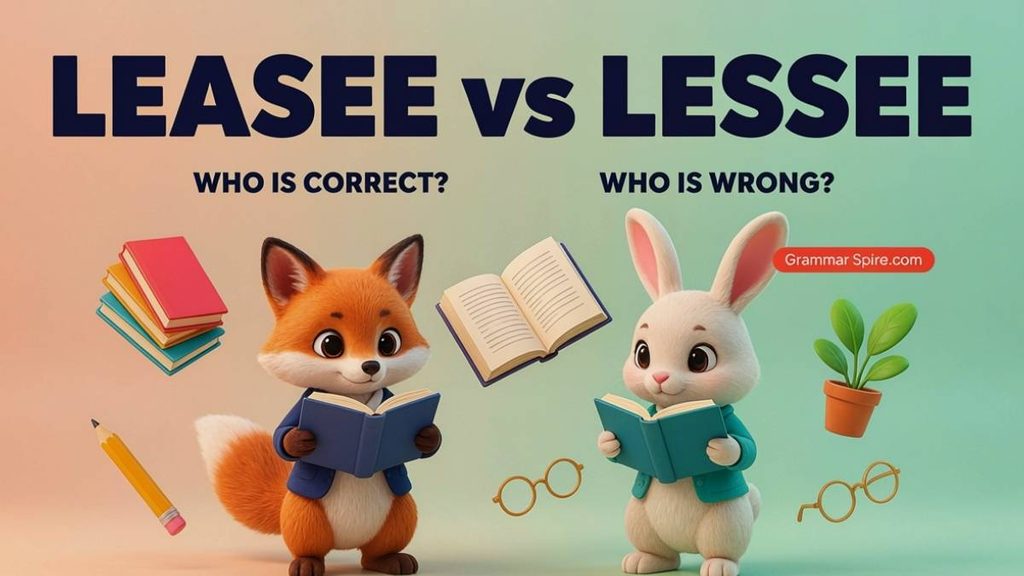
The primary leasee vs lessee difference concerns standard usage.
Lessee is the established standard form.
Leasee sometimes appears as a nonstandard alternative.
Both forms may communicate the same intended idea, but formal English favors lessee.
| Feature | Leasee | Lessee |
|---|---|---|
| Intended meaning | Person receiving lease rights | Person receiving lease rights |
| Standard formal spelling | No | Yes |
| Common legal terminology | No | Yes |
| Found in informal writing | Sometimes | Yes |
| Recommended for contracts | No | Yes |
Therefore, the answer to “leasee vs lessee which is correct?” remains lessee.
Leasee vs Lessee Meaning and Examples
Understanding the leasee vs lessee meaning becomes easier through real examples.
Example Apartment
Sarah rents an apartment under a two-year lease. Sarah is the lessee.
Example Equipment
A construction company leases heavy equipment from an equipment provider. The construction company is the lessee.
These examples show that a lessee can use many different types of leased property.
Learn the difference between similar English words the easy way
Speach or Speech What one is Correct?
Lessee vs Tenant
The lessee vs tenant question comes up often in real estate.
The terms overlap significantly in residential leasing.
A tenant generally occupies property under a rental arrangement.
A lessee holds rights under a lease.
For a typical apartment lease, the same person can accurately be called both.
For example:
Emma rents an apartment under a one-year lease.
Emma is:
- the tenant
- the renter
- the lessee
The word lessee has a broader contractual flavor because it can apply to property beyond residential housing.
with:
Lessee vs Leaseholder
The terms lessee and leaseholder can overlap, especially in property discussions.
A lessee receives rights under a lease.
A leaseholder holds a leasehold interest.
The exact legal distinction can vary by jurisdiction and property arrangement.
For a straightforward rental contract, lessee clearly identifies the party receiving the rights under the lease.
Lessee Pronunciation
The standard lessee pronunciation sounds approximately like:
les-SEE
The stress falls on the second syllable.
Dictionaries commonly represent the pronunciation with forms such as /leˈsiː/.
The ending sounds like see.
Once you hear the word, its pronunciation becomes much easier than its spelling.
Is Lessee a Word?
Yes. Lessee is a standard English noun.
Major dictionaries recognize the word.
Merriam-Webster defines it in connection with possession of real or personal property under a lease. Cambridge describes a lessee as a person or organization with the right to use something according to a lease. Oxford also recognizes the term in legal usage.
The word appears regularly in:
- legal writing
- real estate
- commercial leasing
- property management
- business contracts
- rental agreements
So if you’re wondering “is lessee a word?”, the answer is an easy yes.
Learn the difference between similar English words the easy way
Monkeys or Monkies Which Spelling Is Correct?
Lessee Plural What Is the Plural of Lessee?
The lessee plural is lessees.
Singular
One lessee
The lessee signed the lease agreement.
Plural
Two or more lessees
The lessees signed separate rental agreements.
The plural simply adds s.
| Singular | Plural |
|---|---|
| lessee | lessees |
| lessor | lessors |
| tenant | tenants |
| renter | renters |
Therefore, the plural of lessee is lessees, not lessee’s unless you intend to show possession.
Why Is Lessee Spelled With Two E’s?
People often ask, “Why is lessee spelled with two e’s?”
The spelling reflects the historical development of the word rather than a simple modern spelling formula.
The word comes through Anglo-French and Old French forms connected with leasing or letting.
The ending also fits a broader English pattern found in words such as:
- employee
- trainee
- nominee
- referee
- lessee
That doesn’t mean every word ending in -ee follows exactly the same historical path.
The important point remains simple:
The established spelling is lessee.
Lessee Synonym What Is Another Word for Lessee?
A lessee synonym depends on the situation.
Common alternatives include:
- tenant
- renter
- leaseholder, in certain contexts
However, these terms don’t always carry exactly the same legal meaning.
So, if someone asks for a synonym for lessee, tenant often works for residential property. Lessee remains the safest formal term when the contract itself uses that terminology.
What Is the Opposite of Lessee?
The usual opposite of lessee in a leasing relationship is lessor.
The two words describe opposite sides of the same arrangement.
Lessor → grants the lease rights
Lessee → receives the lease rights
For example:
The lessor owns the commercial building, while the lessee operates a business there under a lease.
This relationship often appears in simpler terms as:
Landlord → tenant
The formal terminology uses:
Lessor → lessee
Lessee Examples in Sentences
Here are several lessee examples that show how the word works naturally.
The lessee signed the lease agreement yesterday.
The lessee must make the monthly rent payment by the date stated in the contract.
Leasee Example Should You Use It?
A leasee example might look like this:
The leasee signed the rental agreement.
Readers can probably understand the intended meaning.
However, formal writing should use:
The lessee signed the rental agreement.
The second sentence uses the standard term.
That small spelling change can make a significant difference in a legal or professional document.
What Is a Lessee Responsible For?
The responsibilities of a lessee depend on the lease contract and applicable law.
Common obligations may include:
- paying rent on time
- following the lease terms
- using the property appropriately
- maintaining the property when the agreement assigns that responsibility
- following occupancy or usage rules
- caring for leased assets
- reporting certain problems
- returning the property when the lease ends, according to the agreement
A residential lessee and an equipment lessee may have very different responsibilities.
For example, a tenant might handle ordinary care of an apartment, while a business leasing machinery might handle routine equipment maintenance.
Always check the actual contract for specific obligations.
What Is a Lessor Responsible For?
The lessor’s responsibilities depend on the lease and applicable law.
Depending on the arrangement, the lessor may have duties involving:
- granting the agreed use or possession
- maintaining certain parts of the property
- handling required repairs
- respecting contractual rights
- complying with applicable legal requirements
- following the agreed lease terms
The lessee and lessor don’t simply exchange money for property.
They enter a contractual relationship with rights and responsibilities on both sides.
Learn the difference between similar English words the easy way
Receive or Recieve Which Spelling Is Correct?
Common Mistakes With Lessee
Understanding the common mistakes can make the correct spelling easier to remember.
Mistake Using Leasee
Incorrect in standard formal usage:
The leasee signed the agreement.
Preferred:
The lessee signed the agreement.
Mistake Reversing Lessee and Lessor
Incorrect:
The lessee owns the building and rents it to the lessor.
Preferred:
The lessor owns the building and leases it to the lessee.
Mistake Confusing Lease With Lessee
A lease is the agreement.
A lessee is a party to that agreement.
Compare:
The lease lasts for three years.
The lessee must follow the lease terms.
Mistake Assuming Lessee Means Home Tenant Only
A lessee doesn’t necessarily rent a home.
A person can lease a car.
A business can lease equipment.
How to Remember Leasee vs Lessee
Here’s a quick trick that works well:
Lessor gives. Lessee gets.
Now connect the spelling to the second part:
LESSEE = the one who gets the lease rights.
For spelling, remember:
L-E-S-S-E-E
You can also separate the word visually:
LES + SEE
That makes the two final e’s easier to remember.
Lease, Lessee, and Lessor The Three Terms You Need
These three words create most of the confusion.
| Term | What it describes | Simple explanation |
|---|---|---|
| Lease | Agreement | The arrangement between the parties |
| Lessor | Granting party | The party that grants the right to use property |
| Lessee | Receiving party | The party that receives the right to use property |
Consider this sentence:
The lessor and lessee signed a lease.
Now the relationship becomes clear.
The lessor grants the rights.
The lessee receives the rights.
The lease records their agreement.
Learn the difference between similar English words the easy way
Lessee vs Renter vs Tenant vs Leaseholder
These words overlap, but context matters.
| Term | Main use | Example |
|---|---|---|
| Lessee | Formal leasing terminology | The lessee signed the contract |
| Tenant | Residential or real-estate context | The tenant rents an apartment |
| Renter | Everyday language | The renter pays monthly rent |
| Leaseholder | Leasehold/property context | The leaseholder holds a leasehold interest |
You shouldn’t treat every term as an exact replacement for every other term.
For ordinary apartment rentals, tenant, renter, and lessee may describe the same person.
For a formal contract, lessee often provides the most precise wording.
Learn the difference between similar English words the easy way
Volumn or Volume Which Is the Correct Spelling?
American and British English
The word lessee appears in both American and British English.
The basic meaning remains the same.
Everyday real-estate terminology can differ between countries, though.
American speakers commonly use tenant, landlord, and lease in residential situations.
British speakers may use terms such as tenant, landlord, tenancy, and tenancy agreement depending on the situation.
Despite those differences, lessee remains a recognized formal term.
The spelling doesn’t change to leasee simply because the context involves American or British English.
Here’s a trusted source for clear more words Comparison:
Grammar Update
Practice Session
Ready to put your lessee vs. lessor knowledge to work? This practice session will help you distinguish between lessee, lessor, lease, leases, lessees, and lessors without getting tangled in the spelling.
Read each sentence carefully and fill in the blank with the word that best completes it.
Fill in the Blanks
- The person who receives the right to use property under a lease is called the __________.
- The person or organization that grants a lease is known as the __________.
- The standard spelling of the word is __________, not “leasee.”
- After signing the rental agreement, Maria became the __________ of the apartment.
- In a typical rental arrangement, the landlord is the __________ and the tenant is the __________.
- An agreement that gives someone the right to use property for a specific period is called a __________.
- The company became the __________ of the office building for five years.
- The property owner and the __________ signed the lease agreement.
- The plural form of lessee is __________.
- The plural form of lessor is __________.
- The plural form of lease is __________.
- A person who rents an apartment under a lease is generally a tenant and a __________.
- The __________ receives rent from the party using the property.
- The __________ is generally responsible for making rental payments according to the lease terms.
- A business can become a __________ when it leases equipment from another company.
- The tenant is usually the __________ because the tenant receives the right to use the property.
- The corresponding party on the other side of a lease is the __________.
- The word “leasee” is generally regarded as a __________ form of “lessee.”
- The company signed several __________ for its offices in different cities.
- The commercial building has several __________.
- The two property owners are the __________ in the lease arrangement.
- The __________ must follow the conditions set out in the lease agreement.
- The __________ grants the right to use the property for an agreed period.
- John leases a car from a company. John is the __________.
Answer Key
- lessee
- lessor
- lessee
- lessee
- lessor; lessee
- lease
- lessee
- lessee
- lessees
- lessors
- leases
- lessee
- lessor
- lessee
- lessee
- lessee
- lessor
- nonstandard
- leases
- lessees
- lessors
- lessee
- lessor
- lessee
FAQs About Leasee vs Lessee
What is the difference between a lessor and a lessee in a lease?
A lessor is the person or organization that grants the right to use property or an asset under a lease. A lessee is the party that receives that right. In a typical rental arrangement, the landlord is the lessor and the tenant is the lessee.
What does “leasee” mean?
“Leasee” is generally used as a nonstandard form of lessee. The established English term is lessee, which refers to a person or organization that leases property or another asset.
Who is the lessor and lessee?
The lessor grants the lease, while the lessee receives the right to use the property or asset. For example, when a landlord rents an apartment to a tenant, the landlord is the lessor and the tenant is the lessee.
How do you spell “lease”?
The word lease is spelled L-E-A-S-E. As a noun, it refers to an agreement that gives someone the right to use property or an asset for a specified period. As a verb, it means to rent or let something under agreed terms.
Is it “lease” or “lessee”?
Both lease and lessee are correct words, but they have different meanings. A lease is the agreement or arrangement. A lessee is the person or organization that receives the right to use something under that agreement.
What is the plural of lessee?
The plural of lessee is lessees.
Example: The building has several lessees.
Is it spelled “leasee” or “lessee”?
The standard spelling is lessee. Although leasee sometimes appears as a nonstandard form, lessee is the preferred spelling in formal, legal, business, and academic writing.
What is another word for lessee?
Depending on the context, tenant, renter, or leaseholder may describe someone who holds rights under a lease. However, these terms aren’t exact substitutes in every situation. Lessee is the more precise term for a party to a lease.
What is the plural of lease?
The plural of lease is leases.
Example: The company manages several commercial leases.
How do you spell “lessee”?
The correct spelling is L-E-S-S-E-E: lessee.
A simple memory aid is: The lessee gets the lease.
What is the opposite of a lessee?
The corresponding party is the lessor. The lessor grants the lease, while the lessee receives the right to use the leased property or asset.
What is the plural of lessor?
The plural of lessor is lessors.
Example: The lessors reviewed the proposed lease terms.
What is a person on a lease called?
A person who receives the right to use property under a lease is called a lessee. In residential real estate, that person is commonly called a tenant.
Is a tenant a lessee?
Generally, yes. When someone occupies real estate under a lease, that person is usually both a tenant and a lessee. However, lessee is the more formal contractual term.
Is a renter a lessee?
A renter can be a lessee when the rental arrangement is established through a lease. Renter is a broader everyday term, while lessee specifically identifies a party to a lease.
Can a company be a lessee?
Yes. A company can act as a lessee when it leases an office, warehouse, vehicle, machinery, equipment, or another asset. The term applies to organizations as well as individuals.
AEO
What is the correct spelling, leasee vs lessee?
Lessee is the standard spelling. It refers to a person or organization that receives the right to use property or another asset under a lease.
Is “leasee” correct?
Leasee isn’t the standard spelling for the legal or contractual term. Lessee is the preferred form in standard English and formal writing.
What is a lessee?
A lessee is a person or organization that receives the right to use or possess property or another asset under a lease.
What does lessee mean in a lease agreement?
In a lease agreement, the lessee is the party receiving the right to use the leased property or asset in exchange for complying with the agreed terms.
Who is the lessee in a lease?
The lessee is the person or organization receiving the right to use the leased property or asset. In a residential arrangement, this is normally the tenant.
Who is the lessor in a lease?
The lessor is the party granting the right to use the property or asset. In a typical residential arrangement, the lessor is the landlord or property owner.
What is the difference between lessee and lessor?
The lessor grants the lease, while the lessee receives the right to use the leased property or asset.
What is the plural form of lessee?
The plural form is lessees.
What is the plural form of lessor?
The plural form is lessors.
How do you spell lessee?
The correct spelling is L-E-S-S-E-E: lessee.
How do you pronounce lessee?
Lessee has two syllables with the stress on the second syllable. Its standard US English pronunciation is commonly represented as /lɛˈsiː/.
What is a synonym for lessee?
Depending on the context, tenant, renter, or leaseholder may be used as alternatives. However, lessee is the most precise term when identifying a party to a lease.
What is the opposite of lessee?
The corresponding term is lessor, which refers to the party that grants the lease.
Can a person be a lessee?
Yes. An individual who receives the right to use property or an asset under a lease can be a lessee.
Can a business be a lessee?
Yes. A business can be a lessee when it leases real estate, vehicles, equipment, machinery, or other assets.
Is a lessee the same as a tenant?
In a real-estate lease, a lessee is generally the tenant. However, lessee can also refer to someone leasing an asset that isn’t real estate.
Is a lessee the same as a renter?
Often, yes, when the renter is party to a lease. However, renter is an everyday term, whereas lessee specifically identifies the party receiving rights under a lease.
Conclusion
The leasee vs lessee confusion is easy to understand, but the correct choice is important in clear, professional writing. Lessee is the standard term for a person or organization that receives the right to use property or an asset under a lease. In contrast, the lessor is the party that grants that right. A useful way to remember the difference is simple: the lessor grants, and the lessee receives. Although “leasee” may look like the obvious spelling, it isn’t the standard form for this meaning. Use lessee in formal and everyday writing, and you’ll avoid one small spelling mistake that can cause a surprisingly big linguistic headache.

Ella AJS
Ella AJS is an experienced blogger and language enthusiast at Grammar Spire, dedicated to making English grammar simple, practical, and easy to understand. She specializes in word comparisons, meanings, usage, and common language confusions. Through clear explanations and engaging examples, Ella helps students, writers, and English learners improve their vocabulary and communicate with greater confidence and accuracy.




