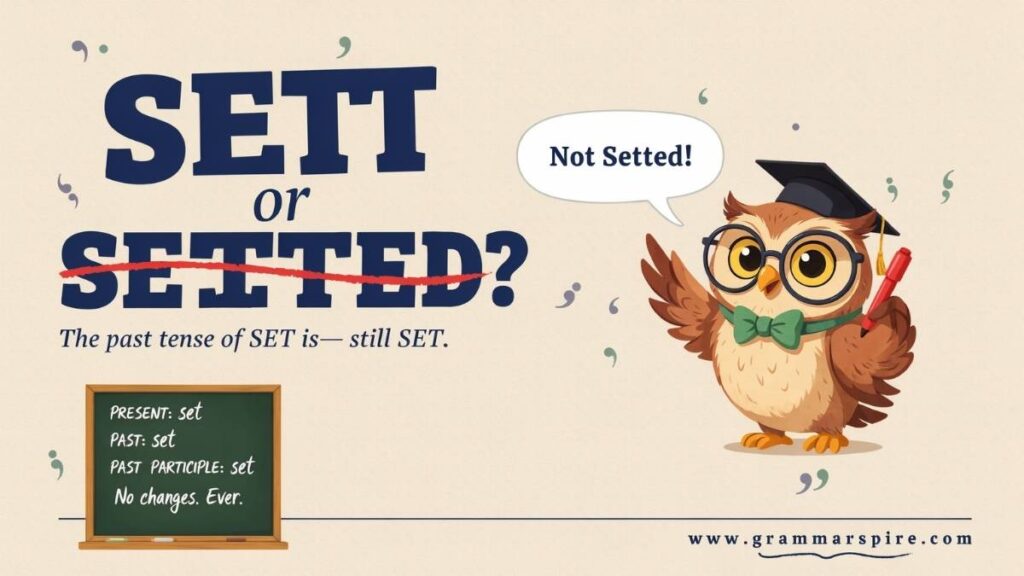
English has a talent for turning tiny words into surprisingly tricky grammar lessons. The question of set or setted is a classic example. Since many verbs form their past tense by adding -ed, setted might seem perfectly reasonable at first glance. Yet English has other plans. Set is an irregular verb that keeps the same form in the present, past, and past participle. That unusual pattern can confuse even careful writers. Whether you’re setting an alarm, setting a date, or setting the table, choosing the right form matters. Let’s clear up the confusion, examine the grammar, and make set versus setted easy to understand once and for all.
| Form | Correct form | Example |
|---|---|---|
| Present | set | I set the alarm every night. |
| Past | set | I set the alarm last night. |
| Past participle | set | I have set the alarm. |
| Present participle | setting | I am setting the alarm now. |
| Third-person singular | sets | She sets the alarm every night. |
Learn the difference between tricky English words with easy explanations
Benefiting or Benefitting Which Spelling Is Correct?
Quick Answer
Set is correct. Setted is not the standard past tense or past participle of the verb set.
The three principal forms of this irregular verb are:
Set → set → set
For example:
1.I set the timer every morning.
2.I set the timer yesterday.
3.I have set the timer already.
Notice what happens. The verb does not change when the sentence moves from the present to the simple past or the past participle. Only the surrounding words tell you which tense you are using.
That is why set or setted past tense questions often seem confusing at first. The answer looks almost too simple: the past tense of set is set.
Why Is Set Correct but Setted Incorrect?
The confusion usually comes from a familiar English pattern. Many verbs form their past tense by adding -ed.
Walk becomes walked.
Clean becomes cleaned.
Jump becomes jumped.
So it feels natural to assume that set should become setted.
English, however, has many irregular verbs that do not follow that pattern. Set belongs to this group.
Instead of adding -ed, set keeps its basic form in the simple past and past participle.
This means that the following sentence is correct:
She set the books on the desk yesterday.
This sentence is not standard English:
She setted the books on the desk yesterday.
The second version may sound logical if you are applying the regular -ed rule, but grammar does not work that way with this verb.
Set Is an Irregular Verb
An irregular verb does not form its past tense by simply adding -ed. Some irregular verbs change completely, such as go → went → gone. Others change only slightly, such as keep → kept → kept.
Then there are verbs such as set that keep the same form.
Set → set → set
This makes set unusual, but it does not make it difficult once the pattern becomes familiar.
Why Adding -ed Does Not Work
The ending -ed is useful for regular verbs, but it cannot be attached to every English verb.
Think of set as a verb with its own grammatical shortcut. It does not need an extra ending to show the past. The context does that job.
For example:
Today, I set the temperature to 70 degrees.
Yesterday, I set the temperature to 68 degrees.
Both sentences use set, but today and yesterday make the time clear.
Learn the difference between tricky English words with easy explanations
In Tact or Intact Which Spelling Is Correct?
Set Verb Forms V1, V2, and V3
If you are searching for set V1 V2 V3, the answer is straightforward.
| Verb form | Form of set | Example |
|---|---|---|
| V1 | set | I set the alarm. |
| V2 | set | I set the alarm yesterday. |
| V3 | set | I have set the alarm. |
The present participle is different:
Setting
For example:
I am setting the alarm now.
So the complete pattern looks like this:
Set → set → set → setting
V1 Set
V1 is the base form. You use it in the present tense with I, you, we, and they.
I set the table every evening.
You set the schedule carefully.
They set a new goal each month.
With he, she, or it in the simple present, the form becomes sets.
She sets the alarm at 6 a.m.
V2 Set
V2 is the simple past form.
The important point is that V2 is still set.
I set the appointment yesterday.
He set a new record last week.
They set the rules before the game began.
You do not need to add -ed.
V3 Set
V3 is the past participle.
It commonly appears with have, has, or had.
I have set the date.
She has set the temperature.
They had set the table before the guests arrived.
Therefore, the past participle of set is also set.
Present Participle Setting
The present participle is different because set becomes setting.
I am setting the table.
She is setting a new goal.
They are setting the alarm.
This is one place where set does change. The spelling follows the normal rule for forming the ing form.
Learn the difference between tricky English words with easy explanations
Bind or Bound which one is correct?
Set or Setted Past Tense What Is Correct?
The correct past tense is set.
If an action happened in the past, use set rather than setted.
Consider these examples:
I set the alarm before bed.
She set the books on the shelf.
We set a date for the meeting.
He set the temperature too high.
They set a new record last season.
The time expression can make the past meaning especially obvious.
I set the alarm last night.
She set the appointment yesterday.
They set the rules before the match.
The verb itself stays unchanged.
Present and Past Can Look Identical
This is where learners sometimes hesitate.
I set the alarm every night.
I set the alarm last night.
The verb looks exactly the same in both sentences. However, the time is different.
In the first sentence, the action happens regularly.
In the second sentence, the action happened in the past.
English relies on context, time expressions, and sentence structure to communicate that difference.
Learn the difference between tricky English words with easy explanations
Beat or Beated Which spelling Is Correct?
Set Past Participle What Is Correct?
The past participle of set is also set.
This form appears after have, has, and had when you use the perfect tenses.
I have set the timer.
She has set the date.
They had set the table before dinner.
The same form appears in all three cases.
Have set
Has set
Had set
For example:
I have set a reminder for tomorrow.
She has set a goal for the month.
We had set the schedule before the meeting started.
Using setted after have, has, or had creates a common grammatical mistake.
Incorrect:
I have setted the alarm.
Correct:
I have set the alarm.
Does Set Stay the Same in All Tenses?
Not exactly. Set stays the same in the simple present base form, simple past, and past participle, but other forms change.
The simple present uses set or sets.
The simple past uses set.
The past participle uses set.
The present participle uses setting.
For example:
I set the alarm every morning.
She sets the alarm every morning.
1.I set the alarm yesterday.
2.I have set the alarm already.
3.I am setting the alarm now.
This distinction is important because saying that set stays the same in all tenses would be slightly inaccurate. The main three forms remain identical, while the third-person singular and ing form change.
Learn the difference between tricky English words with easy explanations
Feed vs Fed What spelling is correct?
Set Meaning and Common Uses
Set has many meanings in English. It can describe placing something somewhere, arranging something, establishing something, or preparing something.
Because the verb has so many uses, you encounter it constantly in everyday English.
Set Something in a Position
Set can mean to put or place something in a particular position.
She set the cup on the table.
He set the keys beside the door.
I set the box on the floor.
In these examples, set describes placing one thing somewhere.
Set a Time or Date
You can also use set when arranging a time or date.
We set a date for the wedding.
She set the meeting for Monday.
They set an appointment for noon.
The meaning here is not simply putting something somewhere. Instead, set means to arrange or establish a particular time.
Set a Goal or Rule
Set can also mean establish something.
The company set a new goal.
The teacher set clear rules for the class.
The team set a challenging target.
The committee set a higher standard.
This use appears frequently in professional, academic, and everyday English.
Set an Alarm or Timer
Set is especially common with devices.
I set the alarm for 6 a.m.
She set a timer for twenty minutes.
He set a reminder on his phone.
We set the temperature before leaving.
These expressions are natural and common in modern English.
Set the Table
Another familiar expression is set the table.
The children set the table before dinner.
She set the table while her brother prepared the food.
Again, the past tense remains set.
Learn the difference between tricky English words with easy explanations
Smoky or Smokey Which Spelling Is Correct?
Set or Setted in a Sentence
Seeing the verb in different sentence patterns makes the rule easier to remember.
Simple Present
I set the alarm at 10 p.m.
You set clear goals.
We set the table together.
They set the schedule every Monday.
With he, she, or it, use sets.
She sets the alarm every night.
He sets high standards for himself.
Simple Past
I set the alarm last night.
She set the books on the desk.
We set a date yesterday.
They set a new record.
Even though these actions happened in the past, the verb remains set.
Present Perfect
I have set the timer.
She has set the meeting date.
They have set the rules.
The form remains set after have or has.
Past Perfect
We had set the table before the guests arrived.
She had set a reminder before she left.
They had set the schedule earlier.
Again, use set rather than setted.
Future
I will set the alarm tonight.
She will set the temperature later.
They will set a new goal next month.
After will, use the base form set.
Set Up or Setted Up Which Is Correct?
The correct expression is set up, not setted up.
Set up is a phrasal verb that can mean arrange, organize, establish, or prepare something.
For example:
I set up the meeting yesterday.
She set up the equipment.
They set up the new office last week.
He has set up a reminder.
Notice that set up remains unchanged in the past tense and past participle.
Incorrect:
She setted up the meeting.
Correct:
She set up the meeting.
Other Phrasal Verbs With Set
Set appears in many common phrasal verbs.
Set aside can mean reserve or save something.
She set aside some money for the trip.
Set down can mean place something somewhere.
He set down the bag near the door.
Set out can mean begin a journey or present something.
They set out early in the morning.
Set off can mean begin a journey or cause something to start.
We set off before sunrise.
Set back can mean delay something or cause a setback.
The storm set back the project.
Set in can describe something beginning and becoming established.
Winter set in early that year.
The past tense remains set in these expressions.
Learn the difference between tricky English words with easy explanations
Swore vs Sworn What’s the Difference?
Common Mistakes With Set
Because set looks the same in several grammatical forms, learners sometimes create errors in other ways.
Using Setted as the Past Tense
Incorrect:
I setted the alarm yesterday.
Correct:
I set the alarm yesterday.
The simple past of set is set.
Using Setted as the Past Participle
Incorrect:
She has setted the timer.
Correct:
She has set the timer.
The past participle is also set.
Confusing Set With Setting
Setting is the present participle, not the simple past.
I set the table yesterday.
I am setting the table now.
The first sentence describes a completed past action. The second describes an action in progress.
Confusing Set With Sat
Set and sat are different verbs.
Set generally means to place or arrange something.
I set the book on the desk.
Sat is the past tense of sit.
I sat on the chair.
A useful distinction is simple: you set something, but you sit somewhere.
Confusing Set With Settled
Set and settled also have different meanings.
Set can mean place, arrange, or establish.
She set the vase on the shelf.
Settled can mean resolved, became stable, or made a place home.
They settled the disagreement.
The family settled in a quiet town.
Adding -ed to set does not create the ordinary past form of set.
Learn the difference between tricky English words with easy explanations
Burst or Bursted? Which One Is Correct?
A Quick Comparison of Common Forms
The easiest way to spot the difference is to compare correct forms with the mistakes people commonly make.
| Meaning or grammar | Correct | Incorrect |
|---|---|---|
| Past action | She set the alarm. | She setted the alarm. |
| Past participle | She has set the alarm. | She has setted the alarm. |
| Phrasal verb in past | He set up the room. | He setted up the room. |
| Action happening now | He is setting the room. | He is set the room. |
| Third-person present | She sets the timer. | She set the timer every day. |
The final row needs context. She set the timer can also be correct when describing a past action. However, for a regular present tense habit, she sets the timer is the correct form.
Set or Setted Grammar Rules to Remember

The most useful rule is also the shortest:
Set, set, set.
The base form is set.
The past tense is set.
The past participle is set.
The present participle is setting.
The third-person singular present form is sets.
Once you memorize that pattern, most set or setted grammar questions become easy.
Another useful rule concerns auxiliary verbs.
After did, use set.
Did you set the alarm?
Not:
Did you setted the alarm?
After will, use set.
I will set the reminder.
Not:
I will setted the reminder.
After have, has, or had, use set.
She has set the date.
Not:
She has setted the date.
These small patterns prevent many common mistakes.
Is Setted a Word?
The question is understandable because setted occasionally appears in specialized, historical, or nonstandard contexts. However, setted is not the standard past tense or past participle of the common English verb set.
For ordinary modern English, use set.
If you are writing an email, article, school assignment, business document, or everyday message, choose set for both the simple past and past participle.
For example:
Correct:
The manager set a new deadline yesterday.
Correct:
The manager has set a new deadline.
Avoid:
The manager setted a new deadline yesterday.
Avoid:
The manager has setted a new deadline.
The standard form is consistent and easy to apply.
Why Does Setted Sound Plausible?
There is a logical reason people make this mistake.
English regularly forms past-tense verbs with -ed. Once you learn that pattern, your brain naturally tries to apply it everywhere.
Call becomes called.
Open becomes opened.
Start becomes started.
So when you encounter set, adding -ed may feel perfectly reasonable.
There is just one problem: English contains many irregular verbs.
Set belongs to the group that does not follow the regular -ed pattern.
The same kind of surprise appears with other verbs.
Put → put → put
Cut → cut → cut
Hit → hit → hit
Let → let → let
Set → set → set
These verbs keep the same form for the base verb, simple past, and past participle.
Learn the difference between tricky English words with easy explanations
Sweeped or Swept Which One Is Correct?
How to Use Set in the Past Tense
Using set in the past tense becomes easier when you connect it to completed actions.
Think about something you arranged, placed, established, or prepared earlier.
I set the alarm before going to bed.
She set the table before dinner.
We set a date for the meeting.
He set the temperature last night.
They set new rules after the problem occurred.
The verb remains set because the action happened in the past.
You can also combine it with clear time expressions.
Yesterday, I set the reminder.
Last night, she set the alarm.
Earlier that morning, they set the schedule.
The verb itself does not need a past tense ending.
Set Sentence Examples
Here are several natural examples that show how the verb works in everyday English.
I set my alarm for six every morning.
She set the cup beside the plate.
We set a date for the interview.
He set the temperature before leaving.
They set a new company record.
I have set a reminder on my phone.
She has set clear expectations.
We had set the table before our guests arrived.
He is setting the timer now.
They are setting up the equipment.
I will set the meeting for Friday.
Did you set the alarm?
These examples demonstrate why context matters. The form changes in some structures, but set remains the correct simple past and past participle.
Learn the difference between tricky English words with easy explanations
Forbid or Forbidden Which One Is Correct?
A Simple Memory Trick

If you keep forgetting whether the past tense is set or setted, remember this three-word pattern:
Set today.
Set yesterday.
Have set.
That pattern covers the three forms most people need.
You can also remember it as:
Set → set → set
Then keep setting for the -ing form and sets for he, she, or it in the simple present.
This small pattern is much easier to recall than a long grammar rule.
Here’s a trusted source for clear more words Comparison:
Grammar Update
Practice Session
Now it’s time to test your understanding of set, sit, and their related forms. Complete each sentence with the word that best fits the meaning and grammar of the sentence. Watch the tense carefully, especially because set keeps the same form in the simple past and past participle. Remember, too, that the past tense of sit is sat.
Fill in the Blanks
- I _____ the alarm for 6 a.m. before going to bed.
- She has _____ the table for dinner.
- We _____ a date for the meeting yesterday.
- He is _____ the timer for twenty minutes.
- They _____ up the equipment before the presentation began.
- Please _____ down and make yourself comfortable.
- I have _____ a reminder on my phone.
- She _____ beside the window every morning.
- He _____ the books on the desk yesterday.
- We had _____ the rules before the game began.
- Did you _____ the alarm before going to bed?
- They are _____ a new goal for the team.
- She _____ in the front row during the lecture yesterday.
- I will _____ the temperature before we leave.
- He has _____ the meeting time for Friday.
- Please _____ the box down carefully.
- The decision did not _____ well with the employees.
- She _____ the timer whenever she cooks.
- We _____ on the bench for nearly an hour yesterday.
- They have _____ clear expectations for the project.
- I am _____ the table while my brother prepares dinner.
- He _____ the bag beside the chair and walked away.
- She had _____ the alarm before she went to sleep.
- Please _____ here until the doctor arrives.
- We _____ the schedule yesterday morning.
- They will _____ up the new office next week.
- He _____ quietly during the entire meeting.
- I have _____ the temperature to 70 degrees.
- She is _____ the books on the shelf now.
- The new policy doesn’t _____ well with many employees.
Answers
- set
- set
- set
- setting
- set
- sit
- set
- sits
- set
- set
- set
- setting
- sat
- set
- set
- set
- sit
- sets
- sat
- set
- setting
- set
- set
- sit
- set
- set
- sat
- set
- setting
- sit
FAQs
Is it correct to say “set up” or “setted up”?
“Set up” is the correct form in standard English. The verb set does not take -ed in the past tense, so write, “She set up the meeting yesterday,” rather than “She setted up the meeting.”
What does the word “set” mean?
Set has several meanings depending on the context. It can mean to place something, arrange an event, establish a rule, adjust a device, or prepare something. For example, you can set a book on a desk, set a date, or set an alarm.
Is there a past tense for set?
Yes. The simple past is set. Unlike regular verbs that usually add -ed, this irregular verb keeps the same form. For example, “He set the alarm last night.”
Which is correct, “sit” or “set”?
Both are correct, but they have different meanings. Sit refers to taking or remaining in a seated position, while set commonly means placing or arranging something. For example, “Please sit here” and “Set the bag on the chair” are both correct.
What is another word for “set”?
The best alternative depends on the intended meaning. Possible synonyms include place, put, arrange, establish, fix, adjust, or prepare. Since set has many meanings, no single synonym fits every sentence.
What is the meaning of the term “set”?
As a noun, set can describe a collection of related things, an arrangement, a particular position, or a fixed condition. As a verb, it can refer to placing, arranging, establishing, adjusting, or preparing something.
Why do some people say “set” instead of “sit”?
Regional speech can sometimes blur the distinction between set and sit. Certain dialects use forms differently from standard English, which can influence everyday conversation. In standard English, however, the two verbs have separate meanings and should not normally be substituted for one another.
Is it “set well” or “sit well”?
“Sit well” is the standard expression when you mean that something is acceptable, pleasing, or easy to accept.
For example:
“The decision didn’t sit well with the employees.”
“Set well” can have a literal meaning in other contexts, such as describing something that becomes firm or properly established. It does not normally replace the idiom “sit well.”
How do British people say “sit”?
British English uses the same verb, sit. The spelling remains unchanged. Pronunciation varies among British accents, but the standard form is still sit.
When should you use the word “set”?
Use set when you mean place, arrange, establish, adjust, or prepare something. Common expressions include “set a timer,” “set a goal,” “set a date,” “set the table,” and “set the temperature.”
What does “set” stand for?
As an ordinary English verb, set does not stand for another phrase. It functions as a complete word. However, the abbreviation SET can represent different terms in specialized subjects, so its meaning depends on the context.
What does the verb “to set” mean?
The verb to set has several meanings. It can mean placing something in a particular position, arranging an event, establishing a rule or goal, adjusting a device, or fixing a time or date.
For example, “She set the alarm for seven” means that she adjusted the alarm to ring at that time.
Do you “set” or “sit” something down?
Use “set something down” when you place an object somewhere.
For example:
“Please set the box down here.”
Use “sit down” when referring to a person taking a seated position.
For example:
“Please sit down here.”
The distinction is simple: you set an object down, but you sit down yourself.
What is another way to say “sit well”?
Depending on the context, alternatives include “be acceptable,” “be agreeable,” “be pleasing,” or “be easy to accept.”
For example, “The decision didn’t sit well with her” could become “The decision was difficult for her to accept.”
Which is correct “doesn’t set well” or “sit well”?
“Doesn’t sit well” is the standard expression when you mean that something feels unacceptable, uncomfortable, or unpleasant.
For example:
“The new policy doesn’t sit well with employees.”
“Doesn’t set well” does not normally express this idea in standard English. However, set can be appropriate when it has a literal meaning, such as describing something becoming firm or taking shape.
AEO Set or Setted
What is the correct past tense of set?
The correct past tense is set. The form does not change in the simple past.
Example: “She set the alarm yesterday.”
Is “setted” grammatically correct?
“Setted” is not the standard past tense or past participle of the common verb set. In standard English, use set instead.
What are the three forms of set?
The three principal forms are set, set, and set.
The base form is set, the simple past is set, and the past participle is set.
Is “set up” correct in the past tense?
Yes. Set up remains unchanged in the past tense.
Correct: “They set up the equipment yesterday.”
Incorrect: “They setted up the equipment yesterday.”
What is the difference between set and sit?
Set usually means to place, arrange, establish, or adjust something. Sit refers to taking or remaining in a seated position.
For example:
“Set the phone on the desk.”
“Sit on the chair.”
Is “sit well” a correct expression?
Yes. “Sit well” is a standard English expression meaning that something is acceptable, pleasing, or easy to accept.
Example: “The decision did not sit well with the team.”
What does “set” mean as a verb?
As a verb, set can mean place, arrange, establish, adjust, prepare, or fix something.
For example, you can set an alarm, set a goal, set a date, or set the table.
Should you say “set something down” or “sit something down”?
Use “set something down” when you are placing an object somewhere.
For example:
“Set the book down on the desk.”
“Sit something down” is not the standard expression for placing an object.
Why is “setted” often confused with “set”?
The confusion comes from the way regular English verbs form their past tense. Many verbs take -ed, so learners may naturally assume that set becomes setted.
However, set is an irregular verb. Its simple past and past participle remain set.
Does “set” change form in English?
The main three forms remain identical: set, set, set. However, other grammatical forms do change.
The third-person singular present is sets, while the present participle is setting.
For example:
“She sets the alarm every night.”
“She is setting the alarm now.”
Is “doesn’t sit well” different from “doesn’t set well”?
Yes. “Doesn’t sit well” is the standard idiom for something that feels unacceptable, uncomfortable, or difficult to accept.
For example:
“The new decision doesn’t sit well with the staff.”
“Doesn’t set well” generally does not carry this idiomatic meaning.
What is the easiest way to remember set and sit?
Use this simple distinction: you set something, but you sit somewhere.
You can set a book on a desk, set an alarm, or set a date. However, you sit on a chair, sit at a table, or sit in a room.
That contrast makes the difference easier to remember and helps prevent common mistakes such as using set when sit is required.
Conclusion
The set or setted confusion may seem like a tiny grammar puzzle, but English has a talent for making small words surprisingly troublesome. Fortunately, the solution is simple set is the correct base form, simple past, and past participle, while setted is not the standard form for the common verb set. You set the alarm yesterday, have set the table already, and can set a new goal tomorrow. Remember the easy pattern set, set, set. Once that rule sticks, this little grammatical troublemaker has nowhere left to hide. Your writing will sound clearer, your grammar will stay accurate, and setted can finally be shown the door.

Ella AJS
Ella AJS is an experienced blogger and language enthusiast at Grammar Spire, dedicated to making English grammar simple, practical, and easy to understand. She specializes in word comparisons, meanings, usage, and common language confusions. Through clear explanations and engaging examples, Ella helps students, writers, and English learners improve their vocabulary and communicate with greater confidence and accuracy.