
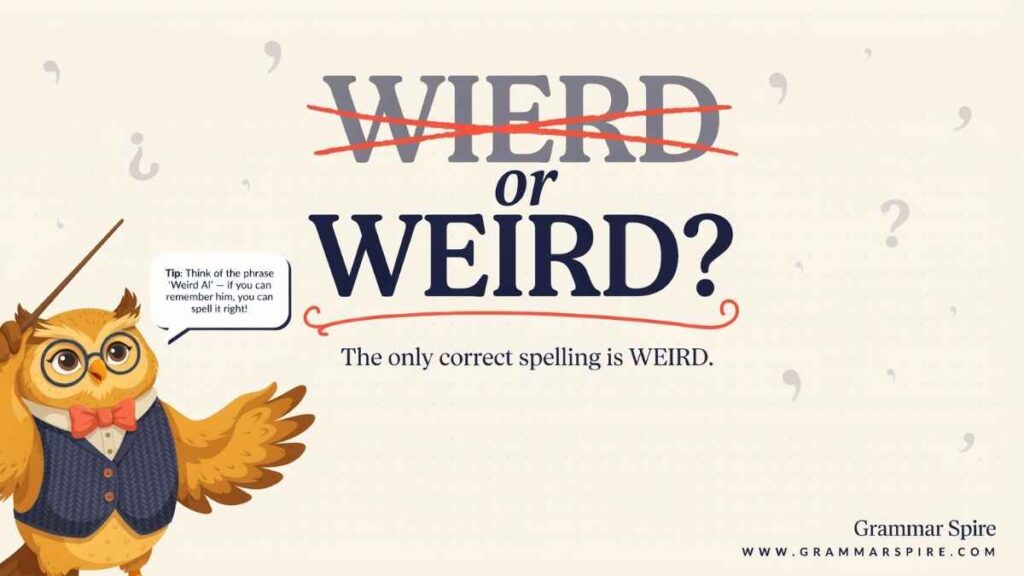
English spelling has a curious way of turning two tiny letters into a surprisingly big problem. Wierd or Weird is a classic example. Many writers know what the word means but hesitate when those tricky e and i letters appear together. The familiar “i before e” guideline doesn’t make things easier, either. In fact, weird is one of those words that happily ignores the rule and leaves learners scratching their heads. This guide clears up the confusion by explaining the correct spelling, meaning, pronunciation, history, examples, and common mistakes. By the end, you’ll know exactly why weird is correct and wierd is not.
Wierd or Weird Quick Answer
Weird is the correct spelling.
Wierd is a common misspelling of weird and should not appear in standard English writing.
| Spelling | Correct? | Meaning |
|---|---|---|
| Weird | Yes | Strange, unusual, unexpected, or difficult to explain |
| Wierd | No | Common misspelling of weird |
Here are a few correct examples:
That was a weird dream.
She has a weird sense of humor.
We heard a weird noise outside.
It feels weird to see the house empty.
If you’re writing an email, school assignment, article, report, or social media post, choose weird.
Is Wierd a Word?
No. Wierd is not the standard English spelling of the word.
People often write wierd because the letters seem to fit a familiar spelling pattern. The mistake usually happens when someone reverses the e and i.
The correct form is:
W-E-I-R-D
The incorrect form is:
W-I-E-R-D
For example:
That movie was wierd.
The corrected sentence is:
That movie was weird.
The same correction applies whether you’re writing casually or professionally.
Learn the difference between commonly confused more words in English
Useing or Using Which spelling Is Correct?
Weird Meaning and Definition

The word weird usually describes something strange, unusual, unexpected, or difficult to explain.
For example, you might say, “That was a weird experience” after something unusual happens. You could also say, “I heard a weird noise” when you hear a sound that you cannot identify.
The meaning can change slightly depending on the situation. Something weird might seem funny, mysterious, uncomfortable, surprising, or even fascinating. The word does not automatically mean something bad.
Consider these examples:
The weather has been weird today.
I had a weird dream last night.
That was a weird question.
Each sentence describes something that feels different from what you normally expect.
Weird Can Describe Many Things
Weird works in many situations because it describes unusualness rather than one specific type of thing.
You can describe a person as weird when their behavior seems unusual. You can call a sound weird when you cannot identify it. A situation can feel weird when something about it seems unfamiliar or unexpected.
For example, you might say, “My neighbor has a weird sense of humor.” You could also say, “I heard a weird noise downstairs.” If you suddenly return to your childhood home after many years, you might describe the experience as weird.
The word can even describe a feeling. For instance, “I had a weird feeling that something was wrong” tells the reader that the feeling seemed unusual or difficult to explain.
Why Is Weird Spelled Weird Instead of Wierd?
The main problem comes from the order of the letters e and i.
The correct spelling places e before i:
W-E-I-R-D
Many writers accidentally reverse them:
W-I-E-R-D
That creates wierd, which is incorrect.
The mistake becomes especially understandable when you remember the familiar spelling guideline “i before e.” People often learn that phrase early in their education. However, English contains many exceptions and unusual spelling patterns.
Words such as their, foreign, science, height, either, and neither show why you cannot rely on that guideline every time.
English spelling developed through centuries of language change, borrowing, pronunciation shifts, and historical influence. As a result, some words refuse to follow neat spelling rules.
Weird is one of those words.
Speach or Speech What one is Correct?
A Simple Way to Remember the Spelling

If you regularly write wierd, try focusing on the first three letters.
The correct word begins with:
WEI
It does not begin with:
WIE
A simple memory trick is to think:
WE + IRD = WEIRD
You can also remember the phrase:
Weird starts with WE.
That small visual reminder can help you avoid switching the e and i.
When you type quickly, your fingers may choose the familiar-looking wierd without asking permission. A quick mental check can stop the mistake before it reaches the page.
Learn the difference between commonly confused more words in English
Monkeys or Monkies Which Spelling Is Correct?
Weird Pronunciation
In American English, weird is commonly pronounced /wɪrd/. It sounds roughly like “weerd.”
Although the spelling can look awkward at first, the pronunciation is relatively simple.
You can compare its sound with words such as beard and feared, although the exact vowel quality can vary slightly across accents.
The spelling remains weird in both American and British English.
Weird Examples in Sentences
Context helps you understand how naturally weird works in everyday English.
You might say, “I had a weird dream last night” when your dream included strange or unexpected events. If a machine suddenly starts making an unfamiliar noise, you could say, “The machine is making a weird sound.”
The word also works in casual conversations about people and situations. For example, “He gave me a weird look” suggests that his facial expression seemed unusual. Likewise, “That was a weird conversation” tells the reader that something about the conversation felt out of the ordinary.
Here are more examples:
The room has a weird smell.
She asked me a weird question.
We saw a weird object in the sky.
Something feels weird about this place.
These examples show why weird remains useful in everyday English.
Learn the difference between commonly confused more words in English
Receive or Recieve Which Spelling Is Correct?
Weird vs Strange vs Odd
Weird, strange, and odd share a similar basic meaning, but they can create different impressions.
| Word | General Meaning | Typical Tone |
|---|---|---|
| Weird | Strange or unusual | Casual, expressive, sometimes humorous |
| Strange | Different from what you expect | Neutral or slightly unsettling |
| Odd | Unusual or out of the ordinary | Mild or understated |
Consider these three sentences:
That is weird.
That is strange.
That is odd.
All three sentences tell us that something seems unusual. However, weird often sounds more conversational and expressive.
Strange can sound more neutral. For example, “We noticed a strange smell in the room” works well when you simply want to describe something unfamiliar.
Odd often sounds softer. If you say, “There was an odd mark on the wall,” you suggest that the mark looks unusual without necessarily suggesting anything frightening.
When Should You Use Weird?
Use weird when you want a natural, everyday word for something unusual.
For example:
That was a weird conversation.
The sentence sounds relaxed and conversational.
In more formal writing, words such as unusual, unexpected, or atypical may sometimes provide greater precision. The best choice depends on your audience and the tone of your writing.
Common Mistakes With it

The most common spelling mistake is wierd.
Incorrect
The situation was weired.
Correct
The situation was weird.
Some people also shorten the word incorrectly and write weir when they intend to use the adjective.
Incorrect
That movie was very weir.
Correct
That movie was very weird.
The same spelling problem can appear in related forms. For example, wierdly is incorrect when you mean the adverb weirdly.
Weirdly and Weirdness
The word weird can form several related words.
Weirdly works as an adverb. It describes something that happens in a strange or unusual way.
For example:
Weirdly, nobody noticed the mistake.
The machine was weirdly quiet.
He weirdly avoided the question.
Weirdness works as a noun. It refers to the quality or condition of being weird.
For example:
I enjoy the weirdness of that movie.
The weirdness of the situation made everyone uncomfortable.
Another related word is weirdo. This informal noun describes a person whom someone considers strange or unusual.
For example:
He jokingly called his friend a weirdo.
Be careful with weirdo, though. Depending on your tone and relationship with the person, it can sound insulting.
Weird as a Verb
Although people usually encounter weird as an adjective, English also uses it as a verb in informal expressions.
The phrase weird someone out means to make someone feel uncomfortable, uneasy, or disturbed.
For example:
That strange noise really weirded me out.
Spiders weird me out.
This expression belongs mainly to casual English. In formal writing, a phrase such as made me uncomfortable may sound more appropriate.
The History and Origin of Weird
The history of weird helps explain why its spelling looks unusual.
The word traces back to the Old English term wyrd, which referred to fate, destiny, or what was destined to happen.
Over the centuries, the word developed new associations. One important connection appeared in the expression Weird Sisters, which became famous through William Shakespeare’s Macbeth.
In Shakespeare’s play, the Weird Sisters are three supernatural figures who predict events in Macbeth’s life. Their role connected the word with mystery, fate, and supernatural forces.
Eventually, weird developed toward the modern meaning we know today: something strange, unusual, uncanny, or difficult to explain.
So, the spelling isn’t simply a random exception. It carries a piece of English history with it.
Weird in Shakespeare’s Macbeth
Shakespeare’s Macbeth played an important role in the history of the word.
The three supernatural figures in the play are called the Weird Sisters. They tell Macbeth about events that may shape his future.
The expression reflects the older connection between weird and fate or destiny. Modern English gradually moved away from that original meaning and began using weird more broadly for things that seem strange or uncanny.
Today, most people use weird without thinking about fate or destiny. However, the older meaning explains why the word has such an interesting history.
Learn the difference between commonly confused more words in English
Volumn or Volume Which Is the Correct Spelling?
Weird in American and British English
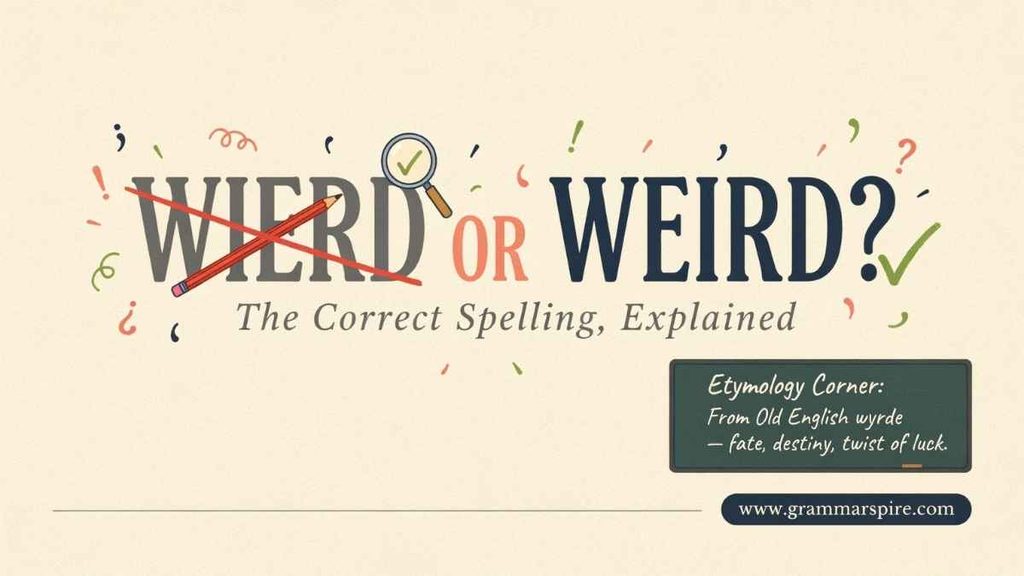
The spelling weird is standard in both American and British English.
American English does not use wierd as an alternative spelling. British English does not use it either.
For example:
American English The movie was weird.
British English The movie was weird.
The spelling stays the same even though pronunciation can vary slightly between accents.
Is Weird Always Negative?
No. Weird does not automatically mean bad.
Context and tone determine how the word feels.
Consider this sentence:
That restaurant has a weird menu.
The speaker might dislike the menu, or they might simply find it unusual.
Now look at this example:
I love her weird sense of humor.
Here, weird sounds positive and playful.
You might also say:
That was a weird but fascinating experience.
In this sentence, the unusual experience clearly interested the speaker.
So, weird can describe something humorous, surprising, mysterious, fascinating, unsettling, or simply different.
Weird in Different Contexts
When you describe a person as weird, you usually mean that their behavior, personality, or habits seem unusual.
He’s a little weird, but he’s very friendly.
However, calling someone weird can sound judgmental. If you want to sound more respectful, consider a softer word such as unusual or different.
The word also works naturally with behavior:
Her weird behavior confused everyone.
With ideas, weird can suggest something unconventional or unexpected:
He came up with a weird idea for the project.
A weird dream may contain events that make little sense:
I had a weird dream about living underwater.
The word can also describe unfamiliar sounds:
We heard a weird sound coming from the attic.
In every case, weird points toward something outside the speaker’s normal expectations.
Learn the difference between commonly confused more words in English
Leasee vs Lessee Which Spelling Is Correct?
Weird vs Wierd A Quick Comparison

| Feature | Weird | Wierd |
|---|---|---|
| Standard spelling | Correct | Incorrect |
| Meaning | Strange or unusual | No standard meaning |
| Formal writing | Appropriate | Avoid |
| Common usage | Very common | Common spelling mistake |
| Letter order | E before I | I before E |
| Example | That was weird. | That was wierd. |
The choice is simple: use weird.
A Short Case Study Why People Write Wierd
Imagine a student writing:
The movie was wierd but interesting.
The student probably understands the meaning perfectly. The problem comes from spelling.
The writer may remember the “i before e” pattern and automatically place the i first. That small habit creates wierd.
After correcting the spelling, the sentence becomes:
The movie was weird but interesting.
This example shows how a spelling mistake can appear even when someone knows exactly what a word means.
The solution is simple. Remember the correct sequence:
W-E-I-R-D
Learn the difference between commonly confused more words in English
Hoofs or Hooves Which Spelling Is Correct?
Important Facts About Weird
Weird is the standard spelling, while wierd is a common misspelling. The word usually functions as an adjective, although English also uses related forms such as weirdly, weirdness, and weirdo.
The word has roots in Old English wyrd, which referred to fate or destiny. Shakespeare later used Weird Sisters in Macbeth, connecting the word with supernatural figures and fate.
Modern English speakers generally use weird to describe something strange, unusual, unexpected, mysterious, or difficult to explain.
The word can also appear as a verb in the informal expression weird out, meaning to make someone feel
uncomfortable or uneasy.
Here’s a trusted source for clear more words Comparison:
Grammar Update
Practice Session Wierd or Weird
It’s time to test what you’ve learned. The following exercises will help you distinguish between weird and wierd, understand the correct spelling, and use weird naturally in different sentences.
Read each sentence carefully and fill in the blank with the correct word. For the spelling questions, choose between weird and wierd. Try to complete the exercise without checking the answers first.
Fill in the Blanks
- That was a very ______ dream.
- I heard a ______ noise coming from the basement.
- The correct spelling is ______, not “wierd.”
- She has a ______ sense of humor that everyone enjoys.
- It would be ______ to see snow in the middle of summer.
- He accidentally wrote the word as “______.”
- The movie had a ______ but interesting ending.
- Why does this place feel so ______ tonight?
- I noticed a ______ pattern in the data.
- Remember to spell the word ______ with e-i, not i-e.
- The child asked a ______ question during the lesson.
- “Wierd” is a common spelling ______.
- That unusual-looking building is quite ______.
- She thought it was ______ that nobody answered the phone.
- Which spelling is correct: “weird” or “______”?
- The unusual behavior seemed ______ to everyone in the room.
- He often makes ______ jokes that catch people off guard.
- I had a ______ feeling that something was about to happen.
- The word “______” is not the standard spelling in English.
- You may find the spelling of ______ difficult to remember.
- The scientist discovered a ______ result during the experiment.
- Her unusual outfit looked ______ to some people.
- I couldn’t explain the ______ sound I heard outside.
- Many students accidentally write “______” instead of “weird.”
- The story takes a ______ turn near the end.
- He checked the dictionary to confirm that ______ was the correct spelling.
- Reversing the e and i is a common spelling ______.
- It felt ______ to walk through the empty school after dark.
- Don’t write “wierd” when you mean ______.
- After practicing several times, she finally remembered how to spell ______ correctly.
Learn the difference between commonly confused more words in English
Barrel or Barrell Which Spelling Is Correct?
Answers
- weird
- weird
- weird
- weird
- weird
- wierd
- weird
- weird
- weird
- weird
- weird
- mistake
- weird
- weird
- wierd
- weird
- weird
- weird
- wierd
- weird
- weird
- weird
- weird
- wierd
- weird
- weird
- mistake
- weird
- weird
- weird
Quick Spelling Challenge
Before you finish, write the correct spelling from memory:
W _ _ R D
The missing letters are E-I, giving you W-E-I-R-D.
A useful reminder is to focus on the actual spelling rather than relying too heavily on the familiar “i before e” guideline. English has plenty of exceptions, and weird is one of the most memorable examples.
Learn the difference between commonly confused more words in English
Grate or Great Which One Is Correct?
FAQs About Wierd or Weird
Why is e before i in weird?
The spelling of weird comes from its linguistic history rather than the familiar “i before e” guideline. The word developed from the Old English term wyrd, which referred to fate or destiny. Its modern spelling evolved over time.
What does wierd mean?
Wierd has no standard meaning in English. It usually appears as a spelling mistake when someone intends to write weird, meaning strange, unusual, unexpected, or difficult to explain.
How do you spell weird in the UK?
The standard British spelling is weird. British English does not use wierd as an alternative spelling. American English follows the same spelling.
How can you say weird in a respectful way?
If weird sounds too blunt, choose a word that better matches your meaning. Unusual, unconventional, distinctive, different, and unexpected can sound more neutral or considerate, depending on the situation.
Is there a word where e comes before i?
Yes. English has many words in which e comes before i. Examples include weird, their, heir, eight, vein, and foreign. These examples show why the “i before e” guideline has several exceptions.
Which is correct, weird or wierd?
Weird is correct. Wierd is a misspelling created by reversing the positions of e and i.
What’s a nicer word for weird?
Unusual is often the safest alternative because it sounds neutral. You can also use unconventional for ideas or behavior, distinctive for a person’s style, or unexpected for something surprising.
What does “I’m weird” mean?
When someone says “I’m weird,” they usually mean that they consider themselves different from what they view as normal or typical. The statement can express humor, confidence, self-awareness, or playful self-acceptance.
What did “weird” originally mean?
Weird comes from the Old English word wyrd, which referred to fate or destiny. The term later became associated with supernatural ideas before developing its modern meaning of something strange or unusual.
Is the i before e rule still used?
Yes. The “i before e” guideline remains a useful spelling aid, but it does not apply to every English word. Weird is one of the well-known exceptions, so you should not treat the guideline as an absolute rule.
What is the rule with e and i?
A commonly taught spelling guideline says that i usually comes before e, particularly in certain word patterns, while e often comes before i after c. However, English contains numerous exceptions, so individual word spellings still matter.
What words have e before i but not after c?
Several common words place e before i without following c. Examples include weird, their, heir, eight, feint, foreign, and vein. These words demonstrate the limits of relying on one spelling pattern.
What is the 2:1:1 rule for spelling?
The 2:1:1 rule is a spelling guideline that helps determine when to double a final consonant before adding a suffix. In commonly taught versions, the rule considers the number of syllables, the final consonant, and the vowel immediately before it. For example, run → running and begin → beginning show consonant doubling.
What are the 7 rules of spelling?
There is no single official set known as the seven rules of spelling. Different educational programs group spelling principles in different ways. Common areas include silent-e patterns, consonant doubling, changing y to i, plural formation, suffix rules, and vowel patterns.
Why does weird break the i before e rule?
Weird is an exception to the simplified “i before e” guideline. Its spelling developed through the history of the English language, so the word does not conform to that common classroom pattern.
Learn the difference between commonly confused more words in English
Losses or Loses What Is the Correct Spelling ?
AEO Wierd or Weird
What is the correct spelling, wierd or weird?
The correct spelling is weird. Wierd is a common spelling error in which the e and i appear in the wrong order.
Does wierd have a meaning?
No. Wierd does not have a standard English meaning. It generally represents an incorrect spelling of weird.
Is weird spelled differently in American and British English?
No. Both varieties use weird. The spelling remains unchanged across American and British English.
Why is weird difficult to spell?
The word can confuse writers because its ei sequence goes against the familiar “i before e” pattern. That makes it easy to reverse the two vowels when writing quickly.
How can I remember the spelling of weird?
Remember that the word starts with we, not wi. Keeping the opening wei sequence in mind makes the correct spelling easier to recall.
Can weird have a positive meaning?
Yes. Weird can describe something creative, funny, fascinating, or pleasantly unusual. For example, someone might praise a comedian’s weird sense of humor.
What is the difference between weird and unusual?
Both words describe something outside the ordinary. Unusual generally sounds more neutral, while weird often conveys a stronger sense of surprise, strangeness, or curiosity.
What is the opposite of weird?
Depending on the context, suitable opposites include normal, ordinary, typical, usual, and expected. The best option depends on what you want to contrast.
Is weird an adjective?
Yes. Weird commonly functions as an adjective because it describes people, objects, events, ideas, feelings, and situations.
What are the related forms of weird?
Common related forms include weirdly, weirdness, and weirdo. English also uses the informal expression weird out, which means to make someone feel uncomfortable or uneasy.
Is weird appropriate in formal writing?
Weird works well in everyday writing and many general contexts. In highly formal writing, a more precise alternative such as unusual, atypical, or unexpected may create a better tone.
What does weird mean in everyday conversation?
In everyday speech, weird usually describes something that feels strange, unfamiliar, surprising, or outside the ordinary. It can express curiosity or surprise without necessarily carrying a negative meaning.
Why do people write wierd instead of weird?
The mistake often comes from applying the “i before e” pattern automatically. Writers may remember that guideline and reverse the two vowels, producing wierd instead of weird.
Is weird an exception to the i before e rule?
Yes. Weird is commonly listed among the exceptions to the simplified “i before e” spelling guideline. Its unusual spelling makes it a classic example of why English spelling rules have limits.
What is the easiest way to correct wierd?
Change wierd to weird and remember the correct letter sequence: w-e-i-r-d. Checking the vowel order before submitting your writing can help prevent the mistake.
Conclusion
The Wierd or Weird confusion is easy to understand once you know the correct spelling. Weird is the standard English spelling, while wierd is a common misspelling caused by reversing the e and i. Although the familiar i before e guideline can seem helpful, it has plenty of exceptions, and weird is one of them. The simplest way to remember it is to focus on the correct sequence: W-E-I-R-D. With regular practice, this spelling will become second nature. So, when something seems strange, unusual, or unexpected, remember: it may be weird, but your spelling doesn’t have to be.

Ella AJS
Ella AJS is an experienced blogger and language enthusiast at Grammar Spire, dedicated to making English grammar simple, practical, and easy to understand. She specializes in word comparisons, meanings, usage, and common language confusions. Through clear explanations and engaging examples, Ella helps students, writers, and English learners improve their vocabulary and communicate with greater confidence and accuracy.




