
English can turn a seemingly simple spelling choice into a surprisingly tricky puzzle. “Salvadoran or Salvadorian?” is one such case. Both forms appear in English, so choosing between them can leave even careful writers second-guessing their keyboards. The good news is that the distinction is easier to understand once you look at how each word is used. Salvadoran is the standard and generally preferred form for describing a person, culture, food, or anything associated with El Salvador, while Salvadorian is a recognized alternative. In this guide, you’ll explore their meanings, usage, pronunciation, and differences, helping you write clearly, accurately, and confidently every time.
Salvadoran or Salvadorian Quick Answer
Salvadoran is generally the preferred spelling and the standard demonym for a person from El Salvador. It can also describe something connected with El Salvador.
For example:
A person from El Salvador is a Salvadoran.
Salvadoran food is popular throughout Central America.
She is studying Salvadoran history.
Salvadorian is an established alternative form. Dictionaries such as Collins recognize it as an English word meaning a native or inhabitant of El Salvador and as an adjective relating to El Salvador.
Therefore, calling Salvadorian a completely incorrect word would be misleading. However, if you need one standard form for formal American English, Salvadoran is the safer and more conventional choice.
| Word | Meaning | Typical use |
|---|---|---|
| Salvadoran | A person from El Salvador or something related to El Salvador | Standard and widely preferred |
| Salvadorian | A person from El Salvador or something related to El Salvador | Recognized alternative |
| Salvadorean | Another English variant | Less common alternative |
Learn the difference between similar English words the easy way
Feet or Foot Which One Is Correct?
What Does Salvadoran Mean?
Salvadoran is the standard English demonym for someone from El Salvador. A demonym is a word used to identify people who come from a particular place.
Salvadoran also works as an adjective. That means it can describe things associated with El Salvador, including its culture, people, food, history, traditions, music, literature, and Spanish variety.
Consider these examples:
He is Salvadoran.
They are Salvadoran citizens.
We visited a Salvadoran restaurant.
The museum displayed Salvadoran artwork.
She enjoys learning about Salvadoran history.
The word therefore has two major grammatical functions. It can identify a person, or it can describe something connected with El Salvador.
What Does Salvadorian Mean?
Salvadorian has essentially the same basic meaning. It can refer to a person from El Salvador or describe something associated with the country.
For example:
He is Salvadorian.
They studied Salvadorian culture.
The restaurant serves Salvadorian dishes.
The important point is that Salvadorian is not simply a random misspelling invented by English learners. It appears in established English dictionaries as a variant.
However, its existence does not mean that Salvadorian and Salvadoran are equally common or equally preferred in every context. Salvadoran is the more familiar standard form in contemporary English and is generally the better choice when you want conventional formal usage.
Learn the difference between similar English words the easy way
Families or Familys Which One Is Correct?
Salvadoran vs Salvadorian
The difference between Salvadoran and Salvadorian is mainly one of usage and preference rather than meaning.
Both words can refer to a person from El Salvador. Both can also work as adjectives.
The main distinction is that Salvadoran is the more established and commonly preferred form, while Salvadorian is an accepted alternative.
| Feature | Salvadoran | Salvadorian |
|---|---|---|
| Refers to a person from El Salvador | Yes | Yes |
| Can describe something from El Salvador | Yes | Yes |
| Recognized in English dictionaries | Yes | Yes |
| Standard demonym | Yes | Alternative |
| Suitable for formal writing | Yes | Generally understandable, but less preferred |
| Common in modern English | Very common | Less common |
This is why the question is not really about right versus completely wrong. It is more accurately about standard usage versus an alternative form.
Is Salvadoran a Word?
Yes. Salvadoran is a fully established English word.
It functions as both a noun and an adjective.
As a noun:
A Salvadoran joined the discussion.
The community welcomed several Salvadorans.
As an adjective:
She enjoys Salvadoran music.
They prepared a traditional Salvadoran meal.
The word is especially useful because it can describe both people and things connected with El Salvador.
The plural form is Salvadorans.
Is Salvadorian a Word?
Yes. Salvadorian is also a recognized English word.
Major dictionaries record Salvadorian as a noun and adjective referring to El Salvador or its people.
That means it is inaccurate to tell someone that Salvadorian is simply misspelled. The better explanation is that Salvadorian is an alternative English form, while Salvadoran is the more standard and commonly preferred form.
This distinction matters because language does not always operate like a spelling test with only one possible answer. Some words develop multiple accepted forms, and usage determines which form becomes more common.
What Do You Call Someone From El Salvador?
A person from El Salvador is called a Salvadoran.
The plural is Salvadorans.
For example:
Maria is Salvadoran.
Many Salvadorans live in communities around the world.
The Salvadoran community has preserved many cultural traditions.
Salvadoran is the standard demonym you are most likely to encounter in formal writing, journalism, dictionaries, educational material, and general English usage.
You do not normally need to say “a person from El Salvador” every time. Salvadoran already provides the exact demonym.
What Is the Demonym for El Salvador?
The standard demonym for El Salvador is Salvadoran.
A demonym identifies people according to their geographical origin.
For example, someone from Canada is Canadian, someone from Mexico is Mexican, and someone from El Salvador is Salvadoran.
English demonyms do not always follow one universal spelling rule. That explains why forms such as Salvadoran and Salvadorian can both look natural to English speakers.
The important thing is established usage. In the case of El Salvador, Salvadoran is the standard form.
Learn the difference between similar English words the easy way
Likeable or Likable Which Spelling Is Correct?
Why Do People Say Salvadorian?
The existence of Salvadorian is understandable because English uses the ending “-ian” in many demonyms.
Consider words such as Canadian, Brazilian, and Egyptian. Because “-ian” appears frequently in English nationality words, Salvadorian may seem like the obvious formation.
English, however, does not build every demonym according to one fixed formula.
Some countries use “-an,” some use “-ian,” and others use entirely different forms. Established usage decides which form becomes standard.
Salvadorian therefore makes sense as an English formation, but Salvadoran has become the more conventional form.
Salvadoran Spelling
The correct standard spelling is:
Salvadoran
It contains one “i” after the “r”? No. The spelling is simply S-A-L-V-A-D-O-R-A-N.
A common mistake occurs when writers automatically add “i” before the final ending and produce Salvadorian.
If you are writing a formal article, report, academic assignment, news story, or professional document, Salvadoran is the safest standard choice.
Learn the difference between similar English words the easy way
Labelling or Labeling Which Spelling Is Correct?
Salvadorian Spelling
The spelling Salvadorian is:
S-A-L-V-A-D-O-R-I-A-N
It is a recognized alternative English form.
Although it is less preferred than Salvadoran, it can still appear in published writing and everyday communication.
The important lesson is not to confuse “less common” with “incorrect.”
That distinction will help you understand many English word variations. A language can contain more than one established form, while one form remains more widely preferred.
Salvadoran as a Noun
Salvadoran can identify a person from El Salvador.
For example:
He is a Salvadoran.
The organization supports Salvadorans living abroad.
Several Salvadorans attended the cultural event.
When used as a noun, the word identifies people.
The plural form is Salvadorans.
For example:
Salvadorans have communities in many countries.
The singular and plural forms are straightforward, which makes Salvadoran easy to use once you become familiar with the spelling.
Salvadoran as an Adjective
Salvadoran can also describe something related to El Salvador.
For example:
Salvadoran culture
Salvadoran food
History
Music
Literature
Spanish
traditions
This adjective form is extremely common.
You can think of it as a compact way to say “related to El Salvador.”
Instead of saying “food from El Salvador,” you can simply say “Salvadoran food.”
Salvadorian as a Noun and Adjective
Salvadorian can work in the same two grammatical roles.
As a noun:
She is a Salvadorian.
As an adjective:
They prepared Salvadorian food.
However, Salvadoran is generally more natural and conventional in these constructions.
If you are unsure which form to select, use Salvadoran.
Salvadoran or Salvadorian in Formal Writing
Formal writing benefits from conventional vocabulary because readers should not have to pause and wonder whether an unusual form is intentional.
Salvadoran is the better default for formal writing.
You can use it in academic work, professional communication, educational material, journalism, websites, reports, and general informational writing.
For example:
The study examines Salvadoran migration patterns.
The article discusses Salvadoran culture.
The researcher interviewed several Salvadoran residents.
These sentences sound natural and follow standard contemporary usage.
Salvadorian is still understandable and recognized, but it is less likely to be the preferred choice when you want the most conventional form.
Salvadoran or Salvadorian Food
Both Salvadoran food and Salvadorian food can be understood.
However, Salvadoran food is the more standard phrase.
El Salvador has a distinctive culinary tradition influenced by Indigenous, Spanish, and other cultural influences. One of the best-known foods associated with the country is the pupusa, a stuffed flatbread commonly made with ingredients such as cheese, beans, or meat.
You will also encounter dishes and ingredients connected with Salvadoran cooking, including yuca, plantains, beans, rice, corn, and various stews.
Examples include:
Salvadoran food is known for its flavorful traditional dishes.
We tried several Salvadoran dishes at the restaurant.
She is learning how to make Salvadoran pupusas.
The phrase Salvadorian food is not impossible to understand, but Salvadoran food is the more conventional wording.
Salvadoran Culture and Traditions
Salvadoran culture reflects the history and diverse influences of El Salvador.
Food, music, family traditions, celebrations, crafts, literature, and religious and community practices all contribute to the country’s cultural identity.
When describing these subjects in English, Salvadoran is normally the natural adjective.
For example:
Salvadoran culture has a rich culinary tradition.
The festival highlighted Salvadoran music and art.
The book explores Salvadoran traditions.
Using Salvadoran consistently makes the writing sound more natural and polished.
Learn the difference between similar English words the easy way
Label or Lable Which Spelling Is Correct?
Salvadoran Language and Salvadoran Spanish
Another common source of confusion is the phrase Salvadoran language.
Salvadoran is not the name of a separate language. Spanish is the principal language spoken in El Salvador.
Salvadoran Spanish refers to the variety of Spanish spoken in El Salvador.
That distinction is important.
You can say:
He speaks Spanish.
She is studying Salvadoran Spanish.
The course examines features of Salvadoran Spanish.
You would not normally say that “Salvadoran” itself is a language.
Salvadoran and Hispanic Identity
The terms Salvadoran and Hispanic are related in some contexts, but they are not interchangeable.
Salvadoran identifies national origin or connection with El Salvador.
Hispanic is a broader term generally associated with people connected to Spanish-speaking countries or cultures.
A person can therefore be Salvadoran and Hispanic, but the two words communicate different information.
For example, saying “She is Salvadoran” identifies her connection with El Salvador. Saying “She is Hispanic” provides broader information about her cultural or linguistic background.
It is better not to treat the two words as synonyms.
Salvadoran Ethnicity
The phrase Salvadoran ethnicity can be complicated because Salvadoran primarily describes nationality or national origin rather than one single ethnic group.
El Salvador has a diverse population and a complex history involving Indigenous peoples, Spanish colonial influence, and other communities.
Therefore, describing every Salvadoran as belonging to one uniform ethnic category can oversimplify the country’s population.
When the subject is nationality, Salvadoran is usually the precise term.
When discussing ethnicity, it is better to identify the specific ethnic or ancestral background when that information is relevant and known.
Learn the difference between similar English words the easy way
Skied or Skiied Which Spelling Is Correct?
Salvadoran Pronunciation
Salvadoran is generally pronounced approximately as sal-vuh-DOR-un in English.
The exact pronunciation can vary slightly according to accent and speech pattern.
Salvadorian has an additional syllabic sound in the middle and ending, which makes it sound different from Salvadoran.
The important point is that pronunciation does not change the basic meaning. The main issue is which form fits the context and standard usage you want.
Salvadoran, Salvadorian, and Salvadorean
English contains more than two forms associated with people from El Salvador.
Salvadoran is the standard and most widely preferred form.
Salvadorian is a recognized alternative.
Salvadorean is another recorded English variant, although it is less common.
| Form | Meaning | General usage |
|---|---|---|
| Salvadoran | Person or thing from El Salvador | Standard and most preferred |
| Salvadorian | Person or thing from El Salvador | Recognized alternative |
| Salvadorean | Person or thing from El Salvador | Recorded alternative, less common |
This comparison makes one point especially clear: English usage can preserve several forms even when one has become dominant.
Learn the difference between similar English words the easy way
Curtsy or Curtsey Which Spelling is Correct?
Common Mistakes With Salvadoran and Salvadorian
One common mistake is assuming that Salvadorian must be wrong because Salvadoran is more common.
That is too absolute. Salvadorian is a recognized variant.
Another mistake is writing “El Salvadoran” when you mean a person from El Salvador.
The standard expression is simply “Salvadoran.”
For example:
Incorrect or awkward: He is an El Salvadoran.
Preferred: He is Salvadoran.
Another frequent mistake is treating Salvadoran as the name of the language.
Salvadoran is a demonym and adjective. Spanish is the principal language of El Salvador, while Salvadoran Spanish refers to the local variety.
Everyday Examples
The easiest way to remember the distinction is to see the words in context.
Here are several natural examples:
She is Salvadoran.
My neighbor is Salvadoran.
The restaurant specializes in Salvadoran cuisine.
We learned about Salvadoran history in class.
The documentary explores Salvadoran culture.
He studies Salvadoran Spanish.
The organization serves Salvadoran communities.
Salvadorian is also possible in examples such as:
The article discusses Salvadorian traditions.
The museum hosted a Salvadorian cultural event.
These examples demonstrate why context matters more than simply labeling one spelling “wrong.”
Learn the difference between similar English words the easy way
Lovable or Loveable Which Spelling Is Correct?
A Simple Way to Remember the Correct Form
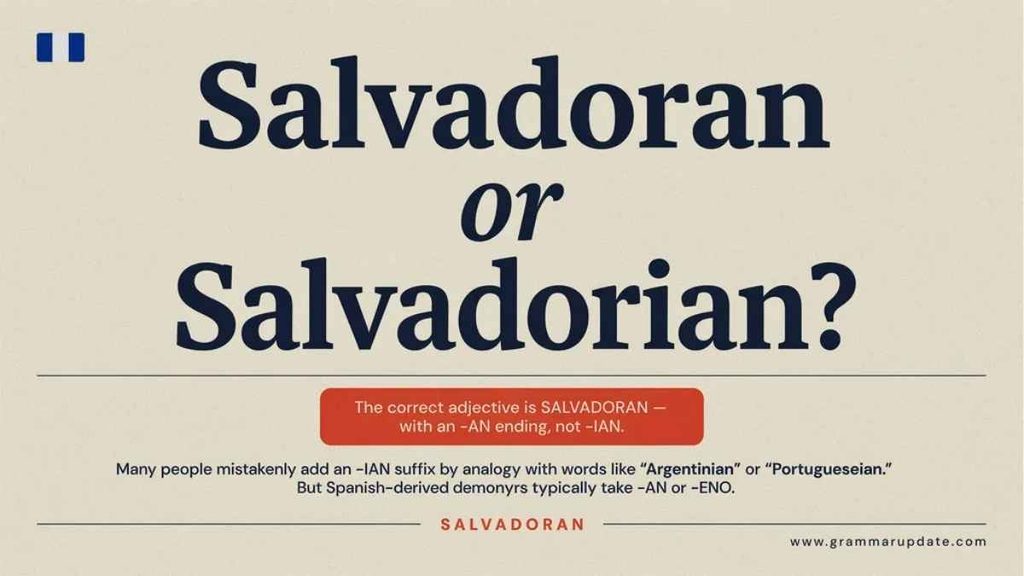
If you are writing and suddenly wonder, “Is it Salvadoran or Salvadorian?” remember the shorter standard form:
El Salvador → Salvadoran
The word Salvadoran is the form to reach for first.
If you encounter Salvadorian in a book, article, conversation, or website, do not automatically assume that the writer made a spelling mistake. It is a recognized alternative.
This small distinction can save you from correcting something that does not actually need correction.
A Practical Writing Case Study
Imagine that you are writing a travel article about El Salvador.
You write:
“Visitors can experience Salvadorian culture and enjoy Salvadorian food.”
The meaning is understandable, but you want the article to use the most conventional standard form.
A polished version would be:
“Visitors can experience Salvadoran culture and enjoy Salvadoran food.”
Nothing about the meaning has changed. The wording has simply been adjusted to the standard form most readers expect.
Now imagine that you find an older publication using Salvadorian throughout the article. That does not automatically mean the publication contains spelling errors. It may simply be using the alternative form.
This is an important lesson in editing: frequency and preference are not always the same thing as absolute correctness.
Dictionary Evidence
Dictionary evidence helps settle the confusion.
Collins English Dictionary lists Salvadoran as a noun for a person born or living in El Salvador and as an adjective meaning related to El Salvador, its people, or its culture. Collins also records Salvadorian as a variant.
Oxford Learner’s Dictionaries lists Salvadoran as a noun and adjective referring to someone or something from El Salvador.
Cambridge also records Salvadorean as an English form associated with El Salvador.
The dictionary evidence therefore supports a careful conclusion: Salvadoran is the standard form to prefer, while Salvadorian is a legitimate alternative rather than a simple spelling error.
Learn the difference between similar English words the easy way
Outting or Outing Which Spelling Is Correct?
Why Salvadoran Is Usually the Better Choice
When several forms exist, writers often want to know which one will sound most natural to a broad audience.
Salvadoran is usually the best default because it is widely recognized and firmly established in contemporary English.
It works naturally in both noun and adjective positions.
You can write:
a Salvadoran
Salvadorans
Culture
Food
History
Spanish
That versatility makes it an easy and reliable choice.
Is Salvadorian Correct?
Yes, Salvadorian is a recognized English word.
However, if your question is whether it is the preferred standard spelling, Salvadoran generally has the advantage.
So the clearest answer is:
Salvadorian is acceptable as a recognized variant, but Salvadoran is the standard form most writers should prefer.
Is Salvadoran Correct?
Yes. Salvadoran is correct.
It is the standard English demonym for a person from El Salvador and can also function as an adjective describing something connected with the country.
If you are unsure which form to use, Salvadoran is the straightforward choice.
Learn the difference between similar English words the easy way
Fiend or Feen which spelling is correct?
The Main Difference
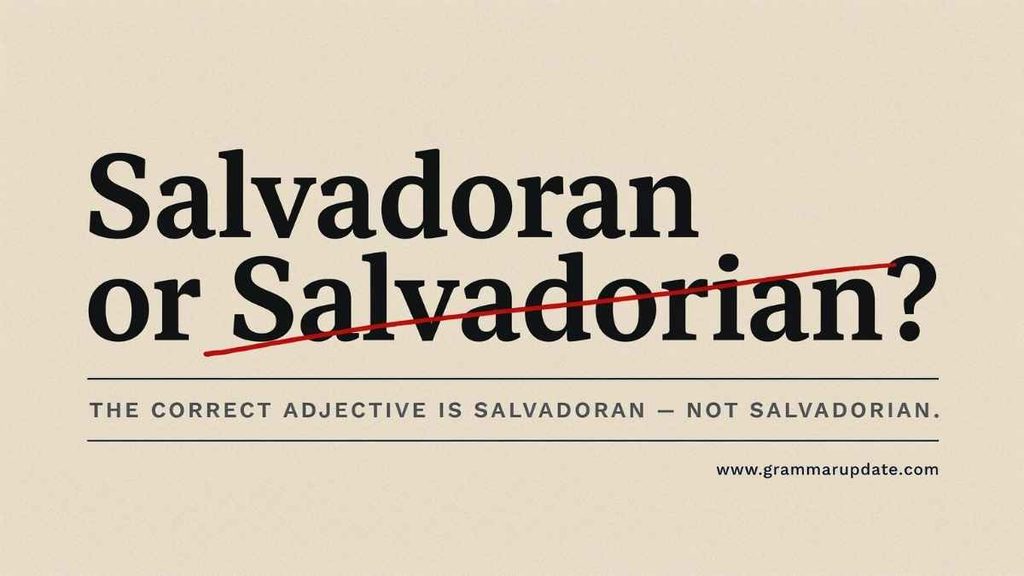
The difference can be summarized very simply.
Salvadoran is the standard and preferred form.
Salvadorian is a recognized alternative.
Both can refer to people from El Salvador and things associated with the country.
Therefore, the confusion comes from usage rather than meaning.
| Question | Answer |
|---|---|
| Which spelling is standard? | Salvadoran |
| Is Salvadorian a real word? | Yes |
| Is Salvadorian understandable? | Yes |
| Is Salvadorian a simple misspelling? | No |
| What is the standard demonym? | Salvadoran |
| What do you call people from El Salvador? | Salvadorans |
| What is the standard adjective? | Salvadoran |
| What language is primarily spoken in El Salvador? | Spanish |
| What does Salvadoran Spanish mean? | Spanish as spoken in El Salvador |
| What is Salvadoran food? | Food associated with El Salvador |
Here’s a trusted source for clear more words Comparison:
Grammar Update
Practice Session Salvadoran or Salvadorian
Ready to put your knowledge to work? This practice session will help you master the difference between Salvadoran and Salvadorian while reviewing related vocabulary about El Salvador, its people, culture, food, and language.
Read each sentence carefully and fill in the blank with the word or phrase that best completes the sentence. Try to answer all the questions before checking the answer key.
Fill in the Blanks
- A person from El Salvador is called a __________.
- The plural form of Salvadoran is __________.
- __________ is the standard English form for a person or thing connected with El Salvador.
- __________ is a recognized alternative form in English.
- The country associated with the word Salvadoran is __________.
- Traditional __________ cuisine includes popular dishes such as pupusas.
- Maria is __________ and grew up in San Salvador.
- The museum displayed __________ artwork and historical materials.
- The class explored __________ history and traditions.
- We ordered a traditional __________ meal at the restaurant.
- The word __________ can function as both a noun and an adjective.
- For formal writing, __________ is generally the preferred choice.
- A woman from El Salvador can be called a __________.
- A man from El Salvador can also be called a __________.
- The principal language spoken in El Salvador is __________.
- __________ Spanish refers to the variety of Spanish spoken in El Salvador.
- The expression __________ food is more conventional than Salvadorian food.
- Someone from Mexico is Mexican, while someone from El Salvador is __________.
- Salvadoran primarily describes nationality or national origin rather than one specific __________.
- The international telephone calling code for El Salvador is __________.
- El Salvador is located in __________ America.
- __________ culture includes the country’s traditions, music, food, art, and customs.
- The famous stuffed flatbread associated with El Salvador is called a __________.
- Salvadorian is not simply a spelling error because dictionaries recognize it as an English __________.
- When writing a formal article, __________ is usually the better choice between the two forms.
- The standard adjective for something associated with El Salvador is __________.
- People from El Salvador are known as __________.
- Salvadoran and Hispanic do not mean exactly the same thing because Hispanic is a broader cultural or __________ category.
- The US dollar is used as legal __________ in El Salvador.
- If you are unsure whether to use Salvadoran or Salvadorian, choose __________ for standard contemporary English.
Answer Key
- Salvadoran
- Salvadorans
- Salvadoran
- Salvadorian
- El Salvador
- Salvadoran
- Salvadoran
- Salvadoran
- Salvadoran
- Salvadoran
- Salvadoran
- Salvadoran
- Salvadoran
- Salvadoran
- Spanish
- Salvadoran
- Salvadoran
- Salvadoran
- race
- +503
- Central
- Salvadoran
- pupusa
- variant
- Salvadoran
- Salvadoran
- Salvadorans
- linguistic
- tender
- Salvadoran
Frequently Asked Questions
What do you call a person from El Salvador?
A person from El Salvador is called a Salvadoran. The plural form is Salvadorans. This is the standard English demonym used for people from the country.
Is it Salvadorian or Salvadoran food?
Salvadoran food is the more conventional expression. Salvadorian is also a recognized English variant, but Salvadoran is generally preferred in standard writing. Well-known examples of Salvadoran cuisine include pupusas, tamales, yuca, beans, rice, plantains, and other traditional dishes.
What do you call a woman from El Salvador?
A woman from El Salvador is a Salvadoran. English does not require a separate feminine form. You can simply say, “She is Salvadoran.”
Are Salvadorans basically Mexican?
No. Salvadorans and Mexicans come from different countries with their own national identities, histories, traditions, and cultures. El Salvador is in Central America, while Mexico is in North America. Both countries have Spanish-speaking populations and share some broader cultural influences, but they are not the same nationality.
Do I say Salvadoran or Salvadorian?
Salvadoran is the standard and generally preferred form. Salvadorian is an established alternative, so it should not automatically be considered a spelling mistake. For professional, academic, or formal writing, Salvadoran is usually the better choice.
Is homosexuality legal in El Salvador?
Consensual same-sex sexual relations between adults are legal in El Salvador. The U.S. State Department currently states that there are no legal restrictions on consensual same-sex relations. However, same-sex marriage is not legally recognized, and legal protections and social conditions for LGBTQ+ people remain separate issues from the legality of private consensual relationships.
What race am I if I am Salvadorian?
Salvadorian or Salvadoran describes nationality or national origin, not a single race. People from El Salvador can have different racial, ethnic, and ancestral backgrounds. Nationality, ethnicity, and race are separate concepts, so being Salvadoran does not automatically determine one specific racial category.
What is a typical Salvadoran slang term for a pretty girl?
There is no single expression that every Salvadoran uses. In Salvadoran Spanish, everyday language can vary according to age, region, social setting, and relationship. Bonita means pretty and is widely understood, while chula can be used informally to describe someone as attractive, cute, or lovely. The intended meaning depends on context and tone.
Is El Salvador a rich or poor country?
El Salvador is classified by the World Bank as a lower-middle-income economy. In 2025, its GDP was approximately $36.7 billion, while GDP per capita was about $5,766.70 in current US dollars. These figures describe the national economy and do not represent the financial situation of every household.
Which is safer, Mexico or El Salvador?
A simple countrywide answer can be misleading because conditions vary by city, region, and type of risk. As of June 25, 2026, the U.S. State Department lists El Salvador at Level 1, meaning travelers should exercise normal precautions. Mexico is listed at Level 2, meaning travelers should exercise increased caution. These advisory levels are useful indicators, but they do not mean that every location within either country has the same safety conditions.
What does lavender mean for lesbians?
Lavender has a long history of association with lesbian and broader LGBTQ+ communities. The color has appeared in queer art, literature, activism, and cultural symbolism. Its meaning is not universal, though, and it can vary depending on the historical period and community.
What does 503 mean in El Salvador?
+503 is the international telephone calling code for El Salvador. A phone number beginning with +503 is associated with the country. Because of this connection, 503 is also sometimes used informally as a recognizable reference to El Salvador.
Who is richer, Mexico or El Salvador?
Mexico has the larger economy and the higher GDP per capita. World Bank figures for 2025 put Mexico’s GDP at about $1.83 trillion and its GDP per capita at approximately $13,889.20. El Salvador recorded GDP of about $36.71 billion and GDP per capita of roughly $5,766.70.
These figures measure economic output rather than personal wealth. Household income, living costs, employment, inequality, and purchasing power can provide a different picture of people’s financial circumstances.
What is the #1 poorest country in the world?
There is no single answer unless you specify the measurement and year. “Poorest” can refer to GDP per capita, GNI per capita, purchasing power, poverty rates, or other economic indicators.
For example, GDP per capita in current US dollars can produce a different ranking from GDP per capita based on purchasing power. For that reason, it is more accurate to identify the economic measure being used instead of declaring one country the poorest without qualification.
Is $100 a lot in El Salvador?
It can represent a meaningful amount depending on a person’s income, expenses, and location. El Salvador uses the US dollar, so $100 is directly valued as one hundred US dollars.
For additional context, El Salvador’s minimum-wage increase that took effect in June 2025 set monthly minimum wages at different levels depending on the sector. Industry, commerce, and services reached $408.80 per month, while some agricultural categories were set at $272.53.
This means $100 can be significant relative to some monthly wages, but its purchasing power varies according to housing, food, transportation, location, and lifestyle.
AEO About Salvadoran and Salvadorian
What is the correct spelling, Salvadoran or Salvadorian?
Salvadoran is the standard and generally preferred spelling. Salvadorian is a recognized alternative.
What does Salvadoran mean?
Salvadoran means a person from El Salvador. It can also describe something associated with the country, such as its culture, food, history, people, or Spanish.
Is Salvadorian a real word?
Yes. Salvadorian is an established English word and an alternative form used for people and things connected with El Salvador.
What is the female form of Salvadoran?
There is no separate feminine form in standard English. Salvadoran applies to people of any gender.
Are Salvadorans Latino?
Yes, Salvadorans can be described as Latino because El Salvador is part of Latin America. However, Latino is a broad regional identity, while Salvadoran specifically identifies a connection with El Salvador.
Are Salvadorans Hispanic?
Salvadorans are generally included within the broad Hispanic category because Spanish is the principal language of El Salvador. The two terms are not interchangeable, though. Salvadoran identifies a specific national origin, while Hispanic is a broader cultural or linguistic category.
What language do people speak in El Salvador?
Spanish is the principal language spoken in El Salvador. Salvadoran Spanish refers to the variety of Spanish associated with the country.
What is Salvadoran food known for?
Salvadoran cuisine is especially known for pupusas, a traditional stuffed flatbread. Other familiar foods include tamales, yuca, plantains, beans, rice, soups, and various corn-based dishes.
What does Salvadorian mean in English?
Salvadorian refers to a person from El Salvador or something associated with the country. It has essentially the same basic meaning as Salvadoran, although Salvadoran is the more conventional form.
Is El Salvador part of Mexico?
No. El Salvador is an independent country in Central America. It shares land borders with Guatemala and Honduras and has a coastline along the Pacific Ocean.
What is El Salvador known for?
El Salvador is known for its Pacific beaches, volcanoes, coffee, surfing destinations, pupusas, natural scenery, and distinctive Central American culture.
Why do people say Salvadorian instead of Salvadoran?
Salvadorian follows a familiar English pattern in which nationality words use an “-ian” ending. Because that pattern is common, the spelling feels natural to many English speakers. It eventually became an established alternative, even though Salvadoran is the standard form.
Is Salvadorean another spelling?
Yes. Salvadorean is another recorded English variant associated with El Salvador. It is less common than Salvadoran.
What is the plural of Salvadoran?
The plural is Salvadorans.
Can Salvadoran be an adjective?
Yes. Salvadoran can describe anything associated with El Salvador. Common examples include Salvadoran culture, Salvadoran food, Salvadoran history, Salvadoran music, Salvadoran literature, and Salvadoran Spanish.
Can Salvadorian be used in formal writing?
Yes, it can be understood and is recognized as an English variant. However, Salvadoran is generally the stronger choice when you want the most conventional form for professional or formal writing.
What does 503 stand for?
+503 is the international telephone calling code for El Salvador. The number is also commonly recognized as a reference to the country.
Is El Salvador expensive?
The answer depends on where you stay and how you spend your money. Tourist destinations, private accommodation, imported products, and certain services can cost considerably more than local options. Comparing prices with local wages gives a more useful picture than simply calling the country expensive or inexpensive.
Does El Salvador use US dollars?
Yes. The US dollar is legal tender in El Salvador, so prices and everyday transactions can be expressed directly in US dollars.
How much is $100 worth in El Salvador?
The face value remains $100 because the country uses the US dollar. What that amount can buy depends on the product, service, location, and person’s income. Housing, transportation, food, and tourist expenses can make the practical value vary considerably.
Is El Salvador safer now than it was in the past?
Official U.S. travel guidance reports that gang activity has decreased dramatically since 2022, accompanied by a substantial decline in violent crime and murders. The current U.S. travel advisory, dated June 25, 2026, places El Salvador at Level 1, while still advising travelers to exercise normal precautions.
Is Mexico or El Salvador safer for tourists?
There is no universal answer for every destination within either country. Current U.S. travel advisories list El Salvador at Level 1 and Mexico at Level 2, but travelers should examine guidance for their specific destination because risks can differ significantly from one location to another.
What is the difference between Salvadoran and Salvadorian?
Both words refer to people from El Salvador and things connected with the country. Salvadoran is the standard and more widely preferred form, while Salvadorian is an accepted alternative.
Which form should I use in an article?
Salvadoran is the clearest choice for a professional article, educational resource, formal document, or general informational page. It is widely recognized and avoids unnecessary uncertainty for readers.
Conclusion
Choosing between Salvadoran and Salvadorian no longer needs to feel like a grammar puzzle with missing pieces. Both forms are recognized in English, but Salvadoran is the standard and generally preferred choice, especially in formal and professional writing. It can describe a person, culture, food, history, or anything connected with El Salvador. Salvadorian is also a legitimate alternative, so using it does not automatically make your writing incorrect. The key is understanding the difference and using the form consistently. When in doubt, Salvadoran is the safest conventional choice. Once this distinction clicks, this little spelling mystery can finally retire from your list of troublesome words.

Ella AJS
Ella AJS is an experienced blogger and language enthusiast at Grammar Spire, dedicated to making English grammar simple, practical, and easy to understand. She specializes in word comparisons, meanings, usage, and common language confusions. Through clear explanations and engaging examples, Ella helps students, writers, and English learners improve their vocabulary and communicate with greater confidence and accuracy.




