
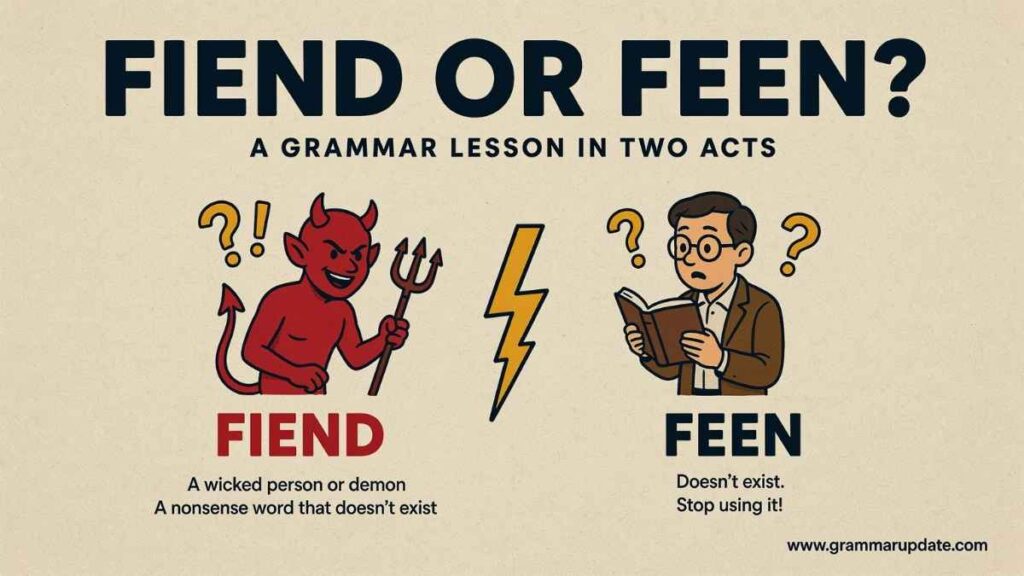
English spelling has a curious way of turning simple words into surprisingly tricky puzzles, and “fiend or feen” is a perfect example. These forms sound remarkably similar, yet their meanings, origins, and uses are not the same. One is a well-established English word, while the other appears mainly in dialect and informal slang. That small spelling difference can cause considerable confusion, especially when these terms appear in conversation or casual writing. Understanding the difference between fiend or feen becomes much easier when you look at their meanings, pronunciation, and context. Let’s clear up the confusion and make these easily mixed-up words much easier to understand.
Quick Answer Fiend or Feen?
Fiend is the standard English word. It can describe an evil or cruel person, a demon or evil spirit, or someone who is extremely enthusiastic about something.
Feen has more limited uses. It appears as an Irish-dialect word meaning “man” and also appears in informal slang, particularly in expressions connected with intense desire or craving.
So, if you are writing formal or standard English, fiend is usually the word you want.
| Word | Main Use | Standard English? |
|---|---|---|
| Fiend | Evil person, demon, or extreme enthusiast | Yes |
| Feen | Irish-dialect “man” or informal slang | Limited/informal |
| Fein | Not a standard spelling of fiend | No |
Learn the difference between tricky words and use them correctly
Ambience or Ambiance Which Spelling Is Correct?
What Does Fiend Mean?
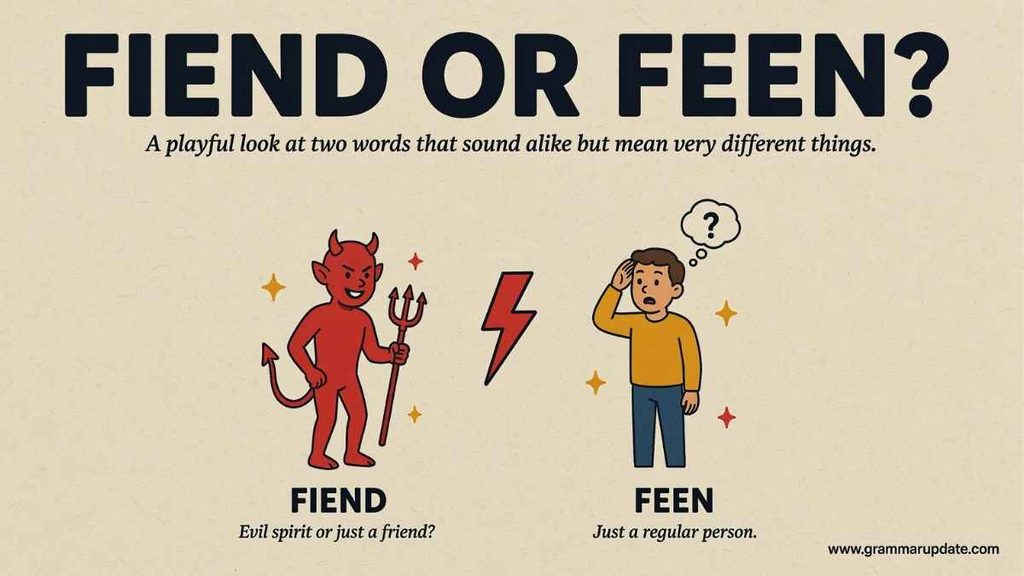
Fiend is a well-established English noun. Its meaning changes slightly depending on context, but the word generally describes something or someone associated with cruelty, evil, obsession, or extreme enthusiasm.
Fiend as an Evil or Cruel Person
One common meaning of fiend is an extremely cruel, wicked, or unpleasant person.
For example:
“The villain was portrayed as a ruthless fiend.”
Here, fiend emphasizes the person’s cruel or evil behavior.
You might also hear someone use the word figuratively:
“That man is a fiend when he gets angry.”
In this context, the speaker is comparing the person’s behavior to something frightening or vicious.
Fiend as a Demon or Evil Spirit
Fiend can also refer to a demon, devil, or evil supernatural being.
For example:
“The ancient story described a fiend lurking in the forest.”
This use is common in fantasy, horror, mythology, and older literature.
Writers often choose fiend when they want a stronger or more dramatic word than simply “enemy” or “villain.”
Fiend as an Extreme Enthusiast
Fiend does not always have a negative meaning.
In modern English, you can call someone a fiend when they have an unusually strong enthusiasm for something.
For example:
“She is a coffee fiend.”
This means she loves coffee and consumes or seeks it enthusiastically.
Other examples include:
“He is a fitness fiend.”
“She is a chocolate fiend.”
“My brother is a crossword fiend.”
In these examples, fiend means someone who is intensely interested in or fond of something.
Learn the difference between tricky words and use them correctly
Feet or Foot Which One Is Correct?
What Does Feen Mean?
Feen is a less common word than fiend, and its meaning depends heavily on context.
It appears in Irish dialect as a noun meaning “man.” It also appears in informal slang, where it can be connected with intense desire or craving.
Because of these different uses, you should not automatically treat feen as a simple alternative spelling of fiend.
Feen as an Irish Dialect Word
In Irish dialect usage, feen can mean “man.”
This use is distinct from the standard English meanings of fiend.
For example, a dialectal sentence might use feen to refer to a man or fellow.
Because dialect words have regional histories and patterns, they should not automatically be treated as standard vocabulary for formal writing.
Feen as Informal Slang
Feen can also appear in informal slang, particularly when people describe someone who strongly craves something.
Its use can overlap with informal spellings connected to fiend and the verb fiending.
For example:
“He is a feen for fast food.”
This is informal and would not normally be the preferred wording in formal writing.
The standard word choice depends on the intended meaning and context.
Fiend vs Feen Key Differences
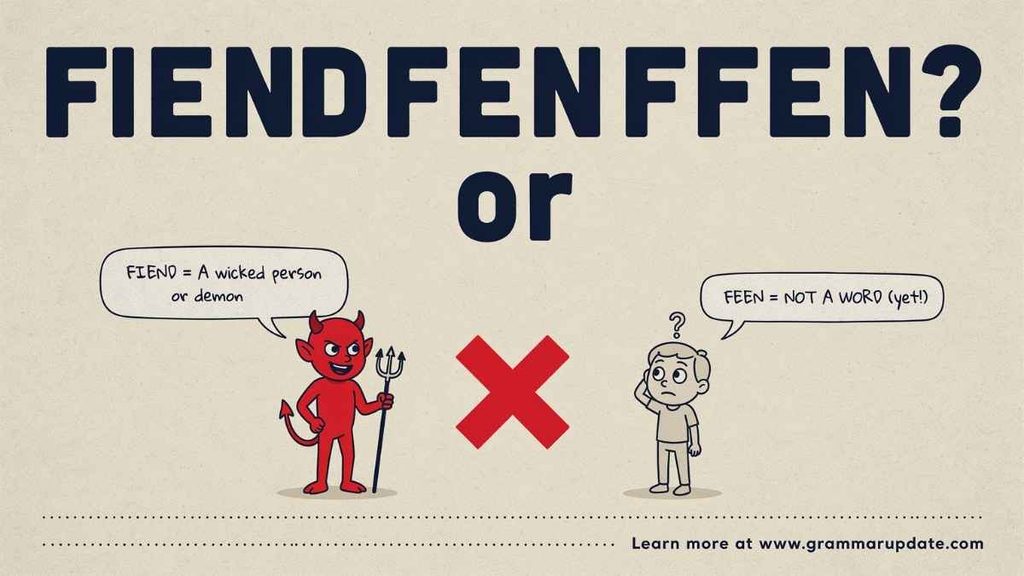
The easiest way to understand the difference is to look at their meanings and contexts.
| Feature | Fiend | Feen |
|---|---|---|
| Standard English word | Yes | Limited |
| Can mean an evil person | Yes | No |
| Can mean a demon | Yes | No |
| Can describe an extreme enthusiast | Yes | Informally related in some slang |
| Irish-dialect meaning “man” | No | Yes |
| Common in formal writing | Yes | Rare |
| Informal slang use | Yes | Yes |
The important point is simple: fiend is an established standard English word, while feen has narrower dialectal and informal uses.
Why Do People Confuse Fiend and Feen?
The confusion usually begins with pronunciation.
Fiend is commonly pronounced like “feend,” while feen is commonly pronounced like “feen.” The sounds are close enough to cause spelling confusion, especially when someone learns the word through conversation rather than reading.
English contains many words that sound similar but have different spellings. That is why hearing a word is not always enough to determine how to write it.
Think of pronunciation as the road sign and spelling as the map. The sign may get you in the right neighborhood, but the map tells you exactly where you are going.
Fiend or Feen in Slang
Modern informal speech sometimes uses fiend or feen in connection with intense craving.
For example:
“He is fiending for pizza.”
This means he strongly wants pizza.
You may also see:
“She is fiending for coffee.”
Again, the meaning is that she strongly desires coffee.
In informal writing, feen or feening may appear as slang spellings. These forms are common in some online and conversational contexts, but they are not interchangeable with every standard use of fiend.
Learn the difference between tricky words and use them correctly
Families or Familys Which One Is Correct?
What Does Fiending Mean?
Fiending is an informal form associated with the noun fiend and the idea of craving something intensely.
For example:
“I am fiending for a cold drink.”
The sentence means that the speaker strongly wants a cold drink.
The expression often appears in casual conversation and slang.
Another example is:
“They were fiending for some good music.”
Here, fiending means strongly wanting or craving something.
The word can sound humorous because it turns an ordinary desire into something much more dramatic. Wanting a cookie becomes a full-scale cookie emergency.
What Does Feening Mean?
Feening is an informal slang spelling that can be used to express intense desire or craving.
For example:
“He is feening for some fries.”
The meaning is similar to saying:
“He is craving some fries.”
However, feening is informal. It is better suited to casual messages, dialogue, social media, or other relaxed contexts.
For formal writing, words such as craving, wanting, desiring, or strongly wanting are usually clearer.
Learn the difference between tricky words and use them correctly
Likeable or Likable Which Spelling Is Correct?
Fiend, Feen, and Feign Do Not Mix Them Up
There is another word that can cause even more confusion: feign.
Feign is a completely different word.
It means to pretend, fake, or give a false appearance of something.
For example:
“She decided to feign surprise.”
This means she pretended to be surprised.
Compare these words:
| Word | Meaning |
|---|---|
| Fiend | Evil person, demon, or extreme enthusiast |
| Feen | Dialectal “man” or informal slang |
| Feign | Pretend or fake |
The spelling difference is small, but the meanings are worlds apart.
A person can be a fiend, someone can use feen in a dialect or slang context, and someone can feign an emotion. English apparently decided that three nearly identical-looking words were not enough of a challenge.
Learn the difference between tricky words and use them correctly
Labelling or Labeling Which Spelling Is Correct?
Fiend or Feen Pronunciation
It is commonly pronounced /fiːnd/.
It rhymes with words such as:
“mind”
“find”
“kind”
Feen is commonly pronounced /fiːn/ in its dialectal use.
The main difference is the final sound. Fiend ends with a “d” sound, while feen does not.
That small difference can become important when speaking carefully.
Is Feen a Word?
Yes, feen can be a word, but its status depends on the context.
It is documented as an Irish-dialect word meaning “man.” It also appears in modern informal slang.
Therefore, saying that feen is simply “wrong” would be too broad.
At the same time, you should not automatically replace fiend with feen in standard English.
If you are writing an academic paper, professional email, article, report, or formal document, choose the word that matches the intended meaning and standard usage.
Learn the difference between tricky words and use them correctly
Label or Lable Which Spelling Is Correct?
Is Fiend a Word?
Yes. Fiend is a standard English word with a long history.
It can refer to an evil or cruel person, a demon or evil spirit, or a person who is extremely enthusiastic about something.
For example:
“He is a history fiend.”
“The story described a terrifying fiend.”
“She is a chocolate fiend.”
The meaning becomes clear from the surrounding words.
The Origin of Fiend
Fiend has a long history in English.
The word comes from Old English feond, which was connected with the idea of an enemy, foe, or adversary. It is related to the concept of hatred or hostility.
Over time, the word developed its modern meanings associated with evil beings, cruel people, and extreme enthusiasts.
Its history helps explain why fiend can carry both negative and playful meanings today.
When you call someone a fiend for chocolate, you are not accusing them of being a supernatural villain. You are simply emphasizing their enthusiasm.
The Origin and Use of Feen
Feen has a different background depending on the sense being discussed.
Its Irish-dialect use refers to a man. Its modern slang use belongs to informal vocabulary and can overlap with expressions involving craving or intense desire.
Because these uses come from different linguistic contexts, it is important to consider the sentence before deciding what feen means.
This is one reason dictionaries and language references may treat uncommon words differently from standard everyday vocabulary.
Fiend or Fein Are They the Same?
No.
Fein is not a standard alternative spelling of fiend.
If you mean the standard English word for an evil person, demon, or extreme enthusiast, the spelling is fiend.
For example:
“He is a coffee fiend.”
Not:
“He is a coffee fein.”
The spelling fiend includes the “d” at the end.
That final letter matters.
How to Spell Fiend
The correct standard spelling is:
Fiend
A useful way to remember it is to connect it with “friend” minus the “r.”
Friend → remove r → fiend
The meanings are obviously very different, so do not invite your fiend to your birthday party unless you are feeling unusually adventurous.
Another helpful reminder is:
Fiend ends with “d.”
Learn the difference between tricky words and use them correctly
Skied or Skiied Which Spelling Is Correct?
How to Spell Feen
The spelling is:
Feen
This form is used in specific dialectal and informal contexts.
Because feen is uncommon in standard English, always check the intended meaning before using it.
If you are simply trying to describe an evil person, demon, or extreme enthusiast, fiend is the appropriate standard spelling.
Use in Everyday Sentences
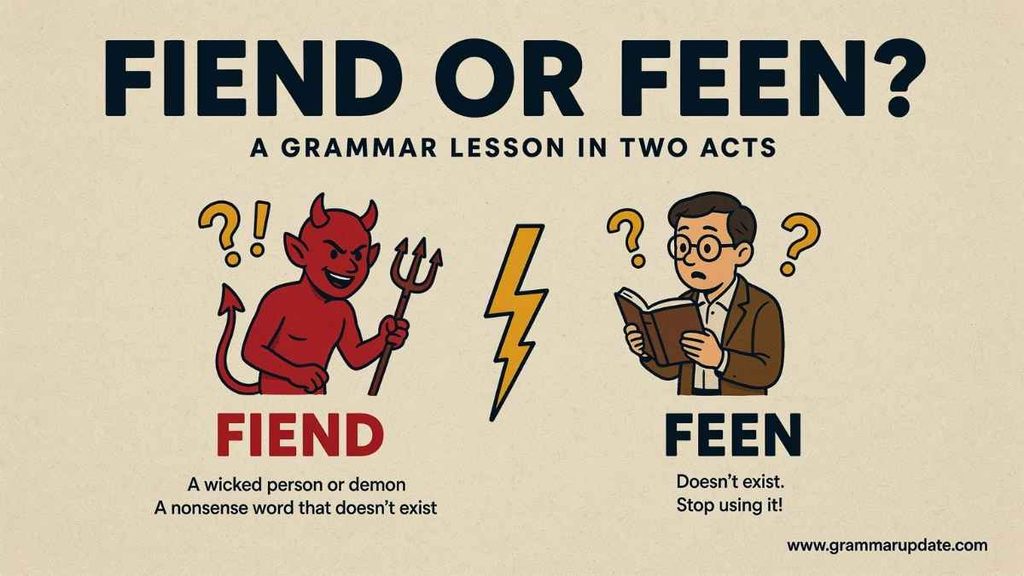
Context makes the difference much easier to see.
| Sentence | Meaning |
|---|---|
| He is a coffee fiend. | He loves coffee intensely. |
| The story featured a terrifying fiend. | The fiend was an evil supernatural being. |
| She called the cruel man a fiend. | She described him as extremely cruel. |
| The dialect uses feen for “man.” | Feen has a regional meaning. |
| He is fiending for pizza. | He strongly wants pizza. |
| She is feening for a snack. | Informal slang for strongly wanting a snack. |
| She tried to feign confidence. | She pretended to be confident. |
These examples show why spelling alone does not tell the whole story. Meaning and context matter just as much.
Learn the difference between tricky words and use them correctly
Curtsy or Curtsey Which Spelling is Correct?
Fiendish, Fiending, and Feening
Several related forms can appear in English.
Fiendish is a standard adjective meaning wicked, cruel, devilish, or mischievous.
For example:
“The villain had a fiendish plan.”
Fiending is an informal term connected with intense craving.
For example:
“He is fiending for a cup of coffee.”
Feening is an informal slang spelling that can express a similar idea of craving.
For formal writing, fiendish is standard, while fiending and feening are more casual.
Can Feen Be Used in Formal Writing?
It can be used when you are deliberately discussing a dialect, slang term, quotation, character voice, or specific linguistic context.
However, you should not use feen simply because you think it is another spelling of fiend.
For standard professional writing, fiend is the safer choice when you mean an evil person, demon, or extreme enthusiast.
If you are writing dialogue, however, an informal spelling may be appropriate when it reflects the speaker’s language.
Learn the difference between tricky words and use them correctly
Lovable or Loveable Which Spelling Is Correct?
Common Mistakes
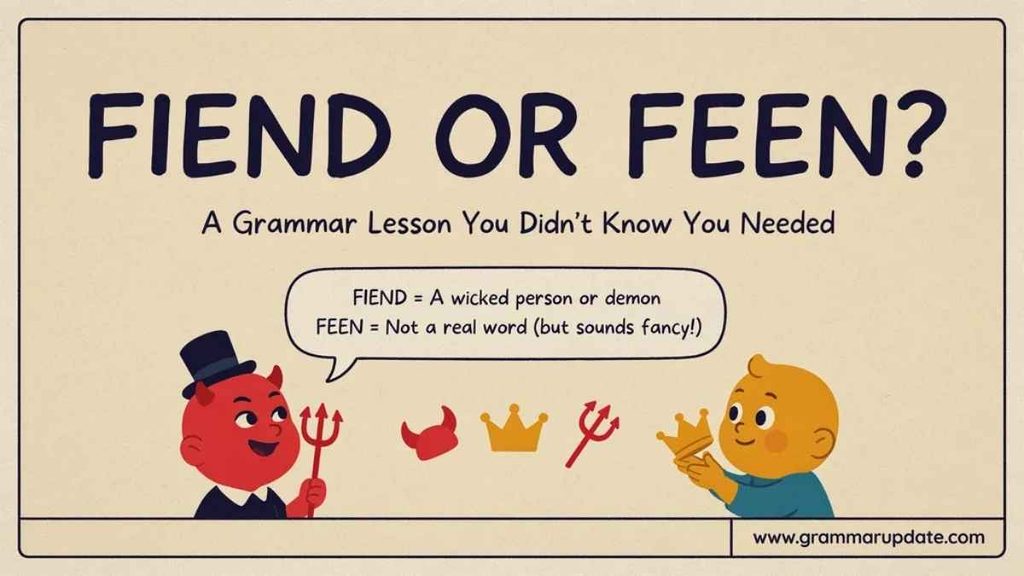
One common mistake is assuming that fiend and feen are interchangeable.
They are not.
Another mistake is writing fein when you mean fiend.
For example:
Incorrect: “He is a chocolate fein.”
Correct: “He is a chocolate fiend.”
A third mistake is confusing feening with feigning.
“Feening” can be an informal slang form related to craving.
“Feigning” means pretending.
For example:
“He was feigning interest.”
That sentence means he was pretending to be interested.
Quick Facts About Fiend and Feen
Fiend is a standard English word.
They can describe an evil or cruel person.
It can refer to a demon or evil spirit.
Fiend can describe someone who is extremely enthusiastic about something.
Feen has documented Irish-dialect use meaning “man.”
Feen can also appear in informal slang.
Fiending is associated with intense craving in informal English.
Feening is an informal slang spelling.
Feign is a completely different word meaning “pretend.”
Fein is not the standard spelling of fiend.
Here’s a trusted source for clear more words Comparison:
Grammar Update
Practice Session Fiend or Feen
Put your understanding to the test with the following sentences. Choose the word or form that best completes each blank. Read the entire sentence before choosing an answer because context determines the correct form.
Fill in the Blanks
- The villain in the novel was portrayed as a cruel ______.
- Daniel is a coffee ______ who starts his morning with a fresh cup.
- In the ancient legend, a terrifying ______ guarded the castle.
- Emma is a chocolate ______ who rarely refuses dessert.
- During the interview, the candidate tried to ______ confidence.
- A mysterious ______ appeared in the horror story.
- After the long hike, James was ______ for a cold drink.
- My brother is a football ______ who follows every major match.
- In Irish dialect, ______ can refer to a man.
- After smelling the pizza, Sarah was ______ for a slice.
- The cruel ruler was described as a heartless ______.
- Mark is a fitness ______ who exercises every morning.
- Within the fantasy novel, a powerful ______ frightened the villagers.
- She tried to ______ surprise when she opened the gift.
- In informal slang, ______ may describe someone with an intense craving.
- Lisa is a book ______ who always carries a novel.
- According to the story, an evil ______ lived beneath the old house.
- After seeing the dessert menu, he was ______ for something sweet.
- The writer described the ruthless villain as a ______.
- Jake is a music ______ who knows hundreds of songs.
- During the performance, the actor had to ______ fear.
- Calling someone a coffee ______ usually highlights a strong love of coffee.
- In the dialectal sense, ______ can mean “man.”
- After dinner, Mia was ______ for a piece of chocolate.
- The old tale featured an evil ______ guarding the entrance.
- Noah is a history ______ who enjoys learning about ancient civilizations.
- Despite feeling nervous, the speaker managed to ______ confidence.
- In some informal contexts, ______ can refer to someone experiencing a strong craving.
- According to the villagers, a dangerous ______ lived inside the abandoned mansion.
- Alex is a technology ______ who closely follows new devices.
- The detective described the murderer as a cruel ______.
- After hours without food, Tom was ______ for a hearty meal.
- The performer decided to ______ confidence during the difficult scene.
- In informal speech, ______ may be used to describe someone who strongly desires something.
- Her love of mystery novels earned her the playful nickname “book ______.”
Answer Key
- fiend
- fiend
- fiend
- fiend
- feign
- fiend
- fiending
- fiend
- feen
- fiending
- fiend
- fiend
- fiend
- feign
- feen
- fiend
- fiend
- fiending
- fiend
- fiend
- feign
- fiend
- feen
- fiending
- fiend
- fiend
- feign
- feen
- fiend
- fiend
- fiend
- fiending
- feign
- feen
- fiend
Learn the difference between tricky words and use them correctly
Frequently Asked Questions
Does fiend mean addicted?
Not exactly. Fiend traditionally refers to an evil or cruel person, a demon, or someone extremely enthusiastic about something. In informal slang, it can describe a person who strongly craves a substance or activity, which can give it an association with addiction.
How do you spell drug fein?
The standard spelling is “drug fiend,” not “drug fein.” In informal speech, “feen” or “feening” may also appear as slang forms related to craving, but “fiend” is the established spelling.
Is it crack, fiend, or feen?
These words have different meanings. Crack refers to crack cocaine, while fiend can describe someone who intensely craves a substance. Feen is an informal slang form that may describe someone experiencing a strong craving. They should not be treated as interchangeable terms.
What is a feen in slang?
In slang, feen can describe someone who strongly wants or craves something. The term often appears in expressions about food, entertainment, drugs, or other intense desires. Its spelling and meaning can vary across informal communities.
Is it feen or fien?
Feen is the spelling used in the slang and dialectal senses discussed here. Fien is not the standard spelling of fiend. If you mean the established English word for an evil person, demon, or intense enthusiast, use fiend.
What are some person called in slang?
Informal English has several terms for people who are dependent on or strongly crave drugs, including fiend and junkie. These expressions can sound judgmental or offensive, so neutral terms such as “person with a substance use disorder” are more appropriate in professional or respectful writing.
Is it spelled fiend or feind?
The correct standard spelling is fiend. Feind is a common spelling mistake. A simple way to remember the spelling is that fiend contains “ie,” just like several other English words with the long-e sound.
What does “fein” mean in slang?
Fein is sometimes used informally as a spelling variation of feen or fiend in slang contexts involving intense desire. It is not the standard spelling of the English word fiend, so its meaning depends on the community and context where it appears.
What is a drug fiend?
A drug fiend is an informal expression for someone who strongly craves or compulsively seeks drugs. The phrase can carry a negative or judgmental tone, particularly when used to label another person.
What is feen?
Feen has more than one use. In Irish dialect, it can mean “man.” In modern informal slang, it can refer to someone who strongly craves something or to the act of craving. The intended meaning depends on context.
Is “Fein” spelled correctly?
Usually not if you are trying to spell the standard English word fiend. Fein can appear as an informal slang spelling in some contexts, but fiend is the established spelling for the standard English word.
Is fiend an insult?
It can be. When fiend describes someone as cruel, wicked, or evil, it carries a strongly negative meaning. However, the word can also be playful or neutral in phrases such as “coffee fiend,” where it simply describes someone with a strong enthusiasm for coffee.
Why are some person called fiends?
The slang sense developed from the broader idea of a person who intensely craves or compulsively seeks something. Over time, fiend became associated with people who strongly desire drugs. The expression is informal and can be stigmatizing, so it should be used carefully.
What is a fiend in slang?
In slang, fiend can describe someone who has an intense desire for something. For example, “He is a coffee fiend” means he is extremely fond of coffee. In drug-related contexts, it can refer to someone who strongly craves a particular substance.
What does the phrase “I’m a fiend for you” mean?
“I’m a fiend for you” is an informal expression meaning “I strongly desire you” or “I’m extremely attracted to you.” Depending on the situation, it can sound romantic, playful, flirtatious, or sexually suggestive. The surrounding conversation determines the intended tone.
Answer Engine Optimization
What is the difference between fiend and feen?
Fiend is the standard English spelling. It can refer to an evil person, demon, or someone with an unusually strong enthusiasm for something. Feen has more limited uses, including an Irish-dialect meaning of “man” and informal slang connected with intense craving.
Is feen a real word?
Yes. Feen is documented in specific dialectal and informal uses. It should not automatically be treated as a misspelling because its meaning can differ according to context.
Is fiend the correct spelling?
Yes, when you mean the standard English word. Fiend is used for an evil or cruel person, a demon, or someone who is extremely enthusiastic about something.
What does fiend mean in drug slang?
In drug-related slang, fiend can describe someone who strongly craves or compulsively seeks a drug. It is an informal expression and may carry a judgmental tone.
What is the correct spelling: fiend, feind, fien, or feen?
Fiend is the standard spelling for the established English word. Feind and fien are incorrect when intended as spellings of fiend. Feen is a separate dialectal and informal form with its own uses.
Does fiend always mean a drug usage people?
No. The word has several meanings. It can describe an evil person, a supernatural creature, or someone who is extremely enthusiastic about something. Its drug-related sense is only one informal usage.
What does “fiend for something” mean?
“Fiend for something” means to strongly want, crave, or desire it. For example, “She is a fiend for chocolate” means she has a very strong liking for chocolate.
Is “drug fiend” formal English?
No. Drug fiend is an informal expression. In professional, medical, or respectful contexts, more precise language should be used to describe substance use, dependence, or a substance use disorder.
Can feen mean addicted?
In informal slang, feen can suggest intense craving, including craving a drug. However, it does not automatically mean that someone has an addiction. Strong desire and clinical addiction are not the same thing.
Which spelling should you use in formal writing?
Use fiend when you need the standard English word. Avoid informal spellings such as feen or fein unless you are discussing slang, dialect, dialogue, or a specific informal expression.
What does “feen” mean in modern slang?
Modern slang can use feen for a person who strongly craves something or for someone experiencing an intense desire. The exact meaning varies with context and community.
Is “feind” correct?
No. Feind is not the standard spelling of fiend. If you are referring to an evil person, demon, or extremely enthusiastic person, the correct spelling is fiend.
Can fiend be positive?
Yes. Fiend can have a playful meaning when it describes strong enthusiasm. Calling someone a “coffee fiend” or “fitness fiend” usually means that person is extremely fond of coffee or fitness rather than evil.
What does “I’m a fiend for you” mean?
The phrase expresses strong attraction or desire toward another person. It is informal and can sound romantic, flirtatious, or suggestive depending on the situation.
What should you remember about fiend and feen?
Remember one simple distinction: fiend is the standard English word, while feen has specific dialectal and slang uses. Context determines whether an informal form is appropriate.
Key Takeaways
The difference between fiend and feen may seem minor, but a small spelling change can take your sentence in an entirely different direction. Fiend is the standard English word for an evil or cruel person, a demon, or someone with an intense enthusiasm for something. Feen has more limited dialectal and informal slang uses, while feign is a separate word meaning “to pretend.” Understanding these distinctions makes the correct choice much easier. Before one misplaced letter turns a clear sentence into a linguistic puzzle, consider the meaning and context. With a little attention to spelling, your writing can stay accurate, polished, and confidently free from unnecessary confusion.

Ella AJS
Ella AJS is an experienced blogger and language enthusiast at Grammar Spire, dedicated to making English grammar simple, practical, and easy to understand. She specializes in word comparisons, meanings, usage, and common language confusions. Through clear explanations and engaging examples, Ella helps students, writers, and English learners improve their vocabulary and communicate with greater confidence and accuracy.




