
English spelling has a talent for making simple words feel like tiny puzzles. The confusion over “lilies or lillies” proves the point. Both spellings may look convincing, but only one is correct in standard English. The correct form is “lilies,” the plural of “lily.” The extra l in “lillies” has no place in the word, even though it may sneak in when you write quickly. Whether you’re describing a garden, writing about flowers, or polishing your grammar, knowing the difference matters. In this guide, you’ll learn why “lily” becomes “lilies,” what the words mean, how to use them correctly, and an easy way to remember the spelling.
Lilies or Lillies The Quick Answer
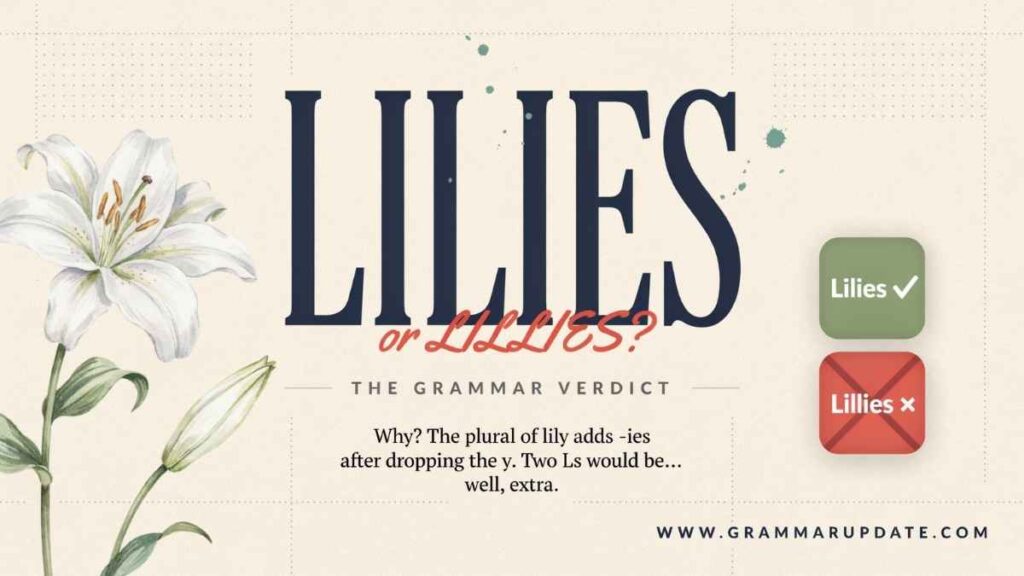
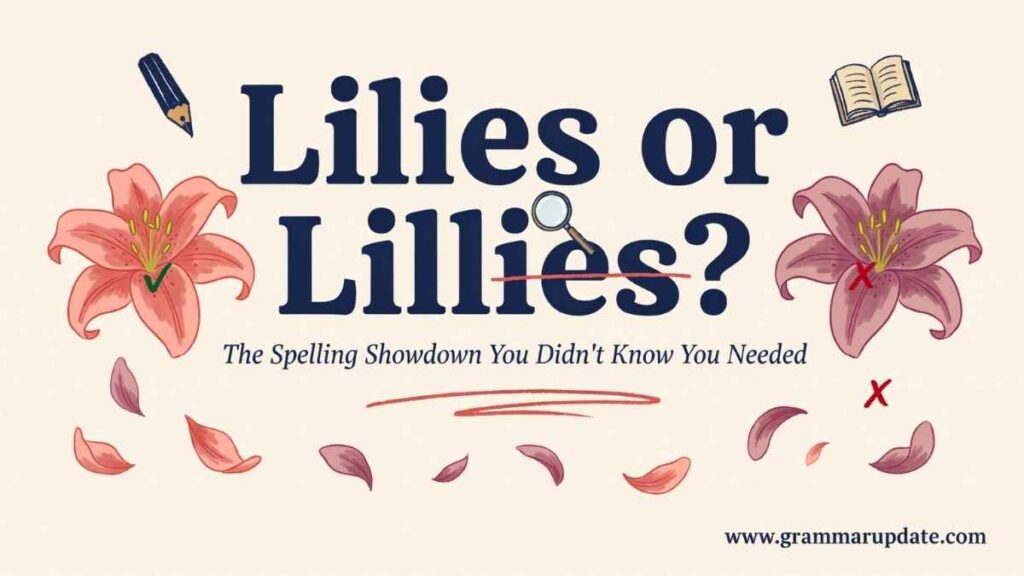
If you are asking, “Is it lilies or lillies?” the answer is lilies.
Lilies is the standard plural form of lily. Lillies is a misspelling when it is intended to mean more than one lily.
| Word | Correct? | Meaning |
|---|---|---|
| lilies | Yes | Plural of lily |
| lillies | No | Common misspelling of lilies |
| lily | Yes | Singular form |
| Lilly | Yes as a personal name | A possible spelling of a person’s name |
For example:
The garden was filled with beautiful lilies.
The florist arranged several white lilies in a vase.
The spelling lillies should not be used in these sentences.
The easiest way to remember the difference is simple: lily becomes lilies by changing y to ies. There is no need to double the l.
Learn the difference between tricky English words with easy explanations
Families or Familys Which One Is Correct?
What Is the Correct Spelling of Lilies?
The correct spelling of lilies is:
l-i-l-i-e-s
The singular form is lily:
l-i-l-y
When you make lily plural, replace the final y with ies.
lily → lilies
This spelling follows an important English pluralization rule. Many nouns that end with a consonant followed by y change the y to ies when they become plural.
For example:
| Singular | Plural |
|---|---|
| lily | lilies |
| baby | babies |
| city | cities |
| story | stories |
| family | families |
| country | countries |
| party | parties |
The same pattern explains why lillies is not the correct spelling.
Learn the difference between tricky English words with easy explanations
Likeable or Likable Which Spelling Is Correct?
Why Does Lily Become Lilies?
The answer becomes much clearer when you examine the ending of lily.
The word is spelled:
l-i-l-y
The final y follows the consonant l. When this type of noun becomes plural, English commonly changes the y to ies.
So:
lily → lil + ies → lilies
Only the ending changes. The rest of the word stays intact.
This is why the spelling does not become lillies.
A useful rule to remember is:
When a noun ends in a consonant plus y, the y usually changes to ies in the plural.
For example:
baby → babies
puppy → puppies
lady → ladies
city → cities
lily → lilies
However, English has another pattern for words ending in a vowel plus y. In those words, the y normally stays and you simply add s.
For example:
boy → boys
key → keys
day → days
toy → toys
So the rule is not simply “every word ending in y becomes ies.” The letter before the y matters.
Lilies vs Lillies Spelling
The difference between lilies and lillies is only one letter, but that extra letter makes the second form incorrect.
Compare the two spellings:
lilies
lillies
The standard form has two l letters in the entire word, but they are separated:
l-i-l-i-e-s
The misspelling places two l letters together:
l-i-l-l-i-e-s
That extra l does not belong there.
The pluralization process does not double the l. It changes the final y to ies.
Therefore:
lily → lilies
not:
lily → lillies
This is one of those spelling problems that can fool your eyes because both versions look familiar. Once you know the rule, however, the correct form becomes much easier to recognize.
Learn the difference between tricky English words with easy explanations
Labelling or Labeling Which Spelling Is Correct?
Is It Lilies or Lillies?
If you are asking, “Is it lilies or lillies?” use lilies.
The word lilies refers to more than one lily.
For example:
One lily is growing in the garden.
Several lilies are growing in the garden.
The singular and plural forms are different, but the plural does not require a doubled l.
This distinction matters in everyday writing as well as professional content. A florist describing a bouquet, a gardener discussing plants, or a student writing about flowers should use lilies when referring to more than one.
Is Lilies a Word?
Yes, lilies is a standard English word.
It is the plural noun formed from lily.
For example:
The lilies are blooming.
She planted several lilies.
The vase contains three lilies.
In each sentence, lilies refers to more than one flower or plant.
So if you are wondering, “Is lilies a word?” there is no mystery here. It is the correct plural form.
Is Lillies a Word?
If you are asking, “Is lillies a word?” the answer depends on what you mean by the spelling.
When you intend the plural of lily, lillies is not the standard spelling. It is a common misspelling of lilies.
The correct form is:
lily → lilies
The extra l in lillies has no grammatical purpose.
Therefore, in standard English writing, use lilies when you mean multiple lily flowers.
Is Lillies Correct?
No. Lillies is not the correct standard plural of lily.
The correct spelling is lilies.
This mistake usually happens because writers expect a consonant to double during a spelling change. English does use doubled consonants in many situations, but that does not apply here.
The plural rule simply changes y to ies.
That gives you:
lily → lilies
Once you remember this pattern, the spelling becomes much easier.
Learn the difference between tricky English words with easy explanations
Label or Lable Which Spelling Is Correct?
Lilies Meaning What Does Lilies Mean?
The lilies meaning is simply the plural meaning of lily.
Lily refers to one.
Lilies refers to more than one.
For example:
A lily is growing beside the walkway.
Several lilies are growing beside the walkway.
The word can describe multiple lily plants or flowers. In everyday language, people also use lily in the names of several plants that are not technically true lilies.
What Does Lily Mean?
A lily is a flowering plant. True lilies belong to the genus Lilium and are perennial plants that commonly grow from bulbs.
Many lilies produce large, attractive flowers. Depending on the species or variety, their blooms can appear in colors such as white, pink, yellow, orange, and red.
The word lily also appears in the common names of plants such as daylily, calla lily, peace lily, and water lily. Despite sharing the word lily, these plants do not all belong to the same botanical group.
That distinction is useful because everyday flower names and scientific classification do not always match perfectly.
Lilies Definition
A simple lilies definition is:
Lilies are two or more plants or flowers known as lilies.
The singular form is lily.
The plural form is lilies.
For example:
The lily is beautiful.
The lilies are beautiful.
The first sentence refers to one. The second refers to more than one.
Lillies Definition
The lillies definition is different because lillies is not the standard plural form of lily.
When someone writes lillies while referring to multiple lily flowers, they almost certainly mean lilies.
Therefore:
lily = singular
lilies = plural
lillies = common misspelling
Learn the difference between tricky English words with easy explanations
Skied or Skiied Which Spelling Is Correct?
Lily Plural What Is the Plural of Lily?
The plural of lily is lilies.
This is the most important grammar point in the entire topic.
The lily plural spelling follows the consonant plus y rule:
lily → lilies
You can see the same pattern in words such as:
family → families
library → libraries
company → companies
country → countries
The rule helps explain why lilies contains ies instead of ys.
For example:
I bought one lily.
I bought three lilies.
The noun changes because the quantity changes.
Learn the difference between tricky English words with easy explanations
Curtsy or Curtsey Which Spelling is Correct?
Lily or Lilies Which One Should You Use?
The choice between lily or lilies depends on whether you mean one or more than one.
Use lily for a single flower or plant.
Use lilies for multiple flowers or plants.
| Situation | Correct form | Example |
|---|---|---|
| One flower | lily | I bought a lily. |
| Several flowers | lilies | I bought three lilies. |
| One plant | lily | The lily is blooming. |
| Several plants | lilies | The lilies are blooming. |
This is a basic singular and plural distinction, but it is especially useful when writing about gardening, flowers, bouquets, and floral arrangements.
Lilies Grammar How the Plural Works
From a grammar perspective, lilies is a plural noun created through a spelling change.
The singular noun lily ends in consonant plus y. English commonly changes the final y to ies when forming the plural.
This process is called pluralization.
The basic pattern is:
consonant + y → ies
Examples include:
lily → lilies
baby → babies
city → cities
story → stories
family → families
The important point is that the spelling change affects the ending, not the beginning.
That is why lily does not become lillies.
Learn the difference between tricky English words with easy explanations
Lovable or Loveable Which Spelling Is Correct?
Lilies Pronunciation
The pronunciation of lilies does not contain a doubled l sound simply because someone may spell the word incorrectly as lillies.
Lilies is normally pronounced as a two-syllable word.
For English learners, the best approach is to learn the standard spelling together with the pronunciation rather than allowing the common misspelling to influence how the word looks or sounds.
The spelling lillies can be especially misleading because the additional l does not represent a meaningful difference in the standard pronunciation.
How to Spell Lilies
If you are searching for how to spell lilies, start with the singular form.
First:
lily
Then replace the final y with ies:
lilies
A simple memory trick is:
Change the y, not the l.
That gives you the correct spelling every time:
lily → lilies
This is easier than trying to memorize lilies as an entirely separate word.
How to Spell Lillies
If you are searching for how to spell lillies because you want the plural of lily, the standard answer is lilies.
The form lillies contains an extra l.
Instead, remember:
lily → lilies
There is no need to add another l.
Why Is Lilies Spelled With One L?
The question “Why is lilies spelled with one l?” comes from a common misunderstanding about English spelling patterns.
The singular word lily already contains the letters needed for the beginning of the plural:
l-i-l
Only the final y changes.
The transformation is:
lily → lil + ies → lilies
Nothing causes the l to double.
This is why the correct spelling has no ll together.
Why Is Lillies Incorrect?
The answer to “Why is lillies incorrect?” is straightforward.
The word lillies contains an extra l that does not belong to the plural form of lily.
The English plural rule changes the final y to ies. It does not double the consonant.
So:
lily → lilies
not:
lily → lillies
The extra l is simply a spelling mistake.
Learn the difference between tricky English words with easy explanations
Outting or Outing Which Spelling Is Correct?
Lily Flower Spelling and Botanical Facts
The standard lily flower spelling is lily for one and lilies for more than one.
True lilies belong to the genus Lilium. They are perennial flowering plants commonly grown in gardens and valued for their attractive blooms.
Many true lilies grow from bulbs. Their flowers can vary widely in size, shape, fragrance, and color.
Commonly recognized lily types include Easter lilies, tiger lilies, Asiatic lilies
Some plants have “lily” in their common name even though they are not true lilies. Daylilies, calla lilies, peace lilies, and water lilies are examples.
This is a useful reminder that common plant names can be broader than scientific classification.
Types of Lilies and Lily Related Plants
Lilies come in many forms, and their names often appear in gardening and flower vocabulary.
Easter lilies are known for their white, trumpet-shaped flowers and strong fragrance.
Tiger lilies are commonly recognized by their orange flowers and dark markings.
Asiatic lilies often produce colorful flowers and generally have little or no fragrance.
Daylilies are popular garden plants, but they are not true lilies. They belong to a different genus.
Calla lilies also are not true lilies. Their distinctive flower shape makes them popular in floral arrangements.
Water lilies are aquatic flowering plants and belong to a different botanical group.
Peace lilies are popular indoor plants, but they are not true lilies either.
These differences matter when discussing plants scientifically, but everyday English often uses the word lily more broadly.
Lilies Flower Meaning
People often search for lilies flower meaning because flowers can carry symbolic associations.
Lilies have been connected with ideas such as purity, beauty, renewal, remembrance, and devotion in different cultures and traditions.
However, flower symbolism can vary depending on the culture, color, species, occasion, and personal interpretation.
White lilies, for example, are often associated with purity and remembrance. Other colors may suggest different feelings or meanings.
A lily bouquet can therefore carry both decorative and symbolic value.
Lilies in a Bouquet
Lilies are popular in flower bouquets because their large blooms can create a strong visual focal point.
A florist may combine lilies with roses, carnations, greenery, or other flowers to create a balanced floral arrangement.
For example:
The florist arranged white lilies with pink roses.
The word lilies is correct because the sentence refers to multiple flowers.
The same spelling applies whether the flowers appear in a bouquet, garden, vase, wedding arrangement, or gift.
Lily or Lilly Flower vs Personal Name
Another common source of confusion is the difference between Lily and Lilly.
For the flower, the standard spelling is lily.
For a personal name, both Lily and Lilly can be used depending on the spelling chosen by the individual or their family.
That means context matters.
For example:
The lily opened in the morning.
Lilly visited the flower garden.
In the first sentence, lily refers to a flower. In the second, Lilly is a person’s name.
A name can have a spelling that differs from the standard spelling of an ordinary noun. That does not make either form universally wrong.
Lily vs Lilly Name Spelling
When discussing personal names, there is no single spelling rule that determines whether a person should be called Lily or Lilly.
Both spellings occur as names.
However, when discussing the flower itself, lily is the standard English spelling.
This creates an important distinction:
Lily can refer to the flower or a person’s name.
Lilly can be a person’s name.
Lillies, however, is not the standard plural spelling of the flower.
So the flower-related forms remain:
lily → lilies
Common Lilies Spelling Mistakes
Several errors can appear when people write about lily flowers.
The first is writing lillies instead of lilies.
Incorrect:
The florist sells beautiful lillies.
Correct:
The florist sells beautiful lilies.
Another mistake is using lily when the sentence requires a plural noun.
Incorrect:
The garden contains several lily.
Correct:
The garden contains several lilies.
A third mistake involves unnecessary apostrophes.
Incorrect:
The lilies are blooming.
Correct:
The lilies are blooming.
An apostrophe does not make an ordinary noun plural.
Possessive forms are different:
The lily’s petals are soft.
Here, lily’s means the petals belong to one lily.
The lilies’ petals were damaged by rain.
Here, lilies’ shows possession by multiple lilies.
Understanding the difference between plural and possessive forms prevents another common grammar problem.
Lilies Sentence Examples
Seeing lilies in complete sentences makes the spelling easier to remember.
The garden is filled with fragrant lilies.
She planted several lilies near the fence.
White lilies decorated the dining table.
The florist added orange lilies to the bouquet.
Several lilies bloomed after the spring rain.
The vase held pink lilies and white roses.
The gardener planted lily bulbs in well-drained soil.
These examples show that lilies works naturally in conversations about flowers, gardening, plants, bouquets, and floral arrangements.
Learn the difference between tricky English words with easy explanations
Fiend or Feen which spelling is correct?
Case Study A Small Error With a Big Visual Difference
Imagine a florist creating an online description for a flower arrangement.
The first version reads:
“A beautiful arrangement of fresh lillies, roses, and greenery.”
The meaning is obvious, but the spelling error makes the description look less polished.
After correcting the word, the sentence reads:
“A beautiful arrangement of fresh lilies, roses, and greenery.”
Only one letter changed, yet the second version looks immediately more professional.
This small example illustrates why spelling rules matter. A single unnecessary letter can distract readers from otherwise strong writing.
Why Is the Lilies Spelling Mistake So Common?
The lilies spelling mistake happens because the incorrect version looks surprisingly believable.
English contains many words with doubled consonants. As a result, writers may instinctively add another l when they see lily.
Another reason is that the pronunciation does not clearly reveal the spelling. You can hear the word correctly while still writing it incorrectly.
The solution is to connect the plural with its spelling rule.
Instead of trying to remember whether the word has one l or two together, remember:
lily → lilies
That pattern removes the guesswork.
Is Lillies a Misspelling of Lilies?
Yes. When lillies is intended to mean multiple lily flowers, it is a misspelling of lilies.
The standard English form is lilies.
The mistake is understandable because the two spellings look almost identical. However, formal, academic, professional, and published writing should use the standard spelling.
What Is the Spelling Rule for Words Ending in Y?
The spelling rule depends on the letter immediately before the y.
When a noun ends in a consonant plus y, the y usually changes to ies.
For example:
lily → lilies
baby → babies
city → cities
When a noun ends in a vowel plus y, the y normally remains and s is added.
For example:
boy → boys
key → keys
toy → toys
This distinction explains the lily plural spelling clearly.
Lilies Dictionary Meaning
Dictionary definitions generally treat lily as the singular noun and lilies as its plural form.
In ordinary English, a lily is a flowering plant, particularly one belonging to the genus Lilium. Lilies can also appear in broader common plant names.
The word can be used in different contexts, including gardening, botany, flower arranging, literature, art, and everyday conversation.
The plural lilies simply indicates more than one.
Lilies Meaning in English
The lilies meaning in English is not complicated.
Lily means one.
Lilies means more than one.
The plural does not create a new type of flower. It simply changes the grammatical number.
For example:
One lily.
Two lilies.
One white lily.
Several white lilies.
One lily flower.
A bouquet of lily flowers or lilies.
The spelling changes because English marks the plural through both grammar and spelling.
Learn the difference between tricky English words with easy explanations
Salvadoran or Salvadorian Which Spelling Is Correct?
Quick Comparison of Lily and Lilies
| Form | Number | Example |
|---|---|---|
| lily | Singular | The lily is blooming. |
| lilies | Plural | The lilies are blooming. |
| lily’s | Singular possessive | The lily’s petals are soft. |
| lilies’ | Plural possessive | The lilies’ petals are soft. |
This table captures the most important grammatical forms.
Quick Comparison of Lilies and Lillies
| Feature | Lilies | Lillies |
|---|---|---|
| Standard spelling | Yes | No |
| Plural of lily | Yes | No |
| Refers to multiple lilies | Yes | Intended meaning only |
| Follows the y-to-ies rule | Yes | No |
| Contains doubled ll | No | Yes |
| Recommended in formal writing | Yes | No |
The difference is small, but the correct choice is clear.
Here’s a trusted source for clear more words Comparison:
Grammar Update
Practice Session Lilies or Lillies
Test your understanding of the spelling, plural form, meaning, and usage of “lily” and “lilies.” Choose the correct word for each sentence. Pay close attention to the spelling because one extra letter can turn a perfectly innocent flower into a spelling headache.
Fill in the Blanks
- The garden was filled with beautiful ______ in several colors.
- I planted one white ______ beside the rose bush.
- The correct plural spelling of “lily” is ______.
- “Lillies” is a common spelling ______ of “lilies.”
- Several ______ bloomed near the pond.
- She bought a single ______ for the vase.
- The florist arranged pink ______ into a beautiful bouquet.
- The correct spelling is “lily” rather than “______” when referring to the flower.
- One ______ stood taller than the other flowers.
- The gardener planted several ______ along the walkway.
- To form the plural of “lily,” replace the final y with ______.
- The phrase “three ______” refers to more than one flower.
- The phrase “one ______” refers to a single flower.
- “Lilies” contains two l letters, but they are not written as a double ______.
- The Easter ______ opened in the warm afternoon sunlight.
- The children admired the colorful ______ in the garden.
- Which spelling is correct: “lilies” or “______”?
- The plural possessive form of “lilies” is “______.”
- The ______ petals looked delicate and fresh.
- White ______ are often used in floral arrangements.
- The gardener noticed that the ______ needed more sunlight.
- “Lily” is the singular form, while “______” is the plural form.
- The spelling “lillies” contains an unnecessary extra ______.
- Several tiger ______ grew beside the garden fence.
- If you want to write about more than one lily, use the word “______.”
- The florist placed one ______ in a small glass vase.
- The colorful ______ attracted visitors to the botanical garden.
- The sentence “The lilies are blooming” uses “______” because more than one flower is being discussed.
- The sentence “A lily is blooming” uses “______” because only one flower is mentioned.
- Remember the simple spelling pattern: lily → ______.
Answer Key
- lilies
- lily
- lilies
- mistake
- lilies
- lily
- lilies
- lilly
- lily
- lilies
- ies
- lilies
- lily
- l
- lily
- lilies
- lillies
- lilies’
- lily’s
- lilies
- lily
- lilies
- l
- lilies
- lilies
- lily
- lilies
- lilies
- lily
- lilies
Quick Review
Remember the key pattern:
lily → lilies
The singular form is “lily,” while the plural form is “lilies.” The final y changes to ies because “lily” ends in a consonant followed by y. The spelling “lillies” adds an unnecessary extra l, so it isn’t the standard plural form.
For the flower itself, use “lily.” “Lilly” can be a personal name or a name variant, but it isn’t the standard spelling of the flower.
Frequently Asked Questions
Are the flowers lilies or lillies?
The correct spelling is “lilies.” “Lillies” is a common spelling error. For example, you can write, “The garden is full of beautiful lilies.”
What is the plural form of lily?
The plural form of “lily” is “lilies.” Since the singular noun ends in a consonant followed by y, the y changes to ies when forming the plural.
Is the flower a lily or lilly?
The standard spelling for the flower is “lily.” “Lilly” is also used as a personal name, but it isn’t the standard spelling for the flower itself.
What is the prettiest Lilly?
There isn’t one variety that everyone considers the prettiest. Appearance depends on color, shape, fragrance, and personal preference. Stargazer and Easter lilies are especially admired for their distinctive blooms.
What did Jesus say about lilies?
In the Gospel of Matthew, Jesus referred to the lilies of the field while teaching about worry and God’s provision. A similar teaching appears in Luke. The passage highlights the beauty of the flowers and their natural growth without human effort.
Are rose lilies actually lilies?
“Rose lily” can describe different plants depending on the context. Some plants sold under this name may be true lilies, while others simply have a rose-like appearance. Checking the plant’s botanical name provides the most reliable identification.
Why are lilies called lilies?
The word “lily” has ancient European roots and has been used for centuries as a name for lily-like flowering plants. In modern English, the term commonly refers to members of the genus Lilium and also appears in the common names of several unrelated plants.
What is a cute nickname for Lily?
Popular affectionate choices include Lil, Lili, Lily-Bee, Lilybug, and Lee. The right nickname often depends on the person’s personality and the relationship between the people using it.
What’s the difference between lily and Lilly?
“Lily” is the standard spelling of the flower. “Lilly” is commonly used as a variant personal name. Therefore, the difference usually comes down to context: one refers to the flower, while the other may refer to a person’s name.
Which lily is not a true lily?
Several plants have “lily” in their common names but don’t belong to the genus Lilium. Daylilies, peace lilies, calla lilies, and water lilies are examples. Botanically, true lilies belong to Lilium.
Can I sleep in a room with lilies?
For most people, keeping lilies in a bedroom isn’t inherently harmful. However, their fragrance may be unpleasant or irritating for some people. If the scent bothers you, move the flowers elsewhere or improve ventilation. If you have cats, keep lilies completely away from them because true lilies can cause severe poisoning in cats.
What flowers are true lilies?
True lilies belong to the genus Lilium. Examples include Easter lilies, tiger lilies, Asiatic lilies and trumpet lilies. These flowering plants generally grow from bulbs and produce the characteristic blooms associated with the genus.
What is the prettiest nickname for a girl?
Beauty is subjective, so there isn’t one nickname that everyone considers the prettiest. Options such as Lily, Lulu, Ellie, Rosie, Bella, and Mimi have a sweet and familiar feel. A good nickname should also suit the person’s personality.
Is Lily a classy name?
“Lily” is often viewed as an elegant and timeless given name. Its association with the flower gives it a graceful, nature-inspired quality. Whether a name feels classy ultimately depends on individual taste and cultural context.
What is the most flirty nickname?
The right flirty nickname depends on the relationship and level of familiarity. Common choices include “Gorgeous,” “Cutie,” “Beautiful,” “Darling,” and “Sweetheart.” A nickname works best when it feels natural rather than forced.
Answer Engine Optimization
What is the correct spelling lilies or lillies?
“Lilies” is the correct spelling. It is the plural of “lily.” The word does not need an extra l, so “lillies” is considered a spelling mistake when referring to more than one lily.
How do you spell lilies?
The correct spelling is “lilies,” written l-i-l-i-e-s. Although the word contains two l letters, they aren’t placed together. This makes “lillies” incorrect as the standard plural of “lily.”
Why does lily become lilies?
The spelling changes because “lily” ends with a consonant followed by y. Under a common English pluralization rule, the y changes to ies. As a result, lily becomes lilies.
Is “lillies” a word?
“Lillies” is not the standard plural spelling of “lily.” If you’re referring to more than one lily, use “lilies.” The extra l creates a common spelling error.
What does lilies mean?
“Lilies” is the plural form of “lily.” It refers to multiple flowers or plants called lilies. In botanical terminology, true lilies belong to the genus Lilium.
What is the singular form of lilies?
The singular form is “lily.” You would write “one lily” for a single flower and “several lilies” when referring to more than one.
Is Lily the same as Lilly?
They can be related but aren’t necessarily interchangeable. “Lily” is the standard spelling for the flower, while “Lilly” is commonly used as a personal name or name variant. The intended meaning depends on the context.
Are lilies and lillies pronounced differently?
When “lillies” is used as a misspelling of “lilies,” the writer normally intends the same pronunciation. The main difference is the spelling. Standard English uses “lilies.”
What is the correct plural possessive form of lilies?
The plural possessive form is “lilies’.” For example, “The lilies’ petals opened in the morning.” Because “lilies” already ends in s, the apostrophe is placed after the s.
Are daylilies true lilies?
No. Daylilies belong to the genus Hemerocallis, not Lilium. Although their common name contains “lily,” they aren’t true lilies from a botanical perspective.
Are peace lilies true lilies?
No. Peace lilies belong to the genus Spathiphyllum and are members of the arum family, Araceae. Their common name includes “lily,” but they aren’t part of the true-lily genus Lilium.
What is the easiest way to remember the spelling of lilies?
Start with the singular word “lily.” Remove the final y and add ies. This gives you “lilies.” The simple pattern to remember is:
lily → lilies
How can you use lilies in a sentence?
You can write, “The colorful lilies brightened the garden.” Here, “lilies” correctly refers to more than one flower.
What is the difference between lily and lilies?
“Lily” is singular, while “lilies” is plural. For example, “A lily is blooming” refers to one flower. “Several lilies are blooming” refers to multiple flowers.
Why is “lillies” incorrect?
“Lillies” adds an unnecessary extra l. English forms the plural by changing the final y in “lily” to ies, producing “lilies.” No doubled l is needed.
Key Takeaways
The confusion between “lilies or lillies” doesn’t need to linger like a stubborn weed in the garden. “Lilies” is the correct spelling, while “lillies” is a common mistake caused by adding an unnecessary extra l. The rule is simple: when “lily” becomes plural, the final y changes to ies, giving us “lilies.” There’s no need to double the l or let this little spelling trap wilt your confidence. Whether you’re writing about flowers, improving your grammar, or creating polished content, choosing the right form makes your writing clearer and more accurate. Remember the pattern, lily → lilies, and this tricky little word will soon bloom effortlessly in your vocabulary.

Ella AJS
Ella AJS is an experienced blogger and language enthusiast at Grammar Spire, dedicated to making English grammar simple, practical, and easy to understand. She specializes in word comparisons, meanings, usage, and common language confusions. Through clear explanations and engaging examples, Ella helps students, writers, and English learners improve their vocabulary and communicate with greater confidence and accuracy.




