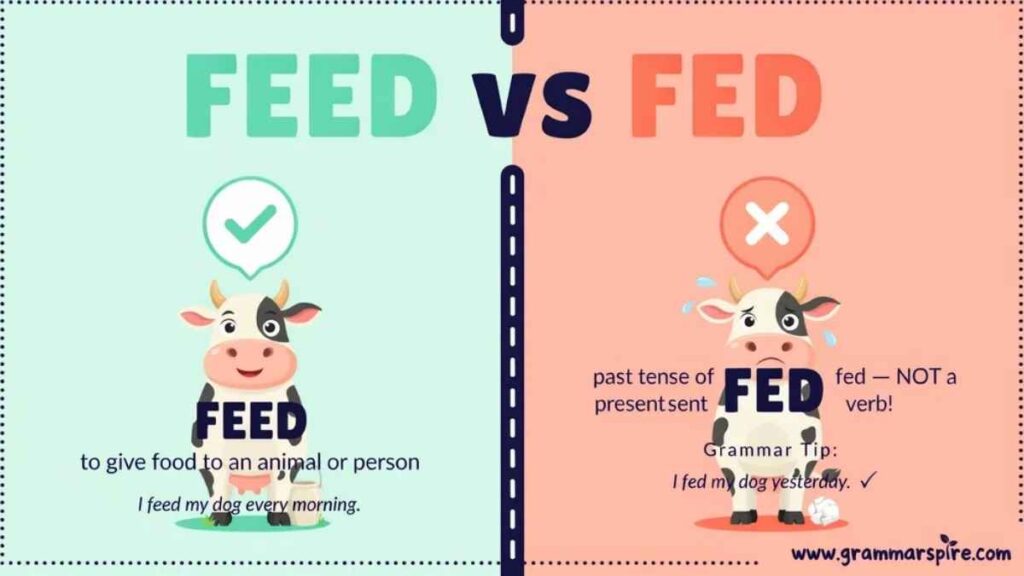
English grammar can turn something as simple as feeding the cat into a surprisingly tricky puzzle. One moment, you feed the cat; the next, you fed the cat, and suddenly you’re wondering which word belongs in your sentence. The confusion around feed vs fed comes from their irregular verb forms and different grammatical roles. Fortunately, the rule is much simpler than it first appears. Feed is the base form, while fed serves as both the simple past and past participle. Once you understand when each form fits, the choice becomes easy. Let’s clear up the confusion with simple grammar rules, practical examples, and a few memorable tips.
| Feature | Feed | Fed |
|---|---|---|
| Basic form | feed | — |
| Simple present | feed / feeds | — |
| Simple past | — | fed |
| Past participle | — | fed |
| After will, can, should, must | feed | — |
| After have, has, had | — | fed |
| After did | feed | — |
| -ing form | feeding | — |
| Example | I feed the dog every morning. | I fed the dog yesterday. |
Learn the difference between tricky words and use them correctly
Tweek or Tweak Which Spelling Is Correct?
Quick Answer
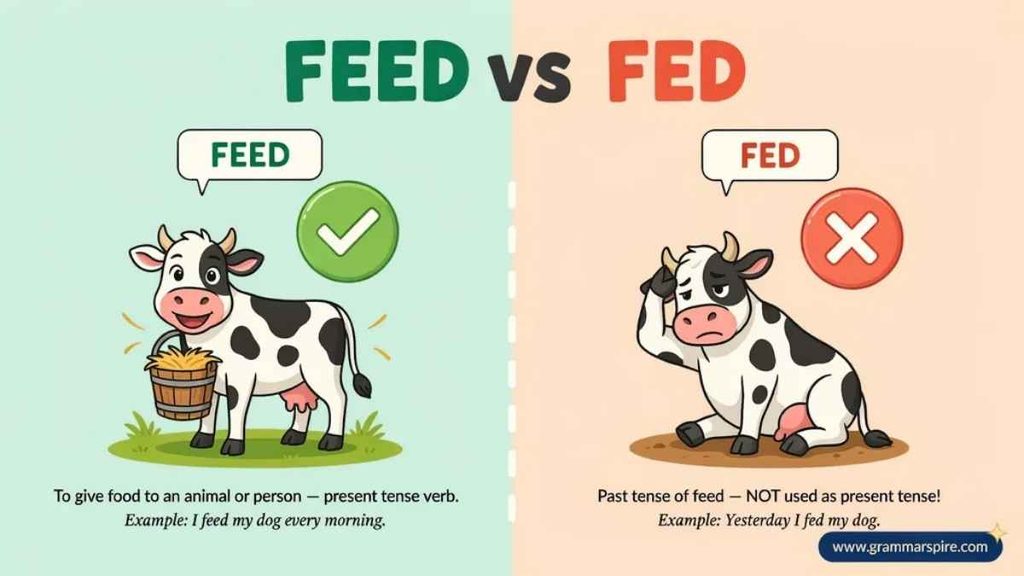
Feed and fed are two forms of the same irregular verb.
Feed is the base or present form. You use it for actions that happen now, happen regularly, or will happen in the future when another helping verb comes before it.
Fed is both the simple past form and the past participle of feed. You use it for a completed past action and after helping verbs such as have, has, and had.
The basic pattern is:
feed → fed → fed
For example:
1.I feed my cat every morning.
2.I fed my cat before work.
3.I have fed my cat already.
The easiest way to remember the feed and fed difference is to connect feed with the present or base form and fed with the past.
Feed vs Fed Meaning
Although feed and fed come from the same verb, their meanings change slightly depending on the grammatical form and context.
What Does Feed Mean?
Feed means to give food to a person, animal, or sometimes a group of people. It can also describe providing nourishment or supplying something to a person, machine, system, or process.
For example:
I feed the dog twice a day.
She feeds her baby before bedtime.
We feed the chickens every morning.
The verb can also appear in contexts that have nothing to do with food.
For example:
The machine feeds paper into the printer.
The river feeds into the lake.
The teacher feeds useful information into the discussion.
In everyday grammar questions, however, feed usually appears when someone wants to talk about giving food or nourishment.
What Does Fed Mean?
Fed is the simple past and past participle of feed.
Use fed when the feeding action happened in the past.
For example:
I fed the dog this morning.
She fed the baby before leaving.
They fed the horses yesterday.
Fed also works with perfect tenses.
For example:
I have fed the dog.
She has fed the baby.
They had fed the animals before the storm arrived.
Therefore, fed doesn’t mean a completely different action. Instead, it is a different grammatical form of feed.
Learn the difference between tricky words and use them correctly
Quiet or Quite What Is the Difference?
Feed vs Fed Verb Forms
The verb feed is irregular, so it doesn’t form its past tense by simply adding -ed.
Its main forms are:
feed → fed → fed
The first form is the base form. The second form is the simple past. The third form is the past participle.
The -ing form is feeding, while the third-person singular present form is feeds.
This gives you the complete basic pattern:
feed
feeds
fed
fed
feeding
For comparison, a regular verb such as walk follows the familiar pattern walk, walked, walked. Feed doesn’t follow that pattern. Its past form changes from feed to fed.
The Feed Fed Fed Pattern
The feed fed fed pattern is one of the most important things to remember.
The first fed represents the simple past.
The second fed represents the past participle.
For example:
I fed the cat yesterday.
I have fed the cat already.
The spelling stays the same, but the grammar around the word tells you which form you’re using.
Is Feed an Irregular Verb?
Yes. Feed is an irregular verb.
Regular verbs usually form the simple past and past participle by adding -ed. Feed doesn’t follow that rule.
You don’t say:
I feeded the dog yesterday.
Instead, you say:
I fed the dog yesterday.
You also don’t say:
I have feed the dog.
Instead:
I have fed the dog.
This irregular pattern explains why learners sometimes confuse feed and fed. The verb doesn’t behave like ordinary regular verbs such as clean, cleaned, and cleaned.
Learn the difference between tricky words and use them correctly
Noisey or Noisy Which Spelling Is Correct?
Feed vs Fed Pronunciation
They also sound different.
Feed is pronounced /fiːd/. Its vowel sound is long, similar to the vowel sound in need.
Fed has a shorter vowel sound, similar to the vowel in bed.
A useful memory trick is:
feed rhymes with need
fed rhymes with bed
The pronunciation difference makes the two forms easier to recognize in spoken English once you become familiar with them. Cambridge Dictionary lists feed as /fiːd/ and gives fed as the past form and past participle of feed.
What Is the Past Tense of Feed?
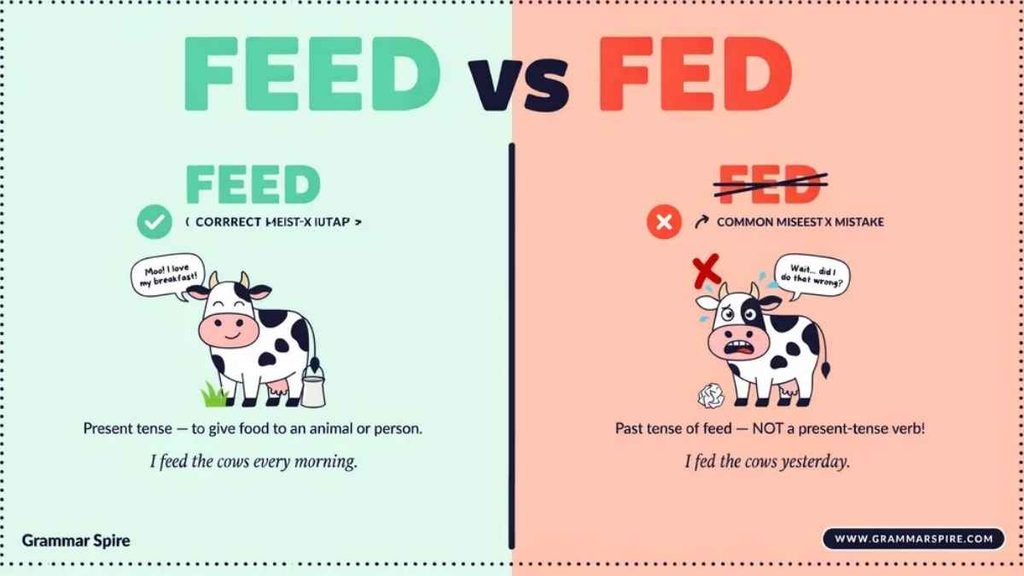
The past tense of feed is fed.
This is one of the most common questions about feed vs fed grammar.
The correct pattern is:
Present: I feed the dog.
Past: I fed the dog.
Future: I will feed the dog.
The past form doesn’t change according to the subject.
I fed the dog.
You fed the dog.
She fed the dog.
We fed the dog.
They fed the dog.
Each sentence uses fed because the action happened in the past.
Feed Past Tense Examples
Here are some natural examples:
I fed the cat before breakfast.
She fed the baby at six o’clock.
We fed the birds in the park.
They fed the horses yesterday.
He fed his fish before school.
The children fed the ducks during the afternoon.
Notice that every example describes a completed action.
Learn the difference between tricky words and use them correctly
Receipt or Reciept Which Spelling Is Correct?
What Is the Past Participle of Feed?
The past participle of feed is also fed.
That gives us:
Base form: feed
Past form: fed
Past participle: fed
The past participle usually appears with a helping verb such as have, has, or had.
For example:
I have fed the dog.
She has fed the baby.
We had fed the animals before the guests arrived.
This is why the feed past tense and past participle look identical. The spelling doesn’t tell you the grammatical function. The surrounding words do.
Feed Past Tense and Past Participle
Compare these sentences:
I fed the cat.
I have fed the cat.
In the first sentence, fed is the simple past form.
In the second sentence, fed is the past participle.
The form stays the same, but the tense structure changes.
Feed vs Fed Grammar Rules
The easiest way to understand feed or fed correct usage is to look at what comes before the verb and when the action occurs.
Use Feed as the Base Form
Use feed after to.
For example:
I want to feed the dog.
She needs to feed the baby.
They plan to feed the animals.
You also use feed after modal verbs such as will, can, should, and must.
For example:
I will feed the cat later.
You should feed the puppy now.
We can feed the birds outside.
They must feed the animals before leaving.
Use Feed in the Simple Present
Use feed when you describe a regular or current action.
For example:
I feed my dog every morning.
We feed the chickens at sunrise.
They feed the horses twice a day.
However, remember the third-person singular rule.
He feeds the dog every morning.
She feeds the baby at noon.
The dog feeds itself from the automatic bowl.
The word becomes feeds with he, she, and it.
Use Fed for the Simple Past
Use fed when the action happened in the past.
For example:
I fed the dog yesterday.
She fed the baby an hour ago.
We fed the animals before dinner.
They fed the ducks last weekend.
Words such as yesterday, last night, earlier, this morning, and an hour ago can often signal that you need the past form.
Use Fed After Have, Has, and Had
Use fed after have, has, or had.
For example:
I have fed the dog.
She has fed the cat.
We have fed the horses.
They had fed the animals before the storm.
This structure is especially important because many learners incorrectly use feed after have or has.
Incorrect:
I have feed the dog.
Correct:
I have fed the dog.
Learn the difference between tricky words and use them correctly
Verbage or Verbiage Which Spelling Is Correct?
When to Use Feed and Fed
The choice between feed and fed usually depends on time and sentence structure.
Use Feed for Regular Actions
If something happens regularly, feed is usually the correct form.
For example:
I feed my cat every morning.
She feeds her children before school.
We feed the birds every afternoon.
The action isn’t presented as one completed event. Instead, it describes a habit or routine.
Use Fed for Completed Past Actions
If the action already happened, use fed.
For example:
I fed my cat this morning.
She fed her children before school.
We fed the birds yesterday.
The key idea is completion in the past.
Use Feed After Did
After did, use the base form feed.
This rule causes many common mistakes.
Incorrect:
Did you fed the dog?
Correct:
Did you feed the dog?
Why? Did already carries the past tense. Therefore, the main verb returns to its base form.
The same pattern appears with other verbs:
1.Did you go?
2.Did she eat?
3.Did they see it?
4.Did you feed the cat?
You don’t need to make feed past tense after did.
Use Feed After Modal Verbs
Modal verbs also take the base form.
For example:
I will feed the dog later.
She can feed the baby.
You should feed the cat.
They must feed the animals.
The modal verb carries the grammatical function, so feed stays in its base form.
Learn the difference between tricky words and use them correctly
Advise or Advice which spelling is correct?
Feed vs Fed in Different Tenses
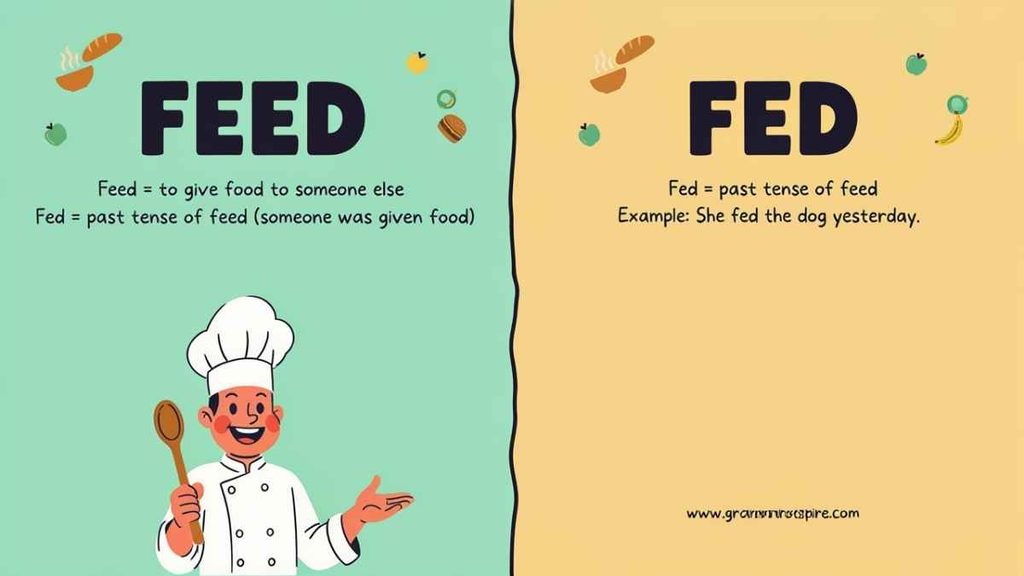
Understanding the verb forms across different tenses makes the feed and fed difference much clearer.
Simple Present
Use feed or feeds for regular or current actions.
I feed the dog every morning.
She feeds the dog every morning.
Simple Past
Use fed for completed past actions.
I fed the dog yesterday.
She fed the dog before dinner.
Present Perfect
Use have fed or has fed.
I have fed the dog.
She has fed the dog.
Past Perfect
Use had fed.
I had fed the dog before the guests arrived.
Future Tense
Use will feed.
I will feed the dog tonight.
She will feed the animals tomorrow.
Present Continuous
Use am feeding, is feeding, or are feeding.
I am feeding the dog now.
She is feeding the baby.
They are feeding the horses.
Notice that continuous forms use feeding, not feed or fed
Feed vs Fed Examples in Sentences
Seeing the forms next to each other can make the difference almost impossible to miss.
| Situation | Correct sentence |
|---|---|
| Regular action | I feed the dog every morning. |
| Third person present | She feeds the dog every morning. |
| Completed past action | I fed the dog yesterday. |
| Present perfect | I have fed the dog already. |
| Past perfect | I had fed the dog before lunch. |
| Future | I will feed the dog tonight. |
| After did | Did you feed the dog? |
| After a modal | You should feed the dog. |
| Continuous action | I am feeding the dog now. |
The important lesson is that you shouldn’t choose feed or fed by looking only at the subject. Look at the tense and any helping verb in the sentence.
Feed or Fed in a Sentence
If you’re wondering, “Is it feed or fed?” check the time of the action first.
Suppose you’re talking about your daily routine:
I feed my cat every morning.
Now suppose you’re talking about yesterday:
I fed my cat yesterday.
Now suppose someone asks you a question using did:
Did you feed your cat?
Even though the question refers to the past, feed remains in its base form because did already marks the past.
Finally, with present perfect:
I have fed my cat.
The helping verb have requires the past participle, so fed is correct.
Feed vs Fed in Everyday Situations
Everyday examples make grammar rules easier to remember because you can connect each form with a real situation.
Feed the Cat or Fed the Cat?
Both can be correct. The sentence determines which one you need.
Use feed for a present or regular action:
I feed the cat every morning.
Use fed for a completed past action:
I fed the cat before I left.
Use feed after did:
Did you feed the cat?
Use fed after have:
I have fed the cat already.
Feed a Baby or Fed a Baby?
Again, both forms can be correct.
For a regular action:
She feeds the baby every three hours.
For a completed past action:
She fed the baby at noon.
For a question with did:
Did she feed the baby?
For present perfect:
She has fed the baby.
Feed Animals or Fed Animals?
Use feed when talking about a routine:
We feed the animals every morning.
Use fed when describing a completed past event:
We fed the animals yesterday.
Use will feed for the future:
We will feed the animals tomorrow.
The meaning remains connected to giving food. The verb form changes according to the grammar.
Learn the difference between tricky words and use them correctly
Benefiting or Benefitting Which Spelling Is Correct?
Feed or Fed Correct Usage in Questions and Negatives
Questions and negative sentences often reveal whether you understand the verb pattern.
Questions
When a question uses did, use feed.
Did you feed the dog?
Did she feed the cat?
Don’t use fed directly after did.
Incorrect:
Did you fed the dog?
Correct:
Did you feed the dog?
However, when there is no did and you’re using a perfect tense, fed can appear.
Have you fed the dog?
Has she fed the cat?
Had they fed the horses?
Negative Sentences
With did not, use feed.
I did not feed the dog.
She didn’t feed the cat.
They didn’t feed the animals.
Don’t write:
I didn’t fed the dog.
The correct form is:
I didn’t feed the dog.
Again, did already carries the past-tense function.
Feed vs Fed in Passive Sentences
The passive voice uses the past participle, so fed can appear after forms of be.
For example:
The dog was fed at noon.
The baby was fed before bedtime.
The animals were fed early.
In these sentences, fed is the past participle.
However, passive constructions aren’t necessary when an active sentence sounds clearer.
Active:
I fed the dog.
Passive:
The dog was fed by me.
The active version usually sounds more direct and natural.
Is “Feeded” Correct?
No. Feeded is not the standard past tense or past participle of feed.
The correct forms are:
feed → fed → fed
Therefore:
Incorrect: I feeded the dog yesterday.
Correct: I fed the dog yesterday.
Incorrect: I have feeded the cat.
Correct: I have fed the cat.
The temptation to say feeded comes from the regular -ed pattern. English has many irregular verbs, however, and feed is one of them.
Learn the difference between tricky words and use them correctly
In Tact or Intact Which Spelling Is Correct?
Feed Spelling and Fed Spelling
The correct spellings are feed and fed.
Feed has two e’s.
Fed has one e.
The spelling doesn’t change to feeded when you move into the past tense.
For example:
Present: I feed the dog.
Past: I fed the dog.
Past participle: I have fed the dog.
A simple memory trick is to remember the three-form sequence:
feed, fed, fed.
What Does Fed Mean When Talking About Food?
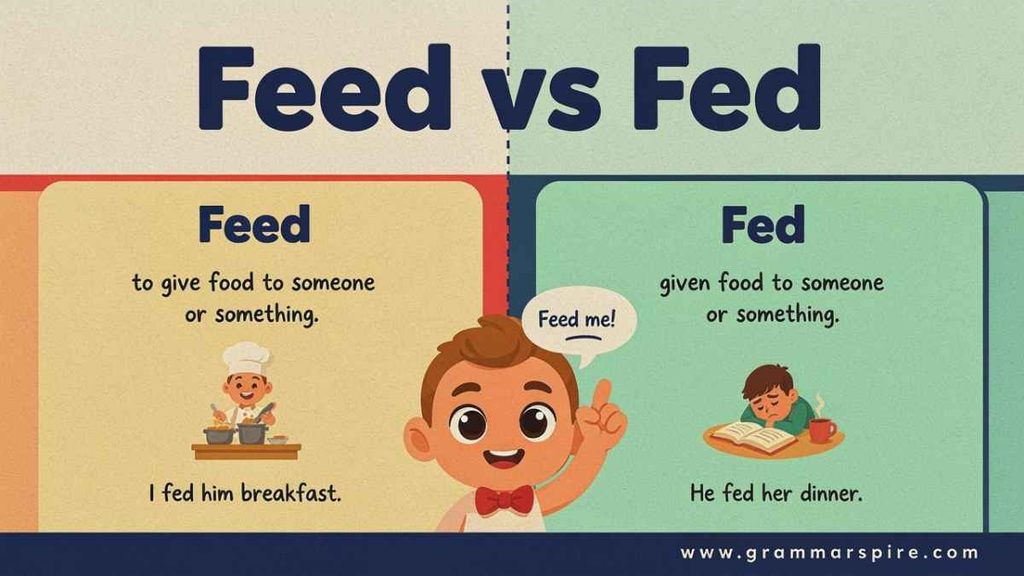
When talking about food, fed means that someone or something received food.
For example:
The baby was fed at eight.
I fed the dog before work.
The farmer fed the horses.
The meaning is connected to the act of providing food or nourishment.
Fed can also appear in expressions such as “well-fed,” which means adequately supplied with food.
For example:
The well-fed puppy looked healthy and energetic.
In this use, fed describes the condition resulting from receiving enough food.
Feed Someone or Fed Someone?
Both phrases can be correct. The correct choice depends on the sentence.
Use feed for present, habitual, infinitive, future, or modal structures.
For example:
I feed my children breakfast every morning.
I need to feed the baby.
You should feed the fish.
Use fed for simple past or perfect structures.
For example:
I fed my children breakfast earlier.
I have fed the baby.
The surrounding grammar makes the correct form clear.
A Practical Example One Dog, Six Sentences
Imagine you have a dog named Max.
You feed Max every morning.
That sentence describes a routine.
Yesterday, you fed Max before work.
That sentence describes a completed past action.
Right now, you are feeding Max.
That sentence uses the continuous form.
Tonight, you will feed Max again.
That sentence describes the future.
You have fed Max already.
That sentence uses the past participle.
Did you feed Max?
That sentence uses feed because did already marks the past.
One verb has created six different structures. Once you see the pattern, feed vs fed stops looking like a guessing game.
How to Use Feed vs Fed A Quick Test
Before choosing the verb form, ask yourself three questions.
Is the action happening regularly or being used as the base form? Use feed or feeds.
Did the action happen and finish in the past? Use fed.
Does the sentence contain have, has, or had? Use fed.
There is one important extra rule. If did comes before the verb, use feed.
For example:
I feed the dog daily.
I fed the dog yesterday.
Did you feed the dog?
These four sentences cover several of the most common situations.
Learn the difference between tricky words and use them correctly
Bind or Bound which one is correct?
Common Mistakes to Avoid
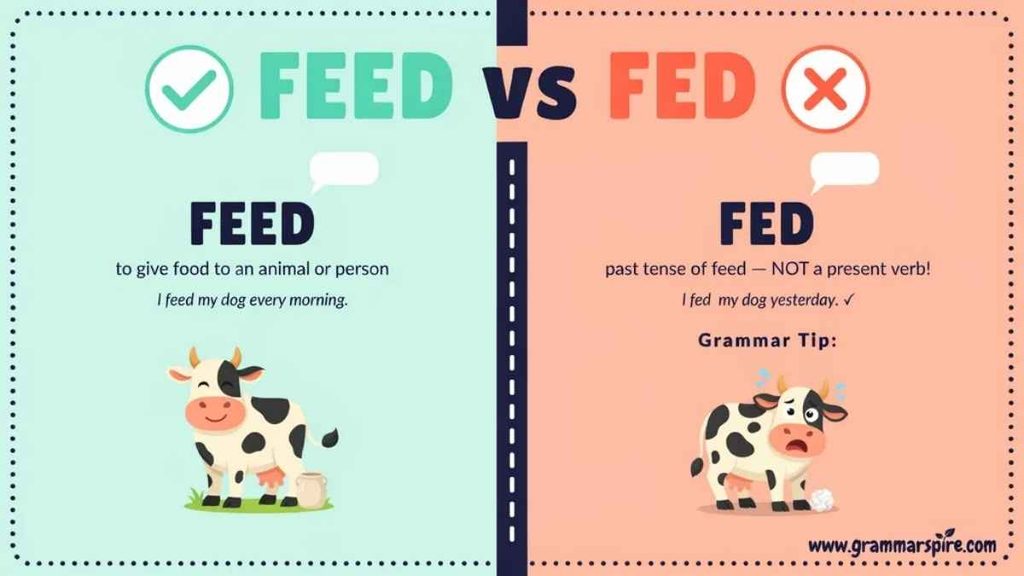
Mistake “I Feeded the Dog”
Feeded is not the standard form.
Correct:
I fed the dog.
Mistake “Did You Fed the Cat?”
After did, use the base form.
Correct:
Did you feed the cat?
Mistake “I Have Feed the Dog”
After have, use the past participle.
Correct:
I have fed the dog.
Mistake “She Feed the Baby”
With he, she, or it in the simple present, use feeds.
Correct:
She feeds the baby.
Mistake “I Am Feed the Dog”
For a present continuous action, use feeding.
Correct:
I am feeding the dog.
These mistakes become much easier to avoid when you identify the helping verb and tense before choosing the main verb.
Is Fed the Past Tense of Feed?
Yes. Fed is the simple past tense of feed.
For example:
Present: I feed the dog.
Past: I fed the dog.
The past tense describes an action that happened earlier.
Is Feed the Present Tense of Fed?
Feed is the base form and can function as the present-tense form with I, you, we, and they.
For example:
I feed the dog.
You feed the dog.
We feed the dog.
They feed the dog.
With he, she, or it, the simple present form becomes feeds.
She feeds the dog.
Therefore, feed is not literally the “present tense of fed” in every grammatical situation. More accurately, feed and fed are different forms of the same irregular verb.
Learn the difference between tricky words and use them correctly
Beat or Beated Which spelling Is Correct?
What Is the Correct Form of Feed in a Sentence?
The correct form depends on the structure.
1.Use feed for the base form, simple present with I, you, we, and they, after did, after modal verbs, and after to.
2.Use feeds for third person singular simple present.
3.Use fed for simple past.
4.Use fed as the past participle after have, has, or had.
5.Use feeding for continuous forms.
Once you identify the sentence structure, the correct form usually becomes obvious.
Here’s a trusted source for clear more words Comparison
Grammar Update
Practice session
This practice session will help you recognize when to use feed, feeds, fed, or feeding. Pay close attention to time words such as yesterday and every morning, as well as helping verbs such as did, have, has, had, and will. Remember the basic pattern: feed → fed → fed.
Complete each sentence with the correct form.
Fill in blanks
- I ______ the dog every morning before work.
- She ______ the cat yesterday.
- We have ______ the horses already.
- Did you ______ the baby before leaving?
- They will ______ the chickens tomorrow morning.
- He ______ his fish every evening.
- I ______ the birds before lunch yesterday.
- She has ______ the puppy.
- We are ______ the ducks right now.
- You should ______ the dog before going out.
- They ______ the animals every afternoon.
- He ______ the baby at noon yesterday.
- I had ______ the cat before the guests arrived.
- Did she ______ the horses this morning?
- We didn’t ______ the dog last night.
- She is ______ the baby right now.
- I ______ my fish every day.
- They ______ the horses yesterday.
- He has ______ the chickens already.
- We will ______ the birds tomorrow.
- Did you ______ the cat before school?
- She ______ her dog every morning.
- I have ______ the puppy.
- They had ______ the animals before sunset.
- You must ______ the fish today.
- We ______ the dog last night.
- He is ______ the ducks now.
- I need to ______ the baby.
- She didn’t ______ the cat yesterday.
- They ______ the horses every weekend.
Answers
- feed
- fed
- fed
- feed
- feed
- feeds
- fed
- fed
- feeding
- feed
- feed
- fed
- fed
- feed
- feed
- feeding
- feed
- fed
- fed
- feed
- feed
- feeds
- fed
- fed
- feed
- fed
- feeding
- feed
- feed
- feed
FAQs of feed vs fed
What is the difference between “feed” and “fed”?
Feed is the base form of the irregular verb, while fed serves as both the simple past and past participle. For example, “I feed my dog every morning” describes a regular routine, while “I fed my dog yesterday” refers to a completed action.
Which is correct “feed me” or “fed me”?
Both expressions are grammatically correct, but they have different meanings. “Feed me” is a request or command asking someone to provide food. “Fed me” describes something that happened earlier.
For example: “Please feed me” and “She fed me before we left.”
Is fed the past tense of feed?
Yes. Fed is the simple past form of feed. The three main forms are feed, fed, and fed.
Which is correct “to be fed” or “to be feed”?
“To be fed” is correct. Here, fed functions as the past participle after “to be.”
Correct: “The baby needs to be fed.”
Incorrect: “The baby needs to be feed.”
What does “feed” mean?
Feed generally means to give food to a person or animal. However, the verb has broader uses. It can also mean to supply something to a machine, system, person, or process.
For example, “She feeds the cat every morning” and “The machine feeds paper into the printer.”
What does “fed” mean?
Fed is the simple past and past participle of feed. It commonly describes giving or receiving food in a past context.
For example: “I fed the dog before breakfast.”
What are the three forms of feed?
The three principal forms are feed, fed, and fed.
The base form is feed. The simple past is fed, and the past participle is also fed. The -ing form is feeding, while the third-person singular present form is feeds.
What does “feed” mean in slang?
In informal English, feed can take several meanings depending on the context. On social media, a feed usually means the stream of posts, photos, videos, or updates shown to a user. In the expression “feed someone a line,” it can mean giving someone an excuse, story, or misleading information.
What does “Fed” mean in English?
Fed can have different meanings depending on capitalization and context. As a verb, it is the past form of feed. In American English, “the Fed” commonly refers to the Federal Reserve. “The feds” can also informally refer to federal law-enforcement officials.
What is another word for “feed”?
The best synonym depends on the context. Possible alternatives include nourish, provide, supply, give, serve, and sustain.
For example, nourish often fits discussions about food and health, while supply works better when referring to materials, information, or resources.
What are the two types of feed?
The meaning of “types of feed” depends on the subject. In animal nutrition, feed can broadly include forage or roughage and concentrated feed. In digital technology, a feed can mean a stream of content, such as a social media feed or news feed.
Why is it called feed?
The word feed originally developed around the idea of giving food or nourishment. Over time, English extended that idea to other forms of supplying something. A machine can feed material into a process, while a website can provide a feed of information or updates.
What is feed and fed?
Feed and fed are different forms of the same irregular verb. Feed is the base form, while fed functions as both the simple past and past participle.
For example:
I feed the dog every day.
I fed the dog yesterday.
What does “feed me” mean in slang?
In informal speech, “feed me” can have a figurative meaning. Depending on the situation, it may mean “give me more information,” “give me attention,” or “give me something I want.” Online, people may also use it humorously or sarcastically.
What does feed mean in the Bible?
In biblical language, feed commonly refers to giving food, caring for, nourishing, or tending to people or animals. In some passages, the word can also have a figurative sense involving spiritual care, guidance, or instruction. The precise meaning depends on the verse and translation.
AEO Feed vs Fed
What is the difference between feed and fed?
Feed is the base form of an irregular verb. Fed is both its simple past and past participle. Use “I feed the dog” for a present or habitual action and “I fed the dog” for a completed past action.
Is fed the past tense of feed?
Yes. Fed is the simple past form of feed. Its basic verb pattern is feed, fed, fed.
What is the past tense of feed?
The simple past form is fed.
Example: “She fed the baby before bedtime.”
What is the past participle of feed?
The past participle is also fed.
Example: “She has fed the baby.”
Should you say “feed me” or “fed me”?
Use “feed me” when making a request or command. Use “fed me” when describing an action that happened in the past.
“Please feed me.”
“She fed me earlier.”
Is “to be fed” grammatically correct?
Yes. “To be fed” is grammatically correct because fed functions as the past participle in this construction.
Example: “The animals need to be fed.”
Is feed an irregular verb?
Yes. Feed is an irregular verb because its past forms do not follow the regular -ed pattern. Its principal forms are feed, fed, and fed.
What form comes after “did”?
Use feed after did because did already expresses the past tense.
Correct: “Did you feed the cat?”
Incorrect: “Did you fed the cat?”
What form comes after “have” or “has”?
Use fed after have or has because these helping verbs require the past participle.
Correct: “I have fed the dog.”
Correct: “She has fed the cat.”
What form comes after “will”?
Use feed after will.
Correct: “I will feed the animals tomorrow.”
What is the difference between “I feed the dog” and “I fed the dog”?
“I feed the dog” generally describes a present routine or repeated action. “I fed the dog” describes a completed action in the past.
Is “feeded” correct English?
No. Feeded is not the standard past form or past participle. The correct form is fed.
Correct: “I fed the dog.”
Correct: “I have fed the dog.”
What is the present form of fed?
The base form is feed. In the simple present, use feeds with he, she, or it.
“I feed the cat.”
“She feeds the cat.”
What is the future form of feed?
Use will feed to form the future.
Example: “I will feed the dog tonight.”
How can you remember feed and fed?
Remember the irregular pattern:
feed → fed → fed
Use feed as the base or present form, and use fed for the simple past and past participle. Once this pattern becomes familiar, choosing the right form becomes much easier.
Final Takeaway
The confusion between feed and fed becomes much easier once you understand their roles in a sentence. Remember the simple irregular pattern: feed, fed, fed. Use feed for the base form, present routines, future actions, and after helping verbs such as did, will, can, and should. Use fed for completed past actions and as the past participle after have, has, or had. For actions happening now, use feeding. With these rules in mind, you can choose the right form confidently instead of letting a hungry cat dictate your grammar. Once the pattern becomes familiar, feed vs fed is one less grammar problem to worry about.

Ella AJS
Ella AJS is an experienced blogger and language enthusiast at Grammar Spire, dedicated to making English grammar simple, practical, and easy to understand. She specializes in word comparisons, meanings, usage, and common language confusions. Through clear explanations and engaging examples, Ella helps students, writers, and English learners improve their vocabulary and communicate with greater confidence and accuracy.