
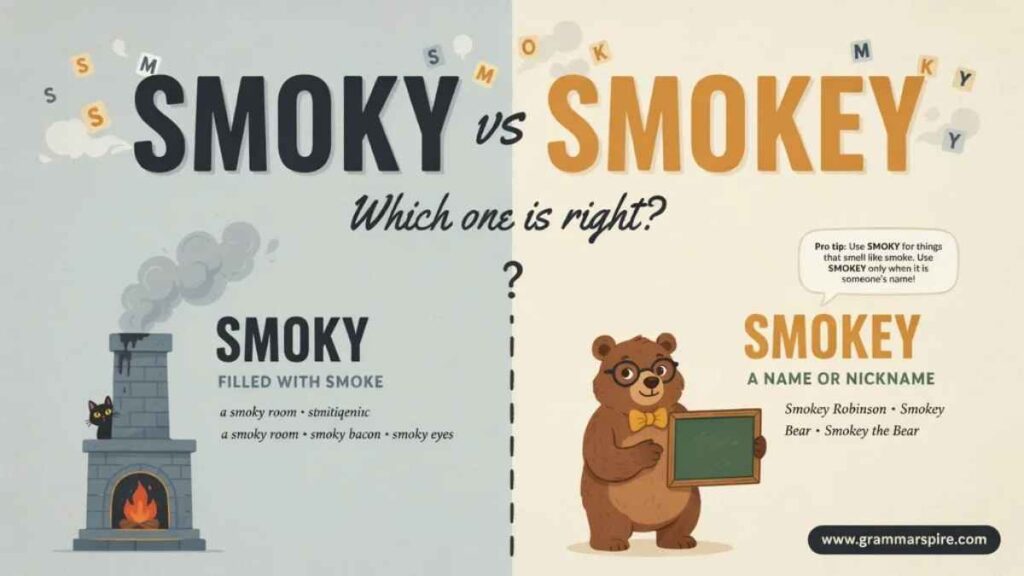
The smoky or smokey debate shows how one little letter can create a surprisingly big grammar headache. You might describe smoky barbecue, smoky air, or smoky eyes, then pause and wonder whether that sneaky e belongs there. The confusion grows when you encounter Smokey Bear and Smokey Robinson, both of whom proudly keep the e. So, which spelling should you use? The answer depends on context. Smoky is the preferred spelling for ordinary descriptions, while smokey appears as a recognized variant and in established names. Once you understand the difference, this tricky pair becomes much easier to handle, helping you write clearly, accurately, and confidently.
| Feature | Smoky | Smokey |
|---|---|---|
| Standard adjective | Preferred standard form | Recognized variant |
| Basic meaning | Related to, filled with, or resembling smoke | Can have the same basic meaning as smoky |
| Food descriptions | Common smoky flavor | Possible variant smokey flavor |
| Smell and atmosphere | Common smoky smell, smoky room | Less common in ordinary descriptions |
| Appearance | Common smoky haze, smoky color | Less common |
| Great Smoky Mountains | Correct official spelling | Not the official spelling |
| Smokey Bear | Not the official name | Correct official name |
| Smokey Robinson | Not the established spelling | Correct established name |
| General writing | Best default choice | Use when the context specifically calls for it |
Learn the difference between tricky English words with easy explanations
Quiet or Quite What Is the Difference?
Quick Answer
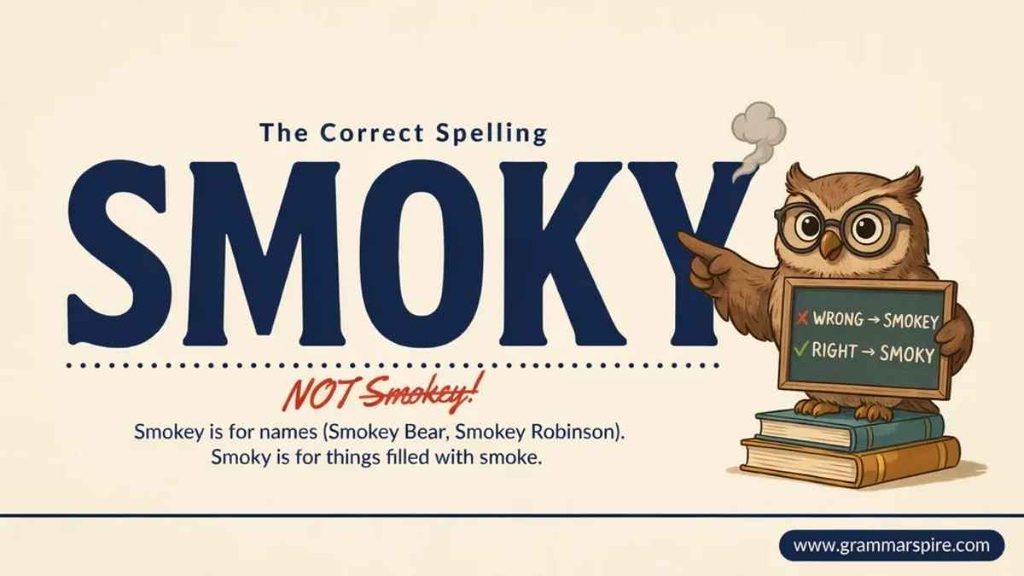
If you’re wondering whether smoky or smokey is correct, smoky is the best choice for ordinary English writing.
For example, you would normally write:
The kitchen was filled with a smoky smell.
The restaurant serves smoky barbecue.
She chose a smoky gray color for the walls.
However, smokey is not simply a spelling error. Major dictionaries recognize it as a variant of smoky. More importantly, the spelling appears in established proper names such as Smokey Bear and Smokey Robinson.
So, the practical rule is simple: use smoky when you are describing something associated with smoke, and use Smokey when that spelling belongs to a specific name or established expression.
Smoky vs Smokey at a Glance
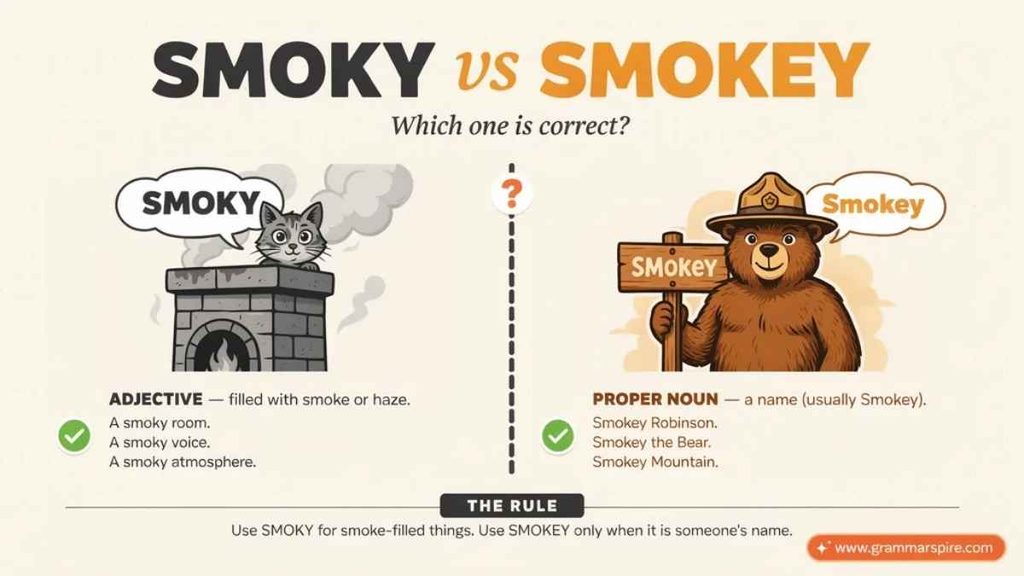
The difference between smoky and smokey is mainly a matter of spelling and usage rather than meaning.
Smoky is the preferred spelling of the adjective in standard modern English. It describes something that contains, produces, resembles, or has the characteristics of smoke.
Smokey can carry the same general meaning, but it is less common as an ordinary adjective. It has also become firmly established in certain names and expressions.
That distinction explains why both forms appear in English without meaning that writers can use them interchangeably in every situation.
Learn the difference between tricky English words with easy explanations
Noisey or Noisy Which Spelling Is Correct?
What Does “Smoky” Mean?
Smoky is an adjective formed from smoke. It describes something connected with smoke or something that resembles smoke.
1.A smoky room, for instance, contains a noticeable amount of smoke. 2.A smoky flavor has a taste or aroma associated with smoke. 3.A smoky color resembles the muted, hazy appearance often associated with smoke.
Smoky as an Adjective
The most common use of smoky is descriptive.
You can use it when something produces smoke, contains smoke, or has qualities that remind you of smoke.
Consider these sentences:
The fireplace left the room smoky.
A smoky haze covered the valley.
The candle created a smoky atmosphere.
The sauce has a rich, smoky flavor.
In each example, smoky tells you something about the quality or appearance of another thing.
Smoky in Food and Drinks
Food writers use smoky frequently because smoke can create a distinctive flavor and aroma.
Think about barbecue. A steak cooked over wood, smoked cheese, grilled vegetables, or a barbecue sauce can all have a smoky taste.
For example:
The ribs have a deep smoky flavor.
The chef added smoked paprika for a smoky taste.
This coffee has a slightly smoky aroma.
Here, smoky describes the sensory quality created by smoke or a smoke-like flavor.
Smoky in Descriptions
Smoky can also describe colors, light, air, and visual effects.
You might see phrases such as smoky gray, smoky blue, smoky haze, and smoky eyes.
For example:
The sunset gave the sky a smoky orange appearance.
A smoky haze drifted across the city.
She wore smoky eye makeup for the evening event.
The word doesn’t always mean that actual smoke is present. Sometimes it simply describes an appearance that resembles smoke.
What Does “Smokey” Mean?
Smokey is a recognized variant spelling of smoky. However, it isn’t usually the first choice when you’re writing an ordinary description.
For everyday writing, smoky is generally the safer and more standard form.
Still, smokey has an important place in English because it appears in established names.
Smokey as a Name
Proper names don’t always follow the spelling rules you would expect from ordinary vocabulary.
That’s why you shouldn’t automatically change Smokey to Smoky just because smoky is the standard adjective.
For example, the official name of the famous wildfire-prevention character is Smokey Bear. Changing the spelling to Smoky Bear would change the established name.
The same principle applies to people. If someone’s established name uses Smokey, keep the spelling exactly as it is.
Smokey in Established Names
Established names deserve special attention because names have their own spelling conventions.
Smokey Bear is one of the clearest examples. The official name uses Smokey with an e. The National Park Service and the official Smokey Bear campaign materials use that spelling.
The character became part of a major U.S. wildfire-prevention campaign launched in 1944. The familiar message associated with the character helped make Smokey Bear one of the best-known public-service figures in the United States.
Smokey Robinson is another familiar example of the spelling with an e. In an established personal name, the correct spelling is the spelling used by the person.
Is “Smokey” a Misspelling?
Not necessarily.
Calling every use of smokey a mistake would be too simplistic. Major dictionaries recognize smokey as a variant of smoky. Cambridge Dictionary, for example, lists smokey as another form, while Merriam-Webster identifies it as a less common variant.
However, that doesn’t mean smokey should replace smoky in normal writing.
If you’re describing a smoky room, smoky food, or smoky air, smoky is usually the better choice.
Learn the difference between tricky English words with easy explanations
Receipt or Reciept Which Spelling Is Correct?
Why Do People Confuse “Smoky” and “Smokey”?
The confusion makes perfect sense once you look at the word smoke.
The Extra E From “Smoke”
Smoke ends with an e, so many people naturally assume the adjective should keep that e.
The logic seems reasonable:
smoke → smokey
English spelling, however, doesn’t always work like a neat mathematical equation.
In standard usage, smoke becomes smoky, not smokey, when forming the common adjective.
You see a similar pattern in many English words where the spelling changes slightly when a suffix is added.
“Smokey” Looks Natural
There is another reason the spelling causes trouble: smokey looks visually familiar.
Because smoke already contains an e, the form smokey feels intuitive. In everyday typing, that extra letter can slip in almost unnoticed.
The problem becomes even more confusing when you encounter legitimate examples of Smokey. After seeing Smokey Bear or Smokey Robinson, it is easy to assume the spelling with e must always be correct.
It isn’t.
Names Make the Confusion Stronger
Proper names create another layer of complexity.
You might learn that smoky is the normal adjective and then encounter Smokey Bear. Instead of concluding that one of them must be wrong, remember that ordinary vocabulary and proper names can follow different spelling conventions.
That’s the key to understanding the pair.
Smoky or Smokey Which One Should You Use?

For most everyday writing, choose smoky.
If you’re describing smoke, smoke-like qualities, a smell, a flavor, an atmosphere, or a color, smoky will usually be the natural choice.
For example:
The room became smoky after the fire.
The chicken has a smoky flavor.
A smoky mist covered the hills.
The painting uses smoky shades of blue and gray.
On the other hand, use Smokey when the spelling belongs to an established name.
A Simple Rule to Remember
Think of it this way:
Ordinary description = smoky.
Established name = use the spelling officially associated with that name.
That small rule will solve most smoky vs. smokey questions.
Learn the difference between tricky English words with easy explanations
Verbage or Verbiage Which Spelling Is Correct?
Smoky or Smokey in American English
In American English, smoky is the standard spelling for the ordinary adjective.
American writers use smoky to describe smoke-filled places, smoke-like appearances, and smoke-related flavors.
For example:
The cabin smelled smoky after the fire.
The whiskey has a smoky character.
The mountains disappeared behind a smoky haze.
At the same time, American English contains well-known uses of Smokey with an e, especially in proper names.
So American English doesn’t simply divide the words into “correct” and “incorrect.” Instead, context determines which spelling makes sense.
Smoky or Smokey in British English
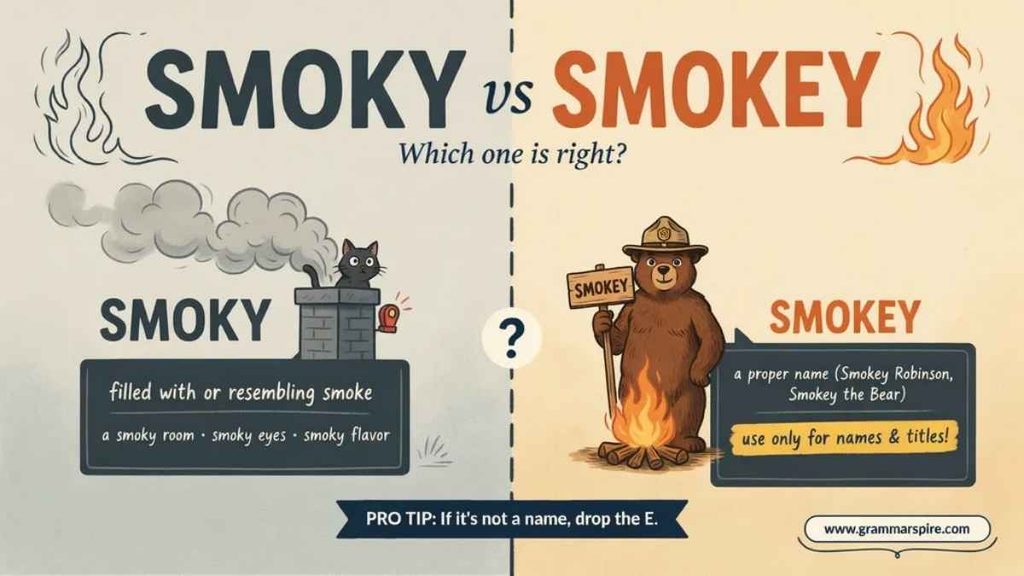
British English also uses smoky as the standard spelling of the adjective.
The same basic meanings apply. You can describe a smoky room, smoky flavor, smoky air, or smoky appearance.
Cambridge Dictionary lists smoky as the main entry while also recognizing smokey as a variant.
Therefore, it would be misleading to say that smoky belongs only to American English or that smokey is exclusively British.
The spelling difference isn’t really a simple US-versus-UK distinction. Usage and context matter more than geography.
Smoky or Smokey Mountains?
When you’re referring to the famous mountain range and national park in Tennessee and North Carolina, the correct official name is Great Smoky Mountains.
The park’s name is Great Smoky Mountains National Park, not Great Smokey Mountains National Park.
The name comes from the natural bluish mist that often hangs over the mountains and gives them a smoke-like appearance. The National Park Service explains that this mist is the source of the “Smoky” name.
The spelling is therefore worth remembering:
Great Smoky Mountains
Not:
Great Smokey Mountains
Here, smoky isn’t being chosen simply because it is the standard adjective. It is also part of an established geographic name.
Learn the difference between tricky English words with easy explanations
Advise or Advice which spelling is correct?
Smokey Bear or Smoky Bear?
The correct official name is Smokey Bear.
This is one of the most famous examples of why you shouldn’t automatically “correct” a proper name.
The wildfire-prevention campaign officially uses Smokey Bear. The character originated in a U.S. Forest Service campaign launched in 1944, and the official name has remained Smokey Bear.
You may occasionally hear “Smokey the Bear.” That wording became popular after a song used it in the 1950s, but the official name remains Smokey Bear.
So if you’re writing about the character, keep the e.
Smokey Robinson or Smoky Robinson?
The established spelling of the musician’s name is Smokey Robinson.
This is another case where a proper name takes priority over the ordinary adjective.
You wouldn’t change someone’s name simply because another spelling is more common in a dictionary. Names are fixed identifiers, so spelling them correctly matters.
That means Smokey Robinson is correct when referring to the artist.
Smokey as a Proper Noun
A proper noun identifies a particular person, place, organization, character, or other named entity.
Smokey can function as a proper noun when it forms part of an established name.
That explains examples such as Smokey Bear and Smokey Robinson.
The important point is that the spelling comes from the name itself. You don’t need to apply the ordinary adjective rule to it.
This distinction is useful beyond smoky and smokey. English contains countless proper names with spellings that don’t match the most common spelling patterns of ordinary words.
Smokey as Slang
In American informal speech, smokey can also appear as slang for a police officer, particularly a highway patrol officer.
This use is informal and should be treated differently from the standard adjective smoky.
For formal writing, news-style writing, academic work, or professional communication, police officer is usually clearer.
If you encounter smokey in casual conversation, fiction, online discussions, or dialogue, the surrounding context will usually make the meaning clear.
Learn the difference between tricky English words with easy explanations
Benefiting or Benefitting Which Spelling Is Correct?
Smoky or Smokey for Food?
When you’re describing food, smoky is normally the better choice.
Food can have a smoky flavor, smoky aroma, or smoky taste. The word works especially well for grilled, roasted, or smoked foods.
| Expression | Preferred wording | Example |
|---|---|---|
| Flavor | smoky flavor | The sauce has a smoky flavor. |
| Taste | smoky taste | The peppers add a smoky taste. |
| Aroma | smoky aroma | The cheese has a smoky aroma. |
| Barbecue | smoky barbecue | We ordered smoky barbecue ribs. |
| Sauce | smoky sauce | The smoky sauce pairs well with chicken. |
You may encounter smokey in food writing because dictionaries recognize it as a variant. Still, if you’re choosing the spelling yourself, smoky is the cleaner standard choice.
Smoky or Smokey Real Life Examples
Seeing the words in context makes the distinction much easier.
The fireplace made the living room smoky.
The grilled vegetables had a smoky flavor.
A smoky haze covered the road.
The artist used smoky shades of gray.
She ordered a smoky barbecue sandwich.
These are ordinary descriptive uses, so smoky fits naturally.
Now compare them with established names:
Smokey Bear teaches people about wildfire prevention.
Smokey Robinson is the artist’s established name.
Great Smoky Mountains National Park uses Smoky without the e.
The difference becomes much clearer when you stop treating the two spellings as simple opposites.
Learn the difference between tricky English words with easy explanations
In Tact or Intact Which Spelling Is Correct?
Common Mistakes
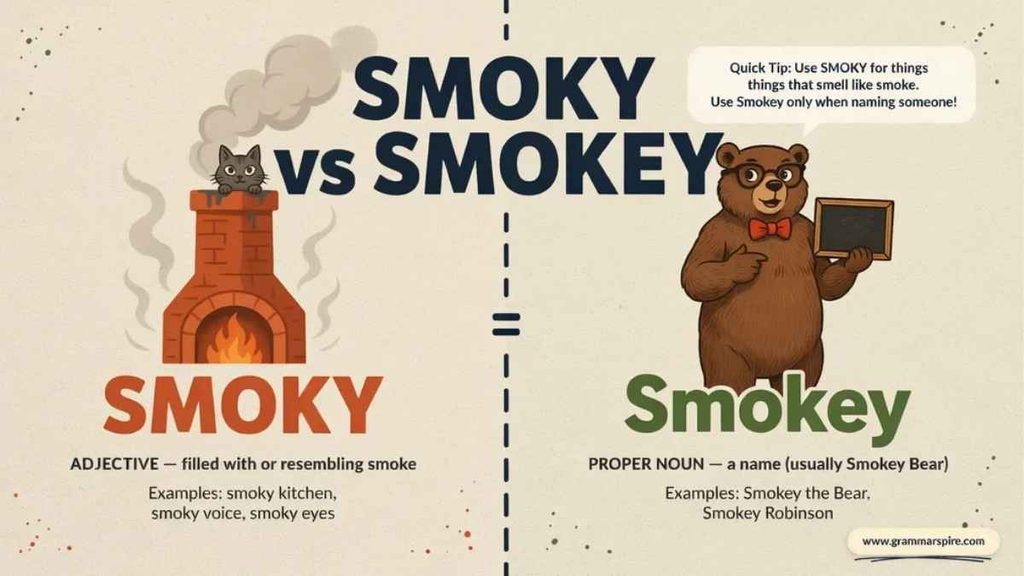
One common mistake is adding the e simply because smoke contains one.
For example, a writer might type “smokey room” when “smoky room” would be the standard choice.
Another mistake is assuming that every appearance of smokey is wrong. That creates a different problem because Smokey is correct in established names and is also recognized as a variant spelling.
A third mistake involves changing a proper name to match standard adjective spelling. Writing Smoky Bear instead of Smokey Bear may look logical, but it changes the official name.
The safest approach is to check what you’re actually trying to write. Are you describing something, or are you naming something? That question often provides the answer immediately.
Why Is Smoky Spelled Without E?
The spelling smoky comes from smoke plus the adjective-forming ending -y.
Although smoke ends in e, English spelling often removes a final silent e before certain suffixes.
That gives you:
smoke → smoky
The same general spelling pattern appears in other words where the final e disappears before a suffix.
So smoky isn’t missing a letter. The spelling follows a common English formation pattern.
Learn the difference between tricky English words with easy explanations
Bind or Bound which one is correct?
Is Smoky a Word?
Yes. Smoky is a standard English adjective.
It can describe something filled with smoke, producing smoke, resembling smoke, or having a smoke-like flavor or appearance.
For example:
The kitchen became smoky.
The soup has a smoky flavor.
The sky looked smoky at sunset.
The word is well established in both American and British English.
Is Smokey a Word?
Yes. Smokey is also a recognized English spelling.
However, it is less common as an ordinary adjective than smoky. Dictionaries recognize it as a variant, while English speakers also encounter it frequently in proper names.
Therefore, “smokey is never a word” is not an accurate rule.
A better rule is that smoky is the preferred standard spelling for ordinary descriptive writing, while smokey may be appropriate when a variant or established name calls for it.
Smoky vs Smokey A Quick Middle of the Article Check
| Situation | Best choice | Example |
|---|---|---|
| Describing a room | Smoky | The room was smoky. |
| Describing food | Smoky | The chicken has a smoky flavor. |
| Describing a haze | Smoky | A smoky haze filled the valley. |
| Describing a color | Smoky | She chose a smoky blue. |
| Mountain range | Smoky | Great Smoky Mountains |
| Wildfire character | Smokey | Smokey Bear |
| Person’s established name | Smokey | Smokey Robinson |
| Variant spelling in informal use | Smokey | Possible, but less common |
This table captures the central idea: smoky is your normal descriptive choice, while Smokey often appears because a particular name or spelling convention requires it.
Learn the difference between tricky English words with easy explanations
Beat or Beated Which spelling Is Correct?
When to Use Smoky
Use smoky when you’re writing ordinary English and describing something connected with smoke.
You can use it for physical surroundings, smells, flavors, colors, visual effects, and atmospheres.
For example:
The restaurant had a smoky atmosphere.
The fire left a smoky smell in the house.
The sauce gives the chicken a smoky flavor.
The sunset created a smoky purple sky.
The room looked smoky through the afternoon light.
In each sentence, smoky works naturally as an adjective.
When to Use Smokey
Use Smokey when the context specifically calls for that spelling.
The clearest examples are established names such as Smokey Bear and Smokey Robinson.
You may also encounter smokey as a variant of smoky in dictionaries or ordinary writing. However, if you’re simply deciding which spelling to use in your own sentence, smoky remains the better default.
That approach keeps your writing clear without pretending that the variant spelling doesn’t exist.
Learn the difference between tricky English words with easy explanations
Feed vs Fed What spelling is correct?
Which one Is Correct?
Both forms can be found in English, but they don’t have equal status in ordinary writing.
Smoky is the standard and preferred spelling of the adjective. Smokey is a recognized variant and an important spelling in established names.
So, if your sentence describes smoke, choose smoky unless there is a specific reason to use smokey.
If you’re writing a proper name, follow the established spelling.
| Question | Answer |
|---|---|
| Is smoky a correct word? | Yes. It is the standard adjective. |
| Is smokey a word? | Yes. It is a recognized variant. |
| Is smoky more common in standard writing? | Yes. |
| Can smokey describe food? | It can, but smoky is the preferred ordinary form. |
| Is Smokey Bear correct? | Yes. That is the official name. |
| Is Great Smoky Mountains correct? | Yes. That is the official geographic spelling. |
| Is smoky British English? | Yes. British English uses smoky. |
| Is smoky American English? | Yes. American English uses smoky. |
| Is smokey only used for names? | No. It is also recognized as a variant spelling. |
Here’s a trusted source for clear more words Comparison
Grammar Update
Practice Session
It’s time to put the smoky or smokey difference into practice. Read each sentence carefully and fill in the blank with the form that best fits the context. Most sentences use smoky because it is the preferred spelling for ordinary descriptions. A few, however, refer to established names where Smokey is the correct form. Look at the meaning and context before writing your answer. That small habit can help you avoid the extra-e confusion that makes this pair so tricky.
Fill in the Blanks
- The kitchen became ______ after the food burned.
- The grilled chicken had a rich ______ flavor.
- A ______ haze settled over the valley.
- The fireplace left a ______ smell in the living room.
- Smoked paprika gave the dish a deeper ______ taste.
- The restaurant is famous for its ______ barbecue.
- The sky took on a ______ appearance after the fire.
- She selected a ______ gray shade for the walls.
- The cheese had a pleasant ______ aroma.
- The cabin became ______ when the fireplace started producing more smoke.
- The famous wildfire-prevention character is called ______ Bear.
- The musician’s established name is ______ Robinson.
- Tourists often visit the Great ______ Mountains.
- She finished her makeup with a classic ______ eye.
- The ribs had a deep ______ flavor from the wood-fired grill.
- A thin ______ mist drifted across the hills.
- The room had a warm but slightly ______ atmosphere.
- The grilled peppers developed a subtle ______ aroma.
- The standard adjective related to smoke is spelled ______.
- The spelling ______ is recognized as a variant of smoky.
- The official name of the wildfire-prevention character is ______ Bear.
- The famous mountain range is called the Great ______ Mountains.
- The steak had a strong ______ taste after being cooked over wood.
- A ______ cloud rose above the campfire.
- The brisket was tender, juicy, and pleasantly ______.
- The artist used ______ shades to create a soft, hazy effect.
- The air became ______ near the fireplace.
- The barbecue sauce has a sweet and ______ flavor.
- The well-known musician’s name is ______ Robinson.
- When describing a room filled with smoke, the preferred spelling is ______.
Answers
- smoky
- smoky
- smoky
- smoky
- smoky
- smoky
- smoky
- smoky
- smoky
- smoky
- Smokey
- Smokey
- Smoky
- smoky
- smoky
- smoky
- smoky
- smoky
- smoky
- smokey
- Smokey
- Smoky
- smoky
- smoky
- smoky
- smoky
- smoky
- smoky
- Smokey
- smoky
FAQs
Is There an E in Smoky?
No. The standard adjective is spelled smoky, without an e before the y. It comes from smoke with the final e removed before the adjective ending. You would write smoky air, smoky barbecue, or smoky gray.
Is It Smokey or Smoky in the UK?
In British English, smoky is the standard spelling. Smokey can appear as a recognized variant, but it isn’t specifically a British form. The same basic preference applies in American English.
What Does “Smokey” Mean?
Smokey generally has the same basic meaning as smoky when it is used as a spelling variant. It can describe something associated with smoke, although smoky is more common in standard descriptive writing. Smokey also appears in established names such as Smokey Bear and Smokey Robinson.
How Do You Spell Smokey?
The correct form depends on what you’re referring to. Smoky is the preferred spelling for the ordinary adjective, while smokey is a recognized variant. Established names should keep their official spelling, such as Smokey Bear and Smokey Robinson.
Do You Say Smoky or Smokey?
For everyday descriptions, smoky is the better choice. You would normally say smoky room, smoky smell, smoky flavor, or smoky atmosphere. Use Smokey when it forms part of an established name.
Why Is It Smoky, Not Smokey?
The standard adjective comes from smoke and follows the spelling pattern smoke → smoky. The final silent e is dropped before the adjective ending. Although smokey exists as a variant, smoky remains the preferred form in standard writing.
Is “Smokey” Spelled Correctly in Canada?
Yes. Smokey can occur as a spelling variant in Canadian English. However, smoky remains the standard choice for ordinary descriptions. Canadian English does not require the e in this word.
Why Is It Smoky in the Mountains and Not Smokey?
The official name is Great Smoky Mountains. The word Smoky refers to the blue-gray haze that often gives the mountains a smoke-like appearance. Because it is part of an established geographic name, Great Smoky Mountains is the correct form.
Is It Smoky or Smokey Bear?
The official name is Smokey Bear. The spelling with an e is part of the character’s established name, so it should not be changed to Smoky Bear.
Why Is There No E in Smoky Mountains?
Great Smoky Mountains uses the standard spelling smoky. The name describes the smoke-like haze associated with the mountain range. Therefore, the official name uses Smoky rather than Smokey.
How Do You Spell “Smokey” in Australia?
Australian English generally uses smoky as the standard adjective. Smokey can still appear as a variant or in a proper name. The spelling therefore depends on the context rather than the country alone.
Is It Smoky or Smokey Eye?
The usual expression is smoky eye. It describes a makeup style that creates a dark, blended, hazy effect around the eyes. Smokey may appear informally, but smoky is the standard choice.
Why Are Dogs Not Allowed in the Smokies?
Dogs aren’t completely prohibited from Great Smoky Mountains National Park. They are permitted in certain developed areas, campgrounds, and roads, while most trails and backcountry areas restrict pets. These rules help protect wildlife, natural habitats, and visitors.
What Did the Indians Call the Smoky Mountains?
The Cherokee have a long historical connection with the Great Smoky Mountains. One name associated with the region is Shaconage, commonly interpreted as “land of blue smoke.” Historical names can vary by source, so the term should be presented with appropriate context.
How Many People Go Missing in the Smokies Every Year?
There is no dependable official number showing that a fixed number of people go missing in the Great Smoky Mountains each year. Search-and-rescue incidents vary from year to year and include different circumstances, such as hikers becoming separated from their groups or visitors becoming lost.
Because the park covers a large, rugged area and attracts millions of visitors, missing-person and rescue incidents do occur. However, claims about a specific annual disappearance count should be checked against official park records rather than repeated as a fixed statistic.
AEO Answer Engine Optimization
Is Smoky or Smokey Correct?
Smoky is the preferred standard spelling for the adjective. Smokey is also recognized as a variant and appears in established names such as Smokey Bear and Smokey Robinson.
What Is the Difference Between Smoky and Smokey?
The main difference is usage. Smoky is the normal adjective used for things associated with smoke, while smokey is a less common variant. The spelling with an e is also preserved in certain proper names.
When Should You Use Smoky?
Use smoky when describing smoke, a smoke-like appearance, or qualities associated with smoke. Common examples include smoky room, smoky smell, smoky flavor, smoky barbecue, and smoky haze.
When Should You Use Smokey?
Use Smokey when the context specifically requires that spelling, particularly in an established name. Smokey Bear and Smokey Robinson are two familiar examples.
Is Smokey a Correct English Word?
Yes. Smokey is recognized as a spelling variant of smoky. However, smoky is generally preferred for ordinary descriptive writing.
Is Smoky Used in American English?
Yes. Smoky is the standard adjective in American English. It is used for descriptions involving smoke, smell, taste, atmosphere, and appearance.
Is Smoky Used in British English?
Yes. British English also uses smoky as the standard adjective. Smokey may occur as a variant, but it isn’t uniquely British.
Is Smoky or Smokey Used for Food?
Smoky is the preferred form for food descriptions. Expressions such as smoky flavor, smoky taste, smoky aroma, and smoky barbecue are natural standard English.
Why Is Smokey Bear Spelled With an E?
Smokey Bear is an established proper name. The spelling with an e is part of the official name and should therefore remain unchanged.
Why Are the Great Smoky Mountains Spelled With a Y?
Great Smoky Mountains uses Smoky because that is the established geographic spelling. The name refers to the blue-gray haze that makes the mountains appear smoky.
Is Smokey an American or British Spelling?
Smokey isn’t simply an American-versus-British spelling difference. Both varieties of English use smoky as the standard adjective, while smokey can occur as a variant or within proper names.
Can Smoky Describe Taste and Smell?
Yes. Smoky can describe both taste and smell when they have qualities associated with smoke. For example, you can describe a food as having a smoky flavor or a smoky aroma.
What Does Smokey Mean as Slang?
In some American informal usage, smokey can refer to a police officer, especially a highway patrol officer. This meaning is slang and depends heavily on context.
Is Smoky the Correct Spelling for Smoky Eyes?
Yes. The standard expression is smoky eyes or a smoky eye. The term describes a blended makeup effect that resembles a soft, smoky appearance around the eyes.
Final Takeaway
The smoky or smokey confusion may look like a tiny spelling problem, but that extra e has certainly earned its place in the grammar hall of fame. For ordinary descriptions, smoky is your safest choice: smoky air, smoky barbecue, smoky flavor, or smoky eyes. However, don’t declare smokey guilty of bad spelling just yet. It’s a recognized variant and appears in established names such as Smokey Bear and Smokey Robinson. The trick is to let context make the decision. Use smoky for everyday descriptions and preserve Smokey when it belongs to a proper name. Once that rule sticks, this spelling mystery should disappear faster than smoke in the wind.

Ella AJS
Ella AJS is an experienced blogger and language enthusiast at Grammar Spire, dedicated to making English grammar simple, practical, and easy to understand. She specializes in word comparisons, meanings, usage, and common language confusions. Through clear explanations and engaging examples, Ella helps students, writers, and English learners improve their vocabulary and communicate with greater confidence and accuracy.




