

English grammar can turn a tiny word into a surprisingly tall problem. The difference between feet or foot seems easy until numbers, body parts, height, and measurements enter the picture. Then five feet tall and a five foot wall suddenly look as if they follow different rulebooks. Don’t worry your grammar hasn’t grown an extra toe! The secret lies in understanding when foot acts as a singular noun and when feet becomes its irregular plural. Compound adjectives add another twist, but the pattern is easier than it looks. Let’s explore the rules, examples, and common mistakes so you can choose feet or foot with confidence and write clearly every time.
Feet or Foot Quick Answer
The simplest rule is this:
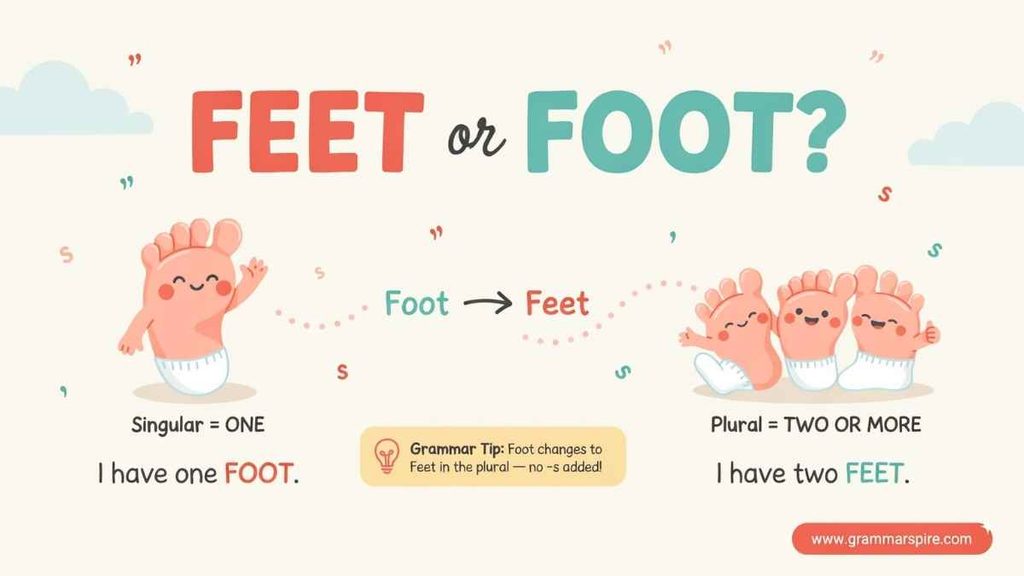
Foot is the singular form of the noun.
Feet is the irregular plural form of foot.
Use foot when you mean one body part or one unit of measurement.
Use feet when you mean two or more body parts or two or more units of measurement.
For example:
My left foot hurts.
Both my feet hurt.
The table is one foot long.
The table is five feet long.
However, when the measurement works as a compound adjective before a noun, English normally uses the singular foot.
For example:
A six-foot fence surrounds the yard.
He is a six-foot-tall athlete.
That small grammatical switch causes much of the confusion surrounding feet or foot.
Learn the difference between tricky words and use them correctly
Monkeys or Monkies Which Spelling Is Correct?
Feet vs Foot at a Glance
| Form | Meaning | Example |
|---|---|---|
| foot | Singular body part | My foot hurts. |
| feet | Plural body parts | My feet hurt. |
| foot | One unit of length | The board is one foot long. |
| feet | More than one unit | The board is six feet long. |
| foot | Compound modifier | A six-foot wall |
| feet | Normal plural measurement | The wall is six feet high. |
Remember the basic pattern: one foot, two feet, three feet, five feet, ten feet.
The compound adjective rule comes later.
What Does “Foot” Mean?
The word foot has several meanings in English. It commonly refers to a part of the human body, but it also functions as a unit of measurement.
Foot as a Body Part
A foot is the lower part of a human leg that supports the body and helps with walking, standing, balance, and movement.
When you mean one body part, use foot.
For example:
My right foot is sore.
She injured her left foot.
He stepped on my foot.
The child washed one foot first.
If you talk about both sides, you need the plural form feet.
For example:
My feet are cold.
She washed her feet.
Both feet were wet after the walk.
The simple test is grammatical number. One equals foot. More than one equals feet.
Foot as a Unit of Measurement
Foot also represents a unit of length in the U.S. customary measurement system.
One foot contains 12 inches.
Therefore:
One foot = 12 inches
1 foot = 30.48 centimeters
1 foot = 0.3048 meters
When you refer to exactly one unit, use foot.
For example:
The shelf is one foot wide.
The ruler is one foot long.
The box is one foot deep.
When the measurement exceeds one foot, use feet.
For example:
The shelf is five feet wide.
The room is ten feet long.
The fence is six feet high.
Learn the difference between tricky words and use them correctly
Receive or Recieve Which Spelling Is Correct?
What Does “Feet” Mean?
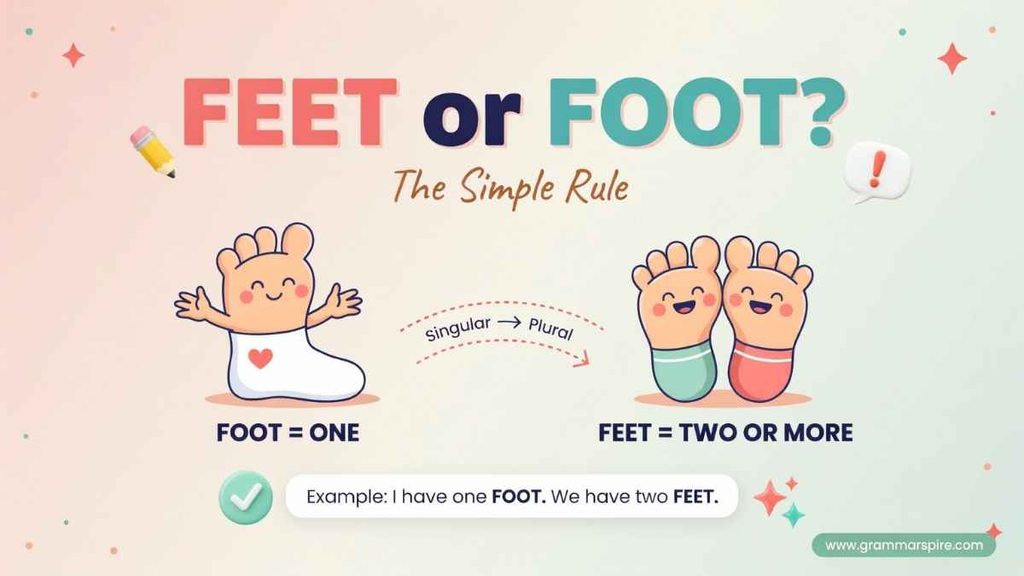
Feet is the irregular plural of foot.
Unlike many English nouns, foot does not become foots when you make it plural. Instead, its spelling changes completely.
One foot becomes two feet.
1 foot becomes three feet.
1 foot becomes ten feet.
Feet as Body Parts
Use feet when you mean more than one human foot.
For example:
My feet hurt after the long walk.
The runner washed his feet after training.
Her feet were covered in sand.
The baby moved his feet excitedly.
The word feet clearly indicates more than one foot.
Feet as a Measurement
Use feet when a measurement contains more than one foot.
For example:
The ceiling is eight feet high.
The bridge is 100 feet long.
The tree is 20 feet tall.
The swimming pool is six feet deep.
This is the normal form for plural measurements.
Learn the difference between tricky words and use them correctly
Volumn or Volume Which Is the Correct Spelling?
Why Is the Plural of Foot “Feet”?
English contains many irregular plural nouns. These nouns don’t follow the familiar pattern of simply adding -s or -es.
For example:
Man → men
Woman → women
Child → children
Tooth → teeth
Foot → feet
The change from foot to feet comes from older forms of English. Historical sound changes gradually altered the vowel in certain words.
You don’t need to memorize the historical development to use the word correctly. For everyday English, remember one simple fact:
Feet is the plural of foot.
So foots isn’t the standard plural when you mean human feet or multiple units of length.
Foot and Feet Difference in the Body
The difference becomes especially easy when you think about anatomy.
If you have one foot, you say:
My foot hurts.
If you have two feet, you say:
My feet hurt.
The verb also changes according to the subject.
Consider these examples:
My foot hurts.
My feet hurt.
Her left foot is swollen.
Her feet are tired.
The noun changes from foot to feet, and the verb follows the grammatical number.
This gives you a useful shortcut:
One body part = foot
Two body parts = feet
My Foot or Feet Which Should You Use?
The correct choice depends on how many body parts you’re describing.
Use my foot for one foot.
For example:
I hurt my foot.
My left foot feels numb.
There is a cut on my foot.
Use my feet for both feet or multiple feet.
For example:
I hurt my feet.
My feet are tired.
I washed my feet after playing outside.
The same rule applies to your, his, her, our, and their.
Your foot is injured.
Your feet are dirty.
His foot hurts.
His feet hurt.
Learn the difference between tricky words and use them correctly
Leasee vs Lessee Which Spelling Is Correct?
Foot vs Feet for Measurement
Measurements follow the same singular-and-plural pattern in ordinary sentences.
One Foot
Use one foot when the measurement equals exactly one foot.
Examples include:
The rope is one foot long.
The box is one foot wide.
The hole is one foot deep.
The shelf stands one foot above the floor.
Two Feet
Use two feet when the measurement equals two feet.
The table is two feet wide.
The child is two feet away.
The board is two feet long.
Three Feet
Use three feet for a measurement of three feet.
The ladder is three feet tall.
The fence is three feet high.
The rope is three feet long.
Five Feet
Use five feet when the measurement equals five feet.
The wall is five feet high.
The table is five feet long.
The pool is five feet deep.
Ten Feet
Use ten feet when the measurement equals ten feet.
The tree is ten feet tall.
The room is ten feet wide.
The car is parked ten feet away.
The pattern remains consistent: measurements greater than one normally take feet.
Learn the difference between tricky words and use them correctly
Hoofs or Hooves Which Spelling Is Correct?
1 Foot or Feet Which Is Correct?
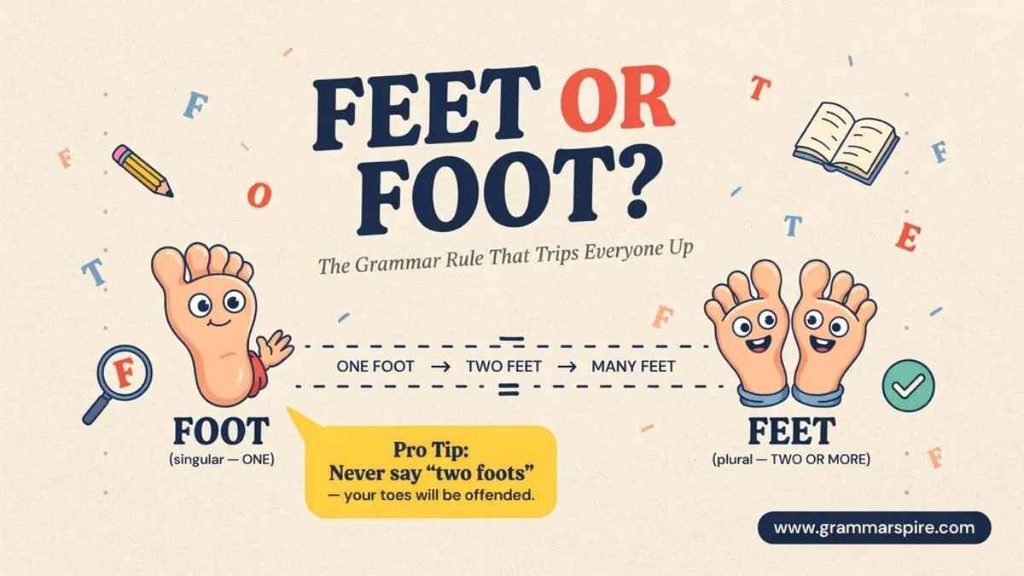
The correct expression is 1 foot.
You should not write 1 feet in standard English.
For example:
The table is 1 foot long.
The wall is 1 foot high.
The rope is 1 foot wide.
Why? Because 1 represents a single unit.
Compare these:
1 foot
2 feet
3 feet
4 feet
5 feet
Only the singular measurement uses foot.
The same principle applies to words instead of numerals:
one foot
two feet
three feet
5 Feet or Foot Which Is Correct?
For an ordinary measurement, 5 feet is correct.
For example:
The wall is 5 feet tall.
The table is 5 feet long.
The room is 5 feet wide.
However, when the measurement directly modifies a noun, English uses 5-foot.
For example:
A 5-foot wall stood beside the garden.
They built a 5-foot table.
He bought a 5-foot ladder.
This difference may look strange at first, but it follows a standard grammatical pattern.
Normal measurement:
The wall is 5 feet tall.
Compound modifier:
It is a 5-foot wall.
Six Feet Tall vs Six Foot Tall
Both forms can be correct, but they perform different jobs.
Six feet tall is a measurement that follows the subject.
For example:
The athlete is six feet tall.
Six foot tall works as a compound adjective before a noun.
For example:
He is a six foot tall athlete.
Notice what happened.
After the verb:
He is six feet tall.
Before the noun:
He is a six-foot-tall athlete.
The singular foot appears inside the compound modifier.
Why Is Foot Singular in “Ten-Foot”?
This question often puzzles learners.
Why do we say:
A ten-foot pole
instead of:
A ten-feet pole?
The answer lies in the structure of the phrase.
The entire expression ten-foot works as one compound modifier. The measurement behaves like a single descriptive unit.
Therefore, standard English uses the singular noun:
A ten-foot pole
A five-foot fence
A three-foot table
A six-foot wall
You can think of the phrase as a measurement label attached to the noun.
Learn the difference between tricky words and use them correctly
Barrel or Barrell Which Spelling Is Correct?
Feet or Foot for Height
When you state someone’s height as an ordinary measurement, use feet for measurements greater than one foot.
For example:
She is five feet tall.
He is six feet tall.
The player is six feet two inches tall.
The child is four feet tall.
For exactly one foot, use one foot.
For example:
The object is one foot tall.
Five Feet Tall or Five Foot Tall?
In standard formal English, five feet tall is the clearest choice.
For example:
She is five feet tall.
He is five feet tall.
The child is five feet tall.
You may hear five foot tall in casual speech or compact descriptions, but standard prose generally uses five feet tall when the phrase functions as an ordinary measurement after the verb.
Compare:
She is five feet tall.
She is a five-foot-tall athlete.
The first sentence uses the plural measurement. The second uses a compound adjective.
5 Foot 9 or 5 Feet 9?
When writing someone’s height formally, 5 feet 9 inches provides the clearest structure.
For example:
He is 5 feet 9 inches tall.
She is 5 feet 9 inches tall.
The athlete stands 5 feet 9 inches tall.
In casual conversation, people may say five-nine or five foot nine. These forms occur in everyday speech, but formal writing benefits from the complete measurement.
A useful distinction is:
5 feet 9 inches tall = clear formal measurement
five-foot-nine = informal or compressed height description
five-foot-nine-inch man = compound modifier
When clarity matters, spell out the measurement.
Six Foot Two Inch as a Compound Modifier
When a height measurement comes before a noun, you can create a compound adjective.
For example:
A six-foot-two-inch athlete
A five-foot-nine-inch player
A six-foot-two-inch basketball player
Notice that the measurement uses singular foot inside the compound adjective.
You don’t write:
A six-feet-two-inches athlete
Instead, write:
A six-foot-two-inch athlete
The hyphens connect the words so readers understand that the entire phrase modifies the noun.
Learn the difference between tricky words and use them correctly
Grate or Great Which One Is Correct?
Foot or Feet for Measurement?
For ordinary measurements, the choice depends on the number.
Use foot with one unit.
Use feet with more than one unit.
Examples:
one foot
two feet
four feet
eight feet
twelve feet
The same pattern appears with height, width, depth, and distance.
The building is one foot wider.
The building is ten feet wider.
The hole is one foot deep.
The hole is three feet deep.
The child is two feet away.
The child is six feet away.
Foot and Feet Difference in Measurement
The difference between foot and feet becomes straightforward once you identify whether the measurement is singular or plural.
| Measurement | Correct Form |
|---|---|
| 1 unit | 1 foot |
| 2 units | 2 feet |
| 3 units | 3 feet |
| 5 units | 5 feet |
| 10 units | 10 feet |
| Compound modifier | five-foot |
| Compound height modifier | six-foot-tall |
The important exception isn’t really an exception at all. A compound adjective follows its own grammatical structure.
Useful Foot Measurement Facts
A foot is a standard unit of length used in the U.S. customary system.
One foot contains:
12 inches
One foot equals:
30.48 centimeters
One foot equals:
0.3048 meters
Three feet equal:
one yard
These conversions make the unit useful for everyday measurements involving height, furniture, construction, rooms, distances, and objects.
For example, if a desk measures four feet long, it measures 48 inches long.
If a person is six feet tall, that equals 72 inches.
Learn the difference between tricky words and use them correctly
Losses or Loses What Is the Correct Spelling ?
Feet or Foot in Everyday Examples
The difference appears naturally in ordinary conversation.
Body Part Examples
My foot hurts after the hike.
Both my feet hurt after the hike.
Length Examples
The board is one foot long.
The board is eight feet long.
Width Examples
The doorway is three feet wide.
The table is four feet wide.
Depth Examples
The pool is five feet deep.
The hole is two feet deep.
Distance Examples
The store is one foot away from the edge.
The chair is three feet away.
These examples show how naturally the singular and plural forms work in everyday English.
Foot or Feet in Compound Adjectives
Compound adjectives create the most common source of confusion.
When a measurement comes directly before a noun and describes that noun, use the singular form foot.
Examples include:
A two-foot ruler
A three-foot table
A four-foot fence
A five-foot wall
A six-foot ladder
A ten-foot pole
The measurement becomes part of a descriptive unit.
Hyphenation in Compound Measurements
Hyphens help connect the measurement to the noun it modifies.
For example:
A five-foot-long table
A six-foot-tall man
A four-foot-wide doorway
A three-foot-deep pool
A ten-foot-high fence
The hyphens make the structure easier to read.
Compare:
A six-foot-tall man
The man is six feet tall.
Both sentences communicate the same basic measurement, but the grammar differs.
Learn the difference between tricky words and use them correctly
Wierd or Weird Which Spelling Is Correct?
Common Mistakes
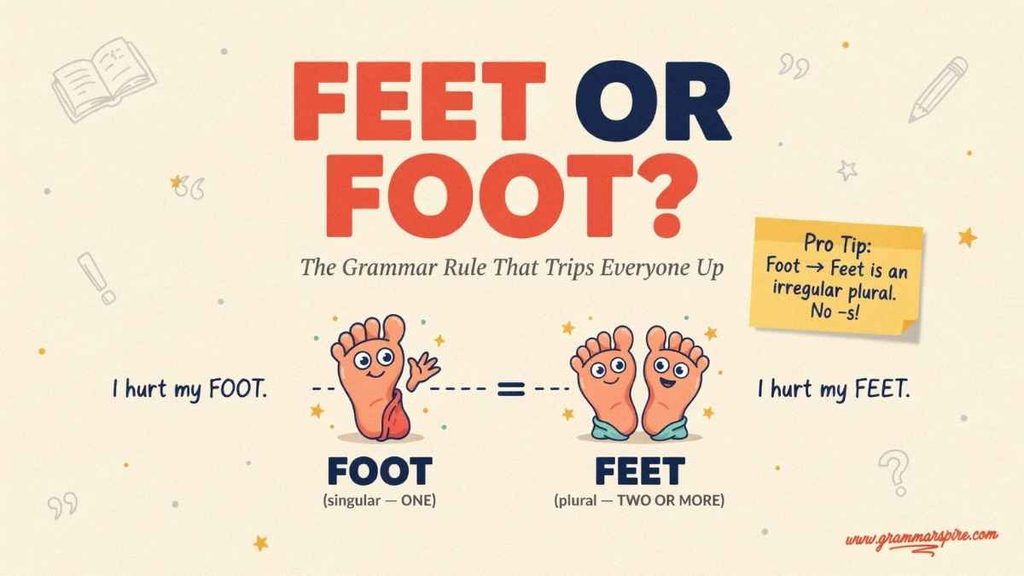
Several errors appear repeatedly when people use these words.
Writing “1 Feet”
Incorrect:
The table is 1 feet long.
Correct:
The table is 1 foot long.
The number one requires the singular form.
Writing “5 Foot” for a Normal Measurement
Incorrect in standard formal measurement:
The wall is 5 foot tall.
Correct:
The wall is 5 feet tall.
However, 5-foot becomes correct when it modifies a noun.
Correct:
It is a 5-foot wall.
Using “Foots” as the Plural
Incorrect:
My foots hurt.
Correct:
My feet hurt.
The plural of foot is feet, not foots.
Using Feet in a Compound Modifier
Incorrect:
A six-feet-tall man
Correct:
A six-foot-tall man
The compound modifier uses singular foot.
Foot and Feet in Common Expressions
The word foot also appears in several familiar English expressions.
On foot means walking rather than traveling by vehicle.
For example:
We explored the town on foot.
Get back on your feet means to recover from a difficult situation.
For example:
After the setback, she worked hard to get back on her feet.
Think on your feet means to respond quickly to an unexpected situation.
For example:
Good speakers know how to think on their feet.
Put your best foot forward means to make a strong effort or good impression.
For example:
Try to put your best foot forward during the interview.
Find your feet means to become comfortable or confident in a new situation.
For example:
It took him a few weeks to find his feet at the new job.
These expressions show that foot can carry meanings beyond anatomy and measurement.
Foot as a Verb
The word foot can also function as a verb.
One common expression is foot the bill, which means to pay a cost or expense.
For example:
The company will foot the bill for the event.
In this expression, foot has nothing to do with walking. English sometimes gives familiar words new jobs, and foot happily wears several grammatical hats.
When to Use Foot or Feet
Use foot when you mean one body part.
My foot hurts.
Use feet when you mean more than one body part.
My feet hurt.
Use foot for exactly one unit of measurement.
The board is one foot long.
Use feet for measurements greater than one unit.
The board is five feet long.
Use singular foot inside a compound modifier.
A five-foot board
A six-foot-tall athlete
A ten-foot pole
This four-part rule solves most feet or foot questions.
Grammar Case Study Five Feet Tall vs Five Foot Tall
Consider these two sentences:
She is five feet tall.
She is a five-foot-tall runner.
Both sentences describe the same height.
The difference comes from grammar.
In the first sentence, five feet functions as the measurement. The phrase appears after the verb.
In the second sentence, five-foot-tall functions as a compound adjective before the noun runner.
This distinction appears throughout English.
The wall is ten feet high.
It is a ten-foot-high wall.
The table is four feet long.
It is a four-foot-long table.
Once you recognize the structure, the rule becomes much easier to remember.
Learn the difference between tricky words and use them correctly
Ambience or Ambiance Which Spelling Is Correct?
Comparison Table

| Feature | Foot | Feet |
|---|---|---|
| Number | Singular | Plural |
| Body part | One foot | Two or more feet |
| Measurement | One unit | More than one unit |
| Example | One foot | Five feet |
| Normal height | One foot tall | Six feet tall |
| Compound adjective | Five-foot wall | Not normally used |
| Plural spelling | Singular form | Irregular plural |
| Standard plural | No | Yes |
Spelling difference
The spelling difference matters because feet doesn’t simply add a letter to foot.
The correct forms are:
Foot
Feet
The incorrect plural foots does not work when you mean human feet or multiple measurement units.
This irregular spelling resembles other English word changes such as tooth → teeth and goose → geese.
Learning these forms as pairs can help:
Foot → feet
Tooth → teeth
Goose → geese
Man → men
Woman → women
English grammar has plenty of surprises, but these patterns become easier with practice
Here’s a trusted source for clear more words Comparison:
Grammar Update
Practice Session Feet or Foot
It’s time to test your understanding of foot and feet. Each sentence below focuses on a slightly different situation, including body parts, measurements, height, distance, and compound descriptions.
Read each sentence carefully before choosing the correct form. Remember that context matters. A number greater than one usually takes feet, while a measurement used directly before a noun generally takes foot.
Fill in the Blanks
- My left ___ hurts after the long walk.
- Both my ___ were covered in mud.
- The table is one ___ long.
- The swimming pool is six ___ deep.
- She is five ___ tall.
- He bought a six-___ ladder.
- The fence is ten ___ high.
- They installed a ten-___ fence around the yard.
- The rope is three ___ long.
- I accidentally stepped on his ___.
- Her ___ were tired after the hike.
- The room is twelve ___ wide.
- We need a four-___ table for the dining area.
- The box is one ___ wide.
- The child is two ___ away from the door.
- They built a five-___ wall beside the garden.
- The wall is five ___ tall.
- He is a six-___-tall basketball player.
- The hallway is eight ___ long.
- She is six ___ two inches tall.
- The shelf is two ___ above the floor.
- They used a three-___ ruler to measure the board.
- My right ___ feels sore today.
- His ___ were wet after walking through the rain.
- The tree is twenty ___ tall.
- They built a seven-___-high fence.
- The board is four ___ long.
- We need a two-___ piece of wood for the project.
- The ditch is three ___ deep.
- The athlete is six ___ four inches tall.
Answer Key
- foot
- feet
- foot
- feet
- feet
- foot
- feet
- foot
- feet
- foot
- feet
- feet
- foot
- foot
- feet
- foot
- feet
- foot
- feet
- feet
- feet
- foot
- foot
- feet
- feet
- foot
- feet
- foot
- feet
- feet
Check Your Understanding
Review the sentence structure rather than relying only on the number. When you describe one unit or one body part, choose foot. When you refer to multiple units or body parts, choose feet.
Compound descriptions follow a different pattern. When the measurement appears directly before a noun, use singular foot.
For example:
The fence is six feet high.
It is a six-foot fence.
The athlete is six feet tall.
He is a six-foot-tall athlete.
The distinction may seem small, but it helps your writing sound precise and natural. Once you identify whether you’re stating a measurement or using it to describe a noun, the correct form becomes much easier to recognize.
FAQs About Feet or Foot
When should you use feet or foot?
Use foot for a single unit of length or one human foot. Use feet when referring to multiple units or body parts. For example, “The shelf is one foot long” is correct, while “The shelf is six feet long” requires the plural form.
Is it 1 foot or 2 feet?
Both expressions are correct because they describe different quantities. Use 1 foot for a single unit and 2 feet for two units. The number determines whether the singular or plural form is appropriate.
Is 5 foot correct or 5 feet?
For a regular measurement, 5 feet is correct. For example, “The wall is 5 feet high.” However, 5-foot is appropriate when the measurement functions as a compound modifier before a noun, as in “a 5-foot wall.”
Is it correct to say “1 foot” or “1 feet”?
The correct form is 1 foot. Because the numeral 1 represents one unit, it requires the singular noun. The expression 1 feet is not standard English.
Do you say 3 feet or 3 foot?
The correct expression is 3 feet when stating an ordinary measurement. Since three represents more than one unit, the plural form is required.
Is it correct to say “6 foot” or “6 feet”?
Use 6 feet when expressing the measurement itself, such as “The tree is 6 feet tall.” Use 6-foot when the measurement directly modifies a noun, as in “a 6-foot tree.”
Do you say 4 feet or 4 foot?
The standard form is 4 feet for a normal measurement. For example, “The table is 4 feet long.” When used as a compound modifier, the singular form appears instead: “a 4-foot table.”
Is it 8 foot or feet?
Use 8 feet for a standard measurement. For example, “The room is 8 feet wide.” Before a noun, use 8-foot, as in “an 8-foot ceiling.”
Do you say 2 feet or 2 foot?
For an ordinary measurement, write 2 feet. The plural form follows numbers greater than one. However, 2-foot is correct when the measurement serves as a compound modifier, such as “a 2-foot ruler.”
Is “9 foot” or “9 feet” correct?
9 feet is correct when stating a regular measurement. For example, “The fence is 9 feet tall.” Use 9-foot before a noun, as in “a 9-foot fence.”
Is 6 ft tall correct for a woman?
Yes. 6 ft tall is grammatically correct when describing a woman’s height. In fully written form, 6 feet tall is also correct and often clearer in formal prose.
Do you say 7 feet or 7 foot?
Use 7 feet for an ordinary measurement. For example, “The wall is 7 feet high.” The form 7-foot is used when the measurement modifies a noun, such as “a 7-foot wall.”
Is it 16 feet or foot?
Use 16 feet when expressing the measurement itself. For example, “The room is 16 feet wide.” When the measurement comes before a noun, use 16-foot, as in “a 16-foot room.”
How do you write 5 ft 4 inches?
A clear abbreviated form is 5 ft 4 in. When writing the units in full, use 5 feet 4 inches. For example, “She is 5 feet 4 inches tall” provides a clear and professional expression of height.
Is 2 ft or inches?
These are different units of measurement. 2 ft means two feet, which equals 24 inches. If you want to express the entire measurement in inches, write 24 inches rather than combining the two forms incorrectly.
AEO Quick Answers About Foot and Feet
What is the basic rule for foot and feet?
Foot is the singular form, while feet is the plural form. Use one foot for a single unit and two feet or more for multiple units. In compound modifiers, the singular foot appears in expressions such as a five-foot fence.
What is the plural of foot?
The plural of foot is feet. It is an irregular plural because the word changes form rather than simply adding -s.
When should you use feet?
Use feet when referring to more than one unit of length or multiple human feet. Examples include three feet long, eight feet high, and my feet hurt.
When should you use foot?
Use foot for one unit or one human foot. It also appears in compound modifiers, including a two-foot ruler and a six-foot-tall athlete.
Why do we say five feet but five-foot wall?
Five feet expresses a measurement, whereas five-foot forms part of a compound adjective describing a noun. Therefore, you write “The wall is five feet high” but “a five-foot wall.”
Is “six feet tall” grammatically correct?
Yes. Six feet tall is the standard construction for expressing someone’s height as an ordinary measurement.
Is “six-foot-tall” correct?
Yes. Six-foot-tall is correct when the entire phrase modifies a noun. For example, “He is a six-foot-tall athlete.”
What is the difference between 5 feet and 5-foot?
5 feet states the measurement itself. 5-foot functions as part of a compound modifier. Compare “The table is 5 feet long” with “a 5-foot table.”
How many inches are in one foot?
One foot equals 12 inches. This conversion applies whether the unit appears in a body measurement, distance, or length description.
How many feet are in one yard?
One yard equals 3 feet. Therefore, a measurement of 6 feet is equivalent to 2 yards.
How should you write someone’s height?
For clear formal writing, use forms such as 5 feet 4 inches tall or 6 feet 2 inches tall. When the measurement precedes a noun, use a compound construction such as a 6-foot-2-inch athlete.
Can “foot” follow a number greater than one?
Yes, but only in specific grammatical structures. Ordinary measurements use feet, while compound modifiers use singular foot. For example, write “The pole is 10 feet tall” but “a 10-foot pole.”
Is “foots” the plural of foot?
No. The standard plural is feet. The word foots does not replace feet when referring to human body parts or standard length measurements.
Which is correct: “one foot” or “one feet”?
One foot is correct because the number one represents a single unit. The plural form feet begins with quantities greater than one.
Which is correct “two foot” or “two feet”?
For a regular measurement, two feet is correct. Use two-foot when the measurement acts as a compound modifier, such as a two-foot board.
Conclusion
The feet or foot question may seem like a small grammar hurdle, but it becomes easy once you know the pattern. Foot refers to one body part or one unit of measurement, while feet refers to more than one. The main twist appears when a measurement becomes part of a compound adjective. You write, “The wall is six feet tall,” but “a six-foot wall.” Same measurement, different grammatical job.
Once this distinction clicks, choosing between foot and feet becomes far less confusing. Check the quantity, examine the sentence structure, and determine how the measurement functions. With a little practice, you’ll avoid common mistakes, write with confidence, and keep your grammar firmly on its feet!

Ella AJS
Ella AJS is an experienced blogger and language enthusiast at Grammar Spire, dedicated to making English grammar simple, practical, and easy to understand. She specializes in word comparisons, meanings, usage, and common language confusions. Through clear explanations and engaging examples, Ella helps students, writers, and English learners improve their vocabulary and communicate with greater confidence and accuracy.




