
English spelling has a funny habit of making simple words surprisingly complicated. The confusion over “labelling or labeling” is a perfect example. Both spellings are correct, but the preferred form depends on the variety of English you use. American English generally favors “labeling,” while British English commonly uses “labelling.” That extra “l” may seem insignificant, yet it can leave writers second-guessing every sentence. In this guide, you’ll discover the meaning, spelling differences, regional preferences, grammar, and practical examples behind labelling or labeling. You’ll also learn how related forms work, so you can choose the right spelling confidently and keep your writing consistent.
Labelling or Labeling Quick Answer
Labelling and labeling are both correct spellings of the present participle and gerund form of the verb label.
American English generally uses labeling.
British English generally uses labelling.
For example:
American English: The company is labeling the new products.
British English: The company is labelling the new products.
The meaning remains exactly the same. The difference is simply a regional spelling preference.
| Spelling | Common regional preference | Meaning |
|---|---|---|
| labeling | American English | Putting a label on something or identifying, describing, or classifying it |
| labelling | British English | Putting a label on something or identifying, describing, or classifying it |
So, if you are asking which is correct, labeling or labelling, the answer depends on the variety of English you are using.
Learn the difference between tricky English words with easy explanations
Leasee vs Lessee Which Spelling Is Correct?
Labelling or Labeling Meaning

To understand the labelling or labeling meaning, it helps to begin with the base verb label.
To label something can mean to attach a physical label to it, identify it with a name or description, or place it into a particular category.
When the ending ing is added, the result is labeling in American English and labelling in British English.
For example:
The worker is labeling the boxes.
The worker is labelling the boxes.
Both sentences describe the same action.
The word can be used in several situations. Someone can label a product, label a package, label a diagram, label a file, or label an item. It can also be used more abstractly when someone assigns a description or category to a person, idea, or behavior.
For example:
The students are labeling the parts of the diagram.
The company is labeling every package before shipment.
She spent the afternoon labeling the storage containers.
The article discusses the problem of labeling people too quickly.
In each example, the central idea involves identifying, describing, marking, or classifying something.
Is Labeling a Word?
Yes, labeling is a standard English word.
It is the American English spelling of the present participle and gerund form of label.
As a present participle, it can describe an action that is taking place.
She is labeling the folders.
As a gerund, it can refer to the activity itself.
Labeling the samples correctly requires careful attention.
The spelling is not informal or incorrect. It is a standard form used in American English.
Is Labelling a Word?
Yes, labelling is also a standard English word.
It is the spelling commonly used in British English.
For example:
She is labelling the folders.
Labelling the samples correctly requires careful attention.
The extra l does not change the meaning. It reflects a spelling convention associated with British English.
Therefore, both is labeling a word and is labelling a word have the same basic answer yes.
Learn the difference between tricky English words with easy explanations
Hoofs or Hooves Which Spelling Is Correct?
Why Are Labelling and Labeling Spelled Differently?
The difference comes from regional English spelling conventions.
The base word is label. When the ending -ing is added, American and British English commonly use different spellings.
American English uses labeling.
British English uses labelling.
This is not a matter of one version being educated and the other being careless. Both forms developed as accepted spelling conventions within different varieties of English.
The difference becomes easier to understand when you compare related forms.
| Form | American English | British English |
|---|---|---|
| Base verb | label | label |
| Present participle | labeling | labelling |
| Gerund | labeling | labelling |
| Past tense | labeled | labelled |
| Past participle | labeled | labelled |
| Person who labels | labeler | labeller |
The pattern explains why the question often appears as both labeling or labelling and labeled or labelled.
Learn the difference between tricky English words with easy explanations
Barrel or Barrell Which Spelling Is Correct?
Labelling or Labeling British English vs American English
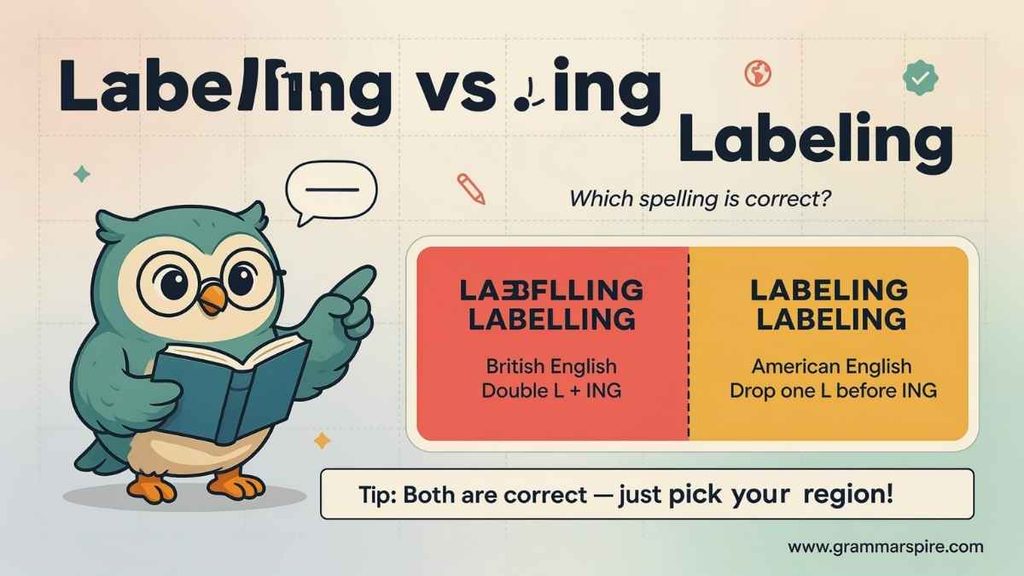
The clearest difference between these spellings is regional usage.
Labelling or Labeling in American English
American English generally prefers labeling with one l before the -ing ending.
You may see it in business documents, educational materials, product information, technical writing, software documentation, and everyday communication.
For example:
The company is labeling the new packages.
The teacher asked the students to label the diagram.
The technician is labeling each sample.
Proper labeling makes the information easier to understand.
American English generally uses labeled for the corresponding past form.
The boxes were labeled according to size.
Labelling or Labeling in British English
British English generally uses labelling with two l characters.
For example:
The company is labelling the new packages.
The teacher asked the students to label the diagram.
The technician is labelling each sample.
Proper labelling makes the information easier to understand.
British English generally uses labelled for the corresponding past form.
The boxes were labelled according to size.
The difference is therefore consistent across these related forms.
American English: labeling and labeled.
British English: labelling and labelled.
Labelling or Labeling in Canadian English
Canadian English contains influences from both British and American English, so spelling preferences can vary.
Both labeling and labelling can be encountered in Canadian writing. The choice may depend on the publication, institution, organization, or style guide being followed.
For that reason, it is better to avoid treating Canadian English as an exact copy of either American or British English.
If you are writing specifically for a Canadian audience, follow the spelling standard required by your publication or organization. Most importantly, keep the spelling consistent throughout the document.
Labelling or Labeling in Australian English
Australian English commonly follows many British spelling conventions. As a result, labelling is commonly used.
For example:
The staff are labelling the new products.
The teacher is labelling the diagram.
The packages have been labelled correctly.
However, Australian English has its own established conventions, and specific publications or organizations may have their own style preferences.
The practical rule is simple: consider the audience and follow the appropriate writing standard.
Learn the difference between tricky English words with easy explanations
Grate or Great Which One Is Correct?
Labelling vs Labeling What Is the Difference?
The labelling vs labeling difference is mainly a matter of spelling.
There is no important difference in meaning.
It is no meaningful difference in pronunciation.
There is no difference in grammatical function.
The difference is the spelling convention used by different varieties of English.
| Feature | Labelling | Labeling |
|---|---|---|
| Correct spelling | Yes | Yes |
| Common regional preference | British English | American English |
| Meaning | Same | Same |
| Pronunciation | Essentially the same | Essentially the same |
| Present participle | Yes | Yes |
| Gerund | Yes | Yes |
| Related past form | labelled | labeled |
This is why labeling vs labelling should not be treated as a choice between a correct word and an incorrect word.
It is a choice between two accepted regional forms.
Labelling or Labeling Spelling Rule
The labelling or labeling spelling becomes much easier once you understand the base word.
The base verb is label.
American English forms the word as:
label + ing = labeling
British English commonly forms it as:
label + ling = labelling
The same distinction appears in the past form.
American English:
label + ed = labeled
British English:
label + led = labelled
This gives you a useful memory pattern.
American English uses labeling and labeled.
British English uses labelling and labelled.
Label + ing Spelling
The spelling pattern can seem unusual if you are used to seeing British forms such as travelling or cancelling.
English contains many regional spelling differences involving a single consonant versus a doubled consonant.
For example:
| American English | British English |
|---|---|
| traveling | travelling |
| canceling | cancelling |
| modeling | modelling |
| signaling | signalling |
| leveling | levelling |
| labeling | labelling |
These examples show why the labeling and labelling distinction fits into a broader pattern of American and British spelling differences.
However, spelling rules do not work identically for every word. It is better to learn established forms individually rather than assuming every verb will follow exactly the same pattern.
Learn the difference between tricky English words with easy explanations
Losses or Loses What Is the Correct Spelling ?
Labeled or Labelled Which Spelling Is Correct?
The question labeled or labelled follows the same regional distinction.
Both forms are correct.
Labeled is generally preferred in American English.
Labelled is generally preferred in British English.
For example:
American English: The package was labeled fragile.
British English: The package was labelled fragile.
The meaning is the same.
This relationship makes the word family easier to remember.
American English uses labeling and labeled.
British English uses labelling and labelled.
Learn the difference between tricky English words with easy explanations
Wierd or Weird Which Spelling Is Correct?
Labeling vs Labelling Grammar
From a grammar perspective, labeling and labelling work in exactly the same way.
Both are forms of the verb label.
They can function as present participles or gerunds.
Labeling as a Present Participle
A present participle can appear with a form of be to describe an action in progress.
For example:
She is labeling the folders.
They are labeling the packages.
The technician was labeling the samples.
In British English, the same sentences use labelling.
She is labelling the folders.
They are labelling the packages.
The grammatical structure does not change.
Labeling as a Gerund
The ing form can also function as a gerund.
For example:
Labeling the samples correctly requires patience.
Here, labeling refers to the activity itself and functions as the subject of the sentence.
The British English equivalent is:
Labelling the samples correctly requires patience.
Again, the grammatical function remains unchanged.
Learn the difference between tricky English words with easy explanations
Ambience or Ambiance Which Spelling Is Correct?
Labelling or Labeling in a Sentence
Examples are one of the easiest ways to understand a spelling difference.
Here are several examples of labeling in a sentence using American English.
The company is labeling every package before shipment.
The students are labeling the parts of the diagram.
The technician is labeling each sample.
Proper labeling helps customers understand the product.
The workers finished labeling the storage containers.
Here are the same ideas using British English.
The company is labelling every package before shipment.
The students are labelling the parts of the diagram.
The technician is labelling each sample.
Proper labelling helps customers understand the product.
The workers finished labelling the storage containers.
The structure and meaning remain unchanged.
Examples in Everyday Writing
The word appears in far more situations than physical stickers.
Labeling Products
Product labeling refers to the process of providing identifying or descriptive information about products.
For example:
The manufacturer is labeling products before sending them to retailers.
In British English:
The manufacturer is labelling products before sending them to retailers.
The term can refer to information printed directly on packaging or to the broader process of identifying products.
Labelling or Labeling Food
Food labeling is another common use.
A food label can provide information about the contents of a packaged product, such as ingredients and nutrition information.
For example:
Clear food labeling makes package information easier to understand.
British English:
Clear food labelling makes package information easier to understand.
The phrase labeling food refers to the process, while food label refers to the actual label or information presented on a product.
Labelling or Labeling Food Label
A food label is a noun phrase referring to the label or information panel associated with a food product.
For example:
The customer checked the food label before buying the product.
By contrast, food labeling refers to the practice or process of providing information through labels.
The distinction is useful:
Food label = the label itself.
Food labeling = the process or practice of providing labels or labeling information.
Labelling or Labeling Products
Businesses often label products to identify them, distinguish them from other products, or provide information to customers.
For example:
The company is labeling products according to size and type.
British English:
The company is labelling products according to size and type.
The word can also appear in discussions of packaging, inventory, shipping, storage, and product information.
Labelling or Labeling Sticker
A labeling sticker is a sticker used to identify or organize an item.
For example:
She placed a labeling sticker on the storage container.
In British English:
She placed a labelling sticker on the storage container.
The word sticker itself is a noun, while labeling or labelling describes the action or purpose associated with the sticker.
Common Uses of Labeling and Labelling
The word label has both physical and abstract uses.
A person can label a package by attaching an identification label.
A student can label a diagram by identifying its parts.
A worker can label a container so its contents are easy to recognize.
A company can label products with names, descriptions, or other information.
A researcher can label samples to distinguish one from another.
A writer can use label in an abstract sense when discussing how people classify or describe others.
For example:
The researcher is labeling each sample before testing.
The teacher is labeling the parts of the diagram.
The company is labeling the boxes for shipment.
The article examines the habit of labeling people based on limited information.
These examples demonstrate that labeling is not restricted to physical stickers.
Labeling, Labels, and Label Understanding the Word Family
The base word label can function as both a noun and a verb.
As a noun:
The label is attached to the package.
As a verb:
Please label the package.
The plural noun is labels:
The labels on the products are easy to read.
The present participle or gerund is labeling or labelling:
The worker is labeling the packages.
The past form is labeled or labelled:
The packages were labeled correctly.
Understanding the entire word family makes the spelling distinction easier to remember.
Which Spelling Should You Use?
The answer to which is correct labeling or labelling depends on your audience and the spelling convention you are following.
If your writing uses American English, labeling is generally the natural choice.
If we writing uses British English, labelling is generally the natural choice.
Your organization follows a particular style guide, follow that guide.
If you are writing for an international audience, choose a consistent spelling standard and use it throughout the document.
The biggest problem is not choosing the supposedly wrong regional form. The bigger problem is mixing conventions without a reason.
For example, an American English document would normally use:
The products were labeled, and the team is labeling the remaining boxes.
A British English document would normally use:
The products were labelled, and the team is labelling the remaining boxes.
Keeping related forms consistent makes your writing look polished.
Labelling or Labeling in Formal Writing
Formal writing requires accuracy, but accuracy does not mean there is only one acceptable spelling.
Regional English varieties have their own established conventions.
If you are writing an academic paper, business report, website, technical document, or professional article, consider the audience before choosing between labeling and labelling.
A professional writer should also consider the style guide used by the organization or publication.
The important principles are simple:
Choose the appropriate regional spelling.
Follow the required style guide.
Use the same convention throughout the document.
Do not change spellings simply because another form looks unfamiliar.
Labeling vs Labelling Style Guide
A style guide can determine which spelling a particular publication or organization expects.
For American English content, labeling will generally fit naturally.
For British English content, labelling will generally fit naturally.
If you are working for a specific publication, school, company, or professional organization, its internal style guide should take priority over personal preference.
This is especially important when several writers contribute to the same document. A shared spelling standard prevents one section from using labeling while another uses labelling.
Labeling vs Labelling AP Style
Questions about labeling vs labelling AP style often arise because writers want to follow a recognized American writing standard.
The general American English preference is labeling, but if you are working under a specific editorial standard, consult the current version of that style guide for its detailed guidance.
The broader spelling distinction remains useful:
American English generally uses labeling.
British English generally uses labelling.
A style guide helps determine how that broader convention should be applied within a particular publication.
Learn the difference between tricky English words with easy explanations
Feet or Foot Which One Is Correct?
Labelling or Labeling Pronunciation
There is no important pronunciation distinction between labeling and labelling.
The additional l in the British spelling does not create a separate spoken word.
Both forms refer to the same action and are normally pronounced alike.
This is one reason the difference can be easy to miss in conversation but noticeable in writing.
You may hear someone say the word and have no idea which spelling they would use on the page.
Labelling or Labeling Synonyms
Depending on the context, several words can express a similar idea.
Common alternatives include naming, identifying, marking, tagging, categorizing, classifying, designating, and describing.
However, these words do not always mean exactly the same thing.
For example, tagging often suggests attaching a tag or digital marker.
Classifying emphasizes placing something into a particular category.
Identifying focuses on recognizing or establishing what something is.
Labeling can cover several of these ideas, so the best replacement depends on the sentence.
Learn the difference between tricky English words with easy explanations
Families or Familys Which One Is Correct?
A Simple Comparison in Context

Imagine that a company prepares packaging for customers in two English-speaking markets.
Its American instructions might say:
The team must label each package before shipment. Every package should be clearly labeled, and employees are responsible for labeling damaged items separately.
The British version might say:
The team must label each package before shipment. Every package should be clearly labelled, and employees are responsible for labelling damaged items separately.
The instructions communicate the same information.
The only meaningful change is the regional spelling convention.
This demonstrates why labeling vs labelling is a spelling issue rather than a difference in meaning.
Learn the difference between tricky English words with easy explanations
Likeable or Likable Which Spelling Is Correct?
Labelling or Labeling Quick Reference
| Question | Answer |
|---|---|
| Is labeling correct spelling? | Yes |
| Is labelling correct spelling? | Yes |
| Is labeling a word? | Yes |
| Is labelling a word? | Yes |
| Is labeling American English? | It is generally preferred in American English |
| Is labelling British English? | It is generally preferred in British English |
| Do they have the same meaning? | Yes |
| Do they have the same pronunciation? | Essentially yes |
| Is labeling used in the US? | Yes, and it is generally preferred |
| Is labelling used in the UK? | Yes, and it is generally preferred |
| Are both accepted spellings? | Yes |
| Is labeled or labelled correct? | Both are correct, with the same regional distinction |
Here’s a trusted source for clear more words Comparison:
Grammar Update
Practice Session Labelling or Labeling
Let’s put your knowledge to the test. Complete each sentence with the correct form of the word. Try to answer all the questions before checking the answers below.
Fill in the Blanks
- The warehouse staff is ________ every package before shipment.
- The British company is ________ its products according to local requirements.
- In American English, the preferred spelling is ________.
- In British English, the commonly used spelling is ________.
- The employee is carefully ________ each box before placing it on the truck.
- The museum has ________ every item in the new exhibition.
- Clear product ________ helps customers understand important information.
- The food company is ________ its packages with updated ingredient information.
- She spent the afternoon ________ folders for the new filing system.
- The teacher is ________ the different parts of the diagram.
- The container was clearly ________ with a warning before it was shipped.
- The British office has ________ all the storage boxes.
- Which spelling is normally preferred in American English?
- Which spelling is commonly used in British English?
- The employee finished ________ the parcels before the office closed.
- The Australian team is ________ the equipment before sending it overseas.
- The American retailer is ________ its products with clearer instructions.
- Each bottle was properly ________ before being placed on the shelf.
- The researcher is ________ samples according to their characteristics.
- The British publisher prefers ________ throughout its publications.
- The manager asked the staff to ________ every box with its destination.
- A clear product ________ can provide useful information to customers.
- The company improved its food ________ to make the ingredients easier to identify.
- The American editor changed “labelling” to ________ to follow US spelling.
- The British editor changed “labeling” to ________ to follow UK spelling.
- Labeling and labelling have the same basic ________.
- The spelling difference mainly reflects ________ English conventions.
- In American English, the -ing form of “label” is spelled ________.
- In British English, the ing form of “label” is spelled ________.
- Choose one spelling convention and use it ________ throughout your article.
Answers
- labeling
- labelling
- labeling
- labelling
- labeling
- labeled
- labeling
- labeling
- labeling
- labeling
- labeled
- labelled
- labeling
- labelling
- labeling
- labelling
- labeling
- labelled
- labeling
- labelling
- label
- label
- labeling
- labeling
- labelling
- meaning
- regional
- labeling
- labelling
- consistently
FAQs About Labelling or Labeling
What Is Correct Labeling or Labelling?
Both spellings are correct. Labeling is generally preferred in American English, while labelling is commonly used in British English. The two forms have the same meaning and grammatical function.
What Is the Difference Between “Label” and “Labeling”?
Label can be a noun or a verb. As a noun, it refers to information attached to or printed on something. As a verb, it means to identify, describe, or classify something. Labeling refers to the act or process of doing so.
Does Labelling Have One L or Two?
Labelling is spelled with two l characters before the ending. This form is commonly used in British English. American English generally uses labeling with one l in that position.
What Do You Mean by the Term Labelling?
Labelling refers to attaching information to an item or assigning a name, description, or category to something. It can involve physical product labels as well as broader forms of identification or classification.
How Do Americans Spell Labelling?
Americans generally spell it labeling. This is the standard form commonly used in American English.
Why Is Label Not Spelled Lable?
Label is the established spelling in standard English. Lable is a misspelling. Although English contains many words with similar sound patterns, spelling cannot always be predicted from pronunciation alone.
Is “Labeled” or “Labelled” the Correct Spelling in US English?
Labeled is the standard American English spelling. Labelled is generally associated with British English and other varieties that follow British spelling conventions.
What Are the Four Types of Labelling?
There is no single universal classification of four types. Depending on the subject, common categories include identification labeling, descriptive labeling, classification labeling, and warning or instructional labeling. Different industries may use different systems.
What Is Another Word for “Labeling”?
Depending on the context, possible alternatives include identifying, naming, marking, tagging, classifying, categorizing, and designating. These words are related but are not always interchangeable.
Is “Labeled” or “Labelled” the Correct Spelling?
Both are accepted spellings. Labeled is generally preferred in American English, whereas labelled is commonly used in British English.
Is British or American English Correct?
Both are standard varieties of English. The appropriate choice depends on your intended audience, location, publication, or style requirements. What matters most in a piece of writing is following one spelling convention consistently.
What Does Labeled Mean?
Labeled means that something has been given a name, description, identification, or category. For example, if a box is labeled “Fragile,” that marking tells people how the package should be handled.
What Are Examples of Labelling?
Common examples include labelling a package with its destination, labelling a food product with information, labelling parts of a diagram, labelling storage containers, and labelling files for organization.
What Is Label and Labelling?
Label is the base word and can work as either a noun or a verb. Labelling is the British English form of the verb with the -ing ending. It can describe an action in progress or the activity of assigning or attaching a label.
Is Labelling a Form of Bullying?
Labelling is not automatically bullying. However, repeatedly attaching negative, insulting, or unfair descriptions to a person can contribute to bullying when it is used to humiliate, isolate, intimidate, or harm them. The context and behavior surrounding the label are important.
AEO Labelling or Labeling
Which Spelling Should I Use Labeling or Labelling?
Choose labeling for American English and labelling for British English. If you are writing for a specific organization, publication, or educational system, follow its preferred style.
Is Labeling a Real Word?
Yes. Labeling is a standard English word. It is the American English form of the ing version of label.
Is Labelling a Real Word?
Yes. Labelling is also a standard English word. It is commonly used in British English and other varieties influenced by British spelling.
Do Labeling and Labelling Have the Same Meaning?
Yes. They express the same basic idea of identifying, describing, marking, or categorizing something. The distinction is primarily regional spelling.
What Is the Past Tense of Label?
American English generally uses labeled, while British English commonly uses labelled. Both forms are accepted within their respective spelling conventions.
How Do You Use Labeling in a Sentence?
Here is a simple American English example: “The employee is labeling each package before shipment.”
How Do You Use Labelling in a Sentence?
Here is a British English example: “The employee is labelling each package before shipment.”
Is Labeling Used in American English?
Yes. Labeling is the generally preferred spelling in American English.
Is Labelling Used in British English?
Yes. Labelling is a common British English spelling.
What Spelling Pattern Helps You Remember the Difference?
A useful pattern is to remember the related forms together. American English generally uses labeling and labeled, while British English commonly uses labelling and labelled.
Why Does English Have Different Spellings for the Same Word?
English developed across different regions, and distinct spelling conventions became established over time. This produced many regional differences between American English, British English, Canadian English, Australian English, and other varieties.
Is Labeling More Formal Than Labelling?
No. Neither spelling is inherently more formal. Both are standard forms. The choice reflects regional convention rather than a difference in formality.
Should I Use Labeling and Labelling in the Same Article?
Generally, choose one spelling based on your target variety of English and use it consistently. For American English content, labeling is usually appropriate. For British English content, labelling is generally preferred.
Conclusion
The confusion between labelling or labeling may seem like a tiny spelling puzzle, but the answer is refreshingly simple: both spellings are correct. The difference comes from regional English conventions rather than meaning or grammar. American English generally prefers labeling, while British English commonly uses labelling.
The same pattern appears in related forms, such as labeled and labelled. So, whether you’re labeling products in the US or labelling packages in the UK, you’re using a legitimate English spelling.
The real trick is consistency. Choose the form that matches your audience, use it throughout your writing, and let that extra “l” stop stealing the spotlight. Once you understand the regional difference, this spelling mystery becomes just another easy quirk of English.

Ella AJS
Ella AJS is an experienced blogger and language enthusiast at Grammar Spire, dedicated to making English grammar simple, practical, and easy to understand. She specializes in word comparisons, meanings, usage, and common language confusions. Through clear explanations and engaging examples, Ella helps students, writers, and English learners improve their vocabulary and communicate with greater confidence and accuracy.




