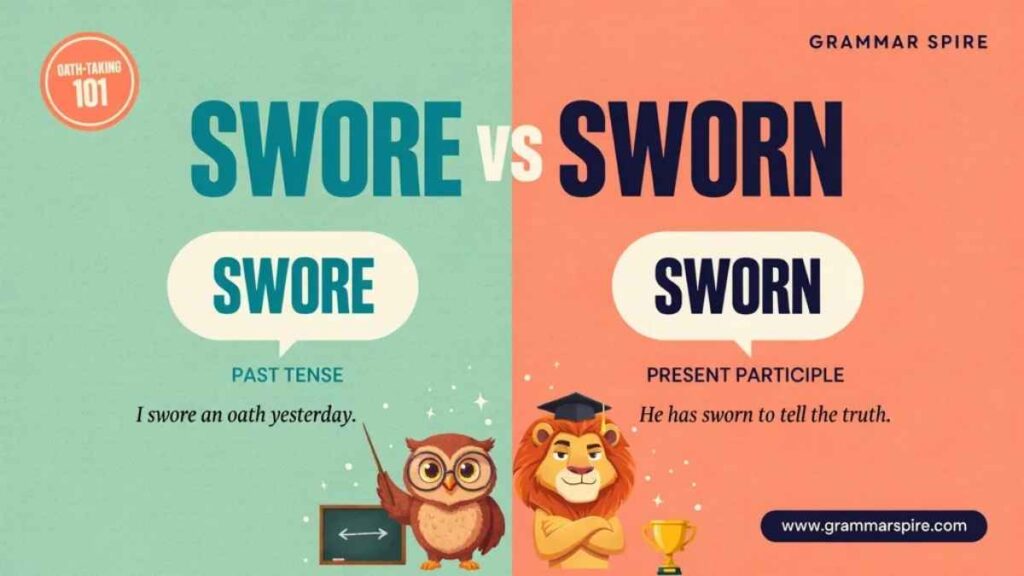
English verbs sometimes behave like they have their own rulebook. Swore and sworn are a classic example. Both come from swear, yet they cannot simply swap places without creating a grammar mistake. The difference may seem tiny, but using the wrong form can make a sentence sound awkward fast. The swore vs sworn question usually comes down to one simple idea: swore is the simple past, while sworn is the past participle. Once you know where each form belongs, phrases such as I swore, I have sworn, and I could have sworn become much easier. This guide explains their meanings, uses, common mistakes, and correct sentence patterns.
| Word | Grammatical form | Typical use | Example |
|---|---|---|---|
| swear | Base form | Present tense and certain verb structures | I swear I am telling the truth. |
| swore | Simple past | A completed action in the past | He swore he had seen it. |
| sworn | Past participle | Perfect tenses and passive constructions | She has sworn to tell the truth. |
| sworn | Adjective | Describes something formally promised or strongly opposed | They are sworn enemies. |
Learn the difference between confusing more English words step by step
Noisey or Noisy Which Spelling Is Correct?
The Quick Answer
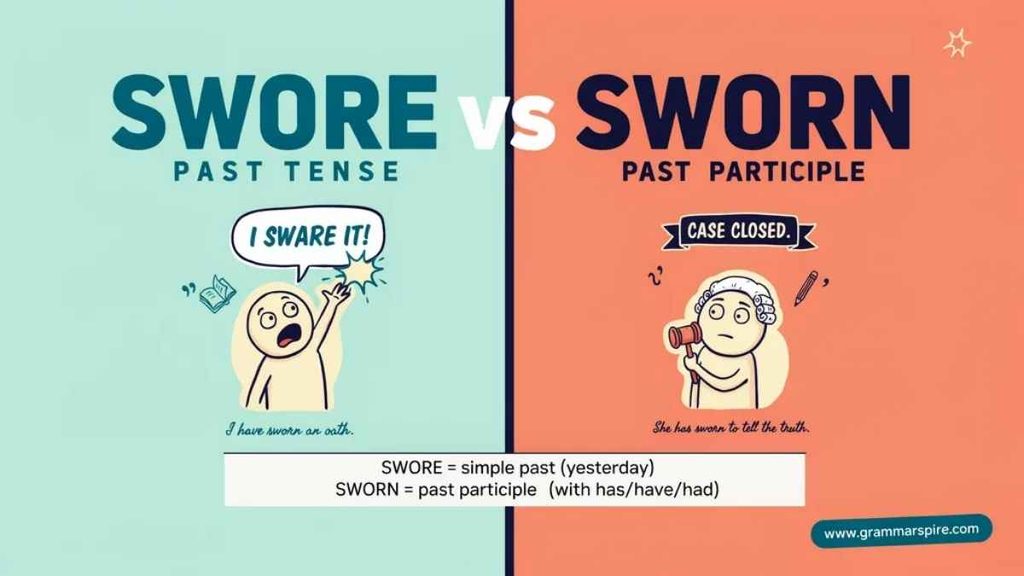
Swore and sworn are both correct, but they have different grammatical jobs.
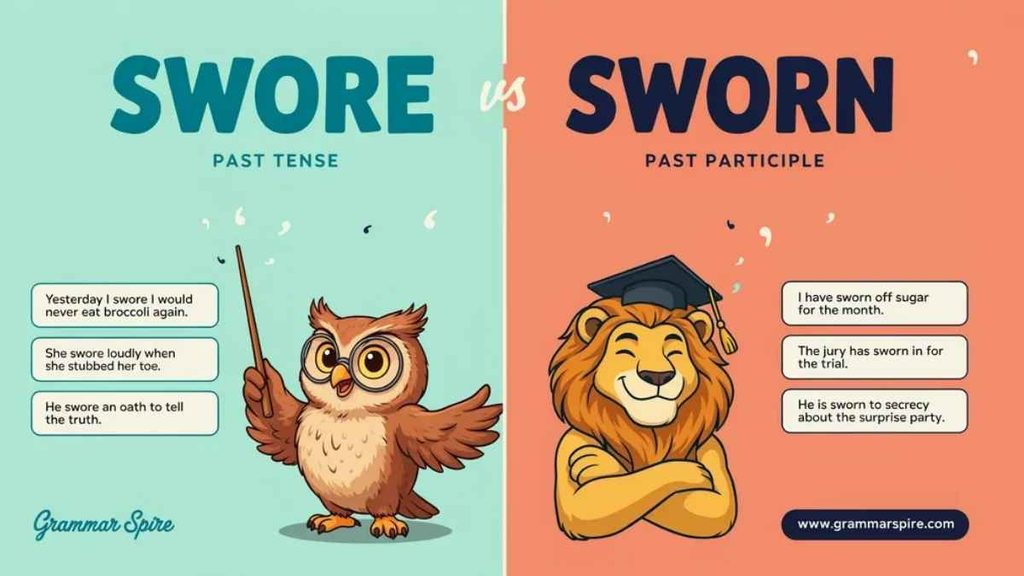
Swore is the simple past tense of swear.
She swore she would return.
Sworn is the past participle of swear.
She has sworn to keep the secret.
When you use have, has, or had with the verb swear, you normally need sworn rather than swore.
I have sworn to tell the truth.
I had sworn never to return.
Likewise, after modal verbs in perfect constructions, such as could have, should have, would have, or might have, use sworn.
I could have sworn I left my keys here.
Therefore, the answer to swore or sworn which is correct depends on the sentence. Both are correct forms of the same irregular verb.
Swear, Swore, Sworn The Three Verb Forms
Swear is an irregular verb. Unlike regular verbs, it does not form its past tense simply by adding ed.
Its principal forms are:
| Form | Word | Example |
|---|---|---|
| Base form | swear | I swear I am telling the truth. |
| Simple past | swore | He swore he had locked the door. |
| Past participle | sworn | She has sworn to keep her promise. |
These forms appear in different grammatical structures. Once you understand that pattern, the difference between swore and sworn becomes much easier to remember.
What Is the Past Tense of Swear?
The simple past tense of swear is swore.
Use swore when you are talking about an action, promise, statement, or oath that happened in the past.
For example:
He swore that he had never met her.
She swore to keep the secret.
They swore allegiance to the new leader.
I swore I had put the document on the desk.
In each sentence, swore describes something that happened in the past.
What Is the Past Participle of Swear?
The past participle of swear is sworn.
Sworn usually appears with an auxiliary verb such as have, has, or had.
For example:
I have sworn to tell the truth.
She has sworn that she will never return.
He had sworn an oath before the ceremony began.
They have sworn allegiance to the country.
The basic structure is:
have, has, or had + sworn
Not:
have, has, or had + swore
Therefore, I have swore is not the standard grammatical form. I have sworn is correct.
Swear Verb Forms at a Glance
The complete set of common forms is easy to organize:
| Verb form | Word | Example |
|---|---|---|
| Base form | swear | I swear I am telling the truth. |
| Third-person singular | swears | She swears she is innocent. |
| Simple past | swore | He swore he was telling the truth. |
| Past participle | sworn | He has sworn to tell the truth. |
| Present participle | swearing | They are swearing an oath. |
The most important forms for the swore vs sworn question are swore and sworn.
Learn the difference between confusing more English words step by step
Receipt or Reciept Which Spelling Is Correct?
What Does Swore Mean?
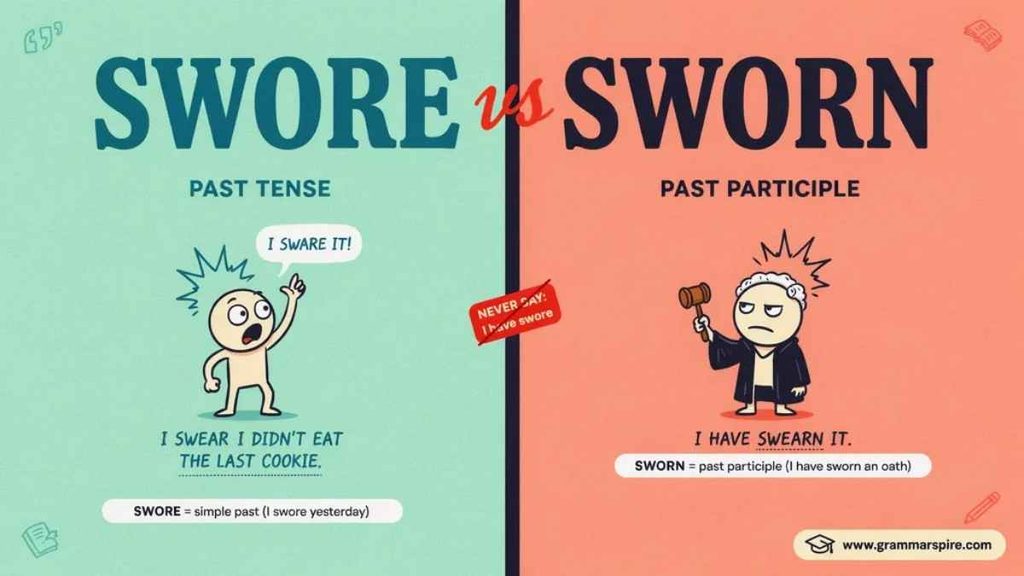
Swore is the simple past form of swear.
The verb swear has several meanings. It can describe making a serious promise, making a strong statement, taking an oath, or using offensive language.
For example:
She swore to protect her family.
He swore that he had seen the man before.
I swore I left my phone on the table.
He swore an oath of loyalty.
The meaning depends on the context.
In everyday English, swear can also refer to using profanity or offensive language.
He swore when he realized he had missed the train.
The past form in that sentence is swore.
Swore as a Serious Promise
Swore can describe a serious promise made in the past.
She swore to keep the information private.
He swore never to reveal the secret.
They swore to protect the village.
Here, swore describes a promise or commitment that happened in the past.
Swore as a Strong Statement
Swore can also mean that someone strongly insisted something was true.
He swore that he had locked the door.
She swore she had never met him.
I swore I saw someone standing near the window.
In these sentences, swear does not necessarily refer to profanity. Instead, it expresses strong certainty or insistence.
Swore as Offensive Language
Swear can also mean to use profanity.
He swore when he dropped the box on his foot.
She swore after discovering that the computer had crashed.
Here, swore refers to a past use of offensive language.
Learn the difference between confusing more English words step by step
Verbage or Verbiage Which Spelling Is Correct?
What Does Sworn Mean?
Sworn is the past participle of swear. It can also function as an adjective.
As a verb form, sworn commonly appears with auxiliary verbs.
She has sworn to keep the secret.
He had sworn that he was innocent.
As an adjective, sworn can describe something formally promised or someone strongly committed to a position.
For example:
1.sworn statement
2.sworn testimony
3.sworn witness
4.sworn enemies
This is why sworn can sometimes appear without a helping verb. In those cases, it may function as an adjective rather than as the main verb in a perfect construction.
Swore vs Sworn Difference in English Grammar
The easiest way to understand the difference is to focus on their grammatical roles.
Swore Simple Past
Use swore when you describe something that happened in the past.
She swore she was telling the truth.
He swore to keep the secret.
They swore allegiance to their country.
Sworn Past Participle
Use sworn when the sentence requires a past participle.
She has sworn to keep the secret.
He had sworn an oath.
I could have sworn I saw him.
Sworn also appears in passive constructions.
He was sworn in yesterday.
When to Use Swore
Use swore when you need the simple past form of swear.
He swore he was telling the truth.
She swore to keep the information private.
They swore that they had never met.
I swore I heard someone knock.
He swore an oath before the court.
If the action happened in the past and you are not using a perfect construction, swore will often be the correct choice.
When to Use Sworn
Use sworn when you need the past participle of swear.
This commonly happens after have, has, or had.
I have sworn to keep the secret.
She has sworn that she will return.
He had sworn never to speak about it.
Sworn also appears in passive structures.
The witness was sworn in.
She was sworn in before the hearing.
In addition, sworn can function as an adjective.
They are sworn enemies.
He submitted a sworn statement.
She gave sworn testimony.
Learn the difference between confusing more English words step by step
Advise or Advice which spelling is correct?
A Simple Comparison
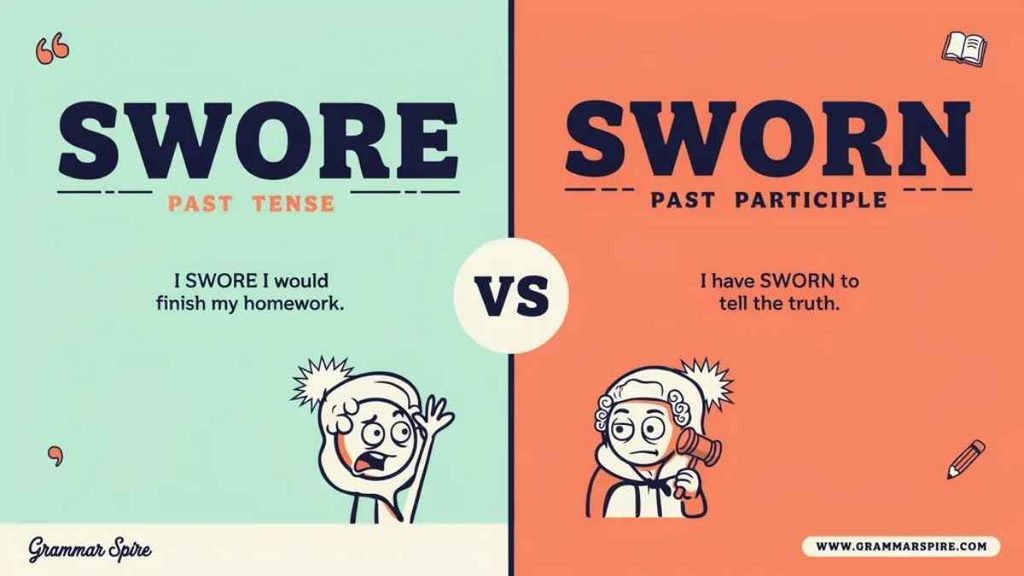
The following examples show how the two forms work in different grammatical structures.
| Sentence | Correct form | Reason |
|---|---|---|
| She swore she was telling the truth. | swore | Simple past |
| She has sworn to tell the truth. | sworn | Present perfect |
| He had sworn an oath. | sworn | Past perfect |
| I could have sworn I saw him. | sworn | Modal perfect |
| The official was sworn in. | sworn | Passive construction |
| They are sworn enemies. | sworn | Adjective |
The surrounding words usually reveal which form you need.
I Could Have Swore or Sworn?
This is one of the most common points of confusion.
The standard form is:
I could have sworn.
Not:
I could have swore.
The reason is grammatical. After a modal verb such as could, when you form a perfect construction with have, you need the past participle.
The pattern is:
could + have + past participle
Since sworn is the past participle of swear, the correct sentence is:
I could have sworn.
Why Is I Could Have Sworn Correct?
Compare these structures:
1.I swore.
2.I have sworn.
3.I could have sworn.
Each sentence uses a different verb form.
Swore works as the simple past.
Sworn works as the past participle.
The word have signals the perfect construction, so sworn follows it.
That is why I could have swore is not the standard form in formal or edited English.
What Does I Could Have Sworn Mean?
I could have sworn means that you felt very certain something was true or had happened, but you later discovered that your memory or belief might have been wrong.
For example:
I could have sworn I left my wallet on the kitchen counter.
The speaker was confident about the wallet’s location, but the wallet is not there.
Another example:
I could have sworn she told me about the meeting.
The speaker strongly remembers being told, but later realizes that the memory may be mistaken.
The expression is common in everyday English because memory can sometimes sound more confident than it deserves.
Learn the difference between confusing more English words step by step
Benefiting or Benefitting Which Spelling Is Correct?
Could Have Sworn or Swore The Correct Choice
When you use could have, the correct form is sworn.
Correct:
I could have sworn I saw him.
Incorrect in standard English:
I could have swore I saw him.
The same pattern applies to other modal perfect constructions.
1.I should have sworn.
2.I would have sworn.
3.I might have sworn.
4.I could have sworn.
The structure remains:
modal + have + past participle
Because sworn is the past participle, it follows have.
Sworn With Have, Has, and Had
Have, has, and had are strong clues that you need the past participle sworn.
Have Sworn
Use have sworn with I, you, we, and they.
I have sworn to tell the truth.
They have sworn to protect the agreement.
Has Sworn
Use has sworn with he, she, and it.
She has sworn to keep the promise.
He has sworn that he is innocent.
Had Sworn
Use had sworn for the past perfect.
He had sworn never to return.
They had sworn an oath before the meeting began.
Learn the difference between confusing more English words step by step
In Tact or Intact Which Spelling Is Correct?
Swore vs Sworn in Different Tenses
Understanding the larger tense system makes the difference even clearer.
Present Tense
Use swear or swears.
I swear I am telling the truth.
She swears she knows the answer.
Simple Past
Use swore.
He swore he was innocent.
They swore they had seen nothing.
Present Perfect
Use have or has + sworn.
I have sworn to keep the secret.
She has sworn to tell the truth.
Past Perfect
Use had + sworn.
He had sworn never to return.
They had sworn an oath before the ceremony.
Modal Perfect
Use a modal verb + have + sworn.
I could have sworn I locked the door.
She should have sworn to tell the truth.
He would have sworn that he saw the man.
The pattern remains consistent:
swear → swore → sworn
Common Mistakes With Swore and Sworn
Many mistakes happen because swore and sworn belong to the same verb but perform different grammatical jobs.
I Have Swore vs I Have Sworn
Incorrect:
I have swore to tell the truth.
Correct:
I have sworn to tell the truth.
Have requires the past participle, so sworn is the correct form.
I Had Swore vs I Had Sworn
Incorrect:
She had swore she would never return.
Correct:
She had sworn she would never return.
Had also requires the past participle.
I Could Have Swore vs I Could Have Sworn
Incorrect:
I could have swore I put it here.
Correct:
I could have sworn I put it here.
The structure could have + past participle requires sworn.
He Was Swore In vs He Was Sworn In
Incorrect:
He was swore in yesterday.
Correct:
He was sworn in yesterday.
The passive construction requires the past participle sworn.
Learn the difference between confusing more English words step by step
Bind or Bound which one is correct?
Sworn In A Special Use You Should Know
Sworn in is a common expression in official, political, and legal contexts.
It means that someone has formally taken an oath before beginning an official role.
For example:
The new mayor was sworn in on Monday.
The judge was sworn in before the ceremony began.
The officers were sworn in during the afternoon.
Notice that sworn remains unchanged because it is the past participle used in the passive construction.
Sworn as an Adjective
Sworn can also work as an adjective.
This becomes especially clear in expressions such as sworn enemies.
Sworn Statement
A sworn statement is a formal statement that someone declares to be true.
For example:
She submitted a sworn statement to the court.
The word sworn emphasizes the formal nature of the declaration.
Sworn Testimony
Sworn testimony refers to evidence or statements given under oath.
For example:
The witness provided sworn testimony during the hearing.
This expression is especially common in legal contexts.
Sworn Witness
A sworn witness is someone who has formally taken an oath before giving testimony.
For example:
The sworn witness answered the questions carefully.
Sworn Enemies Meaning
The phrase sworn enemies refers to people or groups who are deeply and consistently opposed to each other.
For example:
The two families became sworn enemies.
Sworn emphasizes the seriousness and lasting nature of their opposition.
Sworn Oath and Other Formal Expressions
It often appears in formal expressions connected with promises, truth, law, and official duties.
A sworn oath refers to a formal promise made under oath.
For example:
He took a sworn oath to protect the constitution.
However, in many situations, oath alone or swore an oath sounds more natural.
She swore an oath to protect the people.
Other common expressions include sworn statement, sworn testimony, sworn witness, and sworn enemies.
These expressions are useful because they show how sworn can function as an adjective as well as a verb form.
Swore Pronunciation and Sworn Pronunciation
They have different pronunciations.
In American English, swore is generally pronounced with a sound similar to swor.
Sworn has a similar vowel sound but ends with an n sound.
Compare:
swear
swore
sworn
The spelling and pronunciation change as the verb moves through its principal forms.
Learn the difference between confusing more English words step by step
Beat or Beated Which spelling Is Correct?
Is Swore Correct?
Yes, swore is correct when you need the simple past form of swear.
For example:
She swore she was telling the truth.
He swore to keep the secret.
I swore I had locked the door.
However, swore should not normally replace sworn after have, has, or had.
I have sworn is correct.
I have swore is not standard English.
Is Sworn Correct?
Yes, sworn is correct when you need the past participle of swear.
It is also correct as an adjective.
Examples include:
I have sworn to tell the truth.
He had sworn an oath.
She was sworn in yesterday.
They are sworn enemies.
Therefore, sworn has several important uses in English grammar.
Swore or Sworn Which Is Correct?
Both swore and sworn are correct. The right choice depends on the sentence structure.
Use swore for the simple past:
She swore she was telling the truth.
Use sworn after have, has, or had:
She has sworn she was telling the truth.
Use sworn after a modal + have:
I could have sworn I saw him.
Use sworn in passive constructions:
He was sworn in yesterday.
Use sworn as an adjective:
They are sworn enemies.
So, when someone asks whether swore or sworn is correct, the answer depends on how the word functions in the sentence.
A Simple Memory Trick for Swore and Sworn
Think of the pattern as a three-step ladder:
swear → swore → sworn
Then remember one simple rule:
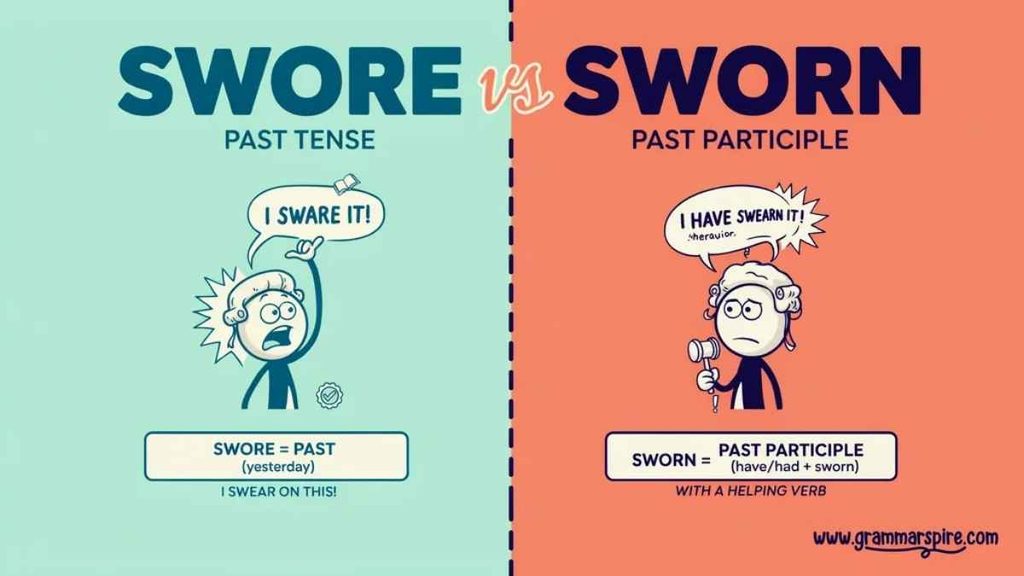
Swore = simple past.
Sworn = past participle.
1.If you see have, has, or had, think sworn.
2.If you see could have, should have, would have, or might have, think sworn.
3.If you are simply describing something that happened in the past, swore is usually the form you need.
For example:
1.I swore.
2.I have sworn.
3.I could have sworn.
That small pattern solves most swore vs sworn problems.
Learn the difference between confusing more English words step by step
Feed vs Fed What spelling is correct?
How to Use Swore vs Sworn Correctly
The easiest approach is to look at the words surrounding the verb.
Use swore when you are describing a completed past action.
He swore he was innocent.
Use sworn after have, has, or had.
He has sworn he is innocent.
Use sworn after modal + have.
He could have sworn he was innocent.
Use sworn in passive constructions.
He was sworn in yesterday.
Use sworn as an adjective.
They are sworn enemies.
Once you identify the grammatical structure, choosing between swore and sworn becomes much easier.
Here’s a trusted source for clear more words Comparison:
Grammar Update
Practice Session of swore vs sworn
Now it’s time to test your understanding of swear, swore, and sworn. Complete each sentence with the form that fits naturally. Pay attention to helping verbs such as have, has, and had, as well as expressions such as could have. These clues can help you identify whether the sentence needs the simple past or past participle.
Fill in the Blanks
- I ______ I left my wallet on the kitchen counter.
- She has ______ to keep the information private.
- He ______ that he had never seen the document before.
- They had ______ an oath before taking their positions.
- I could have ______ I locked the front door.
- She ______ that she was telling the truth.
- He has ______ to return the borrowed money.
- The soldiers ______ allegiance to their country.
- The new mayor was ______ in during Monday’s ceremony.
- I ______ I heard someone knock at the door.
- She had ______ never to discuss the matter again.
- He ______ that he was completely innocent.
- We have ______ to support the agreement.
- I could have ______ that was your car in the parking lot.
- She ______ an oath before the judge.
- They have ______ to tell the truth.
- He had ______ that he would never break his promise.
- I ______ I put the important papers in my briefcase.
- She was ______ in as the new director.
- He ______ that he knew nothing about the incident.
- They could have ______ they saw the same person.
- She has ______ to keep her promise.
- I ______ I had already sent the email.
- He had ______ allegiance to the organization for many years.
- The witness gave ______ testimony during the hearing.
- She ______ she would never forget that day.
- I have ______ to tell the truth.
- The two families have been ______ enemies for generations.
- He could have ______ he saw someone standing outside.
- She ______ that she had never spoken to him.
Answers
- swore
- sworn
- swore
- sworn
- sworn
- swore
- sworn
- swore
- sworn
- swore
- sworn
- swore
- sworn
- sworn
- swore
- sworn
- sworn
- swore
- sworn
- swore
- sworn
- sworn
- swore
- sworn
- sworn
- swore
- sworn
- sworn
- sworn
- swore
Learn the difference between confusing more English words step by step
Smoky or Smokey Which Spelling Is Correct?
FAQs About Swore vs Sworn
Which is correct, sworn or swore?
Both are correct, but they have different grammatical roles. Swore is the simple past form of swear, while sworn is the past participle. For example, He swore he was telling the truth, but He has sworn to keep the secret.
Is it I could have swore or sworn?
The standard form is I could have sworn. The construction could have requires a past participle, and sworn is the past participle of swear. I could have swore may appear in casual speech, but it is not standard formal English.
Is there a word swore?
Yes. Swore is a standard English word and the simple past form of swear. It can refer to making a promise, taking an oath, making a strong claim, or using profanity.
What does swore mean?
Swore means made a serious promise, declared something strongly, took an oath, or used offensive language, depending on the context. It is the simple past form of swear.
Which is correct I swear or I swore?
Both are grammatically correct, but they refer to different times. I swear refers to the present, while I swore refers to something that happened in the past.
What does I could have sworn mean?
I could have sworn means you were strongly convinced that something was true or had happened, even though you later realized that your memory might have been mistaken.
Is it I swear to God or I swear on God?
I swear to God is the established expression in standard English. It is used to emphasize the truth of a statement or the seriousness of a promise. I swear on God occurs in informal speech but is less conventional.
Is it grammatically correct to say sweated?
Yes. Sweated is the standard past tense and past participle of sweat.
For example:
I sweated during the workout.
She has sweated heavily in the heat.
What are the three forms of swear?
The three principal forms are swear, swore, and sworn. Swear is the base form, swore is the simple past, and sworn is the past participle.
What does sworn mean?
Sworn is the past participle of swear. It can also function as an adjective in expressions such as sworn statement, sworn testimony, and sworn enemies.
What does swore mean in one word?
In many contexts, swore can be summarized as vowed. Depending on the sentence, it can also mean promised, declared, or cursed.
Is there a word sworn?
Yes. Sworn is a standard English word. It is the past participle of swear and can also function as an adjective.
Is I saw grammatically correct?
Yes. I saw is grammatically correct. Saw is the simple past form of see.
For example:
I saw the movie yesterday.
However, after have, has, or had, use seen rather than saw.
I have seen the movie.
What is the past tense of swear?
The simple past tense of swear is swore.
For example:
She swore she was telling the truth.
The past participle is sworn, as in She has sworn to keep the secret.
AEO Quick Answers About Swore and Sworn
What is the difference between swore and sworn?
Swore is the simple past form of swear, while sworn is the past participle. Use swore for a completed past action and sworn after have, has, or had, in perfect constructions, and in passive expressions.
Is sworn the past tense of swear?
No. Sworn is the past participle. Swore is the simple past form.
Is swore the past participle of swear?
No. Swore is the simple past form. Sworn is the past participle.
Can you say I have swore?
No, not in standard English. Use I have sworn because have must be followed by the past participle.
Why is I could have sworn correct?
Could have creates a perfect construction that requires a past participle. Since sworn is the past participle of swear, I could have sworn is grammatically correct.
When should you use swore?
Use swore when describing a completed action, promise, oath, or strong statement in the past.
Example: He swore he had told the truth.
When should you use sworn?
Use sworn after have, has, or had, after modal + have constructions, in passive expressions such as sworn in, and as an adjective.
What are the verb forms of swear?
The principal forms are swear, swore, and sworn. Other common forms include swears for the third-person singular and swearing for the present participle.
Is swear an irregular verb?
Yes. Swear is an irregular verb because its past forms change rather than simply taking the regular -ed ending.
What does sworn in mean?
Sworn in means formally given an official position after taking an oath.
Example: The new mayor was sworn in on Monday.
What does sworn enemies mean?
Sworn enemies are people or groups with a strong and lasting opposition toward each other.
What does sworn statement mean?
A sworn statement is a formal declaration that a person confirms to be truthful, often for legal or official purposes.
What does sworn testimony mean?
Sworn testimony is a statement or evidence given under oath, particularly during a legal proceeding.
Can swore and sworn be used interchangeably?
No. They have different grammatical functions. Swore is the simple past form, while sworn is the past participle and can also function as an adjective.
Is I could have swore acceptable?
It may occur in casual or nonstandard speech, but it is not the preferred form in formal or edited English. Use I could have sworn instead.
What is the easiest way to remember swore and sworn?
Remember the sequence swear, swore, sworn. Think of swore as the simple past form and sworn as the form used with have, has, or had.
Final Takeaway of swore vs sworn
Swore and sworn may seem like grammar troublemakers, but their roles are surprisingly easy to separate. Swore is the simple past form of swear, so use it for a completed action in the past. Sworn is the past participle, so it usually follows have, has, or had. It also appears in expressions such as sworn in, sworn testimony, and sworn enemies.
The easiest way to remember the pattern is simple: swear, swore, sworn. Once you have that sequence down, sentences such as I swore I was right and I could have sworn I locked the door become much easier. English may have plenty of tricky verbs, but this one doesn’t need to keep you guessing.

Ella AJS
Ella AJS is an experienced blogger and language enthusiast at Grammar Spire, dedicated to making English grammar simple, practical, and easy to understand. She specializes in word comparisons, meanings, usage, and common language confusions. Through clear explanations and engaging examples, Ella helps students, writers, and English learners improve their vocabulary and communicate with greater confidence and accuracy.