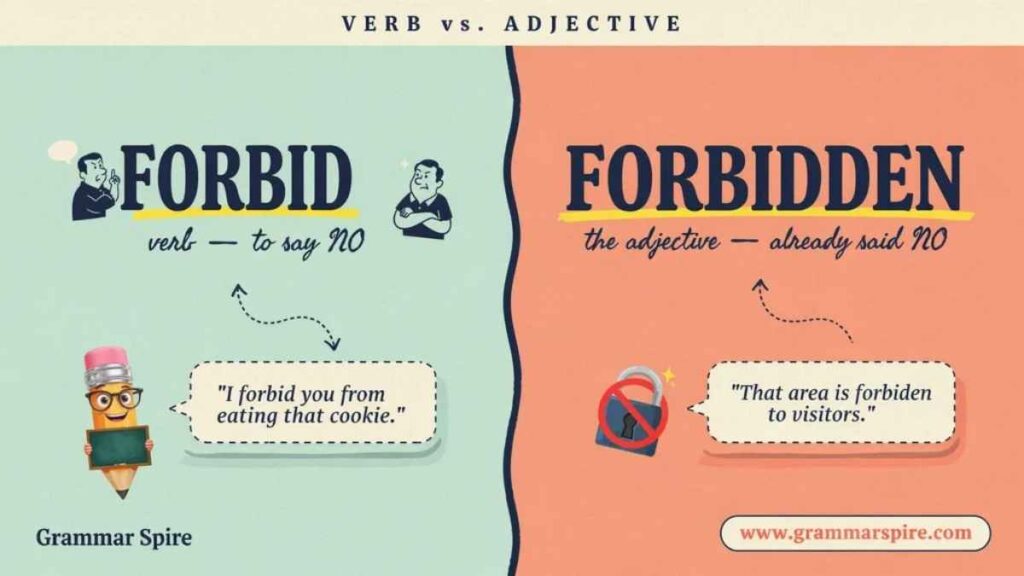
English grammar can turn a simple verb into a surprisingly tricky puzzle. Forbid or forbidden often creates confusion because both forms express the idea of stopping or not allowing something. However, they serve different grammatical purposes. Choosing the wrong form can make a sentence sound awkward, even when your meaning seems perfectly clear. The good news is that the difference becomes easy once you understand how each form works. In this guide, you’ll learn when to use forbid, forbids, forbade, and forbidden, along with clear examples and practical rules. By the end, this grammar puzzle won’t feel quite so forbidden, and your sentences will sound much more confident.
| Word | Grammatical role | Main use | Example |
|---|---|---|---|
| Forbid | Base verb | Present tense and after modal verbs | The rules forbid smoking. |
| Forbids | Present tense verb | Used with he, she, it, or a singular noun | The law forbids parking here. |
| Forbade | Simple past | Describes a completed past action | The school forbade cell phones. |
| Forbidden | Past participle | Used with have, has, or had | The school has forbidden cell phones. |
| Forbidden | Adjective | Describes something that isn’t allowed | Cell phones are forbidden. |
| Forbidding | Present participle | Shows an ongoing action | The policy is forbidding certain activities. |
Therefore, the answer to “Is it forbid or forbidden?” depends on the structure of your sentence. You cannot simply choose one because it sounds more natural. Instead, look at the tense, the helping verb, and the grammatical role of the word.
Once those clues become familiar, the difference becomes much easier. This guide explains the forbid or forbidden meaning, the correct grammar behind each form, common sentence patterns, typical mistakes, and the difference between forbid, forbade, and forbidden.
Learn the difference between confusing more English words step by step
Advise or Advice which spelling is correct?
Forbid or Forbidden Meaning
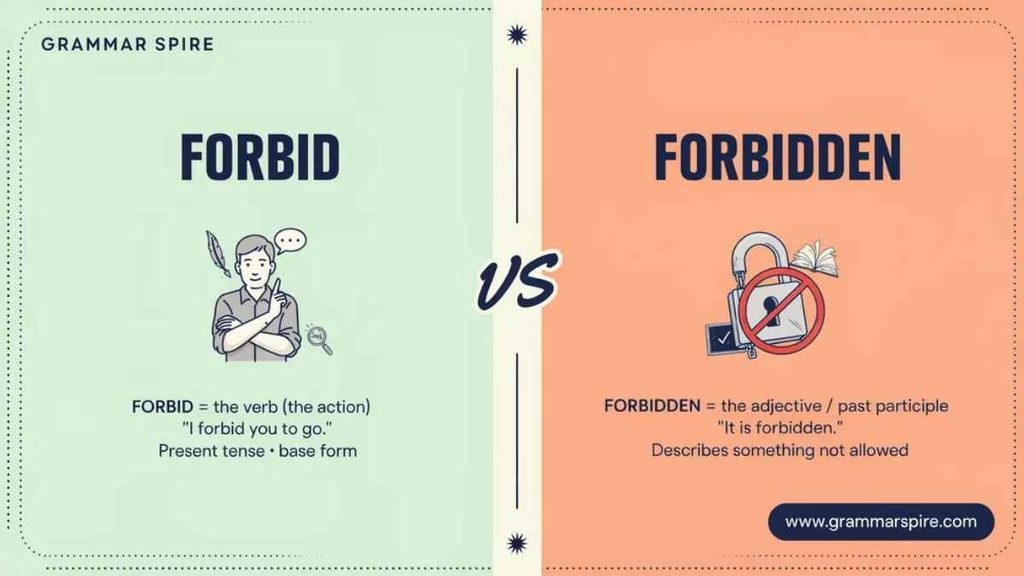
At its core, forbid means to say that something isn’t allowed. It can also mean to order someone not to do something. Therefore, the word focuses on the act of creating or enforcing a restriction.
For example, consider this sentence:
The rules forbid smoking.
Here, the rules actively prohibit the action.
Now compare it with:
Smoking is forbidden.
In this sentence, the focus shifts from the rules to the activity. The sentence tells you that smoking isn’t allowed.
Consequently, both sentences communicate a similar idea, but their grammatical structures differ.
Forbid Definition
The forbid definition is to refuse to allow something or to order someone not to do something.
For example:
The school forbids students from using phones during exams.
The law forbids the sale of certain products.
My parents forbid me to drive their car.
In each example, the subject imposes a restriction. As a result, forbid works naturally when you want to identify the person, organization, rule, or authority responsible for the prohibition.
Moreover, forbid commonly appears when discussing rules, laws, commands, policies, and personal restrictions.
Forbidden Definition
The forbidden definition is something that isn’t allowed or permitted.
For example:
Smoking is forbidden inside the building.
Entry is forbidden after 10 p.m.
Photography is forbidden in this section.
Unlike forbid, forbidden often describes the condition of something rather than the action of imposing the restriction. Therefore, you will frequently see it on signs, in regulations, and in formal notices.
For instance, a sign might simply say “Entry forbidden.” The message doesn’t need to explain who created the rule. The important point is that entry isn’t permitted.
Forbid vs Forbidden Grammar
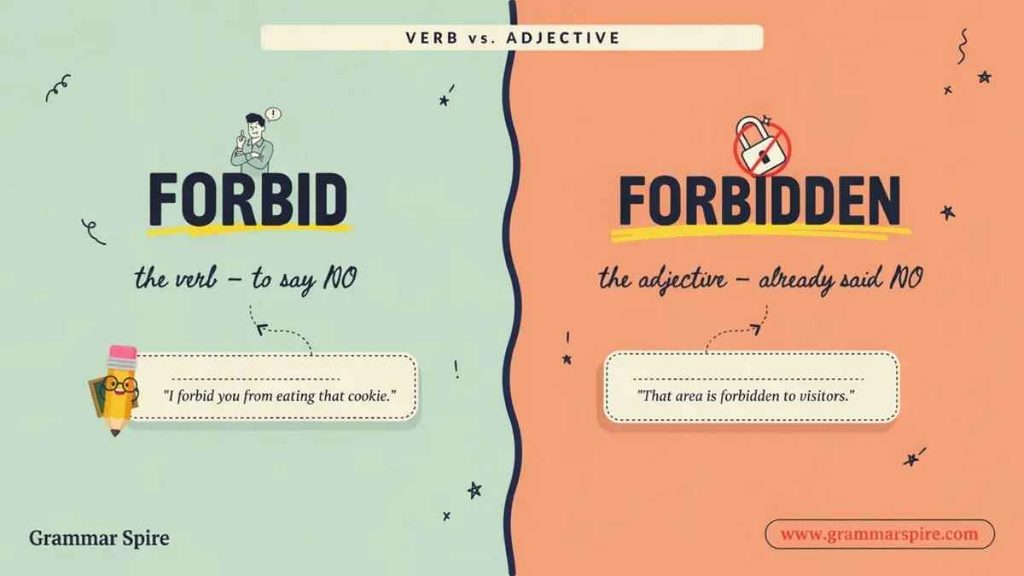
The main difference between forbid and forbidden comes from their grammatical forms.
First, forbid is the base form of the verb. You can use it in the present tense with I, you, we, and they. You can also use it after modal verbs such as can, may, might, should, and will.
For example:
I forbid this behavior.
They forbid outside food.
The policy may forbid visitors from entering.
The new rules will forbid parking here.
However, when the subject is he, she, it, or another singular noun in the simple present, you normally use forbids.
The law forbids this activity.
The school forbids cheating.
The company forbids employees from sharing confidential information.
On the other hand, forbidden serves as the past participle of forbid. It also works as an adjective. Therefore, its grammatical role depends on the sentence.
For perfect tenses, forbidden follows forms of have:
They have forbidden smoking.
She has forbidden the practice.
The authorities had forbidden access.
Similarly, forbidden appears in passive constructions:
Smoking is forbidden.
Visitors are forbidden to enter.
Parking was forbidden during the event.
As a result, the words may look related, but they cannot simply replace one another.
Learn the difference between confusing more English words step by step
Benefiting or Benefitting Which Spelling Is Correct?
Forbid as the Base Verb
Forbid is the basic form of the verb. It expresses the idea of prohibiting an action or refusing permission.
For example:
The school rules forbid smoking.
The company forbids outside food.
The law forbids the practice.
Because forbid is the base form, it also follows modal verbs.
The new policy may forbid outside food.
The law will forbid the activity.
The organization can forbid unauthorized access.
Notice the pattern. After a modal verb, the main verb remains in its base form. Therefore, you say “may forbid,” not “may forbidden.”
Forbid in the Present Tense
In the simple present, use forbid with I, you, we, and they.
I forbid this behavior.
We forbid smoking inside the building.
They forbid outside food.
However, use forbids with he, she, it, or a singular noun.
The teacher forbids talking during the exam.
The law forbids parking here.
The company forbids employees from sharing confidential information.
This distinction is important because the third person singular form requires the final -s.
Forbid With Rules and Authority
Forbid often appears when a person or organization has the authority to establish a restriction.
For example, the following sentences all identify a source of authority:
The manager forbids employees from using personal devices during the inspection.
The school forbids students from leaving campus without permission.
The law forbids the sale of certain products.
The museum forbids visitors from touching the artwork.
In each case, the subject actively creates or enforces the restriction.
Therefore, a useful sentence pattern is:
subject + forbid/forbids + noun or activity
Another common structure is:
subject + forbid/forbids + person + from + activity
These patterns make forbid particularly useful when you want to explain who established a rule.
Learn the difference between confusing more English words step by step
In Tact or Intact Which Spelling Is Correct?
Forbidden as a Past Participle
Forbidden is the past participle form of forbid.
However, it is important not to confuse the past participle with the simple past. The three principal forms are:
forbid → forbade → forbidden
Here, forbade represents the simple past, while forbidden represents the past participle.
For example:
1.They forbade smoking.
2.They have forbidden smoking.
3.They had forbidden smoking.
The first sentence uses the simple past. The second and third use the past participle because have and had introduce perfect constructions.
Perfect Tense With Forbidden
Perfect tenses require a form of have followed by a past participle. Consequently, you use forbidden rather than forbid.
For example:
The company has forbidden the practice.
They have forbidden smoking.
The authorities had forbidden access.
The organization will have forbidden the activity by next year.
Therefore, if you’re deciding between “have forbid” and “have forbidden,” the correct form is “have forbidden.”
Correct:
The authorities have forbidden entry.
Incorrect:
The authorities have forbid entry.
The same rule applies to has and had.
Correct:
She has forbidden the activity.
They had forbidden access.
Once you recognize the helping verb, the correct form becomes much easier to identify.
Is Forbidden the Past Tense of Forbid?
No. Forbidden is not the simple past of forbid.
Instead, the standard simple past is forbade.
The past participle is forbidden.
Therefore, the pattern is:
Present: The rules forbid smoking.
Past: The rules forbade smoking.
Present perfect: The rules have forbidden smoking.
This distinction answers one of the most common questions about forbid verb forms.
Forbid vs Forbade
Forbid and forbade differ mainly in tense.
Use forbid for a present situation or as the base form:
The policy forbids outside food.
Use forbade for a completed action in the past:
The previous policy forbade outside food.
For example, imagine that a school had a strict phone rule last year.
The school forbade students from using phones during exams.
If the same restriction still exists today, you would say:
The school forbids students from using phones during exams.
Thus, the time of the action determines the form.
Forbade vs Forbid
The same principle works in reverse.
Forbade describes a completed past action:
The teacher forbade talking during yesterday’s test.
Forbid describes a current rule:
The teacher forbids talking during every test.
Furthermore, you can use forbid after a modal:
The teacher may forbid talking during the next test.
So, the choice isn’t based on how strong the rule sounds. Instead, grammar and sentence structure determine the correct form.
Learn the difference between confusing more English words step by step
Bind or Bound which one is correct?
Forbid Verb Forms
Learning all the main forms together makes the irregular pattern much easier to remember.
| Form | Word | Example |
|---|---|---|
| Base form | forbid | Rules forbid smoking. |
| Third person singular | forbids | The law forbids smoking. |
| Simple past | forbade | The law forbade smoking. |
| Past participle | forbidden | The law has forbidden smoking. |
| Present participle | forbidding | The rule is forbidding certain activities. |
The most important sequence is:
forbid → forbade → forbidden
Forbid is an irregular verb because its past form doesn’t follow the regular -ed pattern.
Is Forbid an Irregular Verb?
Yes, forbid is an irregular verb.
Unlike a regular verb such as “walk,” which becomes “walked” in the past, forbid changes internally:
forbid → forbade → forbidden
This pattern resembles other irregular verbs such as:
go → went → gone
write → wrote → written
see → saw → seen
Therefore, memorizing the complete pattern is much more useful than memorizing forbidden by itself.
Forbidden as an Adjective
Forbidden can also function as an adjective.
In this role, it describes something that isn’t allowed.
For example:
a forbidden area
forbidden behavior
a forbidden activity
forbidden practice
forbidden access
You can place forbidden before a noun:
The staff entered a forbidden area.
You can also use it after a linking verb:
The activity is forbidden.
This adjectival use explains why forbidden can appear without have, has, or had.
How to Use Forbidden as an Adjective
Use forbidden when you want to describe the status of something.
For example:
Smoking is forbidden.
Parking is forbidden.
Photography is forbidden.
Such behavior is forbidden.
You can also strengthen the meaning with adverbs:
Smoking is strictly forbidden.
Entry is absolutely forbidden.
Certain activities are legally forbidden.
As a result, forbidden appears naturally in rules, signs, policies, and official notices.
Learn the difference between confusing more English words step by step
Beat or Beated Which spelling Is Correct?
use in a Sentence
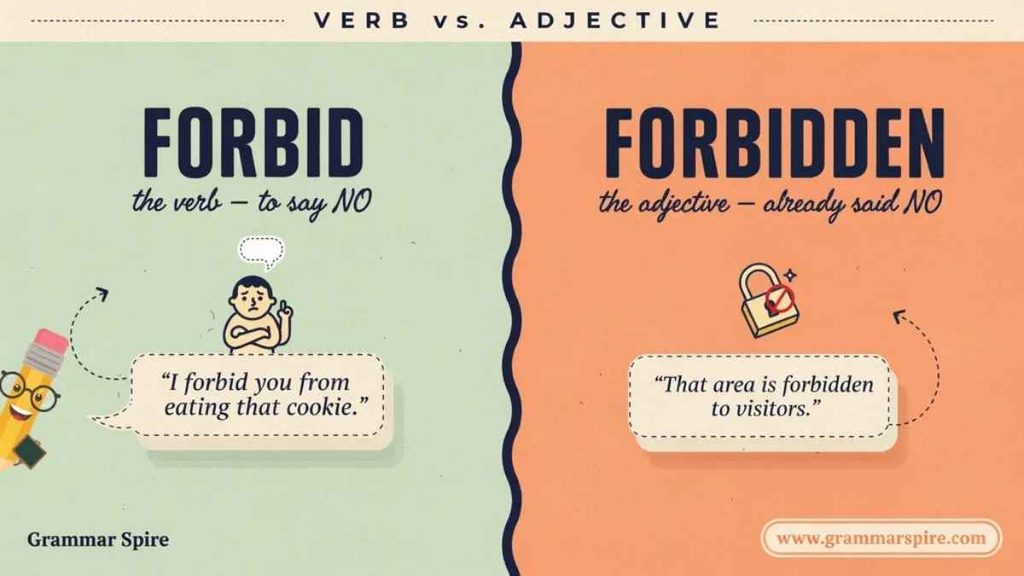
If you’re searching for forbid or forbidden in a sentence examples, compare the structures instead of memorizing isolated sentences.
The rules forbid smoking.
Smoking is forbidden.
The first sentence uses an active verb. The second sentence focuses on the activity that isn’t allowed.
Similarly:
| Sentence | Form | Function |
|---|---|---|
| The rules forbid smoking. | forbid | Present tense active verb |
| The law forbids parking. | forbids | Third-person singular |
| The teacher forbade talking. | forbade | Simple past |
| They have forbidden smoking. | forbidden | Past participle |
| Smoking is forbidden. | forbidden | Passive or adjective |
| They are forbidding certain activities. | forbidding | Present participle |
This comparison makes one point especially clear: forbid and forbidden do not compete for the same grammatical position.
Instead, each form fits a particular structure.
How to Use Forbid in a Sentence
There are several useful structures for forbid. Once you learn these patterns, creating your own sentences becomes much easier.
Forbid Something
The simplest structure places the restricted activity after the verb.
The rules forbid smoking.
The law forbids the practice.
The school forbids cheating.
The company forbids outside food.
The pattern is:
subject + forbid/forbids + noun or activity
This structure works especially well when the rule itself is the focus.
Forbid Someone to Do Something
You can also place a person after forbid and follow it with a to-infinitive.
For example:
I forbid you to enter the room.
Her parents forbid her to stay out late.
The doctor forbade him to exercise.
In these sentences, the person receives the restriction directly.
Forbid Someone From Doing Something
Another common structure uses from followed by an -ing form.
For example:
The rules forbid visitors from entering the area.
The policy forbids employees from sharing confidential information.
The court order forbade him from contacting the witness.
This structure works especially well when you want to emphasize the action that someone cannot perform.
Learn the difference between confusing more English words step by step
Feed vs Fed What spelling is correct?
How to Use Forbidden in a Sentence
Forbidden fits naturally into passive constructions and descriptive phrases.
Forbidden With Is, Are, Was, and Were
You can use forbidden after forms of be.
Smoking is forbidden.
Pets are forbidden.
Entry was forbidden.
Visitors were forbidden to enter.
Here, the sentence focuses on the person or activity affected by the restriction rather than the person who created it.
Forbidden With To
A common structure is:
subject + be + forbidden + to + verb
For example:
Visitors are forbidden to enter.
Students are forbidden to use phones during the exam.
Employees were forbidden to disclose the information.
This construction is especially common in formal rules and instructions.
Forbidden With From
You can also use forbidden from followed by an -ing form.
Visitors are forbidden from entering the building.
Students are forbidden from using phones.
Employees were forbidden from sharing the document.
Both structures are used in standard English. However, the surrounding sentence and intended style should guide your choice.
Active Voice and Passive Voice
The difference between forbid and forbidden becomes even clearer when you compare active and passive sentences.
In an active sentence, the subject performs the action:
The school forbids smoking.
The school acts as the source of the restriction.
In a passive sentence, the focus shifts to the thing affected:
Smoking is forbidden.
The second sentence doesn’t need to identify the school. Instead, it emphasizes the restriction itself.
You can mention the source when it matters:
Smoking is forbidden by school policy.
However, the shorter sentence often sounds more natural.
Therefore, active and passive structures give you two different ways to communicate the same basic idea.
Active:
The rules forbid photography.
Passive:
Photography is forbidden.
The meaning remains similar, but the focus changes.
Forbid vs Prohibited
They share a similar meaning, although they have different grammatical forms.
Forbid is a verb.
Prohibited is the past participle of prohibit, and it also commonly functions as an adjective.
Compare these sentences:
The rules forbid smoking.
Smoking is prohibited.
Both sentences communicate a prohibition.
However, prohibited often sounds more formal. Therefore, it appears frequently in regulations, official policies, legal language, and formal notices.
Forbid, by comparison, works comfortably in both everyday and formal English.
Prohibit vs Forbid
The difference between prohibit and forbid usually concerns tone and grammatical structure rather than the basic idea.
For example:
The school prohibits smoking.
The school forbids smoking.
Both sentences are correct.
However, prohibit often has a more official tone:
The regulations prohibit unauthorized access.
Forbid can sound more personal:
My parents forbid me to stay out late.
Consequently, the best choice depends on the context.
Learn the difference between confusing more English words step by step
Smoky or Smokey Which Spelling Is Correct?
Forbid Synonym and Forbidden Synonym
Several words can express an idea similar to forbid. However, they aren’t always interchangeable.
Prohibit is often formal:
The regulations prohibit unauthorized entry.
Ban can indicate an official or strong restriction:
The city banned smoking in public parks.
Disallow often means that an authority refuses to permit something:
The referee disallowed the goal.
Prevent focuses on stopping something from happening:
The barrier prevented visitors from entering.
Similarly, forbidden has several possible alternatives.
Prohibited can sound formal:
Smoking is prohibited.
Banned can sound direct and strong:
Smoking is banned.
Not allowed sounds conversational:
Smoking isn’t allowed.
Not permitted sounds neutral or formal:
Smoking isn’t permitted.
Restricted can indicate limited access rather than a complete prohibition:
Access is restricted.
Therefore, context remains important when selecting a synonym.
Forbid Me Meaning
The phrase “forbid me” means to refuse to allow someone to do something or to order that person not to do it.
For example:
My parents forbid me to drive their car.
The sentence means that the parents don’t allow the speaker to drive their car.
Another example is:
Don’t forbid me to make my own decision.
Here, the speaker is asking someone not to prevent them from making the decision.
In everyday conversation, however, let often sounds more natural:
My parents won’t let me drive their car.
Forbid sounds stronger and can suggest authority, firmness, or an official restriction.
What Does Forbid Mean?
The question “What does forbid mean?” has a straightforward answer.
Forbid means to refuse permission, prohibit an action, or order someone not to do something.
For example:
The rules forbid smoking.
The law forbids the activity.
The teacher forbade students to leave early.
In each case, someone or something establishes a restriction.
Therefore, forbid is particularly useful when you want to identify the source of a prohibition.
What Does Forbidden Mean?
The question “What does forbidden mean?” is also simple.
Forbidden means not allowed, not permitted, or prohibited.
For example:
Entry is forbidden.
Photography is forbidden.
The activity is strictly forbidden.
Furthermore, forbidden can be either the past participle of forbid or an adjective describing something that isn’t allowed.
The surrounding grammar tells you which role it has.
Learn the difference between confusing more English words step by step
Swore vs Sworn What’s the Difference?
Common Mistakes
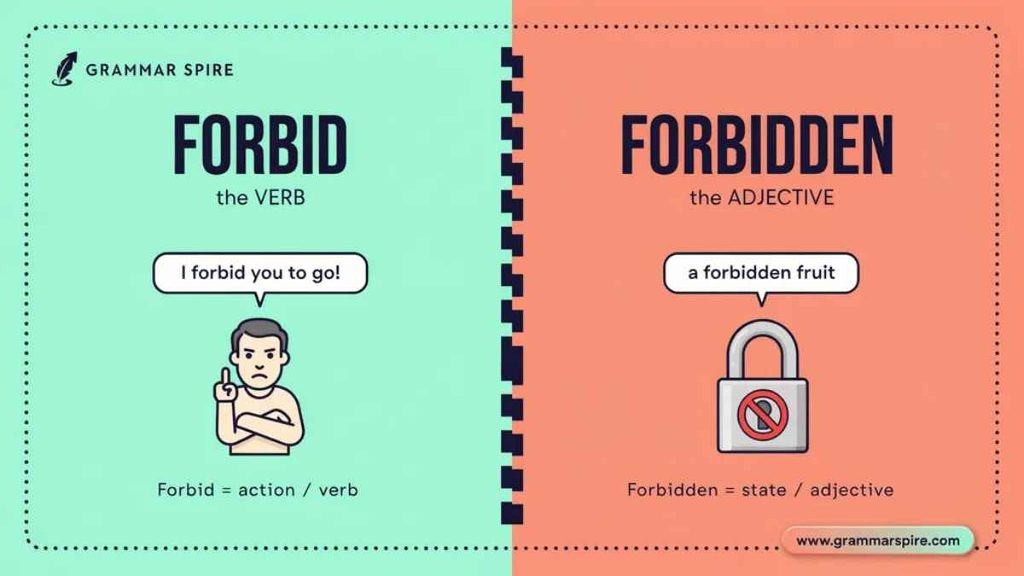
Several mistakes appear repeatedly with these forms. Fortunately, each one follows a predictable pattern.
Using Forbidden as the Simple Past
A common mistake is:
She forbidden him to leave.
The correct sentence is:
She forbade him to leave.
The reason is simple. The sentence describes a completed action in the past, so it needs the simple past form.
Using Forbid After Have or Has
Another common error is:
They have forbid parking here.
The correct form is:
They have forbidden parking here.
Have requires the past participle in a perfect construction. Therefore, forbidden is necessary.
Using Forbidden After a Modal
You might also see:
The policy may forbidden outside food.
The correct version is:
The policy may forbid outside food.
After a modal such as may, can, or will, use the base form.
Forgetting the S in Forbids
Another mistake occurs with singular subjects:
The law forbid parking here.
The correct sentence is:
The law forbids parking here.
Because law is singular, the simple present requires forbids.
Confusing Forbade and Forbidden
Consider this incorrect sentence:
The old policy forbidden the activity.
The correct version is:
The old policy forbade the activity.
The sentence describes a past action, so forbade is the appropriate form.
A Real Life Example School Rules
Imagine that a school has a strict rule against phones during exams.
You could express that rule in several ways.
1.The school forbids phone use during exams.
2.The school forbade phone use during yesterday’s exam.
3.The school has forbidden phone use during exams.
Phone use is forbidden during exams.
Although these sentences describe the same general restriction, each one uses a different grammatical structure.
The first sentence describes a current rule. Meanwhile, the second refers to a completed past action. The third uses the present perfect. Finally, the fourth shifts attention to the restricted activity.
This example shows why the question isn’t simply “Is it forbid or forbidden?” Instead, the surrounding words determine which form belongs in the sentence.
A Second Comparison Rules, Past Events, and Restrictions
The following comparison brings the main forms together.
| Meaning | Correct form | Example |
|---|---|---|
| Current rule | forbid or forbids | The rules forbid smoking. |
| Past rule | forbade | The old rules forbade smoking. |
| Completed restriction | has/have forbidden | The company has forbidden smoking. |
| Earlier completed restriction | had forbidden | The company had forbidden smoking. |
| Current status | is/are forbidden | Smoking is forbidden. |
| Past status | was/were forbidden | Smoking was forbidden during the event. |
As you can see, the form changes because the grammatical structure changes.
Therefore, instead of memorizing one isolated answer, learn the complete pattern and identify the tense first.
Learn the difference between confusing more English words step by step
Burst or Bursted? Which One Is Correct?
Is Forbid or Forbidden Which Is Correct?
Both are correct words. However, they aren’t interchangeable.
Use forbid when you need the base verb:
The rules forbid smoking.
Use forbids with a singular third-person subject:
The law forbids parking here.
Use forbade for the simple past:
The teacher forbade talking.
Use forbidden after have, has, or had:
They have forbidden smoking.
Use forbidden as an adjective or in a passive structure:
Smoking is forbidden.
Consequently, there isn’t one universal winner in the forbid or forbidden debate. The correct form depends on the sentence.
Learn the difference between confusing more English words step by step
Sweeped or Swept Which One Is Correct?
Forbid or Forbidden Grammar Rules to Remember
The most useful way to remember the pattern is to focus on the complete verb sequence.
Forbid is the base form.
Forbids is the third-person singular present form.
Forbade is the simple past.
Forbidden is the past participle.
Forbidding is the present participle.
After a modal verb such as can, may, or will, use forbid.
After have, has, or had, use forbidden.
For passive constructions, use a suitable form of be with forbidden.
When forbidden describes something that isn’t allowed, it can function as an adjective.
Most importantly, remember:
forbid → forbade → forbidden
Once that sequence becomes familiar, many common mistakes disappear
Here’s a trusted source for clear more words Comparison:
Grammar Update
Practice Session
Put the grammar into action with the exercises below. Complete each sentence using the correct form of forbid: forbid, forbids, forbade, forbidden, or forbidding. Pay attention to the subject, tense, and helping verbs. A quick reminder can help forbid is the base form, forbids belongs with a singular third person subject, forbade is the simple past, and forbidden is the past participle. Read each sentence in context rather than relying on how the word sounds.
Fill in the blanks
- The school rules ______ students from using phones during exams.
- The teacher ______ talking during yesterday’s test.
- Smoking is strictly ______ inside the building.
- The company has ______ employees from sharing confidential information.
- The new policy may ______ outside food.
- My parents ______ me to stay out late on school nights.
- The law ______ parking in front of the emergency entrance.
- The authorities had ______ access to the area before the investigation began.
- Visitors are ______ to enter the restricted section.
- The old regulations ______ the practice before the policy changed.
- The museum ______ visitors from touching the artwork.
- Photography is ______ in this area.
- The manager has ______ employees from using personal devices during the inspection.
- The new rules will ______ unauthorized access.
- Her parents ______ her from driving the car when she was younger.
- The company ______ smoking in all indoor areas.
- Employees were ______ from entering the office after midnight.
- The law has ______ the sale of the product.
- The teacher may ______ students from leaving early.
- The previous policy ______ visitors from bringing food inside.
- Entry is absolutely ______ after closing time.
- The organization has ______ the use of unauthorized software.
- The school ______ cheating during examinations.
- The authorities ______ the activity last year.
- Visitors are ______ from taking photographs.
- The new regulation may ______ parking in this area.
- The company had ______ access to the files before the audit.
- My parents ______ me to use their car without permission.
- The rules ______ employees from discussing confidential matters.
- The activity is ______ by law.
Answers
- forbid
- forbade
- forbidden
- forbidden
- forbid
- forbid
- forbids
- forbidden
- forbidden
- forbade
- forbids
- forbidden
- forbidden
- forbid
- forbade
- forbids
- forbidden
- forbidden
- forbid
- forbade
- forbidden
- forbidden
- forbids
- forbade
- forbidden
- forbid
- forbidden
- forbid
- forbid
- forbidden
FAQs
What are the three forms of forbid?
The principal forms are forbid, forbade, and forbidden. Forbid is the base form, forbade is the simple past, and forbidden is the past participle. The present participle is forbidding.
What does “I forbid it” mean?
“I forbid it” means “I do not allow it” or “I order you not to do it.” The phrase expresses a firm refusal or command, often from someone with authority.
What is a better word for forbidden?
The best alternative depends on the context. Prohibited, banned, disallowed, restricted, and unauthorized can all work. In formal writing, prohibited is often the closest substitute.
What is a fancy word for “forbid”?
Prohibit is the most common formal alternative. Depending on the context, you can also use disallow, bar, or proscribe. Prohibit works particularly well in official rules and regulations.
How do you use forbid in a sentence?
Use forbid when a person, rule, law, or authority does not allow an action. For example: “The school forbids students from using phones during exams.”
Why do we say “God forbid”?
“God forbid” expresses a strong hope that something unpleasant or unwanted will not happen. For example, “God forbid anything goes wrong” shows that the speaker hopes the situation never occurs.
What is a better way to say “God forbid”?
For a more neutral or direct expression, you can say “I hope that never happens,” “I sincerely hope not,” or “Let’s hope that doesn’t happen.” The best choice depends on the tone and audience.
What is the meaning of forbid in one word?
A simple one-word meaning is “prohibit.” It captures the central idea of refusing permission or stopping an action.
What is another word for “legally forbidden”?
“Illegal” is the simplest choice when something violates the law. “Prohibited” also works when a law, regulation, or official authority specifically bars an activity.
Is it rude to say “God forbid”?
No. “God forbid” is a well-established English expression and isn’t generally considered rude. However, because it refers to God, you may prefer a more neutral phrase in some professional or secular settings.
What does “forbid” mean in the Bible?
In biblical English, forbid generally means to prohibit, prevent, or refuse permission. The exact meaning can vary according to the verse and the Bible translation being used.
What does “heaven forbid” mean?
“Heaven forbid” expresses a strong wish that an undesirable event does not occur. It has a similar meaning to “God forbid” and often appears when someone discusses a worrying possibility.
What is a 5-letter word for “forbidden”?
“Banned” is a five-letter word that means officially or deliberately not allowed.
What does “forbidden” mean in simple words?
“Forbidden” simply means “not allowed.” If something is forbidden, a person, rule, law, or authority says that it must not be done.
What is the opposite of forbidden?
The most direct opposite is “allowed.” Depending on the context, permitted, authorized, approved, or acceptable may also work.
AEO Quick Answers
What are the three forms of forbid?
The three principal forms are forbid, forbade, and forbidden. Its present participle is forbidding.
What does “I forbid it” mean?
It means “I do not allow it” or “I order that it must not happen.” The phrase expresses a strong prohibition.
What is a synonym for forbidden?
Common alternatives include prohibited, banned, disallowed, restricted, and unauthorized. The appropriate choice depends on the context.
What is a formal word for forbid?
“Prohibit” is the most natural formal alternative. It commonly appears in laws, regulations, policies, and official notices.
How is forbid used in a sentence?
Forbid usually describes a person, rule, law, or authority that prevents an action. For example: “The law forbids parking here.”
Why do people say “God forbid”?
People use “God forbid” to express a strong hope that something unpleasant or frightening will not happen.
What can I say instead of “God forbid”?
You can say “I hope that never happens,” “I sincerely hope not,” or “Let’s hope that doesn’t happen.” These alternatives sound more neutral.
What does forbid mean?
Forbid means to prohibit something, refuse permission, or order someone not to perform an action.
What is another word for legally forbidden?
“Illegal” is the clearest choice when an action violates the law. “Prohibited” is also appropriate for something specifically barred by legislation or regulation.
Is “God forbid” offensive?
“God forbid” is not generally considered offensive. Still, its religious reference may make a neutral alternative more suitable in certain professional or formal situations.
What does forbid mean in biblical language?
In biblical translations, forbid can mean prohibit, prevent, or refuse permission. Its precise sense depends on the surrounding passage and translation.
What does “heaven forbid” mean?
“Heaven forbid” means that the speaker strongly hopes an undesirable event will not happen. It is commonly used when discussing a troubling possibility.
What five-letter word means forbidden?
“Banned” is a five letter word meaning not allowed or prohibited.
What does forbidden mean?
Forbidden means that an action or activity isn’t permitted. In simple English, it means “not allowed.”
What is the opposite of forbidden?
“Allowed” is the direct opposite. In more formal contexts, permitted or authorized may also express the opposite idea.
Conclusion
The confusion between forbid and forbidden doesn’t need to become a permanent grammar headache. Once you understand how each form works, the difference is surprisingly simple. Forbid is the base verb, forbids agrees with a singular third person subject, forbade is the simple past, and forbidden is the past participle used with helping verbs or in passive constructions. For example, “The rules forbid smoking” uses the active verb, while “Smoking is forbidden” uses the past participle. Think of forbid as giving the order and forbidden as describing the restriction. Master that distinction, and this tricky verb will have far fewer opportunities to cause grammatical trouble.

Ella AJS
Ella AJS is an experienced blogger and language enthusiast at Grammar Spire, dedicated to making English grammar simple, practical, and easy to understand. She specializes in word comparisons, meanings, usage, and common language confusions. Through clear explanations and engaging examples, Ella helps students, writers, and English learners improve their vocabulary and communicate with greater confidence and accuracy.