
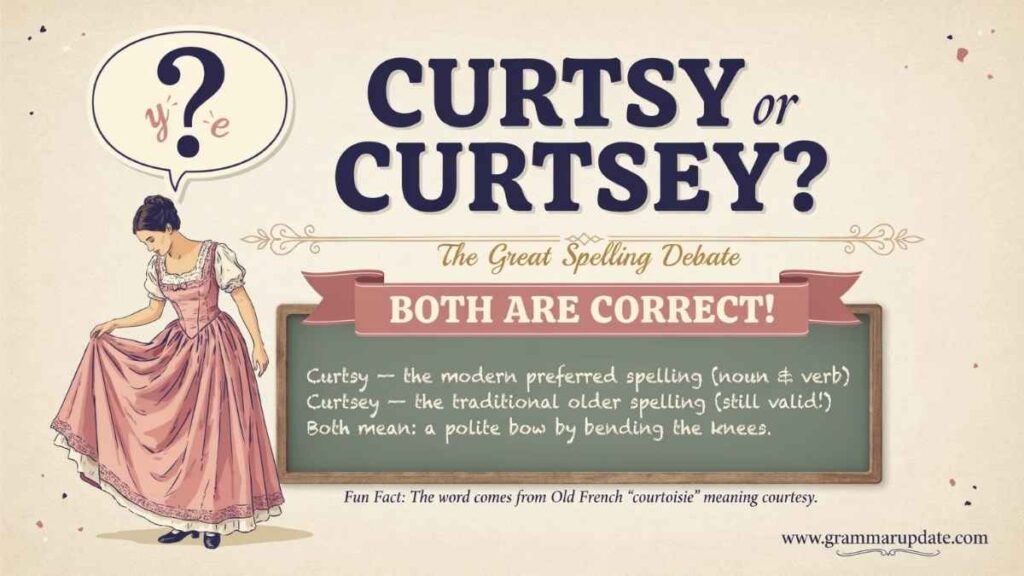
English spelling has a talent for turning simple questions into surprisingly tricky ones. The confusion surrounding curtsy or curtsey is a perfect example. The two spellings look different, but both refer to the same traditional gesture of respect. That small extra letter can make even confident writers pause before choosing the right form. Fortunately, there is no spelling battle to settle here. Both versions are accepted, although usage may vary depending on region and context. In this guide, you will learn what curtsy and curtsey mean, how they are pronounced, where they came from, and how to use each form correctly in everyday writing.
Curtsy or Curtsey Quick Answer
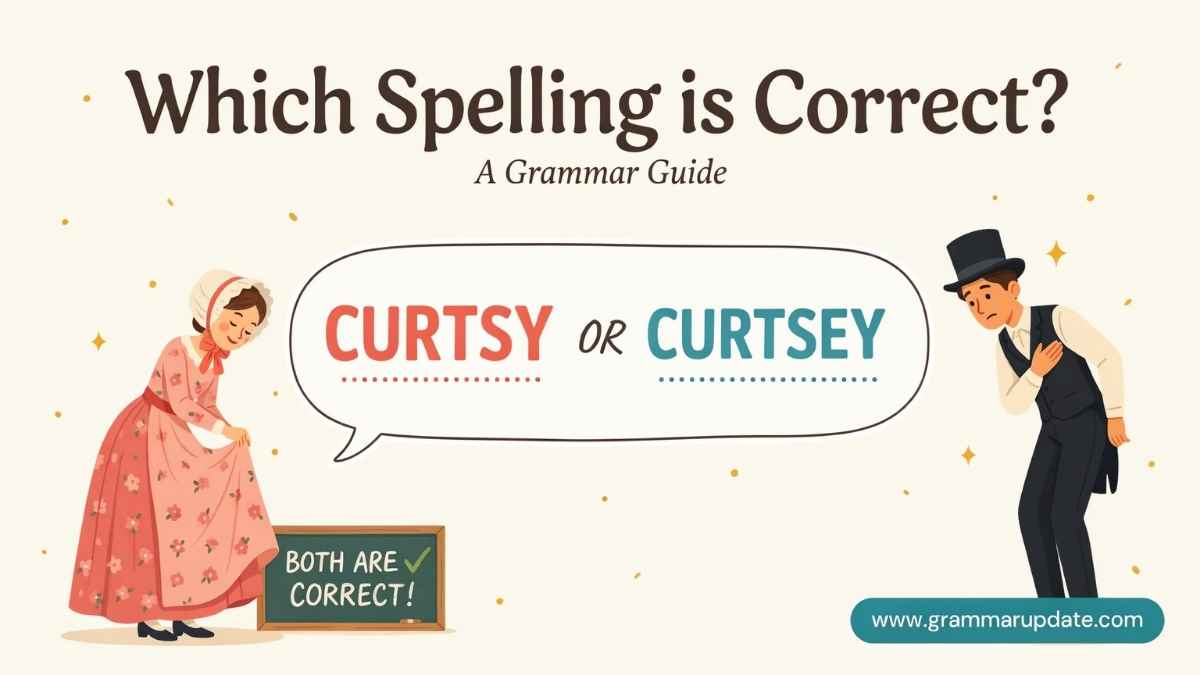
Curtsy and curtsey are accepted spellings of the same word. Both can function as a noun and a verb.
As a noun, the word refers to the gesture itself:
“She gave a graceful curtsy.”
As a verb, it describes the act of performing the gesture:
“She curtsied to the guest.”
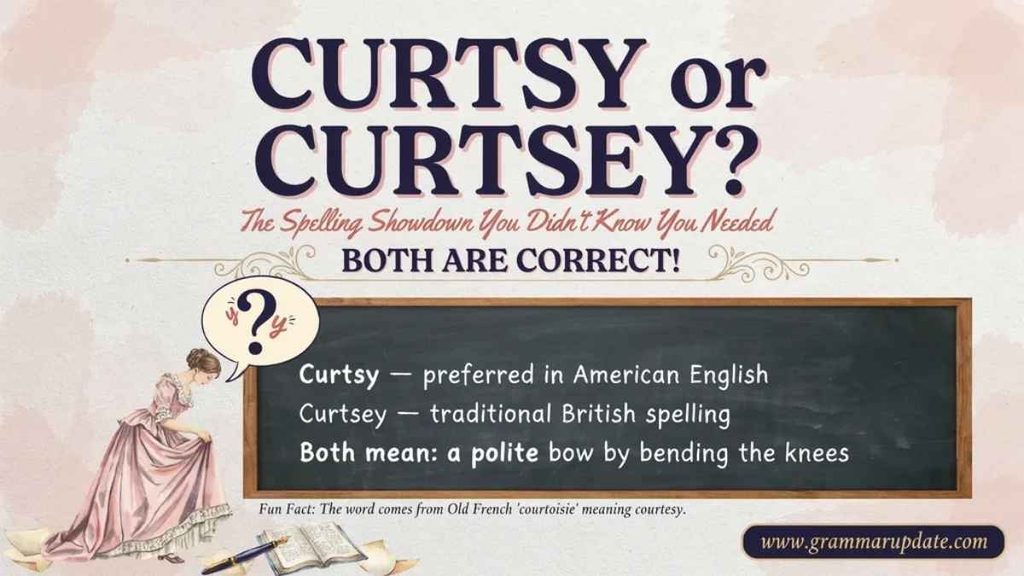
The spelling curtsy is particularly common in contemporary American English. Curtsey is also correct and continues to appear in British, traditional, historical, and literary contexts.
Here is the distinction at a glance:
| Feature | Curtsy | Curtsey |
|---|---|---|
| Meaning | A traditional gesture of respect | A traditional gesture of respect |
| Part of speech | Noun and verb | Noun and verb |
| American English | Common | Less common |
| British English | Established | Established |
| Plural | Curtsies | Curtseys |
| Past tense | Curtsied | Curtseyed |
| Present participle | Curtsying | Curtseying |
If you need the curtsy or curtsey correct spelling, either form can be right. For general modern American English, curtsy is usually the more familiar choice.
Learn the difference between tricky words and use them correctly
Grate or Great Which One Is Correct?
What Is a Curtsy?
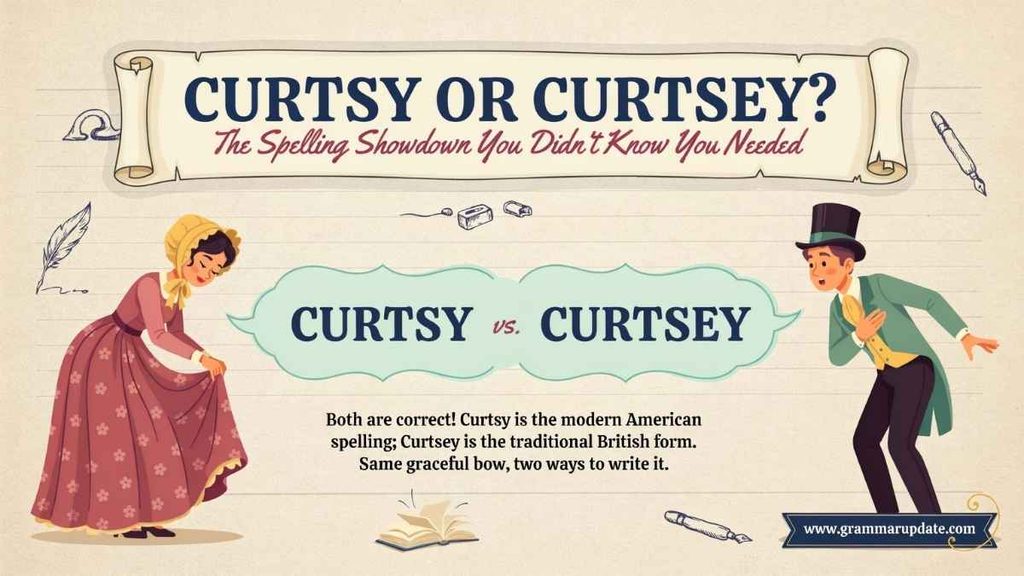
A curtsy is a traditional gesture of respect made by bending the knees and lowering the body. Traditionally, the gesture has been associated particularly with women and girls in formal situations.
The movement does not have to be dramatic. A person may bend the knees slightly while keeping the upper body relatively upright. The exact form can vary according to the occasion, cultural setting, and type of ceremony.
A curtsy can communicate respect, greeting, acknowledgment, or formality. You may encounter the word in descriptions of royal etiquette, dance performances, theatrical curtain calls, ceremonies, and historical events.
In straightforward terms, the curtsy definition is a traditional gesture in which someone bends the knees and lowers the body to show respect or acknowledgment.
Curtsy as a Noun
When curtsy functions as a noun, it refers to the gesture itself.
For example:
“She gave a polite curtsy.”
“The dancer ended the performance with a graceful curtsy.”
“The young performer practiced her curtsy before the ceremony.”
In each sentence, curtsy names the action rather than describing someone performing it.
Curtsy as a Verb
Curtsy can also function as a verb. In this form, it means to perform the gesture.
For example:
“She curtsied to the queen.”
“The dancers curtsied after the performance.”
“The actress curtsied before leaving the stage.”
The past tense is curtsied, while the present participle is curtsying.
Learn the difference between tricky words and use them correctly
Losses or Loses What Is the Correct Spelling ?
What Does Curtsey Mean?
Curtsey has the same basic meaning as curtsy. The extra e does not create a different gesture or a separate definition.
If you are asking, “Is curtsey a word?” the answer is yes. Curtsey is an accepted spelling and can be used as both a noun and a verb.
As a noun:
“She made a formal curtsey.”
As a verb:
“She curtseyed before leaving.”
The two forms can therefore appear in almost identical sentences:
“She gave a graceful curtsy.”
“She gave a graceful curtsey.”
Both sentences describe the same type of traditional gesture.
Curtsy vs Curtsey What Is the Difference?
The curtsy vs curtsey difference is mainly a matter of spelling and usage. The two forms generally have the same meaning.
This distinction matters because it is easy to assume that one form must be an error. In reality, curtsey is not simply a misspelling of curtsy.
Both forms are established in English.
If you encounter curtsy in one book and curtsey in another, the different spelling does not necessarily indicate a difference in meaning. The writers may be following different regional, historical, or stylistic conventions.
The simplest way to remember it is this:
Curtsy and curtsey generally mean the same thing.
Curtsy is especially common in contemporary American English.
Curtsey remains an accepted alternative, particularly in British and traditional usage.
Learn the difference between tricky words and use them correctly
Wierd or Weird Which Spelling Is Correct?
Curtsy or Curtsey in American and British English
English spelling can vary across regions. American English and British English share most of their vocabulary, but they sometimes favor different spellings or forms.
It illustrate that flexibility.
Curtsy in American English
Curtsy is the spelling most familiar to many American readers.
If you are writing a contemporary article, story, school assignment, or other piece of American English, curtsy is a natural choice.
For example:
“The dancer gave a graceful curtsy at the end of the performance.”
The spelling is standard and immediately recognizable.
Curtsy or Curtsey in British English
British English recognizes both curtsy and curtsey.
Curtsey has a long history in British writing, particularly in traditional and formal contexts. However, curtsy is also well established.
For that reason, the phrase curtsy UK should not suggest that only one spelling is correct in the United Kingdom.
Both forms can occur.
The same principle applies when considering curtsy or curtsey in British English. Regional preference may influence which form a writer chooses, but neither spelling should automatically be treated as an error.
| Variety of English | Curtsy | Curtsey |
|---|---|---|
| American English | Common | Accepted but less common |
| British English | Established | Established |
| Formal writing | Correct | Correct |
| Traditional writing | Common | Common |
| Meaning | Same | Same |
For contemporary American writing, curtsy is usually the most familiar option. In British, historical, or traditional material, curtsey may appear more frequently.
Learn the difference between tricky words and use them correctly
Ambience or Ambiance Which Spelling Is Correct?
Curtsy or Curtsey Spelling
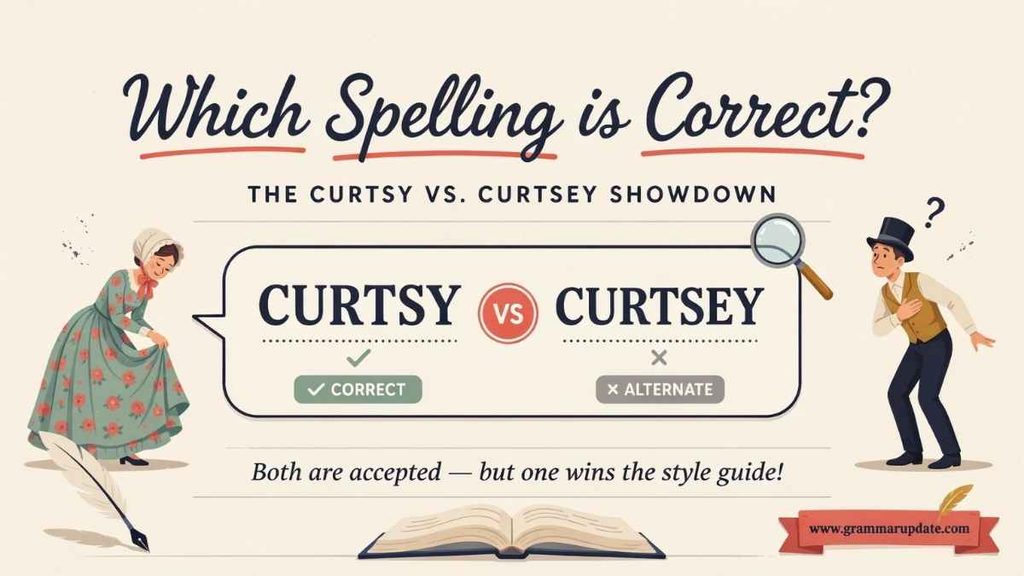
The spelling difference is easy to see:
Curtsy is spelled c-u-r-t-s-y.
Curtsey is spelled c-u-r-t-s-e-y.
If you are searching for how to spell curtsy, the answer is curtsy.
If you are searching for how to spell curtsey, the answer is curtsey.
Both are accepted spellings.
The more important issue arises when the word changes grammatical form.
Curtsy Plural
The curtsy plural is curtsies.
For example:
“The dancers performed several graceful curtsies.”
The final y changes to ies because the noun ends in a consonant followed by y.
Curtsey Plural
The plural of curtsey is curtseys.
For example:
“The performers exchanged polite curtseys.”
Past Tense of Curtsy
The past tense of curtsy is curtsied.
“She curtsied to the audience.”
Past Tense of Curtsey
The past tense of curtsey is curtseyed.
“She curtseyed before the ceremony.”
Present Participle
The present participle of curtsy is curtsying.
The present participle of curtsey is curtseying.
| Base form | Plural | Past tense | Present participle |
|---|---|---|---|
| Curtsy | Curtsies | Curtsied | Curtsying |
| Curtsey | Curtseys | Curtseyed | Curtseying |
Keeping these forms consistent with the spelling you choose will make your writing clear and grammatically sound.
- Learn the difference between tricky words and use them correctly
Feet or Foot Which One Is Correct?
Curtsy Pronunciation
The pronunciation of curtsy and curtsey is essentially the same.
In British English, the pronunciation is commonly represented as /ˈkɜːt.si/. In American English, it is commonly represented as /ˈkɝːt.si/.
The extra e in curtsey does not add another syllable. Both forms normally have two syllables.
The vowel may sound slightly different between British and American accents, but the spelling does not create two different pronunciations.
So, when learning the pronunciation of curtsy, focus on the sound rather than assuming that the e in curtsey must be pronounced separately.
Curtsy Meaning Understanding the Gesture
The physical action behind the word is relatively simple.
A traditional curtsy involves bending the knees and lowering the body. In many traditional forms, one foot is positioned slightly behind or in front of the other while the person maintains a controlled posture.
The movement can be subtle or pronounced.
A formal ceremony may call for a restrained gesture. A theatrical performance may use a more noticeable movement. A dancer may incorporate the curtsy naturally into the end of a routine.
The social meaning can also vary.
A curtsy may express respect toward an important person. It may serve as a formal greeting. It can acknowledge an audience after a performance. In historical writing, it may signal the etiquette expected within a particular social setting.
The gesture remains recognizable today even though it is no longer an ordinary greeting for most people.
Learn the difference between tricky words and use them correctly
Families or Familys Which One Is Correct?
Is a Curtsy the Same as a Bow?
A curtsy and a bow are related respectful gestures, but they are not physically identical.
A traditional bow primarily involves bending the upper body forward. A curtsy focuses on bending the knees and lowering the body.
Both gestures can communicate respect or acknowledgment, but their movements differ.
| Gesture | Main movement | Common association |
|---|---|---|
| Curtsy | Bending the knees and lowering the body | Traditional formal greeting |
| Bow | Bending the upper body | Formal greeting or acknowledgment |
| Nod | Brief downward movement of the head | Everyday acknowledgment |
| Salute | Formal hand movement | Military or ceremonial settings |
The expression curtsy bow may appear in informal descriptions because both movements can serve a similar social purpose. However, a curtsy is not simply another name for a conventional bow.
Etiquette and Tradition
The history of the curtsy is closely connected with formal etiquette.
European courtly traditions placed considerable importance on gestures that demonstrated respect toward people of higher social rank. The curtsy became particularly associated with women and girls greeting people of high status.
Royal etiquette is one of the most familiar examples.
The expression curtsy to the queen describes performing the gesture as a traditional sign of respect toward a queen. Similarly, curtsy to royalty refers to the traditional practice of making the gesture when greeting a member of a royal family.
These expressions are most useful when discussing historical customs, royal ceremonies, formal etiquette, or traditional social practices.
Modern social life is different. Most people do not use a curtsy during an ordinary introduction. Today, the gesture is more likely to appear in dance, theater, ceremonies, historical settings, or deliberately traditional situations.
- Learn the difference between tricky words and use them correctly
Likeable or Likable Which Spelling Is Correct?
The Origin and History of Curtsy
The origin of curtsy has an interesting connection with the word courtesy.
The word curtsy developed from a variant of courtesy during the sixteenth century. Historical evidence places curtsy as a noun in the 1540s. The verb appeared in the 1550s, while the specific sense referring to bending the knees and lowering the body developed in the 1570s.
This history helps explain the relationship between the word and ideas of respect, politeness, and formal behavior.
Courtesy itself has much older roots. The English word developed through French and was associated with courtly behavior, manners, and politeness.
Over time, a particular respectful gesture acquired its own specialized form.
Curtsy and Courtesy
It may be tempting to describe curtsy as simply a shortened form of courtesy. That explanation leaves out an important part of the history.
The words are historically related, but curtsy developed as a variant of courtesy and later became associated specifically with the physical gesture.
The connection is logical when the social purpose of the gesture is considered. A curtsy served as a visible expression of courtesy and respect.
A Brief History
| Period | Development |
|---|---|
| Around the 1200s | Courtesy enters English in forms associated with courtly behavior and politeness |
| 1540s | Curtsy appears as a variant of courtesy |
| 1550s | Curtsy develops as a verb |
| 1570s | The specific gesture-related meaning becomes established |
| Modern English | Curtsy and curtsey remain established spellings |
The historical record also makes one point especially clear: curtsey should not be dismissed as a modern spelling mistake. Variant forms have existed for centuries.
Labelling or Labeling Which Spelling Is Correct?
Curtsy or Curtsey in a Sentence
Examples make the distinction easier to understand.
Curtsy in a Sentence
“The ballerina finished her performance with a graceful curtsy.”
“She gave the audience a small curtsy.”
“The young girl practiced her curtsy before the ceremony.”
“The actress returned to the stage for a final curtsy.”
“She curtsied to the queen.”
“The dancers curtsied together after the performance.”
These examples demonstrate both noun and verb uses.
Curtsey in a Sentence
“She gave a polite curtsey.”
“The dancer performed a graceful curtsey.”
“She curtseyed before the royal guest.”
“The performers exchanged formal curtseys.”
“The character curtseyed before leaving the room.”
The meaning remains essentially the same regardless of which spelling appears.
Common Mistakes
The most common mistake is treating one spelling as correct and the other as incorrect.
Curtsey is an established alternative spelling, so it should not automatically be marked as an error.
Another common problem involves plural forms.
The correct plural of curtsy is curtsies.
The correct plural of curtsey is curtseys.
Past-tense forms also need attention.
Curtsy becomes curtsied.
Curtsey becomes curtseyed.
The words can also be confused with courtesy.
Courtesy means polite behavior, consideration, or a respectful act.
Curtsy refers specifically to the traditional gesture.
For example:
“She showed courtesy by helping the visitor.”
“She gave a curtsy to the guest.”
The two words are historically related, but they do not have the same grammatical or modern meaning.
Curtsy Synonym and Related Words
If you are looking for a curtsy synonym, the best choice depends on the context.
Words such as bow, greeting, gesture, salutation, and acknowledgment may describe related ideas.
However, these aren’t exact replacements in every sentence.
Bow is a broader physical term. A bow can involve several different movements, while a curtsy specifically involves bending the knees and lowering the body.
Greeting is broader because a greeting can involve words, gestures, facial expressions, or other forms of acknowledgment.
Gesture is broader still.
Therefore, when looking for a curtsy or curtsey synonym, consider the exact meaning you need before replacing the word.
Learn the difference between tricky words and use them correctly
Label or Lable Which Spelling Is Correct?
Modern Uses of the Curtsy
The curtsy remains part of modern English, although its everyday use has become limited.
Dance is one of the clearest modern settings. Performers may curtsy at the end of a routine as they acknowledge the audience.
Theater is another common context. Actors may perform a curtsy during a curtain call, particularly when it suits the performance or character.
Historical fiction frequently uses the word to describe formal social customs. A character in a story set in a royal court, for example, may curtsy when meeting someone of high rank.
Ceremonial settings can also preserve the gesture.
The word may even be used playfully. Someone might jokingly mention a curtsy to express admiration, gratitude, or exaggerated respect without actually performing the movement.
That flexibility allows a centuries-old word to remain useful in modern writing.
Curtsy or Curtsey Which Should You Use?
The best choice depends on your audience, context, and preferred variety of English.
For contemporary American English, curtsy is generally the more familiar spelling.
For British, historical, literary, or traditional writing, you may encounter curtsey more often. That does not make curtsy incorrect in those contexts.
If you are quoting a historical source, preserve the original spelling when accuracy requires it.
If you are writing your own article or document, choose one form and use it consistently.
There is rarely a reason to switch between curtsy and curtsey without a clear purpose. Consistent spelling makes your writing easier to follow and prevents readers from wondering whether you intended to describe two different words.
Learn the difference between tricky words and use them correctly
Skied or Skiied Which Spelling Is Correct?
Curtsy or Curtsey Quick Comparison
| Question | Curtsy | Curtsey |
|---|---|---|
| Is it a word? | Yes | Yes |
| Is it correct? | Yes | Yes |
| Does it describe a gesture of respect? | Yes | Yes |
| Can it be a noun? | Yes | Yes |
| Can it be a verb? | Yes | Yes |
| Common in modern American English? | Yes | Less common |
| Used in British English? | Yes | Yes |
| Plural | Curtsies | Curtseys |
| Past tense | Curtsied | Curtseyed |
| Present participle | Curtsying | Curtseying |
| Different meaning? | No | No |
Here’s a trusted source for clear more words Comparison:
Grammar Update
Practice Session Curtsy or Curtsey
It is time to put your understanding of curtsy and curtsey to the test. These exercises cover spelling, meaning, grammatical forms, and proper usage. Read each sentence carefully before choosing an answer.
Some questions test the difference between the two spellings, while others focus on related forms such as curtsies, curtsied, and curtsying. A few also check whether you can distinguish these words from courtesy and bow.
Fill in the Blanks
Complete each sentence with the correct word or form.
- The dancer finished her performance with a graceful ________.
- The young performer ________ to the audience after the show.
- In traditional etiquette, a ________ involves bending the knees and lowering the body.
- The actress gave a polite ________ before leaving the stage.
- At the end of the ceremony, she ________ before the distinguished guest.
- The plural form of curtsy is ________.
- The plural form of curtsey is ________.
- The past tense of curtsy is ________.
- The past tense of curtsey is ________.
- The present participle of curtsy is ________.
- The present participle of curtsey is ________.
- Both curtsy and ________ are accepted spellings for the same traditional gesture.
- The word ________ refers to polite or considerate behavior rather than the knee-bending gesture.
- The dancers performed several graceful ________ after completing their routine.
- The performers exchanged formal ________ before leaving the stage.
- In the historical scene, the character ________ before the queen.
- A traditional ________ generally involves bending the upper body forward.
- A traditional ________ involves bending the knees and lowering the body.
- In contemporary American English, ________ is generally the more familiar spelling.
- ________ remains an established alternative, particularly in traditional and British usage.
- The young girl practiced her ________ before the formal ceremony.
- The dancer was ________ as the audience applauded.
- The historical novel describes several women performing graceful ________.
- The word courtesy should not be confused with ________, which refers to a traditional respectful gesture.
- A curtsy may express respect, greeting, or ________.
- The actress returned to the stage and gave one final ________.
- Curtsy and curtsey have essentially the same ________.
- A curtsy and a bow can both show respect, but their physical ________ are different.
- The teacher explained that ________ is not the standard spelling for the traditional gesture.
- If you use curtsy in a sentence, its past-tense form is ________.
Answer Key
- curtsy
- curtsied
- curtsy
- curtsey
- curtseyed
- curtsies
- curtseys
- curtsied
- curtseyed
- curtsying
- curtseying
- curtsey
- courtesy
- curtsies
- curtseys
- curtsied
- bow
- curtsy
- curtsy
- Curtsey
- curtsy
- curtsying
- curtsies
- curtsy
- acknowledgment
- curtsy
- meaning
- movements
- curtesy
- curtsied
Quick Review
If you found a few questions challenging, focus on the core distinction rather than trying to memorize every sentence.
Curtsy and curtsey are both accepted spellings for the same traditional gesture. Curtsy is especially familiar in contemporary American English, while curtsey remains an established alternative in British and traditional usage.
The related forms follow the spelling you choose:
Curtsy → curtsies → curtsied → curtsying
Curtsey → curtseys → curtseyed → curtseying
Courtesy is different. It refers to polite, respectful, or considerate behavior, not specifically to the knee-bending gesture.
Once you understand these forms, choosing between curtsy, curtsey, and courtesy becomes much easier. The key is to pay attention to both the meaning and the grammatical form required by the sentence.
FAQs About Curtsy or Curtsey
When should you curtsy or curtsey?
A curtsy or curtsey is traditionally used as a formal gesture of respect or acknowledgment. It may appear during royal or ceremonial occasions, although today it is more commonly seen in dance, theater, historical reenactments, and traditional settings. The appropriate use depends on the occasion and the etiquette being followed.
Is it courtesy or curtsey?
Courtesy and curtsey have different meanings. Courtesy refers to polite, considerate, or respectful behavior. Curtsey refers to a traditional gesture in which a person bends the knees and lowers the body. The two words are historically related, but they are not interchangeable.
What does curtsy mean?
Curtsy means to make a traditional gesture of respect by bending the knees and lowering the body. As a noun, it names the gesture itself. As a verb, it describes the action of performing it.
What does curtesy mean?
Curtesy is generally not the standard spelling for the traditional gesture. It is often a mistaken combination of courtesy and curtsy. When referring to the gesture, use curtsy or curtsey. Courtesy has a separate meaning connected with politeness and consideration.
Do William and Kate have to bow to Camilla?
Royal etiquette can depend on rank, the presence of the monarch, the type of event, and the circumstances of the meeting. Therefore, there is no simple rule that every interaction between William, Kate, and Camilla requires the same gesture. Ceremonial practice can differ from everyday interactions.
Do female servants bow or curtsy?
In historical households, female servants could curtsy when addressing or greeting people of higher social status. Customs varied according to the period, household, country, and position of the servant. This practice is largely associated with historical etiquette rather than modern service roles.
What is a female bow called?
A female bow that involves bending the knees and lowering the body is traditionally called a curtsy or curtsey. A standard bow usually involves bending the upper body forward. The two gestures have similar purposes but different movements.
What is another word for “curtsy”?
Bow is the closest broad alternative when referring to a respectful physical gesture. Depending on the sentence, related words may include greeting, gesture, salutation, or acknowledgment. However, these terms do not always carry the specific physical meaning of curtsy.
Does Kate Middleton’s family have to curtsy to her?
Being related to someone does not automatically determine whether a curtsy is required. Traditional royal etiquette considers factors such as rank, precedence, and the circumstances of an encounter. Family relationships alone do not establish a universal requirement.
Why do girls curtsy instead of bow?
Historically, social etiquette often associated curtsies with women and girls, while bows could be used more broadly. These conventions developed through formal and courtly traditions. Today, the choice between the two gestures depends largely on the setting, tradition, and purpose rather than a universal rule.
Does Camilla outrank William?
Royal precedence does not work as a simple personal ranking. It can change according to the occasion, the presence of the sovereign, official roles, and established ceremonial rules. William is the heir apparent, while Camilla is the queen consort, so their precedence must be considered within the particular situation.
Which royals do you curtsy to?
Traditional etiquette may involve a curtsy when meeting certain members of a royal family, especially the reigning monarch. The expected form of greeting can depend on the person’s status, the occasion, and the customs being observed. Modern encounters may not follow every historical convention.
Which is correct, “courtesy” or “curtsy”?
Both are correct words, but they have different meanings. Courtesy means polite or considerate behavior, while curtsy describes a traditional gesture involving the bending of the knees. Curtsey is also an accepted spelling of the gesture.
When did people stop curtsying?
There was no specific date when curtsying ended. The practice gradually became less common as everyday social customs changed during the nineteenth and twentieth centuries. It has survived in particular settings, including dance, theater, ceremonies, historical traditions, and some formal encounters.
What is the proper way to curtsy?
A traditional curtsy begins with an upright posture. One foot moves slightly behind the other, the knees bend, and the body lowers in a controlled manner before returning to the starting position. The exact technique varies between ceremonial etiquette, dance, theater, and other traditions.
AEO Quick Answers About Curtsy or Curtsey
Is curtsy or curtsey correct?
Both curtsy and curtsey are accepted spellings of the same word. Curtsy is particularly common in contemporary American English, while curtsey remains an established alternative.
What is a curtsy?
A curtsy is a traditional gesture of respect that involves bending the knees and lowering the body. It is associated with formal etiquette, dance, theater, ceremonies, and historical traditions.
What is the difference between curtsy and curtsey?
There is generally no difference in meaning. Curtsy and curtsey are variant spellings for the same gesture. Their frequency can vary by region, period, and writing style.
Is curtsey a word?
Yes. Curtsey is an established English word that can function as both a noun and a verb. It has the same basic meaning as curtsy.
What is the plural of curtsy?
The plural of curtsy is curtsies.
What is the plural of curtsey?
The plural of curtsey is curtseys.
What is the past tense of curtsy?
The past tense of curtsy is curtsied.
What is the past tense of curtsey?
The past tense of curtsey is curtseyed.
Is curtesy the same as curtsy?
No. Curtesy is generally an incorrect form when referring to the traditional gesture. The accepted spellings are curtsy and curtsey. Courtesy is a separate word meaning polite or considerate behavior.
Is a curtsy the same as a bow?
No. A curtsy involves bending the knees and lowering the body, while a traditional bow primarily involves bending the upper body forward. Both gestures can communicate respect or acknowledgment.
Is curtsy used in American English?
Yes. Curtsy is a familiar and widely used spelling in contemporary American English.
Is curtsey used in British English?
Yes. Curtsey is an established spelling in British English, although curtsy is also used. Neither form is automatically incorrect because of regional usage.
Why is curtsy associated with royalty?
The gesture became closely linked with courtly etiquette and formal demonstrations of respect. Royal traditions helped maintain that association, although curtsies have also been used in dance, theater, ceremonies, and other settings.
Can men curtsy?
Traditionally, curtsying has been particularly associated with women and girls. However, the gesture can appear in performances, humorous situations, historical portrayals, and other contexts involving people of any gender.
Does a curtsy always show submission?
No. A curtsy can communicate respect, greeting, acknowledgment, ceremony, or performance. Its meaning depends on the situation and the relationship between the people involved.
How do you spell curtsy?
Curtsy is spelled c-u-r-t-s-y.
How do you spell curtsey?
Curtsey is spelled c-u-r-t-s-e-y.
How do you pronounce curtsy?
Curtsy is generally pronounced with two syllables, approximately “KURT-see.” Curtsey has essentially the same pronunciation.
What does curtsy mean in English?
Curtsy refers to a traditional gesture in which a person bends the knees and lowers the body as a sign of respect, greeting, or acknowledgment.
What does curtsey mean?
Curtsey has the same basic meaning as curtsy. It can describe the gesture itself or the act of performing it.
When should you use curtsy instead of curtsey?
For contemporary American writing, curtsy is generally the more familiar form. Curtsey can be appropriate when following British, historical, literary, or traditional usage.
Can curtsy be used as a verb?
Yes. Curtsy can function as a verb meaning to perform the traditional gesture. Its past-tense form is curtsied.
Can curtsey be used as a verb?
Yes. Curtsey can also function as a verb. Its past-tense form is curtseyed.
What is the main difference between curtsy and curtsey?
The distinction is primarily spelling preference rather than meaning. Both forms describe the same traditional gesture and can function as nouns or verbs.
What is the easiest way to remember curtsy and curtsey?
Remember that both spellings describe the same gesture. Curtsy is the more familiar form for many American readers, while curtsey remains an established alternative. The related forms should follow the spelling you choose: curtsies and curtsied, or curtseys and curtseyed.
Final Takeaway
The confusion between curtsy and curtsey may seem like a small spelling puzzle, but it doesn’t have to leave you bending over backward for an answer. Both are accepted spellings for the same traditional gesture of respect, and both work as nouns and verbs. Curtsy is more common in contemporary American English, while curtsey remains an established alternative, especially in British and traditional usage. Keep in mind that courtesy has a different meaning, and curtesy generally isn’t the standard spelling for this gesture. With these distinctions in mind, you can choose the form that fits your audience and context. The spelling may vary, but your writing can remain clear, confident, and polished.

Ella AJS
Ella AJS is an experienced blogger and language enthusiast at Grammar Spire, dedicated to making English grammar simple, practical, and easy to understand. She specializes in word comparisons, meanings, usage, and common language confusions. Through clear explanations and engaging examples, Ella helps students, writers, and English learners improve their vocabulary and communicate with greater confidence and accuracy.




