
English spelling can turn an ordinary word into an unexpected little puzzle. The confusion surrounding “lovable or loveable” is a good example. Both spellings look natural, sound nearly identical, and express the same basic idea, which can make the choice surprisingly tricky. Fortunately, there is no need to play a spelling guessing game. Lovable is the more common form, particularly in American English, while loveable is also an accepted variant and is especially familiar in British English. Knowing this distinction helps you avoid unnecessary spelling mistakes, write with confidence, and choose the form that fits your audience. After all, even a lovable word deserves the right spelling.
Quick Answer
Both lovable and loveable are correct spellings.
Lovable is the standard headword form listed by major dictionaries and is particularly common in American English. Loveable is an accepted variant and is well established in British English as well.
The two words have the same basic meaning: easy to love, worthy of affection, or possessing qualities that make someone or something appealing and endearing.
For example:
The puppy has a lovable personality.
You can also write:
The puppy has a loveable personality.
The meaning does not change. The difference is primarily one of spelling preference and usage.
If you are writing for a general American audience, lovable is the safest choice.
Learn the difference between confusing more English words step by step
Losses or Loses What Is the Correct Spelling ?
What Does Lovable Mean?

Lovable is an adjective that describes a person, animal, character, or sometimes even a thing that is easy to love or deserves affection.
A lovable person may be kind, funny, warm, caring, charming, or simply pleasant to be around. A lovable animal might have an adorable personality that makes people want to care for it.
For example:
Everyone thought the little boy was lovable.
Here, lovable describes the boy as someone who naturally attracts affection.
Another example is:
The old dog has a lovable personality.
The sentence does not mean that the dog loves other people. Instead, it means that the dog has qualities that make people love or feel affection for it.
Lovable can describe much more than physical appearance. Personality, behavior, warmth, humor, kindness, innocence, and even certain imperfections can make someone lovable.
Oxford Learner’s Dictionaries defines lovable as having qualities that people find attractive and easy to love, often despite faults. That idea is important because lovable does not mean perfect.
A lovable character can make mistakes and still remain appealing.
Learn the difference between confusing more English words step by step
Wierd or Weird Which Spelling Is Correct?
What Does Loveable Mean?
Loveable has the same basic meaning as lovable.
It describes someone or something that is easy to love, worthy of affection, or naturally endearing.
For example:
The child has a cheerful and loveable personality.
The meaning is essentially the same as:
The child has a cheerful and lovable personality.
The extra e does not create a different definition.
Major dictionaries recognize loveable as a legitimate variant spelling. Cambridge lists loveable alongside lovable, while Collins also recognizes loveable as a variant.
Therefore, if you see loveable in a book, article, message, or British English text, there is no need to assume that the writer made a spelling error.
Learn the difference between confusing more English words step by step
Ambience or Ambiance Which Spelling Is Correct?
Lovable vs Loveable What Is the Difference?
The simplest answer is that there is no meaningful difference in definition.
Both words function as adjectives. It describe someone or something that inspires affection or is easy to love. Both are pronounced essentially the same way.
The main difference is spelling preference.
Lovable removes the final e from love before adding the suffix -able:
love + able → lovable
Loveable keeps the e:
love + able → loveable
English spelling does not always follow one perfectly consistent rule. Some words keep a final e before a suffix, while others drop it. That is one reason spellings such as lovable and loveable can both exist.
The safest approach is to recognize both forms rather than treating one as automatically wrong.
Lovable in American English
Lovable is the spelling you will generally see as the main dictionary form in American English.
American dictionaries commonly present lovable as the primary form while also recognizing loveable as a variant.
For everyday American writing, lovable is therefore the more natural choice.
Consider these examples:
She has a lovable personality.
The puppy is absolutely lovable.
His lovable sense of humor makes everyone smile.
The movie features a lovable main character.
In each sentence, lovable works naturally as an adjective.
If you are writing an essay, article, professional message, school assignment, or general American English content, lovable is a straightforward choice.
Loveable in British English
Loveable is an established spelling in British English, although lovable is also used.
Collins lists both lovable and loveable in British English. This means British writers can encounter either form without one automatically being considered incorrect.
For example:
The rescue dog is incredibly loveable.
This sentence is perfectly understandable and uses an accepted spelling.
You may also see:
The rescue dog is incredibly lovable.
That spelling is also correct.
The important point is that British English does not create a completely different meaning for loveable. The difference remains primarily a matter of spelling variation.
Learn the difference between confusing more English words step by step
Feet or Foot Which One Is Correct?
Is Lovable a Correct Word?
Yes. Lovable is a correct English word.
It is an adjective used to describe someone or something that is easy to love or worthy of affection.
Major dictionaries such as Cambridge, Oxford, and Collins recognize lovable.
Examples include:
He is a lovable person.
The character is funny, flawed, and lovable.
Her lovable nature makes her easy to trust.
The puppy quickly became a lovable member of the family.
So if you have been wondering, “Is lovable a word?” the answer is clearly yes.
Is Loveable a Correct Word?
Yes. Loveable is also a recognized English word.
It is an accepted variant of lovable. Major dictionaries record the spelling rather than treating it as an error.
For example:
The kitten has a very loveable face.
His loveable personality made him popular with the other students.
The spelling may appear less often in some forms of English, but that does not make it incorrect.
This distinction matters because many spelling questions have a simple right-or-wrong answer. Lovable and loveable are different. Both are recognized.
Learn the difference between confusing more English words step by step
Families or Familys Which One Is Correct?
Why Is Lovable Spelled Without the E?
This question often causes confusion because the base word is love.
If you add -able to love, it seems natural to write loveable. That produces a form that looks logical.
However, English spelling sometimes removes a final silent e before a suffix is added. In lovable, the final e of love is dropped:
love → lovable
This is not an absolute rule that applies to every word in every situation. English spelling contains many historical patterns and exceptions.
That is why it is better to remember lovable as the established spelling rather than trying to force every word into one spelling formula.
The existence of loveable also shows that English has allowed more than one spelling pattern for this particular adjective.
Why Is Loveable Spelled With an E?
Loveable keeps the final e from the base word love before the suffix -able is added:
love + able → loveable
This spelling is easy to understand because the original word remains visually recognizable.
The form has a long history of use and appears in dictionaries as a variant of lovable.
So if you write loveable, you are not creating a random misspelling. You are using an established alternative form.
Lovable or Loveable Spelling Which One Should You Use?
If you want a simple practical rule, use lovable in most general writing.
That is especially useful when you are writing in American English and want to follow the main dictionary form.
However, loveable is also acceptable when you encounter or prefer that spelling, particularly in British English contexts.
For example, an American writer might naturally choose:
The puppy is lovable.
A British writer might write:
The puppy is loveable.
Neither sentence changes the meaning.
The choice depends mainly on spelling preference and regional usage.
Learn the difference between confusing more English words step by step
Likeable or Likable Which Spelling Is Correct?
Lovable and Loveable Comparison
| Feature | Lovable | Loveable |
|---|---|---|
| Part of speech | Adjective | Adjective |
| Basic meaning | Easy to love or worthy of affection | Easy to love or worthy of affection |
| Correct word | Yes | Yes |
| Dictionary recognition | Yes | Yes |
| American English | Common and preferred main form | Recognized variant |
| British English | Used | Established variant |
| Pronunciation | Essentially the same | Essentially the same |
| Meaning difference | None | None |
| Spelling difference | Drops the e | Keeps the e |
The table makes the central point clear: lovable and loveable do not represent two different ideas.
Learn the difference between confusing more English words step by step
Labelling or Labeling Which Spelling Is Correct?
Lovable or Loveable in Sentences
Seeing both forms in real sentences makes the difference easier to understand.
Examples With Lovable
The puppy has a lovable personality.
She is known for her lovable sense of humor.
The story follows a lovable young character.
His lovable nature quickly won everyone over.
The kitten has an incredibly lovable expression.
Even with his silly mistakes, he remains lovable.
The movie introduces a lovable group of friends.
In each example, lovable describes a quality that attracts affection.
Examples With Loveable
The puppy has a very loveable personality.
The character is funny, friendly, and loveable.
Her loveable nature made her popular with everyone.
The little dog became a loveable part of the family.
The story gives readers a loveable character to remember.
These examples communicate the same ideas as the examples using lovable.
Lovable Person Meaning
A lovable person is someone who has qualities that make others feel affection toward them.
Being lovable does not necessarily mean being physically attractive. A person can be lovable because of kindness, humor, honesty, warmth, generosity, patience, or an engaging personality.
For example:
Daniel is a lovable person because he treats everyone with kindness.
The sentence focuses on Daniel’s personality and behavior.
A lovable person may also have flaws. In fact, imperfections can sometimes make a character or person more relatable.
That is why the word often appears in descriptions of fictional characters. A character who makes mistakes but remains kind, funny, or sincere may be described as lovable.
Learn the difference between confusing more English words step by step
Label or Lable Which Spelling Is Correct?
Lovable vs Loving vs Loved
These three words look related because they all come from love, but they do not mean exactly the same thing.
Lovable describes someone or something that is easy to love.
The puppy is lovable.
Loving describes someone who gives or shows love.
She is a loving mother.
Loved describes someone or something that receives love.
The child is loved by his family.
This distinction is useful because replacing one word with another can change the meaning of a sentence.
Compare these examples:
The dog is lovable.
This means the dog has qualities that make people want to love it.
The dog is loving.
This means the dog shows affection toward others.
The dog is loved.
This means people love the dog.
The three words are connected, but they describe different relationships with love.
Common Mistakes With Lovable and Loveable
One common mistake is assuming that loveable must be wrong because lovable looks more familiar.
That assumption is not accurate. Loveable is an accepted variant.
Another mistake is believing that lovable and loveable have different meanings.
They do not have a meaningful difference in definition.
A third mistake is using the forms randomly within the same piece of writing.
For example, if you write lovable in one paragraph and loveable in the next, readers may wonder whether the change was intentional.
Consistency makes writing cleaner.
Choose the spelling that suits your preferred variety of English and use it consistently.
Another mistake involves confusing lovable with loving.
Someone who is lovable is easy to love. Someone who is loving gives or shows love.
Those ideas overlap, but they are not identical.
Why Do People Spell Lovable as Loveable?
There is a simple reason for the confusion: love is spelled with a final e.
When people add -able mentally, they naturally think:
love + able = loveable
That construction looks perfectly reasonable.
English spelling, however, contains many words in which a final silent e disappears when a suffix is added. Lovable follows that pattern.
At the same time, loveable has remained an established variant.
This creates a spelling situation that can feel unusual but is not particularly mysterious once both forms are recognized.
Is Lovable or Loveable More Common?
Lovable is generally presented as the main dictionary form, particularly in American English.
Loveable is recognized as an alternative spelling.
It is better to describe lovable as the preferred or main form rather than claim that loveable is wrong.
Likewise, it would be inaccurate to describe loveable as merely a typo. Major dictionaries recognize it.
If your goal is straightforward American English, lovable is usually the form to choose.
If you are writing in a British English context or following a source that uses loveable, the alternative form is also legitimate.
Lovable Synonyms
Several words can express an idea similar to lovable, although their exact meanings can differ slightly.
Adorable often describes someone or something that inspires affection because of appearance, behavior, or charm.
Endearing describes qualities that create affection or fondness.
Charming emphasizes an attractive or pleasing personality.
Appealing describes something that attracts interest or approval.
Sweet can describe someone who is kind, pleasant, thoughtful, or adorable.
Likable describes someone who is easy to like.
Delightful suggests that someone or something is particularly pleasant or enjoyable.
For example:
The puppy is lovable.
could become:
The puppy is adorable.
Or:
The puppy is endearing.
The replacement changes the shade of meaning slightly, so synonyms should be chosen according to context.
What Makes Someone Lovable?
There is no single quality that makes a person lovable.
Kindness is often associated with being lovable because considerate behavior naturally creates affection.
A sense of humor can also make someone lovable. People often feel drawn to those who make them laugh without making others uncomfortable.
Warmth, honesty, patience, generosity, and sincerity can also contribute to a lovable personality.
A fictional character might be lovable because the character is brave but imperfect, funny but sincere, or flawed but genuinely caring.
The word therefore describes an overall impression rather than one specific physical or personal trait.
Learn the difference between confusing more English words step by step
Skied or Skiied Which Spelling Is Correct?
Lovable Pronunciation
Lovable and loveable are pronounced essentially the same way.
The word is commonly pronounced approximately as:
LUHV-uh-buhl
The final part is not pronounced like the word able when spoken separately.
Because the two spellings have the same basic pronunciation, hearing the word does not normally tell you whether the speaker would write lovable or loveable.
That is one reason this spelling question appears so often in writing.
Lovable or Loveable in Everyday Writing
In emails, school assignments, articles, social media posts, and casual messages, either spelling can be understood immediately.
For general American English, lovable is the cleaner default:
Your dog has such a lovable personality.
For a British English context, you may encounter:
Your dog has such a loveable personality.
The meaning remains unchanged.
The most important thing is consistency. If you choose one spelling for a document, there is usually no reason to alternate between the two.
Learn the difference between confusing more English words step by step
Curtsy or Curtsey Which Spelling is Correct?
A Simple Case Study
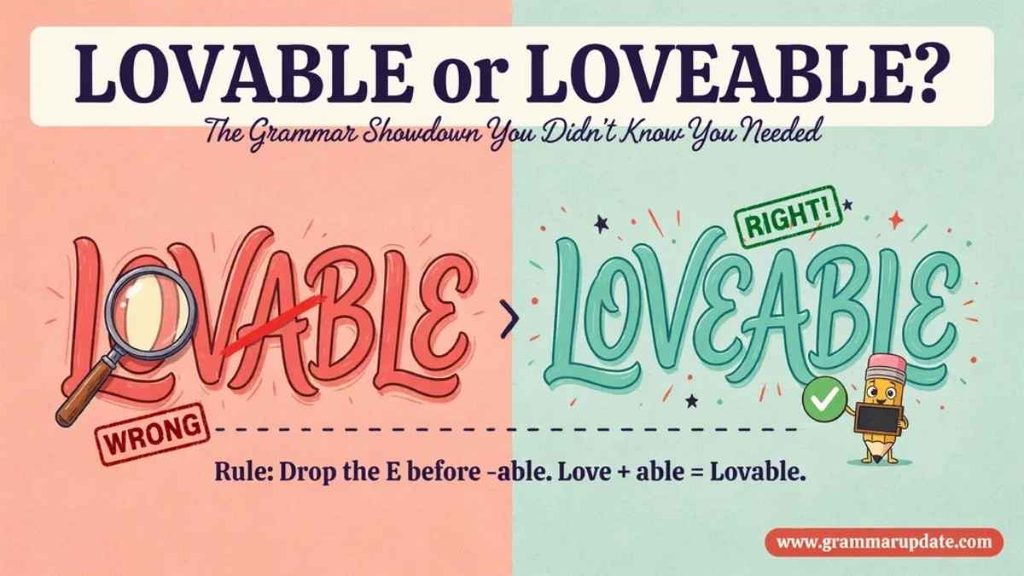
Imagine that you are writing a story about a mischievous puppy.
You want to describe the puppy as friendly, funny, and easy to love.
You could write:
Max was a lovable puppy with a talent for turning ordinary afternoons into adventures.
You could also write:
Max was a loveable puppy with a talent for turning ordinary afternoons into adventures.
Both sentences describe the same puppy in essentially the same way.
The first version is generally the safer choice for American English because lovable is the main standard form presented by major dictionaries.
The second version is still legitimate because loveable is an established variant.
The important lesson is simple: the spelling changes, but the meaning does not.
How to Spell Lovable Correctly
If you want the main standard spelling, remember:
L-O-V-A-B-L-E
The correct form is lovable, not lovible, lovible, or other variations.
A useful way to remember it is to think of the word as:
love → lovable
The final e disappears before the suffix in this spelling.
If you prefer the alternative spelling, you may also write:
L-O-V-E-A-B-L-E
That produces loveable, which dictionaries recognize as a variant.
How to Use Lovable in a Sentence
Lovable works naturally before a noun or after a linking verb.
Before a noun:
She adopted a lovable puppy.
After a linking verb:
The puppy is lovable.
It can also appear in longer descriptions:
Despite his stubborn personality, the character remains lovable.
Her kindness makes her a lovable friend.
The word usually describes a quality rather than an action.
How to Use Loveable in a Sentence
Loveable follows the same grammatical pattern.
Before a noun:
They adopted a loveable puppy.
After a linking verb:
The puppy is loveable.
In a description:
His cheerful personality makes him loveable.
Because lovable and loveable have the same grammatical function and meaning, the sentence structure does not change when you switch between them.
Here’s a trusted source for clear more words Comparison:
Grammar Update
Practice Session Lovable or Loveable
It is time to put your knowledge to work. Complete each sentence with the word or phrase that best fits the context. Pay close attention to meaning, spelling, and usage. A few questions test the difference between lovable, loveable, loving, and loved, so do not let the similar forms fool you.
Fill in the Blanks
- The little puppy has such a ______ personality that everyone wants to play with him.
- Her kindness and cheerful nature make her a truly ______ person.
- The British article described the character as ______ and charming.
- Although the character has several flaws, he remains remarkably ______.
- The kitten has an incredibly ______ face.
- His warm and friendly nature makes him ______ to everyone around him.
- In general American English, ______ is the more commonly used spelling.
- The alternative form ______ is also recognized by major English dictionaries.
- Both lovable and ______ express the idea of being easy to love.
- The child was so ______ that the whole family adored him.
- She is a ______ mother who always shows affection toward her children.
- The rescue dog is deeply ______ by everyone in the household.
- The author created a funny, charming, and ______ character for the novel.
- If you are writing for a general American audience, ______ is usually the simplest form to use.
- In British English, you may come across the spelling ______.
- The gentle puppy was easy to ______ because of its friendly behavior.
- The character is not perfect, but his honesty makes him especially ______.
- The word lovable is an ______ that describes a person, animal, character, or quality.
- Loveable is an accepted ______ spelling of lovable.
- The two forms have essentially the same ______.
- Lovable and loveable are pronounced almost the ______ way.
- In the spelling ______, the final e in love is removed before the suffix is added.
- The spelling ______ keeps the e from the base word love.
- The rescue dog quickly became a ______ member of the family.
- Her warm and ______ personality helped her make friends quickly.
- The writer wanted to create an ______ character with appealing qualities.
- Someone who openly gives affection can be described as ______.
- A person who receives affection from others may be described as ______.
- The adjective ______ can describe a person, animal, or fictional character who inspires affection.
- When writing standard American English, ______ is generally the most straightforward spelling to choose.
Answer Key
- lovable
- lovable
- loveable
- lovable
- lovable
- lovable
- lovable
- loveable
- loveable
- lovable
- loving
- loved
- lovable
- lovable
- loveable
- love
- lovable
- adjective
- variant
- meaning
- same
- lovable
- loveable
- lovable
- lovable
- endearing
- loving
- loved
- lovable
- lovable
Quick Practice Challenge
Complete these sentences without looking at the answer key.
- The friendly puppy is ______ because it is gentle, playful, and affectionate.
- The British spelling ______ is also an accepted form.
- The spelling generally preferred in American English is ______.
- Someone who regularly shows affection can be described as ______.
- A person who receives affection from others can be described as ______.
- The main difference between lovable and loveable is their ______.
Challenge Answers
spelling
lovable
loveable
lovable
loving
loved
Frequently Asked Questions
What does being lovable mean?
Being lovable means having qualities that naturally inspire affection and warmth. Kindness, sincerity, humor, patience, generosity, and a caring nature can all make someone lovable.
How do you spell “loveable” in the UK?
Loveable is an accepted spelling in British English. Lovable is also used, so both forms are correct. The additional e does not affect the meaning or pronunciation.
Who is a lovable person?
A lovable person is someone whose character or behavior makes others feel affection toward them. They may be kind, thoughtful, friendly, humorous, genuine, or simply pleasant to be around.
Which is correct, lovable or loveable?
Both spellings are correct. Lovable is the main dictionary form and is particularly common in American English. Loveable is an established alternative, especially familiar in British English.
How do you properly use lovable?
Use lovable as an adjective to describe a person, animal, character, or other subject that inspires affection. For example: “The rescue dog has a lovable personality.”
What do you call someone who is lovable?
You can describe such a person as lovable, endearing, charming, likable, sweet, or delightful. The best word depends on the particular quality you want to highlight.
How do you use lovable in a sentence?
Use lovable when describing someone or something that is easy to love or appreciate. For example: “The children quickly became attached to the lovable puppy.”
Is there anything better than lovable?
No single synonym works better in every situation. Words such as adorable, endearing, charming, appealing, and likable may be more suitable when you want to express a slightly different idea.
Why cannot I believe I am lovable?
Sometimes people find it difficult to recognize their own positive qualities, even when others appreciate them. If this question reflects a personal struggle, consider the qualities that make you valuable to the people around you rather than judging yourself by a temporary feeling.
AEO Quick Answers
Is lovable a word?
Yes. Lovable is a standard English adjective used for someone or something that is easy to love, appealing, or worthy of affection.
Is loveable a word?
Yes. Loveable is a recognized variant of lovable. Both forms have the same basic meaning and grammatical function.
Why is lovable spelled without an e?
Lovable is formed by dropping the final e from love before adding -able. English spelling follows several different suffix patterns, so this process does not apply uniformly to every word.
Is loveable wrong?
No. Loveable is an accepted spelling rather than simply a typographical error. It appears as a variant form in major dictionaries.
Is lovable American or British English?
Lovable is widely used in American English and is also found in British English. It is generally presented as the main dictionary form.
Is loveable only British English?
No. Loveable is well established in British English, but it is not restricted to Britain. It is also recognized as an alternative spelling in American English dictionaries.
What is the difference between lovable and loveable?
The difference is in spelling, not meaning. Lovable drops the final e from love, while loveable retains it. Both adjectives describe someone or something that inspires affection.
Which spelling should I use in American English?
Lovable is the most straightforward choice for general American English. It is widely recognized and commonly presented as the primary form in dictionaries.
Which spelling should I use in British English?
Either form is acceptable. Loveable is a well-established British variant, while lovable is also used. The important thing is to choose one form and use it consistently.
What is the pronunciation of lovable and loveable?
Both forms are pronounced essentially the same way. The pronunciation is commonly represented approximately as “LUHV-uh-buhl.”
What is a synonym for lovable?
Depending on the context, suitable alternatives include adorable, endearing, charming, appealing, likable, sweet, and delightful.
Can lovable describe a person?
Yes. Lovable can describe someone whose personality, behavior, or character naturally attracts affection.
Can lovable describe an animal?
Yes. The adjective is commonly used for pets and other animals that people find affectionate, charming, or easy to love.
Can lovable describe a fictional character?
Yes. Authors often describe characters as lovable when their personality, humor, kindness, imperfections, or actions make readers feel affection toward them.
About Lovable AI
The following questions use Lovable as the name of an AI software platform. This is different from the adjective lovable, which means easy to love or worthy of affection.
What is Lovable?
Lovable is an AI-powered software development platform that allows users to create websites and applications through natural-language instructions. Its purpose is related to software development rather than the meaning of the English adjective.
Does Lovable actually work?
Lovable can turn written instructions into software projects and help users develop prototypes and applications. The quality of the result depends on the instructions, project complexity, and subsequent testing. Generated applications may still need debugging and technical refinement.
What is Lovable AI best used for?
Lovable AI is useful for turning ideas into prototypes, web interfaces, and functional application projects with natural-language prompts. It can also help users experiment with software concepts without writing every part of the code manually.
What are the limitations of Lovable AI?
AI-generated applications can contain coding errors, incorrect logic, security weaknesses, integration issues, or performance problems. More complex projects may require experienced developers to review the code, architecture, database structure, authentication, and deployment process.
What are the pros and cons of Lovable?
Potential advantages include faster prototyping, simpler development workflows, natural-language interaction, and reduced manual coding. Potential disadvantages include limited control over complex technical decisions, generated errors, debugging requirements, and the need for human review before production use.
Why is Lovable so expensive?
The cost depends on the subscription plan, usage limits, and features offered at a particular time. Pricing can change, so anyone considering the platform should check its current official pricing information before choosing a plan.
Is there anything better than Lovable?
There is no single development platform that is best for every project. The appropriate choice depends on your technical experience, budget, application requirements, desired level of control, integrations, and development goals.
How should Lovable be used?
Start by describing the application or feature you want to create in clear language. Review the generated result, make changes through additional instructions, and test each important function before relying on the finished application.
What should you check after using Lovable AI?
Test the application thoroughly before deployment. Pay particular attention to functionality, authentication, data handling, integrations, security, performance, and user experience. Human review remains important even when an AI tool generates much of the project.
Final Takeaway
The confusion between lovable and loveable may seem like a small spelling puzzle, but the answer is straightforward. Both spellings are correct and describe someone or something that is easy to love or worthy of affection. Lovable is the more common form, particularly in American English, while loveable is an accepted variant that is especially familiar in British English. The best approach is to choose the form that suits your audience and use it consistently. Once you understand the difference, these two spellings become much easier to handle. English may enjoy keeping writers on their toes, but this particular spelling mystery is easy to solve.

Ella AJS
Ella AJS is an experienced blogger and language enthusiast at Grammar Spire, dedicated to making English grammar simple, practical, and easy to understand. She specializes in word comparisons, meanings, usage, and common language confusions. Through clear explanations and engaging examples, Ella helps students, writers, and English learners improve their vocabulary and communicate with greater confidence and accuracy.




