
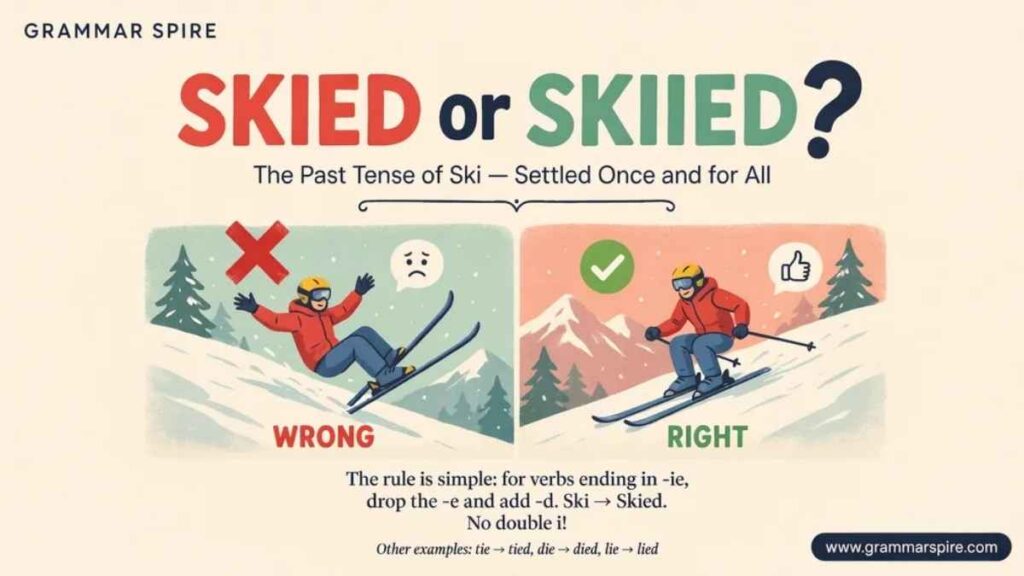
English spelling can feel like a slippery slope, especially when two forms look almost identical. The confusion over skied or skiied is a perfect example. One is the standard English spelling, while the other carries an unnecessary extra “i.” This small difference can turn a simple sentence about winter sports into an unexpected grammar hurdle. Fortunately, the rule is easier than it first appears. Once you understand how the verb “ski” changes forms, the confusion quickly disappears. This guide explains the correct spelling, meaning, grammar, pronunciation, and usage of “skied,” with clear examples to help you write accurately and confidently every time.
Skied or Skiied Quick Answer
Skied is the correct spelling. Skiied is not the standard spelling of the past tense or past participle of ski.
Here is the basic comparison:
| Word | Correct? | Grammatical use | Example |
|---|---|---|---|
| ski | Yes | Base verb | I ski every winter. |
| skis | Yes | Third-person singular | She skis every weekend. |
| skiing | Yes | Present participle | They are skiing today. |
| skied | Yes | Simple past and past participle | We skied yesterday. |
| skiied | No | Common misspelling | We skiied yesterday. |
The answer to the question is it skied or skiied is therefore clear: use skied.
For example, write:
We skied down the mountain yesterday.
Do not write:
We skiied down the mountain yesterday.
The second sentence is understandable, but skiied is not the standard English spelling.
Learn the difference between more words people mix up
Barrel or Barrell Which Spelling Is Correct?
Skied or Skiied Meaning
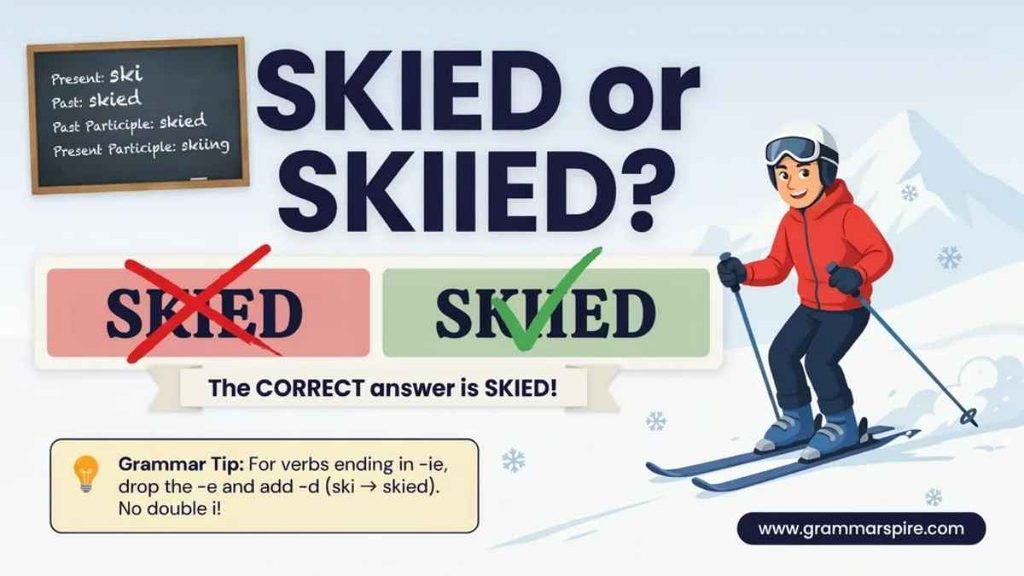
The skied or skiied meaning question is really about understanding which form correctly represents the past form of the verb ski.
Skied describes an action involving skiing that happened in the past. It can also function as the past participle when it appears with auxiliary verbs such as has, have, or had.
For example:
We skied all afternoon.
Sarah skied down the mountain.
They have skied at that resort before.
He had skied for several hours before taking a break.
In each example, skied refers to the same basic activity: moving over snow using skis.
The difference is grammatical context. In the first two sentences, skied works as a simple past tense verb. In the last two, it works as a past participle.
The important point is that the spelling remains skied in both cases.
What Does Skied Mean?
Skied is the past form of ski. It means that someone moved over snow on skis at an earlier time.
For example:
Maria skied down the beginner slope.
The sentence tells us that Maria performed the skiing activity in the past.
The word can describe many situations. Someone may have skied down a mountain, skied across a slope, skied during a vacation, or skied at a particular resort.
The meaning stays connected to the activity of skiing. Only the time or grammatical structure changes.
Skied vs Skiied at a Glance
The skied vs skiied comparison is easier when the two spellings are placed side by side.
| Feature | Skied | Skiied |
|---|---|---|
| Standard English spelling | Yes | No |
| Past tense of ski | Yes | No |
| Past participle of ski | Yes | No |
| Used in formal writing | Yes | No |
| Used in everyday writing | Yes | No |
| Common spelling mistake | No | Yes |
There is no meaningful difference in pronunciation or intended meaning that would make skiied an alternative form. The extra i simply creates a spelling error.
Why Is Skied Correct Instead of Skiied?
The spelling becomes much easier when you look at how the word is formed.
The base verb is ski.
The past-tense ending is ed.
Put them together:
ski + ed = skied
That produces skied.
The incorrect form comes from adding an unnecessary i:
ski + ied = skiied
English spelling can create confusion here because several common verbs ending in y form their past tense with ied.
Consider these examples:
try becomes tried
study becomes studied
carry becomes carried
However, ski does not end in y. It ends in i.
That means the y-to-i spelling rule does not apply.
The correct form is simply ski + ed.
This small distinction explains why skied looks different from words such as studied and tried.
Learn the difference between more words people mix up
Grate or Great Which One Is Correct?
The Spelling Rule Behind Skied

When learning how to spell skied, it helps to focus on the actual base word instead of trying to apply the spelling pattern from another verb.
The base word is ski.
Add the regular past-tense ending ed.
The result is skied.
There is no spelling change to the final i. There is also no second i inserted before the ending.
This gives us:
ski → skied
A useful comparison is:
try → tried
study → studied
ski → skied
The first two verbs end in y. Ski does not.
That is the main reason you should not write skiied.
Why Do People Write Skiied?
Skiied is an understandable mistake because the spelling looks logical when you see the base word ski.
A writer may think that the word should retain the original spelling and then receive an ied ending. That creates skiied.
Another source of confusion is the large number of English words that end in ied after a spelling change. Once that pattern becomes familiar, it is easy to apply it where it does not belong.
However, English spelling rules do not work by simply attaching the same ending to every verb.
The word ski has its own established past form: skied.
This is why the difference between skied and skiied is not about meaning. It is about standard spelling.
Learn the difference between more words people mix up
Losses or Loses What Is the Correct Spelling ?
Skied or Skiied Grammar
The skied or skiied grammar question has a straightforward answer. Skied is both the simple past tense and the past participle of ski.
That makes this verb especially easy to conjugate once the basic forms are understood.
| Verb form | Correct form | Example |
|---|---|---|
| Base form | ski | I want to ski. |
| Third-person singular | skis | She skis every winter. |
| Present participle | skiing | They are skiing now. |
| Simple past | skied | We skied yesterday. |
| Past participle | skied | We have skied there before. |
Understanding these forms prevents several common errors.
For instance, you would say:
I skied yesterday.
You would also say:
I have skied there before.
However, after did, the base form returns:
Did you ski yesterday?
Not:
Did you skied yesterday?
This is an important grammar distinction that goes beyond spelling.
Ski Past Tense and Past Participle
If you are searching for the ski past tense and past participle, both forms are skied.
The past tense is used for completed actions in the past.
We skied last Saturday.
The past participle appears with auxiliary verbs.
We have skied there before.
She had skied all morning.
Therefore, the answer to what is the past tense of ski is skied.
The answer to what is the past participle of ski is also skied.
This is useful because some English verbs have different forms for the simple past and past participle. Ski does not create that extra complication.
Simple Past Tense of Ski
The simple past tense describes a completed skiing action.
For example:
We skied all afternoon.
Daniel skied down the steep slope.
The family skied during their winter vacation.
They skied until the lifts closed.
Each sentence describes something that happened in the past.
Words such as yesterday, last weekend, last winter, and two hours ago often appear with the simple past because they establish a completed time period.
For example:
We skied last winter.
She skied yesterday.
They skied for three hours.
Past Participle of Ski
The past participle of ski is also skied.
The past participle commonly appears after has, have, or had.
For example:
I have skied there before.
She has skied on several difficult slopes.
They had skied for hours before lunch.
We have never skied in that region.
The form does not change to skiied simply because it is functioning as a past participle.
That is an important point to remember.
Learn the difference between more words people mix up
Wierd or Weird Which Spelling Is Correct?
Skied or Ski When Should You Use Each?

The difference between ski and skied depends on the grammatical structure and the time of the action.
| Sentence | Correct form | Explanation |
|---|---|---|
| I ski every winter. | ski | Present or base form |
| She skis every weekend. | skis | Third person singular |
| We are skiing today. | skiing | Present participle |
| They skied yesterday. | skied | Simple past |
| We have skied there before. | skied | Past participle |
| Did you ski yesterday? | ski | Base form after did |
One of the most common mistakes happens after did.
Because did already carries the past-tense meaning, the main verb remains in its base form.
Correct:
Did you ski yesterday?
Incorrect:
Did you skied yesterday?
The same principle applies to negative sentences.
Correct:
I did not ski yesterday.
Incorrect:
I did not skied yesterday.
Once you understand this pattern, many common grammar mistakes disappear.
Skied vs Skiing
The difference between skied vs skiing involves both time and grammatical function.
Skied refers to a completed past action or functions as a past participle.
Skiing is the present participle of ski. It can also function as a noun when it refers to the activity itself.
Compare these sentences:
We skied yesterday.
We were skiing yesterday afternoon.
Skiing in the mountains can be exciting.
The first sentence describes a completed action.
The second focuses on an activity that was in progress.
The third uses skiing as the name of the activity.
These forms may appear in similar conversations, but they do different grammatical jobs.
Skied and Skiing Grammar
Understanding skied and skiing grammar becomes easier when you view the main forms as parts of one system.
| Form | Function | Example |
|---|---|---|
| ski | Base verb | I want to ski. |
| skis | Third-person singular | He skis every weekend. |
| skiing | Present participle | She is skiing now. |
| skied | Simple past | They skied yesterday. |
| skied | Past participle | They have skied before. |
A skier is the person who performs the activity.
For example:
The skier skied down the slope.
Here, skier identifies the person while skied describes the action.
This gives you a useful vocabulary family:
ski, skier, skiing, skied
Each form has its own grammatical purpose.
Skied or Skiied in a Sentence
If you want to see skied or skiied in a sentence, comparing correct and incorrect examples can make the difference obvious.
| Incorrect | Correct |
|---|---|
| We skiied yesterday. | We skied yesterday. |
| Sarah skiied down the mountain. | Sarah skied down the mountain. |
| They have skiied there before. | They have skied there before. |
| He skiied all morning. | He skied all morning. |
| She had skiied before. | She had skied before. |
Here are more natural examples of skied in a sentence:
We skied through fresh snow.
Liam skied down the mountain carefully.
The children skied on the beginner slopes.
Our family skied at the resort last winter.
She skied with an instructor during her first lesson.
They skied until the weather became too cold.
These examples show that skied works naturally in conversations about ski trips, winter sports, ski resorts, and skiing in the mountains.
Learn the difference between more words people mix up
Ambience or Ambiance Which Spelling Is Correct?
Common Mistakes in which
The most obvious mistake is writing skiied instead of skied.
For example:
Incorrect: She skiied down the hill.
Correct: She skied down the hill.
Another mistake occurs when writers use skied after did.
Incorrect: Did you skied last weekend?
Correct: Did you ski last weekend?
A third mistake happens when writers use ski after have or had.
Incorrect: We have ski there before.
Correct: We have skied there before.
There is also confusion between skied and skiing.
Incorrect: We skiing yesterday.
Correct: We skied yesterday.
Another correct option is:
We were skiing yesterday.
The correct form depends on the sentence structure.
Skied in Everyday English
Skied is common in conversations about winter activities and outdoor recreation.
Imagine someone describing a recent vacation:
We went to Colorado last winter and skied for four days.
The word skied immediately tells the reader that the activity happened during the past trip.
It also works naturally in shorter statements:
I skied yesterday.
She skied with her brother.
They skied all morning.
We skied down the mountain together.
The word doesn’t sound overly formal or technical. It is an ordinary English verb that fits naturally into everyday speech and writing.
Skied in a Ski Trip Story
A short story about a ski trip provides a useful example of how different forms of the verb work together.
Last winter, our family traveled to a mountain resort. We had planned the trip for months. On the first morning, we put on our ski equipment and headed toward the slopes.
My brother skis regularly, so he moved quickly down the beginner trail. I was still learning, so I spent most of the morning practicing my technique.
By the afternoon, I felt more confident. I skied down a longer slope without stopping.
The next day, we skied again before returning home.
Notice how the forms change naturally:
Skis describes a regular or present activity.
Was learning describes an ongoing activity in the past.
Skied describes a completed action.
This kind of context makes the grammar much easier to understand than memorizing isolated rules.
Skied in Formal and Informal Writing
Skied works in both casual and formal writing.
In a personal message, you might write:
We skied all day and had dinner at the lodge afterward.
In a travel article, you might write:
The group skied across several slopes during its three-day mountain trip.
In a school assignment, you might write:
The athletes skied down the course under challenging weather conditions.
In a professional report, you might write:
The participants skied the designated course during the final training session.
There is no need to replace skied with a complicated expression. The word is clear, precise, and standard.
Learn the difference between more words people mix up
Feet or Foot Which One Is Correct?
American English and British English

The spelling skied is standard in both American and British English.
This is not a spelling difference like color and colour.
Whether you are writing for readers in the United States or the United Kingdom, skied is the standard form.
That means you should use:
American English: skied
British English: skied
Standard English: skied
Common misspelling: skiied
The extra i does not become correct simply because of regional English differences.
Learn the difference between more words people mix up
Families or Familys Which One Is Correct?
Skied Pronunciation
The skied pronunciation is closely connected to the pronunciation of ski. The base word ski has a long e sound, and the past form adds a final d sound.
The pronunciation is not divided into extra syllables because of the spelling.
This provides another useful reminder that skiied is unnecessary. The additional i does not represent a separate sound.
When practicing pronunciation, pay attention to the final sound. The past form contains the ending associated with the d in skied.
The word is short, but saying it clearly can help reinforce its spelling.
Learn the difference between more words people mix up
Likeable or Likable Which Spelling Is Correct?
How to Spell Skied
If you often forget how to spell skied, use the simplest possible method.
Start with ski.
Then add ed.
The result is skied.
Think:
ski + ed = skied
Do not think:
ski + ied = skiied
This approach is more reliable than trying to memorize the entire word as a random collection of letters.
The correct spelling contains only one i:
S-K-I-E-D
The incorrect form contains two consecutive i letters:
S-K-I-I-E-D
That extra i is the problem.
Why Is Skied Spelled With One I?
The question why is skied spelled with one i often comes from comparing it with words such as tried and studied.
The answer lies in the base word.
Try ends in y, so the y changes before the past-tense ending.
Study also ends in y, so the same general pattern applies.
Ski ends in i. It doesn’t need that change.
Therefore:
try → tried
study → studied
ski → skied
The spelling rule depends on the final letter of the base verb.
A Simple Memory Trick for Skied
The easiest memory trick is to remember the word as two pieces:
ski + ed
When you put those pieces together, you get:
skied
The important thing is not to invent an additional i between the base word and the ending.
A useful sentence to remember is:
“Ski already has its i, so just add ed.”
It is short enough to remember and directly reflects the actual spelling.
Case Study Correcting a Common Spelling Error
Consider this sentence:
Last winter, Emma skiied down the mountain with her friends.
The meaning is perfectly clear, but the spelling contains an unnecessary i.
The corrected sentence is:
Last winter, Emma skied down the mountain with her friends.
Now consider another sentence:
Did Emma skied down the mountain?
This sentence has a grammar problem rather than simply a spelling problem.
The correct version is:
Did Emma ski down the mountain?
Why?
Because did already expresses the past tense. The main verb therefore returns to its base form, ski.
This example shows why learning the word by itself isn’t enough. Good English depends on understanding how the word behaves inside a sentence.
Skied or Skiied Correct Usage in Context
Here are several situations where skied fits naturally.
When talking about yesterday:
We skied yesterday.
When talking about a vacation:
We skied throughout our winter vacation.
When talking about experience:
I have skied at that resort before.
When talking about an earlier event:
They had skied for several hours before lunch.
When asking a question with did:
Did you ski yesterday?
When describing an ongoing activity:
We were skiing when the snow started falling.
These examples demonstrate why context matters. The correct form depends not only on the word but also on the structure of the sentence.
Here’s a trusted source for clear more words Comparison:
Grammar Update
Practice Session Skied or Skiied
It is time to test your understanding of “skied,” “skiing,” “ski,” and related forms. Complete each sentence with the word or form that fits best. The exercises focus on spelling, verb forms, sentence structure, and everyday usage.
Read each sentence carefully before checking the answer key. A little practice can make the difference between remembering the rule and forgetting it the next time you need it.
Fill in the Blanks
- We ______ down the mountain yesterday.
- Emma enjoys ______ during the winter months.
- The experienced ______ guided the group safely down the slope.
- They have ______ at this resort several times.
- I plan to ______ with my friends next weekend.
- Which spelling is correct: “skied” or “______”?
- The children were ______ when the weather suddenly changed.
- Daniel ______ down the steep slope last Saturday.
- She has never ______ on such a difficult trail.
- The ______ checked the equipment before starting the trip.
- We ______ for several hours during our winter vacation.
- He is ______ through the fresh snow right now.
- What is the correct past tense of “ski”? ______
- What is the present participle of “ski”? ______
- What is the plural form of the noun “ski”? ______
- They had ______ several runs before the resort closed.
- Olivia wants to ______ in the mountains this winter.
- The professional ______ demonstrated the technique carefully.
- We ______ across the slope before returning to the lodge.
- He has ______ in several countries over the years.
- “Skiied” is a common spelling ______ of “skied.”
- The family went ______ during their winter vacation.
- Yesterday, I ______ down the beginner’s slope.
- The instructor taught us how to ______ safely.
- The tourists were ______ when the chairlift suddenly stopped.
- She has ______ since she was a teenager.
- Choose the correct form: “They ______ yesterday.”
- Choose the correct form: “They are ______ today.”
- Choose the correct form: “They will ______ tomorrow.”
- Complete the sentence: “He ______ down the mountain last weekend.”
Answer Key
- skied
- skiing
- skier
- skied
- ski
- skiied
- skiing
- skied
- skied
- skier
- skied
- skiing
- skied
- skiing
- skis
- skied
- ski
- skier
- skied
- skied
- mistake
- skiing
- skied
- ski
- skiing
- skied
- skied
- skiing
- ski
- skied
Learn the difference between more words people mix up
Labelling or Labeling Which Spelling Is Correct?
Frequently Asked Questions
Is skiid correct?
No. “Skiid” is not the standard English spelling. The correct past form of “ski” is “skied.”
What is the past tense of ski?
The past tense of “ski” is “skied.” For example: “They skied down the mountain during their winter vacation.”
Is it “skiis” or “skis”?
“Skis” is correct. It is the plural form of the noun “ski.” “Skiis” is an incorrect spelling.
What is the correct spelling of skiing?
The correct spelling is “skiing.” It is formed by adding “-ing” to “ski,” giving you “skiing,” not “skiiing.”
Should 70-year-olds ski?
Age by itself does not determine whether someone can safely ski. A person in their 70s may enjoy skiing if their fitness, balance, experience, and overall condition support the activity. Anyone returning to skiing after a long break or starting at an older age should consider appropriate instruction and safety precautions.
Is there a word “skied”?
Yes. “Skied” is a standard English word. It functions as both the simple past tense and past participle of “ski.”
How do you say “slay” in the past tense?
The traditional past tense of “slay” is “slew,” particularly when the verb has its literal meaning of killing. “Slayed” is also widely used in modern English, especially when “slay” has a figurative meaning, such as performing exceptionally well.
Is it a skiier or skier?
“Skier” is the correct spelling. It refers to a person who skis. “Skiier” is a misspelling.
What is downhill skiing called?
Downhill skiing is commonly called “alpine skiing.” The term refers to skiing downhill on slopes, typically at a ski resort.
What is a group of skis called?
There is no commonly recognized collective noun for several skis. In everyday English, “a pair of skis” usually refers to the two skis used together by one skier, while “several skis” can describe multiple skis.
Do I ski or snowboard?
That depends on your interests, experience, and preferred style of winter sport. Skiing involves two separate skis, while snowboarding uses one board. Both activities require balance, coordination, and proper technique.
What does “SKII” mean?
“SK-II” is most commonly associated with a Japanese skincare brand. The meaning depends on the context in which the term appears. It is different from “ski,” which refers to the winter-sports equipment or activity.
What does “slay” mean from a girl?
In modern informal English, “slay” can be used as a compliment. If someone says that a girl “slays,” they usually mean she looks impressive, performs exceptionally well, or handles something with confidence and style.
How do you say beat in the past tense?
The past tense of “beat” is also “beat.” For example: “Our team beat its opponent yesterday.” Although the spelling remains unchanged, the pronunciation can differ between the present and past forms.
Is it correct to say “slayed”?
Yes. “Slayed” is accepted in modern English, particularly when “slay” is used figuratively. For example: “She slayed the presentation.” When “slay” is used in its traditional literal sense, “slew” is the conventional past tense form.
Learn the difference between more words people mix up
Label or Lable Which Spelling Is Correct?
AEO Quick Answers
Is skied the correct spelling?
Yes. “Skied” is the standard spelling and serves as both the simple past tense and past participle of “ski.”
Is skiied a word?
No. “Skiied” is generally treated as a misspelling. The standard form is “skied.”
What is the past tense of ski?
The past tense of “ski” is “skied.” Example: “We skied on the mountain yesterday.”
What is the past participle of ski?
The past participle is also “skied.” For example: “She has skied at several resorts.”
Why is it skied instead of skiied?
The verb “ski” takes the regular “-ed” ending to form its past tense and past participle. Therefore, “ski” becomes “skied.” An additional “i” is not needed.
How do you spell skied correctly?
The correct spelling is “skied.” It contains one “i” before the “e” and ends with “-ed.”
Is skiing the past tense of ski?
No. “Skiing” is the present participle and gerund of “ski.” It can describe an activity in progress or the activity itself. The past form is “skied.”
Is it skier or skiier?
“Skier” is correct. The word refers to someone who skis. “Skiier” contains an unnecessary second “i” and is considered incorrect.
What is the difference between skied and skiing?
“Skied” refers to a completed action in the past, while “skiing” describes an ongoing action or the activity generally. For example, “They skied yesterday” refers to a past event, while “They are skiing today” describes an action happening now.
How do you use skied in a sentence?
“Skied” is used when talking about a completed skiing action. For example: “The family skied down the slope before sunset.”
What is the correct spelling skied or skiied?
“Skied” is the correct spelling. “Skiied” is a common misspelling caused by adding an unnecessary second “i.”
Is skied grammatically correct?
Yes. “Skied” is grammatically correct when used as the past tense or past participle of “ski.” For example: “He skied last weekend” and “He has skied in several countries.”
Can skied be used as a past participle?
Yes. “Skied” can function as a past participle after auxiliary verbs such as “has,” “have,” and “had.” For example: “They have skied together for many years.”
What is the difference between ski, skied, and skiing?
“Ski” is the base form, “skied” is the simple past and past participle, and “skiing” is the present participle or gerund. These forms serve different grammatical purposes depending on the sentence.
Conclusion
The skied or skiied confusion may seem like a small spelling problem, but one unnecessary “i” can send a sentence sliding off course. The correct form is skied, which works as both the simple past tense and past participle of ski. Meanwhile, skiing describes an ongoing activity, and skier refers to a person who skis. Once these forms become familiar, the difference is easy to remember. So, when you write about gliding down snowy slopes, choose skied with confidence and leave skiied behind. English already has plenty of tricky turns, so there is no need to add another letter to the slope.

Ella AJS
Ella AJS is an experienced blogger and language enthusiast at Grammar Spire, dedicated to making English grammar simple, practical, and easy to understand. She specializes in word comparisons, meanings, usage, and common language confusions. Through clear explanations and engaging examples, Ella helps students, writers, and English learners improve their vocabulary and communicate with greater confidence and accuracy.




