
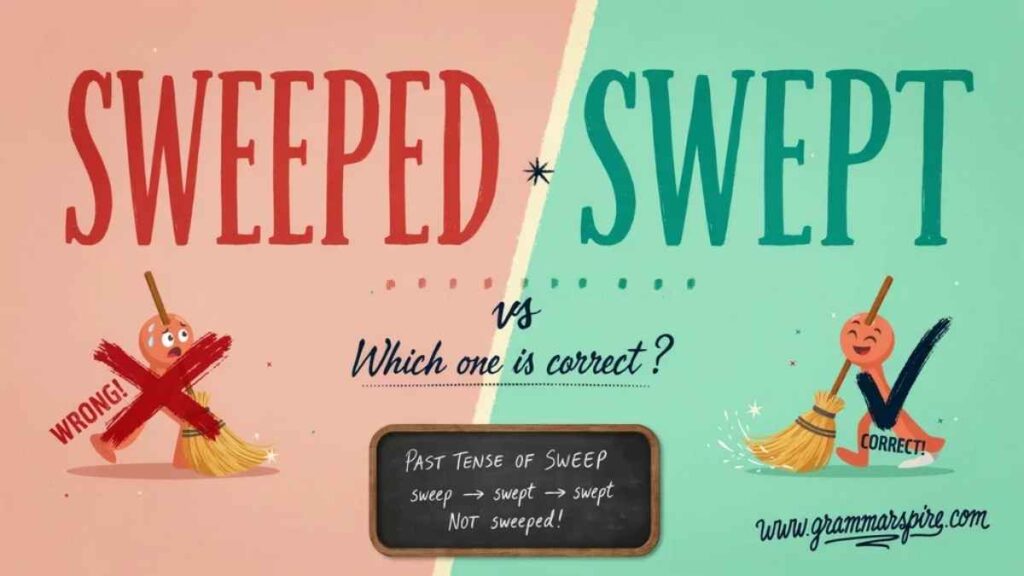
English grammar loves a good surprise, and the verb sweep delivers one. At first glance, sweeped seems logical because many English verbs form the past tense by adding -ed. However, this verb takes a different route. The standard past form is swept, not sweeped. If this tiny difference has ever made your writing feel like a grammar puzzle, you’re in the right place. In this guide to sweeped or swept, you’ll discover the correct forms, understand why the change occurs, and learn how to use them naturally. From spotless floors to powerful storms, you’ll soon sweep this confusion away for good.
| Verb form | Correct form | Example |
|---|---|---|
| Present | sweep | I sweep the floor every morning. |
| Past | swept | I swept the floor yesterday. |
| Past participle | swept | I have swept the floor. |
| Present participle | sweeping | She is sweeping the kitchen. |
So, if you are wondering whether to use sweeped or swept, choose swept in standard English.
Learn the difference between similar English words the easy way
Verbage or Verbiage Which Spelling Is Correct?
Quick Answer

Swept is the correct past tense and past participle of sweep. Sweeped is not the standard English form.
For example, the correct sentence is:
She swept the floor yesterday.
The incorrect version would be:
She sweeped the floor yesterday.
The confusion usually comes from a simple grammar habit. Many English verbs form their past tense by adding -ed. We say walked, cleaned, opened, jumped, and washed. However, sweep is an irregular verb, so it changes form instead of simply taking -ed.
The easiest pattern to remember is:
Sweep → Swept → Swept
Once you learn that pattern, the difference becomes much easier to recognize.
Sweep Present, Past, and Past Participle
Sweep is an irregular English verb. Its basic forms do not follow the regular verb pattern.
| Verb form | Word | Example |
|---|---|---|
| Base form | sweep | I sweep the floor daily. |
| Third-person singular | sweeps | She sweeps the porch every morning. |
| Present participle | sweeping | He is sweeping the room. |
| Simple past | swept | We swept the kitchen yesterday. |
| Past participle | swept | They have swept the entire house. |
The important point is that the past tense and past participle are identical.
You do not need to memorize two separate words. Instead, remember the three-part pattern:
Sweep → Swept → Swept
That small pattern can save you from a surprisingly common grammar mistake.
Learn the difference between similar English words the easy way
Advise or Advice which spelling is correct?
What Does Swept Mean?
Swept is the past tense and past participle of sweep. Its meaning depends on the context, although the basic idea often involves moving something away, across, or through an area.
Swept as the Past Tense
When swept describes an action that happened in the past, it works as the simple past form of sweep.
For example:
I swept the floor before dinner.
She swept the room after the children left.
He swept the kitchen early in the morning.
They swept the house before the guests arrived.
We swept the leaves from the sidewalk.
In each sentence, the sweeping happened in the past.
The sentence I sweep the floor every morning describes a present or habitual action. Once that action happened yesterday, the verb changes to swept:
I swept the floor yesterday.
Swept as the Past Participle
Swept also works as a past participle. You commonly see it after forms of have or in passive constructions.
For example:
I have swept the floor.
She had swept the room before lunch.
They have swept the entire house.
The floor was swept before the meeting.
The room has been swept.
Notice the difference between these two sentences:
I swept the floor.
I have swept the floor.
The first sentence uses swept as the simple past tense. The second uses swept as a past participle after have.
The word stays the same, even though its grammatical role changes.
Swept in Figurative Expressions
Swept does not always describe a broom moving across a floor. English speakers also use it for powerful movement, sudden change, emotions, weather, and events.
For example:
The wind swept across the field.
A wave swept over the shore.
Panic swept through the crowd.
The storm swept through the region.
She was swept away by the excitement.
In these examples, no one is necessarily holding a broom. Instead, swept describes something moving quickly, strongly, or widely.
Is Sweeped a Word?
The question Is sweeped a word? comes up because sweep looks like it should behave like a regular verb.
In standard English, however, sweeped is not the accepted past tense or past participle of sweep. The correct form is swept.
You may occasionally encounter sweeped in informal writing, learner errors, historical material, or unusual contexts. That does not make it the standard form you should use in normal English writing.
If you are writing an email, school assignment, article, report, or professional message, use swept.
For example:
Incorrec: She sweeped the floor.
Correct She swept the floor.
Incorrect They have sweeped the house.
Correct:They have swept the house.
The rule is simple: use swept, not sweeped, when you need the past form of sweep.
Learn the difference between similar English words the easy way
Benefiting or Benefitting Which Spelling Is Correct?
Sweeped or Swept The Key Difference

The difference between sweeped and swept is mainly grammatical rather than a difference in meaning.
Sweep is the base form.
Swept is the correct past tense.
Swept is also the correct past participle.
Sweeped is not the standard past form.
That gives you a straightforward pattern:
| If you need | Use | Example |
|---|---|---|
| Present tense | sweep | I sweep the floor. |
| Simple past | swept | I swept the floor. |
| Past participle | swept | I have swept the floor. |
| Present participle | sweeping | I am sweeping the floor. |
This also answers the question sweep or swept which is correct? Both can be correct, but they serve different grammatical purposes.
Use sweep for present-tense actions and swept for completed past actions.
Sweeped or Swept in a Sentence
Seeing both forms in complete sentences makes the difference easier to understand.
Correct Examples
I swept the floor after breakfast.
She swept the leaves into a pile.
He swept the dust from the corner.
They swept the house before the party.
We swept the street after the storm.
The wind swept across the valley.
Panic swept through the crowd.
She has swept the entire kitchen.
He had swept the porch before sunrise.
Each sentence uses the correct form of the verb.
Incorrect Examples
She sweeped the floor yesterday.
They sweeped the leaves from the yard.
He has sweeped the kitchen.
We sweeped the house last weekend.
These sentences use sweeped where standard English requires swept.
A useful correction strategy is to identify the time of the action first. If the action happened in the past, ask yourself whether the verb has an irregular form. With sweep, the answer is yes.
Why Do We Say Swept Instead of Sweeped?
English contains many irregular verbs, so not every verb follows the regular -ed pattern.
Regular verbs usually form their past tense by adding -ed:
Clean → cleaned
Walk → walked
Jump → jumped
Wash → washed
Open → opened
Irregular verbs follow different patterns:
Go → went
Take → took
Write → wrote
Buy → bought
Sweep → swept
This is why sweeped may seem logical but still remains incorrect in standard English.
The mind often learns a general rule such as past tense equals -ed. Then it tries to apply that rule to every verb. That creates mistakes such as sweeped.
Sweep simply belongs to the irregular group.
Learn the difference between similar English words the easy way
In Tact or Intact Which Spelling Is Correct?
Sweep as an Irregular Verb
It is an irregular verb because its past form does not come from simply adding -ed to the base form.
Its main pattern is:
Sweep → Swept → Swept
Compare it with a regular verb:
Clean → cleaned → cleaned
The difference is easy to see. With clean, you add -ed. With sweep, the spelling changes from sweep to swept.
Once you recognize sweep as an irregular verb, the correct past tense becomes much easier to remember.
What Does Sweep Mean?

Sweep usually means moving a broom, brush, or similar tool across a surface to remove dirt, dust, leaves, or other material.
For example:
I sweep the floor every evening.
She sweeps the kitchen after cooking.
He swept the porch before the guests arrived.
However, sweep has several other meanings.
It can describe something moving quickly across an area:
The wind swept across the field.
It can describe something spreading rapidly:
Fear swept through the crowd.
It can describe something being carried away:
The strong current swept the boat downstream.
It can also describe winning every part of a competition or series in some sports contexts:
The team swept the series.
The meaning changes with the context, but the verb forms remain the same.
Learn the difference between similar English words the easy way
Bind or Bound which one is correct?
Swept in Different Contexts
The word swept becomes especially interesting when you move beyond cleaning.
Cleaning
The most familiar use involves a broom or brush.
She swept the floor.
He swept the garage.
They swept the leaves from the driveway.
Here, swept means cleaned or moved unwanted material from a surface.
Weather and Movement
Swept can describe strong movement caused by wind, water, or another force.
The wind swept across the field.
The waves swept over the rocks.
The storm swept through the city.
In these sentences, swept creates a sense of force and movement.
Emotions and Reactions
English also uses swept in figurative expressions involving emotions.
Excitement swept through the audience.
Relief swept over her.
Fear swept through the crowd.
Here, swept suggests that an emotion spreads quickly from one person or place to another.
Sports and Competition
In sports writing, sweep can describe winning every game or stage in a series.
The team swept the championship series.
Because the action happened in the past, the sentence remains:
The team swept the championship series.
This use has nothing to do with cleaning. Context tells you which meaning applies.
Learn the difference between similar English words the easy way
Beat or Beated Which spelling Is Correct?
A Small Comparison to Make the Difference Clear
The same verb can describe completely different actions while keeping the same grammatical pattern.
| Sentence | Meaning |
|---|---|
| She swept the floor. | She cleaned the floor. |
| The wind swept across the field. | The wind moved quickly across the field. |
| Panic swept through the crowd. | Panic spread rapidly. |
| The waves swept over the rocks. | The waves moved forcefully over the rocks. |
| The team swept the series. | The team won every game in the series. |
This is one reason context matters when learning English vocabulary. A single verb can carry several related meanings while keeping the same basic verb forms.
Learn the difference between similar English words the easy way
Feed vs Fed What spelling is correct?
Common Mistakes
One of the most common mistakes is adding -ed to sweep.
Incorrect:
I sweeped the floor.
Correct:
I swept the floor.
Another mistake involves using sweep when the sentence clearly describes a completed past action.
Incorrect:
She sweep the kitchen yesterday.
Correct:
She swept the kitchen yesterday.
The opposite problem can happen too. Some writers use swept when they actually need the present form.
Incorrect:
I swept the floor every morning.
If you mean this is your regular current routine, say:
I sweep the floor every morning.
However, if you are describing a past routine, swept can work:
When I lived there, I swept the floor every morning.
The surrounding time expression helps determine the correct form.
Learn the difference between similar English words the easy way
Smoky or Smokey Which Spelling Is Correct?
How to Remember Sweep → Swept → Swept
Think of sweep as a verb that changes its spelling rather than simply adding an ending.
Sweep becomes swept.
It does not become sweeped.
A useful memory trick is to connect sweep with other short irregular verbs that change their internal spelling.
Keep the three forms together:
Sweep → Swept → Swept
Then attach a simple example to each form:
1.I sweep today.
2.I swept yesterday.
3.I have swept already.
This three-sentence pattern gives you both meaning and grammar at the same time.
Learn the difference between similar English words the easy way
Swore vs Sworn What’s the Difference?
Sweeped or Swept Grammar
From a grammar perspective, the choice is straightforward.
Sweep functions as the base form. You use it with the present tense, after modal verbs, and in infinitive constructions.
For example:
I sweep the floor daily.
She can sweep the room.
They need to sweep the porch.
Swept functions as the simple past and past participle.
For example:
I swept the floor yesterday.
She has swept the room.
They had swept the porch before lunch.
This distinction matters because English verbs often change according to tense and grammatical structure.
Sweep Verb Forms
The complete basic conjugation of sweep is useful to memorize.
| Verb form | Example |
|---|---|
| Sweep | I sweep the floor. |
| Sweeps | She sweeps the floor. |
| Sweeping | She is sweeping the floor. |
| Swept | She swept the floor. |
| Swept | She has swept the floor. |
Notice that swept appears twice.
That is not an error. The simple past and past participle happen to have the same form.
Once you learn this pattern, sweep becomes easier to use correctly.
Learn the difference between similar English words the easy way
Burst or Bursted? Which One Is Correct?
Sweeped or Swept Which One Should You Use?

If you are deciding between sweeped and swept, use swept.
The correct forms are:
Present: sweep
Past: swept
Past participle: swept
Present participle sweeping
Therefore, these sentences are correct:
I swept the floor.
She has swept the room.
They swept the leaves.
He had swept the kitchen.
The form sweeped should not replace swept in standard English.
Here’s a trusted source for clear more words Comparison:
Grammar Update
Practice Session
Now it’s time to put the grammar into practice. Complete each sentence with the appropriate form of sweep. Pay close attention to the tense and the surrounding words. The base form is sweep, while swept serves as both the simple past and past participle. The form sweeping is used for ongoing actions.
Fill in the Blanks
- I ______ the kitchen every morning before breakfast.
- Maya ______ the porch yesterday afternoon.
- We have ______ the entire house already.
- The children were ______ leaves from the backyard.
- He ______ the floor before the guests arrived.
- The janitor ______ the hallway every evening.
- She had ______ the room before the meeting began.
- Please ______ the floor after dinner.
- A strong wind ______ across the field.
- Daniel is ______ the dirt into a small pile.
- They ______ the classroom before the students returned.
- She has ______ the garage twice this week.
- We usually ______ the front steps on Saturdays.
- The storm ______ through the town during the night.
- I ______ the kitchen floor this morning.
- By noon, they had ______ all the leaves from the yard.
- Please ______ those crumbs off the floor.
- The team ______ the entire playoff series.
- He was ______ the sidewalk when the rain started.
- I have never ______ such a large area by myself.
- She ______ the dust into the corner yesterday.
- We need to ______ the floor before the party starts.
- Powerful waves ______ across the beach during the storm.
- He ______ the porch every weekend.
- They had ______ the floor before the visitors arrived.
- I ______ the hallway after breakfast yesterday.
- She has ______ the leaves away from the doorway.
- The wind was ______ dust across the road.
- We ______ the kitchen every evening.
- The cleaning crew had ______ the entire building before closing time.
Answers
- sweep
- swept
- swept
- sweeping
- swept
- sweeps
- swept
- sweep
- swept
- sweeping
- swept
- swept
- sweep
- swept
- swept
- swept
- sweep
- swept
- sweeping
- swept
- swept
- sweep
- swept
- sweeps
- swept
- swept
- swept
- sweeping
- sweep
- swept
FAQs
Is sweeped grammatically correct?
No. Sweeped is not the standard past form of sweep. The correct form is swept.
Is it sweeped or swept the floor?
Use swept when talking about a completed action.
Correct: She swept the floor before dinner.
Is it correct to say I sweeped?
No. Say I swept instead.
Correct: I swept the kitchen this morning.
What is sweep in past tense?
The simple past form is swept.
Present: I sweep the floor.
Past: I swept the floor.
What is the difference between sweep and swept?
Sweep is the base form used for present actions, while swept is used for completed actions and as a past participle.
For example, I sweep the room describes a present or regular activity. I swept the room refers to something completed earlier.
How do you say sweep the floor?
Sweep the floor is the standard expression. It means to clean a surface by moving a broom across it.
Example: Please sweep the floor before the guests arrive.
What does swept mean?
Swept is the past form of sweep. It can refer to cleaning with a broom, moving forcefully across an area, or spreading quickly.
Example: The wind swept across the field.
What is the past tense of sweep the floor?
The correct form is swept the floor.
Example: We swept the floor after lunch.
What is the present tense of sweeped?
There is no standard present-tense form called sweeped. The base form is sweep.
Example: I sweep the floor every morning.
With he, she, or it, use sweeps.
Example: She sweeps the porch every morning.
Which is correct: broom the floor or sweep the floor?
Sweep the floor is the standard expression in everyday English.
Broom can work as a verb in some varieties of English, but sweep is the clearer and more widely used choice for cleaning a surface with a broom.
How do you say swept?
Swept has one syllable. It begins with the sw sound and has the same short vowel sound found in words such as kept and slept.
What is another word for sweeping the floor?
Depending on the context, you could say cleaning the floor, brushing the floor, or removing dirt from the floor. However, sweep is the most natural everyday verb when a broom is involved.
Is sweeped not a word?
Sweeped may appear in nonstandard writing or as a learner error, but it is not the accepted past form of sweep in standard English. Use swept instead.
What are the three forms of the verb sweep?
The three principal forms are:
Sweep → swept → swept
Sweep is the base form, swept is the simple past, and the second swept is the past participle.
What is the past perfect tense of sweep?
The past perfect uses had with the past participle.
Correct form: had swept
Example: She had swept the floor before the guests arrived.
AEO Quick Answers
Is sweeped correct?
No. Swept is the standard form used for both the simple past and past participle.
What is the past tense of sweep?
Swept is the simple past form.
Example: He swept the porch yesterday.
What is the past participle of sweep?
The past participle is also swept.
Example: They have swept the entire house.
Why is swept used instead of sweeped?
Sweep is an irregular verb. It does not form its past tense by simply adding -ed. Instead, the spelling changes to swept.
What are the verb forms of sweep?
The main forms are sweep, sweeps, sweeping, swept, and swept.
Can sweep be used for cleaning?
Yes. Sweep commonly means to clean a surface with a broom.
Example: She sweeps the kitchen every evening.
Can swept mean something other than cleaning?
Yes. Swept can describe strong movement or the rapid spread of something.
Example: Excitement swept through the crowd.
Is sweep an irregular verb?
Yes. Its past and past participle forms do not follow the regular -ed pattern.
How can you remember the correct form?
Remember this simple sequence:
Sweep → Swept → Swept
Think of it as base form, past tense, and past participle. Once this pattern becomes familiar, choosing swept instead of sweeped becomes much easier.
Conclusion
Conclusion
The confusion between sweeped or swept is understandable because adding -ed works for many English verbs. Sweep, however, follows an irregular pattern. Swept serves as both the simple past and past participle, while sweep is the base form. You sweep the floor today, swept it yesterday, and have swept it before the guests arrive. The easiest way to remember the pattern is simple: sweep → swept → swept. Once this sequence becomes familiar, there’s little reason to reach for sweeped again. English may enjoy bending its own rules, but this one is easy to tidy up: choose swept and leave sweeped in the dust.

Ella AJS
Ella AJS is an experienced blogger and language enthusiast at Grammar Spire, dedicated to making English grammar simple, practical, and easy to understand. She specializes in word comparisons, meanings, usage, and common language confusions. Through clear explanations and engaging examples, Ella helps students, writers, and English learners improve their vocabulary and communicate with greater confidence and accuracy.




